
WALK 7
At A Glance – the following stories, plays and novels are highlighted in this walk:
The Red-headed League. The Adventure of the Sussex Vampire. The Stock-broker’s Clerk. The Man with the Twisted Lip. The Adventure of the Blanched Soldier. A Case of Identity. The Adventure of the Bruce-Partington Plans. The Adventure of the Mazarin Stone. The Five Orange Pips. The Sign of Four
Distance: About 5.1 kilometres/3.2 miles. At Bank the walk stops for a break and details several possible short ‘excursions’ out and back again – in total, these probably add about 2 kilometres/1.2 miles.
Time to allow: A complete day as it is almost inevitable that you will wander off course here and there or find an alley or street that merits an extra look in this fascinating part of London. It is also very easy to become temporarily lost with all the criss-crossing lanes and passageways around these parts. In terms of general interest – as opposed to places of interest specifically to Holmes’ fans – the walk passes close by the Museum of London, the Bank of England Museum and ends at the Tower of London, all of which merit a stay of at least an hour or two.
Walking conditions: A mix of business and more touristy areas, so quite busy with many places to eat and drink along the route. No steep slopes. Take a camera to capture especially scenic parts of the walk such as Smithfield Market, Monument or the Tower of London.
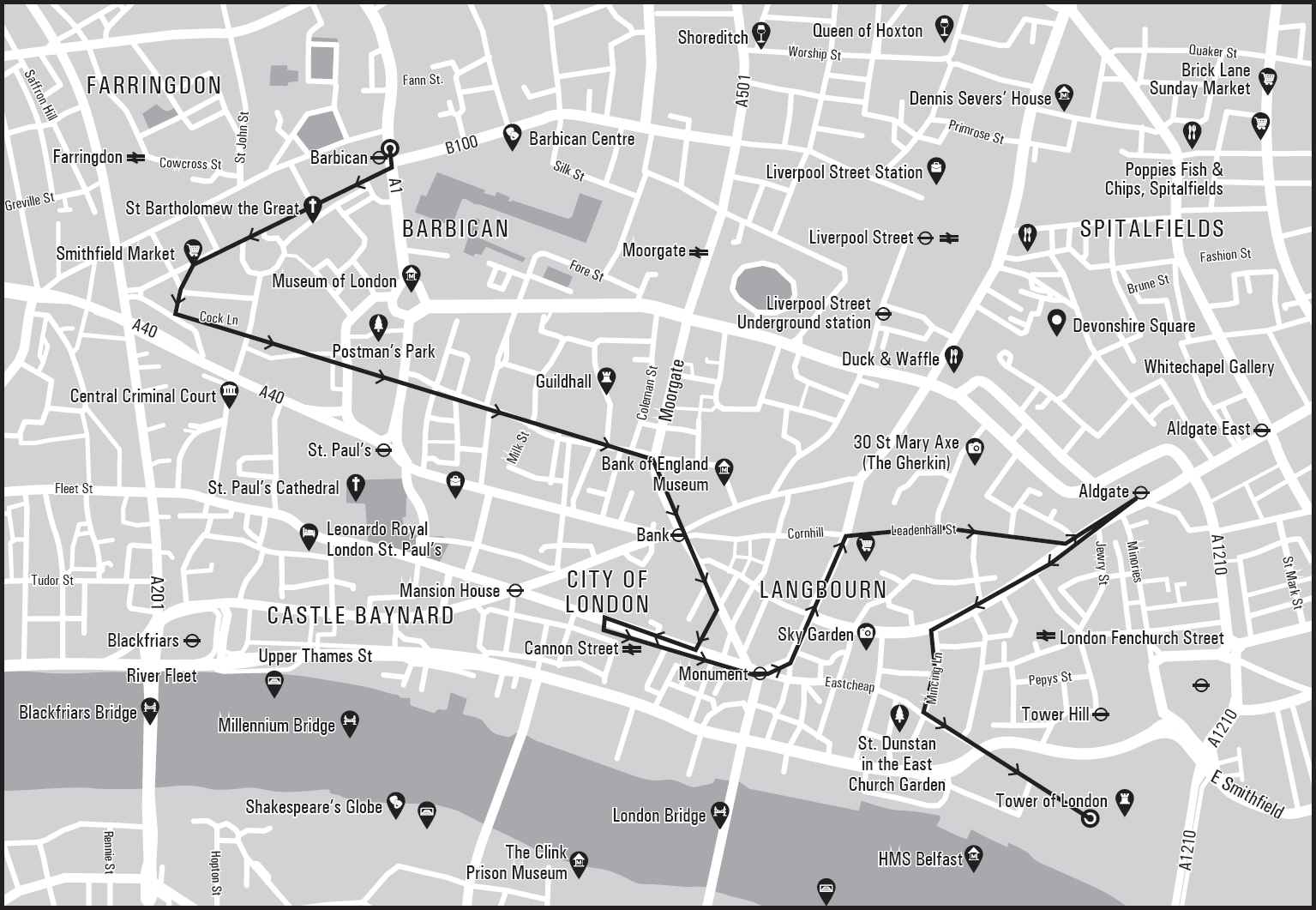
Route
• Barbican tube station
• Charterhouse Street
• Smithfield Market
• Bank
• Cannon Street station
• Monument
• Cornhill
• Leadenhall Street
• Aldgate High Street
• Fenchurch Street
• Mincing Lane
• Tower Hill
• Tower of London
The walk begins at Barbican tube station, served by the Circle, Hammersmith and City and Metropolitan lines – Aldersgate until 1924. It is to this station that Holmes and Watson come during The Red-headed League to find Jabez Wilson’s small pawnbroker’s shop which is ‘a short walk away’ in Saxe-Coburg Square, ‘a poky, little, shabby-genteel place’. Holmes is in super-mysterious mood as he thumps the ground around the shop with his stick before asking the man who answers the door how to get to the Strand; he confides afterwards to Watson that they have just encountered the fourth smartest man in London, and that he just wanted to see the knees of his trousers. Afterwards they inspect the area and find a branch of the City and Suburban Bank in Aldersgate Street – a real bank, now part of the NatWest group. Holmes has basically now solved the case in this shortish early story (1891), perhaps a little disappointed that it was so easy, and at the end quotes Gustave Flaubert: ‘L’homme, c’est rien – l’oevre, c’est tout’.
Proceed down Charterhouse Street to Smithfield Market. Meat has been sold here for 800 years. It was also the scene used for major medieval tournaments as well as public hangings for heretics – between 1400 and 1601, forty-three were hanged and six burned here – and others who had fatally fallen foul of the law. There once was a market for unwanted wives.
For Holmes’ fans there is, on the southern side of Smithfield, St Bartholomew’s Hospital, known as St Barts or just Barts, founded in 1123. In probably the most famous introduction in literature, young Stamford introduces Dr Watson to Sherlock Holmes in this building. They shake hands and Holmes says ‘You have been in Afghanistan, I perceive.’ Watson replies in astonishment: ‘How on earth did you know that?’ The stories are well and truly afoot; as a result of the meet-up, they are soon to begin sharing Mrs Hudson’s rooms at 221B Baker Street.
The setting was used in the BBC Sherlock episode The Reichenbach Fall when Holmes, played by Benedict Cumberbatch has his final meeting with Moriarty, portrayed by Andrew Scott, on the roof of the hospital before jumping off to his supposed death.
Barts also has a very unusual museum, often referred to as ‘weird’ in an interesting sense, which houses surgical instruments, medieval manuscripts and paintings by William Hogarth. It is situated under the North Wing archway. Entry is free and it is open weekdays 10am to 4pm.
The location is an attractive one for writers. Charles Dickens, always with a keen eye for the dramatic and humorous, uses the great Smithfield area in Oliver Twist, Great Expectations, Barnaby Rudge and Nicholas Nickleby. Specifically regarding Barts, he chose the hospital as the place where the immortal Mrs Gamp in Martin Chuzzlewit has a friend who works as a nurse. In Little Dorrit, Arthur Clenham helps a wounded man into Barts where they see a surgeon. The injured man has been hit by a coach. The surgeon notes that the man’s injuries are serious ‘with the thoughtful pleasure of an artist contemplating the work on an easel…’
Before leaving, check for signs to the Museum of London, which charts the history of London from prehistoric to modern times. It is a wonderful museum, free to enter and fares very well on TripAdvisor. However, as it is currently ‘on the move’, best to check the latest status on museumoflondon. org.uk. Tel: 020 7001 9844.
The walk heads down Gresham Street towards Bank station, taking a right at Princes Street. Immediately before this, however, on the right, is Old Jewry and down here, at number 46, was the firm of Morrison, Morrison and Dodd. Holmes received a bizarre letter from them at the beginning of The Adventure of the Sussex Vampire letting them know that a Mr Robert Ferguson would soon be in touch on a matter concerning vampires. In this letter they mention Holmes’ successful investigations in the matter of Matilda Briggs. Holmes tells Watson that Matilda Briggs is not a woman but a ship, which prompts a reference to one of the most famous untold stories in the canon as this ship is associated with the Giant Rat of Sumatra, a tale for which the world, says Holmes, is not yet prepared. This short mention has seen decades of speculation about the rat, a number of pastiches, plays, an album of music, a musical and even scholarly papers asking what kind of animal this giant rat could be. At the time of writing there is a report of a new species of giant rat, with very coarse fur, firm jaws and about the size of a well-fed cat, being located in Asia; is it possible that Conan Doyle in his youthful adventures on a whaling ship, came across such a creature? Undoubtedly, to the delight of Sherlockians everywhere, a great deal more along these lines will follow.
Conan Doyle was to write that throwing titles such as these fictitious cases about was to impress the reader with a general sense of power. In the same way and for the same reason, in the stories themselves he often has Holmes make clever deductions that have nothing to do with the matter in hand; he says that the South Americans apparently called these ‘Sherlockolmitos’.
You will soon come to Bank tube station which has several exits, one of which is to a seated area fronted by the old Royal Exchange – which is now converted to cafes, offices and top-end shops – opposite the imposing edifice that is the Bank of England. This is much frequented by city workers, has seats, and is an excellent place to have a rest or eat your sandwiches while watching the comings and goings in this, the heart of the city’s financial district.
The Bank of England was established in 1694 and was often referred to as ‘The Old Lady of Threadneedle Street’ after a satirical cartoon by James Gilray. Its main function was to act as the banker to the United Kingdom government although until 2016 employees could also hold personal accounts with it. Granted independence in setting monetary policy, the bank also now holds the gold reserves of the United Kingdom and thirty other countries in a vast underground vault. In 2020 the total value of the gold was £194 billion, enough, apparently, to cover the whole of the UK in gold leaf. There is a museum, free to enter, open on weekdays and very much worth a visit, the entrance of which is in Bartholomew Lane, off Threadneedle Street.
One of the most successful books of all time, The Wind in the Willows, was written after retirement by a Bank of England employee of thirty years, Kenneth Grahame. Conan Doyle would have been very much aware of it as publication was in 1908 and during the next twenty years the Edwardian adventures of Mole, Rat, Toad and Badger went through thirty printings. It has been adapted for stage and film, the latest being a musical written by Julian Fellowes in 2016.43
Holmesian locations within a short walking distance of Bank station
‘After all, the best part of a holiday is perhaps not so much to be resting yourself, as to see all the other fellows busy working.’
Kenneth Grahame, Wind in the Willows; as he worked
here for three decades, Grahame probably had this area in mind when writing this
Using the present location as a base, there are several nearby Sherlockian addresses to see:
• The first couple are from a story which is set in this area called The Stock-broker’s Clerk. It starts unusually in that Holmes drops in on Watson in his Paddington home and surgery and asks him if he fancies helping out with another case – today and in Birmingham. They are soon on a train and Holmes introduces Mr Hall Pycroft, ‘a smart young City man’, who until recently had a good job at Coxon and Woodhouse’s of Draper Gardens. This location, at the corner of Throgmorton Avenue and Copthall Avenue, can be found just right off London Wall a short distance from where you are now. Also, just south of Bank station is Lombard Street which housed Mawson and Williams where young Pycroft at last manages to secure a good position, and which, unbeknown to him, he is destined never to take up. The story then moves to Birmingham before returning to Mawson and Williams for its shocking denouement.
• The next location of interest, leading off Bank station is Threadneedle Street. It is from the banking firm of Holder and Stevenson in this street that Alexander Holder arrives at 221B in a terrible funk regarding the fate of the Beryl Coronet, in an adventure of that name, the coronet being ‘one of the most precious public possessions of the empire’, in Watson’s words.
• Then, in The Man with the Twisted Lip we find ‘Hugh Boone’, in reality Neville St Clair, selling wax vestas some ‘little distance down Threadneedle Street’ where there is ‘a small angle in the wall’. Neville St Clair later admits ‘that it was a very bad day in which I failed to take £2.’
• Finally, along Threadneedle Street, to the side of the Bank of England, is Bartholomew Lane and right at the top of this is Throgmorton Street. Mr James Dodd introduces himself to Holmes at the start of The Adventure of the Blanched Soldier, in a rare story written by Holmes himself and which he dates as happening in January 1903. Holmes reels off some facts about his guest: that he is from South Africa, in the Imperial Yeomanry and the Middlesex Corps. All this is correct and Mr Dodd is suitably impressed, calling Holmes a ‘wizard’. Mr Dodd then begins his tale by saying that he is a stockbroker in Throgmorton Street.
The walk, when you are ready to leave the area of Bank, drops down to Cannon Street station, which has a mention in The Man with the Twisted Lip as it is from here that Mr St Clair habitually caught the 5.14 train to near Lee in Kent at the end of the working day (Conan Doyle was meticulous in planning the correct London mainline station for the travels of his characters; this route still operates except today it is the 5.39).
We then proceed to Monument tube, up Cornhill, and along Leadenhall Street to Aldgate tube. In A Case of Identity, Miss Mary Sutherland tells Holmes that her missing husband-to-be, Mr Hosmer Angel, had a position as a cashier ‘in an office in Leadenhall Street’, and she sent letters to him at Leadenhall Street Post Office
Nearby Aldgate station is central to the drama of The Adventure of the Bruce-Partington Plans, a matter serious enough to have Mycroft plead for his brother Sherlock’s help. The top-secret plans for a submarine have gone missing when a young man, Cadogan West, is found on the tracks at Aldgate with some of the plans, but not the most vital ones, in his pocket. He has no ticket. Holmes, Lestrade and Watson visit the scene at Aldgate to begin piecing together the disparate parts of a strange puzzle which, as already mentioned in Walk 2, reaches a thrilling conclusion in Charing Cross Hotel. Among many highlights of the story is the telegram sent by Holmes, dining at Goldini’s restaurant in Kensington, to Watson, asking him to come at once and making it quite clear that Holmes is proposing to break the law: ‘Bring with you a jemmy, a dark lantern, a chisel, and a revolver.’ The morality of Homes’ actions is one thing, but there is always a ratcheting up of tension and excitement in the stories when such action is proposed, and especially if Watson is asked to bring a gun.
Leave Aldgate station and walk down Aldgate High Street which becomes Fenchurch Street a little farther on. Second on your left is Minories which features in The Adventure of the Mazarin Stone as the location of Straubenzee’s workshop. Straubenzee is the master-maker of precision air guns, one of which Holmes believes is trained upon his dummy which he has set up in the window of 221B as he briefs Watson about Count Sylvius.
Back on the main road again, Lloyd’s Register of Shipping is situated at 71 Fenchurch Street, which you will pass. Holmes is explaining to Watson, at the end of The Five Orange Pips, where he has been to finally tie up the complex case. ‘I have spent the whole day,’ said he, ‘over Lloyd’s registers and files of the old papers, following the future career of every vessel which touched at Pondicherry in January and February in ‘83’. One, the Lone Star, caught Holmes’ attention, but Holmes is not, for once, to have total satisfaction as the ship is lost in equinoctial gales in the Atlantic.
You may imagine, as you walk, a thriving fictitious firm – Westhouse and Marbank of Fenchurch Street – which was the wine importers that employed Miss Sutherland’s stepfather, Mr Windibank, in A Case of Identity and was the source of the tickets to the gasfitters’ ball where the lady met her fiancé, Mr Hosmer Angel. Unusually, when Holmes has revealed the true nature of the deception upon Miss Sutherland he declines to tell her, remarking to Watson: ‘You may remember the old Persian saying, “There is danger for him who taketh the tiger cub, and danger also for who so snatches a delusion from a woman.”’
Turn left into Mincing Lane – here was yet another imaginary firm, Ferguson and Muirhead, tea importers, created by Conan Doyle for the story The Adventure of the Sussex Vampire.
The walk is now near the Tower of London which is where, in The Sign of Four, Holmes tells Jones to head for in the police launch as they try to capture the Aurora. Specifically, he says to stop opposite Jacobson’s Yard.
The walk ends here. Tower Hill tube is very close (District and Circle line) and the train will take you quickly back into the city centre. Hop on/ hop off buses operate from here, too. Alternatively, you could cruise back along the river. Or, of course, stay for a while, see the Crown Jewels and explore the Tower along with the Thames riverside area.
If you travel any further east you will be in Whitechapel which is significant in that it was the area where Jack the Ripper operated and, in a Holmesian context, the setting for a large number of pastiches; writers have understandably been unable to resist the idea of combining Holmes and Jack the Ripper into a single story.
’The Weasel’
It was also the stamping ground of a character seen by many at the time as a real-life Sherlock Holmes – there are a few others, too, highlighted in other parts of this study. He was nicknamed ‘The Weasel’, not entirely kindly, and his name was Detective Inspector Frederick Porter Wensley (1865–1949). He was involved in solving the Houndsditch Murders and in the Siege of Sidney Street.
In December 1910 a group of Latvian immigrants attempted to rob a jeweller’s in Houndsditch which resulted in the death of three policemen, the wounding of two others and the death of the leader of the gang, a man called George Gardstein. Most of the gang members were quickly rounded up but two escaped police until, on 3 January, they were holed up at 100 Sidney Street in Stepney. For the first time ever, as the police had inadequate weapons to deal with the danger, the army was called in and Winston Churchill himself controversially commanded the operation from the street. Pathe News filmed the stand-off which lasted six hours and resulted in the death of a fireman. The murdered policemen and fireman are today commemorated with plaques. The events have inspired novels and at least two films, The Man Who Knew Too Much (1934) and The Siege of Sidney Street (1960).
In a long and illustrious career DI Wensley was awarded both the King’s Police Medal and the Order of the British Empire. He began his career in 1888 and retired in 1929, almost exactly the period when the public was accompanying Holmes on his many adventures and generally becoming more and more interested in criminal detection. His autobiography was originally called Detective Days but is better known by the title it assumed upon publication in America in 1931, Forty Years of Scotland Yard. He also kept a scrapbook of his many press cuttings, lovingly created by himself with scissors and glue, and which is preserved today at the Bishopsgate Institute.