
Chapter 18

IN THE FIRST CENTURY CE, THE CHINESE BEGAN MAKING paper, and it remained an exclusively Asian product for a number of centuries to come. In time, it was embraced so universally that few thought of it as Asian anymore. But now in the twenty-first century, two thousand years later, China is again the world’s leading paper producer, and the Japanese are the acknowledged masters of handmade paper.
Modern China very much wanted to be the largest paper producer in the world. It was not only that they wanted to produce a great deal of paper, they also wanted the title of “biggest.” Aside from a certain desire for a verisimilitude of history, the reason why China would want such a thing baffles the world’s paper industry. Centuries ago, in the time of the Han, China was a society perfectly suited for paper. But today’s China is so ill-suited for modern papermaking that the industry is bemused by China’s ambition. Mark Wilde, formerly of Deutsche Bank and now of the Bank of Montreal, is the leading—in fact, the last—market analyst focused exclusively on the paper industry. He said of China, “I don’t think anyone is making money. Why they have been so aggressive in communication paper is a mystery. They have to import the pulp and the energy.”
Although it is the fourth-largest country in the world in terms of landmass, China does not have a lot of trees and can ill afford to chop down the ones it has. The country has a long history of disastrous flooding, and trees help stave off floods and landslides. In the late 1990s, the tragic flooding of the Yangtze and other major river valleys was blamed, in part, on deforestation, which has led to an interdiction on cutting down trees. More than half of the wood pulp used to make wood-based paper in China is imported in the form of pressed board that turns back to pulp when soaked.
One alternative to importing pulp is importing used paper for recycling. China is the largest importer of used paper and the largest maker of recycled paper in the world. About half of the used paper for recycling sold in the world is bought by China, and about 40 percent of the paper made in China is recycled. On any day, ship after ship lines up in the South China port of Ningbo, all filled with thousands of bales of used paper from all over the world, though most of it comes from Japan and the United States. Much of this paper is taken to a nearby paper mill owned by the Indonesian giant Asia Pulp & Paper.
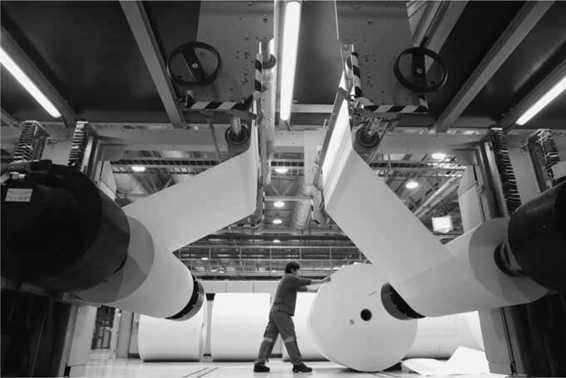
Workers at the Finnish-owned UPM Changshu Paper Mill in Changshu, Jiangsu Province, China, on July 23, 2012.
The paper is used to make cartons and boxes, including shoeboxes. A man in Kansas City might read the Kansas City Star and then toss it in a recycle bin. It is baled and shipped to Ningbo, where it is made into shoeboxes that are sold to Italy and used for a pair of Italian shoes in a Florentine boutique where a vacationing American buys a pair of shoes, takes it back to New York, and throws out the box. Then it is off to Ningbo again.
PAPERMAKING REQUIRES A tremendous expenditure of energy, and while China is the world’s largest coal producer, it is also a net importer of coal, oil, and natural gas. Until the early 1990s, China exported oil, but it is now the second-largest importer of oil in the world, just behind and close to surpassing the United States. It is also the largest coal consumer in the world, and as such, is under international pressure to burn less coal because of the role that carbon emissions play in causing climate change.
Even though China’s per capita consumption of paper is not high by Western standards, its huge population—the largest in the world—uses a significant amount of it: some 60 million tons a year, a figure that is growing at about 15 percent annually. Even newsprint consumption, something that is rapidly fading in most of the world, was, until recently, growing in China.
But this is not to say that China’s enormous paper production is for domestic use. China is so aggressively selling inexpensive, reasonable-quality paper around the world that the United States, the European Union, and Brazil have all put trade barriers in place to prevent entry of too much Chinese paper. But since the tariff is on sheets of paper, not rolls, the Chinese are starting to bring rolls and cutting equipment into the United States to cut the rolls into sheets here. In time, there will be trade restrictions on that too. As of 2014, China was selling the United States 20 percent of its copy paper.
SOUTH CHINA, WHICH includes the ports of Ningbo and Shanghai, and the provinces of Anhui, Zhejiang, Suzhou, and Hangzhou, is historically the rich part of the country. This is the region from which food comes. The soil is fertile, the climate wet. There is rain, or at least mist, much of the time, and water is everywhere—in rivers, lakes, streams, canals, and flooded rice fields. Thus, the region has two of the prerequisites for papermaking—lots of water and good transportation.
South China has the look celebrated in classical Chinese paintings of the mountain and river school—steep, green, mist-blurred mountains and winding silver rivers. Once it was a region of beautiful country villages centuries old, but most of them have been torn down in recent decades to build large high-rise buildings that are seldom filled. The cities, too, have been ruined. There is construction everywhere, which creates whole villages of blue-roofed white trailers that serve as dormitories for construction workers from other parts of the country. The workers rarely get to see their families and struggle to save their meager wages.
Of late, the Chinese have been thinking about what they have lost. The newest trend in architecture is fanggu, meaning “rebuilding the old.” It originally referred to the practice of copying old painting masters but now also refers to the new reproductions of old houses and other traditional structures.
The city of Suzhou, a beautiful metropolis of canals and gardens, is one of the few towns in China that was never destroyed. Centuries ago, officials of the Ming dynasty built private gardens along the canals, with artificial lakes, flowers, trees, and huge wind-carved rocks that look like statues. Large red carp were farmed for the garden ponds—the world’s first farmed fish. Suzhou’s humid, rainy, warm climate is ideal for gardening. Its most spectacular garden is called the Humble Administrator’s Garden, but the site creates the suspicion that the administrator wasn’t all that humble.
Chinese gardens are all about the interplay of textures and colors. Water, rocks, and plants are their principal components. The wind-carved rocks of South China are treasured as natural pieces of art. The Chinese collect rocks—sometimes worn smooth in rivers, sometimes sculpted into wild shapes with tunnels and swirls—and these rocks decorate their homes and gardens. Tang Guo, a Suzhou artist who has a spectacular naturally carved rock in his studio and often paints rocks, said, “It is useless to talk to Western artists about rocks. They cannot understand our connection with rocks.”
In 1996 the paper giant APP, with some twenty mills in China, many in South China, opened the Gold HuaSheng Paper Mill in an industrial park outside Suzhou. The city’s good transportation and the Wu Song River drew them. Next to the paper mill, in Suzhou tradition, they started a garden with local plants. The area had been wild and natural before it became an industrial park, and today the mill’s garden is filled with white and pink oleander and a great variety of local trees and vines. The garden lake, fed by the mill’s water retreatment plant, is flush with local fish—black fish, carp, and whitefish—along with soft-shelled turtles. The garden is inhabited by local bird species native to the area when it was wild—egrets; pheasants; magpies; and the common kingfisher, a funny, stubby, long-beaked blue bird whose Latin name is Alcedo atthis. The park also has four ponds and a canal that carries water to the wide, brown Wu Song River. In the background, you can hear the hum of the pipes and ponds of the mill’s water-treatment plant. For an industrial park, it is a successful imitation of the traditional Suzhou gardens.
Like many modern paper mills, Gold HuaSheng boasts of its environmental efforts—of its $10 million waste treatment plant that recycles all chemicals and of the $100 million that APP claims to have spent on environmental protection in China. But the Chinese people are used to paper mills polluting their environment and have grown cynical about such claims. One local said, “If they weren’t polluting, they wouldn’t have built a garden.” And it is true that rising above the green canopy of the garden are the tall, white-and-red smokestacks of the mill’s power plant, alternately fired by coal, gas, and oil.
Gold HuaSheng is the third-largest paper mill in China, thereby making it one of the largest in the world. It has four machines operating twenty-four hours a day, seven days a week. Together, they produce 600,000 tons of paper a year. Typical of China’s import-based paper industry, none of the machines is Chinese-made; the largest is made in Japan and produces 1,300 tons of paper a day in rolls 8 meters wide by 200 meters long. Sixty percent of Gold HuaSheng’s paper is exported to North America, South America, Europe, and Africa. They produce a range of paper products, but they are especially proud of their fine paper for art books.
Chinese paper operates on a strange economic model: it is made primarily from imports but its products are for export. The Chinese are currently trying to change this by producing some of their own pulp. Two huge APP mills, one on Hainan Island, off the southern and most tropical part of China, and one in Guangxi Province on the Vietnam border, have planted fast-growing, easy-to-farm acacia trees.
BETWEEN THE ESTABLISHMENT of the Communist state in 1949 and 1979, two years after Mao Zedong’s death, there was no private enterprise in China. This meant no private paper mills, printers, or publishers. The most successful book was Máo zhǔxí yǔlù (Quotations from Chairman Mao Tse-tung [Zedong]), which may be the most printed book in history. It is certainly the most printed book in the twelve-year period between 1964 and the chairman’s death in 1976.
The book originally included two hundred quotes from Mao; later, it was expanded to include 267 quotes. The Chinese government claimed that 6.5 billion copies of the book were printed, though some historians believe it was less. Billions were printed in thirty-seven foreign languages and in Braille. More than a billion copies were printed of the bilingual English-Chinese edition alone. The book came out in various versions, the most popular of which was palm-sized in a red plastic cover with a small, coin-shaped portrait of Mao. Westerners dubbed it the Little Red Book. The paper was of good quality and has not discolored over time. The quotations have proven less durable. After the death of Mao, many of the Little Red Books ended up as kitschy, inexpensive souvenirs for tourists. Another popular item for tourists was an alarm clock that when wound showed a revolutionary waving a Little Red Book.
In 1979 the Chinese government broke with their previous policy of only state-run enterprise and allowed, even encouraged, Chinese people to establish their own businesses. Among those businesses were paper mills. It had been more than a generation since anyone had run a private paper mill in China, but there were still people who knew how to do it and people who thought it would be a good business to be in.
In modern Japan, Korea, and much of the rest of the world, men and women who produce handmade paper want to continue an old tradition that they fear might disappear. In Japan, small handmade paper operations are found in rural villages, and in Korea, the practice is centered around Jeonju, a city known as a center for Korean culture. Handmade paper is low-technology and requires very little investment. The papermaker simply has to buy some beaters, build a few vats, and find someone to make the molds.
In China, however, people wanting to have their own company started hundreds and hundreds of paper mills, many in South China. They would have gladly made industrial paper, but they could never get the capital investment to buy all the necessary foreign-made equipment. So they built some vats and turned out handmade paper. Many companies try to boost production by operating ten or a dozen vats or more so they can produce a large quantity of paper but it is still infinitesimal compared to the output of big industrial mills. Among the equipment that the new Chinese papermakers couldn’t afford were treatment plants for contaminated water. They just poured the contaminated water back into the rivers, and soon the rivers and streams near paper mills ran black and foul-smelling. The Chinese government, newly attuned to environmental concerns, began issuing an annual list of polluting small paper mills that had to be shut down. They have already closed hundreds.
The most valued handmade paper in China comes from Jinxian County in South China’s Jiangxi Province. After 1979, about three hundred paper mills were started up here, in the valleys between the county’s steamy green mountains, along beautiful curving streams—beautiful, that is, before they all started turning black. By the twenty-first century, only two hundred mills were still allowed to work in the area.
Ever since the Ming dynasty, Jinxian has been famous for its paper. It is the home of xuan zhi, China’s most valued handmade paper. White, thin, and strong, xuan zhi is both delicate and durable. The name derives from Duanzhou, which is what the area was called during the Tang dynasty. Many Chinese artists say they would not work on anything but xuan zhi.
Tang Guo, an artist from nearby Nanjing, is one of them. He works with black ink on paper, as do many contemporary Chinese artists, and is always looking for new forms of expression while remaining rooted in traditional materials. “Ink to me is like green tea,” he said. “Sometimes I might want black tea. Sometimes I might even want a cup of coffee. But I always go back to green tea.” For paper, he insists on xuan zhi.
A great deal of fake xuan zhi is sold, but real xuan zhi is made with qing tanpi, the bark of a blue sandalwood tree (Pteroceltis tatarinowii). This small round tree grows all over China, to no more than sixty feet high. But only in Jinxian is the tree’s bark of high enough quality for papermaking. To make xuan zhi, a grass that grows around the rice fields of Shatian in nearby Anhui Province is also required. Guo said, “It is not difficult to learn how to make paper. It is difficult to get the right ingredients.”
Traditionally, it takes almost a year to prepare the pulp for xuan zhi. The ancients used to say that the paper took three hundred days to make. The bark is soaked for two days to a week in lime. (Today the process is sometimes speeded up with the use of caustic soda; Guo denounces such “chemical” paper, however.) Then it is washed over and over again for a few months, left on a hillside for a month, and periodically turned. There used to be bark turners who did nothing but this. The grass used in the making of xuan zhi is also dried on the hillside for ten months.
Next, the bark and grass are chopped and pounded by stone mortar and a pestle driven by a levered pole—originally, this work was done by hand, and today, a water-powered machine is sometimes used. Seeds of the paulownia tree are broiled to ashes and added to the mix, followed by gooey syrup made by boiling roots from starfruit trees.
The Zai Yuan Tang Mill in Anhui Province, just north of Jinxian, was founded along a peaceful stretch of river in 1988 with thirty-seven employees. Among China’s new handmade paper mills, this one is medium-sized. There are six vatmen working the molds used for most papers; in another room, two men work one large mold for larger paper. They all work six days a week, making 600 to 700 sheets per day, but as industrial jobs go, these are considered good ones. At least the workers are able to live at home with their families and not in dormitory trailers in far-away provinces.
The mill uses a chemical imported from Japan instead of starfruit root juice, and caustic soda instead of lime. Since the all-natural process for turning pulp white takes a long time, they also sometimes use bleach. For some orders, they don’t even use blue sandalwood bark, because there is not enough; they substitute with other types of bark—sometimes even using imported pressed spruce pulp from Canada. Nonetheless, the mill follows other very exacting rules for xuan zhi: 100 sheets of paper measuring 70 x 138 centimeters should weigh exactly 2.8 kilos. The real stuff costs 8–9 yuan per sheet, or US $1.30 to $1.50. A more ordinary sheet of paper costs 1–2 yuan a sheet.
The Zai Yuan Tang Mill also makes other products, such as the long, bright-red banners that people buy for New Year’s; their customers then hire a calligrapher to paint the banners with messages of good luck and paste them vertically on their front doors. The banners are sold mostly to poor, rural people, so they are made of less-expensive paper, though the mill also produces high-quality, expensive banners to sell to Taiwan. Whatever the quality, this is all handmade paper; the mill cannot afford machines.
Another paper based on local pulp is made in the neighboring province to the southwest, Zhejiang, where some of the most appreciated green tea in the world is grown on terraces gracefully carved into green mountainsides, blue mist-shrouded peaks behind them. The area is known for its bamboo forests, and along its Fuchun River are small, family-owned paper mills that make bamboo paper. Bamboo paper dates back to ancient times in China.
The mills make their paper only from the current year’s bamboo stalk, so the forest is left intact. There will be new stalks the following year. The bamboo’s green outside skin is peeled off and the white flesh is removed from the joints. The poles are then split and cut into one-foot pieces, which are bundled together and boiled in water and lime for twenty-four hours. Then they are left in a big pot with water and lime for six months, washed in fresh water, and beaten into pulp. In most cases, this paper is neither fine nor white. It is used for such ritual purposes as burning at funerals.
ONE OLD TRADITION that has remained in modern China, as well as in Japan and Korea, is calligraphy. Under Mao’s rule, it was used for propaganda. Today, it is deployed in commercial advertising. But it has always been primarily an art form.
According to Sun Xiaoyun, a leading Chinese calligrapher, calligraphy has changed over the centuries with technology. Up until 400 CE, paper was very rough and so characters were not very precise. Brushstrokes were made while rolling the brush between the thumb and forefinger, as had also been the case when writing on tortoise shells in ancient times.
Then, larger molds were made. Paper became larger and thinner and had to be laid on a tabletop. This required a significant change in posture, considered an essential element in calligraphy. Still, calligraphers rolled the brush up until the Ming dynasty. “Gradually,” said Sun Xiaoyun, “writing changed, though you have to be an expert to see the difference. It used to be about the techniques of movements that made stroke marks. These techniques became lost and it became about slowly making stroke marks that looked that way without having the movements. Instead of one fast stroke it became the careful painting of stroke marks. It became about the way you wrote and not finger movement. No one knows the old stroke movements anymore.”
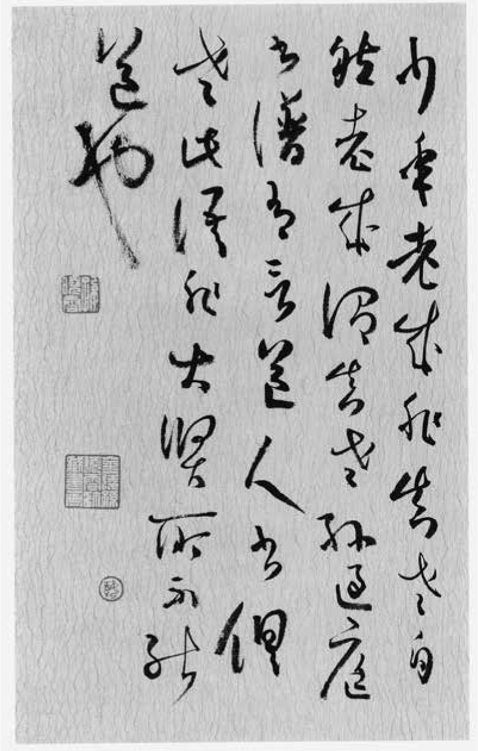
Calligraphy by Sun Xiaoyun in the cursive style.
Another huge change was the adaptation of what is called “raw paper.” Artists had traditionally used sized paper, which was treated with alum and wax; it held the ink and took a clear, thin line. But during the Ming dynasty, calligraphers and watercolor artists began using unsized paper—or raw paper—previously utilized mostly for wrapping or burning at funerals. This inexpensive paper is very absorbent, can blot or spread ink or watercolors, and make thick fuzzy lines. Raw paper has been the paper of choice for calligraphers and watercolor artists ever since.
Sun Xiaoyun recalled, “It used to be children were taught to write [with a brush] in school and most anyone could be a calligrapher. Applicants were tested and had to have especially beautiful calligraphy to qualify for a position as an official in the imperial court.” But that all changed when schoolchildren were taught to write with a pen instead of a brush. Born in 1959, Sun Xiaoyun grew up writing with a brush, but the generation after her was given pens, and the art of calligraphy started to fade. It was no longer taught in mainstream schools; those who were interested had to go to art school. But now, Sun said, “The government has realized that this was a mistake and they have announced that they are going back to teaching with a brush in schools.”
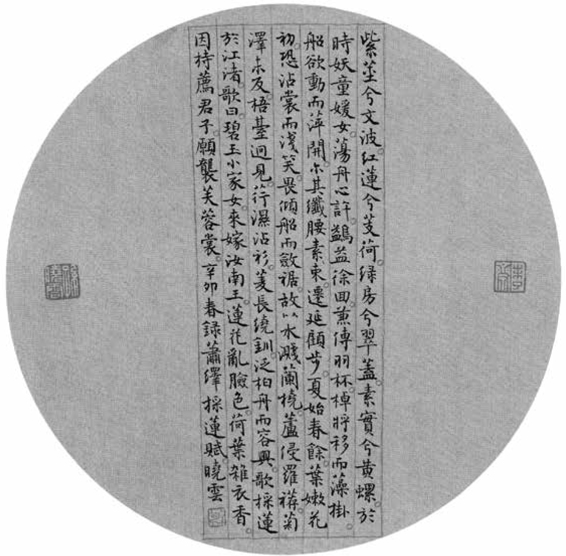
Calligraphy by Sun Xiaoyun with the regular style of letters in a passage from Xiao Yi,  , a Shang dynasty ruler.
SUN XIAOYUN WHISPERED, “Sometimes I use Japanese paper. It is better.” Then she giggled. “They make us lose face.”
The Chinese recognize that although they have retaken their place as the biggest papermakers in the world, they have lost their place as the best. Gong Bin, an artist and a papermaker in his forties, is particularly bitter about this. He lives and works in one of Beijing’s newly bohemian neighborhoods, where brick workshops have given way to art and architecture studios, a café, a flower shop. Gong Bin is one of a new breed of papermakers popping up all over the world. He has a small, one-vat operation that makes paper to order for artists. He gets his pulp—blue sandalwood or mulberry bark—from Anhui Province. He doesn’t use bleach because he believes the bark’s natural vanilla color was the original color of Chinese paper. One of his customers is the China National Library, which uses his paper to repair ancient books.
On Gong Bin’s right cheek are thin scars from when he deliberately cut his face in November 2014 because UNESCO had added Japanese handmade paper to its List of Intangible Cultural Heritage in Need of Urgent Safeguarding. According to Gong Bin, that was a “day of humiliation for China.” He cut the lines on his cheek not because he thought the Japanese didn’t deserve the honor, but because, in his words, “We lost face.”
IN NINETEENTH-CENTURY JAPAN, there was a growing demand for paper and papermakers. Answering that demand, perhaps unfortunately, was the Yukosha Company, which introduced machine-made paper in Tokyo in 1874. Six other companies followed suit, establishing operations in Osaka, Kobe, and Kyoto. And from that time on, though the paper companies were not Western, handmade paper was known as washi, Japanese paper, and machine-made paper was yoshi, Western paper.
Koreans also call machine-made paper “Western.” Their handmade paper is called hanji, which means Korean paper. “Western” is not a particularly endearing term in Asia, but the Asians do make and use a lot of Western paper. In 1880, the Japanese were using mainly washi, but by 1910, they had switched to mostly yoshi.
In Korea today, the small surviving companies that still produce hanji are being consolidated. Three larger multi-vat companies, including the giant Andong Hanji, which produces paper year-round and has its own water-treatment plant, are replacing the many one-vat family operations that run only in the winter. In 1910, there were 8,000 hanji makers. In 2009, there were twenty-six. But these figures are somewhat deceptive because Korea was not divided in 1910, and 2009 figures for North Korea are unavailable. But there is only one well-known mold maker left in South Korea, living in the traditional town of Jeonju.
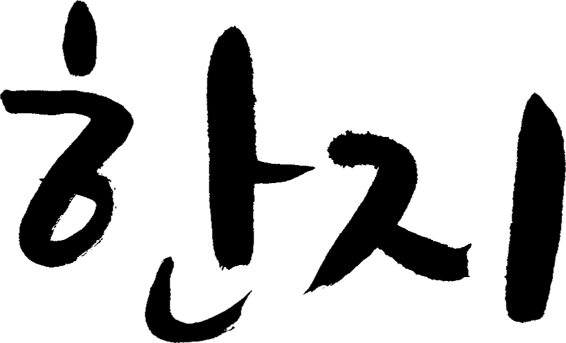
Korean calligraphy, which reads hanji, by Oh Sang Youl, a popular calligrapher known for a contemporary style used in advertising, movie posters, and signs for stores and restaurants.
Hanji is still used for traditional objects such as lamps, umbrellas, boxes, fans, and masks. Hanji strips are twisted into cords and woven into baskets, shoes, and hats. It is used for the floor covering known as jangpanji, found in traditional homes, which have become increasingly rare in the past forty years. Korean red clay is believed to have health benefits, and it is used to make a soft-rose colored hanji that is used for wall coverings.
Hanji is made from dak, the bark of the paper mulberry, or sometimes from Broussonetia kazinoki, a tree celebrated in Japan, where it is called kozo. The bark is mixed with hibiscus root which, when beaten and cooked, becomes the mucilage that holds the fibers of the paper together. Koreans say that their bark is tougher than that of Japan because their weather is more extreme and this makes their paper stronger. The Japanese, understandably, are uncertain about this claim.
_____________
IN THE EARLY twentieth century, there were 68,000 washi makers in Japan, which was a high point. By the second decade of the century, the number started dropping off. Now there are slightly fewer than 450, and according to some estimates, as few as 300. Still, they are almost all extremely high-quality operations, and that is enough to ensure Japan’s status as the mecca of handmade paper.
Satsuya Matsulira, a gray-haired gentlemanly fellow often dressed in a blue kimono with matching pants, the traditional style worn by Japanese men in studios and ateliers, is the curator of the Ozu Shoten paper museum in eastern Tokyo, originally a paper store, founded in 1653. According to him, the biggest threat to washi is the fact that Western paper manufacturers have learned how to make imitation handmade paper at a fraction of the price. “It looks like washi and if it is made in accordance with the Japanese taste, most Japanese people don’t know the difference. It’s made in Japan by Japanese,” he said.
In Eden Phillpotts’s novel set in a nineteenth-century English paper mill, the papermakers say that the biggest threat to their livelihood is the fact that machine-made paper has gotten too good: “The public doesn’t know hand made paper from machine-made.” Now, Satsuya fears that the same is happening in Japan, where a good factory can make one ton of imitation washi in eight hours. They have even learned how to use traditional kozo bark in a Fourdrinier machine.
Yet of late, there has been a tremendous concern in Japan about preserving washi. Schoolchildren are brought to the Ozo Shoten museum and taught to make it. In the Tokyo school system, learning about washi is a standard part of a child’s education. Satsuya said, “Washi is part of Japan.”
A huge change took place in Japan after an earthquake destroyed Tokyo in 1923. The little shops where transactions were recorded with brushes on washi were replaced with modern stores where bills were written with a pen on pads of industrial paper. “When I was growing up, my umbrella was made of paper, the walls of my room were paper, kimonos had paper woven in them,” Satsuya said. “Paper was a part of regular life but we don’t use it anymore.”
That is somewhat of an exaggeration. Artists still always use washi for wood blocks, watercolors, ink drawings, paintings, and calligraphy, and many traditional Japanese goods still come wrapped in washi—among them new kimonos and sweets such as mochi, a dumpling made from pounded rice, filled with fruit or sweets. The Japanese emperor, the symbolic but official head of state, uses washi almost exclusively. Tea ceremonies, which last for hours and involve drinking an intense, shade-grown green tea called matcha, use only washi. Little snacks and brightly colored sugar candies are served on washi, and the hefty bill delivered after the snacks is written on washi.
Gohei paper, folded into complex rectangles and hung from rice straw rope to mark sacred areas, is still in use and is always made from washi. Some sake factories still hang gohei in their fermentation rooms even though they now understand that fermentation is not caused by magic. And at Shinto shrines, messages of good fortune are still written on little strips of washi and sold for a coin in a washi envelope, to be tied to a nearby tree.
Traditional houses of washi paneling, shoji, have become rare. But some houses set aside one traditional shoji room, not only out of a sense of heritage, but for the pleasure of soft natural light. Today, most shoji paneling is at least partially machine-made and often contains some wood pulp because pure washi sheets of that size are extremely expensive. Washi absorbs humidity. In winter it holds in heat, and in summer, the panels slide open. Karakami, sliding washi room dividers, are still popular. Lamps and lighting fixtures are also still shaded with washi.
Ayako Kohno’s family has owned the leading karakami company in Tokyo, Tokyo Matsuya, since 1690. Traditionally, the karakami are decorated with wood-block prints, and occasionally with gold or silver leaf. The Kohno family often works with a type of washi called torinoko, which means “child of a bird” and is eggshell-colored. Karakami paper is hard to make, because the panel is a single sheet the height of a short seventeenth-century man, which means that the man at the vat, or two men, must wield a mold this size. There are not many washi makers doing this kind of work anymore. Ayako Kohno said, “Yes, there is less washi available but there is also less demand so it balances out, but there is some fear that it will one day be gone.”
The Yamastaya paper shop in Tokyo has been selling washi to the imperial household since the late nineteenth century. There is a tradition that states whenever the emperor has his hair cut, it can’t just be thrown away. It must be wrapped in washi. No one seems to know what happens to it after that. The emperor is fond of parties at which the guests have a Haiku writing contest. Haiku is a traditional form of poetry from the seventeenth century. It is a seventeen-syllable verse form with three units of 5, 7, and 5 syllables. At the imperial palace, Haiku is written in a single vertical line with a brush on washi.
NEITHER THE TECHNIQUES and the equipment nor the material for handmade Japanese paper have changed greatly in the past thousand years. A thousand years ago, papermakers used the inner bark of mulberry bushes and cooked down the juice of the tororo aie, a relative to okra, just as they do today. But now the papermakers often grow their own mulberry bushes because the wild mulberry bushes are gone. The wild plants began disappearing at the beginning of the twentieth century.
The Saga prefecture on Kyushu, the southernmost of the four main islands of Japan, is the only place in Japan that still makes paper from kajo mulberry, which was once one of the country’s principal bushes for papermaking. Kozo is a cultivated plant developed to resemble kajo, but it is now getting difficult to find even enough kozo, and so the Japanese are importing it from Korea. The other bark that papermakers use is mitsumata, which is of the junchoge family of East Asian flowering evergreens. But these are shrubs, not trees; a ten-foot-high mitsumata would be unusually tall.
Another problem facing the washi industry is that only about thirty people in Japan know how to make washi molds and other washi equipment, and almost none of these artisans are young. Washi makers are not only traditionalists, they are a stubborn, rugged breed of individualists who do hard physical labor for a small profit, spending their winters dipped in cold water most of the day.
Shimizu Tadao, born December 8, 1937, and living in the village of Kawai-cho, part of the town of Hida, high in snowcapped mountains, is such an individualist. He is a tough old farmer who built his own house on the snow flats so that he could collect the run-off from a mountain stream in a concrete tank for washi making.
One papermaker in Gokayama, a very traditional area northwest of Tokyo, rubs the kozo he uses in snow because he believes this makes its paper whiter. This may seem unscientific, but his paper is indeed very white. But when Tadao lays the scraped-off bark that he uses on the snow to bleach, he is being scientific. If there are enough sunny days, the bright sunlight reflected off the white snow will bleach the bark. It is what people all over the world once did, and in some places still do, with clothes before bleach was invented.
Tadao grows his own kozo and his own rice and pickle vegetables, and from January to April he makes washi. He does everything himself with only an occasional helping hand from his wife or a caring neighbor. When Tadao’s son was in junior high school, he wrote an essay about why he wanted to become a washi maker like his dad. But the school told him that that would be impossible and directed him to a regular high school. Now he works for the prefecture. “He would like to be a washi maker,” said Tadao, “but I don’t think it will be possible. He can’t earn a living.” Then he proudly held up a sheet of white paper and said, “But look what I made from that black bark.”
Tadao and his wife make 100 sheets in a good day. In earlier years, he used to have helpers, and together they would make 250 sheets in a day. “Also, my back is hurting,” he said, explaining the reason for the reduced amount. But Tadao has traditions to uphold. His mother stripped bark until she was ninety-two. “If you do everything right on a January day, when you dip your hands in that cold mountain water you know you are doing something good,” he said.
Tadao is bothered by the way the branches stripped for washi making are just burned or thrown away. “People need to find a use for them,” he said. “Wood ought to be used.” He has tried selling them as hiking sticks to tourists who come to the mountains. He has tied washi strips on the end and tried selling them as feather dusters. So far these ideas have not taken off.
ABOUT FORTY-FIVE MILES north of Tokyo, in the Dohira Mountains, is the town of Ogama-Machi, famous for making washi for the past 1,200 years. Before World War II, the town had eighty papermakers. After the war, that number dropped to only three, but it is now back up to ten. Some people have taken up the practice and some have gone back to it. Teizou Takano, a fourth-generation papermaker, is one who went back. He said, “I hated it. Especially in the winter. All that cold water.” He quit for fifteen years and then an American who wanted to know about washicame through town and was so interested and enthusiastic and appreciative of the paper that Teizou felt shamed into continuing the tradition.
His shop is not picturesque. His next-store neighbor, who also makes paper in the winter and farms the rest of the year, lives in a 1750 thatch-roofed house with a Japanese garden, complete with a cherry tree and carp pond. But Teizou Takano toils in a one-room shop with two women who work for him, making paper the old-fashioned way. They begin by cooking the kozo with lye to make it soft. After three hours, it is a silky mush and is poured into a big rectangular vat, along with a little slimy tororo aie pulp to make it stickier. They stir it well and lower a wooden mold—not wire, but an old bamboo strainer—into it. The size of a door, the mold is hard to handle. It makes two sheets. Teizou swishes it around in the vat and, with remarkable skill, shifts, shakes, and sifts until in a matter of seconds he has created a barely visible film of fibers. This he carefully turns out as a wet sheet of paper. He and his helpers leave the sheets in a stack for about twelve hours, then press the water out, and lay them flat one by one on a steam-heated metal wall to dry. The use of the wall is the only change in process from that used during medieval times.
The people of Ogama-Machi started making washi in the ninth century because so much mulberry grew there. Now, only a small amount can be found wild in the area. Teizou uses kozo, which he buys from places all over Japan, though he prefers the denser bark from colder regions. Colder weather is also why Korea claims to have better bark. Teizou is now seventy-eight and says of his craft, “I get easily sick of it.” It does not seem that there will be a fifth generation of papermakers in this family. His son, who sells motorcycles, has made it clear that he wants nothing to do with papermaking. And his daughter is not interested either. One of his workers, Tamara Satoni, has said she will stay with Teizou Takano as long as he is working. Then she plans to leave and form her own washi company.
There was a time when washi makers were part of rural life. It was a winter activity for farmers. Children would volunteer to strip bark so they could keep the sticks for firewood. But houses are not heated with wood fires anymore and there are few farmers.
The Japanese government subsidizes the studies of young people interested in learning how to make washi. But it takes many years to learn how to make it well, and the government will only pay for two years of training.
There are a few young washi makers, such as Tange Naoke, born in 1980, who learned the trade from his grandfather. He lives in the picturesque tile-roofed town of Kurashiki, along the beautiful Seto Inland Sea. He grows mitsumata and kozo on a small lot in front of his studio, but he also buys some; shoots that are less than an inch thick, which have soft bark, are best for papermaking. He also gets people in the area to pick wild gampi, a bush that has been used for making paper since ancient times. He makes 200 sheets of paper in an eight-hour day; his grandfather, he says, could make twice that amount in the same time period.
Both in Asia and the West, the image of the vatman has an element of machismo to it. It takes someone large and strong to wield the big molds. But then there is Kachiwagi Kazue, born in 1936. She is a tiny woman barely over four feet tall. The widow of a washi maker, she decided to make washi herself after his death and learned the craft from her forty-three-year-old son. He and his wife have given up washi making, but Kazue is determined “to carry on.” She stands on a step to dip the large mold into the vat and quickly shake it into a perfect, even sheet.
THERE IS ONE kind of papermaking that gets more and more popular every year in Japan: nori, the thin sheets of seaweed used to wrap sushi or to wrap around rice if your chopstick skills are up to it. Nori is made exactly like paper. In fact, it fits the definition of paper—randomly woven fibers.
Nori production begins with nets that are stretched out horizontally at the low-tide level between bamboo poles. Barely visible seaweed seeds are planted on the nets. Then, for forty days, nori growers take boats out at low tide every day to check on the plants. They remove other types of seaweed and other matter that gets caught in the nets, while leaving the nori to grow—in effect, weeding their nets.
Several varieties of red algae of the genus Porphyra, common along the Japanese coastline, serve for making nori. They have local names such as asukusa and susabi.
In the past, nori was made like washi. It was chopped by hand, mixed with water, and sifted by hand on screens. Then about fifty years ago, machines were introduced and hand-made nori started to disappear. The nori machine resembles a Fourdrinier, complete with a continuous belt. The machine chops the seaweed, mixes it with water, and runs the solution over plastic screens so that the water drains through. The nori is then pressed to squeeze out any remaining water, and dried.
Some washi makers are switching to making nori, because, it is said, they can make better money. But not everyone, including nori maker Norio Kinman, agrees that making nori is necessarily more profitable than making washi. Some older people who remember handmade nori complain about the machine-made product. Machine-made nori is heated to make it crisper, which also makes it greener, less black. The connoisseurs say that handmade nori was not only blacker, but also thicker, softer, and more flavorful. Today, high-priced nori still has those characteristics.
Pegasus, a South Korean multinational, has gone one step further than both washi and nori to make real paper out of red algae. The product is a smooth, very white paper that has gone through a double bleaching process. Pegasus claims that making red-algae paper uses less energy than making paper from wood pulp because there is no need to remove lignin. They also say that ethanol is a by-product of the algae papermaking process. Their paper tastes like—paper.
IN EAST ASIA, the paper arts—calligraphy, watercolor, and ink on paper—remain popular. The 2000, Nobel Prize winner Gao Xingjian, author of the novel Soul Mountain, about a man in search of the mountain spirit, is also known for his ambiguous and evocative black-ink paintings on paper. Like the poet-artists of the classical period, he uses both writing and painting to express similar ideas linked through the theme of landscape.
Other popular Chinese artists, such as Arnold Chang and Peng Wei, are still painting watercolor landscapes in the classical tradition. Still others, such as Tang Guo, use traditional inks. Calligrapher Wang Dongling uses his training to paint abstract scrolls with huge black ink brush strokes.
Japanese paper art has had an influence on contemporary architecture. Architect Shigeru Ban, who has built museums, mansions, and corporate headquarters, is also famous for his $50 paper tube tents. He originally designed them for the aftermath to the Rwandan Civil War, and they have since been used in many other crisis situations. But much of his work is not inexpensive, such as his Aspen Art Museum, a largely glass structure in which he uses resin-infused paper.
In a very chic Kyoto studio, Eriko Horiki is redefining the role of washi in interior design. “I was originally a banker,” she recalled. “I worked four years for a bank, and through the bank, I ended up administrating a washi company. I was invited to watch the washi making and I thought it would be fun. I saw the artisans in that cold, cold air, their arms turning purple in cold, cold water. I was impressed with the dedication of these craftsmen in a tradition that went back fifteen hundred years.”
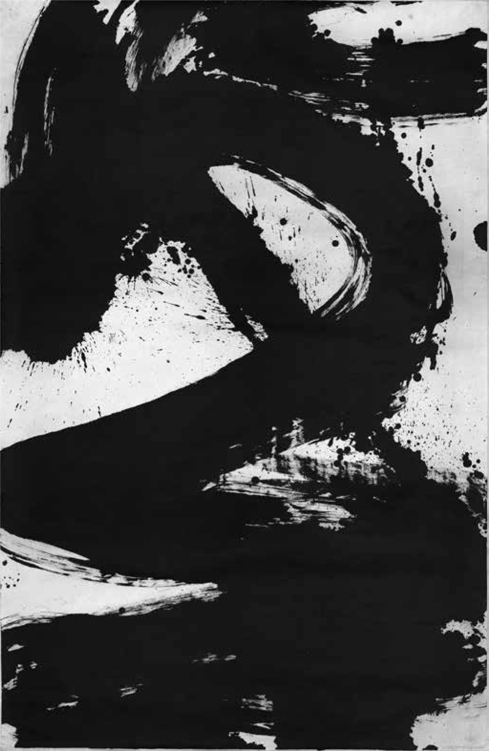
Wang Dongling, Open and Empty, 2005. This abstract painting was influenced by years of training as a calligrapher.
Starting when she was twenty-four, it took years for Horiki to persuade experienced washi makers to work with her. She wanted to do seemingly impossible things. “The important thing,” she said, “is to produce something that is useful. What did handmade washi have to offer? It doesn’t weaken over time. It improves with age. But they were making things that you only used once, like stationery and wrapping. What could this washi that lasted a long time be used for? Architecture.”
Along with five or six papermakers working one giant mold, Horiki makes sheets of washi that are eighteen feet by forty-eight feet. She creates panels that look completely different with front lighting from how they look with back lighting, so that they change in appearance as the day progresses. Sometimes she embeds bits of silver foil, which reflect light when the panel is front-lit, but look black and opaque when it is back-lit. Sometimes she weaves in long strips of kozo. Sometimes she splashes the wet sheet with water to create random holes—like the European papermakers used to do by accident. Sometimes she adds chemical dyes. Some panels are two- and three-ply, with a different pattern on each layer. In short, the studio reinvents shoji, in ways never thought of before.
Horiki also creates large washi objects by molding kozo paper into shapes—spheres, cylinders, gourds, bones—and lighting them from the inside. She has made panels for the prime minister’s residence, light fixtures for Tokyo’s Narita Airport, and a backdrop for cellist Yo-Yo Ma.
THROUGHOUT PAPER HISTORY, there has always been a dialogue between papermakers and artists. English papermaker James Whatman consulted with J. M. W. Turner; Japanese papermakers made paper for specific artists and labeled it accordingly—for example, “Gahoo-shi,” Gahoo’s paper, which was made for the artist Gahō. But with less and less commercial use for handmade paper today, artisans in small Japanese shops are working even more closely with artists. An artist can now tell a papermaker exactly what he or she desires, and the papermaker responds with a custom-made product. This is what papermaker Gong Bin does in Beijing, and what many similar artisans all over the world are doing.
In the steep, velvet-green Basque hills above the port of Hondarribia, within walking distance from the French border, is a home with a flat-roofed, one-story, glassed-in studio. Here, Kikis Alamo and her husband José Ramon Alejandre make paper by hand. If you look out their windows in one direction, you see the Basque mountains, green from rain, with white-walled red-roofed houses on distant slopes. If you look in the other direction, you see the lush tropical forest of Vera Cruz state on Mexico’s Caribbean coast. The couple have planted their garden with plantain bushes and agave, tamarind, and lavender-flowering jacaranda trees from their native state. They are Mexican-born Basques, the children of Spanish Civil War refugees, who moved back to this spot in the Basque Province of Gipuzkoa in 1982.
Kikis’s fascination with papermaking stemmed from her interest in Mexican basket making. There are two connections. Straw is a material that is used for papermaking. More important, paper molds are woven, like baskets. It was the molds that first attracted her interest.
The place that Kikis and José chose to live, though a lovely spot, is completely unsuited to papermaking. There is no natural water source and so they use tap water, which they treat with chemicals to counteract the ones in the municipal water supply. The water also has to be filtered because it has too much metal content. Then it is kept in a large tank. The water is not recycled, and so a great deal of tap water is used. In addition, the fibers that they utilize for papermaking—raw cotton, linen, and abaca—are not native to the area.
Artists come to the studio and specify the type of paper they want. A few sample sheets are made until just the right weight, texture, and sizing is determined. “The watercolorists are the worst,” Kikis joked. Turner’s papermakers would have agreed. Watercolor, more than any other art form, is dependent upon the absorbency, sizing, and texture of the paper used. The same brushstroke will look entirely different on different papers.
The studio’s customers range from King Juan Carlos of Spain, who requested a lightly textured thick paper, to internationally famous Basque abstract sculptor Eduardo Chillida, celebrated for his drawings, etchings, and lithographs. Chillida, who died in 2002, requested a somewhat greasy paper surface for his etchings, which the studio created by using polymer sizing on well-textured paper.
A small woman, Kikis makes small sheets of paper on small molds. Some is thick and highly textured, some is as smooth as fine Japanese paper, and some is so heavily textured it is almost three-dimensional. Asked if her paper is expensive, she said that it was, and added: “A sheet of paper is a work of art, but it is thought of as nothing. Someone draws a line on it and it is twenty times more valuable.”
IN THE LATE twentieth and twenty-first centuries, artists have been using paper not only to create art on it, but to create art from it. This was probably first popularized in the West by cubists Picasso and Braque, who glued painted paper, oil cloth, rope, and other material to their work, inventing the term collage, meaning “glued.” Toward the end of his life, French painter Henri Matisse turned from painting to making collages with colorful paper. His technique suited the physical restraints that age was imposing on him, but it also satisfied the direction in which his painting had been heading all his life as he searched for ways to strip down figurative images to their bare essence.
Matisse was not a restless connoisseur of handmade paper. He used machine-made French paper produced for artists. In particular, he liked Arches paper, made on a cylinder sheet by sheet, with deckle edges and a smooth wove surface. He also used paper manufactured on Fourdrinier machines by Barjon and by Canson & Montgolfier, another very old French company. He wanted paper that he or his assistants could paint with saturated colors.
But since Matisse’s time, artists have become much more involved in the making of the paper with which they work. Kikis Alamo’s artists ask her not just for various colors of paper but for various textures—some with long fibers, some with short fibers, and some with different lengths of fibers in different parts of the same sheet. Artists will even sometimes lick a corner of a piece of paper to test its sizing. If it is sticky, it means the paper is heavily sized.
Upon his return from World War II, Douglas Howell, inspired by paper historian and papermaker Dard Hunter, built his own mill for handmade paper on Grand Street in Manhattan. He had learned how to make paper in France after being discharged from the army. In New York he developed techniques for a wide variety of colors and textures, working with everything from the flax he grew in his backyard on Long Island to blue jeans. He even designed and built his own pulp beater. He made paper for many prominent artists, including Jackson Pollock, Lee Krasner, Jasper Johns, Larry Rivers, and Robert Rauschenberg. Although his own work is in major collections, he is most remembered for reviving the craft of papermaking in America and inspiring numerous other papermakers and departments of papermaking in art schools.
In 1974, Susan Gosin and Bruce Wineberg at the University of Wisconsin started the Dieu Donné Press. Their original project was to hand-print a book of Bruce’s poems on handmade paper. Two years later, they started their own paper mill on Crosby Street in Manhattan, a short distance from where Douglas Howell’s press had been. Later, they moved to various other Manhattan locations, and are now a busy shop where artists come to invent with paper.
Most of the paper that Gosin and Wineberg produce is made from cotton, from a pressed board of semiprocessed fiber that they buy, or from abaca imported from the Philippines. But sometimes they purchase linen scraps, as in earlier eras, and beat them for ten hours in a modern Hollander beater. Sometimes they make paper with gampi. It all depends on what the artist is trying to do. Artist Saul Melman puts pigment in water, which he freezes into ice cubes. He then places the cubes on paper, and as they melt, they leave cube designs with drip marks. Do Ho Suh makes drawings with thread and presses them into paper. Roxy Paine creates sculpture out of molding pulp. Other artists paint with different colored pulp using brushes or squeeze bottles.
There are such papermakers and paper artists in many places. Matthew Shlian is a Michigan-based industrial designer who works with companies such as Apple and Procter & Gamble. These companies have become increasingly interested in how their products are packaged; there is a growing belief that opening a purchased product should be a positive experience, like opening a present.
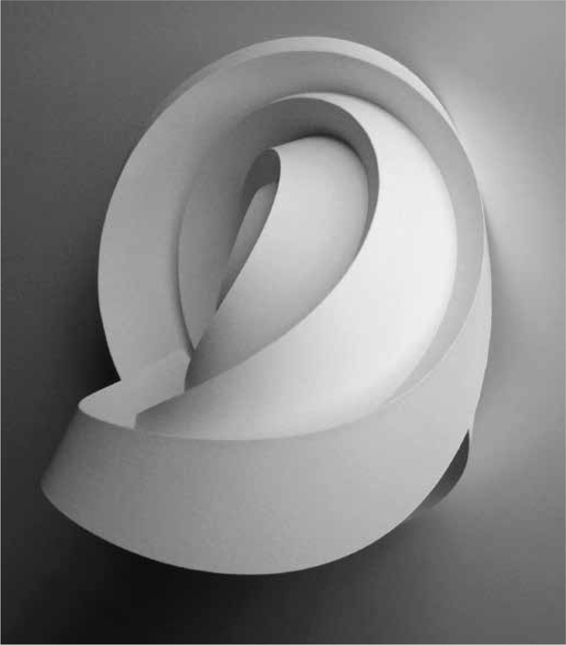
Matthew Shlian, We Are Building This Ship as We Sail It, paper sculpture.
While working in the corporate world, Shlian became increasingly interested in creating aesthetic objects out of paper and is now a respected paper sculptor. He designs huge installations for thousands of dollars, and little geometric sculptures for $300. The latter are popular for first anniversaries, which, by tradition, are commemorated with a paper present. He said, “There is a renaissance in art on paper because it is such a tactile media. It’s so nice to hold things in your hand.” Pixar animators, who seldom get to hold anything, told him the same when he was working with them on a project.
LIKE MOST THINGS in Japanese culture, origami first came to their islands from China, arriving around the sixth century, about the same time paper did. At first, a simple type of origami was used to wrap offerings to deities. But true origami, decorative folded paper figures, didn’t begin, according to legend, until a twelfth-century nobleman named Kiyosuke folded a piece of paper into the shape of a frog.
Origami is often taught to children, who are shown how to make flowers and animals. There are rules. A piece of origami must be made by folding a single sheet of rectangular paper. There can be no cutting. Nothing can be added or subtracted. The strictest origami rules state that the folding must take place in the air and not on a table, but often this rule is not observed.
Origami became sculpture with a little-known Japanese innovator named Akira Yoshizawa, who lived from 1911 to 2005. Self-taught, he left his factory job to pursue his paper-folding passion, supporting himself with odd jobs and with selling soup door to door. He invented “wet folding,” folding paper while it is wet. He also invented a form of diagraming that shows how each fold is made, which is how serious origami work is recorded today. He started by making pieces with twenty folds. By the 1980s, he was making pieces with eighty folds; his later work involved between two hundred and three hundred folds. He created figures with expressive faces and remarkable details. In his life he made about 50,000 pieces, none of which he ever sold.
Because of Akira Yoshizawa’s work, serious origami makers in the United States, France, and other places all over the world started producing their own human and animal figures—even whole scenes—of dazzling complexity and detail from a single rectangular piece of paper.
Physicists, mathematicians, biologists, and computer scientists have also been inspired by Yoshizawa. They are asking what can be learned from folding paper. Mathematicians see implications for problems of geometry, number theory, and abstract algebra. Engineers see implications that could apply to such things as how to fold air bags used in automobiles so that they deploy properly, or how to fold pieces of equipment used on satellites so they unfold as desired in space.
At the MIT Computer Science and Artificial Intelligence Laboratory, Erik Demaine, who earned his PhD at age twenty and was the youngest professor ever hired at MIT, is working on folding human proteins to fight diseases. It is his belief that proteins have a shape that they fold into; if they fold the wrong way, it causes diseases. He believes that developing mathematical formulas on how proteins fold could lead to the creation of protein drugs to fight particular viruses. He also creates beautifully curved origami sculptures.
California architect Tina Hovsepian uses origami paper-folding concepts to create tents out of folded cardboard that can be used to shelter the homeless. She calls her structures “carboardigami.” They fold up for easy transport and fold out where needed. She says the structures are weatherproof and insulated. A trained worker can set one up anywhere in a half hour.
In a world where inventions are replacing the use of paper, new uses of paper are also being invented all the time.