Part I
In this part . . .
In the chapters in this part, we dissect poetry into its basic elements. Here you find out why attention to each element is essential if you want to fully appreciate and understand poetry. We take you on a tour through subject and tone and point out the essential tools of the storyteller’s art. We give a short course on sound in poetry and how poets orchestrate the music of words. And then we get to the good stuff: the art of interpretation itself. You’ll discover how to speculate about a poem’s meaning and recognize the implications of that meaning. Finally, we give you a short course on reading poems of the past — and understanding language that may not be second nature to you. In these chapters, you get a sense of the poem’s impact on you as a reader.
Chapter 1
In This Chapter
 Knowing what sets poetry apart from other words on a page
Reading poetry aloud — and knowing why you’re doing it
Creating your own poetry from scratch
The word poetry sends chills down the spines of many otherwise strong and balanced people. Perhaps you have flashbacks of being called on in class to read a poem aloud — and not having a clue what the words you were reading meant. Or maybe you remember being required to write a poem, and even today you’re still not exactly sure what sets a poem apart from any other bunch of words thrown onto a blank page. Or perhaps you’re just curious about poetry, but you’re intimidated by the huge number of poetry books in your local bookstore or library.
No matter what your past experiences with poetry have been, you can set your worries aside. To read and write poetry, you don’t have to join some secret club, where you have to wear a moose hat with antlers, stand on one leg, and recite secret ritual formulas in Greek . . . although, goodness knows, that would be quite interesting, and we’d be happy to watch if you volunteer.
Poetry is something human beings have always done and always loved. If you want to be one of them, come along. In this chapter, we give you a working definition of what poetry is and fill you in on why people have been writing it for thousands of years. We also let you know about some great places to turn if you want to read more poetry — and while we’re on the topic, we give you a quick guide for actually reading a poem. Finally, if all this talk about poetry has inspired you (and we sure hope it has!), you can dive right in and write a poem of your own.
What Is Poetry and Why Do People Write It?
Poetry is the practice of creating artworks using language. Sculptors use marble, steel, cardboard, goose liver pâté, whatever material they choose. Musicians use sound. Painters use paint. Furniture-makers use woods and fabrics. And poets use language.
So what makes poetry different from other uses of language? Here are five things almost all poetry has more of than other language (the non-poetic kind):
 Attentiveness: Poets are extremely careful with the way they use language. They pay attention to everything from spelling to the way the words sound and what they mean. They think about punctuation and the spaces between and around words. Most people simply don’t pay as much attention to these elements of language — but paying attention is the poet’s job. And poets want you to pay that sort of attention, too — to the language you read and use and to your life.
Concentration: Poetry has more meaning, music, and emotion per word, per syllable, and per letter than other kinds of writing. Poets find ways to open up explosions of understanding and emotion — while using carefully selected combinations of words. More meaning, fewer words — a nice trick. Whenever you find language especially charged with passion, music, or significance, you’re probably looking at poetry or something close to it.
Experiment: Poets try to use language in as many new, surprising, and challenging ways as they can come up with. They use language in special ways to startle, awaken, or challenge you.
Originality: Poetry says or does something new; it makes something new happen in the reader’s mind. This new thing can be a totally original observation about life, or it can be a neat way of saying something many other people have already thought or said. Whatever it is, you can tell it’s original because it doesn’t try to echo someone else’s way of saying it — it finds its own way.
Form: Most people write from one margin across to the next. Sometimes they indent to show that a new paragraph is starting. But poetry is different: It’s very often about form — the very shape or structure a particular group of words takes. The word form also refer to the way a poem is written (its mode). You can write a poem in the form of a prayer, a letter, a laundry list. And all forms carry their own worlds of meaning. So poets think a lot about form.

Poetry isn’t the only way of using language to make art, of course — for example, short stories and novels are works of art, too. But poetry usually has a greater degree of attentiveness, concentration, experiment, and form than you find in most other uses of language.
Poets are interested in exploring experience through the written word. That includes any experience you can have, as well as the world of your dreams and fantasies — the story of civilization; the taste of a peach; dancing with your father; imaginary worlds with imaginary inhabitants; sending your daughter off to college; leaving someone you love; a full moon transfiguring a winter sky; explaining the ways of God to humanity. The poet takes all these kinds of experiences, and the emotions and feelings they bring with them, and makes them into art through the way he uses language. And that — because you use language, too — gives you an instant link to poetry as well.
So why do people write poetry? The reasons are as numerous as the poems themselves. Some people want to
Make nice with the gods, as in the Psalms or the Bhagavad Gita.
Tell the stories of their communities, as Homer did in The Odyssey.
Record history, as Anna Akhmatova did in “Requiem, 1935–1940.”
Commemorate a moment of personal history, as Ben Jonson did in “On My First Son.”
Take an achingly clear snapshot of experience, as H.D. did in “Heat.”
Embody their feelings, as Theodore Roethke did in “I Knew a Woman.”
Create a state of feeling, as Stéphane Mallarmé did in “Afternoon of a Faun.”
Explore language, as John Ashbery did in “Corky’s Car Keys.”

If you haven’t read some or all of these poems, consider this list a good place to start.
No formula can cover all these different motivations. But most poets are trying to do one or both of the following:
Create an intense emotional experience.
Draw attention to something that is true.
We delve a little deeper into both of these goals of poets in the following sections.
Creating an intense emotional experience
Poetry constantly presents its readers with bursts of concentrated emotion — the poem that makes your beloved fall in love with you; the poem that comforts a suffering friend; the poem that celebrates a day of joy or triumph; the poem that praises God, mourns the dead, or exults in the universe. The more attention you pay to poetry, the more you’ll savor these surges of passion and understanding.
In his poem “On My First Son,” Ben Jonson, a Renaissance poet who lived at the same time as Shakespeare, writes a poem of farewell to his son, who has died at just 7 years old. The poem contains a few examples of Renaissance English (words that you may trip over initially), but only a few. Read the poem silently, and then read it aloud:

Farewell, thou child of my right hand, and joy;
My sin was too much hope of thee, loved boy:
Seven years thou wert leant to me, and I thee pay,
Exacted by thy fate, on the just day.
O could I lose all father now! For why
Will man lament the state he should envy,
To have so soon ’scaped world’s and flesh’s rage,
And if no other misery, yet age?
Rest in soft peace, and asked, say, “Here doth lie
Ben Jonson his best piece of poetry.”
For whose sake henceforth all his vows be such
As what he loved may never like too much.
Here’s a brief list of the phrases you may find unfamiliar in this poem:
child of my right hand: The name Benjamin means “son of the right hand” in Hebrew, so this phrase means both “son of whom I’m especially proud” and is a pun on the name of both the father and the son.
the just day: The day on which payment is due on a debt. The boy was “lent” to the speaker for seven years, and then “fate” (the lender) “exacted” (required) repayment on the due date.
O could I lose all father now!: This passage could mean, “Now I am no longer a father,” or “After such pain, I never want to be a father again.”
’scaped: This is just the poetic way of saying “escaped.”
And if no other misery, yet age: Here the poet is saying that even if his son escaped no other misery, at least he escaped getting old.
Ben Jonson his: This is a fancy way of saying “Ben Jonson’s.”
Across five centuries, this poem delivers the speaker’s suffering to you. But notice that Jonson never refers directly to his own pain. The line “O could I lose all father now!” is the closest the poem comes to that. Instead, you can guess at the great suffering from the tender restraint in this poem: “Rest in soft peace” is one of the tenderest leave-takings in all poetry; the punning on “best piece of poetry” (the son is the best “poem” Ben Jonson ever created) and the name Benjamin (which in Hebrew means “son of my right hand”) suggest, without dwelling on them, the father’s fondness for his son; and the vow at the end — to love things in this world, but not to become attached to them — suggests the suffering of a father at the death of his child without speaking any of those words directly.
“On My First Son” is a quiet, dignified poem, but the concentrated emotion in it is unmistakable. Ben Jonson gives you a demonstration of what poets everywhere try to do: Lead you into an intense encounter with feeling.
Drawing attention to something that is true
Most people are so busy living their lives that they don’t pay attention to what’s around them. Poets are constantly beckoning their readers to stay alert to the things of this world — both the familiar things that become invisible to you through habit, and the miraculous things right in front of you that you’re too busy to notice. Poetry can expand your awareness and keep you alert to truth and beauty — and to what they can both teach you.
The Japanese master-poet Issa captures an exquisite moment in this passage:
morning:
one deer licks
snow from the other’s
coat
This poem presents a delicate, exquisite image of animals seemingly taking care of each other in the wild — and it also suggests that it is a cold morning, and the deer have spent the night out in the snow. The poet doesn’t have to comment on this image; he simply lets its truth show and lets you marvel at it. You may find the words meaningful, or you may find no meaning beyond their beauty — but surely that was worth the poet writing it down.
In this poem, Li Po, a Chinese poet from the T’ang Dynasty, mistakes one thing for another and gives you a vivid experience that ends on a meditative note:
Moonlight pools at the head of my bed —
I mistook it for frost blanketing the earth!
I look up: see the moon on the mountain;
I look down: think long thoughts of home.
You have to change the image in your mind from moonlight to frost and back again. Then the speaker, after he realizes it is moonlight, follows it up to the source of the light itself. That would be neat enough — a call to be sensitive, just like Basho’s poem earlier in this section — but then the speaker’s eyes stray from the moon, and the speaker becomes nostalgic for home. Why does this moment make the speaker miss home? Good question. Maybe something about seeing the moon on the mountain reminded him of home. Sometimes that happens: An image out of nature unlocks old memories, unexpected feelings.
Poetry keeps telling you to pay attention. It’s a way to expand your awareness, your understanding, your store of experience.
Bringing Poetry into Your Life
Although most people don’t realize it, poetry is all around them. You may hang poems on your refrigerator or on the walls of your bedroom or office, just so you have your favorite inspiration nearby. A friend of ours has George Herbert’s “Love (III)” on a scroll over her desk at work. City subways in London, Chicago, and New York run poems in the subway cars all the time. And although graffiti is a form of vandalism, it’s also often a form of poetry.
You can also find poetry in the more traditional places, like books and magazines. In fact, poetry is easy to find — it certainly isn’t hiding. And you don’t actually need to go anywhere to get it. If you have access to the Internet, you can connect to poetry from all over the world, sampling the best poetry of all time for the cost of logging on.
In the following sections, we let you know where you can turn if you want to inject some more poetry into your life.
Checking out libraries
Your local library is a great source for poetry — and best of all, it’s free! When you visit your library, ask the librarian where the poetry section is, go there, and pull a book out at random. We did, and we came upon these lines:
Summer swallows spring and goes into September
Like long division it is always there
Autumn, fall we say, fruit releases itself
You are new enough so the old catches up
Cross this bridge come to that one
You grow up and ancient history snaps back
Rubber band and rake handle
The poem turns out to be “Vermont Apollinaire” by William Corbett. Not bad for a stab in the dark at a random shelf in a library.
When you read this poem, the first line tells you that it’s about autumn: Corbett writes about summer “go[ing] into” September, an echo of long division (in the second line), in which things “go into” other things. The poem explores how the past comes back to you, snapping back like a rubber band or a rake handle when you step on the upturned part of the rake. But Corbett doesn’t use the word like; instead, he gives you two things that snap back — a rubber band and a rake handle — and lets you make the connection. The way things “snap back” stings a little — as autumn does when it makes you think of summer days gone by.
Notice that Corbett is comparing the past with the rubber band and rake handle in an implicit, unspoken comparison — called a metaphor. Had Corbett said “ancient history snaps back like a rubber band or a rake handle,” he would have been using a simile. Metaphors and similes are among the most important techniques in a poet’s repertoire.
Try pulling a poetry book off a library shelf yourself, and if you like what you read, check out the book and sample more.
Browsing through bookstores
If you’d rather own your own books of poetry than check them out from the library, poetry won’t bust your pocketbook. Go to your local bookstore and peruse the following list of inexpensive books of poetry. Select two or three and see what you think.
The Inferno of Dante: A New Verse Translation, by Dante Alighieri. Translated by Robert Pinsky. (New York: Noonday Press, 1996.) $9.00
Selected Poems, by Emily Dickinson. (New York: Dover, 1991.) $1.00
Eight American Poets: An Anthology, edited by Joel Conarroe. (New York: Vintage Books, 1997.) $14.00
Twenty Love Poems: And a Song of Despair, by Pablo Neruda. Translated by W.S. Merwin. (New York: Penguin, 1993.) $9.95
Favorite Poems, by William Wordsworth. (New York: Dover, 1992.) $1.00
Note: The prices we provide here are the list prices of the books (the prices the publishers recommend selling them for). But you can usually find them for even less at major bookstores, used bookstores, and online booksellers.
Anthologies a go-go
A great way to begin a search for new poetry is to check your local library or bookstore for anthologies (collections of poems from different poets). An anthology (the word anthology means “collection of flowers” in Greek) is like a literary smorgasbord of writing: You can sample a variety of poets within the pages of one book. When you get a taste for certain poets, you can satisfy your hunger by finding books containing only poems written by them.
Thousands of poetry anthologies are in existence — many with specific themes — and many display the best a particular culture or group has to offer. A very brief list of titles suggests the range of what you can find: 1000 Years of Irish Poetry; A Book of Luminous Things: An International Anthology; A Book of Women Poets from Antiquity To Now; Americans’ Favorite Poems; Canadian Poetry: From the Beginning through The First World War; Unleashed: Poems by Writers’ Dogs; Listen Up! Spoken Word Poetry; Moving Borders: Three Decades of Innovative Writing by Women; What Book? Buddha Poems from Beat to Hip Hop; Spirit & Flame: An Anthology of Contemporary African American Poetry; The New Young American Poets; Cowboy Poetry Matters; Word of Mouth: An Anthology of Gay American Poetry; Literatures of Asia, Africa, and Latin America; In the Grip of Strange Thoughts: Russian Poetry in a New Era; The Defiant Muse: Hebrew Feminist Poems from Antiquity to the Present; and 100 Great Poems by Women. Get out and start your personal flower collection today!
Attending readings
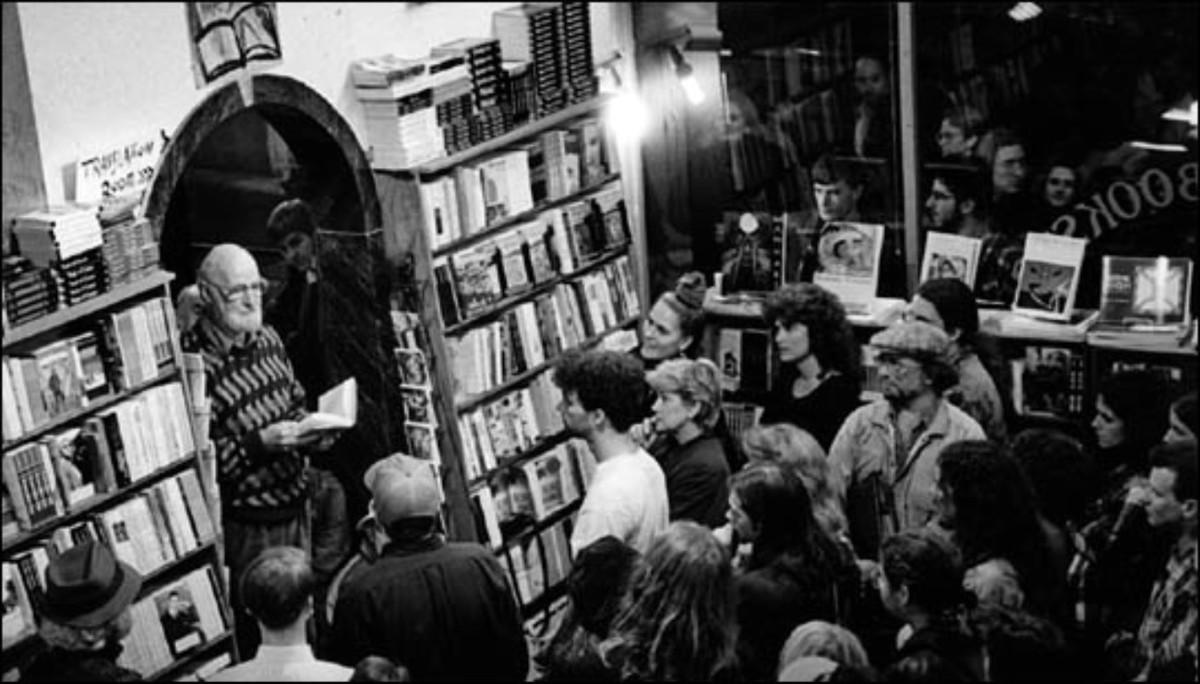
More likely than not, you can find a number of places near you where poetry readings, like the one shown in Figure 1-1, happen every week. Do you live near a college or university? A coffee shop? Does your local library have a reading series? Are there any reading groups in town? (If not, you could always start one.)
If you’re not sure whether poetry readings are happening in your neighborhood, check your local newspaper. Most papers have entertainment sections that list things to do. Also, if your city has a Web site, check to see what’s available. Call area bookstores to see if poetry readings take place there as well. Check bulletin boards at your local college or café.
Seeking cyber-poetry
You don’t even need to leave your house to get your hands on some poetry. Thousands of Web sites feature poetry, and they’re yours for the taking. Just type a poet’s name into your favorite search engine, and you’re sure to come up with numerous sites worth your perusal. We typed Emily Dickinson into a search engine and found 22,599 Web pages! Dickinson is one of many poets, including William Shakespeare, Dante, Homer, and Walt Whitman, whose work has a big presence on the Web.
So get out or stay in, and find some of this good stuff. Poetry takes many forms, is almost always a pleasant surprise, and can improve your world. Not bad for a few words in a small space.
|
|
© Christopher Felver
Reading Poetry Aloud
If you’re like most people, you haven’t read aloud since the last time you read to a child or since you were in school. For many people, reading aloud just doesn’t feel good — maybe it conjures up all those bad memories of being called on by a teacher to read in front of the rest of the class. But it’s time to lose those fears. Because, after all, poetry is meant to be read aloud. That’s right, aloud — as though you were delivering the poem to an attentive audience.
Why you should read poems aloud
Here are the three most important reasons you should read poetry aloud:
Poets design their poems to be read aloud. The earliest poetry was oral. People chanted it, sang it, recited it — and they still do. From its earliest forms to the poems being written today, poetry has kept its close alliance with speaking and singing. The music of poetry — that is, its sounds and rhythms — is not just for the eye and the mind, it’s meant to be given voice. In fact, as they write, most poets imagine someone reading their poems aloud. Poetry is supposed to be a living thing, and poets write accordingly, with an audience in mind.
You’ll experience the whole poem if you read it aloud. Poems read aloud are different animals from poems read silently. A big part of poetry is sound and rhythm — and the best way to get the full impact of these important elements is to put them into action by pronouncing them with your own throat, lungs, teeth, lips, and tongue. Sound and rhythm don’t exist just for their own sakes, either; they exist to give you pleasure (because humans naturally like music and rhythm in our poetry) and lead you to the poem’s meanings. Commas, spaces between words, line endings, and other pauses may hint at melancholy, hesitancy, or passion. Punctuation has its traditional functions (exclamations! questions? wistfulness . . .), and it often also is used in unexpected ways — or not used at all. You may miss all these signals if you don’t read aloud.
You’ll understand and remember more if you read aloud. Memory and understanding are everything. If you remember something and understand it, it takes up long-term residence inside your brain. And then you can use that knowledge as a building block to discover more and more about the world of poetry.
Don’t believe us? Read these four sad lines (by the Greek poet Sappho) silently to yourself:
The moon has set
and the Pleiades. Middle of the
night! Time passes,
and I lie here alone.
Reading silently is a great way to make a poem’s acquaintance. Here, you can instantly absorb the situation: The speaker is lying alone at night. The speaker can feel time pass, and she isn’t thrilled, apparently, at being up this late.
Now read the lines aloud. Pause a little at the end of each line. Notice how each pause carries a little information, a little jolt of feeling with it.
The moon has set
and the Pleiades
If you look up the word Pleiades in your handy reference book, you’ll find out that the Pleiades are that familiar cluster of stars at the top of the sky. So maybe the word Pleiades is just a time-reference: The moon goes down, and then this cluster of stars follows. That could take quite a while (depending on how the constellations are arranged that night) — it gives you the feeling that a good amount of time has passed.
Now you come to another pause:
Middle of the [pause]
night!
You can almost hear the speaker groan. Pausing helps emphasize how weary and restless the speaker is. You may even begin to wonder why the speaker is staying awake. Is she waiting for someone? You may spot an answer in the last two lines:
Time passes, [pause]
And I lie here alone.
This insomniac speaker is alone. You get a feeling (without being told) that she wishes she weren’t. Where do you get it from? Her wakefulness, maybe, or her awareness of time passing and her solitude.
One more word about the Pleiades: In mythology, the Pleiades were the seven daughters of the Greek gods Atlas and Pleione. And the hunter Orion — also a constellation in the sky — was thought to be eternally chasing them (without ever catching them). So each time you looked at the Pleiades — at least, if you were Sappho — you may have thought of the chase of love, which would not help your insomnia or lonesomeness at all.
Keep your reference books handy when you’re reading poetry!
Chances are, you understand Sappho’s poem better for having read it aloud. And that’s the way she would have wanted it.
The basic steps to good reading
We hope we convinced you in the previous section of the importance of reading poetry aloud. Now you need to know the best ways to do it. Check out the next sections — you don’t have to take the suggestions below one by one. You can do them in different orders, and some you may do simultaneously. Think of all these steps below as components of good poetry reading.
Have the right tools handy
A firefighter who charged into flames without a hose wouldn’t be very well prepared. And you wouldn’t start painting your house, or shampooing your dog, or beginning any other activity without the right tools nearby, would you? Reading poetry isn’t any different.
When it comes to poetry, the right tools include the following:
A dictionary. A dictionary is a great help when you come across words you don’t know. Don’t be ashamed — they happen, such words. Looking up words you don’t know (see the discussion of the word Pleiades in a previous section) helps you understand a bit more of the poem — and of the poet who wrote it. One of the many Webster’s dictionaries (or similar ones) are excellent places to start.
A book about the history and forms of poetry. Such a book can help answer questions that arise as you read — questions about kinds of poems, traditions, histories of poetry in different languages, and so on. We recommend The New Princeton Encyclopedia of Poetry and Poetics, edited by Alex Preminger and T.V.F. Brogan, as a great reference in this category.
Poetry For Dummies. This, of course, is a fine book providing much good information on poetry. And we’re not at all biased. Nope. Not one bit.
Read silently first
When you first look at a painting, you probably step back to take in the whole thing before you move closer to see the details. Follow the same approach with poetry:
1. Scope out the poem.
Skim over it, noting its title, length, and overall structure. Do you see one big flow of words on the page? Or is the poem broken into groups of lines (often called stanzas)? Does the poem rhyme? Who wrote the poem? If the information is available, find out when the poet lived. This kind of background information could come in handy in understanding the poem’s meaning.
2. Read the poem silently, to yourself.
Enjoy yourself. Stay relaxed and open. No one’s timing you. In fact, the slower you read, the better — because you can absorb more.
3. Take notes as you read silently, if you want.
Taking notes isn’t required, but it’s a good idea — especially if the poem includes unfamiliar words, allusions (references to persons, places, things, or history, for example), or concepts you don’t understand. If you own your book, you may even want to make notes in the margins, jotting down the meaning of this or that line, for example. The notes some people make in their poetry books become a sort of journal for them, a history of their reading and their thought processes over time.
Note surprises and unfamiliar words
As you read, you will most likely run across some words you’re not familiar with or words whose impact (in the context of the poem) you aren’t ready for. Even in the shortest poems, you get them.
Take a look at this Native American “Song of Naquali”:
I wonder what
my future life
will do to me.
The first two lines are “normal” enough — but then “will do to me” is unexpected. You may expect the speaker to say, “I wonder what / my future life / will be like,” or, “I wonder what / my future life / has in store.” But instead, the speaker is wondering what the future will “do to me,” as if the future was a force that could make things happen. What will the future cause to happen to the speaker? Good question: The speaker sets up the future almost as a malevolent force, and there’s not much you can do about what it brings your way. What’s going to happen is going to happen, and much of it won’t be that great. The poem is wry — in the sense of being ironic or grimly humorous — and it is also fatalistic, meaning the speaker doesn’t think you can do much about fate, besides wonder what it will do to you.
You don’t ever have to plow top to bottom, all the way through, when you read a poem. Stop, repeat, go back, dwell. If you really like certain lines, reread and enjoy them again. If the poem is in a book you own, underline the part you like or note it in the margin. And keep your dictionary by your side so that you can look up words you’re not familiar with.
Find an engaged, conversational tone
Every poem has a speaker — someone you imagine saying the poem. Sometimes the speaker is a disembodied voice, just saying the words. At other times, the speaker is a character you get to know in the poem. When you read aloud, you need to use the right tone of voice for that speaker. Here are some suggestions for the kind of tone you should shoot for:
Engaged. Your tone of voice should show that you’re really interested in what you have to say. You’re leaning forward to tell someone else. If you’re happy, you’re really happy. If not, you’re really not. Give the words a slight push; project.
Conversational. Don’t shout and don’t whisper. True, you are performing the poem, but you can still remain close to the normal way in which you speak to people in everyday conversation. You’re just reading as though you’re engaged in interesting conversation, conversation with passion behind it.
Many poets and poetry fans like to work on their reading aloud. If you want to practice your reading, record yourself (this exercise can be humbling at first, but it’s always instructive). Listen to how you read. Is your reading clear? Is it attentive to the poem? Are you pausing in the right places? Are you being expressive? Are you bringing your idea of the poem across? Attend readings and observe how other people read their poetry, too.
Don’t rush
Read at a moderate, deliberate pace. Enjoy the words and phrases you’re saying. Enunciate (pronounce the words clearly). You may come across very long sentences as you read. Just take your time, and you’ll have an easier time understanding what the sentences are saying.
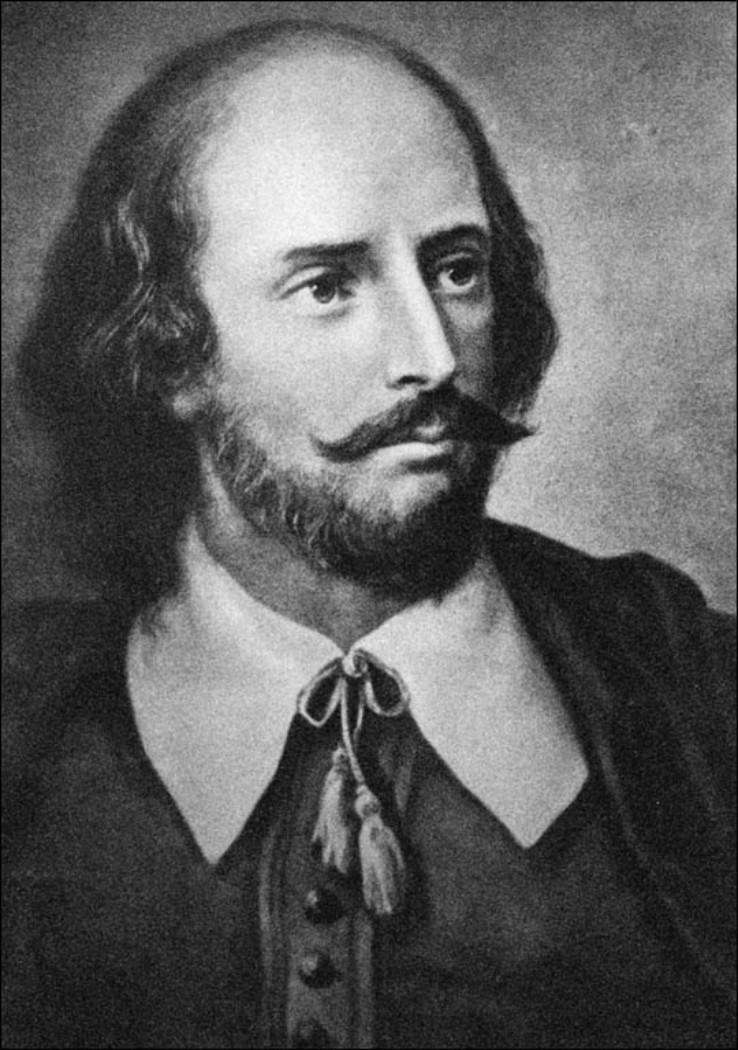
Use the following poem as a reading-aloud challenge. The passage is from the play Antony and Cleopatra, by William Shakespeare (see Figure 1-2 for a glimpse of what he looked like). Someone is describing Cleopatra, Queen of Egypt, as she sails down the Nile in her barge. Remember:This passage will be gobbledygook unless you relax and let it go at its own pace. When you read over the passage, you’ll find a lot of commas and periods, which means you’re meant to pause quite a bit. Consider what’s being described: a queen in her private barge (a stately subject). So this is an excellent opportunity to observe that great piece of wisdom, “No need to rush.”
The barge she sat in, like a burnish’d throne,
Burnt on the water. The poop was beaten gold,
Purple the sails, and so perfumed that
The winds were love-sick with them; the oars were silver,
Which to the tune of flutes kept stroke, and made
The water which they beat to follow faster,
As amorous of their strokes. For her own person,
It beggar’d all description: she did lie
In her pavilion — cloth of gold, of tissue —
O’er-picturing that Venus where we see
The fancy outwork nature.

Shakespeare lived in the 17th century, so the English he used is a bit different from the English you use today. Here are some definitions of words or phrases that may be unfamiliar to you:
poop: Short for poop deck, which is a partial deck over the last half of a boat’s main deck.
As amorous of their strokes: This phrase means “as though the water were longing for the oars’ strokes.”
her own person: Her physical self.
beggar’d all description: The literal meaning is “made description go begging,” a creative way of saying, “You really can’t describe what she was like.”
pavilion: A big tent, underneath which Cleopatra is reclining.
O’er-picturing that Venus: This phrase means “outdoing that famous picture of Venus.” The speaker is imagining a very famous portrait of Venus, the Roman goddess of love and beauty, and then says Cleopatra was even more beautiful than that.
fancy: Imagination.
You may not feel you “get” the entire passage from Antony and Cleopatra at first reading. Not to worry. The idea is to read poetry again and again, feeling your way in. Try breaking the passage down into sentences. This passage has three sentences, the first of which is
The barge she sat in, like a burnish’d throne,
Burnt on the water.
The word Burnt is a surprise: You may initially ask, “Why is Cleopatra’s boat burning?” But the speaker doesn’t mean it literally. The boat is so polished, so bright, that it’s brilliant, fiery, sunlike. (You find out in the next lines that the poop deck is “beaten gold” and the oars silver.) So Burnt is a metaphor — without using like or as, the speaker is comparing a brilliant, golden boat to something aflame.
The word Burnt gives you a good opportunity for a pause, to register its full impact: “The barge she sat in, like a burnish’d throne, [pause] Burnt on the water.” Do you hear the repeated b sounds in barge, burnish’d, and Burnt? That’s called alliteration (the repetition of initial consonant sounds), and it’s a hint to you, as the reader, to emphasize those three words a little more than the rest.
You can’t rush the stately pace of Shakespeare’s verse. Too much is going on; too many gorgeous images are presented to you. Yet the speaker here is enthusiastic, and that enthusiasm grows as the speaker warms to the description of the barge — which leads to a description of its beautiful passenger. Enjoy the imaginative images throughout this passage: The wind is “lovesick” for the sails, and the water is in love with the oars. The speaker is overwhelmed with the “burning” barge, the gold, the silver, and most of all with Cleopatra. As you get to know this passage, see whether you can read the passage with the same loving admiration that the speaker has for Cleopatra.
|
|
Pause for power
One of the reasons people read poetry over and over is to figure out how to read it aloud. The better you know a passage, the better you’ll know what tone of voice to use as you read it, where to go quickly, and where to slow down.
One of the most powerful tools in any reader’s arsenal is the pause. Where do pauses come? Wherever you see a powerful moment. Such moments include
Any punctuated pause, including dashes, commas, semicolons, or periods. Poets use punctuation as carefully and meaningfully as they use any other part of language; it’s always powerful.
Any surprise. If you find yourself surprised by a word, phrase, or image when you read, dwell on it just a little bit, long enough to let that word, phrase, or image register in the mind of your audience (real or imagined).
The end of one stanza (or group of lines) and the beginning of another.
The ends of lines.
Pay attention to line endings
When you come to a line ending, pause slightly unless doing so is unnatural. Refer to the Sappho poem in the section called “Why you should read poems aloud,” earlier in this chapter: “Middle of the [pause] night.” Just a little pause bestows such power on the word night.
Here’s a passage from “In What Manner the Body Is United with the Soule,” by Jorie Graham. The speaker suddenly realizes how to listen to music, and the epiphany is magic. This poem really needs you to pause slightly at the ends of lines, to lend the images and feelings their full drama.
Finally I heard
into music,
that is, heard past
the surface tension
which is pleasure, which holds
the self
afloat, miraculous
waterstrider
with no other home.
Not that I heard
very deep,
but heard there was a depth
As you read aloud, you’ll find yourself pausing at mid-sentence commas as well as at line endings: “which is pleasure [pause] which holds [pause] the self [pause] afloat.” Isn’t that gorgeous?
Keep in mind that there aren’t any hard rules about exactly how long to pause, or whether to pause longer at commas or at line endings. Experiment. See what seems to fit. You can even decide not to pause if you feel the lines run strongly together — as some readers do with the words “heard past / the surface tension.” But if there is more white space (where no words exist, as between “the self” and “afloat”), pause longer. Treat white space as time, and observe that time with silence. More space, more pause.
You’ll find, as you reread and reread, that some words call for slightly more emphasis. For example, try emphasizing the words into, surface, pleasure, waterstrider (especially the water part of the word), and the word was in the last line. Those are just suggestions; you may choose to accent other words. Again, experiment. Although emphasizing the word was may seem trivial, it can actually lead you to a distinction the speaker finds important: She isn’t claiming she was very sensitive, but she was learning there were depths to music she never dreamed of before.
A waterstrider is one of those long-legged bugs that walks on water (it actually walks on the surface tension of the water). What does the word waterstrider refer to in this poem? Our guess is the self (from the last line of the previous stanza). The self is just striding along, held aloft by pleasure.
This passage has a striding, loping rhythm. The many opportunities for subtle pauses in these lines set up a rhythm that allows room for the quiet depth of this passage. The poet is telling you that the self, that old waterstrider, has “no other home” than pleasure. What an interesting idea — your self is most at home when you are experiencing things that give you pleasure. Could be. And you may not have seen that meaning so clearly had you not paused at the ends of the lines.
Treat white space as time
Just as you pause a little at the ends of lines and pause more between stanzas and groups of lines, pause where you see white space (where no words exist). If you see a little break before another word, pause a little. If you see a lot of white space, pause more. (It’s no accident that poems look the way they do on paper, with ragged edges, margin indents, single words appearing smack-dab in the middle of a line — the poet crafts the pauses as carefully as the words.)
“Silent Poem,” by Robert Francis, is almost impossible to read silently. But if you read it aloud, with the right pauses, it turns into a striking, descriptive piece, with a sense of time passing.
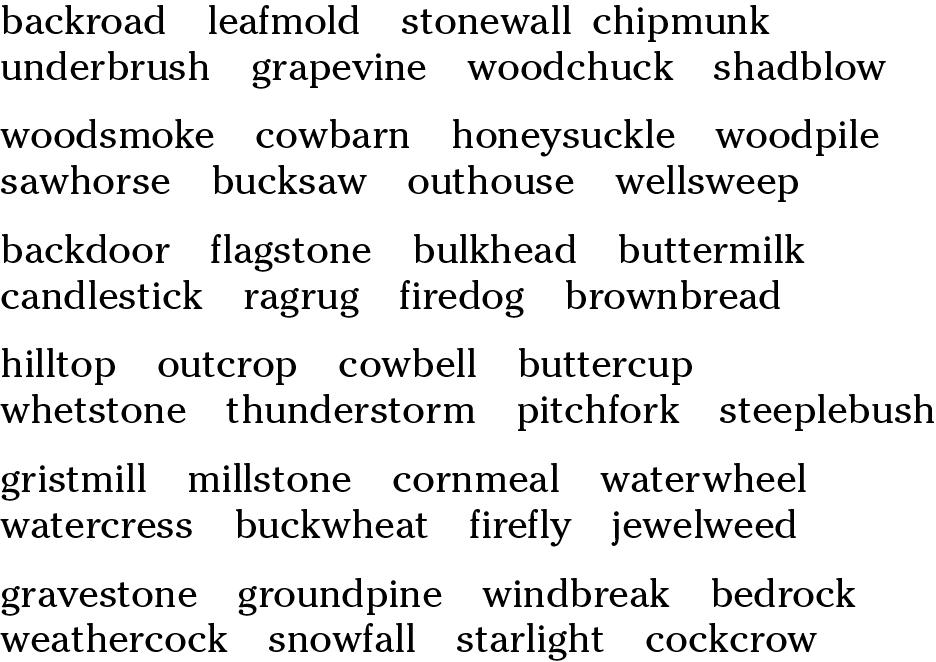
The short pauses between the words help you — perhaps even gently force you — to visualize each hard, concrete thing as you come to it, until, as the reader, you are in the midst of nature.
One poet known for his unusual punctuation (and use of lowercase letters) is e.e. cummings. Here is one of cummings’s best poems, “in Just–.” Try observing the white space as time. If words run together, runthemtogether.
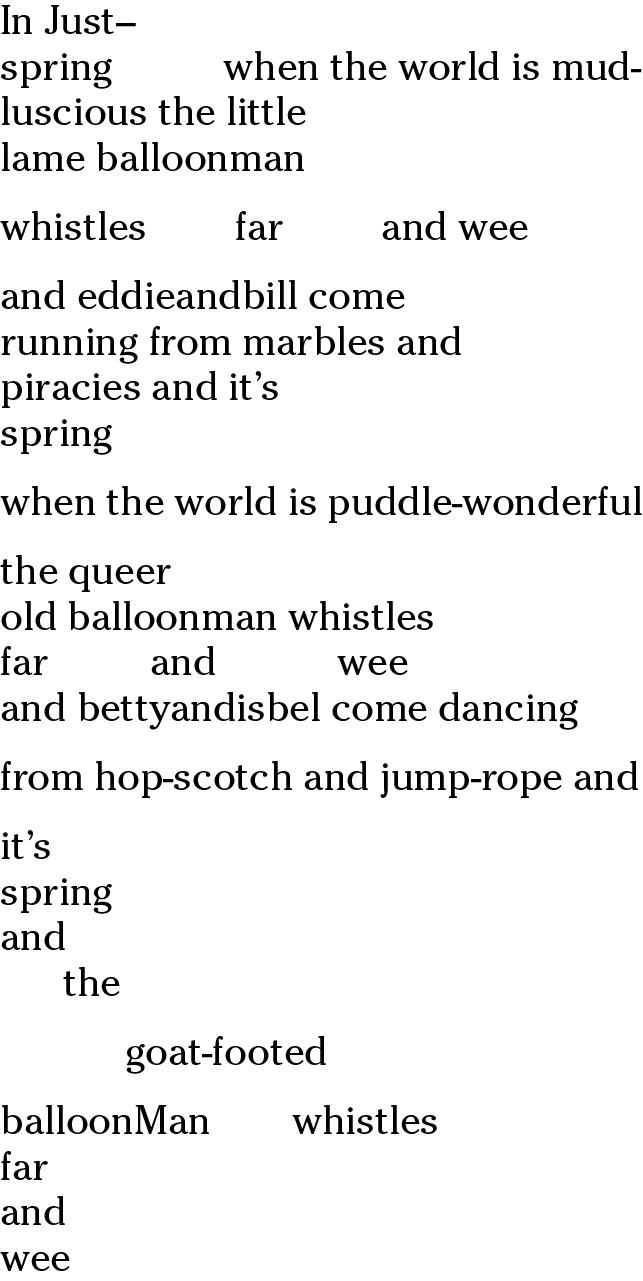
Read those last three words with great pauses between them. But earlier in the poem the kids (eddie and bill) should come running fast, as the words do.
Do it more than once
Ask anyone who likes poetry: When you find a poem you like, you keep reading it your whole life. As you change, it changes. And that changes you some more.
So whenever you read a poem aloud, read it aloud several times. Each time, you’ll probably see something different. (Try using pauses differently each time, vary your tone of voice, add more or less drama to your reading.) You wouldn’t date someone you like only once, would you? One poetry reading deserves another.
Writing Poetry
Millions of people have tried their hand at writing poetry. Often, people turn to writing verse at times of great emotion, insight, or need. And many people who always loved poetry think about writing it.
We could never cover everything about writing poetry in just one chapter (that’s why we devote a whole part of this book to poetry writing). But here are some basic guidelines for you to consider right now, if you just can’t wait to get your feet wet.
Becoming a poet
Writing poetry involves not just scribbling in a notebook, but also undertaking a way of life, one in which you value being creative and sensitive. To write good poetry, work to do the following:
Discover as much as you can about the poetic craft. Read lots of poetry. Meet other poets. Become part of a poetic community. Get a mentor who will guide you. Attend readings and workshops. Take writing classes.
Become as sensitive as you can, both to life and to language. Figure out your personal sense of what is beautiful — both in life and in poetry.
Think divergently (that is, keep your mind open and nimble, and be willing to think in different ways and new directions). You never know when, where, or how inspiration will come to you, but you can prepare the way for it.
Make time for yourself to write. After all, if you don’t write, you’re not a writer.
Be disciplined. Rewrite your poetry again and again. Don’t settle for using clichés or other people’s language. The idea is to find out what kind of poetry only you can write.
Keeping a poetic journal
Many poets keep a journal, a repository containing ideas, images, subjects for poems, drafts of poems, other people’s poetry, found objects (things you pick up that inspire you or that could become the basis for poems, such as someone else’s grocery list). You can keep a journal in anything that’s portable and easily accessible, such as a notebook, on a laptop, or on a microrecorder.
Many poets commit to writing in their journals each day. Their journals are, in a way, the “office” where the work of poetry takes place. Keeping a daily journal is a good idea, so we heartily recommend you go out and get a journal for your own use.
So what do you put in your journal when you have it? Some people keep a diary in their journals. Some write down their dreams, their meals, or scraps of personal or overheard conversation. Some poets have separate journals for individual topics (say, a journal exclusively dedicated to Money and My Lack of It.) But only you can decide the exact way in which you’ll fill your journal.
Trying your hand at a writing exercise
Here’s an exercise you can try in your journal. It’s called the “Poetry Pentad.” A pentad is a group of five things, and this exercise applies our five major poetic principles — attentiveness, concentration (of language, insight, and emotion), originality, experimentation, and form (all covered earlier in this chapter) — to seemingly mundane ideas. The pentad helps you do two things: generate material for poetry, and think about what makes poetry poetic.
Here’s how it works:
1. Write down a very mundane, straightforward prose statement about the outside world.
You could write about a cut on your hand, a kiss, awkward silences, a cash machine that won’t give you any money, the death of a loved one, the lyrics of a song you can’t stand but hear all the time, a painful memory you avoid, a car crash, what it feels like to sit at the bottom of a pool and look up, homeless people, Leonardo Da Vinci’s Mona Lisa, the last movie you saw, a pet that makes you feel uncomfortable, or a sunset. Write something as simple as, “Sure is a nice sunset.”
2. Now pay closer attention to the thing you just wrote about.
Write down what you notice. Brainstorm. List as many aspects as you can — for example, “The color of the sunset is red in some places and a flat grayish-blue in others. The sky nearer to the sun is pretty, but farther away some of it is already dark and colorless.”
3. Concentrate on your subject and come up with a few new ways of presenting or describing the thing your original statement was about.
Try using some metaphors, images, turns of phrase. Don’t write down anything you’ve ever heard or read before. Reject anything that seems familiar or secondhand. Using the sunset as your subject, you could write, “The sunset is like a bruise; it’s like spilled stew on a rug; it’s a molten core with a hard outer crust.”
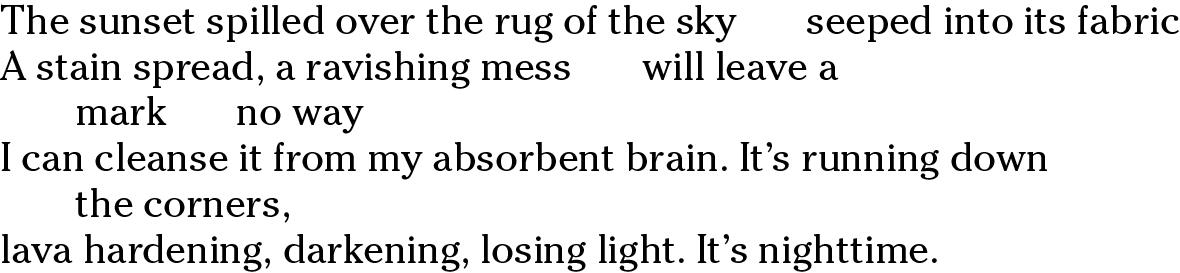
4. Write at least two passages of poetry on this subject, experimenting with different forms.
Choose very different forms (say, two lines that rhyme with each other, or a passage of free verse, which doesn’t have any rhyme). Use some of the material you generated under Step 3. For example, two rhyming lines about the sunset could be:

5. Now rewrite one of the passages in as few words as you can.
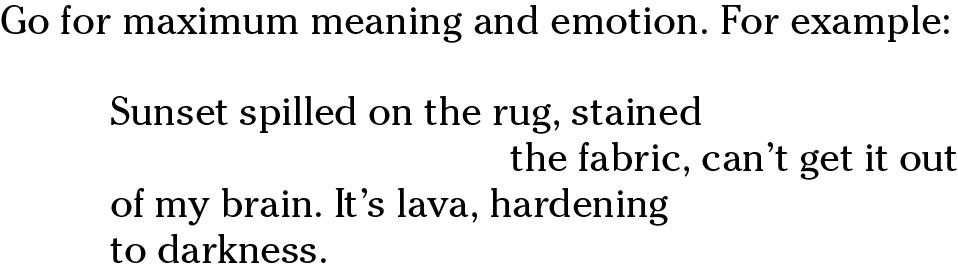
In this example, we started with a pretty common subject for poetry — a sunset — and then really observe one. We brainstormed a list of interesting observations. Then we generated some pretty divergent images (bruise, stew, lava) for what we saw the sunset doing. Then we tried a rhyming couplet and a free-verse passage. We rewrote the second one, working for greater concentration.
Did we come up with Shakespeare? We didn’t have to — our aim was to find fresh ways of making our readers experience a sunset. “Sure is a pretty sunset” wasn’t poetry, but in our final passage — with spills, stains, and hardening lava — we’re much closer to something poetic. Notice how we don’t explain what the “rug” is — it could be a metaphor for the sky, or it could be just a rug on which the day’s fading light is falling. And “hardening / to darkness” conveys the last moments of a sunset in an unexpected way.
You can go through this process as often as you want for any one statement. If you get inspirations while working your way through, stop and work on them.
The whole idea is to get used to some of the distinguishing characteristics of the poetic craft — and to generate images, ideas, and forms that you can use later in building poems. If you don’t come up with anything useful in one round, don’t worry — you will always throw more away than you use. Keep trying, and watch what you come up with.