
SEVEN
We try to build an elevator which will allow a person access to every level of his personality.
—Roberto Assagioli
We have seen how an authentic unifying center facilitates an openness to all we are, a self-empathy. As in the case of spending time with a trusted friend, we feel free to experience whatever arises in the moment. We are not identified with any particular aspect of our experience, and so can fully engage a broad range of experience—the transcendent-immanent “I” blossoms.
We also have seen that this is precisely how optimum human growth occurs throughout the life span. As we are mirrored, empathically responded to, we can include all of our developmental gifts and skills as they emerge during our growth. Interacting with the empathic presences in our lives, we develop the ability to express our I-amness in the world, the mode of being that we call “authentic personality.”
This connection with empathic unifying centers could not be more profound. It is ultimately a connection to Self—what also can be called Spirit, the Divine, God, or the Ground of Being—a connection that gives us our existence as well as our sense of place and purpose in the universe. Accordingly, when an important unifying center fails as an empathic other, when we are treated as an “It” rather than a “Thou,” primal wounding occurs; our lifeline to the source of being is threatened, and we face a headlong fall out of the universe, a plunge into nothingness, a seeming rejection by the Source of Being itself.
As we have seen, this wounding leads to inner conflict, addictions and attachments, and the formation of survival personality, but beneath all of these lies something even more fundamental. Underlying these painful reactions, and infusing them all, is a primal split between our heights and our depths. This chapter will explore this deeper split in our being.
PRIMAL WOUNDING AND SPLITTING
In order to approach the experience of primal wounding, imagine again that you are spending time with a good friend. Trusting the warmth and acceptance flowing in the relationship, you spontaneously speak your love for your friend. But to your shock and embarrassment, your friend responds coldly and withdraws. A silent chill replaces the warmth between you, and you know that your expression of love has for some reason broken the empathic flow between you.
This empathic break makes you feel suddenly disconnected, alone, even abandoned—primal wounding. You may even feel as though you did something wrong and may feel angry that you are being made to feel this way. Your friend’s cold withdrawal in the face of your love has sent a message about the limitations of the relationship. Consciously or not, you understand that to maintain this relationship you will need to somehow adjust yourself to fit within certain confines: first, you will need to inhibit your feelings of warmth, acceptance, and love; and second, you will need to ignore the shame and anger you felt in the rejection because, if expressed, this will bring up again the issue that your friend wants to avoid. In sum, for you to have any hope of recapturing that original connection with your friend, these two aspects of your experience must be left out.
Of course, adults often can stand back and discuss such moments of empathic failure. In this discussion you both might find, for example, that your expression of love threatened your friend, touching on a long-standing fear of intimacy, which caused the cold withdrawal. Together you may realize that your friend’s need to avoid the fear in effect took precedence over the connection between the two of you. Then you could talk about your own experience—rejection, isolation, shame, and anger—clearing the way for apologies to be made and empathy to flow again, allowing the whole shared experience to be held by both of you.
SPLITTING THE HEIGHTS AND DEPTHS
But if you do not have such a candid discussion, much the same may happen as it does in childhood—the positive, natural self-expression, as well as the feelings resulting from the rejection of that expression, will be pushed out of consciousness, beyond the limits of the relationship. You may simply be aware of an awkward moment with your friend, allow it to pass, and continue as if nothing had happened. But now you will operate under unspoken rules about how you are to feel and act within the relationship, and your connection with your friend will be more superficial.
By ignoring a painful moment of empathic failure in this way the relationship survives—an absolute imperative for the child—but it does so at the expense of distancing you from your heights and depths. Here your friend functions as a survival unifying center, a point of authority informing you of how you are to behave in order to maintain the relationship. And you in turn express survival personality, conforming yourself to the dictates issuing from the survival unifying center.
If the relationship continues, your friend will actually begin to see you as someone who conforms to the relationship, as someone who does not experience and express warmth and love nor hurt and shame. In short, your friend will see you as your survival personality.
Similarly, over time, you might begin to see yourself in this way too, losing your ability to experience this range within yourself; in other words, you become identified with your survival personality. Although Assagioli himself never wrote directly about the formation of the higher and lower unconscious, we can use his oval-shaped diagram (Figure 2.1) to illustrate this survival relationship (see Figure 7.1).
In relating to some people in our lives, the condition illustrated in Figure 7.1 might be a passing phenomenon; this dissociation from our heights and depths passes, and we return to our normal experiential range afterward. We can do this largely because we have other unifying centers in our lives—internal and external—that see our heights and depths, mirror our wholeness, and thus allow us to maintain our full, experiential range.
For example, as discussed earlier, if you and your friend were not able to talk about the interaction together, you might go to others who could hear and understand both the love and pain you felt in the interaction. Relating to these others, your experience with your friend could be held, understood, and integrated, and your experiential range would remain intact. In such cases, there is no chronic splitting, because there is only a temporary dissociation of your experience and not a structuralized break within you.
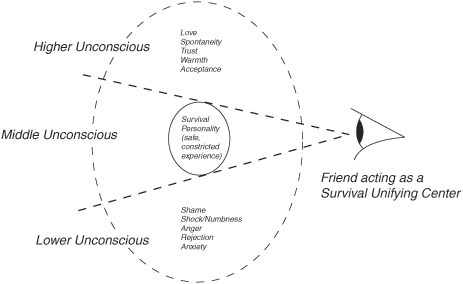
FIGURE 7.1
STRUCTURALIZING THE SPLIT
But in childhood a relationship with a survival unifying center may not be temporary at all, and we may not have anyone else to mirror our experience. In fact, our existence often depends on our conforming to nonempathic environments in an ongoing way. We must then find a way to permanently split off certain heights and depths of ourselves, to actually become someone who seemingly does not have, and has never had, these heights and depths at all. We cannot even afford an internal awareness of this broader range of experience, because this internal awareness might be recognized from the outside and thus threaten our place in the relationship. We must become someone who knows nothing of these experiences at all.
The way we become such a person is by internalizing the relationship with the nonempathic environment. We then can actually appear to ourselves and others precisely how the environment wishes to see us, no more and no less. By internalizing the relationship, we no longer need to depend on the outer environment to tell us what experiences are not acceptable; we now have the relationship present within us, and so we can conform to its dictates smoothly, automatically, “naturally.”1
To put it another way, in the face of an external survival unifying center, we form an internal survival unifying center, as shown in Figure 7.2.
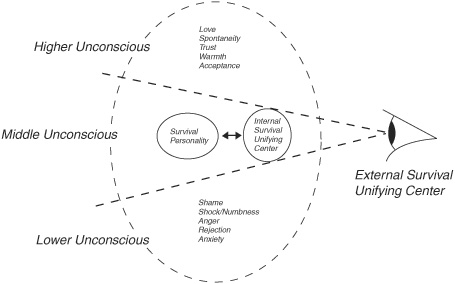
FIGURE 7.2
This diagram shows that we have split our natural experiential range in a permanent way by repressing the two ends of the range. Just as the external survival unifying center is blind to our wounding and gifts, so we are now blind to them as well. Bonded to the internal center, we are in a trance, unaware of the heights and depths within us. However, such splitting and repression allow us to survive primal wounding and secure some sense of stable existence within a nonempathic environment. In a particularly rich passage, psychologist John Welwood describes just this loss of our heights along with our depths:
As children, the pain of not being truly seen or loved is so utter that we contract and thus disconnect from the original openness of our being. This loss of being leaves behind an abyss, a gaping hole [the primal wound], which we cover up with trance—with beliefs, imaginings, and stories about who we are. Our ego structure develops as a survival strategy, as a way of getting by in a world that does not see or support who we really are. It is a protective shell, which diverts our attention from the abyss and loss of being, so that our mind can “step around, across, upon it” without falling in. Yet the shell of our self-constructed identity also blocks access to the deeper seed potentials—for passion, vitality, joy, power, wisdom, presence—contained in our basic nature. (2000, 247, latter emphasis added)
In order to become what the environment wants us to be, we now have eliminated our heights and depths from consciousness and have formed what is known as the higher unconscious and the lower unconscious—two areas of experience that have been repressed by the internal formation of the survival personality and the survival unifying center.2
THE LOWER UNCONSCIOUS AND HIGHER UNCONSCIOUS
As we relate to nonempathic environments over the course of development, the higher and lower sectors of our unconscious will continue to grow. Increasingly, one sector of our unconscious will be related to our capacity to experience qualities that arise from empathic holding, such as love, joy, spontaneity, and beauty, and another sector will be related to our capacity to experience qualities associated with empathic failure, such as shame, fear, pain, despair, and rage. By repressing both our higher and lower range of experience in this way we are able to find some stability and safety within the various problematic environments.
Thus Figure 7.2 represents our normal—though not natural—psychological situation. Although we may not be aware of it, our normal, stable, experience of ourselves and others is, to a greater or lesser extent, cut off from our heights and depths by primal wounding. Let us now more closely examine the lower and higher unconscious in turn (see also Chapter 2).
THE LOWER UNCONSCIOUS
If the threat of nonbeing or annihilation (Winnicott) derives from an empathic failure on the part of an external unifying center, it seems safe to assume that every personality is riddled with greater or lesser amounts of primal wounding. Human life is rife with moments and periods of nonempathic response from significant others, whether covert or overt, intentional or unintentional. These confrontations with nonbeing, when split off and repressed, form what we are calling the “lower unconscious.”
One way to think of the lower unconscious is that it is a particular bandwidth of our experiential range that has broken away from consciousness. It comprises that range of experience related to the threat of personal annihilation, destruction of self, nonbeing and, more generally, the painful side of the human condition.3
When we then repress this range in forming survival personality, it is as if we begin wearing eyeglasses that filter out these types of threatening experiences both within ourselves and in other people. Experiences or qualities associated with nonbeing might include the following:
· Anxiety and disintegration
· A lack of meaning in self or world
· Feeling lost, trapped, or buried
· Isolation, abandonment, banishment
· Feeling overwhelmed, helpless, or hopeless
· Emptiness or hollowness
· Endless despair
· Rage, revenge
· Wanting to die
· Shame and guilt
· Overwhelming terror at the possible loss of another
· A sense of inauthenticity or falseness
· Low self-esteem or worthlessness
All of the above qualities are symptomatic of a break in an empathic connection, causing the threat of nonbeing; they are all related to a potential fall toward annihilation, nonexistence.
THE HIGHER UNCONSCIOUS
As the lower unconscious represents the loss of an aspect of our experiential range related to the threat of nonbeing, so the higher unconscious represents the loss of an aspect of our experiential range related to being. When we repress our heights in forming survival personality, it is, again, as if we begin wearing eyeglasses. But these limiting glasses now prevent us from seeing positive experiences arising from empathic connections with unifying centers in our lives. Just as we did with our friend in the example above, here we remove from our consciousness positive aspects of ourselves and the world.
While the lower unconscious is infused by the type of difficult experiences just listed, the higher unconscious includes quite opposite experiences that in psychosynthesis are called transpersonal qualities. Maslow called such qualities being values and being cognitions, and they can been seen in Richard Bucke’s (1967) cosmic consciousness; in those moments William James (1961) studied as “varieties of religious experience”; in what Marghanita Laski (1968) explored as ecstasy; and in the peak experiences researched by Maslow (1962, 1971). Transpersonal qualities are probably infinite in variety, but a partial list was published by the Psychosynthesis Institute in Redwood City, California (circa 1970):
· Beauty, compassion, comprehension
· Courage, creativity, energy, power
· Enthusiasm, eternity, infinity, universality
· Freedom, liberation, detachment
· Cooperation, friendship
· Generosity, goodness, goodwill
· Gratitude, appreciation, admiration, wonder
· Harmony, humor, inclusiveness
· Joy, bliss, light, love
· Order, patience, positiveness
· Reality, truth, service
· Renewal, trust, faith
· Serenity, peace, silence, quiet, calm
· Simplicity, synthesis, wholeness
· Understanding, vitality, will, wisdom
Transpersonal qualities derive ultimately from our connection to Self, the source of our being, potentially facilitated by authentic unifying centers. They are essential properties of this primal relationship which, once repressed, characterize the higher unconscious (of course, many aspects of these qualities are not split off or repressed and have been integrated into ongoing functioning).
THE PROFUNDITY OF SPLITTING
The childhood splitting of positive and negative, good and bad, within the personality has been recognized throughout the history of Western psychology. It was seen by Sigmund Freud (1981), by Melanie Klein (1975) and W. Ronald D. Fairbairn (1986), by James Masterson (1981) and Otto Kernberg (1992) and, in the field of transpersonal psychology, by Michael Washburn (1994). However, most thinkers seem to understand this as a simple splitting of, for example, inner representations of parental figures into good and bad representations, or good and bad “objects,” not to mention that these thinkers often hold differing theories about the cause of splitting. But it is vastly more profound than this would imply.4
In this splitting and repression we truncate our most fundamental experience of ourselves, of others, of the cosmos, and of Divinity. Remember that the empathic connection with a unifying center—a connection that can be broken or distorted by empathic failure—is ultimately a connection to the source of our being, or Self (see Chapter 6). Thus a break in this connection is experienced as a break in our connection to the Ground of Being, to Source, to God, to Spirit, to the Universe.
As children, then, our connection to a failing unifying center is akin to encountering a God who is giving us our existence and at the same time annihilating us. Faced with such an impossible contradiction, and given no other unifying center to help us hold it, we split the unifying center into a positive God and a negative God, and we repress both. This splitting and repression leave us with a constricted world, one devoid of the heights and depths, but one in which we can find some stability and safety—the world of the survival personality and the survival unifying center.
So the situation represented in Figure 7.2 is that we, right now, at this moment, are radically unaware of the mystery, the beauty, the love, and the Divinity that surrounds us. Although at times we do realize such wonders, our day-to-day experience often leaves us unmoved by the infinite colors of a sunset, the intricate counterpoint of a symphony, the good hearts of those around us, the touch of the Eternal, or our unity with the Divine.
Likewise, we are relatively blind to the wounding around us, whether from our own behavior or that of others. We cannot feel the full impact of the contemptuous comment, the disdain in attitudes around us, the bigotry within and without, and the raw suffering of humanity and of the planet itself. Our empathy, our compassion, for ourselves and others is thereby limited, and our capacity to heal and to serve is likewise limited.
POSITIVE AND NEGATIVE IDEALIZATION
Remember that the higher unconscious and lower unconscious are split off and polarized aspects of a single whole, that is, of our full experiential range by which we can engage both the heights and depths of life. When we are held in being via external and internal authentic unifying centers, this range is intact, and we are able to experience whatever arises in our lives.
However, while each repressed sector represents an aspect of our full experiential range, each also is distorted by its isolation from the conscious personality. Over time, each sector remains insulated not only from the other sector but also from the transformative and integrative effects of daily living; these sectors remain untouched and unchanged by the learning gained from ongoing experience in a world that is in fact both light and dark, bitter and sweet, and full and empty.
It is as if certain positive and negative elements of our experience now exist in pure form; they exist as essences, potent and heady, in a sense extracted from the world like juice extracted from a fruit. Or, to use another metaphor, we have lost the eyeglasses through which we can see both the positive and negative in life, leaving us instead with (1) one pair of glasses through which we can see all of the positive, (2) one pair through which we can see all of the negative, and finally, (3) another pair, that of the survival personality, which excludes broad ranges of both negative and positive.5
In any case, the positive and negative now seem to exist in an idealized form. That is, they seem more pure than concrete reality; they are energies or forms that appear to exist beyond our daily living, somehow more fundamental or more true than our normal existence.
POSITIVE IDEALIZATION
It is therefore understandable that when higher unconscious energies suddenly become conscious, the experience often is described as ideal and perfect, seeming to point to a realm that is more pure and grand than daily life—what we call positive idealization. Two examples of higher unconscious experience, taken from the many accounts gathered in Laski’s (1968) important study, Ecstasy, follow:
. . . the heart leaps like a fountain—a wordless feeling of sudden tremendous expansion, sudden glory . . . it is an end of individuality for a moment, because there’s sudden glory in both me and the universe, both inextricably mingled. (383)
I don’t know how to put it into words—forgetting oneself, no, oneself ceasing to matter and no longer being connected with everyday things, with the commercial sort of life one lives—a feeling that for the first time you’re seeing things in proper proportion. (387)
We can see here wonder, joy, and expansion as the person feels a perfect, pure holding by a larger reality. There is a sense of an ideal union with this greater reality—a union that moves well beyond the normal sense of separate identity and the details of daily life.
However, especially if the peak experience is a powerful one, it can seem as though the experience reveals a wondrous ideal realm beyond our mundane lives to which we must aspire—a dualism that can be misleading, as we have seen. It is more accurate to say that we have momentarily removed the “lens” of the survival personality and are perceiving reality through the pure “lens” of the higher unconscious. That is, these transpersonal energies do not in fact exist in another, ideal world; they are aspects of this world that have been disconnected from it, and they seem so utterly pure because we encounter them initially as separate from their original context in the world.
In a peak experience we regain our ability to experience particular transpersonal qualities, and we suddenly see the beauty, love, and wonder that was always there, in us and in the world. In other words, these qualities are no longer idealized—experienced as dualistically separate from the real—but realized. They may now be integrated into our daily lives which, in truth, is where they existed all along.
NEGATIVE IDEALIZATION
The pure and universal nature of positive idealization can be seen mirrored in what we call the negative idealization, characteristic of the lower unconscious. An example of what Laski calls a desolation experience, what we would call contact with the lower unconscious, follows:
Instead of the light of ineffable revelation I seem to be in perpetual fog and darkness. I cannot get my mind to work; instead of associations “clicking into place” everything is an inextricable jumble; instead of seeming to grasp a whole, it seems to remain tied to the actual consciousness of the moment. The whole world of my thought is hopelessly divided into incomprehensible water-tight compartments. I could not feel more ignorant, undecided or inefficient. It is appallingly difficult to concentrate, and writing is pain and grief to me.
As for wickedness, although my mind has not reached the stage of regarding itself as the most wicked person in the world and responsible for all the sin and evil afflicting mankind, I know too well that it can do so. The appalling self-centeredness is the reverse of the delusions of grandeur and power. It leads to the uttermost depths. (1968, 160–61)
When lower unconscious energy emerges strongly in such desolation or abyss experiences, we may feel that brokenness and pain are the substance of the world, that suffering or evil reigns in the cosmos, that we are doomed and worthless, or that all of life is meaningless. So these painful experiences can be every bit as pure as the positive experiences; they too seem larger or more true than life—ergo, “negative idealization.” Laski clearly points out that idealization is present in both ecstasy and desolation:
The only characteristic of ecstasy equally found in these desolation states is feelings of totality; what is felt is total and absolute, affects the whole life, is the most of its kind, lasts for ever: e.g., “thus it will be with it for ever . . . abandonment with respect to all creatures . . . an object of contempt to all,” “I could not feel more ignorant, etc. . . . the uttermost depths,” “doomed to remain there for ever.” (1968, 163, emphases in original)
Because of this sense of “totality,” of the absolute or universal, desolation experiences can overshadow any points of brightness in life, just as peak experiences can outshine the darkness. In effect, lower unconscious experience results from contact with the distilled essences of our wounding—essences that seem fundamental and universal, because they have been extracted from the concrete events of our lives; in other words, they have been idealized.
Thus both the higher and lower sectors of the unconscious represent distilled essences or pure experiences and, as such, they can be disorienting and difficult to integrate. Just as higher unconscious experience is contact with the heady, concentrated sweetness extracted from the world, so the lower unconscious is contact with the heady, concentrated bitterness extracted from the world.
Clearly, neither of these realms of experience, although they can appear as an idealized totality, are in fact the whole story. For one thing, they each leave the other out—they are split-off fragments of a whole. Life is neither totally good nor totally evil, purely pain nor purely joy. It is a mysterious mix of birth and death, loss and gain, desolation and consolation.
. . . joy at some level can coexist with suffering at other levels.
—Roberto Assagioli
As we begin to integrate the higher and lower bandwidths of our perception, we begin to perceive this profound mix that has always surrounded us. In such an integration, we will find positive-negative polarizations becoming less pronounced; we will be better able to feel our joy with our pain, our gratitude with our sorrow, our emptiness with our fullness—the heights and depths of human existence will be more easily available to us. (This integration is the expansion of the middle unconscious, as described in Chapters 2 and 8.)
This integration of higher and lower is far easier said than done. One might even say that life itself is a journey in which we increasingly realize the awesome heights and depths of existence. Furthermore, the challenges to this integration take a wide variety of forms; the higher and lower unconscious can interact in multitudinous ways within the human personality, presenting different sorts of challenges to each of us. When these challenges are sufficient to disrupt our lives, they may manifest as psychological disturbances. Let us now explore some of the more common types of these disturbances, discerning the operation of the higher unconscious and lower unconscious within them.
PSYCHOLOGICAL DISTURBANCES
When discussing how the higher and lower unconscious impact us, it is important to keep in mind the nature of the I-Self connection. A central aspect of this primal relationship is that it gives us our being, our spirit, our ability to exist distinct-but-not-separate within the flow of ongoing experience. As we explored in Chapter 5, essential human being or I-amness is distinct from all content and process (transcendent), and yet it is engaged with content and process (immanent). We are the experiencer, transcendent-immanent within experience.
As discussed in Chapter 6, modern psychoanalysis has at least partially recognized this sense of being and the source from which it comes: psychoanalytic thinkers write of the child’s sense of “cohesion in space and continuity in time” (Kohut) and “continuity of being” (Winnicott) emerging within the empathic relationships with early caregivers.
Although our sense of being does indeed emerge vis-à-vis empathic or authentic unifying centers, in our view this sense ultimately derives from a source distinct-but-not-separate from all such nurturing relationships—the Ground of Being, Self. Self is transcendent-immanent within all unifying centers, just as “I” is transcendent-immanent within the contents of experience. So the I-Self connection is ultimately a spiritual connection, one that transcends—and yet is immanent within—other relationships in our lives.
The connection to Self then should not be confused with experiences of ecstasy, bliss, or unitive states of consciousness, nor with any sort of insulated imperviousness to the human experiences of pain, grief, and loss. Self simply holds us in being, so that we may be open to the full range of our experience—good or bad, pleasant or painful, personal or transpersonal, empty or full. Held securely in existence, our experience does not fragment or destroy us; we can be there within it. This is why, held in this way, we can include and integrate all of the experiences, gifts, and modes of being that arise throughout development, in an unfolding of authentic personality.
It follows that as this I-Self connection is disturbed by nonempathic unifying centers—primal wounding—our sense of being is undercut so that we can no longer hold certain heights and depths of our experience. These latter are in effect too big for us to hold, thus we split them off and repress them. We hereby lose this ability to be empathic with the full range of our experience.
Although this higher-lower splitting is largely repressed, its impact is profound and pervasive. The effects can be seen in any and all patterns of attitude and behavior that disrupt our lives, from problematic subpersonalities and painful inner conflicts, to addictions and compulsions, to a wide variety of other psychological disturbances.
THE ROLE OF PRIMAL WOUNDING
Before examining specific psychological disturbances, we should point out that we are not claiming that primal wounding is the sole causal factor in all such disturbances. Psychological disturbances are varied and complex and often will involve genetic, biochemical, and constitutional factors as well as psychosocial ones. We are saying, however, that many common disturbances, whatever their origin, exhibit a problematic interplay between what we are calling the higher and lower unconscious—sectors that, we believe, arise from primal wounding.6
Here too we should reiterate our statement in Chapter 6 (“Who is to blame?”) that the infliction of primal wounding can be a completely unconscious process and may come from a variety of different sources. Thus even if wounding were found to be the dominant cause of a particular disorder, this would not necessarily mean that caregivers consciously inflicted the wounding; the transmission of this wounding can occur as silently and blamelessly as genetic inheritance or intrauterine infection.
It is beyond the scope of this book to delve deeply into the many types of psychological disturbances, so we will take a shorthand approach by presenting brief statements that illuminate a few common ones. In using this illustrative method, however, let us be clear from the outset that these statements are to be understood as no more than abstract sketches, merely suggestive of highly complex, powerful patterns. The phrases we shall use are not statements necessarily uttered or thought by those suffering these disturbances and should in no way be thought to minimize the magnitude of these destructive patterns nor the often lengthy and painful recovery from them. So when we refer to higher unconscious and lower unconscious in these phrases, we are referring only to the qualities of these two areas of the unconscious; they may or may not be unconscious in the particular psychological disturbance that we are describing.
With these caveats firmly in mind, let us look at some statements that illustrate the higher-lower dynamics in a variety of common psychological disturbances.
ADDICTIONS AND COMPULSIONS
A few statements that symbolize the split between higher and lower unconscious as manifest in addictions and compulsions follow:
I use alcohol not only to overcome my feelings of anxiety and emptiness (lower unconscious) but in order to feel connected to other people (higher unconscious).
Is the alcoholism simply a result of failed willpower, oral fixation, or solely biological determinants? We think rather a deeper dynamic is that alcoholism embodies an attempt to integrate the higher unconscious while avoiding the wounding in the lower unconscious. In the words of William James, “The sway of alcohol over mankind is unquestionably due to its power to simulate the mystical faculties of human nature” (1961, 304). And these higher unconscious positive “kernels” or “nuclei” (Firman and Gila 1997) are apparent in other addictions as well:
I feel worthless (lower unconscious) unless I’m working, whether at my job or at home; I’ve got to work all the time because that’s how I know I am worthwhile (higher unconscious).
Is the person who works compulsively, causing pain to himself or herself and others, the victim of a powerful instinct for self-preservation? More to the point is that the person is caught in a compulsive pattern that seeks to establish self-worth in the face of the worthlessness brought about by primal wounding.
I compulsively attach to my partner in order to escape my inner sense of abandonment and despair (lower unconscious), but also because this is the only thing that gives meaning to my life (higher unconscious).
And is the relationship addict simply caught up in an overactive erotic drive or an archaic need to merge with another? No, here again is a desperate attempt to secure essential qualities of human being in spite of primal wounding.
Note that each addictive pattern is a painful synthesis of the types of higher unconscious qualities and lower unconscious qualities outlined above. Here there is a vicious cycle in which we, in effect, seek the higher unconscious, fall into the lower unconscious, seek the higher unconscious again, continually ad infinitum—a cycle that often becomes destructive to ourselves and others. A Buddhist might call this a cycle of aversion and craving. This is a common experience in addictions, a moving from the euphoria of the addiction into remorse and worthlessness, only to begin the cycle again.
The tragedy is, of course, that the positive qualities ultimately remain out of reach and unintegrated. They can only be experienced within the addiction and are unavailable for any graceful, natural expression in daily life. Here our connection to others is available only when we are high, our self-worth only when working, or our sense of meaning only when we cling to another person. These are toxic syntheses but nevertheless are desperate attempts to manage the deeper splitting in our being.
What these patterns all have in common is that they are bigger than we are; they dominate our consciousness and will. But note again that this domination is not a function of upwelling primitive drives and basic instincts; it is the result of a profound higher-lower splitting caused by wounding to our spirit.
MULTIPLE PERSONALITY OR DISSOCIATIVE IDENTITY DISORDER
We have seen that there is a natural multiplicity within the human personality, a multiplicity with the potential for forming a coherent expression of ourselves and our life’s journey. We have seen too that difficult or problematic subpersonalities arise in response to primal wounding. Such subpersonalities constitute problematic syntheses. They are driven by the “stick” of their underlying pain and drawn by the “carrot” of expressing their positive gifts—aversion and craving. However, the greater the wounding, the more dissociated and polarized the parts may become as the entire personality system responds to the wounds:
It actually worked well for a long time. Some of us were in charge of different types of functioning, giving some sense of self-confidence and identity (higher unconscious), while other parts were holding different aspects of our abuse (lower unconscious). But finally it wasn’t working. There were too many of us and not enough communication. Then, as we came closer together to improve functioning (higher unconscious), the wounded ones (lower unconscious) began to emerge to be included also.
So a pattern of extremely dissociated multiplicity, as problematic as this can become, can in fact be seen as a creative response to primal wounding. Some parts form a functioning system, handling daily affairs, and keeping things together, while others perform the task of holding the wounding. All works well, as long as there is enough communication to function and distance is maintained between the ones who function and the ones who are wounded. The entire system is in fact a synthesis—a painful synthesis when it becomes self-destructive—which embodies an attainment of higher unconscious qualities yet manages the pain of the lower unconscious.
NARCISSISM AND DEPRESSION
We can see this same interplay of higher and lower in other, apparently quite dissimilar, types of disturbances:
I generally feel I am a special person, even sometimes a pure shining light (higher unconscious, positive idealization), but whenever I get some criticism or meet a defeat, I feel awful about myself (lower unconscious, negative idealization) and angry (lower unconscious) at the person or situation who has done this.
This statement might be called by some a fixation at an early, primitive, narcissistic stage of development. But even if that case were to be made, it is somewhat irrelevant when compared to the paramount fact that here is someone suffering the effects of violence done to her or his spirit. There has been primal wounding here that has demanded an idealized survival personality based on higher unconscious energy—“I am a special person,” and so on—an identification that can function to keep the lower unconscious pain at bay.7
Another common disturbance that seems quite different from the previous one, yet embodies a similar higher-lower polarity, is described thus:
I have been so traumatized by significant others that I have been left feeling I am a worthless, bad person. I feel I am a failure and have no right to be alive, I hate myself, I’m simply wasting space on the planet (lower unconscious, negative idealization).
In some ways, though, I feel like by accepting this painful identity I am maintaining a meaningful loyal connection (higher unconscious, positive idealization) to my significant others; in other ways this identity is a way of holding my trauma in the hope that the truth of it may finally be seen and validated (higher unconscious).
These statements are of a type that can be associated with depression. Here we can see the domination of lower unconscious dynamics in the feelings of extreme self-loathing (here quite conscious, of course). However, such feelings are not in fact self-loathing, but rather the loathing is coming from an internalized oppressor or perpetrator in the lower unconscious.8
Such an inner perpetrator is the internalization of the actual perpetrator(s) in the person’s life, the distilled essence of early, nonempathic unifying centers. As painful as this is, the position of slave or victim to this inner oppressor nevertheless embodies higher unconscious qualities such as connection, hope, loyalty, and truth—an important point to remember if one is seeking to ameliorate such a condition.
BORDERLINE AND BIPOLAR
Still other disturbances involve wide swings between the heights and depths of these two realms of the unconscious. A common one follows:
I can move so quickly between highs (higher unconscious) and lows (lower unconscious). One moment I see the beauty of the other person (higher unconscious, positive idealization), but then when the other person doesn’t seem to get who I truly am, it feels terribly hurtful, and I suddenly see them as bad and get angry (lower unconscious, negative idealization).
Here we have a statement that represents what some call a borderline type of experience. But is this most essentially a failure to wrestle an ego from a primitive state located on the border between neurosis and psychosis (thus the term borderline)? Is the sensitivity and anger indicative of uncontrolled, innate aggression or envy?
We would say instead that this type of experience is a state of high vulnerability caused by profound wounding. Here we have someone whose wounds are so unprotected that the slightest empathic failure will feel terribly painful and will trigger the emergence of lower unconscious experience. This is like walking around with an untreated abscess that will trigger pain and rage at the slightest touch.
Another experience of dramatic swings between highs and lows might be described like this:
I’ll go along for quite awhile having wondrous experiences, seeing everything so clearly, having great insights, and enthusiastically throwing myself into inspired creative activity (higher unconscious). But then I will crash and become very low energy, down on myself, despairing of life, not wanting to live (lower unconscious).
This type of experience is characteristic of what has been called manic-depressive or bipolar disorder, or the less severe cyclothymic disorder, in which one cycles from the heights to the depths over longer periods of time. But is this a failure to grow beyond the supposed grandiosity and insecurities of the toddler? Clearly, such an explanation completely misses and obscures the most fundamental point: that this is someone who has been traumatized, causing the split between higher unconscious and lower unconscious and leading to an oscillation between these two separate domains of experience.9
THE MALEVOLENT, ANTI-SOCIAL, AND VIOLENT
There also is a terribly destructive psychological disturbance in which the person seems to feel no empathic connection with other people and may perpetrate horrific acts of ruthless violence. We often are shocked and confused by these depths of human evil, and we may speak of “senseless acts of violence”—but they are quite sensible within the world of the brutalized personality. This type of disturbance includes the child who guns down classmates at school, the remorseless serial killer, the fanatical terrorist, and the sadistic dictator who oversees torture and genocide; but to a lesser extent, we find similar dynamics in any person motivated by hatred, rage, or revenge.
I have been so violated by life, so unseen and brutalized (lower unconscious), and so schooled in violence (middle unconscious), that my resultant rage (lower unconscious) is spontaneously expressed in violent ways. The world seems so utterly dangerous that I must assert power (higher unconscious) violently in order to maintain a sense of self that is exalted enough (higher unconscious) to triumph over violent oppression.
Further, my internal and external significant others (unifying centers) support an ethos of violence, and I act in moral union with their values and worldview.
Is this violent behavior, then, the result of an upwelling of innate human aggression? An archaic holdover from a violent, primitive past? No. As many have pointed out, there is a direct relationship between early violent wounding and human malevolence (Athens 1992, 1997; Goldberg 1996; Miller 1984a; Rhodes 1999; Winnicott 1984).
Many violent patients are infuriated by . . . injustices . . . because they are symbolic of injustices rendered to them in the past.
—Roberto Assagioli
In response to this wounding, there develops a survival personality that uses violence as a primary response to the world. And yes, society must protect itself from the destructive behavior that this wounding engenders. But can we at the same time hear the abyss of violation beneath these extremes of human evil?10
PSYCHOSIS
Finally, can our analysis of psychological disturbances be extended to that perhaps most mysterious disorder called psychosis—disorders of thought and feeling so extreme that they seem simply the chaotic disintegration of the entire personality?
I have had much neglect and abuse (lower unconscious) in my life which no one, now or then, ever seems to be able to acknowledge. Therefore I have needed to hold my truth (higher unconscious) symbolically, forming what are seen as crazy and delusional ideas but which for me encapsulate what has happened to me in my life.
Psychotic experience might be considered a failure to grow beyond the supposed autistic or symbiotic stage of infantile development, a failure to differentiate from an archaic, fused state dominated by fantasy and hallucinatory wish fulfillment. We do not think that this is the case, of course, especially in light of the fact that modern developmental research has discounted the existence of such a primary fused state (Stern 1985).
It is quite true that on the face of it the worldview manifest in such experience might indicate that the person is out of touch with consensual reality, confusing the inner and outer worlds. However, as it has been clearly pointed out (Stolorow, Brandchaft, and Atwood 1987), such seemingly crazy world-views can carry the deeper truth of the person’s suffering. Here there is a symbolic expression of the wounding, past and present, that the person has suffered in life, and a desperate hope that this wounding will finally be recognized and responded to.11
The power and stability of the psychotic pattern again seem to derive from twin factors: it is an embodiment of a quest for the higher unconscious, a quest for validation, for being seen, for truth, and at the same time, it is an attempt to manage the pain from wounding. In the words of Winnicott, “It is wrong to think of psychotic illness as a breakdown, it is a defence organization relative to a primitive agony” (1989, 90). Psychosis does not appear to be a regression to some sort of primal, undifferentiated state but just another attempt to bridge the higher-lower splitting.
On the other hand, the psychotic process can be seen as a massive crisis of transformation similar dynamically to those discussed in earlier chapters (Ellen in Chapter 3, for example), although far more intense and chaotic. Here a psychotic break may be a complete failure of survival personality to maintain itself, leading to a radical openness to all levels of the unconscious, and finally perhaps to a gradual formation of a more authentic personality.12
ON THOSE WHO STRUGGLE
The types of disturbances that we have outlined above involve different responses to primal wounding, different ways of managing the higher-lower splitting that this wounding causes. We hope that you, the reader, can empathize with these experiences. Perhaps you yourself have had these types of experiences at one time or another.
We all have suffered primal wounding and splitting to a greater or lesser extent, and we all face some struggle with these vast, split-off dimensions of our being. Those with diagnosed psychological disorders are not lost in some sort of mad world completely foreign to a normal world; they are simply experiencing—acutely and painfully—particular points on an experiential spectrum that we all share.
It may even be that those who focus on their healing in this way have been called to deal with the collective primal wounding that most of us desperately attempt to avoid. Perhaps they struggle for us, seeking to heal a hidden abscess in our collective spirit that insidiously poisons all of our lives. Perhaps, as Chris Meriam (1999) speculates, through their healing work, they “somehow keep the consensual/collective psyche flexible and moving forward.”
In each of us there are, potentially, all the elements and qualities of the human being.
—Roberto Assagioli
From this perspective, those who so intensely confront our collective wounding are not tragically flawed unfortunates unable to achieve normality but instead are dedicated laborers in the field of human evolution. If grappling with the truth of our lives is the measure of spiritual development, these people may not be in the early stages of this development but in the advanced stages.
PSYCHOLOGY AND SPIRITUALITY
Note, then, that most, if not all, psychological disturbances can at some level be seen as involving a response to primal wounding that has been inflicted by empathic failures of various kinds. This wounding cuts us off from the ground of our being, thereby forcing us to split off the heights and depths of our experiential range, and this splitting in turn seems to infuse the wide range of disturbances outlined above. Thus underlying psychological disturbances seem to be a wounding to our spirit—a spiritual wounding.
We posit, then, that such disturbances are not simply the result of basic instincts clashing with society; nor of an inner conflict between powerful drives; nor of a struggle to differentiate from a supposed archaic, infantile merged experience; nor of perturbations in the collective unconscious; nor even of a difficulty integrating split internal objects. While some of such phenomena may be viewed as accompanying primal wounding, we would hold as probable that these disturbances of body and soul are secondary to an essential spiritual wounding underlying them all.13
TREATMENT IMPLICATIONS
The notion that primal wounding is involved in psychological disturbances also is a worthy hypothesis for its humanitarian value. That is, if we are holding a hypothesis that does not allow for a fundamental wounding of human spirit, then we will not be looking for the wounding, nor will we understand the depth of empathic concern that it demands, nor will we fully appreciate the skills, gifts, and creativity that have been actualized in spite of the wounding.
In other words, we will miss the essential person, “I,” the human spirit transcendent-immanent within the wounding and gifts—the one who is experiencing this split in being. We will then actually retraumatize those seeking healing by ignoring the profundity of their experience and, thus, once again, we will give them the experience of not being seen. Trauma researcher Bessel A. Van der Kolk, speaking of “a variety of psychiatric disorders,” says:
However, if clinicians fail to pay attention to the contribution of past trauma to the current problems in patients with these diagnoses, they may fail to see that they seem to organize much of their lives around repetitive patterns of reliving and warding off traumatic memories, reminders, and affects . . . if clinicians deny the essential truth of their patients’ experiences, they can only aggravate feelings of rage and helplessness by invalidating the realities of their patients’ lives. (Van der Kolk, McFarlane, and Weisaeth 1996, 183–84)
So while research into all of the possible causes of psychological disorders should proceed on all fronts, such research also should entertain the hypothesis that there is a primal wounding present that has been suffered within significant relationships, and that there exists an essential human spirit within these disturbances seeking liberation. As it has been pointed out, much research, even that looking at psychosocial factors, fails to ask the questions that would reveal the role of trauma in psychological disturbances (see Herman 1992; Van der Kolk, McFarlane, and Weisaeth 1996).
The treatment implications for this model are simple but far-reaching ones. In short, if empathic failure causes this spiritual wounding, then ultimately only empathic connection can heal. Empathy is fundamental to the healing process. This, of course, is the type of empathic connection that we have been describing throughout this book—the type of listening, respect, dynamic response, and acknowledgment of deeper Self, which allows the emergence of the essential I-amness of the other. So note that this empathy is not mere passive listening, not necessarily being “warm, friendly, and nice.” This is a fierce spiritual empathy that demands continual disidentification and personal work by the practitioner so that this essential empathy will not be obscured by responses from his or her own survival personality.
Clearly, too, this spiritual empathy is not a technique or method among many but the context of all technique and method. Most techniques, ranging the entire spectrum from receptive listening to active interventions, can be done empathically—or not.14
PSYCHOLOGY IS SPIRITUAL
This view of the human spirit and the wounding of this spirit can perhaps refocus attempts to encourage psychology to expand its scope to include spirituality. For example, although a worthy and needed effort, it can be misleading to include spirituality only in the Diagnostic and Statistical Manual of Mental Disorders (First 1994) under the recently appended category of “Religious or Spiritual Problem, V62.89.” Rather, all disorders involve spiritual problems, because the human being and the wounding of the human being are essentially spiritual in nature. It is similarly misleading to consider bringing spirit into psychotherapy as simply adding spiritual and religious practices to therapy; instead, psychotherapy itself must be understood as spiritual at its very core.
Such empathy is made possible by the fact of the essential unity of human nature existing beneath, and in spite of, all individual and group diversities.
—Roberto Assagioli
So, in a very real way, spirit does not need to be brought into psychology—spirit is already present, however hidden, at its very center. Spirituality must not be seen as an appendage to psychology, something that we should work to include, but as the essence of all personality, clinical, and developmental theory. Psychology has not neglected spirit but has been grappling in the dark with spirit. From the earliest insights of the pioneering psychological thinkers, to all of the modern differentiations of psychology and psychotherapy, we have throughout been attempting to deal with the human spirit. It is interesting to ponder the changes in modern psychology that would occur if this realization became widespread.