
12
Let your “Yes” be “Yes,” and your “No,” “No.”
MATTHEW 5:37 NKJV

Someone called me in great remorse one spring over a small bunny that was left orphaned and hungry. “A tree was being cut down, and when it fell, it landed smack on top of a bunny nest!” this distressed caller exclaimed. “The falling tree killed this bunny’s mother and every one of its siblings, so it’s the sole survivor.”
“Bring the bunny over, and I’ll take a look at it,” I said.
“Do you think there is anything you can do for it?” the person asked. “It’s small but seems uninjured. We sure hope it survives. The person cutting down the tree had no idea there was a nest of bunnies in the way, and we all feel terrible about what happened!”
“I’ll do all I can, but you should know that in spite of their huge numbers, bunnies often don’t do well in rehab. That probably seems surprising when you see so many rabbits hopping around outside. But a lot of rehabbers won’t even take in baby bunnies because their low survival rate gets depressing. I’ll take this one anyway and do my best with it, as long as you understand that it may not live.”
“Understood! We’ll be right over,” replied the relieved caller.
To Rehab or Not to Rehab?
Not to go down a rabbit trail, but a fair-sized debate among rehabbers is whether or not it’s worth trying to rehabilitate wild baby bunnies. The bunnies don’t thank us for any sort of intervention into their secret little lives!
Young babies with their eyes still closed are especially hard to rehabilitate. Mother rabbits manage to raise them by the millions, so you wouldn’t think it would be so hard. Yet rehabbers who don’t specialize in rabbits are looking at only a 10 percent rabbit survival rate. For many rehabbers, a 50 percent rabbit survival rate overall would be considered a really, really good result. So the question becomes, Is it worth the time, energy, and resources needed to take care of little rabbits?
I don’t have a definitive answer to that, which doesn’t stop the bunny calls from coming in fast and furious, almost as numerous in spring as the rabbits themselves. I decided that, in spite of the bunnies’ sorry survival statistics, I should take a 12-hour online course in rehabilitating rabbits from a large and successful rehabbing facility to see if I could up my percentage of survivors. The course covered everything you could think of, from feeding newborns to making sure juveniles get enough natural light to produce vitamin D. It was intense and involved. It was also kind of funny that when all was said and done, the instructor’s concluding remark was along the lines of “You can try to do…[this, that, and the other], but in the end, young bunnies are just very hard to rehabilitate!”
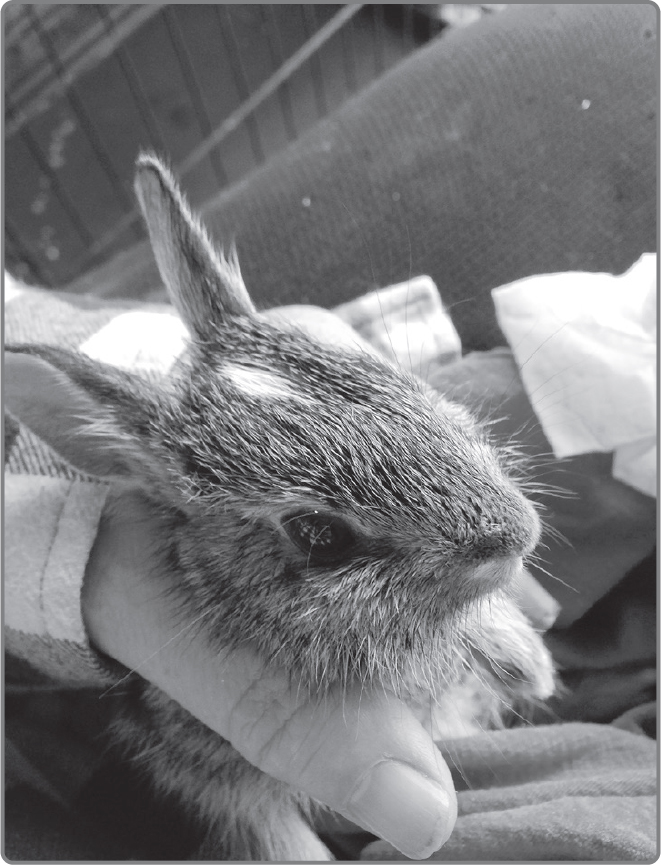
Bunny at intake
That much I already knew. Bunny babies are so cute, but it can be so hard to keep having the buns you take in be fine at one feeding and stiff, cold, and gone the next. All the same, I couldn’t help feeling sorry for this lone survivor of the tree disaster. I had rabbit formula on hand and the know-how to relieve its immediate hunger. I had the caging to keep it warm and protected. I even had some tips from the online bunny class that I was hoping to put into practice. Besides all of that, I had already named the little one Bunny, albeit not very creatively. Once you name an animal in your head, it’s pretty much too late to refuse to take it in. Live or die, this orphan bunny was coming my way.
Coming Out on Top
I can’t even describe the sweetness of holding a silky soft baby rabbit, and this one was cuter than any Easter bunny picture I’d ever seen! Thankfully, Bunny was already eyes open, ears up, and furry—all important developmental milestones since the older a bunny is when it comes into rehab, the better its chance of survival. Plus, of all the pinkies out there nesting in the wilderness, bunnies are far and away the ugliest. On days 1 and 2 of a neonate bunny’s life, before it grows any fur, it looks for all the world like a dark and tiny hippopotamus. The first time I held one, I had no idea what it was. I was relieved that Bunny was well beyond that stage, probably between one and two weeks old.
From the start it surprised me that Bunny would even take in the milk I offered. Rabbit orphans often have to be tube-fed, which is effective but still no guarantee of ultimate survival. It is an awkward feeding method. But this bun was eating from a syringe for me right away and was enjoying it.
Bunny grew quickly and didn’t bloat on me (succumb to gastrointestinal tract stasis), which is a huge issue for these little ones. The things I had learned in the online class were paying off in that regard. I was using distilled water only. Even though our well water tastes wonderful to humans, the minerals in it can damage delicate bunnies’ digestive systems. Their inner workings develop so quickly that it’s impossible to duplicate the gut bacteria, enzymes, and other factors that must stay finely balanced for them to negotiate that speedy growth. Hoping to ward off internal issues, I supplemented Bunny’s diet with a probiotic powder other rehabbers had used successfully. In Bunny’s case, an ounce of prevention was turning out to be worth a pound of cure.
Even more satisfying, Bunny and I were somehow managing to negotiate the tricky changeover from formula to leafy greens, which is the crucial weaning period most rehab rabbit babies don’t survive. Trying to provide the right greens in the right amounts at the right age (from about the second week onward) is the stage where things often go so wrong. You’d think popping a little pile of fresh-plucked green grass in front of a young rabbit would do it. Or giving a bunny lettuce or spinach from the fridge. But those greens can actually be disasters for its gut during this transition period. I learned from the class to search for exactly the right kind of wild foods wild bunnies grow up eating, at least in our locale—dandelion greens, white clover, ribwort plantain, and lots of crabgrass (aka goose grass), which turns out to be good for something after all if you’re a bunny rehabber.
I hoped providing these four specific greens in the right amounts would make all the difference. I pulled them up anywhere I could find them, cut them into bite-sized niblets, misted them with distilled water for moisture, and popped them into Bunny’s cage in a huge pile. Then I held my breath to see what would happen.
Why a huge pile for such a small creature? Because a little pile won’t do! I learned from my bunny course that if you have two or three bunny weanlings in a small cage, to provide enough nourishment for them you have to fill the cage up to the very top with moistened greens. When they eat their way out from underneath that monster pile, it’s time to do it all over again. Good thing these greens are so easy to find. Each baby bunny consumes between two and three cups a day, which keeps rehabbers busy scouring their yards for “feed weeds.”
I piled Bunny’s greens fresh and high every morning, and Bunny mowed down every pile. Thriving so well, Bunny soon was able to move into a roomy wire hutch outside during the day. The hutch had no floor, so it sat directly on the grass. For added security, I moved the upside-down cardboard box that served as Bunny’s sleeping quarters into the hutch, too, but Bunny rarely hopped inside. Clearly, the feeling of grass underfoot (or underpaw) was a novelty too delightful to miss.
Bunny stretched and rolled and lippity lopped around the new enclosure blissfully, often nestling down in the tall grass and soaking up the sunlight with just some ear tips visible. I spent a lot of time soaking up the sight from a distance, doing my best to avoid startling Bunny, who was fast learning to enjoy the great outdoors as a wild rabbit should.
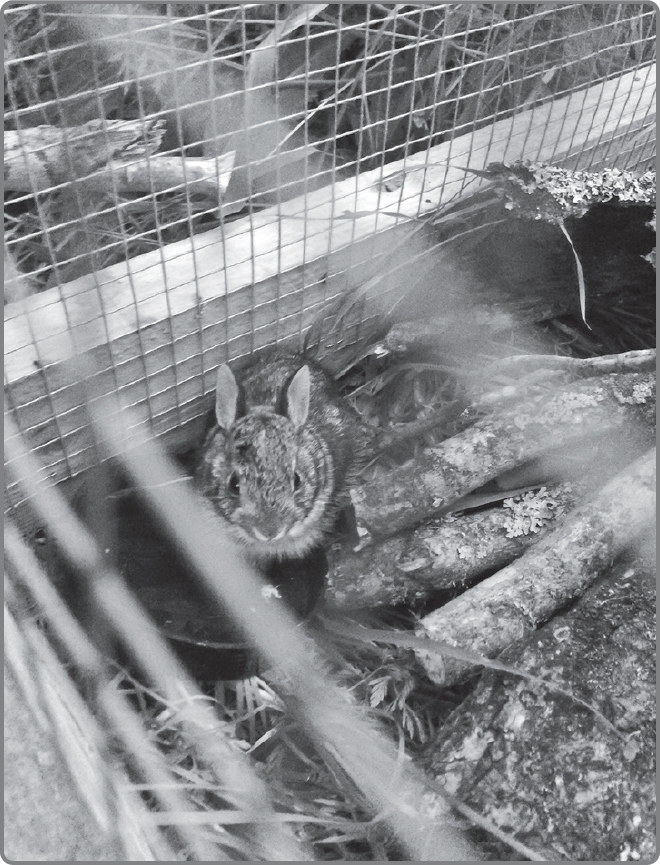
Bunny graduates to the release cage
At night I put Bunny back into the Lion’s Den to thwart any predators, and each morning I moved the floorless hutch to a new location in the yard before popping Bunny back inside. Letting this little one forage for greens at will was a huge relief after all the time I had already spent hunting and gathering them.
Living on such rich fare, Bunny soon stopped drinking formula altogether and likewise was becoming more skittish all the time about my presence. When I had a hard time catching Bunny to bring inside at night, I knew it was time for the next transition. I dug a ready-made rabbit hole in the ground next to the wildlife shed and popped the whole wire hutch over it. Then I propped up one edge on a brick so Bunny could move in and out of the hutch freely or pop down the rabbit hole to hide or to rest. After that, I left everything alone, other than keeping a sharp eye out for telltale rabbit movements around the yard.
Bunny moved into the rabbit hole the very first day—exactly what I hoped would happen. I left the hutch propped over the top of the hole for another week or so, and then I moved it out of the way. At about a third the size of an adult rabbit, Bunny was growing quickly and didn’t need that kind of cover anymore. From time to time after that, I would often see a young rabbit I’m sure was Bunny hopping around the yard.1 The other day, I even caught Bunny meandering around in our old garage/barn, gleefully cleaning up the spilled birdseed around the storage bin. “Momma” didn’t raise no dummy!
When the Answer Is No
For me, taking in sorry little Bunny was a wildlife intervention worth attempting. Yet the answer is not always yes to the question “To rehab or not to rehab?” This question gives rise to a fair amount of debate in some quarters about whether wildlife rehabilitation itself is worthwhile. People ask, “Wouldn’t it be better simply to let nature take its course in most cases?”
I don’t have a definitive answer to that question either. Public opinion runs the gamut. On one extreme you have the belief that we must try to save every animal, no matter the time, effort, money, or danger. On the other extreme is the belief that nature should always be allowed to take its course, and any form of human interference is harmful.
As I grew more involved in wildlife rehab, I had to consider where I would place myself on that spectrum. As it turns out, I think the answer is both yes, we should do it, and no, we should not—on a case-by-case basis. Sometimes we can prevent or relieve a lot of animal suffering by stepping in with a compassionate yes and intervening in a case like Bunny’s. Sometimes there’s room for wisdom that would cause us to step back with a no and let nature take its course, for the best resolution of an animal’s situation and perhaps to protect human health and safety.
A “Surfeit” of Skunks
Enter a “surfeit” of skunks… that’s a no. The longer I engage in wildlife rehab, the more I realize that the best balance between the two extremes of yes and no comes in knowing which answer to give when. When a call came in from a frustrated person whose old outbuilding was serving as a roof over the heads of a whole family of skunks, no was my answer.
“Hello, I think there’s a litter of eight little skunks living under an old building on my property. I don’t know what to do about it. I don’t want them under there. Can you come take them away?”
No! There was no way I was going to go out and personally hand a whole passel of skunks an eviction notice. Actually, a whole passel of skunks is called a surfeit, which, according to Webster’s, is a word that means “disgust caused by excess.” If you think about the odious odor these animals can emit, that name for a passel of them makes perfect sense. It didn’t make sense, however, for me to take on a surfeit of naughty skunks.
“I’m sorry,” I told this caller, “but I can’t do that. For one thing, we rehabbers can’t spend our time driving around to remove what people call nuisance animals, because then we would never have time to rehab the other animals we have in our care. For another, because skunks have been confirmed to carry rabies in this state, Michigan rehabbers are not allowed to take in any of them. I understand your frustration at having a whole litter of skunks nearby, but if I want to remain in good standing as a rehabber, I can’t intervene. And you shouldn’t interfere with them, either. This is one time where we need to be strictly hands-off. Do you think for some reason that these skunks are orphans?”
“No, they look to be in pretty good shape. They’re very active. I probably just haven’t seen the mom yet, or maybe they’re old enough to be out and about on their own already. I guess I understand the reasons why you can’t come get them, but is there anything that can be done? I’m not looking to hurt them, but I’d like them to move on!”
I thought about that for a minute, feeling compassion not just for the skunks but also for this poor person stuck with an outbuilding full of them. “It’s really best in this case to let nature take its course,” I answered. “But you just might be able to speed up the process. There’s a lot of information online about how to carry out what’s called a humane eviction of unwanted wildlife—without endangering yourself or the animals. If you google humane eviction, sites like urbanwildliferescue.org will suggest numerous things you can do. For example, I know you can play a loud radio in the building the skunks are living under, and hopefully the noise will drive them crazy enough to move on. You can leave a light on out there, and you can put out some safe, nontoxic items with odors they hate. Make the area where they’re living a whole lot less appealing to them, and perhaps they’ll leave of their own accord.”
The caller really liked the ideas I shared. “That’s brilliant!” he said. “A humane eviction—I never thought about trying anything like that! I’ll look it up and give it a try.”
The ideas I gave that caller have worked for a lot of people who find unwelcome wildlife living at uncomfortably close quarters. Humane evictions are just that—humane. They basically let nature take its course—with a little prodding—but they avoid endangering the animals. More importantly, they are meant to avoid endangering the people as well. I know I felt safer in this case by not putting myself in close proximity to a surfeit of skunks—and no doubt I could breathe easier too!
1To watch “Rabbit on release,” a video of a young rabbit about Bunny’s size here that I later managed to rehab and release (and also catch on camera, although it’s not easy since they’re shy and speedy), visit my website at www.trishann.com and click on the “Raccoon Gangs Book” tab. Then scroll on down to “Videos from the book.”