
14
When he calls to me, I will answer him; I will be with him in trouble; I will rescue him.
PSALM 91:15 ESV

A lot of good-hearted folks just cannot pass up an animal in distress, which I think is admirable. Somewhere inside each of us, we have a God-ordained inner drive to steward our Creator’s creation, just as He assigned Adam and Eve to do. I believe God built that kind of concern and compassion into the very fiber of our being.
But at times, the best intentions can result in unintended outcomes (hi, George). People can find themselves in all kinds of unexpected or potentially harmful situations as an animal they’ve taken under their wing grows up and starts acting, well, like an animal. While these animals may indeed have needed to be rescued at the start, now the people involved may also need to be rescued.
Rescuing the Rescuers
Enter Frodo the raccoon. By the time I heard from his rescuers, they were in terrible trouble with him, and it was almost too late altogether for Frodo.
“Hello, we picked up this tiny, terrified raccoon baby next to its dead mother on the side of a busy road. We were afraid it would be hit by a car. We bottle-fed it and it’s doing okay, but we’ve decided we can’t keep it.”
“Okay, I’m glad you rescued it! But what kind of formula are you using? If it’s not the right kind, it can make the baby sick.”
“Oh, Frodo isn’t on formula anymore. He’s weaned, so he eats almost anything.”
“How long have you had this baby?” I asked.
“Oh, it’s been a few months,” they answered. “We’ve been keeping Frodo caged out in our shed. We wanted to keep him as a pet because we knew someone who used to have a pet raccoon that was really fun. But then we got busy and didn’t have time to handle him much, and now he’ll be way too hard to tame. Can you take him?”
Naming this kit after a favorite fictional character, Frodo from The Lord of the Rings, these rescuers managed to keep him alive via bottle-feeding—no small feat as by now I’m sure you’ve noticed that much of what people feed to wild babies kills them. But then these rescuers’ kindness turned unintentionally unkind when they confined this tiny critter all by himself, day and night, in a cage in their shed. For months, Frodo had no sibling playmates, no mother’s warmth and training, no exposure to the big outdoors, and very little human contact. That last part wasn’t a bad thing; wariness of humans would be a good thing if he could ever be released into the wild. But the rest of it added up to a really rough patch for the little guy.
I say if he could ever be released because, although his rescuers had saved Frodo from physical harm on the roadside, I was pretty sure that they had inadvertently harmed his mind or instincts or whatever you prefer to call a little animal’s “thinking” processes. The way they had isolated Frodo at that early developmental stage of his life must have been sheer misery for him. As you might expect, he soon grew unhappy and unmanageable under those circumstances.
At the point that these now-desperate people had decided some kind of change was needed for Frodo, three choices were left for him, two of which would be fatal. One, he could be euthanized to put him (and them) out of his misery. The rescuers told me they considered that option but couldn’t bear to think about it, having grown attached to their “pet” raccoon (or at least to the idea of it).
Two, they could simply open up his crate somewhere in the woods and let him go themselves, which thankfully they realized would be a death sentence for him. The odds of this lone raccoon kit surviving his first winter in the wild—with no others of his kind and no experience feeding himself, finding shelter, or avoiding predators—were almost certainly zero.
Three, they could put him in the hands of a wildlife rehabilitator and hope for the best. That’s the option they chose, so that’s where I came into the story. Frodo needed a new lease on life, if such a thing was possible.
If only these finders had turned the tiny raccoon over to a rehabber right when they found him! At best, he would have been introduced to other orphans the same size, and he could have grown up gleefully wrestling around with his playmates. Raccoon kits need to play rough! At worst, as a single he would have been raised with plenty of warmth and affection from a human rehab “parent,” which tiny single raccoons need, while the search would have been on among rehabber networks to place him with others of his own kind. Instead, this sorry little raccoon had sat enclosed alone in a cage, shoved away in a shed, during the most vital stage of his development. Nothing good ever comes of that approach.
I didn’t read these people the riot act when they called, although some rehabbers certainly would have. But nothing good ever comes of that, either. So instead of expressing my horror at what they had done to Frodo, I consoled myself with the thought that at least they had rescued him from his initial danger and were choosing to do the right thing by him in the end. Hoping for better things ahead for this poor guy, I simply told them, “Yes, of course I’ll take him.”
Long, Uncertain Odds
What I observed when they brought Frodo to the Lion’s Den wasn’t pretty. Physically, he was magnificent. Obviously, they had never neglected to feed him. He was the picture of health on the outside, with a plump belly and a luxurious coat of fur.
His stress level on the inside, however, was painfully apparent. His aggressive behavior as they carried his wire crate from the car to my wildlife shed had me taking a step back. Not literally; I did all I could to make sure his transfer from crate to rehab cage went safely for him—and more importantly, for us. Yet his arrival was not a peace-filled moment. I made a mental note to keep my hands and fingers well out of Frodo’s reach at all times.
I imagine he was frustrated at being confined for so long in an isolated, unstimulating atmosphere. Added to that, he must have been completely terrified by the trip from their place to mine. The way he curled into a sorry-looking ball in the bottom corner of the rehab cage made me want to cry.
Taking Our Best Shot
Standing next to Frodo (and out of reach) after the drop-off, I waved good-bye to his finders and did indeed cry a few tears at the pathetic sight of him. Then it was time to dry my tears and take action. I talked over his case with a raccoon-savvy rehab mentor and put a plan in place. First, Frodo would spend a few nights in the wildlife shed so I could observe him and check his overall health. Second, I would worm him for the insidious raccoon roundworms, which the rescuers had never done (horror of horrors). Third, I would make sure he was eating well. Based on the look of him, he had a hefty appetite. Eating was probably the only thing he had ever had a chance to enjoy.
The rehab cage was much larger than anything Frodo was used to, so I didn’t feel too terrible about keeping him confined in the Lion’s Den for a few days. And there was a hammock hanging up in the top for him, should he choose to use it. Every raccoon I have ever known has been positively fanatical about hanging around in hammocks. They love to be up high, looking down on the world. Frodo had never had the opportunity to climb, much less hang out on high, so I tossed some nice treats into the hammock and watched to see if the sorry little ball of fur at the bottom of the cage would uncurl itself.
Nothing happened. Frodo stayed stock-still, other than tipping his head a little to glare at me with one eye. Figuring he was stressed by the move and the change of scenery, I stepped out of the shed and gave him some privacy. When I stepped back in a little later, two bright eyes stared out at me from the hammock, and the treats were gone. He looked wary at my approach and made a few threatening noises, but unless I was imagining it, he also looked a little bit pleased with himself. While he watched me closely from “upstairs,” I put on some hefty gloves and quickly took the opportunity to make sure he had adequate food and water “downstairs” in his cage. Then we said goodnight (or one of us did, anyway).
The next day, Frodo glued himself into the hammock unless he needed food or water. He slept away that whole first day, probably exhausted from having his whole life as he knew it turned upside down. He became much more active the day after that, although no less wary. He was healthy, all right, which I was glad to see. And I had managed to make sure that he took in some worming medicine along with his much-loved food. That meant we were ready to take the next step in my plan and move him out to the raccoon release cage in the woods.
Except that I would need to get him into a plastic pet carrier to move him. No way was I going to use my hands for that! When he was upstairs in his hammock, I speedily put the pet carrier into the bottom corner of the cage, filling it with treats at the back and leaving its door propped wide open. I left it there for 24 hours, throwing treats into it at every opportunity. It didn’t take long for him to get quite used to going inside the carrier face first to eat.
As soon as we reached that point, I readied the big release cage by the pond. Conveniently, no other raccoons were residing in it at the time. Given to me by a rehabber friend, that cage is a Raccoon Hilton. It’s several times the size of the raccoon cage in the wildlife shed, with a really high, really big hammock. It also sports logs to climb up, a high ledge to zip around on, and sturdy wire that allows for a panoramic view of the surrounding wilderness. Raccoon Hilton would be by far the biggest place in which Frodo had ever stretched his legs.
Once the release cage was ready, I placed another pile of alluring snacks at the back of the pet carrier in his current cage. The instant Frodo dove inside to eat them, I reached my hand in the cage faster than the speed of light and fastened the carrier door shut behind him. Naturally, that dastardly act on my part greatly displeased him, but I had gotten used to his baleful glare by then. I knew his discomfort would last only a few minutes, and then he would be in for the time of his life.
Frodo was no lightweight! I popped the raccoon-heavy carrier into our wheelbarrow, still mindful of keeping my hands well protected. Just how much a hefty junior raccoon can weigh is mind-boggling. When nicely plump, they often look like bowling balls, albeit with legs and a tail, and they weigh about the same. Then I wheeled him out into the woods. Transferring the carrier into the Raccoon Hilton, I sprung the latch on its door. Again with the speed of light, I pulled my hand away and fastened the outer release cage door tightly so he would be securely confined.
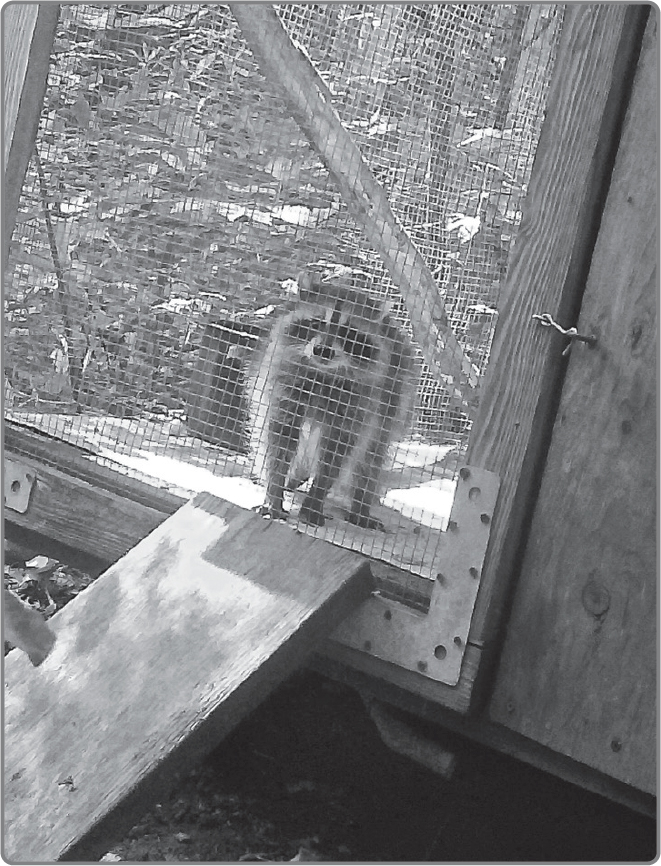
Frodo shows a new interest in life
Frodo didn’t stay stock-still this time. More used to my presence, he ignored me and explored the Hilton with glee—up and down the logs, around and around the high ledge, up and across the huge hammock. For once in his life he seemed energized and enthused, and it thrilled me to the core to watch that transformation.
It All Depends…
I left Frodo to it, hoping that what the rehab mentor and I had in mind was going to work. Success wouldn’t depend on him alone. It would also depend on some other young raccoons I had recently released in the same spot. If they would induct Frodo as a member of their gang, it would astronomically improve his chances of going over to the wild side. So the next part of our plan was to install the woods camera and watch what happened on the outside of the cage with them, as well as on the inside of the cage with him.
Typically, the thing to do with a singleton raccoon is to network with other rehabbers to find other raccoons that can serve as its adopted siblings. This just wasn’t possible to do for Frodo. He qualified as a rare exception because of the timing, his attitude and age, and the release limitations in our area, all of which were working against him. As I’ve mentioned, my state’s disease containment rules say raccoons must be released in the county in which they are born. That meant I couldn’t have taken him very far to join other raccoons anyway.
At worst, my rehab mentor and I figured Frodo could continue living in the release cage after I opened the door, coming and going as he pleased. I would supplement feed him long-term, and he could enjoy a little taste of freedom in the woods at our place for as long as he managed to survive.
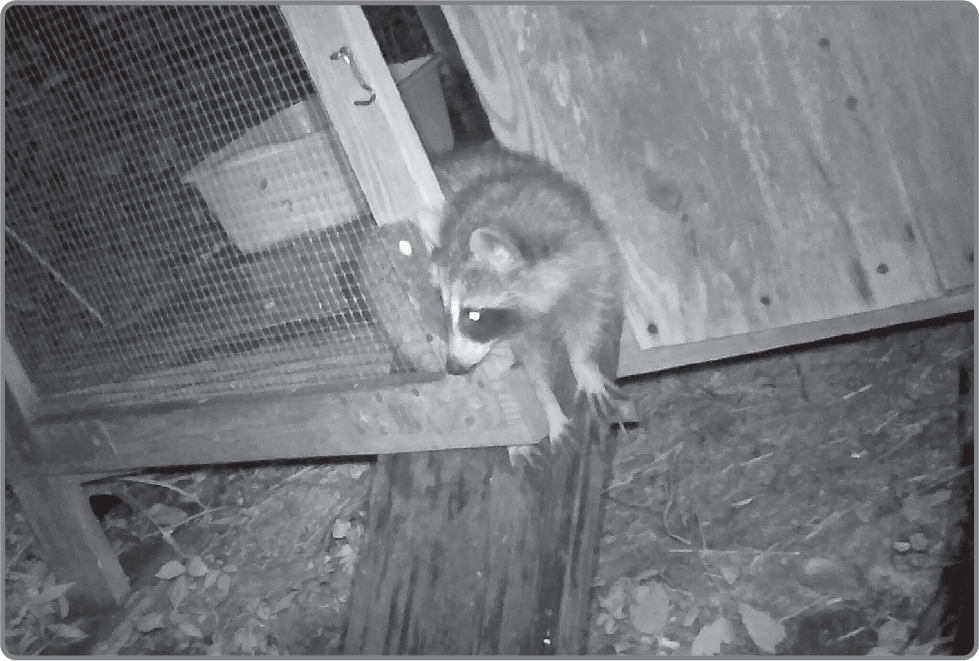
In this shot from my woods camera, Frodo is starting to explore the nighttime woods
At best, we were hoping for a far better outcome. Raccoons sometimes lead solitary lives, but other times, especially if they are young or food is plentiful, they’ll hang around together in a big group. I had never released more than three or four raccoons at a time by the pond, but the woods camera frequently showed groups of eight or more eating together. We had high hopes that Frodo would soon become an accepted member of such a gang—if the other rehabbed raccoons running around back there would play nice.
To my delight, the resident raccoon gang didn’t fail to deliver! Two raccoons of similar size to Frodo started showing up in late-night cameo shots outside his cage. Inside and out, they all seemed to show great interest in one another, and the two wildish ones made repeat appearances on subsequent evenings.
“Open the door!” my mentor exclaimed when I told her what I was seeing take place on camera between the raccoons. “Let’s let him go and see what happens.”
One of the Gang
When I opened the door to the wild world for Frodo, I didn’t stand around to watch his reaction. I wanted to give him the space to explore the woods for the first time, unimpeded by my human presence. (Admittedly, I also wanted to stay out of his reach.) Once I offered him his freedom, he was quick to take advantage of it. I carefully checked the cage after a few hours and saw no sign of him. Yet from the telltale signs I did see over the next few days, he seemed to make the transition into the wild very quickly, aided by his already rehabbed raccoon cohorts. His rough start in life did not turn out to be a life sentence—or worse, a death sentence—after all.
I have continued to keep one eye on Frodo with the woods camera, and I even ran into him not long after his release. He was hanging out in a tree near Raccoon Hilton with those two wilder raccoons, apparently as one of the gang—a very good development. How did I know it was the same guy? Of the three raccoons I ran into that day, the other two shot high up in the tree right away and hid on the far side, doing their best to stay well out of sight. (As they should do in the presence of a human.) The recently released Frodo did not. He went a little way up the tree, following the others (also a good development), but then he stopped on a branch not far above my head and turned around to stare at me with those bright, no longer baleful eyes. Obviously, he had a question for me: “What’s for dinner?” (Again, Momma didn’t raise—or at least in this case briefly take care of—no dummy. I did indeed have a pail of supplement feed in my hand.)
By all indications ever since, Frodo no longer lives in the open release cage, although he continues to be fond of the supplement feed, which disappears at regular intervals. Now that he has joined the rest of the resident raccoon gang, I imagine he has a little help making that happen. Beyond those secondhand signs of his presence, it looks as though Frodo is well and truly living on the wild side, back where he belongs. And he’s not alone. It’s no longer a single ringtail tale.