
2
Suddenly, a powerful wind swept in from the wilderness.
JOB 1:19

My rescuer husband and I spent a couple of blissful weeks as new raccoon parents. The fun part was that raccoon orphans need a ton of tender, loving care, which helps bolster their will to live. Area rehabbers told us it was fine to give them all the TLC we wanted to at first, at least while they were still babies.
Everything got off to what seemed like a great start. It didn’t even cost us much. The rehabilitator had given me plenty of that specialized raccoon formula worth its weight in gold, plenty of electrolyte mix for their first week, plenty of wormer, and plenty of instructions to get us started.
I soon became used to mixing bottles, which I’d never had to do as a human mom since I had nursed my own kids. Soon I got on a (barely) manageable schedule of feeding the babies every few hours. I even grew to like the smell of raccoon milk powder, and I still do. You probably would, too, if you smelled it. The odor is sweet, milky, and hearty at the same time. Getting the milk into the front end of the babies was quite satisfying.
The not-so-fun part was cleaning the babies up at the other end afterward, the way their wild momma would have. Many animal mothers stimulate their babies at the back end to help them urinate and defecate. That way, the moms can make sure all the waste is removed from the nest (one way or the other), so their babies stay clean and the odor doesn’t attract predators.
You don’t want to know the messy details of how I tried to duplicate that process as a human wildlife mom. All you need to picture in your mind is that whatever liquid and/or solid poo came out, it came out quickly. Very quickly. Everywhere. Soon my goal was to become proficient at positioning each kit over a trash can lined with paper towels during the cleanup process. My hope was that my aim would be better than the kit’s, but I never had been very good at hitting a target.
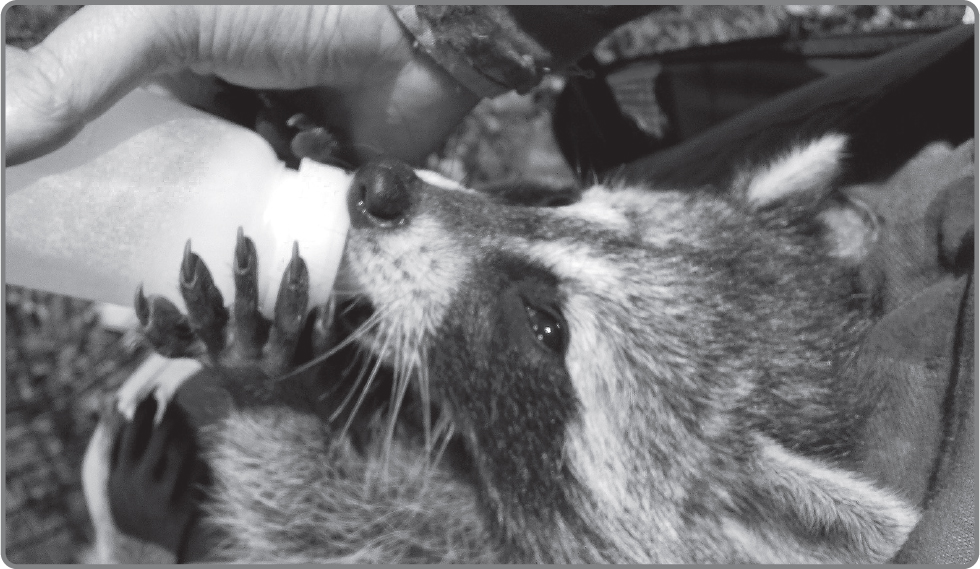
This juvenile Gangster still wants a bottle
Practice makes perfect, however, and with multiple mouths to feed and multiple nether ends to clean up, I had no shortage of opportunities to aim for my goal. Besides, it simply had to be done. Many wild babies can’t go to the bathroom on their own for days or even weeks, so if they are orphaned and their human rescuers feed them but don’t take care of business at the other end, the bladder pressure and toxic effects build up so much inside the babies that they cannot survive. I would not have known that without some training from a rehabber.
What made me think that cleaning cages later on would be easier than cleaning back ends—I don’t know, but suffice it to say that cleaning up poo in any form at any stage by any method is less than fun. That much I can now tell you from lots and lots of experience.
The Trouble with Toddlers
As the babies grew and became much more vocal (screechy) and much more mobile (16 grabby paws a minute), mothering four raccoon kits sometimes rivaled what I imagine it would be like to have four human toddlers around at once. I’m not sure how else to describe it. We have three children of our own, but they came one toddler at a time. Now that they are grown, married, and having children of their own, I’ve experienced what it is like to have half a dozen grandchildren around who all want Grandma’s attention at once, and I love the welcome chaos. But even that doesn’t rival the chaos of taking care of four toddler-aged raccoons. One minute they were tiny specks of fur sleeping softly and soundly in a warm nest all day; the next minute they were toddler tornadoes taking life by storm, and we were blindsided.
Yet parents still love their toddlers who are making trouble, and some even love toddler quadruplets. If only they weren’t so cute (human or raccoon). I couldn’t help feeling attached to these little bundles, especially when they were sweetly sleeping together in a ball of fluff, rare though it became for all four to be asleep at once. We even gave them names, which can be wise or unwise as a rehabber, depending on how well you can control your level of attachment. These four became Skeeter (short for “mosquito” as he was always grabbing something, including me, with his mouth), Sharky (because he went beyond grabbing, straight to nipping), Golden Boy (because he was lighter in color than the rest, almost a blonde raccoon), and Ducky (I don’t remember why, but what an odd name, I now think).
If their names aren’t clue enough, did I mention that all four of them were males? What are the odds? In a way, that worked in my favor. Boy raccoons go wild and usually leave for good, so it’s not as if these would be underfoot forever. Girls go wild, but sometimes will return in subsequent spring seasons to show off their babies. That sounded somewhat appealing, but I wouldn’t be having that pleasure out of this litter.
Each one of these guys was all boy! The weak among them got stronger, the small got bigger, and they grew and grew. After their eyes opened and their coordination kicked in, their grabbing and climbing and running began in earnest. If you’ve never tried to open a cage door and do some necessary task while four juvenile raccoons make a beeline for the exit all at once, you’ve never really faced an animal challenge and prevailed. Come to think of it, I rarely prevailed myself. But I expended a lot of effort trying.
Nothing Straightforward About It
Let me digress and make a quick disclaimer before I tell any more of this tale. If you are a professional animal person yourself, maybe a biologist or state game officer or another rehabber, keep in mind as I describe this first time around that I was learning about working with wildlife. I was in training. I didn’t do everything right, and I did a lot of things wrong that I wouldn’t do again. I even got a fair amount of conflicting advice from rehabbing experts. I refined the process in the following seasons, dropped a lot of dumb things I had done at the start, and added a lot of important things I initially overlooked.
But this first time around I didn’t do everything wrong, either, as evidenced by the woods camera out back (an outdoor camera that captures videos or stills of wildlife), which is still catching photos of what I believe are some of the raccoons from this first bunch in all their wildness, even as I write these pages a couple of years later. So be merciful as you read about my first attempts at raising orphan raccoon kits. It’s not like rehabbing raccoons is all that easy or straightforward in the best of circumstances.
In fact, almost all the experts agree on one thing: Raccoons are far and away the hardest mammals to rehabilitate successfully—not so much in keeping them alive and healthy, but in keeping yourself sane and healthy in the process. The statistics certainly back that up. In my home state of Michigan, and no doubt in countless others, many licensed wildlife rehabilitators specialize in two things—taking in a certain favorite species, and not taking in raccoons.
If you look at online lists of rehabbers county by county, entry after entry will include the qualifier “No raccoons.” That has less to do with raccoons being an RVS—rabies vector species—and more to do with their being what I call a DVS—delinquency vector species. As the saying among rehabbers goes, “You can do raccoons, or you can do everything else, but you can’t do both!” So I figure it must be worth something that I survived rehabbing a litter of four male raccoon kits all the way to release on my first attempt.
Despite the challenges the first time presented, rehabbing had its bonus features. For hours and hours, I could have watched this first litter wrestle with each other, squeal, shimmy up anything with their busy paws, and play with water of any sort (bowls, pans, drips, drops, anything the least bit wet). For hours and hours, I often did watch them. They were far more entertaining than television.
The Ringtail Gang
These four guys cooked up all sorts of mischief—raccoons aren’t called ring-tailed rascals for nothing. I couldn’t imagine it in my wildest dreams, but some people keep a raccoon for a pet. What would be left of a house? Besides being unpredictable (if not dangerous) when they mature, raccoons leave nothing untouched. You’ve heard the saying “What’s mine is mine, and what’s yours is mine”? I’m pretty sure a raccoon said it first. These guys were not all for one but each one for himself.
The kits always made a beeline for anything new they set their shiny little eyes on. They could never resist grabbing it, exploring it, tasting it, or chewing it up. And it seemed as if they had the longest reach of any animal on the planet. No matter how far away from their cage I set an item, one of them would manage to snag it, pull it between the bars, and start a full-scale riot over it. Especially if it was a set of keys—either real ones or toys. You’ve seen those little colored plastic key sets made for human babies? Baby raccoons cannot get enough of those, so it’s a good thing I rarely find a garage sale without a used plastic key set going cheap or free because the keys usually have teeth marks in them. Raccoon kits don’t care who has chewed what before them.
Soon I was calling these sweet babies—which were fast turning into juvenile delinquents—the Ringtail Gang for short. I meant it in a Mafia sort of way. It’s how they operated. They were quickly learning how to employ every underhanded scheme the term gangster implies to get what they wanted or to do what they wanted. I’ve gained so much insight into the criminal mind from rehabbing raccoons!
Like any respectable mobsters, they certainly were extortionists. If they had something I wanted, or if they had planted themselves somewhere I didn’t want them to be, I knew I would have to ante up with some pretty high-stakes payoffs to get any cooperation from them. Usually that involved something sweet or something shiny, or both.
Sometimes to preserve my sanity, I would shut them into our enclosed side porch while I cleaned their cage, just so I didn’t have to wrestle with them. All four of them always wanted to be involved in every little cleaning task, dirtying everything all over again before I ever got anything clean. Or they all wanted out the cage door when I wanted them to stay in. To sidestep the daily rumble, I would float a few handfuls of grapes, one of their first and favorite solid foods, in a big pan of water out on the porch. Then I would pop the gang out there to practice their fishing skills while I tidied up their digs. That made for good multitasking, as they learned a skill they would need in the wild while I accomplished my very necessary cleaning task.
Once the gang’s cage was livable again (by human standards), I would pop out to the porch too, refill the pan with grapes, and watch the show. You know how raccoons love water, and they certainly love tasty grapes, so it was a hoot to see their excitement over this activity. It caused quite a wet and crazy uproar, which was fine with me (although I then had to clean the porch).
The glitch in the plan came whenever it was time to catch them and put them back inside their clean cage. You would not believe how many hiding places a relatively small and fairly empty side porch contains in the minds of four raccoons looking to make a fast getaway. One would squeeze under the cedar chest I could barely get one finger under myself. Another would squeeze behind it, where I thought there wasn’t so much as the smallest sliver of room. A third would disappear down the toe of a muck boot, making it hard at that odd angle to get a handle on anything but teeth. A fourth would somehow scamper into a cabinet I thought was firmly latched and then burrow behind anything to stay out of sight and out of reach (and usually knocking everything over in the process). Besides honing their fishing skills on the porch, the gang got a lot of practice at hiding out in unreachable places. That was also a skill that would stand them in good stead once they were released into the wild, but I wasn’t all that fond of them practicing it on me!
All too soon—and at the same time not nearly soon enough—the Ringtail Gang grew big enough that it became a challenge to keep them content in a cage when they weren’t out for exercise, or even to keep them happy playing on our enticing little porch. The time was coming to let our little group of gangsters take over some new territory.