
7
Father to the fatherless… God places the lonely in families.
PSALM 68:5-6

Spark drank and drank his squirrel milk, which I delivered and delivered on a regular basis, minus the nighttime feedings once he grew a little bigger under my care. Eventually, he even sprouted some peach fuzz. That was an exciting day for me after looking for so long at his pathetic pinkie self. I’ll never forget the sight of his first short, wispy hair sticking straight up on the top of his head. It was the funniest and most welcome sight ever, if barely visible to the naked eye on his naked body.
Soon other wispy hairs sprouted to join it, which made Spark look endearingly comical. Even though it wasn’t my first time around the tree with orphan squirrels, Spark was special, maybe because he was by himself and was beating such overwhelming odds. I couldn’t help taking pictures like the proud “mother” that I was. Over time his peach fuzz turned into real fur, and what a sight for sore eyes that long-awaited, fiery red fur was when it finally grew in!
It was astonishing to see Spark grow from a dehydrated, dying ember into a flaming red squirrel—an unbelievable transformation. His finders thought the same, as I kept them apprised of his growth by sending photo updates their way. They were some of the most involved and interested finders after the fact that I had ever known, which was both wonderful and unusual. We all agreed that Spark’s transformation was miraculous. The way God designed every creature to grow and reproduce after its own kind is miraculous anyway! Whenever I rehab any animal orphan, watching that growth process close up always feels like a miracle to me.
Rattle, Rattle, Bang
You’d think having one very tiny red squirrel squirrelled away in a little cage in my bathroom would be a relatively quiet affair, but you’d be mistaken. It was quiet only at first. Spark’s transformation from newborn to toddler was nearly as noisy as the Ringtail Gang’s. He was simply a tornado on a smaller scale. Once he got his paws under him and figured out how to use them to climb up and down the bars of his cage, the rattle, rattle of his speedy movements was almost constant whenever he was awake. Around and around his little cage he would go, and when I added a few tree branches going every which way, his delight knew no bounds as he practiced his balance and even a few tentative jumps (not tentative for long).
Now that he was running around outside his cozy nest so much, I had to keep the bathroom door shut day and night. Otherwise, the temptation to sit and watch Spark was too overpowering for poor Satin the cat, whose posture clearly told me she was hatching plans to break into the cage and break out the squirrel—and not with any good result. I increased my vigilance, and so did Fritz. He plopped himself down by the bathroom door and did a fair job of keeping the cat at bay.
Meanwhile, the rattle, rattle coming from behind that closed door was turning into a bang on a regular basis. Spark started to push and pull on everything in his cage, rearranging his little world to suit himself. He was also making it abundantly clear that his little world was starting to feel too confining. His behavior reminded me of those old Westerns where the jailbirds grab their tin cups and run them over the bars of their jail cells, setting up such a clatter that it drives the sheriff crazy.
In addition to his stunning physical growth and development, I could almost see a mental growth spurt taking place behind Spark’s bright little eyes. He was still drinking formula, but only a few times a day, and he often preferred to lap it up himself from a little dish rather than sucking it from a Miracle Nipple in my hand. Although he still loved his spot of milk, his taste for being treated like a baby was diminishing every day.
The Priceless Payoff
On release days, I have to say that the payoff on my rehab investment is priceless. To stand at the squirrel cage out in the woods, open the door wide, and watch nearly grown youngsters like Spark get excited over scrambling up and down a tree trunk for the first time in their lives is a sight worth seeing. The excitement is just… squirrelly.
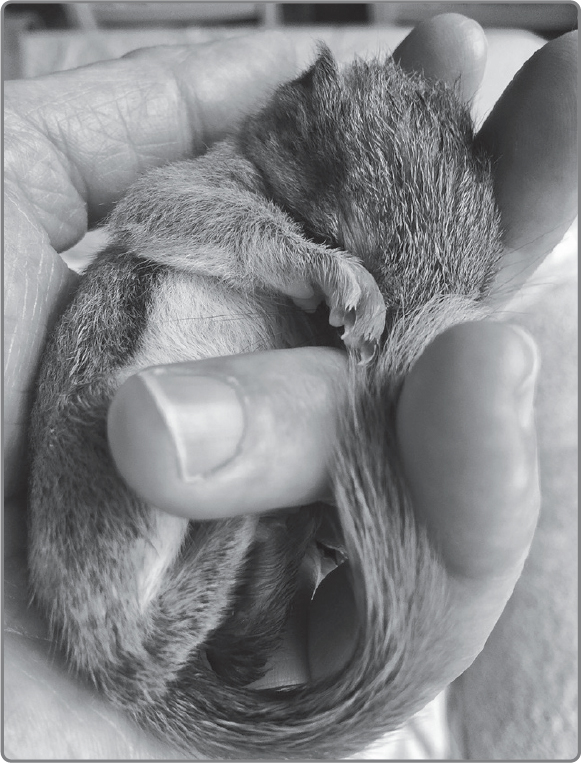
Spark curled up in my hand
Alas, I didn’t get to share that kind of excitement with Spark. Not to worry; as far as I know, nothing as yet has extinguished the fiery young red squirrel Spark has grown into. But when he was old enough to open his eyes and ears and start scampering around, I knew the time had come for me to let him go in an unusual way—to another rehab facility. Like many orphans, red squirrels do much better raised and released with others of their own kind. Most seasons when I get in a singleton like Spark, other red squirrels soon follow, so I had never had to raise one alone. That had been true every season until Spark. He came in by himself, and no other squirrel calls followed. That meant I needed to get creative about networking with other rehabbers in order to give him the best chance of survival.
Spark was a late-season baby, born at the tail end of the summer, almost into the fall. The later into the fall it became, the less likely it was that another singleton red squirrel would come my way. Sure enough, by the time Spark was ready to work on his squirrel socialization skills, I was still second-squirrel free. That meant I needed to call other rehabbers to find out who else had baby red squirrels and what we could arrange to foster Spark’s next growth stage.
To my relief, another facility not impossibly far away had a small litter of late-season reds similar in age that would make excellent adopted siblings. So once the energetic Spark of life I had raised fully developed from a ghastly pink blob into a gorgeous specimen of a red squirrel, I loaded him up and made the bittersweet trip to the other rehab facility to hand him over.
To my delight, once I got Spark where he was going, I found out the facility would be overwintering him and his new siblings for eventual release in the spring. That was more than I had dared hope for! Overwintering requires extra staffing and a wintertime cage setup much larger than I have at the Lion’s Den. This facility was well suited to overwinter wildlife and was caring for several other squirrels that were also too young for a fall release. I didn’t get to see this squirrel zoo firsthand because I dropped Spark off at the intake office, and the different litters were spread throughout volunteer foster parents’ homes. But his new foster parent sent me a picture of Spark thriving in his new digs, which I appreciated because I know how busy parenting squirrels can keep you.
Spark and I had hit the jackpot with his new arrangement. Release day would come for him the next spring, but I didn’t mind at all spending the winter thinking about how he would pass the cold-weather months safely indoors in the company of his adopted siblings. They would stay warm and well fed by their human foster parent, all without having to face the rigors of a Northern Michigan winter while still so young.
I knew that by the time spring came around again, Spark would be more than ready to go out and light his wild world on fire, and he wouldn’t have to do it by himself. I wouldn’t see that payoff moment personally, but I have enjoyed the fun of releasing enough juvenile red squirrels near the Lion’s Den to imagine what it would look like. Everybody’s adrenaline, human and animal, is always off the charts when release day comes around. I could easily imagine the fireworks Spark and his pals would cause when their cage door was first opened to the outside world. The excitement would be positively contagious!1
Squirrels like Spark that I’ve released myself spend their first few minutes racing sky-high up into the trees like the wild and free things they suddenly are. Then they often come back down to home base, sit on top of their cage, and look at me with bright, happy eyes (or so I imagine). The fun thing about squirrels old enough to release in the fall (besides the fact that they’re so much easier to rehab than raccoons) is that they’ll return to the release cage again and again, and maybe even spend the winter living inside it with the door left ajar if the location is protected enough from the weather. Then I can stop by often and drop some treats for them, knowing they’re not starving their way through their first winter out in the wild.
We call that supplement feeding, where we drop food every day or two as a way of seeing those inexperienced, motherless types through. We don’t do it often enough or in large enough quantities that they can live off it without lifting a finger, so to speak. We want them to be motivated to hunt and gather for themselves. But we drop enough so that they don’t starve or suffer in a rough weather patch, especially if they didn’t have the time or know-how during good weather to stock up on winter provisions for themselves. That is often the case for released juveniles, so supplement feeding helps.
The red squirrels, which are the squirrel species I most often rehabilitate, sleep through some of the cold weather, but certainly not straight through. They stay quite active all winter. And seeing them day to day in the wild makes the payoff priceless for me. Even simply seeing their tracks in the snow here and there and everywhere around the cage tells me that my rehabbed, released critters are doing just fine. That puts some spark in my life on the coldest winter days!
1To watch a fun “Red Squirrel Release Day!” video and catch the excitement for yourself, visit my website at www.trishann.com and click on the “Raccoon Gangs Book” tab at the top. Scroll down to the “Videos from the book” section, where you’ll find the release day video under the drop-down arrow. You’ll also want to watch the “First Taste of Freedom” video that you’ll find there.