
8
Hair … mediates between the individual and their culture…. It is a site of immense conflict—external authorities, parents, church, peer groups, schools gangs and fashion gurus all seek to impose their conventions on the individual.
JULIET McMASTER, “TAKING CONTROL,” 2002
What began as the colour of children, comics and clowns is now a flag of determination.
GRANT McCRACKEN, BIG HAIR, 1995
The town of Breda stands where the River Aa broadens upon meeting the River Mark, about sixty-five miles south of Amsterdam. “Brede” means “wide,” so the name of the town means “wide-Aa,” basically, which is not only easy to remember but conjures up pleasing visions of an European Economic Community river-naming directive; one that might mean some other river, twenty-six water-courses distant, would be known only as the “Bb.”
In its long history Breda has been bought, sold, taken in battle, inherited as a dowry, and (briefly, in 1795) French. It has been burned to the ground, immortalized by Velázquez, and laid siege to by the Spanish. In 1590 it was recaptured by the Dutch when a tiny force of sixty-eight men managed to get into the town by hiding under the turfs in a peat-boat, which is about as Dutch a version of a Trojan horse as you could ask for. Charles II lived in Breda during most of his exile and signed the Treaty of Breda in 1667, by which England gained the far-off territory of New York, but precious little else. Polish soldiers liberated the town in 1944. Such are the fortunes of war, however, that General Maczek, who led the liberating force, and who died at the age of 102 and is now buried in Breda, spent his old age working as a barman among the redheads of Edinburgh. The town is known for chocolate, lemonade, licorice, and beer. It has a park, the Valkenberg, and a splendid Grote Kerk, a building of such Gothic ribbiness, such piercings and knobbly crockets that it looks as if its bones are poking through its skin—a great gray Gothic pachyderm, quietly moldering away under those horizonless Dutch skies. But in all its long, eventful history, I doubt Breda ever anticipated any such happening as Redhead Days.
It is, after all, a very strange thing for a redhead to find him- or herself completely surrounded by other redheads. As the actress Julianne Moore has said, redheads notice one another, we become preternaturally alert to another redhead in the room—there’s even a redhead look, a glance of complicity that passes between us. But put 6,000-odd redheads into the center of one small historic Dutch town, and complicity ain’t in it. That’s no longer a minority population of any sort, that’s a tribe. Not bad for an event that started by accident, with the Dutch painter Bart Rouwenhorst placing an ad for models to act as inspiration. Rouwenhorst likes redheads. He paints redheads. In 2005 he wanted fifteen or so redheaded models for a sequence of paintings inspired by the works of Rossetti and Klimt; some 150 turned up. Faced with the choice between creating 150 paintings or a festival of redheads, Rouwenhorst went for the latter.
So here I am on Eurostar, heading for Brussels and ultimately to Breda and the largest gathering of redheads on the planet. I’ve been looking out for others of my rubified kin ever since manhandling my suitcase through security at St. Pancras, and thus far I haven’t spotted a single one. I mean, I know we’re rare, but. Six thousand redheads (the number the organizers of Redhead Days tell me they are expecting this year), at a very generous average of 6 percent of the population at large, would be the seasoning for 100,000 or so non-redheaded folks. Surely the number of people at St. Pancras should include one other, at least?
Apparently not. What my carriage can offer instead is a party of jolly sixty-somethings, on their way to Bruges. Their conversation is loud and joyous; it’s one couple’s anniversary, it’s someone else’s birthday, a fourth member of the group has just retired. They have crackers, pâté, wine. The men twit the women over the amount of chocolate being in Bruges will require them to eat. The women hoot with laughter, josh the men, and exchange sotto voce wisecracks of their own. The men are mostly dressed in affluent beige; the women are much more colorful—turquoise blues, purples, coral reds.
Red. I suddenly notice the queen of the group has hennaed hair. She has a voice so rich with damage (cigarettes, hard liquor, holding its own in God knows how many marital disagreements) that it almost carries its own static. The end of every sentence she utters, every tale she tells, is lost as the group dissolves with laughter, bending over their tabletops, lifting their plastic tumblers of wine up high as if to keep them safe. There’s another woman seated beside her dressed in pale pinks and blues, round-faced, round-eyed, a little blonde duckling, tucked in beside this creaking, cackling scarlet parrot. Red, I find myself intoning inwardly, is the color of dominance.
The last time I was one among many redheads was as an extra, filming Atonement. A lot of titivating goes on in the longueurs between takes, and it passes the time, having your hat adjusted, lipstick renewed, 1940s pageboy recurled. “You have lovely hair,” the woman with the curling tongs said, behind me, holding on to a hank of it with urethra-contracting tightness as all around us cables writhed across the floor like Laocoön’s serpents, and the lighting guys cursed at the strength of the sun soaking into St. George’s, Hanover Square. “Lovely color,” she continued. “Is it natural?” She pulled the curling tongs free. “And really thick. Redheads always have lovely thick hair.” I’m about to correct her—no, it’s not thicker hair, it’s thicker hairs, but seizing another hank, winding it around her tongs, she forestalled me. “It’s a shame you’re all going extinct. Is it your natural color?” The time before that was a family holiday near Balmoral, where everything was red—the deer, the squirrels, the grouse, the heads of hair on the people. We went to the Highland Games at nearby Ballater, and from a lifetime of being the odd one out in this family of blondies and brownies, suddenly I fitted in, and it was the other members of my family who were the anomalies, the Sassenachs, the ones who stood out from the crowd. Now here I am heading toward Redhead Days in Breda and there’s not another redhead in sight.
I have to change at Brussels, wait for a train to Roosendaal. I have to change again at Roosendaal for Breda. At Breda I am to speak, for an hour, to an audience of redheads about the history of the redhead, be interviewed by a documentary crew, and get myself photographed with a bottle of Gingerella ginger beer. These are not things I have ever done before, nor are they things I have ever envisaged myself doing. Even saving my receipts from this journey is a reminder that I am here in my capacity as a professional redhead. I am a tad nervous.
The men in beige, the scarlet parrot, and her blonde duckling girlfriend decant from the train still holding their plastic cups of wine on high. I locate the platform for Roosendaal, then go buy myself a beer.
And I’m standing there, on the concourse, drinking my beer and people-watching when I see a man, whitish hair in a long ponytail, denim shirt, South American striped and tagged and fringed and toggled waistcoat, fingers full of silver, and the reason I see him is because as he approaches, he is staring at me. He takes in my face, then his eyes go around my head as if checking on my aura, and as he passes, he pulls an imaginary hat from his head and tilts me a bow. “Enchanté.”
Man with a Thing for Redheads.
On we go. I’m watching, on my iPhone, the blue dot that is me, traveling through these hinterlands of Belgium and on into the Netherlands, and through or past so many of the towns where the medieval artists, the medieval men with a thing for redheads lived. Brussels, where Rogier van der Weyden died. Bruges, which had Jan van Eyck. And now here we are at Antwerp, which had them all, including in the winter of 1885, Vincent van Gogh—cold, lonely, hungry, miserable, ill, ginger hair close-cropped as a prisoner’s, sitting for hours in front of the paintings of Peter Paul Rubens (whose own surname in Latin means “colored” or “tinged with red”), worming his way into Rubens’s paint swirls in his thoughts and bringing red into his own palette thereafter. The sky is boiling with clouds, the end of Hurricane Cristobal, flicking Europe with its tail. Strobes of sunlight pass across the fields, stride over the roof-scapes of the towns. Van Gogh was born near Breda. I feel as if I’m approaching redhead ground zero.
The train is much, much quieter than was the Eurostar. There’s a discreet conversation in French bubbling like a water fountain to the right of me; I try to listen in as subtly as I can while taking notes. It seems one half of the conversation is recommending a hairdresser to her friend. I am reduced to the amateur subterfuge of examining both, as far as I can see them, in my handbag mirror. Writers are awful people, we respect nothing, and Sherlock Holmes would be proud of me. Sure enough, one purplish-reddish head, one orangey-brown. People have asked me all the way through the writing of this book, “Does dyed red hair count?” Of course it does. What more wholehearted acclamation could there be?
Roosendaal. Time to go grapple with the suitcase again.
Roosendaal is one of those stations where the platforms are as far apart as the coasts of a couple of continents, facing each other over a waste of rusty unused lines and wonky buddleia bushes, bright and lively in this Indian summer with bees. Traveling like this on my own to a place where I will be both new and everywhere, where I will know no one and everyone, is strangely nerve-inducing. My fellow redheads in Breda could include a little girl from the Kibbutz Gezer (Carrot Kibbutz), a teenager from Afghanistan, and a Venus from Australia. It’s ridiculous to think I am related to any of them in any way at all, or they to me, to presume that we will have anything in common, and yet we will. We do.
A train, grinding in. The sign hanging above the platform does a noisy electronic blink. BREDA.
There’s something unshowy, self-effacing about Dutch towns, like the people—endlessly polite and, for a Brit, shamingly bilingual. They don’t do look-at-me high-rise. Breda sits low to the landscape, the same height to the buildings as they have had for centuries. I do a little walkabout after checking in to my hotel (the Golden Tulip—how Dutch is that?) and register vague impressions of grayness and stone and mild hubbub from the bars. But the redheads, if they are here yet, are plainly all in hiding. I spotted two, in the park, from my taxi on the way to the hotel and that’s it. Back at the hotel and the only thing orange is the Dutch football team on the television in the bar. I, like Breda, also have a Mark. I get into bed with my laptop and email mine assorted disconnected thoughts and a string of kisses.

According to my dog-eared program, I will be able this weekend to indulge in a weekend’s worth of redheaded music, join a pub crawl, take a canoe trip or win one in a hot-air balloon, have my fortune told, my nails done, my colors done, get a makeover, speed-date, do a fire art workshop, a Lindy Hop workshop, a burlesque workshop, a cocktail workshop, buy more redheaded merchandise than I ever knew existed, watch a catwalk fashion show, immortalize myself in the group photo, and learn how to keep my energy levels high by laughing at myself, which will no doubt come in very handy at two p.m. on Sunday afternoon. Before that, I have to meet with Papercut Films.
What the hell do you wear to be filmed? Solid colors, I am told, no black, no white, which leaves such an endless amount of space for picking the wrong thing you could fit my entire wardrobe into it. We start by walking me around the nave of the Grote Kerk, now bedecked with Thomas Knights’s photographs, one of which apparently had to be removed when the church council took exception to the lowness of the model’s low-slung jeans. The camera follows me, around and around the curve of the nave, and then behind me, up the winding stone stair to the room where the filming and interviewing proper is to take place. I manage to resist making the obvious and awful joke, as the cameraman labors up the stairs behind me, as to whether my bum looks big in this. I sit as directed and am powdered anew—apparently I’m shiny. The camera rolls. I keep such desperate eye contact with my interviewer that in the heat of the room my eyeballs start to dry out. Being interviewed seems to consist of being asked the same question three different ways until I give them an answer they can use, until Chris and Mark—another Mark?—are happy. I have a horrible sense that most of my answers are a disappointment to them, but I find an unexpected core of obstinacy within myself. Never mind the professional redhead, the redheaded activist has decided the time to assert herself is now. I have spent months surrounded by books and theses and journals and offprints, and in my opinion the true history of red hair is infinitely more fascinating than any of the myths. So no, redheaded young women were not hauled off by the hundreds to be burned at the stake as witches; no, we do not bleed more than other hair colors; no, we do not originate in Ireland; and no, we are not going to become extinct. The noise from the street outside is increasing. The crew is filming at the speed-dating session next, and there is some discreet checking of watches going on. The session wraps. There is lunch. I say that I hope I wasn’t too useless. “You were fine,” Chris tells me, very kindly. Music is bass-booming from a band in the town square. I head down the stairs, outside, and—
Whoa. Whoa. What the—what’s the—whatever the collective noun is for six thousand redheads (a bonfire, a sunrise, a solar flare, a rubescence, an incarnadination, a conflagration, an incandescence, a frenzy, an apocalypse of redheads), let’s hear it now. There are tall redheads, short redheads, plump redheads, thin; there are tiny little ones charging through the crowd at knee-height; there are redheads in baby carriers and redheads in wheelchairs. There are old redheads, gone sandy with age; there are redheads so new and young that to see any hint of color on their infant heads would be an act of faith only two redheaded parents could perform. There’s an open-top bus with redheads on its top deck, an immense poster of the crowd from last year’s festival completely covering one side, and redheads having their photographs taken in front of it, a sort of past, present, and future of red. There are redheads in costume—Rapunzels, mermaids, Magdalenes, vampires, Vikings. There’s the redhead queen from the Irish Redhead Convention here somewhere; there are redheads in facepaint: foxes and squirrels. A man passes me with a dog, a red setter with a spotted handkerchief tied around its neck, padding along at heel, which makes me laugh—do redheads chose red pets? Ginger cats? Pomeranians? Dachshunds?
And there is hair, hair, everywhere. There is hair here that has plainly never been cut once in its life. There are manes of hair. There are braids down to hips; there are walking bushels of red, there is every shade of it describable. Tight deep red curls; curtains of pale, pale cinnamon; orange-hued skinheads; terracotta plaited like lawn edging; peppery cornrows; masses of ginger so prodigious they follow their owners a bounce or so behind with beards and whiskers to match. There are mothers and redheaded daughters, bonding as only mothers and daughters will. There are tribes overlapping—rockers and bikers and punks circulating around the merchandise tents side by side with neat little families in Peter Pan collars with babies in strollers. There are redhead dreads. You stop looking at the people—the first thing you measure up on everybody is the hair, and there is a certain air of rivalry in some of those sizings-up as well, a slight sense of “Who’s the reddest?” It certainly isn’t me. There are redheads here who put me to shame. One of the questions Papercut asked was where do redheads feel they belong? If we can come from so many different places, where’s home? Here’s the answer—right here (Fig. 33).
I wander the streets, sketching tableaux. The one redheaded sibling, for example, in a group of three, where it’s the other two (bigger, older) who look awkward, who are now the odd ones out. A redheaded couple, doing that linked-together couple’s walk, arms across each other’s backs and fingers through each other’s belt loops. She has her head on his shoulder and from behind their hair is meshing, too. A teenage girl in a costume made of a cloud of purple netting (this year’s signature color), through which her face peers as if through purple stage smoke. A giant red plait, draped from the upstairs window of a bar. An older couple, must be in their seventies, in matching sweatshirts and sturdy hiking boots, who look both totally at home here and totally out of place—her hair faded with time, clipped sensibly short, his almost gone. They’d have been toddlers when the Nazis were in town, which reminds me of the one internet factoid that has eluded all my attempts so far to run it to ground—that the Nazis forbade redheads to marry. I can’t believe red hair was any different a signifier for the Nazis than it was for the bureaucrats of the Spanish Inquisition. The way prejudice works is never more than predictable.
And standing here in the square outside the Grote Kirk of Breda is surreal. It hadn’t occurred to me before how much a part of being a redhead is the business of being the only one on the train. It’s so much a given of having the hair that no one else has the hair, but here everyone does. Breda makes the outsiders the tribe; the exception the rule. So if we are no longer the other, who are we?
Ruth is here from Bristol with her sister and her two sons. I find her in the Grote Kirk, admiring the men in Thomas Knights’s photographs. It’s very easy to fall into conversation on Redhead Day in Breda. Everyone seems keen to share the experience of being here and of being red in a manner that has something to it of catharsis. Her sister is a redhead too, but a toned-down version; Ruth is fire-engine red. Her two boys are darker, she tells me, pointing to one of the photographs, “like him.” Teenagers, off on their own; she suspects they will be down at the redhead speed-dating tent. Do they like redheads? She laughs. “They like girls.” It’s kind of telling, that the graphic for the speed-dating venue has a gorgeous redheaded coquette, fluttering her lashes at a man whose hair is brown. She frowns when I point this out. Does she think it’s different for girls?
It turns out Ruth is an army wife; when her boys were born, the family was in Germany. Her sons went all the way though kindergarten and junior school without a problem; then they moved back to the UK and everything changed. “They were big enough to stand up for themselves then,” Ruth says, and from the sound of it, just as well they were. Do they get treated differently now? “There’s two of them. They look out for each other.” It was the same with her and her sister when they were young. Harder to pick on two. And attitudes are changing; she’s noticed that. Things are different now.
Are they?
A long, long pause for thought. “Yes,” she says at last, and then brightens. “I mean, there’s Prince Harry, isn’t there?”
Marius’s family is half Hungarian, half Romanian. Despite his youth (when I offer to buy him a beer, he modestly requests a Coke), he’s a Redhead Days veteran. Heard about it through the internet in 2006—could any of this be happening without social media? Helped out as a volunteer last year, brought along a gang of friends this. He and his mates have also been down at the speed-dating tent, which must be doing a roaring trade. He’s also been to one of the gay bars in town, which was a good experience, as he calls it. He is trilingual at least; has moved with his family to Scandinavia and then with them to Germany. What was it like being a redhead in the land of the Vikings, I ask, anticipating a positive response, but Marius pulls a face. He was bullied, he says, “a little bit” in Norway, but that was because he wasn’t Norwegian. His remark puts me in mind of a depressing suggestion made in their study by Feinman and Gill, that people have an inherent psychological need to dislike something.115 All the same (Marius is thoughtful when he speaks, weighing his words), on balance he thinks red hair for guys is a bad thing, despite the fact that if you have red hair it makes you more tolerant, more aware of the feelings of others. His role model is the character played by Tim Roth in Lie to Me (to whom, it must be said, he bears more than a passing resemblance). Where, having lived in so many countries, does he feel at home? “Here.”
Just to confirm my worst suspicions of the prevalence of being bullied in so many redhead lives: Kelly. Kelly comes from New Zealand, is a media student, and has deep red hair that truly does shine like polished copper and a tale of being picked on and marginalized all the way through her school days, with one of her worst persecutors being the only other redhead at the school. “Only,” says Kelly, “she wasn’t as red as me.” Now, at college, her red hair is both envied and emulated. This is indeed the story for most redheads: you’re teased as a child (and even the most well-meaning of teases, from those you know are fond of you, is wearing and unwelcome, please note—those teased always taste the vinegar more strongly than the honey). Then you grow up, and especially if you’re a girl, your experience of being red can transform with bewildering rapidity. Are you happy now with being a redhead, I ask her, thinking what a tragedy, with hair as beautiful as that, if she’s not, and she nods her head, vigorous emphasis: yes. Now, it’s her. Everything about it is her—even the interest and awareness it has given her, as a media student, in what makes other people tick. Happy ending. So should they all be.
Laura-May Keohane, crowned queen of the Redhead Convention at Crosshaven in Ireland in August. She’s here in a red-and-gold cloak, like an old-time coachman, gowned and crowned, one of the stars of the show, and is so ridiculously pretty that when people stop to take photographs of us I want to get out of the picture. There is a huge amount of snapping going on. Two redheads need only stand together to be photographed by someone. You get the feeling this is not simply building up an archive of memories; there’s some dedicated search for self-definition going on here as well, a crowd-sourcing exercise in personal classification. Laura-May is astonishingly gracious in her role; if I had been crowned queen of the Irish redheads at the age of twenty-one I doubt I would have been quite so mature about it. “Now where does the red hair come from?” she asks, smiling away as the camera-phones are flourished all about us. She has a lovely line in Irish lyricism, too. “There was a fella told me it was caused by the clouds and the rain.”
Dr. Tim Wentel, my fellow speaker in the Grote Kirk at Redhead Days. He’s the man to tell you where red hair comes from, if anyone can, but as well as being an expert on the hair, the skin, the freckles, he’s something of an authority on beers as well. My notes from our meeting stray exuberantly up and down the page and at one point toddle off into the gutter of my notebook for a lie-down. We end up at an Indian restaurant where I preserve the redhead’s reputation for dealing coolly with the hottest curries, and Dr. Tim gives me chapter and verse on the origination of the redhead extinction story—predictably, another internet myth, from years ago, but as he tells it, with a twist. Globalization may, eventually, many generations down the line, succeed where the makers of woozles have failed. We may all, as we mix, eventually revert to the phenotype of dark hair, eyes, and skin with which we once emerged from Africa. Given global warming, of course, we may all be thankful that we do, but if globalization should have this effect, if—does that mean no more red hair? Anywhere? Or might Mother Nature have more tricks up her sleeve?
I’m up at the business end of things now, tents selling t-shirts and wristbands, makeovers and do-overs, and it is beginning to feel a little odd, this relentless concentration on just the one body part. I have an urge to stand on the steps to Breda’s noble town hall and shout, “I am not a redhead! I am a free woman!” I tell myself I at least will no longer gawp and stare at my fellow redheads. Instead, I step away and almost immediately find myself on the outskirts of a small circle of people gawping in amazement at a tall teenage girl who not only has the most wonderful skin, like illuminated bronze, but with it the most astonishing red, red, red, red afro, an aureole as bright as molten lava. This, so I learn, is Sterra. And Sterra is what Mother Nature can come up with if you only give her the right breaks (Fig. 33).
Sterra is here at Breda with her mother, Irmgard. They’ve been coming here since Sterra was a child. And while Irmgard’s hair is now dark, when she was young, she tells me, it was red. Irmgard is Dutch, but Sterra’s father is from Senegal, and somehow those two gene pools, as they mixed, created this thirteen-year-old standing here. I ask the obvious question: has Sterra ever experienced any racial prejudice (wondering, even as I ask the question, what on earth, given her coloring, the form of such prejudice could take)? No, Irmgard assures me, never. There’s a line in Emily Cameron Walker’s thesis to the effect that red hair is no more than a “genetic spandrel,” that pale skin is the genetic driver, red hair the side effect, and technically yes, she is right. But in that case, looking at Sterra, all I can say is quelle spandrel.
Sunday. My talk is mere hours away. I’m brunching in Breda’s main square, fortifying myself, and David and Anna are at the table next to mine. Anna has princess ringlets of the palest ginger, delicate as a cobweb, all the way down to her waist. She also has a wonderful story from her days at school. The rest of her class developed a game they called “carrot-busters” where every break time they would pile on top of or cannonade into Anna and the two or three other redheads in the playground. (Months later I’ll find myself talking with a class of embryonic writers in a school in New York. The members of the class are about the age Anna was in her story, and we start talking about discrimination and prejudice and red hair. They all mention one girl in their year who has red hair, and thinking of Anna and her carrot-busters game, I ask if their classmate has ever been picked on in any way, and the whole of my audience recoils in horror. And that, I guess, is the difference, between growing up on the Upper West Side and growing up in the West Country.)
I turn to David and ask him if he noticed Anna because of her hair, if he would call himself an example of Man with a Thing for Redheads. “Well,” he says proudly, “Anna is the only girl I’ve ever asked to marry me.” And Anna waggles at me on her left hand the most delicate diamond ring, so unmistakably new that even the hand has the look of still getting used to it.
The Grote Kirk in Breda can seat one thousand people, and I’m not saying it’s full, I’m just saying that from the podium set up for us speakers it certainly looks that way. Row upon row of people fanning themselves with postcards of Alexa Wilding. I’ve been warned by the organizers that given the sensibilities of those who care for the Grote Kerk, I should mention that there will be nudity in the slides I’m going to be showing. So I’m now scrawling WARN THEM ABOUT THE COURBET in caps two inches high across the top of the first page of my talk when the hum and scrape of people settling into their seats is drowned out by a motorbike roar from outside. I look up. For the first time it registers quite how much studded leather as well as hair there is among my audience. Well, well. It seems I will shortly be explaining the historical significance of L’Origine du Monde to a gang of bikers. This is going to be interesting.
Joachim, who has gallantly volunteered to video-record my talk, gives me the thumbs-up. I take a deep breath.
“Okay. Ladies and gentlemen. Let me introduce you to King Rhesos of Thrace.”
So after all that, where are we now in the history of the redhead?
First, I think Ruth is right. I think attitudes are changing, and I think it is redheads who are changing them. When, in response to the notorious South Park episode, “Kick a Ginger Day” was set up on Facebook by a particularly misguided fourteen-year-old in Vancouver, the Canadian comedian and activist (and redhead) Derek Forgie boldly co-opted the Canada Dry logo and pushed back by setting up, also on Facebook, “Kiss a Ginger Day.” Nothing like turning your opponents’ weapons against them. This year Kiss a Ginger Day became such a phenomenon it was trending on Twitter, although it certainly didn’t hurt that it fell just before the announcement of the nominations for the 2015 Oscars. Lo and behold, redheads were so in the camera’s eye that in the UK the Mirror newspaper ran the ebullient headline “It’s Kiss a Ginger Day! Here are 13 red-haired celebs we definitely want to celebrate with,” and went on to list them: Damian Lewis, Michael Fassbender, Emma Stone, Karen Gillan, Benedict Cumberbatch, Christina Hendricks, Prince Harry, Amy Adams, Eddie Redmayne, Ed Sheeran, Isla Fisher, Rupert Grint, and Lily Cole. Here is how you change a stereotype: you make it cool. You take what was marginalized and you make it desirable just by pointing out how unusual it is. You turn its downside upside. Simple. Comedians such as Catherine Tate get in on the act, with her “Ginger Refuge” sketch (270,000 views on YouTube and counting). Thomas Knights launches his RED HOT 100 photographic show, to “rebrand the ginger male,” as its creator puts it, and takes it around the world. Papercut Films creates their documentary, the catalyst being the experience of my interviewer, growing up as a boy with red hair. And in Breda, after his talk, I watched couple after couple come up to Tim Wentel, wanting a forecast of their chances of having a child with red hair, and asking this as something which they, like the clients of Cryos International, positively desired.
And this, I suspect, is the real Redhead Dilemma, and it doesn’t have a thing to do with invisible eyebrows. We want to shake off the perjorative associations of being red, but we don’t want to give up our so-called rare color advantage, the thing that makes us stand out, that sees us exchange the redhead look in public, that means we feel special, rare, unique. We want to have our ginger cake and eat it. We love Ed Sheeran, and that he calls his red hair his saving grace; we adore the fact the Michael Fassbender grows his ginger sideburns long; at the same time we wish to God that Putin weren’t so carroty. We groaned in disbelief at I Wanna Marry Harry when that appeared on our television sets (to be fair, so did everyone else), yet when Ruth Wilson, Amy Adams, and Julianne Moore all triumphed at the Golden Globes and Julianne Moore went on the win the first redhead Best Actress Oscar, it felt like a tipping point. And I don’t think this is something where you can pick and choose. If we were ever in a world where redheads weren’t singled out for the color of their hair, where that wasn’t the one thing about us that everyone remembers, would we really like it more? Looking at so many redheads, all with such different stories, let alone with such different reds, brings it home all the more forcefully. Redhead Days is a celebration of individuality just as much as it is of our one uniting factor. To see every redhead as being the same as every other is absurd.
And that goes for us all. I began working through the final draft of this book in New York, watching thousands of people march wearing t-shirts bearing the words I Can’t Breathe. I ended it watching more silent marchers, this time wearing t-shirts reading Je Suis Charlie. And if all this seems to have become rather political all of a sudden, that’s because when you drill down into it, dammit, it is. Sometimes it feels as if what will finish us off as a species is not climate change, is not running out of fossil fuels, is not some super-plague, is not even our deleterious habit of trashing the planet we live on. What will do for us in the end will be just two things: ignorance and intolerance. A world that can’t deal with something as small and insignificant as people whose hair is a different color is one where there is little hope of dealing with any of the problems created by those far bigger issues, of different skins, different faiths, different loves, different lives. It’s not simple at all.
But who wants to live in a world where we don’t try?
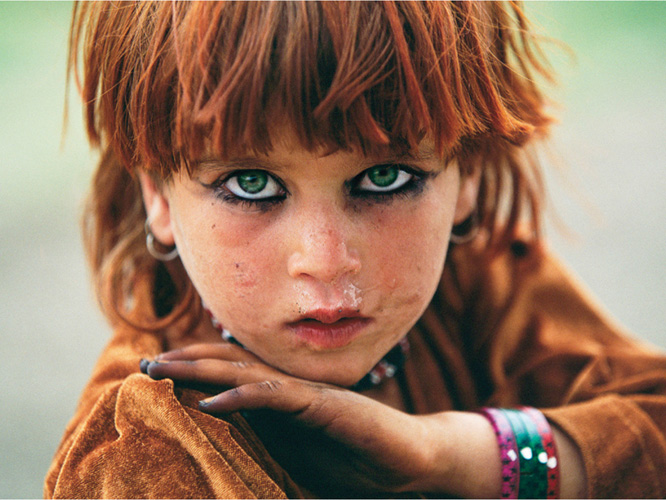
Fig. 1: This portrait of a redheaded Afghan girl was taken in 2004 by REZA in the Pashtun tribal zone in Afghanistan.
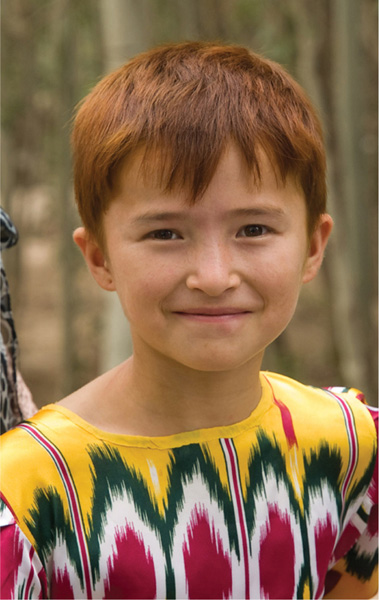
Fig. 2: Uyghur girl photographed in Kashgar, in China’s Xinjiang Uyghur Autonomous Region. The ethnicity of the Uyghur is Turkic, rather than Han Chinese. They see themselves as an occupied people, and identify both ethnically and culturally with the non-Chinese civilization of the Tarim mummies rather than with that of Bejing, referring to their region as “East Turkestan.” Recently there has been ethnic violence in the region, bombings and knife attacks, indiscriminate as these events always are in the victims they have claimed.
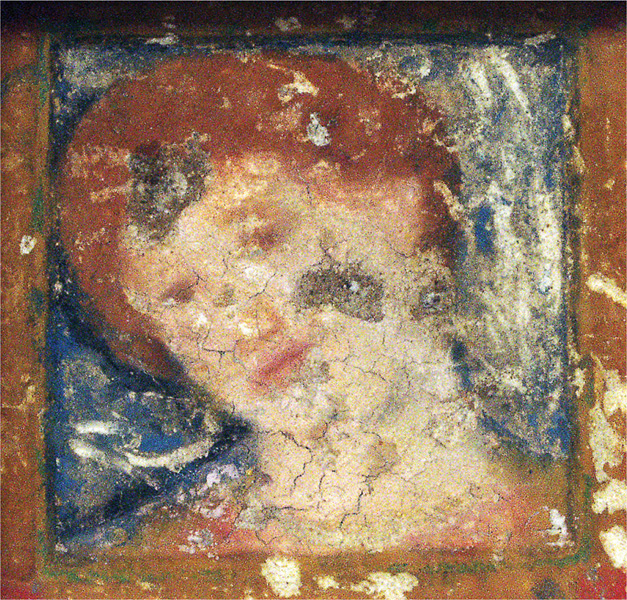
Fig. 4: The red-haired divinity from coffer 32 in the ceiling of the Ostrusha tomb in central Bulgaria. Dating back to 330–310 BC, it is one of the earliest representations of a redhead in Western art.
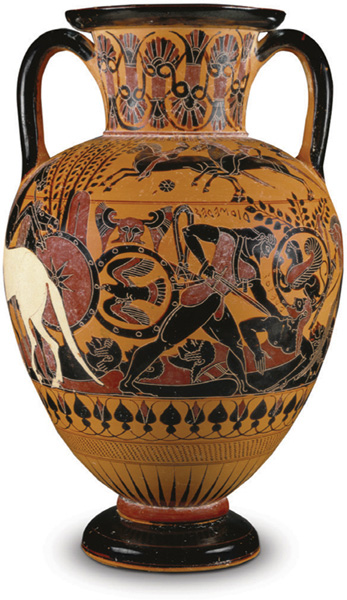
Fig. 5: King Rhesos and a very rude awakening. This Chalkidian black-figure amphora was made in southern Italy about 540 BC. The artist, known to us as the Inscription Painter, uses a red glaze for Rhesos’s hair and beard. As the story was recounted in Homer’s Iliad, Odysseus and Diomedes infiltrated the Thracian camp outside the walls of Troy, hoping to steal their fine horses, one of which can be seen being led away to the left.
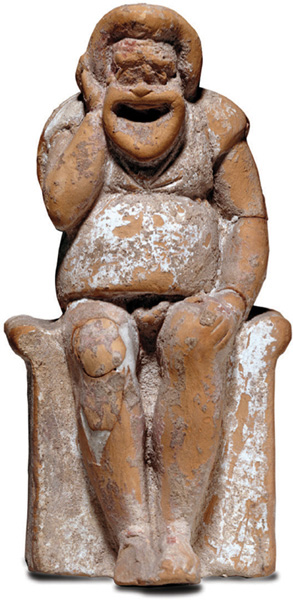
Fig. 6: This tiny terracotta figure, just 13 centimeters high, of an actor playing the part of a runaway slave, was made in Athens between 350 and 325 BC. It came to the British Museum from the collection of Eugene Piot (1812–90). Piot squandered a fortune collecting treasures from across the Classical world. Microscopic remains of red paint still adhere to the figure’s terracotta hair.
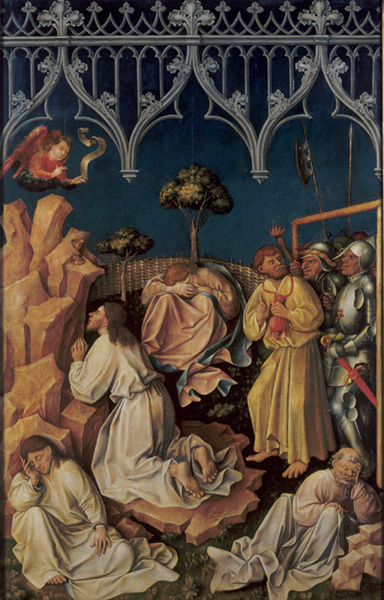
Fig. 7: Gabriel Angler the Elder, The Agony in the Garden, 1444–45, Bayerisches Nationalmuseum, Munich. The altarpiece this panel comes from was made for Tegernsee Abbey in Bavaria, where, four centuries before, in the eleventh century, an unknown monk wrote the Ruodlieb, one of the earliest knightly epics, containing one of the first warnings against men with red hair: “A red beard rarely hides a good nature….”
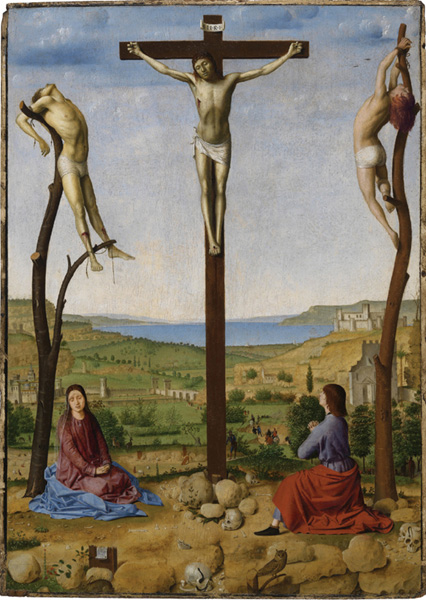
Fig. 8: Antonello da Messina, Calvary, 1475. The well-tended landscape, the figures of the Virgin and St. John the Evangelist, even the central figure of Christ on the Cross seem oblivious of the agonies going on around them to left and right. Note, however, the point being made by the artist in showing the impenitent thief’s red hair. Royal Museum of Fine Arts, Antwerp.
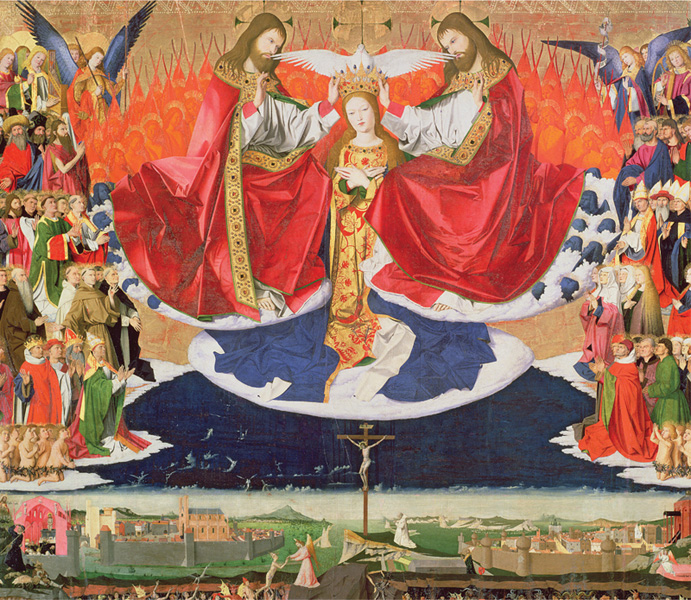
Fig. 9: Enguerrand Quarton, The Coronation of the Virgin, 1454, Monastery of Chartreuse du Val de Bénédiction, Villeneuve-lès-Avignon. The Carthusian order is closed and silent, with monks undertaking a life of prayer and contemplation, each within his own cell. Each cell, however, has a garden, and once a week the community walks in the countryside. An atmosphere of calm and quiet, and of love of the world while being removed from it, permeates Quarton’s painting.
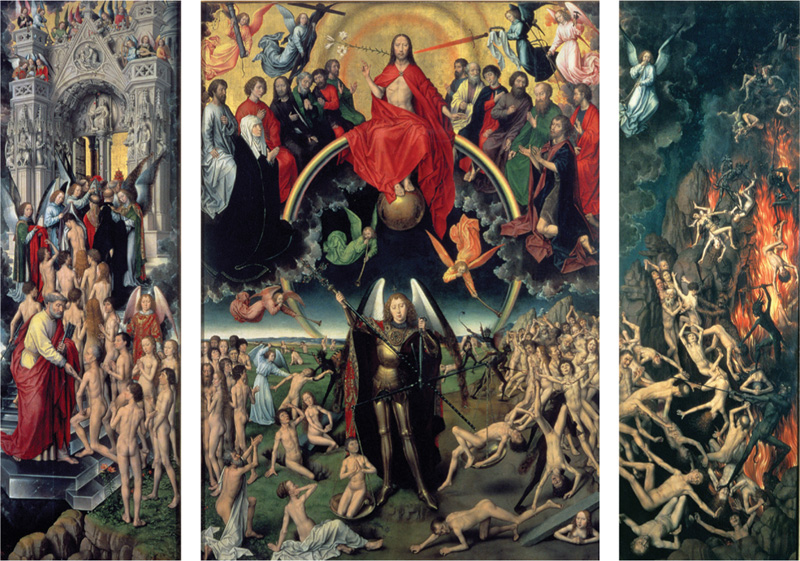
Fig. 10: Hans Memling’s triptych of The Last Judgement, c.1467-73. Memling was around forty years old when he painted this work. Born in Germany, he lived in Brussels and Bruges, and his paintings, which represent one of the summits of Early Netherlandish art, feature redheaded Virgins as well as angels and here, two souls of the saved, walking up the crystal stairs to Paradise.
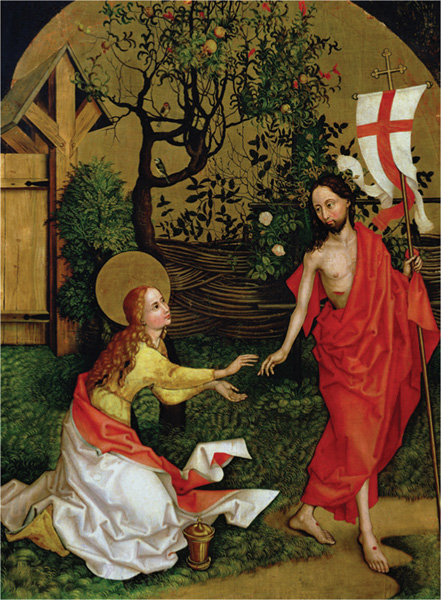
Fig. 11: Studio of Martin Schongauer, Noli Me Tangere, c. 1480. Schongauer, like Memling, was a follower of Rogier van der Weyden. His works, like Memling’s, are prized for their use of color and the quality of their execution. And like Memling, Schongauer created redheaded Virgins, saints, and angels, as well as Magdalenes.
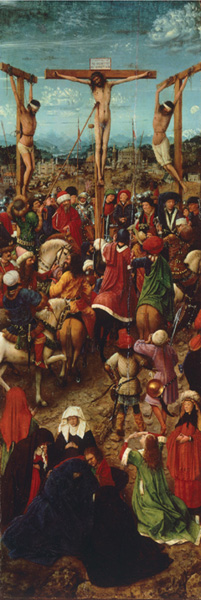
Fig. 12: Jan van Eyck, The Crucifixion, c. 1435–40. This painting is twinned with a right-hand panel showing the Last Judgment. It is the Crucifixion as narrative, and has been aptly called almost an eyewitness account. The Virgin is almost indistinguishable, shrouded in her blue robes as if these are her grief; Mary Magdalene, identifiable by her red hair, lifts up her hands in a gesture that combines horror, pity, and entreaty all at once.
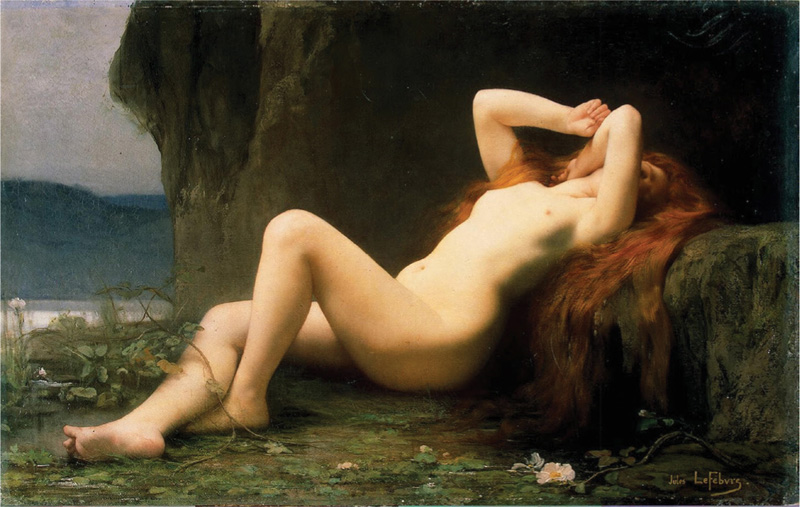
Fig. 13: Jules Joseph Lefebvre, Mary Magdalene in the Cave, 1876. Now in the Hermitage, this work is typical of the highly finished Salon style of painting—so establishment on the surface, and at the same time so ripe for decoding and reinterpretation.
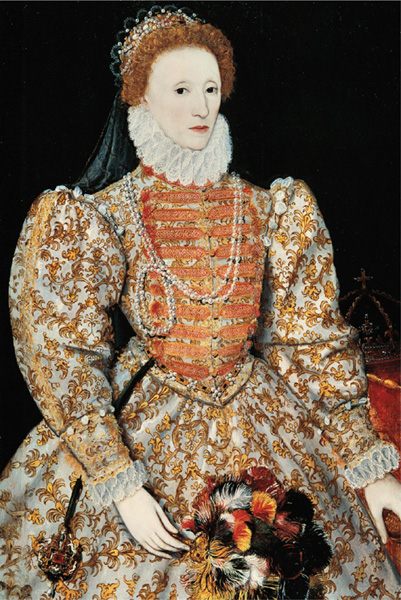
Fig. 16: Elizabeth I, painted by an unknown artist around 1575. Now in the National Portrait Gallery, London, this portrait epitomizes both Elizabeth’s image and her elegance. The choice of colors in her dress and her accessories is perfect for a redhead, the masklike face somehow both ineffably sad and totally remote.
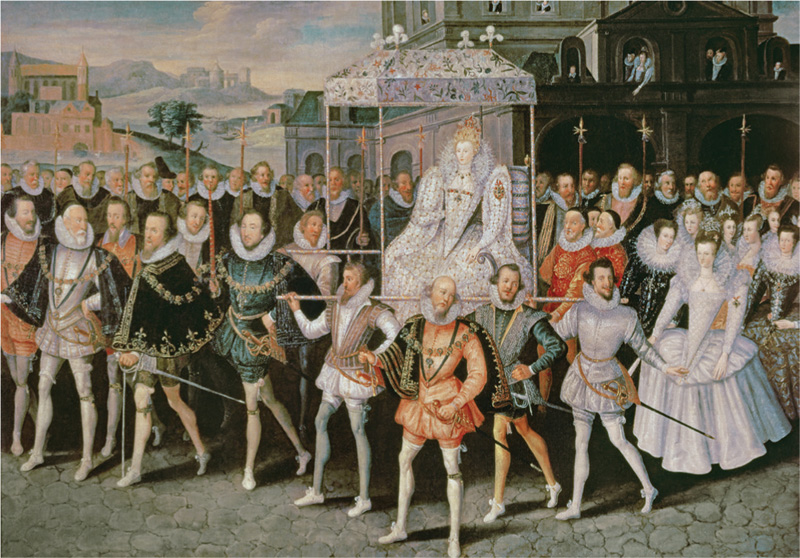
Fig. 17: Robert Peake’s Procession Picture of the Queen, c. 1601. One of the last public images of Queen Elizabeth I, who was to die in 1603, showing her in one of the paler-colored wigs she favored at the end of her life. This is a snapshot of the Elizabethan court at the end of her reign, with the queen surrounded by just about all the men of influence and power of the day, bearing her aloft. At her death, an effigy, gowned and wearing one of her wigs, was carried on her coffin.

Fig. 18: James Abbott McNeill Whistler, Symphony in White, No. 1: The White Girl, 1862. Whistler came to object strongly to the notion that his paintings had any meaning beyond being art. He described this portrait of Joanna Hiffernan as “ … a woman in a beautiful white cambric dress, standing against a window which filters the light through a transparent white muslin curtain—but the figure receives a strong light from the right and therefore the picture, barring the red hair, is one gorgeous mass of brilliant white.”
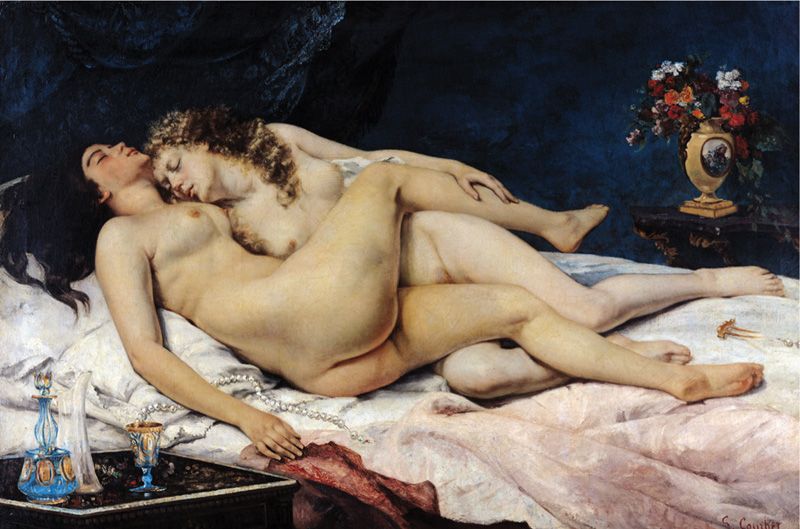
Fig. 19: Gustave Courbet, The Sleepers, 1866. The naked curves, the tumbled, loosened hair… Joanna Hiffernan and an unknown dark-haired model, posed by Courbet for the delectation of Halil Bey, and for the rest of us ever since. The painting is now in the Petit Palais in Paris.
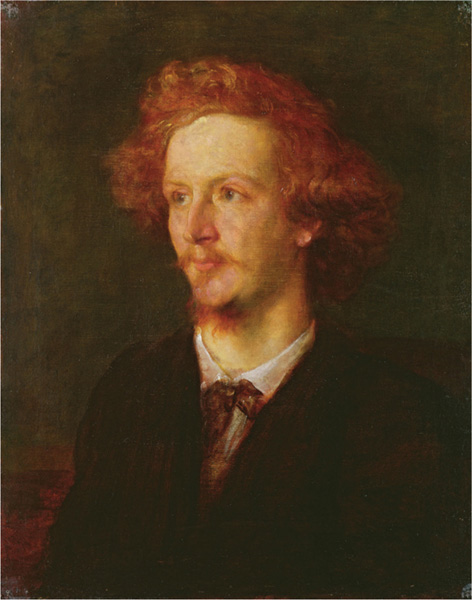
Fig. 20: Algernon Charles Swinburne, painted by G. F. Watts in 1867. At the height of his alcoholism, in 1879 Swinburne would be taken into to the Putney home of the poet and critic Theodore Watts-Dunton, who also provided a refuge for Henry Treffry Dunn after the latter quarreled with Rossetti.
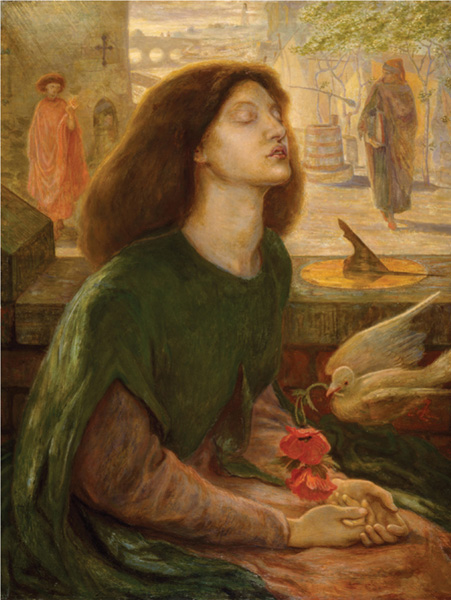
Fig. 21: Beata Beatrix (1864–70). Lizzie Siddal as painted by Dante Gabriel Rossetti after her death. The red-robed figure might be taken as Dante Aligheri, waiting to escort her in the Underworld; the sundial is a centuries-old emblem of mortality. The poppy in the dove’s beak alludes to her death by an overdose of laudanum.
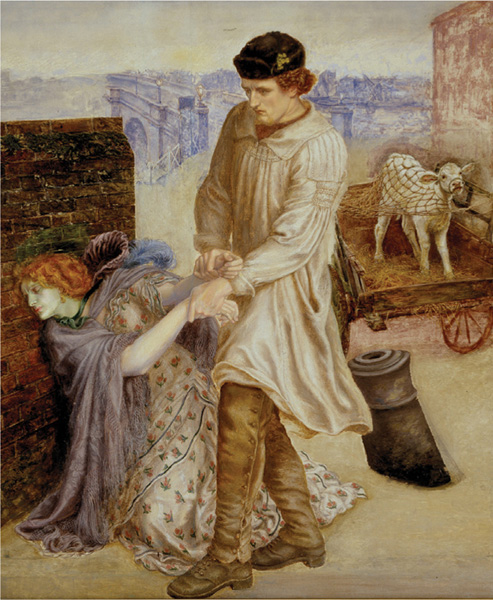
Fig. 22: Dante Gabriel Rossetti, Found, c. 1869 (uncompleted). The calf is meant to typify the woman’s plight. Rossetti published a highly charged poem, “Found,” in his Ballads and Sonnets of 1881; the real Fanny Cornforth, who posed as his model, was photographed proudly wearing the gold earrings of the figure here.
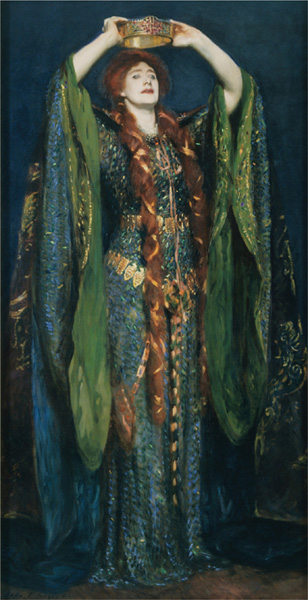
Fig. 23: John Singer Sargent, Ellen Terry as Lady Macbeth, 1889. Terry wrote of the painting, “It’s talked of everywhere and quarreled about as much as my way of playing the part…. Sargent has suggested in this picture all that I should like to convey in my acting.”
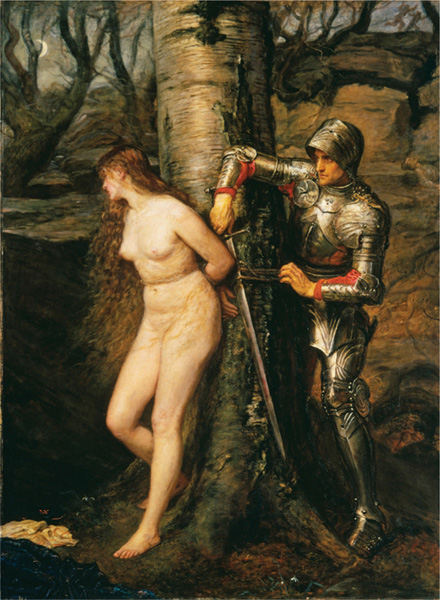
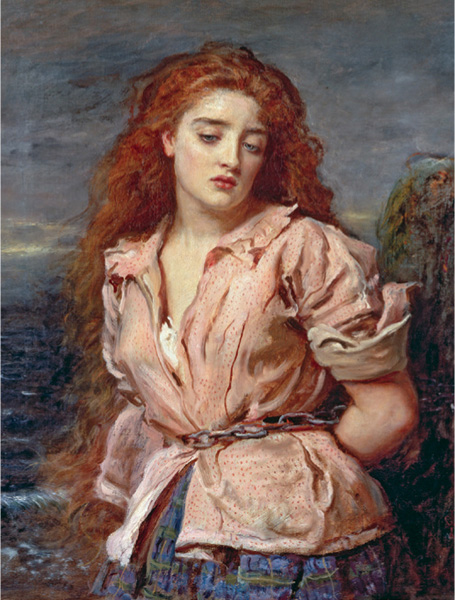
Fig. 24: Sir John Everett Millais, The Knight Errant (1870) and The Martyr of the Solway (1871). The critics had a field day with The Knight Errant, seeing evidence on the woman’s body of “the ligature of draperies,” meaning she had been undressed, and in her face a character not “over pure” or “refined.” In other words, whatever is supposed to have happened to her, she asked for it.
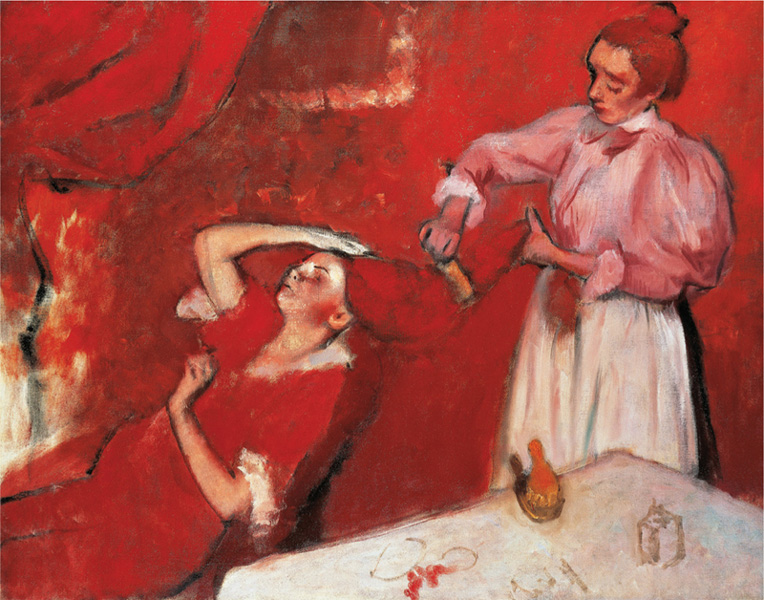
Fig. 25: Edgar Degas, La Coiffure, c. 1896. Is this a servant preparing her prostitute mistress for the night’s work, or an aristocratic young woman being tended to by her maid? Are the two mother and daughter? The one is impassive, absorbed in her task; the other holds on to the roots of her hair with one hand and raises her other in pain. Is the interior where this scene takes place a boudoir, or a brothel? Only one thing is certain: it’s all about the hair.
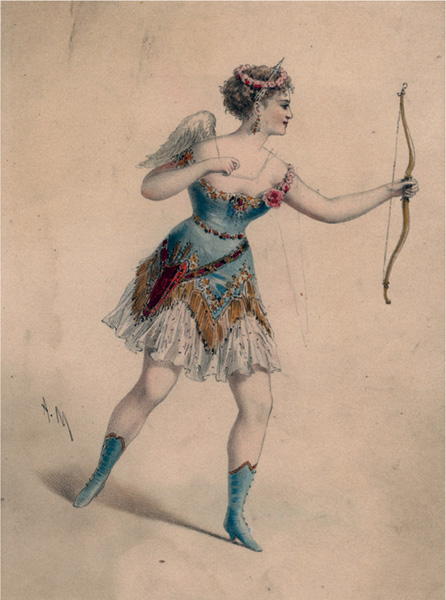
Fig. 26: Cora Pearl (born Emma Elizabeth Crouch) as Cupid in Offenbach’s Orpheus in the Underworld, of 1867. The operetta was notorious for its cancan; Cora by this time had also appeared in public as Eve, and at a dinner party at her château in the Loiret, had herself served naked on a silver platter.
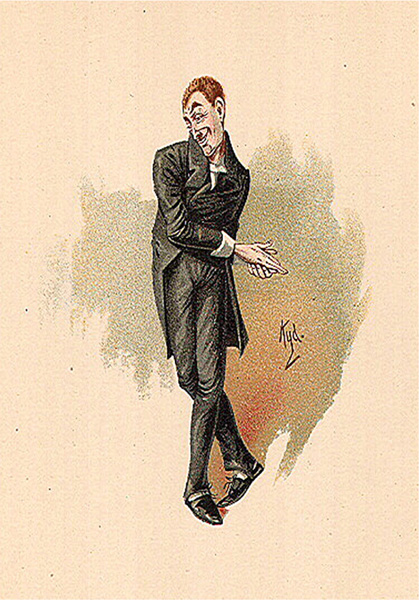
Fig. 27: Dickens’s Uriah Heep, as imagined by “Kyd” (Joseph Clayton Clarke: 1857–1937). Father of ten, Clarke worked as a designer of cigarette cards and as a book illustrator. His Dickens characters still influence how we visualize them today.

Fig. 28: Tintin, who first appeared in 1929. His creator, Hergé, may have been influenced by a freckle-faced red-haired Danish fifteen-year-old, Palle Huld, who in 1928 won a competition to travel around the world, Phineas Fogg–style, and who completed the trip in just forty-four days.
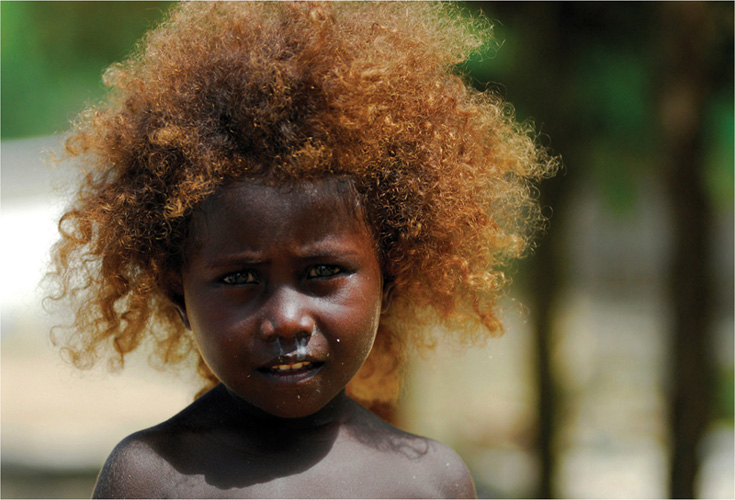
Fig. 29: Around 26 percent of the population of the Solomon Islands carry a unique gene found nowhere else on earth. This gives 5 to 10 percent of them fair hair, which ranges from bright blond to a light ginger.
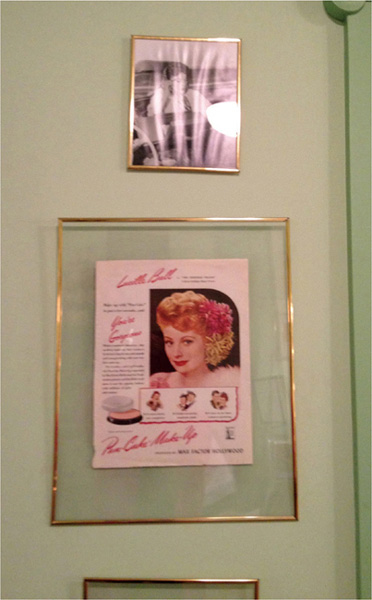
Fig. 30: A detail of the decoration of the Max Factor mint-green “Redheads Only” room at the Hollywood History Museum, with a Max Factor advertisement endorsed by none other than Lucille Ball.
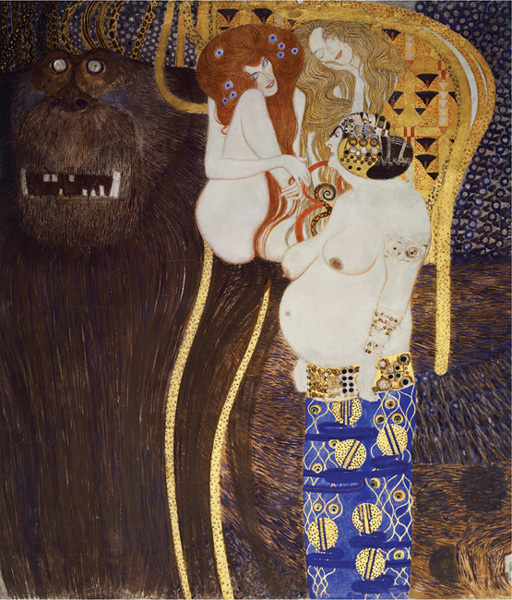
Fig. 31: Gustav Klimt, Lust, from the Beethoven Frieze in the Secession Building, an exhibition hall built in 1897 in Vienna. The building was created to show the work of artists who had seceded from the Austrian establishment, and was financed by Karl Wittgenstein, a steel tycoon and father of the philosopher, Ludwig Wittgenstein. The plump dark-haired figure is Intemperance; the sleeping blonde represents Debauchery.

Fig. 32: Redhead apocalypse. A detail of the group shot from Redhead Days in Breda in 2014. No fewer than six thousand redheads from all over the planet attended the festival.
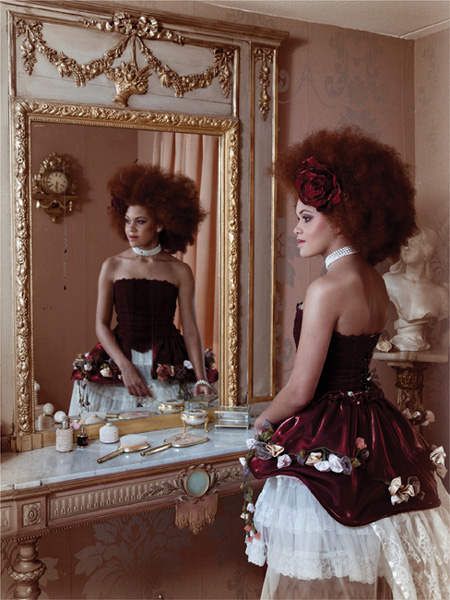
Fig. 33: Sterra Vlamings, a redheaded model of Dutch and Senegalese descent.