
THREE
Travelers fleeing slavery in the newly independent United States in 1782 crossed the Atlantic in search of what they called liberty. Their paths from the American South to Nova Scotia to London and Sierra Leone crossed those of white revolutionaries integrally interested in their plight. Their narratives compiled as they neared the end of their journey revealed the frustrations and disappointments, as well as dreams of the revolutionary era when commerce, religion, and political ideals combined to drive the abolitionists’ colonial projects. Settling at last in Sierra Leone, the black travelers’ liberty amalgamated different ideals gathered en route through the revolutionary era.
On his return from Africa, Swedish abolitionist Carl Wadström encountered an astonishing number of intrepid black sailors who, he observed, “expose themselves voluntarily to great dangers, and to many inconveniences of life, only from a hope of obtaining a more extensive Liberty than at present they enjoy.”1 He knew that it was the American Revolution that had set thousands of people of color in motion. He did not realize that they constituted the largest transatlantic migration of the revolutionary era. These travelers fleeing slavery felt less at home in this revolutionary world than the English poets and Genevan pastors who had settled provisionally in Paris.
In search of their own land, transatlantic cosmopolitans “roved” across three continents, in the words of Olaudah Equiano, whose Interesting Narrative of the Life of Olaudah Equiano, or Gustavus Vassa, the African, Written by Himself took readers on journeys back and forth across the Atlantic. Freed slaves fearing recapture by the victorious American revolutionaries, they followed the British promise of liberty to Nova Scotia, the West Indies, England, and eventually Sierra Leone. As they journeyed along the margins of revolutions, their vision of “a more extensive Liberty” emerged.
Some of these imperial itinerants kept journals; more composed narratives toward the end of their lives based on their memories of arduous sojourns. The “autobiographical turn” of these black writers almost always originated with the reclaiming of an African identity, some tied to a specific ethnic kinship and others to a mythic African past.2 That thrust their narratives into the midst of the discussion over the humanity of Africans at a time when European travelers were chronicling the limitations posed by slavery to American liberty and Americans were exploring the explosive possibilities of the new French liberty. Writing as Africans, but also as Christians, these black writers disrupted the preconceived categories held by their white European and American readers.
Narratives written by freed slaves forced their readers on both sides of the Atlantic to confront the experience of human bondage. Their descriptions of the stench of the close quarters on the Middle Passage on slave ships bound for the Americas were even more disturbing to most eighteenth-century readers than the images of carts rolling to the guillotine in Paris painted by American and English visitors to revolutionary France. Equiano recounted in his widely read Interesting Narrative stories of masters whose “injustice and insanity would shock the morality and common sense of a Samoyed or a Hottentot,” white men who fathered children with their slaves and then worked their own offspring almost to death in the fields, buying and selling them for fifteen pounds.3His eloquent narrative undermined readers’ fundamental assumptions of the humanity of white Christian men and the barbarity of African slaves.
One of the first white women to record her visit to West Africa, Anna Falconbridge purposefully unsettled the assumptions of the readers of her epistolary journal. Although she complained that the daily writing was “really a fatiguing job, being obliged to sit in bed with a book placed on my knee, which serves for a writing desk,” she diligently recorded the incidents of malfeasance, crop failure, and racial disharmony that would call into question the motives of the directors who had sent her husband, a slave ship’s surgeon turned abolitionist, to settle a colony of free blacks in Sierra Leone.4 John Clarkson, a young naval officer and the first governor of Sierra Leone, chronicled his encounters in this new world of free blacks on the African coast that he and the Falconbridges helped to mold.5 Imperialism and abolition “dove tailed” in this new era of freedom, but the obstacles to an easy fit were many.6 Falconbridge’s narrative was reprinted twice in 1794 and reissued in a new edition in 1802, but Clarkson was afraid of adding fodder to the attacks on the antislavery movement that had aligned itself with imperialism and decided not to publish his account.
By contrast, the two-volume work by his older brother, the renowned abolitionist Thomas Clarkson, The History of the Rise, Progress, and Accomplishment of the Abolition of the Slave-Trade by the British Parliament, was widely read at the time and has continued to define our understanding of the antislavery movement in Britain. That was its purpose. Thomas Clarkson attributed the “progress” of abolitionism to Christian altruism, to the convergence of Quaker activists, Evangelicals, and, of course, his own efforts, all informed by a British tradition of liberty.7 His narrative recorded that history of individual choice and action.
The story of collective action to found a free state on the coast of Africa comes from the narratives, published and unpublished, written by the black loyalists and abolitionists who “roved” over three continents and sailed the seas. The revolutions of the indigenous people of Benna, Moria, and Sumbuya among whom black loyalists settled are rarely mentioned in narratives.8 All of these life stories, recorded or not, were integrally intertwined with white commerce and political revolutions on the one hand, but on the other, they were mostly invisible to white revolutionaries. Their paths all crossed because their goals interlocked around the tortuous dilemma of slavery. Their narratives carried their readers along on their quest for a liberty whose definition stretched from the American Revolution through the French Revolution to insurrection in Sierra Leone.
“Great liberty from the Lord”: Freed Slaves after the American Revolution
In 1789, the first year of the French Revolution, Olaudah Equiano defined himself in print as a free black man. Spending much of his life at sea between continents, “Olaudah Equiano, or Gustavus Vassa, the African,” challenged the fixed identities that populated the late-eighteenth-century Atlantic world by claiming multiple ones. “A native of Africa,” he wrote, he felt “almost an Englishman.”9 His elegant portrait inside the cover of his autobiography displayed a black man dressed as a European, open book in hand. It was not only his name that slipped from one paragraph to the next in this revolutionary document. Olaudah Equiano or Gustavus Vassa, the African, as he was named by an owner and as he called himself, filled lecture halls night after night to promote his self-published autobiography on tours of Britain. It was reprinted eight times in his lifetime, with translations published in the United Provinces, Russia, and Germany.
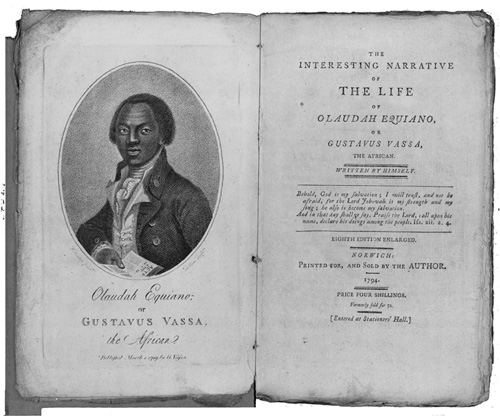
FIGURE 3.1
Frontispiece and title page from The Interesting Narrative of the Life of Olaudah Equiano. Readers would have been struck by the elegant portrait of “the African” in European dress. Courtesy of Prints and Photographs Division, Library of Congress
In the first paragraph of his chronicle, Equiano reflected, “I believe there are few events in my life which have not happened to many.”10 His was the story of thousands of men, women, and children of color his readers had not seen. What made his adventures unique was that he freed himself, and then wrote and published his narrative to document his journey. Equiano wrote out of his conviction that they, as “citizens of the world,” had an obligation “to profess universal benevolence. More particularly, “as Christians,” freed slaves should “commiserate and assist, to the utmost of our power, all persons in distress, or captivity.”11
Olaudah Equiano’s narrative opened in Africa, in “a country where nature is prodigal of her favours, our wants are few and easily supplied,” and where neighbors helped each other to raise houses, expecting “no other recompense than a feast” for their labors.12This idyllic African picture turned on its head the prevailing view propagated by sailors and slave traders of a barren continent inhabited by primitive peoples. The Europeans were the ones who introduced barbarism to the prodigious African continent. Equiano recounted that one day, after all the adults had gone off to till the fields, leaving him alone with his sister to mind the house, two men and a woman scaled the walls of their house and seized the two children. Marched for days on end through the forest in a trek toward the sea, Equiano described being sold several times, sometimes serving a new master for only two or three days, before they reached the slave ships anchored on the coast. In a reversal of the commonly told European sailors’ stories, Equiano portrayed the slave-trading Europeans, not their African victims, as cannibals and monsters. He defined an African identity that slaves could claim as their own, as he challenged the humanity of the white Christian slavers.
In his Interesting Narrative, Equiano recounted in intimate detail his childhood in “Esaka” among the Igbo-speaking people along the Niger River. A recently discovered ship’s register and baptismal record, however, listed South Carolina as his birthplace. That led Equiano’s biographer Vincent Carretta to speculate that the first chapters of Equiano’s journal describing his African origins might be fiction, crafted by a literate black man to convince his white European readers of the evils of the slave trade.13 The historian James Sweet sees Equiano’s shifting African-American-European identity as a record of the fragmented and disjointed lives of men and women of color in the fluid Atlantic world. Douglas Egerton suggests a middle course. “As a boy and man,” Egerton writes, Equiano “told so many contradictory stories that even today it remains unclear which were true and which were fictions crafted for self-protection or for propaganda.”14 Compared with a European, “I might say my sufferings were great,” Equiano himself acknowledged. “But when I compare my lot with that of most of my countrymen, I regard myself as a particular favourite of Heaven, and acknowledge the mercies of Providence in every occurrence of my life.”15 He was not only a freed man, but to add to the ambiguities of his identity, was himself a former overseer of slaves.
Equiano’s description of the Middle Passage was one of the earliest firsthand accounts of the slaves’ transatlantic passage to be published and read by Europeans. His friend Quobna Ottobah Cugoano, who had been abducted from the Fante village of Agimaque on the African coast while he played with the chief’s children, had in 1787 published a blistering attack on the slave trade, Thoughts and Sentiments on the Evil and Wicked Traffic of the Slavery and Commerce of the Human Species, but Cugoano avoided the autobiographical detail that seared Equiano’s account into his readers’ imaginations.16 Equiano told of being herded on board ship as human cargo by “white men with horrible looks, red faces, and long hair.” He feared he had fallen “into a world of bad spirits, and thought that they were going to kill me.” When the ship anchored off Bridge Town in Barbados, Equiano reported, white men came on board to assess the African captives who had been divided into parcels. Driven into a large pen on shore as if they were wild beasts, brother was parted from brother, child from parent, husband from wife. “Is it not enough that we are torn from our country and friends to toil for your luxury and lust of gain?” Equiano asked his readers. “Must every tender feeling be likewise sacrificed to your avarice?”17 Who were these unchristian, inhuman traders in slaves, he asked, challenging his readers’ consciences without directly calling for the abolition of slavery.
Transported to Virginia, separated from his countrymen, Equiano was set to work weeding grass and gathering stones on a Virginia plantation, unable to converse with anyone for want of a common language, before being sold to an officer in the British navy who took him to England in 1757. There Equiano was taught to read by two of his master’s sisters, who also baptized him. Equiano purchased his freedom in 1766 with the money he had made as a shrewd independent entrepreneur while enslaved. He recalled in his narrative that he, “who had been a slave in the morning, trembling at the will of another, was become my own master and completely free.”18 Manumission returned Equiano to “my original free African state.”19 The Americans had stolen his liberty, turning him into a commodity. He bought back his freedom by working their commercial system. His narrative documented his oppression, but also the resolve and intelligence of the man who had been their slave. It extended liberty from the political term employed by American and European revolutionaries to encompass the freedom to be human.
Equiano’s timely narrative troubled the consciences of his British readers just as Parliament opened a new debate on the slave trade. He told the British Parliament that he had written the Interesting Narrative “to excite in your August assemblies a sense of compassion for the miseries which the Slave Trade has entailed on my unfortunate countrymen.”20 Ottobah Cugoano’s treatise, published two years earlier and translated into French, made the case even more directly against Christians who plied the slave trade in the name of their religion. “The destroyers and enslavers of men can be no Christians,” Cugoano explained simply, “for Christianity is the system of benignity and love.”21
A free man, Equiano settled in London. He had thirty-seven guineas in his pocket. England represented a free state to him. In 1772, Lord Chief Justice Mansfield had sided with an escaped slave, James Somerset, against his master, who had intended to carry him back to the West Indies. Thereafter, slaves who escaped their masters and found refuge in the black community in London were effectively free, even if few found steady employment. The abolitionist Granville Sharp, who had defended Somerset, personally supplied relief as far as his resources would stretch, even though private charity was not nearly sufficient to relieve the plight of the swelling population of free blacks in the British capital.
Equiano intervened himself in 1774 to prevent the transportation from England of a free black sea cook, John Annis, whose master in Saint Kitts reclaimed him. The lawyer whom Equiano hired on Sharp’s advice lost the case. The abolitionists could do little more than watch as Annis was dragged back to Saint Kitts, staked to the ground with pins through his ankles and wrists, and flogged. In his narrative, Equiano refused to be discouraged, predicting that the day would come when all the “sable people shall gratefully commemorate the auspicious era of extensive freedom.”22 He did warn of the bloody insurrections that would ensue if full rights were not readily granted the Africans who had been enslaved by Christians throughout the Americas.
It was not long before Equiano set sail again, journeying to Greece, Turkey, Portugal, Naples, Madeira, Barbados, Grenada, Jamaica, Nevis, and the North Pole in search of a passage to India. Throughout the narrative of his travels, he praised “the Lord God on high for all his mercies!”23 Equiano glimpsed Providence in his narrow escapes from shipwreck and reenslavement. To protect himself from being sold back into slavery, Equiano’s friend Cugoano was baptized, taking the name John Steuart. A free man, Cugoano learned to read and to write. He thanked God that through Christianity he had obtained liberty and literacy. Theirs were spiritual as well as physical journeys, recognizable to their readers as stories of struggle and Christian redemption. Equiano concluded that true freedom came to him at last when he “was received into church-fellowship” and “rejoiced in spirit, making melody in my heart to the God of all my mercies.”24 Freedom meant more than being unshackled. It implied salvation in religious terms.
Religious convictions prompted other former slaves to recount the stages of their “pilgrimage” to freedom, away from slavery and also from sin. The conversion stories at the center of the narratives, unpublished as well as published, emphasized the equality of all before God and the possibility of personal salvation. They celebrated individual struggles and divine grace. The religious freedom they portrayed appealed particularly to men and women who had broken the physical chains of slavery but had yet to chart a course for themselves through a revolutionary world.
Boston King was raised on the Waring plantation in South Carolina by parents he characterized in his 1796 journal as God-fearing: his father read Scripture alone in the woods every Sunday afternoon, and his mother ministered to the sick. Put to work in his master’s house when he was six years old, at nine he was sent outside to tend cattle, where, contrary to his religious upbringing, he “learnt from my comrades the horrible sin of swearing and cursing.” At the age of twelve, he recalled in his narrative, “it pleased God to alarm me by a remarkable dream.” King “dreamt that the world was on fire, and that I saw the supreme Judge descend on his great white Throne! I saw millions on millions of souls; some of whom ascended up to heaven; while others were rejected, and fell into the greatest confusion and despair.” Chastened, King resolved to serve God and no longer to swear. He wrote down his memories to acknowledge “Almighty God,” who “delivered me from the hand of the oppressor, and established my goings.”25
King won his physical freedom by fleeing the plantation and joining the British in Charleston. “They received me readily, and I began to feel the happiness of liberty, of which I knew nothing before,” he wrote, “altho’ I was most grieved at first, to be obliged to leave my friends, and remain among strangers.”26 The war for American independence created the conditions for the physical exodus of slaves away from the plantations of American patriots. Lord Dunmore’s proclamation promising freedom to rebels’ slaves who joined British forces attached liberty to loyalty to the British and their king, not to the cause of the American revolutionaries. The black loyalists who wrested their freedom from the American patriots claimed a liberty rooted in a long British tradition of constitutional liberty.
David George, like Boston King, wrote his story toward the end of his life under the guidance of church leaders in England. He was born into slavery in Essex County, Virginia, in about 1743. The hanging of his brother Dick from a cherry tree, suspended just above the ground, with a pole between his legs, and the whipping almost to death of his mother, the master’s cook, led him at nineteen to run away from the plantation. He was quickly captured by Creek Indians and sold to George Galphin, a plantation owner and trader in deerskins. One day in the fields, a black traveler warned the young man given to profanity that if he continued to live “a bad life and had no serious thought about [his] own soul,” he would “never see the face of God in glory.”27 Chastened and baptized by a passing preacher, George learned to read from the white children on the plantation. When the American revolutionaries banned whites from preaching to blacks for fear that Christian messages of freedom and equality might incite the slaves to rebel, George organized the first black Baptist church in America. In 1778, as British troops approached Silver Bluff, George’s master fled and the black congregation seized the occasion to escape, finding shelter at the British encampment twenty miles upriver. They joined the hundred thousand other slaves who had responded to Lord Dunmore’s promise of freedom.
The eventual American victory over the British filled these former slaves not with joy but with “inexpressible anguish and terror,” George wrote in his narrative. Rumors flew that as part of the peace settlement they would be handed back by the defeated British troops to “our old masters coming from Virginia, North Carolina, and other parts.” George was awakened by nightmares of these American patriots traveling north and “seizing upon their slaves in the streets of New York, or even dragging them out of their beds.” Now that he was free, he could not imagine a return to slavery, as King called it, a life “without liberty.”28 In the end, the British ensured that many of the black loyalists were registered in the Book of Negroes and allowed to leave the new republic.
More than half of the former slaves who had fought for the British, including George and his family, sailed to Nova Scotia, where the British promised them “freedom and a farm.”29 Land ownership was part of the American understanding of freedom that the former slaves carried with them from the plantations. Independent men owned land. Another three thousand black loyalists boarded ships sailing for Jamaica and Saint Lucia, and two thousand freed slaves ended up in east Florida, which became a Spanish territory after the American Revolution. Most of these Africans were enslaved again when they reached their destination.
The black loyalists who sailed north to Canada settled along the rocky coastline of Nova Scotia. They founded villages in the dense forests, keeping their distance from the land already cleared by white settlers. Although the British government dispensed rations of flour and pork to the newly arrived Canadian settlers, it failed to follow through on the guarantee of one hundred acres for each family. The black loyalists had been promised land allotments equal to “the rest of the Disbanded soldiers,” the whites.30 In that promise, they were disappointed.
That first winter, forced indoors by the continuous blizzards, Boston King recalled, “the work of religion began to revive among us; and many were convinced of the sinfulness of sin, and turned from the error of their ways.” King’s wife, Violet, “awakened” by the preaching of Moses Wilkinson, the leading Methodist in Birchtown, struggled with the Lord for a year and a half, according to King, until she was freed from her fears and her soul “set at perfect liberty.” Unable to find the same freedom, King trekked into the forest, buried three feet deep in snow, with only a blanket and a firebrand. There, he wrote, the devil convinced him that he was “predestined to be damned before the foundation of the world.” He returned home and dutifully read Scripture daily at morning and evening prayer meetings until at last, when he least expected it, “the Lord again spoke to my heart, ‘Peace be unto thee.’ All my doubts and fears vanished away: I saw, by faith, heaven opened to my view, and Christ and his holy angels rejoicing over me.”31Freed from the doubt that had enslaved his soul, King was still without employment in the midst of a famine so severe that poor people “fell down dead in the streets, thro’ hunger.” In 1791, he moved his family to Preston and began preaching.
David George, too, “had great liberty from the Lord.”32 He traveled up and down the Nova Scotia coast with his wife and their two children in search of a place to preach. Baptist services, held in kitchens, chapels, or, as in George’s case, the woods, were thunderous, emotionally charged affairs, “groanings, screamings, roarings, tremblings & faintings … with a falling down & rolling upon the floor, both sexes together.”33 George recalled, “I was so overjoyed with having an opportunity once more of preaching the word of God that after I had given out the hymn, I could not speak for tears.” Wherever George went, he wrote in his narrative, his message of freedom and equality attracted large numbers of black worshipers, including slaves who “were so full of joy that they ran out from waiting at table on their masters, with knives and forks in their hands to meet me at the water side.”34 George established seven “New Light” Baptist churches in outposts throughout Nova Scotia. This was not the Christianity of their former masters, who had preached subordination. Evangelical Christianity promised emancipation for the soul, a hope requisite to life in such harsh conditions.
The black loyalists would continue their quest for a political freedom rooted in land of their own. Their time in Nova Scotia, although marked by disappointment, deepened the black loyalists’ attachment to their newly won liberty and to the British king who guaranteed it. They had won their freedom through their loyal service to the British. That British loyalty would be as important to their identity as free people as their ownership of land. Both were their heritage from the American Revolution.
Clarkson and Sharp: “To expose to publick view the cruelties practiced in it”
In May 1787, a small group, among them Granville Sharp, known for his defense of the slave James Somerset’s rights before Judge Mansfield, and the well-traveled American abolitionist William Dillwyn, met at the London shop of printer James Philipps to establish the Society Instituted for Effecting the Abolition of the Slave Trade. They believed fervently that limiting importation of slaves to British colonies would lay “the axe at the very root” of the evil institution.35 Sharp and Dillwyn had met thirty years earlier, when Dillwyn, a Quaker merchant, delivered a letter to Sharp in London from Anthony Benezet, the leading Philadelphia abolitionist.36 Quaker abolitionists in America had circulated Sharp’s letters calling attention to “the present miserable and deplorable slavery of Negroes and Indians, as well as white servants in our colonies.”37 The web of antislavery correspondence stretched across the Atlantic, following the lines laid down by the first Atlantic movement, the slave trade that had bound Africa, Europe, and the Americas since the seventeenth century.
Sharp attested in his memoirs, later edited and published by Prince Hoare, that the abolition of slavery was a moral duty for him.38 An evangelical Anglican, son of the archdeacon of Northumberland, he shared neither the Enlightenment faith in reason nor the revolutionaries’ commitment to the truth as an instrument of conversion. His vision, guided by fear of the coming judgment day, had more in common with that of black loyalists than with that of enlightened philosophers. Thomas Clarkson, son of an Anglican minister and author of a prize-winning Cambridge thesis attacking the slave trade, was convinced of the power of the truth. Believing that “nothing more was necessary than to unfold the true state of the Slave Trade, and to expose to publick view the cruelties practiced in it,” Clarkson set out on horseback in the summer of 1787 to gather evidence for a public antislavery campaign.39 He interviewed captains and inspected slave ships docked in British ports, talking along the way with ships’ physicians and former slaves. Late into each night, Clarkson read letters describing the terrible conditions of confinement on the Middle Passage, poured over muster lists, and diagramed the holds of the ships in which slaves had been transported. When he finally did go to bed, he recalled in his influential narrative, “My rest was frequently broken by the visions which floated before me. When I awoke, these renewed themselves to me, and they flitted about with me for the remainder of the day.”40
In Manchester, Clarkson met Thomas Walker and the radical Deist, lawyer, scientist, and philosopher Thomas Cooper, leaders of the Manchester Society for Constitutional Information, who proposed to petition Parliament against the slave trade. Petitioning had previously been reserved for privileged groups, such as nobles or clergy, with strong claims on government attention, but the Manchester Society planned to collect names of common citizens at mass public meetings. Their drive spread rapidly. By the end of 1788, more than one hundred petitions had been gathered from all over Britain, including slave-trading ports like Bristol. The Manchester petition alone had 10,639 signatures; the petition from York bore 1,800, one quarter of all adult males in that city. The abolitionists’ campaign brought workers and artisans into the heart of British politics.
The organizers of the drive refused to allow women to sign their petitions, lest opponents dismiss the cause itself as frivolous. Still, Manchester women lent substantial financial support, their “ladies subscription” contributing almost a quarter of the income of the antislavery society. Too, they summoned men to action that they themselves were forbidden to take, reminding husbands engaged in business “that some attention is due to the Humanity of our Commerce as well as to the Gains of it.”41 Beginning in 1791, women across Britain also boycotted sugar, the largest import from the colonies where slaves labored. Abolitionists assumed that as mothers, women would understand the suffering of the slaves, and as consumers, they would connect that colonial misery to British families’ consumption of sugar. Three hundred thousand families of “all ranks” and political persuasions joined the boycott.42 The arrival in London of black loyalists fleeing American independence brought the problem of the slave trade home to Britain. The London Society elicited and published the testimonies of the first black speakers and writers many Englishmen and women had ever heard or read.43 Clarkson postulated in his narrative on how quickly “light and information proceed under a free government in a good cause.” All it took to begin was one individual who “communicates his sentiments to others. Thus, while alive, he enlightens; when dead, he leaves his works behind him.” Accounts such as his would perpetuate the antislavery campaign, “encouraging us in libraries” into the future.44
How much more effective were individuals combined in a society. Together, Clarkson noted, the Anti-Slavery Society “had produced a kind of holy flame, or enthusiasm, and this to a degree and to an extent never before witnessed.” The society, Clarkson boasted, arrested “the attention of the nation.”45 In 1788, the French journalist Jacques-Pierre Brissot wrote the London Society and asked for permission to join, noting “the intimate relations that link England and France to each other.”46 He promised financial support from Genevan banker Étienne Clavière, but the London abolitionists politely suggested to him that French and Swiss resources would be better spent in France. Rebuffed, Brissot organized the Société des Amis des Noirs, or, as British visitors to Paris called it, the Society of Friends of Negroes.
In February 1788, the philosopher Mirabeau, the journalist A. M. Cérisier, and the marquis de Lafayette joined Brissot at the first meeting of the Société chaired by Clavière. Its annual membership dues of two louis effectively limited the French Société to nobles and wealthy bourgeois, but it did offer honorary memberships to visiting abolitionists. In recognition of “their zeal for everything that concerns humanity, the interest they have demonstrated in abolition, and their influence on the other sex,” the Parisian Société admitted women.47 Their first order of business was to establish correspondence with British abolitionist societies. Brissot read aloud British abolitionists’ essays and American Quakers’ letters. The French society also reprinted Granville Sharp’s Plan to Abolish the Slave Trade.48
Basing its campaign in the writings of French philosophers, the French Société reminded the National Assembly that the Declaration of the Rights of Man had “engraved on an immortal monument that all men are born and remain free and equal in their rights.”49 They had but to “follow nature” and abolish slavery.50
So convinced were they of the philosophical inevitability of their cause, the Société did not bother to rally popular support. The Genevan revolutionary exile Étienne Dumont scoffed that in contrast to the London Society, the Parisian Société was “not very respectable for its numbers, its activity, or indeed anything, but the goodness of its intentions, and the virtues of many of its members”; other foreign visitors complained that meetings were tediously formal.51 Wadström, who kept the Société’s minutes while he was in Paris, noted that it was often impossible to assemble enough members for a discussion, and that a number of those who came to the meetings sauntered in over an hour late. The secretary sent out frequent reminders to be punctual. Brissot invited Jefferson to join, but he refused even though his chargé d’affaires, William Short, was active in the Société. Jefferson assured them that no one desired the end of the slave trade and of the institution of slavery more than he did, but that public announcement of his membership in a French society would make him less effective in opposing slavery at home.52 He hoped French abolitionists would understand his prudence. The leaders of the Société voiced their surprise at the equivocation of the contributor to two declarations of rights.
When the Société did decide to petition the National Assembly, it asked the British, more experienced in outreach, to collect signatures for them. The British refused, but sent Thomas Clarkson to assist. British parliamentarian and abolitionist William Wilberforce hoped that “if an application were made to them judiciously,” the French revolutionary leaders might “be induced to take the Slave trade into their consideration, and incorporate it among the abuses to be done away.”53 As soon as Clarkson arrived in Paris, rumors of the presence in the French capital of an English spy intent to “impose equality on the French Nation” led Lafayette to offer Clarkson shelter in a hotel near his own so that he could protect the English abolitionist from the mobs he feared would gather.54 National suspicions undermined international abolition. Caribbean planters camped out in the French capital lobbied against the Société as a British-inspired conspiracy to ruin the French colonies by cutting off their labor supply.
On 21 August 1789, Clarkson attended his first meeting of the Paris Société, but his expectations that the French, who had abolished feudal privileges on 4 August, would also put an end to the slave trade were quickly dashed. Clarkson was unimpressed by the sparse attendance of members at the Paris Société; even Lafayette claimed he was too busy with the National Assembly in Versailles to attend. Clarkson, though, “found great delicacy as a stranger” and generally kept his own counsel.55 The politics of the French Revolution seemed to Clarkson to have eclipsed the antislavery movement in Paris. How different from England, where the two movements seemed to evolve together. Not so in Paris.
One evening when Clarkson was dining with Lafayette, or so he recalled in his narrative, they were joined by a delegation from the French colony of Saint-Domingue, six men “of a sallow or swarthy complexion … already in the uniform of the Parisian national guard.” The deputies led by Vincent Ogé had come to Paris to demand “that the free People of Color be put upon an equality with the whites” and be seated as delegates to the National Assembly.56 A free man of color, Ogé had been born in the Dondon parish outside of Cap Français, on a coffee plantation owned by his mother, a free woman of color, and his father, a white man. Educated in Bordeaux, he was apprenticed to a goldsmith there before returning to Saint-Domingue. Ogé returned to France in 1788 to fight the construction of a road through his family’s plantation and to engage in trade.57 He was joined in Paris by Julien Raimond, another wealthy free man of color, who had come to France to lobby in 1783. Clarkson thought these delegates of color from Saint-Domingue should be seated in the place of the white delegation.
In the National Assembly, Mirabeau challenged the mandate of the white delegates who claimed to represent the people of Saint-Domingue. Condorcet echoed, asking how a free nation could seat delegates who forcibly kept slaves. Alarmed, colonial planters collected petitions from all of the French ports protesting the claims of the free people of color. The Société in response condemned the colonial planters as aristocratic interlopers “a thousand times more odious than the Nobles.”58 When the Assembly refused to reconsider the exclusion of free men of color, Ogé warned the white revolutionaries, if they would not recognize mulattos as free men, “Our own arms shall make us independent and respectable. If we are forced to desperate means, it will be in vain that thousands are sent across the Atlantic to bring us back to our former state.”59
Ogé left Paris at the end of 1789, both frustrated by the continuing delays in the National Assembly and inspired by the ideal of the citizen militia whose uniform he had worn so proudly. He tried to charter a ship in Le Havre from a captain who had made it through the British blockades of the American War for Independence, but that fell through. Finally, Ogé sailed to Saint-Domingue by way of England and America, where he collected funds, arms, and ammunition. Thomas Clarkson received him in London, but with much trepidation, “for the errand of the deputies of colour to France was as odious to the slave-merchants and planters of England, as it was to the white colonists at Paris, and I trembled therefore at the thought of being seen in company with Ogé in London, lest it should do a serious injury to our cause.”60 Clarkson gave him money for his passage to America. Ogé spent two weeks in South Carolina before returning to Saint-Domingue.
Ogé landed near Dondon, where a veteran of the American Revolution, Jean-Baptiste Chavannes, had not only petitioned the Provincial Assembly, protesting the unequal treatment of free colored militia, but had organized an assembly of free colored people. Together, Ogé and Chavannes wrote letters to the governor of Saint-Domingue and the Provincial Assembly demanding that they enfranchise all free citizens “without distinction” of race. Comparing themselves to the French Third Estate, they levied the first explicit attack on the colonial racial order based on the principles of the French Revolution.61 After soldiers tried to arrest Ogé and Chavannes, three hundred men assembled at Chavannes’s house. Their makeshift militia took the town of Grande-Rivière, disarming whites and imprisoning several men overnight in the town jail.
One of the plantation owners captured by the militia threatened the rebels with vengeance from the French army. Ogé allegedly countered that he had just come from France, where he enjoyed “the protection of men in power. Those who dominate the National Assembly are completely devoted to us.”62 What happened next is uncertain. In his own testimony, Ogé referred to only one battle, followed by a long spell of camping out on farms and the flight across the border into Santo Domingo. The narrative that has informed most historians, written by Jean-Philippe Garran-Coulon in 1795, described a two-wave attack on the men of color, the first unsuccessful and the second by a larger force under Colonel Cambefort.63 Ogé asked the Spanish for asylum, but the Spanish instead turned them over to the French. Ogé and Chavannes were tried, forced to repent their crimes on bended knee, a noose around their necks, tied to a wheel, and broken on a scaffold. Their heads were cut off, mounted on pikes, and displayed on the roads to their homes. Thirty other rebels were sentenced to death two days later. Colonial officials claimed to have found a Wedgwood abolitionist medallion from British abolitionists and an antislavery pamphlet from France in Ogé’s luggage. They refused to believe that Ogé could have acted on his own.
In France, the Société took up Ogé’s cause in the National Assembly, championing him as a defender of the rights of man who resisted oppression in the name of the French Revolution. They recounted his story to make it clear that the villains were the white planters who had perverted the National Assembly’s decrees. With rumors circulating in Paris that agents of the Société were trying to rouse revolutionaries throughout the French colonies to follow the American example and that the Société was supplying twelve hundred guns to slaves on Saint-Domingue, soldiers searched the Société’s meeting rooms in Paris. They found papers and books, but no weapons.
The defeat of Ogé’s rebellion in Saint-Domingue reverberated across the Caribbean. Authorities in Spanish Santo Domingo worried that “innumerable mulattos of the same condition and mode of thinking as Ogé, and perhaps also many discontented whites with depraved ideas,” would follow Ogé into the Spanish territory.64 They summoned troops from Spain and Puerto Rico “to form a Cordon to prevent any communication whatever between the French and Spanish part of the Island.”65 The French were identified as the source of revolutionary contagion that threatened to incite violence throughout the Caribbean.
In the end, though, the French Revolution overran the antislavery movement, at least in the metropole. Jacobins imprisoned or guillotined the leading French abolitionists, including Lafayette, Brissot, and Condorcet, for their political moderation. The Société des Amis des Noirs was silenced, resurrecting itself only in 1796 to stake out an argument in Paris against the slave trade with the backdrop of colonial insurrection.66
Sierra Leone: “Civilising Africa”
Abolitionists and imperialists might strike us as strange allies, but at the end of the eighteenth century their beleaguered goals seemed compatible, at least to them. That explains why, in January 1787, two ships left their moorings on the Thames with about 250 poor black passengers on board and sailed for Spitsend near Portsmouth, where they were joined by a third and a naval escort to head for Africa. British antislavery activists saw in this mission a solution to the inconvenience of so many poor blacks lodged in London. If abolitionists believed in colonization, it followed that the resulting expansion of commerce with a free African colony would promote the cause of abolition, or so Equiano, a supporter of the African resettlement scheme, had been convinced. Others believed that the project in Sierra Leone would help to reassert British moral authority in the Atlantic world, an authority undermined by the American Revolution.67
Equiano should have been aboard one of the four ships, but they sailed for Sierra Leone without him. Although the company had hired him as commissary, the first black man to serve in an official capacity for the British government, he did not remain in his position for long. He observed the white superintendent pilfering provisions and reported the offense to a naval officer and to his friend Ottobah Cugoano in a public letter published in the Public Advertiser. The Navy Board responded to the complaint by relieving Equiano of his position, charging him with inciting discord. Equiano was put ashore. Instead of partnership with the British, Equiano found contemptuous patronizing.68 His experience sums up the abolitionists’ venture into colonization.
The naturalist Henry Smeathman had spearheaded the founding of a colony to absorb the black expatriates sheltering in London, and to promote British commerce. Smeathman, who in his travel journal proposed the fertile land lying in the shadow of verdant mountains of Sierra Leone as a site for colonial development, expected crops would flourish with little attention and a simple hut would protect against the elements. He saw in Sierra Leone a free colony, “a sanctuary for the oppressed people of colour,” and predicted that over time the promise of liberty in this African colony would exert an influence “wider than even American Independence.”69 From the African shore it would shine as a model of multiracial colonial possibilities, a beacon of Christian liberty.
A skeptical friend sneered in 1783, when Smeathman set off to raise funds for his venture, “Master Termites is gone to Paris to tell Dr. Franklin of his plan for civilising Africa.”70 Benjamin Franklin listened respectfully, but it was Granville Sharp who advanced “much more money than a private Person in my situation ought to have done,” convinced as he was that “the Establishment of a Free Settlement on the Coast of Africa for honorable Trade would be the most effectual means of destroying the Slave Trade.”71How better to challenge the arguments that slavery was necessary to the economic profitability of a colony than to establish a colony of free blacks engaged in the free trade of sugar and other agricultural products?
How better also to refurbish Britain’s image after the American War for Independence? In response to a correspondent who “dislikes the name of a colony and wishes rather to promote a free settlement,” Sharp explained that under “this glorious Patriarchal system of Frankpledge,” with its “Regular Rotation of all the Males from 16 to 60 with their own Arms in their own Hands … Colonies or even Kingdoms and Monarchies may be rendered perfectly free and happy.”72 British colonial rule could be compatible with freedom.
Smeathman was not the only traveler who saw beyond the rapacious slave traders infesting the African continent. C. B. Wadström lobbied Swedish King Gustaf III to establish a colony, a New Jerusalem, that would extend full human rights to blacks in Africa. He persuaded the Swedish government to send a team to West Africa to survey the prospects. Thomas Clarkson, who met Wadström and his colleague Andrew Spaarman on their return from Africa, recalled in his journal that the Swedish abolitionists “showed me their journals, which they had regularly kept from day to day” as they traveled through the lands bordering Senegal. “In these I had the pleasure of seeing a number of circumstances minuted down, all relating to the Slave trade, and even drawings on the same object.” From the Swedish journals, he “obtained a more accurate and satisfactory knowledge of the manners and customs of the Africans … than from all the persons put together whom I had yet seen.”73 The journals chronicled the promise of Africa. Clarkson helped Wadström publish his Plan for a Free Community upon the Coast of Africa, with all of the unconscious paternalism common to the antislavery movement. Clarkson agreed with Wadström’s declaration that “civilized nations for their own advantage must of necessity act unanimously for the happiness of the barbarous and uncivilized.”74
The poor blacks in London had not been as easy to convince. Africa for them resonated with the threat of reenslavement. Too many remembered kidnappings. They wanted assurances, official documentation, of protection against slave traders.75 Black “corporals” finally convinced them that Smeathman’s “humane plan” offered them their best option, better than the Bahamas, where they would have been surrounded by slavery, or Nova Scotia, with its harsh climate. Those men, women, and children who did sign on found themselves virtually incarcerated onboard ship through the winter months as the government prepared their provisions.
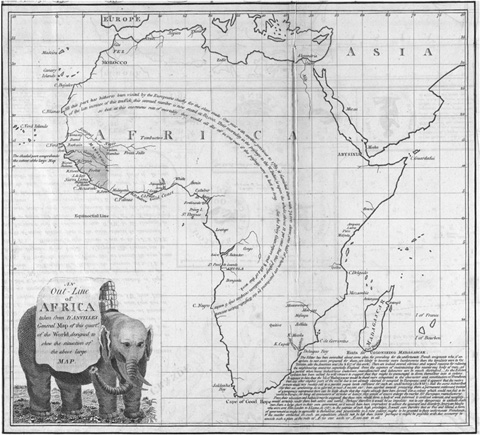
MAP 3.1
Inset from “Nautical Map Intended for the Use of Colonial Undertakings on the W. Coast of Africa … more particularly those of Sierra Leona and the Island of Bulama Respectfully Dedicated to the Humane and disinterested Promoters of those & similar Establishments.” From Carl Bernhard Wadström, An Essay on Colonization, particularly applied to the western coast of Africa. London: Darton and Harvey, 1794. Courtesy of the Houghton Library, Harvard University. Econ 2400.3*
The ships reached the mouth of the Sierra Leone River on 10 May 1787. The settlers negotiated with the local chief of the Temne people, King Tom, for a tract of land along the harbor. The ship-weary settlers disembarked, hacked a passage through the brush, and marched up the hillside to plant a British flag at what was to be known as Granville Town in the “Province of Freedom,” the slave-free colony. Following Sharp’s scheme, they elected a chief in command to govern a common council made up of household heads. Physical labor was to be shared equally by all of the inhabitants without regard to wealth or race. Arriving too late to build permanent houses before the relentless downpours of the rainy season began, they camped in open tents pitched in the clearing, through which eighteen-foot-long snakes slithered during the day and leopards prowled after nightfall. It was also too late to plant crops, so they were forced to subsist on the meager rations brought from England and what they could barter for from King Tom. By mid-September of the first year, 122 people had perished. Back in London, Granville Sharp despaired at the “melancholy accounts of my poor little ill-thriven swarthy daughter, the unfortunate colony of Sierra Leone.”76 The poor timing of the launch had doused the revolutionary expectation that change would come from this model of prosperous freedom carved by the black settlers themselves from the fertile coast of Africa.
Neighborly relations were almost as troublesome as the weather for the colonists, wedged as they were on the coast between the slave traders who operated from Bance Island and the Temne people inland. Although the philanthropists and colonists referred to the settlement as returning home, their culture differed markedly from those of the indigenous people who lived and traded up and down the coast and inland along the Sierra Leone River. The sources of conflict between the black settlers and the indigenous peoples, including religion, the slave trade, and land ownership, were many. In 1789, the commander of a British naval warship anchored off the Sierra Leone coast tried to mediate “a permanent peace” between the slave traders, the settlers, and the new Temne chief, King Jemmy. Instead, they brought war. Flares from the ship accidentally set an African village aflame. Jemmy’s men fired on the naval vessel, sending it back to sea, leaving the settlers to deal with a king intent on revenge. Taking pity on the besieged colony, the slave traders from Bance Island provided the settlers with canoes to travel upriver to Bob’s Island as Jemmy razed Granville Town to the ground. In London, the colonial investors blamed the black colonists for the settlement’s misfortunes.77 Their terms of abuse were harsher than those of Sharp’s paternalism. The young evangelical banker Henry Thornton replaced Granville Sharp as director of the newly incorporated Sierra Leone Company in 1791. Thornton was firmly convinced that “trade is the great engine by which towns are made to rise up & industry excited in all uncivilized countries.”78 As plans for establishing a commercially viable colony trading in agricultural produce displaced Sharp’s dreams of a self-governing “Province of Freedom,” the two goals began to appear less compatible. The company chose Alexander Falconbridge, a surgeon and abolitionist, to execute its commercial mission in the colony. Anna Maria Falconbridge, who accompanied her husband to “the wilds of Africa,” narrated the journey in an epistolary journal,Narrative of Two Voyages to the River Sierra Leone.79 The youngest of five children whose mother had died when she was little, Anna had hastily married Alexander in 1788, against the wishes of her family and friends. She would come to regret her rash decision. When her husband, a renowned abolitionist, drank to excess, he did not treat her kindly.
As soon as they arrived, Alexander and Anna Falconbridge journeyed upriver to negotiate with the Temne ruler, Naimbana, for the return of the land on which Granville Town had been sited. After seven meetings, including one that so frightened Anna Falconbridge that she swooned in hysterics, Naimbana agreed to allow the English to return to their settlement in exchange for more tobacco, rum, iron bars, and gold-laced hats. Before the rains started, the settlers built huts and planted cassava. Anna Falconbridge complained in her journal about the mosquitoes that swarmed in the settlement and the insects, “rather larger than a locust, covered with a tortoise coloured shell” with “forceps like a lobster,” that had stung one of the settlers. She was appreciative, though, that the “tygers and lions” she had heard inhabited the mountains did not venture down to the coastal settlement. “Nature seems to have been astonishingly sportive in taste and prodigality here, both of vegetable and animal productions, for a man cannot stir without admiring the beauties or deformities of her creation,” she wrote. She kept three pet monkeys. “Everything I see is entirely new to me. … There is such a variety here as to afford a continual zest to the sight.”80 That variety in all that was exotic made for a captivating narrative.
Falconbridge described her solitary evening stroll to an African village where a crowd gathered, staring, she supposed, at her dress. She gaped back at the naked women. Relieved by the approach of a group of women attired in European dress, she soon realized they were concubines, not wives of tribal leaders, further disturbing her preconceptions of colonial paternalism and, in the letters to a fictional friend in Bristol that formed her journal, those of her readers.81 That was her goal.
With but the addition of a few of her accustomed comforts and some friends from England, Falconbridge wrote after the first few months, she might even consider remaining in Africa. At the approach of the rainy season, however, the Falconbridges returned to Falmouth to procure additional money and supplies from the Sierra Leone Company. In a meeting with Thomas Clarkson, they learned that one thousand blacks had been recruited from Nova Scotia to join the initial black settlers in Sierra Leone. Writing with the advantage of hindsight, Anna Falconbridge dismissed the imperial plan: “It was surely a premature, hair-brained, and ill-digested scheme, to think of sending such a number of people all at once, to a rude, barbarous and unhealthy country, before they were certain of possessing an acre of land.”82 She understood the ambiguities of land ownership and the harshness of the African coastal climate, and was surprised that the company would bring more poor black settlers, this time from Canada. Nova Scotia, after all, had been considered as a destination for the black poor of London who ultimately settled and died in Sierra Leone.
In 1790, the Nova Scotians dispatched a delegate, Thomas Peters, a British veteran of the American Revolution, to plead their unhappy case in London. “Slaves have no more Protection by the Laws of the Colony (as they are at present misunderstood) than the mere Cattle or brute beasts,” the black loyalists charged in their petition.83 Peters told the British government that the blacks in Nova Scotia were so miserable that they would happily settle “wherever the Wisdom of Government may think proper to provide for them as free Subjects of the British Empire.”84 They had subsisted in shelters with makeshift roofs and worked as sharecroppers for white Nova Scotians, all the while deprived of political rights. The secretary of state invited Peters, “the poor Black, to tell his own melancholy Tale,” framed in the language of British rights.85 He was convinced black loyalists would finally find liberty in the Province of Freedom floundering on the west coast of Africa under the direction of the Sierra Leone Company.
With the support of the British government, the Sierra Leone Company promised the black loyalists of Nova Scotia twenty acres for every man, ten for his wife, and five for each child who went to Africa. The government offered to pay the passage of the former slaves on their exodus across the waters to freedom in Africa. John Clarkson, Thomas Clarkson’s younger brother, was put in charge of the expedition. He followed Thomas Peters back across the Atlantic to Nova Scotia to recruit the new settlers for Sierra Leone. On leave from the navy, the twenty-eight-year-old Clarkson seemed the ideal man to escort the black loyalists to Sierra Leone from Nova Scotia. Known for his gentle charm and negotiating skills, he was guided by a strong religious faith and a devotion to the abolitionist cause. Thomas Clarkson and William Wilberforce, however, warned John not to discuss abolition while recruiting settlers in Nova Scotia. He was not to call the black loyalists “Blacks or Negroes,” but was told to use “Africans as a more respectful way” of speaking of them.86 That must have surprised the black loyalists.
Clarkson and Peters traveled throughout Nova Scotia and into New Brunswick to promote the exodus to Africa. Boston King, who had just secured a good job as a domestic servant in Preston, agreed to emigrate to preach Christianity. Clarkson then met with David George, now the father of six children, at Merchants’ Coffee House in Halifax. George delivered a list of men, women, and children eager to escape the misery of Nova Scotia. After hearing a rousing presentation in Birchtown, another 514 men, women, and children decided to emigrate. Clarkson reported back to the company in October 1791: “I feel myself much interested in the welfare of these oppressed people; indeed I never viewed the business I have undertaken to perform with that degree of awe, that I do at this moment.” The former slaves, so often disappointed, had been subject in their journeys to “everything that is base,” he wrote.87 That explained why a staggering number signed on the rosters to leave the Americas behind.
Theirs was more than a simple migration; they traveled as a community.88 Exceeding the government’s most optimistic expectations, more than one thousand black loyalists set sail in January 1792 from Nova Scotia in fifteen ships, including one named the Ark, bound for Sierra Leone. Peters made sure that conditions on board were not reminiscent of the transatlantic voyages in the other direction experienced by some of the older Nova Scotians, ordering ventilation holes drilled in the decks and berths added to the ships.
Clarkson commented in his journal that the passengers were mostly “sober, hardworking men, and extremely grateful & rather enthusiasts in religion which I hope to be able to moderate on the voyage, though I commend them for their intentions.”89 With little exposure to the freedom conferred by their evangelical religious faith, Clarkson assumed that a conscientious Anglican clergyman could convert them through prayer in the new African colony. He had come to appreciate the depth of their disappointment with governments in America, but not their religion. He did not really understand, therefore, what they meant by liberty.
Once they dropped anchor, Thomas Peters led the first group of new settlers ashore singing: “The day of jubilee is come; return ye ransomed sinners home.” One of the passengers recognized the landing place on the West African coast. The thirty-year-old had been kidnapped as a child and sold to an American slave ship that embarked from the same port fifteen years earlier. He reported that when a party of natives visited the settlement, a woman recognized him as her son, long lost to the slave trade.90 They had come home to land they could farm and call their own. They would be free at last.
The new settlers from Nova Scotia began to build mud houses with thatched roofs and to organize their own churches. Divided into seven different congregations, each with its own preacher, the Baptists followed David George, while the Methodists were led by Cato Perkins, Moses Wilkinson, and Boston King. Within earshot of the Sierra Leone Company’s Anglican minister, David George preached under a canvas tent on the first Sunday in Africa. The spirited religious meetings that often lasted all night and into the early morning annoyed Anna Falconbridge. “I have awoke at every hour of the night” and heard one congregation or another, she complained in her journal.91 The directors in London, alarmed by the exuberance of the Baptist and Methodist congregations in Sierra Leone, dispatched the Reverend Nathaniel Gilbert, the son of a wealthy planter in Antigua, to conduct Anglican services to compete with the black ministers. The directors and the settlers alike little understood the spreading Islamic faith of their neighbors among whom they sought to proselytize.
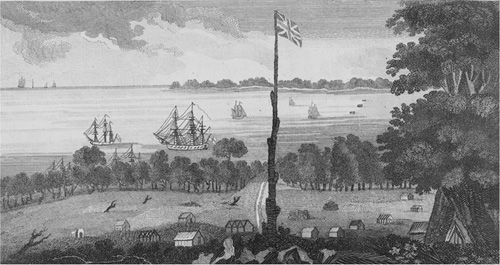
FIGURE 3.2
A View of Sierra Leone from John Matthews, Voyage à la Rivière de Sierra-Leone. Paris: Hautbout l’Aine, 1797. Depiction of the original 1787 “Free Black settlement” of Sierra Leone under the British flag as seen from Saint George’s hill looking north to Bullom across the harbor. New York Public Library/Art Resource, NY
Many of the settlers from Nova Scotia perished that first year in one of the wettest rainy seasons in West African history. Tornados and lightning threatened the hastily constructed settlement. “Who wonders that Savages adore the Sun,” Clarkson despaired in his journal.92 The fever that killed sixty-seven people en route and confined him to his bed continued to spread through the settlement, infecting eight hundred of the settlers at one point. “It is quite customary of a morning to ask, ‘how many died last night?’” Anna Falconbridge explained in her journal.93 By the end of 1792, only forty white settlers remained alive, giving the settlement the unfortunate name “White Man’s Grave.”94 With the rains came swarms of insects, both cockroaches and red ants that ate everything in their path, even chickens and goats.
The Nova Scotians who survived were once again disappointed in their hopes for acquiring the land that was so integral to their definition of freedom. The plots they were allocated by the company were small, one-fifth of the promised size, of poor quality, and not contiguous. Free men in Africa, they had expected to enjoy a new status as peasant proprietors on freehold land, supporting themselves from their own property and selling their excess produce to the Africans. Instead, the company charged them quitrents or annual fees for their land, in essence making them feudal tenants. Without land of their own, they were not truly free.
The settlers had also been promised representation in a government composed of black men, a government in keeping with their self-definition as British subjects. They identified themselves as a self-governing, just community. However, the Sierra Leone Company had dismantled Sharp’s system of self-government, destroying with it the promise of racial and economic justice as envisioned by the black loyalists. In its place, the Sierra Leone Company installed eight white directors. “Never were characters worse adapted to manage any purpose of magnitude,” Anna Falconbridge commented of the white directors. She did not think them “fit to be guardians and stewards of the immense property required for erecting the fabric of a new colony.”95 John Clarkson, who had won the trust of the blacks in Nova Scotia with his sympathy for their plight, could do nothing to rein in the white directors who drank to excess, stole supplies, claimed the waterfront land for their own houses, and abused the black settlers. The black loyalists had chosen freedom under the empire rather than slavery in a new American republic. They were disappointed to find themselves subject once again to the rule of a white government.
In April 1792, their rations reduced, the settlers deputized Thomas Peters to convey their discontent to Clarkson. The conditions they found in Sierra Leone reminded them of the slavery they had long since escaped in America, Peters observed. Quite simply put, they did not need white rule. On Easter, Peters and Clarkson held a four-hour palaver, or discussion, under a massive silk cottonwood tree. Clarkson had assumed that since he had shared the discomforts of the voyage with the Nova Scotians, the black settlers would accept him as Moses delivering them from bondage. Confronted instead with demands presented by Peterson, Clarkson admitted that he was confused by their “strange notions … as to their civil rights.”96 Peters recalled the promises Clarkson had made in Birchtown that they would be “free” in Africa, governed by laws consistent with the British constitution.
The black loyalists saw themselves as founders of a new nation. They were loyalists, but their understanding of liberty in Sierra Leone bore the stamp of the American Revolution. They had incorporated property ownership into their definition of liberty. Property implied independence for them, as it had for Crèvecoeur’s farmer in New York.
Surprised by the insubordination of the black loyalists, the company warned the “Nova Scotians” that “on their due obedience to government, under the blessing of Providence, their happiness, their liberty, and perhaps their very lives depend.”97 The black loyalists finally compromised. They accepted freedom as British subjects, on the condition that there was someone “of our Color in it.”98 They declared that they would not be made to pay quitrents, with or without representation. Their revolutionary image of liberty required new laws and a refuge at the end of their long sojourn within the British Empire.
No matter the frustrations that John Clarkson confided to his journal, Thomas, who had not yet read the journal, wrote to congratulate his brother: “The Eyes of England are upon you & this Infant colony. … To your lot it falls to be Governor of the Noblest Institution ever set on foot, an institution which embraces no less than an Attempt to civilize and Christianize a great Continent, to bring it out of Darkness & to abolish the Trade in Men.”99 Colonization and civilization could be accomplished together, Thomas Clarkson still believed. And their enterprise would be commercially profitable.
By the fall of 1792, in Freetown, there were twelve streets lined with timber houses raised a foot or two off the ground, and three avenues housing the public buildings, including a school, a church, and a multipurpose gathering place, Harmony Hall. Many of the Freetown householders were women. In fact, women owned three of the six shops and women voted in the elections; other than citizens of New Jersey, they were the only women in the world with that right.100 Fifteen acres of land had been put into cultivation, twelve with alternate rows of rice and cotton. The settlers had planted a nursery of sugar cane, but insects—ants and “bugabugs”—ate most of the plants.
In December 1792, John Clarkson returned to England to be married. He was sorely missed by the black loyalists, especially because he was replaced by William Dawes, an evangelical and the governor of the penal colony at Botany Bay. Dawes was assisted by the twenty-four-year-old Zachary Macaulay, formerly an overseer of slaves on a Jamaican sugar plantation. Macaulay arrived expecting to temper the “inadequate or enthusiastic notions of Christianity” of the black settlers and thereby to squelch their “false and absurd notions … concerning their rights as free-men.”101 His Christianity would teach the “truly unfortunate” settlers to be obedient, he told the directors in a journal that he kept, edited, and posted to London at regular intervals. In this journal, he dwelled on the constant rains and the horrifying variety of insects. Macaulay was even more appalled to find settlers “falling down as if dead” and “bellowing with all their might” as they wrestled with the Devil.102 Methodists lacked discipline, and “their government is a pure democracy,” he complained, boasting of his requirement that all settlers attend Anglican services.103 These would “do them good.”104 At least on Christmas, the church was quite full. Evidence suggests that the directors were pleased with his reports, especially his detailed discussions of commercial ventures.105
Boston King and David George followed Clarkson back to England in 1793 to further their religious education. The Methodists at the Kingswood School near Bristol persuaded King to write down and publish the story of his life.106 David George met English Baptist preachers and, like King, was encouraged to write his “account” of his journey from American slavery to the wilderness in Nova Scotia to Africa. His narrative of enslavement, escape, and conversion was published in the first volume of The Baptist Annual Register. Like the Israelites led by Moses out of Egypt, the black loyalists portrayed their escape not only from slavery, but from a land of bondage, the newly independent American republic. King and George both acknowledged the “goodness of God” that had set them free from “their oppressors.”107 Their narrative written, they sailed back to Africa to confront continuing disagreements over property and quitrents.
Anna Falconbridge had also returned to London in June 1793, traveling with her second husband (her first had died) on a slave ship commanded by her brother. She published her journal, “an uncompromising account” of the failure of the directors of Sierra Leone Company. After two years in Sierra Leone, she questioned the principles of the abolitionists, including those of her first husband. It seemed to her that these well-meaning idealists had been merely “sporting with the lives of such numbers of their fellow creatures.”108 If imperialism and abolition were not compatible, and she did not think they were, she emerged from her experience in the free colony of Sierra Leone doubting the latter. Stopping in Jamaica, she witnessed Thomas Paine and William Wilberforce being burned in effigy. She lamented her hero Paine’s involvement with the abolitionists. She had concluded that the slave trade would benefit Africa by spreading Christianity and taming the ambitions of the African chiefs who subjugated their own people. Equivocating and tired, she was “heartily glad to get rid of this subject, and am surprised how I came to entangle myself in it.”109 She dismissed the British colonial project in Africa as naïve and unrealistic.
Anna Falconbridge published her account, daring the directors of the Sierra Leone Company “to contradict one tittle” of her evidence that vindicated her second husband, if not her first, from charges that held them responsible for the settlers’ unrest and the commercial failure of the colony.110 Carl Wadström commented that her journal proved “that even the tender sex, under the influence of conjugal attachment, may be so much interested in a great undertaking, as to forget the delicacy of their frame, and to face danger and distress in every terrifying shape.”111 Her narrative was reprinted twice in 1794, then reissued in a new edition in 1802, and its success confirmed Thomas Clarkson’s adage about popular interest in the coast of Africa, colonial exploration, and the antislavery movement.
Henry Thornton, the director of the Sierra Leone Company, issued a 175-page report to rebut Falconbridge’s journal. It did not prove popular reading. John Clarkson, whose own Sierra Leone journal, his brother assured him, would command five hundred pounds from a publisher, remained silent. Sympathetic to the black settlers who “have been deceived through life and have scarcely ever had a promise made that was performed,” Clarkson worried about setting back the cause of the abolitionists by portraying the settlers’ shortcomings.112 His journal remains in manuscript form.
For another decade, the black settlers struggled for control over their colonial government. They now referred to Freetown as “A Town of Slavery,” infuriating the Sierra Leone Company, which held it up as a model of British moral values. Two of the settlers, Cato Perkins and Isaac Anderson, carried a petition to London to deliver to the Court of Directors of the Sierra Leone Company in October 1793, complaining that Dawes treated them “just as bad as if we were all slaves which we cannot bear.”113 When they received no answer to their petition, the settlers followed up, reading aloud passages from Anna Falconbridge’s recently published book. “We are sorry to think that we left America to come to be used in that manner,” they wrote.114 In an echo of Equiano’s warning, they added that if the directors did not stop abusing them, God would “see the tyranny and oppression” and “attack the Barbarous Task Masters in the Hight of their Pomp and Oppression.”115 News that “liberty had been proclaimed to the French slaves in the West Indies and that America had wholly abandoned the slave trade” arrived in September 1794 aboard a slave brig.116
The directors in London replied in their annual report to the charges levied against them that they had sacrificed much to promote the cause of “Christianity and Liberty and Civilization among the Africans.” They suggested that the complainants were too suddenly emancipated to realize the limits of “civil rights” or to understand the difference between tyranny and the unavoidable hardships of life.117 The settlers might have answered that Macaulay and Dawes taught them all they needed to know about taxation without representation and religious interference in Africa.
“Thorough Jacobins” in a “Town of Slavery”
In July 1792, John Clarkson wrote the marquis de Lafayette, pleading with the French not to attack Sierra Leone should war break out between Britain and France. This was no ordinary British colony, he explained; the settlement had been “established on the true principles of Freedom and intended to promote the general Happiness of Mankind.”118 On the coast of Africa, the black settlers had at last found liberty, Clarkson informed the French hero of the American Revolution, adding that if threatened, the residents of Sierra Leone might become revolutionaries themselves. Lafayette, who would probably have shared Clarkson’s sympathy for the former slaves, never received Clarkson’s letter. He was locked away in an Austrian prison for betraying the French Revolution.
In September 1794, seven French ships disguised as British vessels sailed into Freetown harbor. Governor Macaulay, with just twenty-four guns positioned on rusting parapets to defend the British colony against the hundred French cannon pointed directly at him, hoisted a white tablecloth as a sign of surrender an hour and a half into the bombardment. David George and a crowd of unarmed settlers watched as warehouses, churches, and houses went up in flame. For the next two weeks, French sailors, called “sans-culottes” by Macaulay, plundered the black loyalist settlement, showing no mercy. They looted shops, burned the public library, dismantled the printing press, trampled Bibles, ate and drank their way through provisions, dug up farm allotments, slaughtered hogs, mutilated dogs and cats, and burned the settlers’ crops. They left one child dead, reportedly hacked in half in his mother’s arms, two men without legs, and George shirtless. Settlers who could flee found shelter in the Temne villages.119
In his journal, Macaulay recalled his personal efforts to convince the French commanders that the black loyalists were “not Englishmen,” something he probably believed himself.120 In their own entreaties to the French, the black loyalists took a different tack and reclaimed their revolutionary American identity, “telling them we was Americans from North America.” Neither ploy worked. Instead, the encounter with revolutionary France opened new possibilities, both for revolt and for repression, as soon as the ships sailed away. Macaulay, whose own children had escaped only through the kindness of Mary Perth, a black loyalist and shopkeeper, imposed quitrents and a new loyalty oath on the black loyalists and demanded that they share the costs of rebuilding and restoring company property.121 This resonated among the black loyalists with reminders of decades of injustice in the Americas. A preacher complained in a letter to John Clarkson, “We wance did call it Freetown but since your absence—we have Reason to call it a Town of Slavery”122 The opportunity for revolt would come soon.
The outspoken French abolitionist Abbé Grégoire apologized for the French attack in an address to the French Academy that eventually found its way to Granville Sharp, carried by “a Swedish gentleman.”123 How was it, he asked, that the French, who had declared the liberty of black slaves in the Caribbean, would destroy a settlement of free blacks established to end the slave trade on the coast of Africa? Sierra Leone shone for Grégoire as a living demonstration that civilization could eradicate slavery by educating and improving the Africans so recently enslaved by the Europeans and Americans.124 He was disappointed by the action of French revolutionaries.
Rebuilt after the French-set fires, by 1796 the four hundred timber-and-shingle houses of Freetown made it the largest town on the west coast of Africa. Struggles over payment of the quitrent continued, leading the settlers to threaten to ask the Temne for land free of the governance of the Sierra Leone Company. Macaulay complained that the Methodists wanted to throw “off the jurisdiction of the company servants” and name one of their own as “a kind of dictator, who assisted by a council, should rule them after the manner of the Natives around us.”125
In September 1800, the residents of Freetown took advantage of Macaulay’s departure and issued their own code of laws before rising up in armed rebellion. After a decade as British subjects, liberty to them definitely meant the right to rule themselves. They named three justices of the peace, and created a bicameral legislature that recognized the black loyalists and surviving London poor as the proprietors of Sierra Leone.126 Years earlier, they had reminded Dawes of the fate of the French king, Louis XVI, who had also denied his people the bread and freedom they demanded. Then, that had proved to be an idle threat, especially with British warships to back up the governor just off the coast. Now, to assert their independence once and for all from white rulers, the black loyalists looked inland to Africa and opened talks with King Tom for land. The settlers menaced the whites still in Sierra Leone, threatening to set them afloat upon the ocean in boats without oars or sails. Revolution was imminent here on the periphery of the British empire, with the white company men outnumbered by the rebels who were negotiating for support from Temne and Mori-Kanu warriors.127
Just as freedom seemed within reach at last for the black loyalists, five hundred Maroon warriors, free blacks from Jamaica, sailed into the harbor of Freetown aboard a British transport ship under the command, it happened, of Macaulay’s brother. The Maroons were in search of land to farm, because they too had failed to thrive among the rocks of the Nova Scotia coast. “A Most unexpected intervention of providence completely changed the face of affairs,” Thomas Ludlam, the otherwise not particularly religious new governor, later recalled.128 Ludlam told the Maroons of the insurrection ashore. Their Maroon commander noted in his journal entry of Wednesday, 1 October, “The evening was spent in a humdrumish way arranging matters for a general attack on the Rioters.”129 It was one of the more ironic twists in the increasingly interconnected and contentious revolutionary world.
The Jamaican barrister Robert Charles Dallas observed with hindsight in 1803, “Had the Maroons been the disciples of revolutionary emissaries, or the abettors of anarchy and equality, they would in all probability have joined the people of their own complexion to extirpate the white tyrant; on the contrary they joined with alacrity in quelling the insurrection.”130 After a stormy night, the Maroons surprised the “Rascals,” chasing them into the forest.131 The Maroons then turned their attention to defeating the native chiefs who had allied with the black loyalists. Their definition of liberty also included property. They, too, had escaped both slavery and the disappointed promises of Nova Scotia, but they also brought military experience from the Caribbean.
The Sierra Leone Company hanged the would-be ruler of an independent Freetown, Isaac Anderson, and banished the leaders of the short-lived Freetown revolution, including George Washington’s former slave Harry Washington, from the colony. Sierra Leone was absorbed into the British Empire. The black loyalists’ vision of racial and economic justice, their moral sense of liberty, was effectively silenced, to be forgotten as a critical voice in the revolutionary struggles, a movement that drew on cross-cutting revolutionary traditions from three continents.
In London, Lord Wilberforce, known as an outspoken abolitionist and supporter of the colony, responded in horror to news of the insurrection in Sierra Leone. He feared that the black loyalists, transported across the ocean and given land by the British government, had become “as thorough Jacobins as if they had been trained and educated in Paris.”132 These revolutionaries not only abolished slavery but established institutions of self-government and advocated the broad distribution of property in an egalitarian society undivided by race and unified by their deeply felt religious faith. Where could they have imbibed such radical views of their rights, he asked, if not from the French revolutionaries in their famous Jacobin clubs? After all, was that not how the revolutionary demands of free people of color such as Ogé and the slaves in the Caribbean had been explained? Perhaps, Wilberforce speculated, if British abolitionists had not promised these former slaves the liberty the Americans denied them in the War for Independence, they would not have posed such a threat in this era when the destabilizing example of the French Revolution loomed large. In his mind, the Jacobin threat eclipsed all others.