
An Imagined Order
The food surpluses produced by peasants, coupled with new transportation technology, eventually enabled more and more people to cram together first into large villages, then into towns, and finally into cities, all of them joined together by new kingdoms and commercial networks.
Yet in order to take advantage of these new opportunities, food surpluses and improved transportation were not enough. The mere fact that one can feed a thousand people in the same town or a million people in the same kingdom does not guarantee that they can agree how to divide the land and water, how to settle disputes and conflicts, and how to act in times of drought or war. And if no agreement can be reached, strife spreads, even if the storehouses are bulging. It was not food shortages that caused most of history’s wars and revolutions. The French Revolution was spearheaded by affluent lawyers, not by famished peasants. The Roman Republic reached the height of its power in the first century BC, when treasure fleets from throughout the Mediterranean enriched the Romans beyond their ancestors’ wildest dreams. Yet it was at that moment of maximum affluence that the Roman political order collapsed into a series of deadly civil wars. Yugoslavia in 1991 had more than enough resources to feed all its inhabitants, and still disintegrated into a terrible bloodbath.
The problem at the root of such calamities is that humans evolved for millions of years in small bands of a few dozen individuals. The handful of millennia separating the Agricultural Revolution from the appearance of cities, kingdoms and empires was not enough time to allow an instinct for mass cooperation to evolve.
Despite the lack of such biological instincts, during the foraging era, hundreds of strangers were able to cooperate thanks to their shared myths. However, this cooperation was loose and limited. Every Sapiens band continued to run its life independently and to provide for most of its own needs. An archaic sociologist living 20,000 years ago, who had no knowledge of events following the Agricultural Revolution, might well have concluded that mythology had a fairly limited scope. Stories about ancestral spirits and tribal totems were strong enough to enable 500 people to trade seashells, celebrate the odd festival, and join forces to wipe out a Neanderthal band, but no more than that. Mythology, the ancient sociologist would have thought, could not possibly enable millions of strangers to cooperate on a daily basis.
But that turned out to be wrong. Myths, it transpired, are stronger than anyone could have imagined. When the Agricultural Revolution opened opportunities for the creation of crowded cities and mighty empires, people invented stories about great gods, motherlands and joint stock companies to provide the needed social links. While human evolution was crawling at its usual snail’s pace, the human imagination was building astounding networks of mass cooperation, unlike any other ever seen on earth.
Around 8500 BC the largest settlements in the world were villages such as Jericho, which contained a few hundred individuals. By 7000 BC the town of Çatalhöyük in Anatolia numbered between 5,000 and 10,000 individuals. It may well have been the world’s biggest settlement at the time. During the fifth and fourth millennia BC, cities with tens of thousands of inhabitants sprouted in the Fertile Crescent, and each of these held sway over many nearby villages. In 3100 BC the entire lower Nile Valley was united into the first Egyptian kingdom. Its pharaohs ruled thousands of square kilometres and hundreds of thousands of people. Around 2250 BC Sargon the Great forged the first empire, the Akkadian. It boasted over a million subjects and a standing army of 5,400 soldiers. Between 1000 BC and 500 BC, the first mega-empires appeared in the Middle East: the Late Assyrian Empire, the Babylonian Empire, and the Persian Empire. They ruled over many millions of subjects and commanded tens of thousands of soldiers.
In 221 BC the Qin dynasty united China, and shortly afterwards Rome united the Mediterranean basin. Taxes levied on 40 million Qin subjects paid for a standing army of hundreds of thousands of soldiers and a complex bureaucracy that employed more than 100,000 officials. The Roman Empire at its zenith collected taxes from up to 100 million subjects. This revenue financed a standing army of 250,000–500,000 soldiers, a road network still in use 1,500 years later, and theatres and amphitheatres that host spectacles to this day.
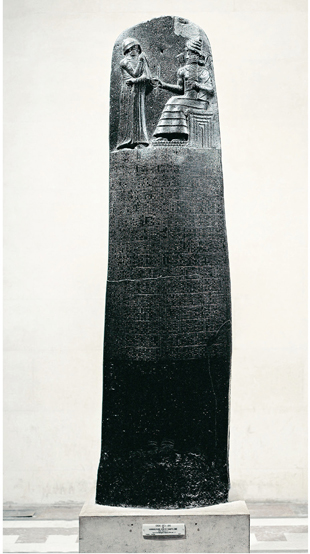
16. A stone stela inscribed with the Code of Hammurabi, c.1776 BC.
Impressive, no doubt, but we mustn’t harbour rosy illusions about ‘mass cooperation networks’ operating in pharaonic Egypt or the Roman Empire. ‘Cooperation’ sounds very altruistic, but is not always voluntary and seldom egalitarian. Most human cooperation networks have been geared towards oppression and exploitation. The peasants paid for the burgeoning cooperation networks with their precious food surpluses, despairing when the tax collector wiped out an entire year of hard labour with a single stroke of his imperial pen. The famed Roman amphitheatres were often built by slaves so that wealthy and idle Romans could watch other slaves engage in vicious gladiatorial combat. Even prisons and concentration camps are cooperation networks, and can function only because thousands of strangers somehow manage to coordinate their actions.
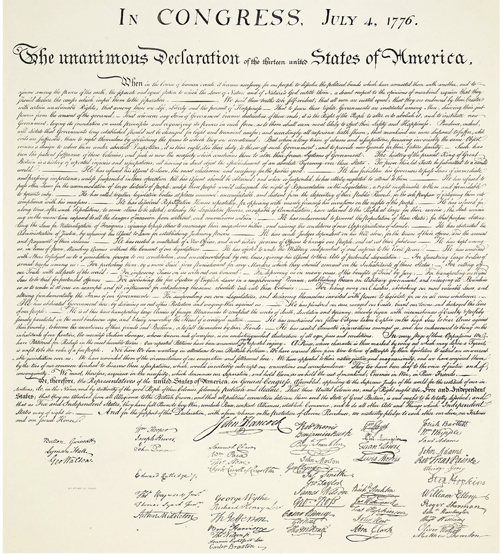
17. The Declaration of Independence of the United States, signed 4 July 1776.
All these cooperation networks – from the cities of ancient Mesopotamia to the Qin and Roman empires – were ‘imagined orders’. The social norms that sustained them were based neither on ingrained instincts nor on personal acquaintances, but rather on belief in shared myths.
How can myths sustain entire empires? We have already discussed one such example: Peugeot. Now let’s examine two of the best-known myths of history: the Code of Hammurabi of c.1776 BC, which served as a cooperation manual for hundreds of thousands of ancient Babylonians; and the American Declaration of Independence of 1776 AD, which today still serves as a cooperation manual for hundreds of millions of modern Americans.
In 1776 BC Babylon was the world’s biggest city. The Babylonian Empire was probably the world’s largest, with more than a million subjects. It ruled most of Mesopotamia, including the bulk of modern Iraq and parts of present-day Syria and Iran. The Babylonian king most famous today was Hammurabi. His fame is due primarily to the text that bears his name, the Code of Hammurabi. This was a collection of laws and judicial decisions whose aim was to present Hammurabi as a role model of a just king, serve as a basis for a more uniform legal system across the Babylonian Empire, and teach future generations what justice is and how a just king acts.
Future generations took notice. The intellectual and bureaucratic elite of ancient Mesopotamia canonised the text, and apprentice scribes continued to copy it long after Hammurabi died and his empire lay in ruins. Hammurabi’s Code is therefore a good source for understanding the ancient Mesopotamians’ ideal of social order.3
The text begins by saying that the gods Anu, Enlil and Marduk – the leading deities of the Mesopotamian pantheon – appointed Hammurabi ‘to make justice prevail in the land, to abolish the wicked and the evil, to prevent the strong from oppressing the weak’.4 It then lists about 300 judgements, given in the set formula ‘If such and such a thing happens, such is the judgment.’ For example, judgements 196–9 and 209–14 read:
|
196. |
If a superior man should blind the eye of another superior man, they shall blind his eye. |
|
197. |
If he should break the bone of another superior man, they shall break his bone. |
|
198. |
If he should blind the eye of a commoner or break the bone of a commoner, he shall weigh and deliver 60 shekels of silver. |
|
199. |
If he should blind the eye of a slave of a superior man or break the bone of a slave of a superior man, he shall weigh and deliver one-half of the slave’s value (in silver).5 |
|
209. |
If a superior man strikes a woman of superior class and thereby causes her to miscarry her fetus, he shall weigh and deliver ten shekels of silver for her fetus. |
|
210. |
If that woman should die, they shall kill his daughter. |
|
211. |
If he should cause a woman of commoner class to miscarry her fetus by the beating, he shall weigh and deliver five shekels of silver. |
|
212. |
If that woman should die, he shall weigh and deliver thirty shekels of silver. |
|
213. |
If he strikes a slave-woman of a superior man and thereby causes her to miscarry her fetus, he shall weigh and deliver two shekels of silver. |
|
214. |
If that slave-woman should die, he shall weigh and deliver twenty shekels of silver.6 |
After listing his judgements, Hammurabi again declares that
These are the just decisions which Hammurabi, the able king, has established and thereby has directed the land along the course of truth and the correct way of life … I am Hammurabi, noble king. I have not been careless or negligent toward humankind, granted to my care by the god Enlil, and with whose shepherding the god Marduk charged me.7
Hammurabi’s Code asserts that Babylonian social order is rooted in universal and eternal principles of justice, dictated by the gods. The principle of hierarchy is of paramount importance. According to the code, people are divided into two genders and three classes: superior people, commoners and slaves. Members of each gender and class have different values. The life of a female commoner is worth thirty silver shekels and that of a slave-woman twenty silver shekels, whereas the eye of a male commoner is worth sixty silver shekels.
The code also establishes a strict hierarchy within families, according to which children are not independent persons, but rather the property of their parents. Hence, if one superior man kills the daughter of another superior man, the killer’s daughter is executed in punishment. To us it may seem strange that the killer remains unharmed whereas his innocent daughter is killed, but to Hammurabi and the Babylonians this seemed perfectly just. Hammurabi’s Code was based on the premise that if the king’s subjects all accepted their positions in the hierarchy and acted accordingly, the empire’s million inhabitants would be able to cooperate effectively. Their society could then produce enough food for its members, distribute it efficiently, protect itself against its enemies, and expand its territory so as to acquire more wealth and better security.
About 3,500 years after Hammurabi’s death, the inhabitants of thirteen British colonies in North America felt that the king of England was treating them unjustly. Their representatives gathered in the city of Philadelphia, and on 4 July 1776 the colonies declared that their inhabitants were no longer subjects of the British Crown. Their Declaration of Independence proclaimed universal and eternal principles of justice, which, like those of Hammurabi, were inspired by a divine power. However, the most important principle dictated by the American god was somewhat different from the principle dictated by the gods of Babylon. The American Declaration of Independence asserts that:
We hold these truths to be self-evident, that all men are created equal, that they are endowed by their Creator with certain unalienable rights, that among these are life, liberty, and the pursuit of happiness.
Like Hammurabi’s Code, the American founding document promises that if humans act according to its sacred principles, millions of them would be able to cooperate effectively, living safely and peacefully in a just and prosperous society. Like the Code of Hammurabi, the American Declaration of Independence was not just a document of its time and place – it was accepted by future generations as well. For more than 200 years, American schoolchildren have been copying and learning it by heart.
The two texts present us with an obvious dilemma. Both the Code of Hammurabi and the American Declaration of Independence claim to outline universal and eternal principles of justice, but according to the Americans all people are equal, whereas according to the Babylonians people are decidedly unequal. The Americans would, of course, say that they are right, and that Hammurabi is wrong. Hammurabi, naturally, would retort that he is right, and that the Americans are wrong. In fact, they are both wrong. Hammurabi and the American Founding Fathers alike imagined a reality governed by universal and immutable principles of justice, such as equality or hierarchy. Yet the only place where such universal principles exist is in the fertile imagination of Sapiens, and in the myths they invent and tell one another. These principles have no objective validity.
It is easy for us to accept that the division of people into ‘superiors’ and commoners’ is a figment of the imagination. Yet the idea that all humans are equal is also a myth. In what sense do all humans equal one another? Is there any objective reality, outside the human imagination, in which we are truly equal? Are all humans equal to one another biologically? Let us try to translate the most famous line of the American Declaration of Independence into biological terms:
We hold these truths to be self-evident, that all men are created equal, that they are endowed by their Creator with certain unalienable rights, that among these are life, liberty, and the pursuit of happiness.
According to the science of biology, people were not created’. They have evolved. And they certainly did not evolve to be ‘equal’. The idea of equality is inextricably intertwined with the idea of creation. The Americans got the idea of equality from Christianity, which argues that every person has a divinely created soul, and that all souls are equal before God. However, if we do not believe in the Christian myths about God, creation and souls, what does it mean that all people are ‘equal’? Evolution is based on difference, not on equality. Every person carries a somewhat different genetic code, and is exposed from birth to different environmental influences. This leads to the development of different qualities that carry with them different chances of survival. ‘Created equal’ should therefore be translated into ‘evolved differently’.
Just as people were never created, neither, according to the science of biology, is there a ‘Creator’ who ‘endows’ them with anything. There is only a blind evolutionary process, devoid of any purpose, leading to the birth of individuals. ‘Endowed by their creator’ should be translated simply into ‘born.
Equally, there are no such things as rights in biology. There are only organs, abilities and characteristics. Birds fly not because they have a right to fly, but because they have wings. And it’s not true that these organs, abilities and characteristics are ‘unalienable’. Many of them undergo constant mutations, and may well be completely lost over time. The ostrich is a bird that lost its ability to fly. So ‘unalienable rights’ should be translated into ‘mutable characteristics’.
And what are the characteristics that evolved in humans? ‘Life’, certainly. But ‘liberty’? There is no such thing in biology. Just like equality, rights and limited liability companies, liberty is something that people invented and that exists only in their imagination. From a biological viewpoint, it is meaningless to say that humans in democratic societies are free, whereas humans in dictatorships are unfree. And what about ‘happiness’? So far biological research has failed to come up with a clear definition of happiness or a way to measure it objectively. Most biological studies acknowledge only the existence of pleasure, which is more easily defined and measured. So ‘life, liberty, and the pursuit of happiness’ should be translated into ‘life and the pursuit of pleasure’.
So here is that line from the American Declaration of Independence translated into biological terms:
We hold these truths to be self-evident, that all men evolved differently, that they are born with certain mutable characteristics, and that among these are life and the pursuit of pleasure.
Advocates of equality and human rights may be outraged by this line of reasoning. Their response is likely to be, ‘We know that people are not equal biologically! But if we believe that we are all equal in essence, it will enable us to create a stable and prosperous society.’ I have no argument with that. This is exactly what I mean by ‘imagined order’. We believe in a particular order not because it is objectively true, but because believing in it enables us to cooperate effectively and forge a better society. Imagined orders are not evil conspiracies or useless mirages. Rather, they are the only way large numbers of humans can cooperate effectively. Bear in mind, though, that Hammurabi might have defended his principle of hierarchy using the same logic: ‘I know that superiors, commoners and slaves are not inherently different kinds of people. But if we believe that they are, it will enable us to create a stable and prosperous society.’