
The Ideal of Progress
Until the Scientific Revolution most human cultures did not believe in progress. They thought the golden age was in the past, and that the world was stagnant, if not deteriorating. Strict adherence to the wisdom of the ages might perhaps bring back the good old times, and human ingenuity might conceivably improve this or that facet of daily life. However, it was considered impossible for human know-how to overcome the world’s fundamental problems. If even Muhammad, Jesus, Buddha and Confucius – who knew everything there is to know – were unable to abolish famine, disease, poverty and war from the world, how could we expect to do so?
Many faiths believed that some day a messiah would appear and end all wars, famines and even death itself. But the notion that humankind could do so by discovering new knowledge and inventing new tools was worse than ludicrous – it was hubris. The story of the Tower of Babel, the story of Icarus, the story of the Golem and countless other myths taught people that any attempt to go beyond human limitations would inevitably lead to disappointment and disaster.
When modern culture admitted that there were many important things that it still did not know, and when that admission of ignorance was married to the idea that scientific discoveries could give us new powers, people began suspecting that real progress might be possible after all. As science began to solve one unsolvable problem after another, many became convinced that humankind could overcome any and every problem by acquiring and applying new knowledge. Poverty, sickness, wars, famines, old age and death itself were not the inevitable fate of humankind. They were simply the fruits of our ignorance.
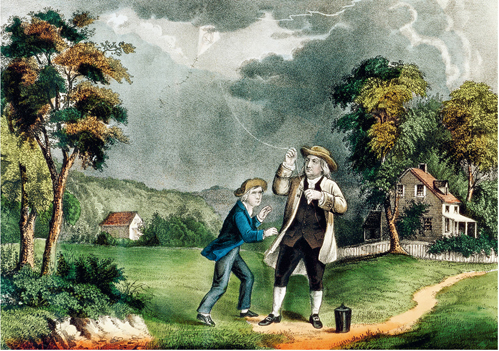
34. Benjamin Franklin disarming the gods.
A famous example is lightning. Many cultures believed that lightning was the hammer of an angry god, used to punish sinners. In the middle of the eighteenth century, in one of the most celebrated experiments in scientific history, Benjamin Franklin flew a kite during a lightning storm to test the hypothesis that lightning is simply an electric current. Franklins empirical observations, coupled with his knowledge about the qualities of electrical energy, enabled him to invent the lightning rod and disarm the gods.
Poverty is another case in point. Many cultures have viewed poverty as an inescapable part of this imperfect world. According to the New Testament, shortly before the crucifixion a woman anointed Christ with precious oil worth 300 denarii. Jesus’ disciples scolded the woman for wasting such a huge sum of money instead of giving it to the poor, but Jesus defended her, saying that ‘The poor you will always have with you, and you can help them any time you want. But you will not always have me’ (Mark 14:7). Today, fewer and fewer people, including fewer and fewer Christians, agree with Jesus on this matter. Poverty is increasingly seen as a technical problem amenable to intervention. It’s common wisdom that policies based on the latest findings in agronomy, economics, medicine and sociology can eliminate poverty.
And indeed, many parts of the world have already been freed from the worst forms of deprivation. Throughout history, societies have suffered from two kinds of poverty: social poverty, which withholds from some people the opportunities available to others; and biological poverty, which puts the very lives of individuals at risk due to lack of food and shelter. Perhaps social poverty can never be eradicated, but in many countries around the world biological poverty is a thing of the past.
Until recently, most people hovered very close to the biological poverty line, below which a person lacks enough calories to sustain life for long. Even small miscalculations or misfortunes could easily push people below that line, into starvation. Natural disasters and man-made calamities often plunged entire populations over the abyss, causing the death of millions. Today most of the world’s people have a safety net stretched below them. Individuals are protected from personal misfortune by insurance, state-sponsored social security and a plethora of local and international NGOs. When calamity strikes an entire region, worldwide relief efforts are usually successful in preventing the worst. People still suffer from numerous degradations, humiliations and poverty-related illnesses, but in most countries nobody is starving to death. In fact, in many societies more people are in danger of dying from obesity than from starvation.