
Why Europe?
The fact that people from a large island in the northern Atlantic conquered a large island south of Australia is one of history’s more bizarre occurrences. Not long before Cook’s expedition, the British Isles and western Europe in general were but distant backwaters of the Mediterranean world. Little of importance ever happened there. Even the Roman Empire – the only important premodern European empire – derived most of its wealth from its North African, Balkan and Middle Eastern provinces. Rome’s western European provinces were a poor Wild West, which contributed little aside from minerals and slaves. Northern Europe was so desolate and barbarous that it wasn’t even worth conquering.
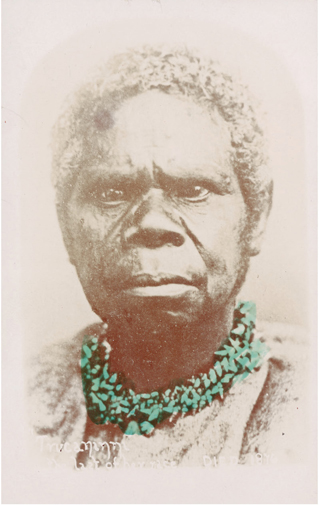
35. Truganini, the last native Tasmanian.
Only at the end of the fifteenth century did Europe become a hothouse of important military, political, economic and cultural developments. Between 1500 and 1750, western Europe gained momentum and became master of the ‘Outer World’, meaning the two American continents and the oceans. Yet even then Europe was no match for the great powers of Asia. Europeans managed to conquer America and gain supremacy at sea mainly because the Asiatic powers showed little interest in them. The early modern era was a golden age for the Ottoman Empire in the Mediterranean, the Safavid Empire in Persia, the Mughal Empire in India, and the Chinese Ming and Qing dynasties. They expanded their territories significantly and enjoyed unprecedented demographic and economic growth. In 1775 Asia accounted for 80 per cent of the world economy. The combined economies of India and China alone represented two-thirds of global production. In comparison, Europe was an economic dwarf.3
The global centre of power shifted to Europe only between 1750 and 1850, when Europeans humiliated the Asian powers in a series of wars and conquered large parts of Asia. By 1900 Europeans firmly controlled the worlds economy and most of its territory. In 1950 western Europe and the United States together accounted for more than half of global production, whereas Chinas portion had been reduced to 5 per cent.4 Under the European aegis a new global order and global culture emerged. Today all humans are, to a much greater extent than they usually want to admit, European in dress, thought and taste. They may be fiercely anti-European in their rhetoric, but almost everyone on the planet views politics, medicine, war and economics through European eyes, and listens to music written in European modes with words in European languages. Even today’s burgeoning Chinese economy, which may soon regain its global primacy, is built on a European model of production and finance.
How did the people of this frigid finger of Eurasia manage to break out of their remote corner of the globe and conquer the entire world? Europe’s scientists are often given much of the credit. It’s unquestionable that from 1850 onward European domination rested to a large extent on the military–industrial–scientific complex and technological wizardry. All successful late modern empires cultivated scientific research in the hope of harvesting technological innovations, and many scientists spent most of their time working on arms, medicines and machines for their imperial masters. A common saying among European soldiers facing African enemies was, ‘Come what may, we have machine guns, and they don’t.’ Civilian technologies were no less important. Canned food fed soldiers, railroads and steamships transported soldiers and their provisions, while a new arsenal of medicines cured soldiers, sailors and locomotive engineers. These logistical advances played a more significant role in the European conquest of Africa than did the machine gun.
But that wasn’t the case before 1850. The military-industrial-scientific complex was still in its infancy; the technological fruits of the Scientific Revolution were unripe; and the technological gap between European, Asiatic and African powers was small. In 1770, James Cook certainly had far better technology than the Australian Aborigines, but so did the Chinese and the Ottomans. Why then was Australia explored and colonised by Captain James Cook and not by Captain Wan Zhengse or Captain Hussein Pasha? More importantly, if in 1770 Europeans had no significant technological advantage over Muslims, Indians and Chinese, how did they manage in the following century to open such a gap between themselves and the rest of the world?
Why did the military-industrial-scientific complex blossom in Europe rather than India? When Britain leaped forward, why were France, Germany and the United States quick to follow, whereas China lagged behind? When the gap between industrial and non-industrial nations became an obvious economic and political factor, why did Russia, Italy and Austria succeed in closing it, whereas Persia, Egypt and the Ottoman Empire failed? After all, the technology of the first industrial wave was relatively simple. Was it so hard for Chinese or Ottomans to engineer steam engines, manufacture machine guns and lay down railroads?
The world’s first commercial railroad opened for business in 1830, in Britain. By 1850, Western nations were criss-crossed by almost 40,000 kilometres of railroads – but in the whole of Asia, Africa and Latin America there were only 4,000 kilometres of tracks. In 1880, the West boasted more than 350,000 kilometres of railroads, whereas in the rest of the world there were but 35,000 kilometres of train lines (and most of these were laid by the British in India).5 The first railroad in China opened only in 1876. It was twenty-five kilometres long and built by Europeans – the Chinese government destroyed it the following year. In 1880 the Chinese Empire did not operate a single railroad. The first railroad in Persia was built only in 1888, and it connected Tehran with a Muslim holy site about ten kilometres south of the capital. It was constructed and operated by a Belgian company. In 1950, the total railway network of Persia still amounted to a meagre 2,500 kilometres, in a country seven times the size of Britain.6
The Chinese and Persians did not lack technological inventions such as steam engines (which could be freely copied or bought). They lacked the values, myths, judicial apparatus and sociopolitical structures that took centuries to form and mature in the West and which could not be copied and internalised rapidly. France and the United States quickly followed in Britain’s footsteps because the French and Americans already shared the most important British myths and social structures. The Chinese and Persians could not catch up as quickly because they thought and organised their societies differently.
This explanation sheds new light on the period from 1500 to 1850. During this era Europe did not enjoy any obvious technological, political, military or economic advantage over the Asian powers, yet the continent built up a unique potential, whose importance suddenly became obvious around 1850. The apparent equality between Europe, China and the Muslim world in 1750 was a mirage. Imagine two builders, each busy constructing very tall towers. One builder uses wood and mud bricks, whereas the other uses steel and concrete. At first it seems that there is not much of a difference between the two methods, since both towers grow at a similar pace and reach a similar height. However, once a critical threshold is crossed, the wood and mud tower cannot stand the strain and collapses, whereas the steel and concrete tower grows storey by storey, as far as the eye can see.
What potential did Europe develop in the early modern period that enabled it to dominate the late modern world? There are two complementary answers to this question: modern science and capitalism. Europeans were used to thinking and behaving in a scientific and capitalist way even before they enjoyed any significant technological advantages. When the technological bonanza began, Europeans could harness it far better than anybody else. So it is hardly coincidental that science and capitalism form the most important legacy that European imperialism has bequeathed the post-European world of the twenty-first century. Europe and Europeans no longer rule the world, but science and capital are growing ever stronger. The victories of capitalism are examined in the following chapter. This chapter is dedicated to the love story between European imperialism and modern science.