
Modern Time
While all these Sapiens have grown increasingly impervious to the whims of nature, they have become ever more subject to the dictates of modern industry and government. The Industrial Revolution opened the way to a long line of experiments in social engineering and an even longer series of unpremeditated changes in daily life and human mentality. One example among many is the replacement of the rhythms of traditional agriculture with the uniform and precise schedule of industry.
Traditional agriculture depended on cycles of natural time and organic growth. Most societies were unable to make precise time measurements, nor were they terribly interested in doing so. The world went about its business without clocks and timetables, subject only to the movements of the sun and the growth cycles of plants. There was no uniform working day, and all routines changed drastically from season to season. People knew where the sun was, and watched anxiously for portents of the rainy season and harvest time, but they did not know the hour and hardly cared about the year. If a lost time traveller popped up in a medieval village and asked a passerby, ‘What year is this?’ the villager would be as bewildered by the question as by the strangers ridiculous clothing.
In contrast to medieval peasants and shoemakers, modern industry cares little about the sun or the season. It sanctifies precision and uniformity. For example, in a medieval workshop each shoemaker made an entire shoe, from sole to buckle. If one shoemaker was late for work, it did not stall the others. However, in a modern footwear-factory assembly line, every worker mans a machine that produces just a small part of a shoe, which is then passed on to the next machine. If the worker who operates machine no. 5 has overslept, it stalls all the other machines. In order to prevent such calamities, everybody must adhere to a precise timetable. Each worker arrives at work at exactly the same time. Everybody takes their lunch break together, whether they are hungry or not. Everybody goes home when a whistle announces that the shift is over – not when they have finished their project.
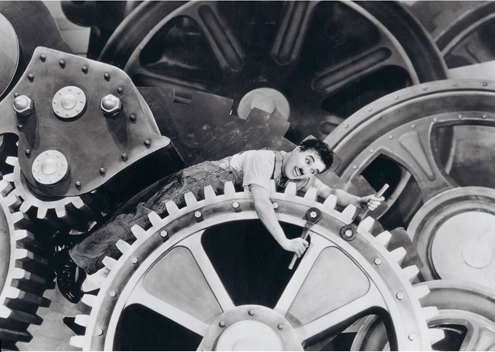
42. Charlie Chaplin as a simple worker caught in the wheels of the industrial assembly line, from the film Modern Times (1936).
The Industrial Revolution turned the timetable and the assembly line into a template for almost all human activities. Shortly after factories imposed their time frames on human behaviour, schools too adopted precise timetables, followed by hospitals, government offices and grocery stores. Even in places devoid of assembly lines and machines, the timetable became king. If the shift at the factory ends at 5 p.m., the local pub had better be open for business by 5:02.
A crucial link in the spreading timetable system was public transportation. If workers needed to start their shift by 08:00, the train or bus had to reach the factory gate by 07:55. A few minutes’ delay would lower production and perhaps even lead to the lay-offs of the unfortunate latecomers. In 1784 a carriage service with a published schedule began operating in Britain. Its timetable specified only the hour of departure, not arrival. Back then, each British city and town had its own local time, which could differ from London time by up to half an hour. When it was 12:00 in London, it was perhaps 12:20 in Liverpool and 11:50 in Canterbury. Since there were no telephones, no radio or television, and no fast trains – who could know, and who cared?2
The first commercial train service began operating between Liverpool and Manchester in 1830. Ten years later, the first train timetable was issued. The trains were much faster than the old carriages, so the quirky differences in local hours became a severe nuisance. In 1847, British train companies put their heads together and agreed that henceforth all train timetables would be calibrated to Greenwich Observatory time, rather than the local times of Liverpool, Manchester or Glasgow. More and more institutions followed the lead of the train companies. Finally, in 1880, the British government took the unprecedented step of legislating that all timetables in Britain must follow Greenwich. For the first time in history, a country adopted a national time and obliged its population to live according to an artificial clock rather than local ones or sunrise-to-sunset cycles.
This modest beginning spawned a global network of timetables, synchronised down to the tiniest fractions of a second. When the broadcast media – first radio, then television – made their debut, they entered a world of timetables and became its main enforcers and evangelists. Among the first things radio stations broadcast were time signals, beeps that enabled far-flung settlements and ships at sea to set their clocks. Later, radio stations adopted the custom of broadcasting the news every hour. Nowadays, the first item of every news broadcast – more important even than the outbreak of war – is the time. During World War Two, BBC News was broadcast to Nazi-occupied Europe. Each news programme opened with a live broadcast of Big Ben tolling the hour – the magical sound of freedom. Ingenious German physicists found a way to determine the weather conditions in London based on tiny differences in the tone of the broadcast ding-dongs. This information offered invaluable help to the Luftwaffe. When the British Secret Service discovered this, they replaced the live broadcast with a set recording of the famous clock.
In order to run the timetable network, cheap but precise portable clocks became ubiquitous. In Assyrian, Sassanid or Inca cities there might have been at most a few sundials. In European medieval cities there was usually a single clock – a giant machine mounted on top of a high tower in the town square. These tower clocks were notoriously inaccurate, but since there were no other clocks in town to contradict them, it hardly made any difference. Today, a single affluent family generally has more timepieces at home than an entire medieval country. You can tell the time by looking at your wristwatch, glancing at your Android, peering at the alarm clock by your bed, gazing at the clock on the kitchen wall, staring at the microwave, catching a glimpse of the TV or DVD, or taking in the taskbar on your computer out of the corner of your eye. You need to make a conscious effort not to know what time it is.
The typical person consults these clocks several dozen times a day, because almost everything we do has to be done on time. An alarm clock wakes us up at 7 a.m., we heat our frozen bagel for exactly fifty seconds in the microwave, brush our teeth for three minutes until the electric toothbrush beeps, catch the 07:40 train to work, run on the treadmill at the gym until the beeper announces that half an hour is over, sit down in front of the TV at 7 p.m. to watch our favourite show, get interrupted at preordained moments by commercials that cost $1,000 per second, and eventually unload all our angst on a therapist who restricts our prattle to the now standard fifty-minute therapy hour.
The Industrial Revolution brought about dozens of major upheavals in human society. Adapting to industrial time is just one of them. Other notable examples include urbanisation, the disappearance of the peasantry, the rise of the industrial proletariat, the empowerment of the common person, democratisation, youth culture and the disintegration of patriarchy.
Yet all of these upheavals are dwarfed by the most momentous social revolution that ever befell humankind: the collapse of the family and the local community and their replacement by the state and the market. As best we can tell, from the earliest times, more than a million years ago, humans lived in small, intimate communities, most of whose members were kin. The Cognitive Revolution and the Agricultural Revolution did not change that. They glued together families and communities to create tribes, cities, kingdoms and empires, but families and communities remained the basic building blocks of all human societies. The Industrial Revolution, on the other hand, managed within little more than two centuries to break these building blocks into atoms. Most of the traditional functions of families and communities were handed over to states and markets.