
Pax Atomica
The independent states that came after these empires were remarkably uninterested in war. With very few exceptions, since 1945 states no longer invade other states in order to conquer and swallow them up. Such conquests had been the bread and butter of political history since time immemorial. It was how most great empires were established, and how most rulers and populations expected things to stay. But campaigns of conquest like those of the Romans, Mongols and Ottomans cannot take place today anywhere in the world. Since 1945, no independent country recognised by the UN has been conquered and wiped off the map. Limited international wars still occur from time to time, and millions still die in wars, but wars are no longer the norm.
Many people believe that the disappearance of international war is unique to the rich democracies of western Europe. In fact, peace reached Europe after it prevailed in other parts of the world. Thus the last serious international wars between South American countries were the Peru-Ecuador War of 1941 and the Bolivia-Paraguay War of 1932–5. And before that there hadn’t been a serious war between South American countries since 1879–84, with Chile on one side and Bolivia and Peru on the other.
We seldom think of the Arab world as particularly peaceful. Yet only once since the Arab countries won their independence has one of them mounted a full-scale invasion of another (the Iraqi invasion of Kuwait in 1990). There have been quite a few border clashes (e.g. Syria vs Jordan in 1970), many armed interventions of one in the affairs of another (e.g. Syria in Lebanon), numerous civil wars (Algeria, Yemen, Libya) and an abundance of coups and revolts. Yet there have been no full-scale international wars among the Arab states except the Gulf War. Even widening the scope to include the entire Muslim world adds only one more example, the Iran-Iraq War. There was no Turkey—Iran War, Pakistan-Afghanistan War, or Indonesia-Malaysia War.
In Africa things are far less rosy. But even there, most conflicts are civil wars and coups. Since African states won their independence in the 1960s and 1970s, very few countries have invaded one another in the hope of conquest.
There have been periods of relative calm before, as, for example, in Europe between 1871 and 1914, and they always ended badly. But this time it is different. For real peace is not the mere absence of war. Real peace is the implausibility of war. There has never been real peace in the world. Between 1871 and 1914, a European war remained a plausible eventuality, and the expectation of war dominated the thinking of armies, politicians and ordinary citizens alike. This foreboding was true for all other peaceful periods in history. An iron law of international politics decreed, ‘For every two nearby polities, there is a plausible scenario that will cause them to go to war against one another within one year.’ This law of the jungle was in force in late nineteenth-century Europe, in medieval Europe, in ancient China and in classical Greece. If Sparta and Athens were at peace in 450 BC, there was a plausible scenario that they would be at war by 449 BC.
Today humankind has broken the law of the jungle. There is at last real peace, and not just absence of war. For most polities, there is no plausible scenario leading to full-scale conflict within one year. What could lead to war between Germany and France next year? Or between China and Japan? Or between Brazil and Argentina? Some minor border clash might occur, but only a truly apocalyptic scenario could result in an old-fashioned full-scale war between Brazil and Argentina in 2014, with Argentinian armoured divisions sweeping to the gates of Rio, and Brazilian carpet-bombers pulverising the neighbourhoods of Buenos Aires. Such wars might still erupt between several pairs of states, e.g. between Israel and Syria, Ethiopia and Eritrea, or the USA and Iran, but these are only the exceptions that prove the rule.
This situation might of course change in the future and, with hindsight, the world of today might seem incredibly naïve. Yet from a historical perspective, our very naïvety is fascinating. Never before has peace been so prevalent that people could not even imagine war.
Scholars have sought to explain this happy development in more books and articles than you would ever want to read yourself, and they have identified several contributing factors. First and foremost, the price of war has gone up dramatically. The Nobel Peace Prize to end all peace prizes should have been given to Robert Oppenheimer and his fellow architects of the atomic bomb. Nuclear weapons have turned war between superpowers into collective suicide, and made it impossible to seek world domination by force of arms.
Secondly, while the price of war soared, its profits declined. For most of history, polities could enrich themselves by looting or annexing enemy territories. Most wealth consisted of fields, cattle, slaves and gold, so it was easy to loot it or occupy it. Today, wealth consists mainly of human capital, technical know-how and complex socio-economic structures such as banks. Consequently it is difficult to carry it off or incorporate it into one’s territory.
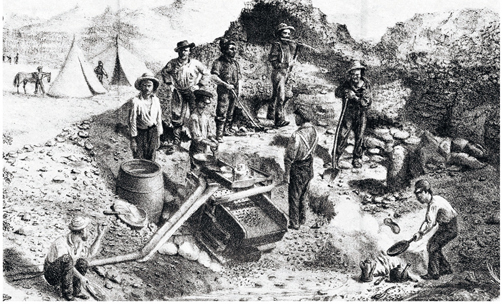
Consider California. Its wealth was initially built on gold mines. But today it is built on silicon and celluloid – Silicon Valley and the celluloid hills of Hollywood. What would happen if the Chinese were to mount an armed invasion of California, land a million soldiers on the beaches of San Francisco and storm inland? They would gain little. There are no silicon mines in Silicon Valley. The wealth resides in the minds of Google engineers and Hollywood script doctors, directors and special-effects wizards, who would be on the first plane to Bangalore or Mumbai long before the Chinese tanks rolled into Sunset Boulevard. It is not coincidental that the few full-scale international wars that still take place in the world, such as the Iraqi invasion of Kuwait, occur in places were wealth is old-fashioned material wealth. The Kuwaiti sheikhs could flee abroad, but the oil fields stayed put and were occupied.
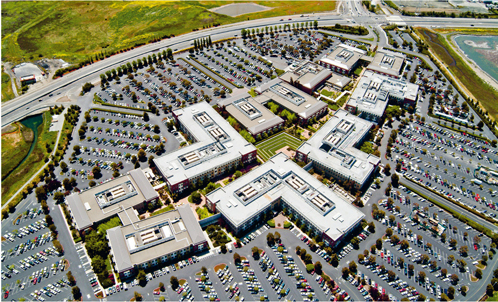
43. and 44. Gold miners in California during the Gold Rush, and Facebook’s headquarters near San Francisco. In 1849 California built its fortunes on gold. Today, California builds its fortunes on silicon. But whereas in 1849 the gold actually lay there in the Californian soil, the real treasures of Silicon Valley are locked inside the heads of high-tech employees.
While war became less profitable, peace became more lucrative than ever. In traditional agricultural economies long-distance trade and foreign investment were sideshows. Consequently, peace brought little profit, aside from avoiding the costs of war. If, say, in 1400 England and France were at peace, the French did not have to pay heavy war taxes and to suffer destructive English invasions, but otherwise it did not benefit their wallets. In modern capitalist economies, foreign trade and investments have become all-important. Peace therefore brings unique dividends. As long as China and the USA are at peace, the Chinese can prosper by selling products to the USA, trading in Wall Street and receiving US investments.
Last but not least, a tectonic shift has taken place in global political culture. Many elites in history – Hun chieftains, Viking noblemen and Aztec priests, for example – viewed war as a positive good. Others viewed it as evil, but an inevitable one, which we had better turn to our own advantage. Ours is the first time in history that the world is dominated by a peace-loving elite – politicians, business people, intellectuals and artists who genuinely see war as both evil and avoidable. (There were pacifists in the past, such as the early Christians, but in the rare cases that they gained power, they tended to forget about their requirement to ‘turn the other cheek’.)
There is a positive feedback loop between all these four factors. The threat of nuclear holocaust fosters pacifism; when pacifism spreads, war recedes and trade flourishes; and trade increases both the profits of peace and the costs of war. Over time, this feedback loop creates another obstacle to war, which may ultimately prove the most important of all. The tightening web of international connections erodes the independence of most countries, lessening the chance that any one of them might single-handedly let slip the dogs of war. Most countries no longer engage in full-scale war for the simple reason that they are no longer independent. Though citizens in Israel, Italy, Mexico or Thailand may harbour illusions of independence, the fact is that their governments cannot conduct independent economic or foreign policies, and they are certainly incapable of initiating and conducting full-scale war on their own. As explained in Chapter 11, we are witnessing the formation of a global empire. Like previous empires, this one, too, enforces peace within its borders. And since its borders cover the entire globe, the World Empire effectively enforces world peace.
So, is the modern era one of mindless slaughter, war and oppression, typified by the trenches of World War One, the nuclear mushroom cloud over Hiroshima and the gory manias of Hitler and Stalin? Or is it an era of peace, epitomised by the trenches never dug in South America, the mushroom clouds that never appeared over Moscow and New York, and the serene visages of Mahatma Gandhi and Martin Luther King?
The answer is a matter of timing. It is sobering to realise how often our view of the past is distorted by events of the last few years. If this chapter had been written in 1945 or 1962, it would probably have been much more glum. Since it was written in 2014, it takes a relatively buoyant approach to modern history.
To satisfy both optimists and pessimists, we may conclude by saying that we are on the threshold of both heaven and hell, moving nervously between the gateway of the one and the anteroom of the other. History has still not decided where we will end up, and a string of coincidences might yet send us rolling in either direction.
* An ‘intimate community’ is a group of people who know one another well and depend on each other for survival.