
Every way of life has its own language and the stock market is no exception. I have tried in this book to keep explanations as simple as possible, and we have covered a great number of concepts already, but there are some more often used expressions that are worth learning about.
In particular, you will see name tags attached to shares:
Blue chips
The largest companies on the stock market. The term is often used about any company in the FTSE 100.
Recovery stocks
Shares that have taken a battering but could be turning the corner, perhaps because of new management or improving markets.
Cyclical stocks
Companies that see their fortunes rise and fall with cycles in the economy. As the economy slows, theirs are the products that consumers can most easily manage without. Examples would be furniture retailers and leisure groups. Transport groups could suffer, as fewer goods are moved and fewer people travel to work.
Counter-cyclical stocks
These companies do well out of a recession but are abandoned in the good times. A budget clothing retailer would expect to sell more when people are out of work but most of us prefer something stylish to wear when we go out to celebrate a pay rise.
Defensive stocks
These companies expect their share price to hold up well when shares prices are falling. Supermarkets should survive a downturn because we still have to eat.
Growth stocks
Small companies that are growing strongly and are expected to continue to do so.
Value stocks
Companies whose shares are cheap given their excellent prospects.
Penny stocks
Shares that have fallen below 10p on the stock market (some investment commentators define a penny stock as one that has fallen below 100p).
Shells
Companies that have cash but do not have any operating companies.
Those pesky animals
Bulls and bears
Most people have heard of bulls and bears, the most popular exhibits in the stock market zoo:
· Bulls are the optimists, the ones who buy shares in the touching belief that the good times will roll forever and a day. If you think shares will go up, you are a bull.
· Bears are the gloomy pessimists, the Victor Meldrews who see the end of the world rapidly approaching. If you think shares will go down, you are a bear.
You can mix and match your animal instincts. You may be bearish about the market as a whole but bullish about an individual company or vice versa.
Stags
While bulls and bears abound freely, stags have been almost hunted to extinction. A stag buys newly-issued shares with the intention of selling for a quick profit. They were a protected species under Margaret Thatcher, who fed them on a rich diet of privatisation issues.
The theory is that when a company is floated on the stock market it will be priced just below its real value. This (it is hoped by the financial advisers) avoids the ignominy of new issues dropping heavily as soon as they are released. As the shares gently rise in value, the advisers bathe in the healthy glow of a successful flotation and a large fee.
Stags attempt to spot when the advisers under-price the share issue. They apply for shares then sell in the market at a substantially higher price.
Alas, most new share issues are placed with institutional investors because that is cheaper than offering them all round. By sounding out how many shares institutions are willing to take and at what price (this is called book running or book building) it is possible for the shares to be placed at a realistic price.
All in all, the opportunities for stagging are few and far between for private investors. However, a great opportunity for stags did arise with the flotation of Royal Mail at the end of 2013, when it was quite obvious to everyone except the City-based advisers to the government that the issue was grossly underpriced at 330p. The shares closed on their first day of trading at 455p and quickly ran up to 615p before the stags grabbed their profits.
Dead cat bounce
Better to be a stag than a cat, the unfortunate creature that features in the dead cat bounce. Squeamish readers and cat lovers should look away now.
If you went to the top of a very tall building and dropped a dead cat over the edge it would hit the ground with such force that it would bounce, though not very high and it would immediately splat back onto the ground. Please do not try this at home and rest assured that the author has never conducted such an experiment with any creature, dead or alive.
When shares have fallen heavily, they often reach a point where they bounce up a little. This may be because shareholders who sold out at the top decide it is time to get back in or because new investors judge that the fall has gone far enough.
Alas, in dire circumstances the shares may well start falling again after a short pause. That short-lived minor recovery is known as a dead cat bounce.
Case study: Accrol
You may think that making toilet rolls is selling into a steady market but any company in any line of business can run into trouble.
Toilet roll manufacturer Accrol’s shares had been fairly steady on AIM for most of 2017, trading above the level at the start of the year, when bad news came like a bolt from the blue.
A new chief executive appointed in September began a full review of operations and in less than a month he put out a profit warning. The cost of paper had increased and although Accrol had pushed up its own prices it had not been possible to recover all the extra costs.
Chart 11

For good measure, Accrol now feared that a significant fine would be imposed by the Health & Safety Executive for an incident some time previously.
The board was reviewing the dividend for the current financial year, which was a euphemism for saying that it would be reduced and possibly scrapped.
Accrol asked for its shares to be suspended while it considered whether it had the financial resources to continue. This suspension was lifted in November as it set about raising £18 million to solve its short-term funding problems.
The shares were suspended at 131p and returned at 44p before sinking as low as 35p. There was a dead cat bounce back up to 44p on hopes that the problems were short term and Accrol would fare better in the 2018–19 financial year. However, long-term worries soon resurfaced and the shares slid back below 40p.
Catching falling knives
A short walk from the menagerie to the kitchen takes us to the concept of catching falling knives. Sometimes the shares really do recover. It isn’t a dead cat bounce after all.
Now the name of the game is to buy while shares are cheap and sell when they are dear. If you can catch a share after it has fallen heavily and hold it as it recovers, you make a nice profit.
This is, however, a dangerous tactic, rather like trying to catch knives dropping from the top of the same building as the dead cat.
You might grab the handle – in other words, catch a share that has been oversold and will recover as soon as the panic is over.
On the other hand, you could grab the blade. You now own shares that keep falling. Snatching at falling shares is a dangerous business. They could be falling for a very good reason – the company could even be going bust.
Case study: Dixons Carphone
Some financial commentators doubted the wisdom of merging the Dixons electricals shop with mobile phone retailer Carphone Warehouse but the link-up worked well at first.
Then worries that the squeeze on consumer spending, caused by rising inflation outpacing pay rises, pushed the shares lower throughout 2017, presenting several opportunities for investors trying to catch the bottom of the slide.
As so often happens, the slide in the share price continued for longer than many expected and a disappointing trading update at the end of August, showing that growth had tailed off in the UK and Ireland, sent the shares sharply lower.
Chart 12
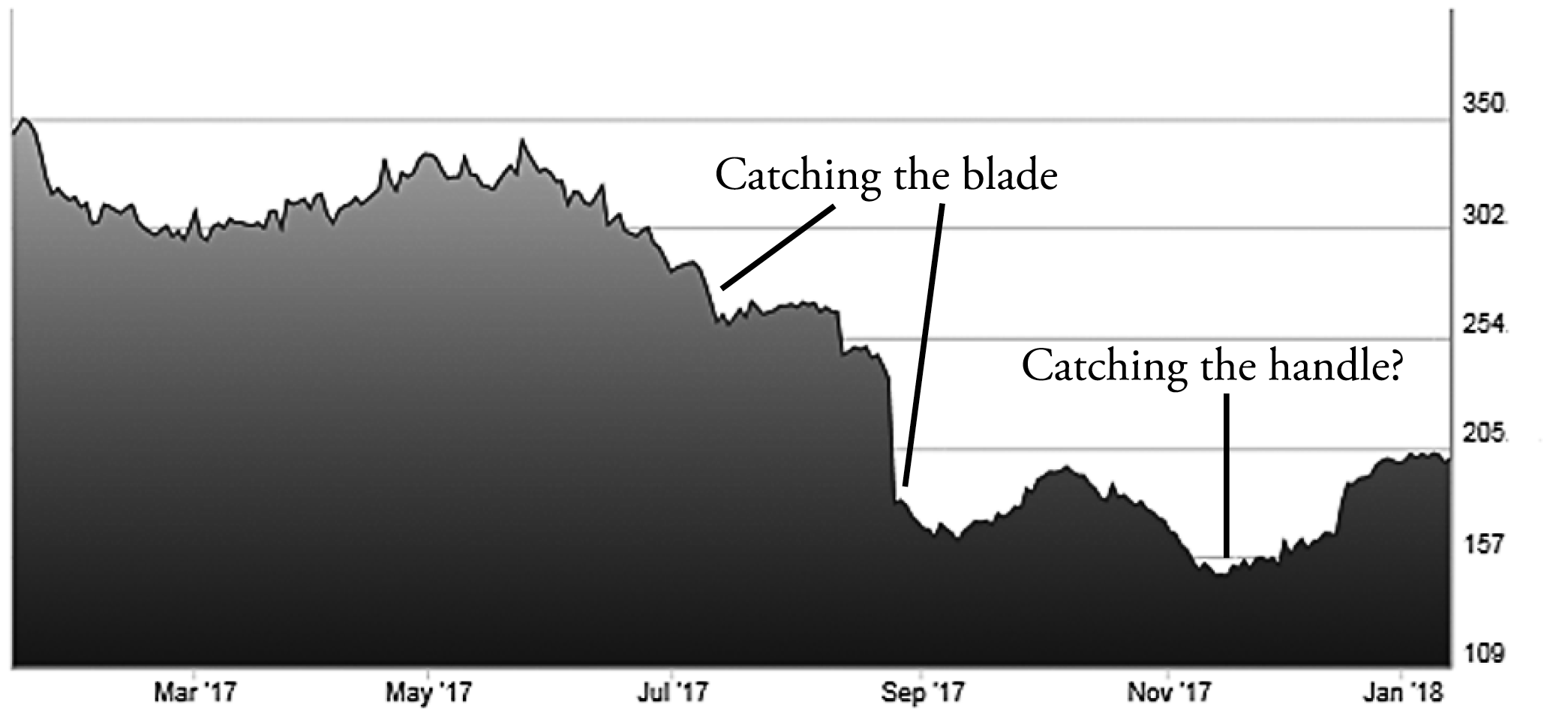
This time, however, they really did seem to have hit the bottom and a slow recovery was underway before more upbeat interim results in mid-December suggested that the worst was over in the UK and Ireland, while operations in Scandinavia and Greece were growing rapidly.
The interim dividend had been maintained rather than reduced, as feared, and the board declared its confidence that the payout for the full year would also be unchanged.