

It isn’t easy being an organism. In the whole universe, as far as we yet know, there is only one place, an inconspicuous outpost of the Milky Way called the Earth, that will sustain you, and even it can be pretty grudging.
From the bottom of the deepest ocean trench to the top of the highest mountain, the zone that covers nearly the whole of known life is only around 20 kilometres thick—not much when set against the roominess of the cosmos at large.
For humans it is even worse because we happen to belong to the portion of living things that took the rash but venturesome decision 400 million years ago to crawl out of the seas and become land-based and oxygen-breathing. In consequence, no less than 99.5 per cent of the world’s habitable space by volume, according to one estimate, is fundamentally—in practical terms completely—off limits to us.
It isn’t simply that we can’t breathe in water, but that we couldn’t bear the pressures. Because water is about 1,300 times heavier than air, pressures rise swiftly as you descend—by the equivalent of one atmosphere for every 10 metres of depth. On land, if you rose to the top of a 150-metre eminence—Cologne Cathedral or the Washington Monument, say—the change in pressure would be so slight as to be indiscernible. At the same depth under water, however, your veins would collapse and your lungs would compress to the approximate dimensions of a Coke can. Amazingly, people do voluntarily dive to such depths, without breathing apparatus, for the fun of it, in a sport known as free diving. Apparently, the experience of having your internal organs rudely deformed is thought exhilarating (though not, presumably, as exhilarating as having them return to their former dimensions upon resurfacing). To reach such depths, however, divers must be dragged down, and quite briskly, by weights. Without assistance, the deepest anyone has gone and lived to talk about it afterwards is 72 metres—a feat performed by an Italian named Umberto Pelizzari, who in 1992 dived to that depth, lingered for a nanosecond and then shot back to the surface. In terrestrial terms, 72 metres is a good bit shorter than a football pitch. So even in our most exuberant stunts we can hardly claim to be masters of the abyss.
Other organisms do, of course, manage to deal with the pressures at depth, though quite how some of them do so is a mystery. The deepest point in the ocean is the Mariana Trench in the Pacific. There, some 11.3 kilometres down, the pressures rise to over 16,000 pounds per square inch. We have managed just once, briefly, to send humans to that depth in a sturdy diving vessel, yet it is home to colonies of amphipods, a type of crustacean similar to shrimp but transparent, which survive without any protection at all. Most oceans are of course much shallower, but even at the average ocean depth of 4 kilometres the pressure is equivalent to being squashed beneath a stack of fourteen loaded cement trucks.
Nearly everyone, including the authors of some popular books on oceanography, assumes that the human body would crumple under the immense pressures of the deep ocean. In fact, this appears not to be the case. Because we are made largely of water ourselves, and water is “virtually incompressible,” in the words of Frances Ashcroft of Oxford University “the body remains at the same pressure as the surrounding water, and is not crushed at depth.” It is the gases inside your body, particularly in the lungs, that cause the trouble. These do compress, though at what point the compression becomes fatal is not known. Until quite recently it was thought that anyone diving to 100 metres or so would die painfully as his or her lungs imploded or chest wall collapsed, but the free divers have repeatedly proved otherwise. It appears, according to Ashcroft, that “humans may be more like whales and dolphins than had been expected.”

Umberto Pelizzari, the world’s most successful free diver, surfaces after plunging (with the assistance of weights) to a depth of 131 metres without breathing apparatus in 2001. Until recently it was thought no human could survive at such depths. (credit 16.1)
Plenty else can go wrong, however. In the days of diving suits—the sort that were connected to the surface by long hoses—divers sometimes experienced a dreaded phenomenon known as “the squeeze.” This occurred when the surface pumps failed, leading to a catastrophic loss of pressure in the suit. The air would leave the suit with such violence that the hapless diver would be, all too literally, sucked up into the helmet and hosepipe. When hauled to the surface, “all that is left in the suit are his bones and some rags of flesh,” the biologist J. B. S. Haldane wrote in 1947, adding for the benefit of doubters, “This has happened.”
(Incidentally, the original diving helmet, designed in 1823 by an Englishman named Charles Deane, was intended not for diving but for fire fighting. It was called a “smoke helmet,” but, being made of metal, it was hot and cumbersome; as Deane soon discovered, fire-fighters had no particular eagerness to enter burning structures in any form of attire, but most especially not in something that heated up like a kettle and made them clumsy into the bargain. In an attempt to save his investment, Deane tried it under water and found it was ideal for salvage work.)

Typical nineteenth-century diving machines. Such equipment allowed divers for the first time to spend prolonged periods under water, but difficulties in controlling air pressure meant constant risk to their lives. (credit 16.2)
The real terror of the deep, however, is the bends—not so much because they are unpleasant, though of course they are, as because they are so much more likely. The air we breathe is 80 per cent nitrogen. Put the human body under pressure, and that nitrogen is transformed into tiny bubbles that migrate into the blood and tissues. If the pressure is changed too rapidly—as with a too-quick ascent by a diver—the bubbles trapped within the body will begin to fizz in exactly the manner of a freshly opened bottle of champagne, clogging tiny blood vessels, depriving cells of oxygen and causing pain so excruciating that sufferers are prone to bend double in agony—hence “the bends.”
The bends have been an occupational hazard for sponge and pearl divers since time immemorial, but didn’t attract much attention in the Western world until the nineteenth century, and then it was among people who didn’t get wet at all (or at least, not very wet and not generally much above the ankles). They were caisson workers. Caissons were enclosed dry chambers built on river beds to facilitate the construction of bridge piers. They were filled with compressed air, and often when the workers emerged after an extended period of working under this artificial pressure they experienced mild symptoms like tingling or itchy skin. But an unpredictable few felt more insistent pain in the joints and occasionally collapsed in agony, sometimes never to get up again.

Cutaway drawing of an early twentieth-century steel caisson, an enclosed chamber that allowed men to work beneath water. An occupational hazard for such workers was the excruciating condition known as “the bends.” (credit 16.3)
It was all most puzzling. Sometimes the workers would go to bed feeling fine, but wake up paralysed. Sometimes they wouldn’t wake up at all. Ashcroft relates a story concerning the directors of a new tunnel under the Thames who held a celebratory banquet as the tunnel neared completion. To their consternation their champagne failed to fizz when uncorked in the compressed air of the tunnel. However, when at length they emerged into the fresh air of a London evening, the bubbles sprang instantly to fizziness, memorably enlivening the digestive process.
Apart from avoiding high-pressure environments altogether, only two strategies are reliably successful against the bends. The first is to suffer only a very short exposure to the changes in pressure. That is why the free divers I mentioned earlier can descend to depths of 150 metres without ill effect. They don’t stay down long enough for the nitrogen in their system to dissolve into their tissues. The other solution is to ascend by careful stages. This allows the little bubbles of nitrogen to dissipate harmlessly.
A great deal of what we know about surviving at extremes is owed to the extraordinary father and son team of John Scott and J. B. S. Haldane. Even by the demanding standards of British intellectuals, the Haldanes were outstandingly eccentric. The senior Haldane was born in 1860 to an aristocratic Scottish family (his brother was Viscount Haldane), but spent most of his career in comparative modesty as a professor of physiology at Oxford. He was famously absent-minded. Once, after his wife had sent him upstairs to change for a dinner party, he failed to return and was discovered asleep in bed in his pyjamas. When roused, Haldane explained that he had found himself disrobing and assumed it was bedtime. His idea of a holiday was to travel to Cornwall to study hookworm in miners. Aldous Huxley, the novelist grandson of T. H. Huxley, who lived with the Haldanes for a time, parodied him, a touch mercilessly, as the scientist Edward Tantamount in the novel Point Counter Point.
Haldane’s gift to diving was to work out the rest intervals necessary to manage an ascent from the depths without getting the bends, but his interests ranged across the whole of physiology, from studying altitude sickness in climbers to the problems of heatstroke in desert regions. He had a particular interest in the effects of toxic gases on the human body. To understand more exactly how carbon monoxide leaks killed miners, he methodically poisoned himself, carefully taking and measuring his own blood samples the while. He quit only when he was on the verge of losing all muscle control and his blood saturation level had reached 56 per cent—a level, as Trevor Norton notes in his entertaining history of diving, Stars Beneath the Sea, only fractionally removed from nearly certain lethality.
Haldane’s son Jack, known to posterity as J.B.S., was a remarkable prodigy who took an interest in his father’s work almost from infancy. At the age of three he was overheard demanding peevishly of his father, “But is it oxyhaemoglobin or carboxyhaemoglobin?” Throughout his youth, the young Haldane helped his father with experiments. By the time he was a teenager, the two often tested gases and gas masks together, taking it in turns to see how long it took them to pass out.
Though J. B. S. Haldane never took a degree in science (he studied classics at Oxford), he became a brilliant scientist in his own right, mostly working for the government at Cambridge. The biologist Peter Medawar, who spent his life around mental Olympians, called him “the cleverest man I ever knew.” Huxley parodied the younger Haldane too, in his novel Antic Hay, but also used his ideas on genetic manipulation of humans as the basis for the plot of Brave New World. Among many other achievements, Haldane played a central role in marrying Darwinian principles ofevolution to the genetic work of Gregor Mendel to produce what is known to geneticists as the Modern Synthesis.
Perhaps uniquely among human beings, the younger Haldane found the First World War “a very enjoyable experience” and freely admitted that he “enjoyed the opportunity of killing people.” He was himself wounded twice. After the war he became a successful popularizer of science and wrote twenty-three books (as well as over four hundred scientific papers). His books are still thoroughly readable and instructive, though not always easy to find. He also became an enthusiastic Marxist. It has been suggested, not altogether cynically, that this was out of a purely contrarian instinct and that if he had been born in the Soviet Union he would have been a passionate monarchist. At all events, most of his articles first appeared in the Communist Daily Worker.
Whereas his father’s principal interests concerned miners and poisoning, the younger Haldane became obsessed with saving submariners and divers from the unpleasant consequences of their work. With Admiralty funding, he acquired a decompression chamber that he called the “pressure pot.” This was a metal cylinder into which three people at a time could be sealed and subjected to tests of various types, all painful and nearly all dangerous. Volunteers might be required to sit in ice water while breathing “aberrant atmosphere,” or subjected to rapid changes of pressurization. In one experiment, Haldane himself simulated a dangerously hasty ascent to see what would happen. What happened was that the dental fillings in his teeth exploded. “Almost every experiment,” Norton writes, “ended with someone having a seizure, bleeding or vomiting.” The chamber was virtually soundproof, so the only way for occupants to signal unhappiness or distress was to tap insistently on the chamber wall or to hold up notes to a small window.
On another occasion, while poisoning himself with elevated levels of oxygen, Haldane had a fit so severe that he crushed several vertebrae. Collapsed lungs were a routine hazard. Perforated eardrums were quite common, too; but, as Haldane reassuringly noted in one of his essays, “the drum generally heals up; and if a hole remains in it, although one is somewhat deaf, one can blow tobacco smoke out of the ear in question, which is a social accomplishment.”
What was extraordinary about this was not that Haldane was willing to subject himself to such risk and discomfort in the pursuit of science, but that he had no trouble talking colleagues and loved ones into climbing into the chamber, too. Sent on a simulated descent, his wife once had a fit that lasted thirteen minutes. When at last she stopped bouncing across the floor, she was helped to her feet and sent home to cook dinner. Haldane happily employed whoever happened to be around, including on one memorable occasion a former Prime Minister of Spain, Juan Negrín. Dr. Negrín complained afterwards of minor tingling and “a curious velvety sensation on the lips” but otherwise seems to have escaped unharmed. He may have considered himself very lucky. A similar experiment with oxygen deprivation left Haldane without feeling in his buttocks and lower spine for six years.
Among Haldane’s many specific preoccupations was nitrogen intoxication. For reasons that are still poorly understood, at depths beyond about 30 metres nitrogen becomes a powerful intoxicant. Under its influence divers had been known to offer their air hoses to passing fish or to decide to try to have a smoke break. It also produced wild mood swings. In one test, Haldane noted, the subject “alternated between depression and elation, at one moment begging to be decompressed because he felt ‘bloody awful’ and the next minute laughing and attempting to interfere with his colleague’s dexterity test.” In order to measure the rate of deterioration in the subject, a scientist had to go into the chamber with the volunteer to conduct simple mathematical tests. But after a few minutes, as Haldane later recalled, “the tester was usually as intoxicated as the testee, and often forgot to press the spindle of his stopwatch, or to take proper notes.” The cause of the inebriation is even now a mystery. It is thought that it may be the same thing that causes alcohol intoxication, but as no-one knows for certain what causes that, we are none the wiser. At all events, without the greatest care, it is easy to get in trouble once you leave the surface world.

Left: Haldane’s father, John Scott Haldane, conducts toxicity tests in a mine shaft in 1910. Like his son, the elder Haldane braved constant personal danger to understand the limits of human physiology. (credit 16.4a)
Right: British physiologist J.B.S. Haldane inserts himself into a decompression chamber in 1941. Haldane’s risky and eccentric experiments on himself, his friends and loved ones transformed our understanding of the effects of rapid changes of pressurization on the human body. (credit 16.4b)
Which brings us back (well, nearly) to our earlier observation that the Earth is not the easiest place to be an organism, even if it is the only place. Of the small portion of the planet’s surface that is dry enough to stand on, a surprisingly large amount is too hot or cold or dry or steep or lofty to be of much use to us. Partly, it must be conceded, this is our fault. In terms of adaptability, humans are pretty amazingly useless. Like most animals, we don’t much like really hot places, but because we sweat so freely and easily succumb to strokes, we are especially vulnerable. In the worst circumstances—on foot without water in a hot desert—most people will grow delirious and keel over, possibly never to rise again, in no more than seven or eight hours. We are no less helpless in the face of cold. Like all mammals, humans are good at generating heat; but—because we are so nearly hairless—we are not good at keeping it. Even in quite mild weather half the calories you burn go to keep your body warm. Of course, we can counter these frailties to a large extent by employing clothing and shelter, but even so the portions of the Earth on which we are prepared or able to live are modest indeed: just 12 per cent of the total land area, and only 4 per cent of the whole surface if you include the seas.
Yet when you consider conditions elsewhere in the known universe, the wonder is not that we use so little of our planet but that we have managed to find a planet of which we can use even a bit. You have only to look at our own solar system—or, come to that, the Earth at certain periods in its own history—to appreciate that most places are much harsher and much less amenable to life than our mild, blue, watery globe.
So far, space scientists have discovered about seventy planets outside the solar system, out of the ten billion trillion or so that are thought to be out there, so humans can hardly claim to speak with authority on the matter; but it appears that if you wish to have a planet suitable for life, you have to be just awfully lucky, and the more advanced the life, the luckier you have to be. Various observers have identified about two dozen particularly fortunate breaks we have had on the Earth, but this is a flying survey so we’ll distil them down to the principal four.
Excellent location. We are, to an almost uncanny degree, the right distance from the right sort of star, one that is big enough to radiate lots of energy, but not so big as to burn itself out swiftly. It is a curiosity of physics that the larger a star is, the more rapidly it burns. Had our Sun been ten times as massive, it would have exhausted itself after ten million years instead of ten billion and we wouldn’t be here now. We are also fortunate to orbit where we do. Too much nearer, and everything on Earth would have boiled away. Much further away, and everything would have frozen.
In 1978, an astrophysicist named Michael Hart made some calculations and concluded that the Earth would have been uninhabitable had it been just 1 per cent further from or 5 per cent closer to the Sun. That’s not much, and in fact it wasn’t enough. The figures have since been refined and made a little more generous—5 per cent nearer and 15 per cent further are thought to be more accurate assessments for our zone of habitability—but that is still a narrow belt.1
To appreciate just how narrow, you have only to look at Venus. Venus is only 25 million miles closer to the Sun than we are. The Sun’s warmth reaches it just two minutes before it touches us. In size and composition, Venus is very like the Earth, but the small difference in orbital distance made all the difference to how it turned out. It appears that during the early years of the solar system Venus was only slightly warmer than the Earth and probably had oceans. But those few degrees of extra warmth meant that Venus could not hold on to its surface water, with disastrous consequences for its climate. As its water evaporated, the hydrogen atoms escaped into space and the oxygen atoms combined with carbon to form a dense atmosphere of the greenhouse gas carbon dioxide. Venus became stifling. Although people of my age will recall a time when astronomers hoped that Venus might harbour life beneath its padded clouds, possibly even a kind of tropical verdure, we now know that it is much too fierce an environment for any kind of life that we can reasonably conceive of. Its surface temperature is a roasting 470 degrees Celsius, which is hot enough to melt lead, and the atmospheric pressure at the surface is ninety times that of Earth, more than any human body could withstand. We lack the technology to make suits or even spaceships that would allow us to visit. Our knowledge of Venus’s surface is based on distant radar imagery and some startled squawks from an unmanned Soviet probe that was dropped hopefully into the clouds in 1972 and functioned for barely an hour before permanently shutting down.

Computer-enhanced image of the surface of Venus derived from radar-mapping of the planet by the Magellan spacecraft, showing the giant Cunitz impact crater in the centre and the volcanic cone of Gula Mons about a thousand kilometres away at the top left. In reality, no camera or spacecraft could survive such a close approach to Venus’s murderous surface. (credit 16.5)
So that’s what happens when you move two light minutes closer to the Sun. Travel further out and the problem becomes not heat but cold, as Mars frigidly attests. It, too, was once a much more congenial place, but couldn’t retain a usable atmosphere and turned into a frozen waste.
But just being the right distance from the Sun cannot be the whole story, for otherwise the Moon would be forested and fair, which patently it is not. For that you need to have:
The right kind of planet. I don’t imagine even many geophysicists, when asked to count their blessings, would include living on a planet with a molten interior, but it’s a pretty near certainty that without all that magma swirling around beneath us we wouldn’t be here now. Apart from much else, our lively interior created the outpourings of gas that helped to build an atmosphere and provided us with the magnetic field that shields us from cosmic radiation. It also gave us plate tectonics, which continually renews and rumples the surface. If the Earth were perfectly smooth, it would be covered everywhere with water to a depth of 4 kilometres. There might be life in that lonesome ocean, but there certainly wouldn’t be football.
In addition to having a beneficial interior, we also have the right elements in the correct proportions. In the most literal way, we are made of the right stuff. This is so crucial to our well-being that we are going to discuss it more fully in a minute, but first we need to consider the two remaining factors, beginning with another one that is often overlooked:
We’re a twin planet. Not many of us normally think of the Moon as a companion planet, but that is, in effect, what it is. Most moons are tiny in relation to their master planet. The Martian satellites of Phobos and Deimos, for instance, are only about 10 kilometres in diameter. Our Moon, however, is more than a quarter the diameter of the Earth, which makes ours the only planet in the solar system with a sizeable moon in comparison to itself (except Pluto, which doesn’t really count because Pluto is itself so small)—and what a difference that makes to us.
Without the Moon’s steadying influence, the Earth would wobble like a dying top, with goodness knows what consequences for climate and weather. The Moon’s steady gravitational influence keeps the Earth spinning at the right speed and angle to provide the sort of stability necessary for the long and successful development of life. This won’t go on for ever. The Moon is slipping from our grasp at a rate of about 4 centimetres a year. In another two billion years it will have receded so far that it won’t keep us steady and we will have to come up with some other solution, but in the meantime you should think of it as much more than just a pleasant feature in the night sky.
For a long time, astronomers assumed that either the Moon and the Earth formed together or that the Earth captured the Moon as it drifted by. We now believe, as you will recall from an earlier chapter, that about 4.4 billion years ago a Mars-sized object slammed into Earth, blowing out enough material to create the Moon from the debris. This was obviously a very good thing for us—but especially so as it happened such a long time ago. If it had happened in 1896 or last Wednesday, clearly we wouldn’t be nearly so pleased about it. Which brings us to our fourth and in many ways most crucial consideration:
Timing. The universe is an amazingly fickle and eventful place and our existence within it is a wonder. If a long and unimaginably complex sequence of events stretching back 4.6 billion years or so hadn’t played out in a particular manner at particular times—if, to take just one obviousinstance, the dinosaurs hadn’t been wiped out by a meteor when they were—you might well be a few centimetres long, with whiskers and a tail, and reading this in a burrow.
We don’t really know, because we have nothing else to which we can compare our own existence, but it seems evident that if you wish to end up as a moderately advanced, thinking society, you need to be at the right end of a very long chain of outcomes involving reasonable periods of stability interspersed with just the right amount of stress and challenge (ice ages appear to be especially helpful in this regard) and marked by a total absence of real cataclysm. As we shall see in the pages that remain to us, we are very lucky to find ourselves in that position.
And on that note, let us now turn briefly to the elements that made us.
There are ninety-two naturally occurring elements on the Earth, plus a further twenty or so that have been created in labs, but some of these we can immediately put to one side—as, in fact, chemists themselves tend to do. Not a few of our earthly chemicals are surprisingly little known. Astatine, for instance, is practically unstudied. It has a name and a place on the periodic table (next door to Marie Curie’s polonium), but almost nothing else. The problem isn’t scientific indifference, but rarity. There just isn’t much astatine out there. The most elusive element of all, however, appears to be francium, which is so rare that it is thought that our entire planet may contain, at any given moment, fewer than twenty francium atoms. Altogether, only about thirty of the naturally occurring elements are widespread on Earth, and barely half a dozen are of central importance to life.
As you might expect, oxygen is our most abundant element, accounting for just under 50 per cent of the Earth’s crust, but after that the relative abundances are often surprising. Who would guess, for instance, that silicon is the second most common element on the Earth, or that titanium is tenth? Abundance has little to do with their familiarity or utility to us. Many of the more obscure elements are actually more common than the better-known ones. There is more cerium on the Earth than copper, more neodymium and lanthanum than cobalt or nitrogen. Tin barely makes it into the top fifty, eclipsed by such relative obscurities as praseodymium, samarium, gadolinium and dysprosium.
Abundance also has little to do with ease of detection. Aluminium is the fourth most common element on Earth, accounting for nearly a tenth of everything that’s underneath your feet, but its existence wasn’t even suspected until it was discovered in the nineteenth century by HumphryDavy, and for a long time after that it was treated as rare and precious. Congress nearly put a shiny lining of aluminium foil atop the Washington Monument to show what a classy and prosperous nation we had become, and the French imperial family in the same period discarded the state silver dinner service and replaced it with an aluminium one. The fashion was cutting edge even if the knives weren’t.
Nor does abundance necessarily relate to importance. Carbon is only the fifteenth most common element, accounting for a very modest 0.048 per cent of Earth’s crust, but we would be lost without it. What sets the carbon atom apart is that it is shamelessly promiscuous. It is the party animal of the atomic world, latching on to many other atoms (including itself) and holding tight, forming molecular conga lines of hearty robustness—the very trick of nature necessary to build proteins and DNA. As Paul Davies has written: “If it wasn’t for carbon, life as we know it would be impossible. Probably any sort of life would be impossible.” Yet carbon is not all that plentiful even in us who so vitally depend on it. Of every 200 atoms in your body, 126 are hydrogen, 51 are oxygen, and just 19 are carbon.2
Other elements are critical not for creating life but for sustaining it. We need iron to manufacture haemoglobin, and without it we would die. Cobalt is necessary for the creation of vitamin B12. Potassium and a very little sodium are literally good for your nerves. Molybdenum, manganese and vanadium help to keep your enzymes purring. Zinc—bless it—oxidizes alcohol.
We have evolved to utilize or tolerate these things—we could hardly be here otherwise—but even then we live within narrow ranges of acceptance. Selenium is vital to all of us, but take in just a little too much and it will be the last thing you ever do. The degree to which organisms require or tolerate certain elements is a relic of their evolution. Sheep and cattle now graze side by side, but actually have very different mineral requirements. Modern cattle need quite a lot of copper because they evolved in parts of Europe and Africa where copper was abundant. Sheep, on the other hand, evolved in copper-poor areas of Asia Minor. As a rule, and not surprisingly, our tolerance for elements is directly proportionate to their abundance in the Earth’s crust. We have evolved to expect, and in some cases actually need, the tiny amounts of rare elements that accumulate in the flesh or fibre that we eat. But step up the doses, in some cases by only a tiny amount, and we can soon cross a threshold. Much of this is only imperfectly understood. No-one knows, for example, whether a tiny amount of arsenic is necessary for our well-being or not. Some authorities say it is; some not. All that is certain is that too much of it will kill you.

Chemical elements that are harmless or beneficial in small doses often become dangerously toxic when concentrated—few more so than chlorine, which is routinely used as a purifying agent in water, but was also used to tragically devastating effect to make blinding gases in the First World War. (credit 16.6)
The properties of the elements can become more curious still when they are combined. Oxygen and hydrogen, for instance, are two of the most combustion-friendly elements around, but put them together and they make incombustible water.3 Odder still in combination are sodium, one of the most unstable of all elements, and chlorine, one of the most toxic. Drop a small lump of pure sodium into ordinary water and it will explode with enough force to kill. Chlorine is even more notoriously hazardous. Though useful in small concentrations for killing micro-organisms (it’s chlorine you smell in bleach), in larger volumes it is lethal. Chlorine was the element of choice for many of the poison gases of the First World War. And, as many a sore-eyed swimmer will attest, even in exceedingly dilute form the human body doesn’t appreciate it. Yet put these two nasty elements together and what do you get? Sodium chloride—common table salt.
By and large, if an element doesn’t naturally find its way into our systems—if it isn’t soluble in water, say—we tend to be intolerant of it. Lead poisons us because we were never exposed to it until we began to fashion it into food vessels and pipes for plumbing. (Not incidentally, lead’s symbol is Pb for the Latin plumbum, the source word for our modern plumbing.) The Romans also flavoured their wine with lead, which may be part of the reason they are not the force they used to be. As we have seen elsewhere, our own performance with lead (not to mention mercury, cadmium and all the other industrial pollutants with which we routinely dose ourselves) does not leave us a great deal of room for smirking. When elements don’t occur naturally on Earth, we have evolved no tolerance for them and so they tend to be extremely toxic to us, as with plutonium. Our tolerance for plutonium is zero: there is no level at which it is not going to make you want to lie down.
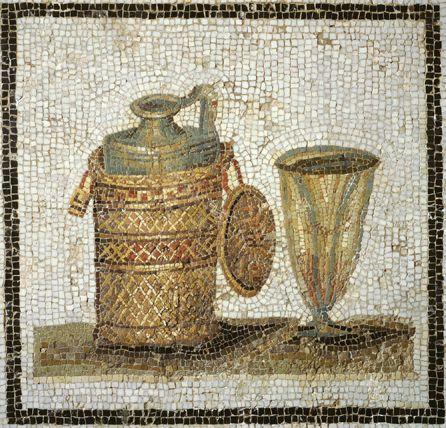
Mosaic of a Roman wine jug and glass from the second century AD. The wine almost certainly was flavoured with lead—an odd and dangerous practice. (credit 16.7)
I have brought you a long way to make a small point: a big part of the reason that Earth seems so miraculously accommodating is that we evolved to suit its conditions. What we marvel at is not that it is suitable to life but that it is suitable to our life—and hardly surprising really. It may be that many of the things that make it so splendid to us—well-proportioned Sun, doting Moon, sociable carbon, more molten magma than you can shake a stick at and all the rest—seem splendid simply because they are what we were born to count on. No-one can altogether say.
Other worlds may harbour beings thankful for their silvery lakes of mercury and drifting clouds of ammonia. They may be delighted that their planet doesn’t shake them silly with its grinding plates or spew messy gobs of lava over the landscape, but rather exists in a permanent non-tectonic tranquillity. Any visitors to the Earth from afar would almost certainly, at the very least, be bemused to find us living in an atmosphere composed of nitrogen, a gas sulkily disinclined to react with anything, and oxygen, which is so partial to combustion that we must place fire stations throughout our cities to protect ourselves from its livelier effects. But even if our visitors were oxygen-breathing bipeds with shopping malls and a fondness for action movies, it is unlikely that they would find the Earth ideal. We couldn’t even give them lunch because all our foods contain traces of manganese, selenium, zinc and other elemental particles at least some of which would be poisonous to them. To them the Earth might not seem a wondrously congenial place at all.
The physicist Richard Feynman used to make a joke about a posteriori conclusions—reasoning from known facts back to possible causes. “You know, the most amazing thing happened to me tonight,” he would say. “I saw a car with the licence plate ARW 357. Can you imagine? Of all the millions of licence plates in the state, what was the chance that I would see that particular one tonight? Amazing!” His point, of course, is that it is easy to make any banal situation seem extraordinary if you treat it as fateful.
So it is possible that the events and conditions that led to the rise of life on the Earth are not quite as extraordinary as we like to think. Still, they were extraordinary enough, and one thing is certain: they will have to do until we find some better.

1 The discovery of extremophiles in the boiling mudpots of Yellowstone and of similar organisms elsewhere made scientists realize that actually life of a type could range much further than that—even perhaps beneath the icy skin of Pluto. What we are talking about here are the conditions that would produce reasonably complex surface creatures.
2 Of the remaining four, three are nitrogen and the remaining atom is divided among all the other elements.
3 Oxygen itself is not combustible; it merely facilitates the combustion of other things. This is just as well, for if oxygen were combustible, each time you lit a match all the air around you would burst into flame. Hydrogen gas, on the other hand, is extremely combustible, as the dirigible Hindenburg demonstrated on 6 May 1937, in Lakehurst, New Jersey, when the hydrogen that gave it lift exploded, killing thirty-six people.

The ceaseless majesty of “the Great Aerial Ocean,” as Alfred Russel Wallace called Earth’s atmosphere, becomes immediately evident in this photograph from space taken from Skylab. The central swirls are known as von Karman vortices, after the man who first studied them. (credit 17.1)