
Buy this book on Amazon: A Short History of the World
Meanwhile, in western Europe, the Frankish kingdom reached its apogee under the grandson of Charles Martel, Carolus Magnus, better known by his Gallic name, Charlemagne. Crowned king of the Franks in AD 771 at the age of 29, he is often recognised as the greatest king of the European Early Middle Ages, and with good reason: he united the Frankish tribes and kingdoms in the West into the largest European empire since Rome, an empire which included much of present-day France, Germany, the Netherlands, Belgium Switzerland, Austria, Poland and Italy.

Charlemagne was rewarded for being on good terms with the Pope, whom the Franks had helped on more than one occasion, by being crowned Roman emperor in Saint Peter's Basilica in Rome on Christmas Day in AD 800. Although Charlemagne reigned for 46 years his empire was short lived; his son split the empire into three parts – one for each of his own sons – and the result was an empire divided into numerous feudal states and threatened by enemies on its frontiers – Muslims to the south, Slavs to the east and Vikings to the north.
One of Charlemagne’s accomplishments was to bring back to public consciousness the idea of a renewed and reinvigorated Roman Empire. While his immediate successors failed to do justice to the title, the coronation of the German king, Otto I, by Pope John XII in AD 962, marks the beginning of an unbroken line of emperors that lasted for the next eight centuries, nominally ruling a territory encompassing most of present-day Germany and parts of Italy. In 1157, Frederick I added the word ‘Holy’ to ‘Roman Empire’ in recognition of his role as defender of the faith.
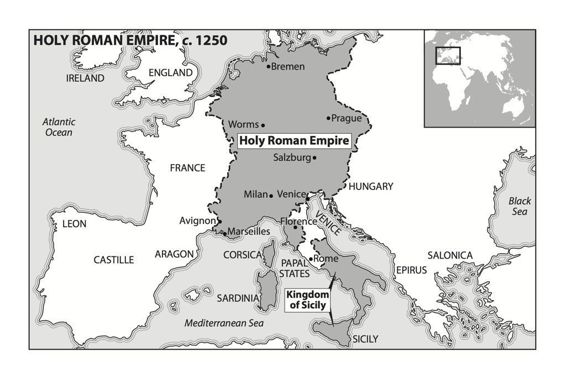
German sovereigns who ruled over a confederation of hundreds of independent entities, large and small, held this title at all times. The largest of these ruling families was the Austrian House of Habsburg, with which the title stayed from 1452 until 1806. Looking back on the Empire in the 18th century, the Enlightenment philosopher, Voltaire, rightly commented that it was ‘neither Holy, nor Roman nor an Empire’.