
Buy this book on Amazon: A Short History of the World
From the very little evidence we have,2 it is generally understood that ape-like primates named ‘Australopithicus’ first appeared in the forests of Eastern Africa roughly 20–30 million years ago. Climate change may have destroyed their natural habitat, forcing them out into the open savannah where they evolved the ability to stand in order to keep an eye out for predators. The advantage of walking on two legs enabled them to have their hands free to carry food and children, which would have played a considerable part in the success of their evolution.
Two and a half million years ago a species of these primates began using tools, as evidenced by materials found with their remains. As a result of this, the species was named Homo Habilis or ‘Handy Man’, and is generally thought to be the first direct ancestor of Homo Sapiens, which are modern humans. Homo Ergaster, Homo Erectus, Homo Heidelbergensis and the better-known Homo Neanderthalensis, or Neanderthal man, are categories of hominids that have been assigned in order to describe and name fossils of our early relatives who are believed to have lived between Homo Habilis and the present day, with each one evolving greater brain capacity over time.
Fossil remains discovered to date suggest that by a million years ago Homo Erectus (Upright Man), our first ancestor to walk truly upright, had spread across the world, having migrated outwards from East Africa.3 There then follow two schools of thought: one is the Multi-Regional Theory of Evolution that states that humans thereafter evolved separately wherever they made their home; while the other, and the generally more accepted view, is that there was a second major migratory movement4 by Homo Sapiens (Wise Man), once again out of Africa, starting approximately 60-80,000 years ago – very possibly along the same routes as previous migratory movements – with Homo Sapiens gradually replacing all other types of hominid. The assumptions for the ‘Out of Africa’ theory are based on research that has traced our roots back to a common African ancestor by studying the differences in the genetic code of people living around the world today.
While Homo Sapiens and Neanderthals originated in different parts of the world,5 they nevertheless came into contact. To this day, there is much discussion within the scientific community as to how close the two species might have been to each other and whether or not they interbred.6 Either way, there is strong evidence to suggest that Neanderthals learned to hunt in coordinated groups, use tools and fire, speak, and even bury their dead. Making fire was important in that it allowed early man to cook food, thereby making it more digestible and increasing the number of food sources available to him. This would have considerably helped with man’s evolution.
From around 30,000 BC – with few exceptions – traces of Neanderthals disappeared and evidence of Homo Sapiens rapidly increased. This may have been caused by a number of different factors, including Homo Sapiens outcompeting or killing Neanderthals, the introduction of a disease to which Neanderthals were not immune, a change of climate with which they could not cope, or a host of other reasons that we can only speculate about due to a lack of conclusive evidence. What we do know is that from around this time, Homo Sapiens reigned supreme, as no fossils of any other hominid discovered so far have been dated back to earlier than around 30,000 BC, give or take a few thousand years.
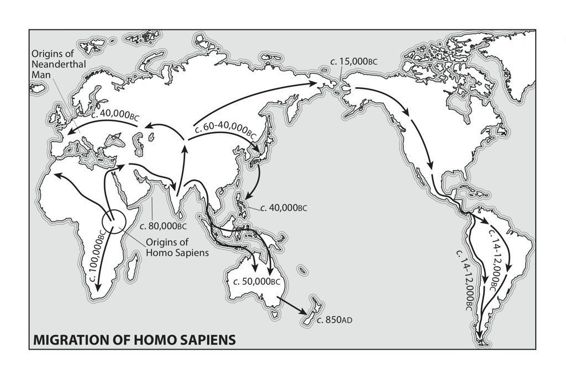
We do not currently know if the causes for human migrations were competition for resources, climate change, or simply the desire to explore. Regardless of the reasons, the general view is that Australia was reached approximately 50,000 years ago and that, by circa 15,000 BC, Homo Sapiens crossed into present-day Alaska via what is now the Bering Strait, when it was either dry land or frozen.7 Then, within a few thousand years, they reached the southernmost tip of South America and, with the exception of a few islands in the Pacific, most of the world was colonised by humans by this time. From then on, life in the Americas would develop in complete isolation from the rest of the world until European colonisation began in 1492, notwithstanding a brief visit by the Vikings around AD 1,000.