
Buy this book on Amazon: A Short History of the World
By the mid-15th century, slaves from Africa had been imported to Portugal in larger and larger numbers as a result of the expeditions down the west African coast. There had been a long history of slave trading among native Africans and Arab middlemen for centuries prior to European intervention. Acclimatised to the temperature and of strong build, African slaves had made good labourers in the sugar plantations of the newly discovered Portuguese colonies off the west African coast such as the Canaries, the Azores and Madeira.
It was this realisation that encouraged Portuguese entrepreneurs to begin exporting slaves to newly-discovered Brazil where they rapidly began growing highly profitable sugarcane and mining silver. African slaves were imported in such huge numbers76 that by the end of the 17th century up to half of Brazil’s population consisted of African slaves.
Growing demand for sugar in Europe, which came as a result of the increasing popularity of tea and coffee, encouraged other nations to grow sugarcane in the Caribbean, a group of islands that had a similar climate to that of Brazil. This interest coincided with the reduced return on investment that the tobacco growing industry in the Caribbean had seen after the world markets were flooded by cheap Virginian tobacco. Yet high mortality rates in the Caribbean meant that much of the original European workforce had either died or fled to northern America where the climate was more agreeable. Not only a new crop, but a new workforce would be needed.
While the English and the French busied themselves with setting up sugarcane plantations, the Dutch supplied much of the credit and the slaves in return for which they handled the sale of the sugar. It was the Dutch who first supplied slaves to northern America in 1619, where they would eventually become essential to the economy.
By the time the slave trade ended, the Caribbean had taken an estimated 50 percent of the roughly fifteen million African slaves transported to the Americas as cheap labour over a three hundred year period. In fact, up until the beginning of the 19th century, the majority of immigrants to the Americas were African.
The journey across the Atlantic from Africa to the Americas generally took place under horrendous conditions. Slaves were chained together in the hulls of overcrowded ships to maximise profits for the trader, disease was rife, and it was not uncommon for 25 percent of the slaves to die during the ‘Middle Passage’, as the crossing came to be known. Once they arrived they were treated like animals. Their low life expectancy, combined with the shortage of women, and therefore children, meant that regular shipments were required.
By the 1680s, the Dutch, English and French all had their own sugar plantation colonies, with production surpassing even that of Brazil. For a while, British-owned Barbados became the largest sugar producer in the world, only to be surpassed by Jamaica and French-held Santo Domingo in present-day Haiti. Entire islands became dependent on sugar, and huge profits earned it the name ‘white gold’.
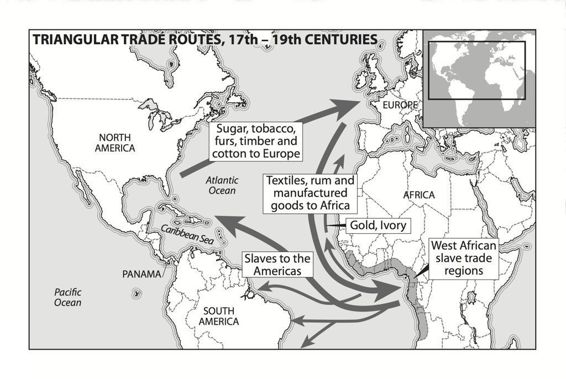
The trade in slaves was part of the triangular trade pattern or ‘Atlantic System’ between the 17th and 19th centuries. Western manufactured goods, such as textiles and guns, were sent to Africa where they were exchanged for slaves who were, in turn, shipped to the Caribbean and exchanged for sugar and other commodities such as tobacco and coffee. These commodities were then sold in Europe and used to buy manufactured goods that were subsequently exported to Africa where the whole process repeated itself. A sugar by-product called molasses was distilled into rum and also shipped to Africa in a vicious cycle of profit where slave labour led to the enslavement of more slaves.
Capital generated from the sugar and other slave-dependent industries was used to finance banks, extend credit and invest in new inventions, all of which contributed to the industrial revolution in Britain.