
Buy this book on Amazon: A Short History of the World
American independence had been accompanied by a huge growth in population, doubling to eight million between 1790 and 1814, and subsequently increasing to 23 million by 1850.
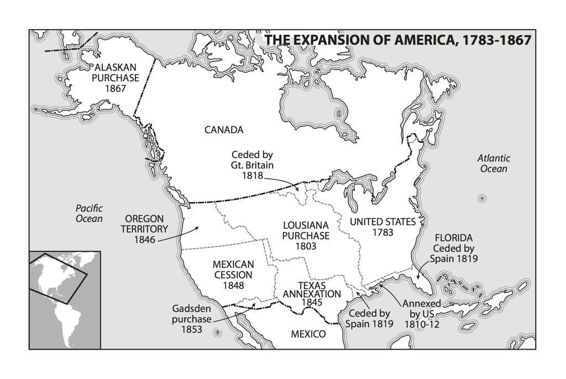
Much of this latter growth had come from an influx of Europeans seeking to escape Europe after 1815 and attracted by the almost unlimited demand for labour in an expanding economy. A substantial number of Irish arrived in America from 1846 onwards in an attempt to escape a terrible famine that occurred between 1846 and 1851 as a result of the devastation of Ireland’s potato crop. The result of this influx of people was an economic boom that led to the major westward expansion of the United States.
In 1803, under President Jefferson, America purchased the Louisiana territory – all two million square kilometres of it – from Napoleon, who had required funds to wage his wars in Europe95 and the purchase of land roughly the size of Europe effectively doubled the size of the country at the time. The annexation by the Americans of Texas in 1845 caused a war with the Mexicans, who were forced to concede California, and Alaska was bought from the Russians in 1867 for USD 7.2 million dollars.96 In 1898, after a ten-week war with Spain, the US gained Cuba, Puerto Rico, Guam and the Philippines, though they never became states.
The growth in its manufacturing industry and the production of cheap steel, a metal that is less expensive to produce and lighter and stronger than iron, allowed America to develop the railroads that were instrumental in opening its territory to trade and settlement. The railroad, the steamship, and the telegraph reduced the cost and time of transportation and communication, and helped create a new market for American goods. By the end of the 19th century, the United States had become the largest and most competitive industrial nation in the world. In Europe, the flood of cheap American food led to falling European death rates and an increase in the population, which subsequently acted as a driving factor for industrialisation on the mainland.