
CHAPTER ONE
On my desk in front of me is a little white cylinder, approximately 10cm long with rounded ends. It looks rather like a large capsule from a pharmacy, except that the case ‘instead of being smooth’ is slightly woolly to the touch. Given the title of this book, readers will probably have guessed that this is the cocoon of the domestic silk moth, Bombyx mori, a close relation to the wild silk moth, Bombyx mandarina. The cocoon is just one stage in the life of this rather dull looking creature.
The story starts with the female moth, which lays as many as 500 eggs over a period of three or four days and then dies. These are minute eggs – a hundred of them only weigh about a gram – and from these the tiny worms emerge a fortnight later with only one object in life; to eat as much mulberry leaf as they can manage, and not just any mulberry leaf. They are picky eaters and only really thrive on the white mulberry. During the next month, they will increase their weight 10,000 times. They are such voracious eaters that if you visit a silkworm farm you can actually hear the steady chomp of their tiny jaws. In that time there are four moults, in which the dark hairy larvae become smooth skinned, at first white and in the final stage slightly yellow. It is then that they begin to secrete the silk thread that wraps round the body as the cocoon, to protect the creature as it pupates. This single filament can be anything from 600 to 900 metres long. Once this stage is completed, the moth emits enzymes that attack the silk and allow the moth to escape the cocoon. The wild silk moths will fly out, but the domestic silk moth has a heavy body and can scarcely lift itself into the air, but that does not mean that they are inactive, far from it. The female emits a powerful pheromone that basically makes the males so mad for sex they will try and mate not just with the females but even with each other. Once mating has occurred, the moths soon die and the whole cycle starts again.
The wild silk moths had been following this same pattern, producing silk for their own purposes, from the time when the moth first evolved in an age long before the first humans appeared on the planet. The interesting question is this; what on earth made anyone think that the hairy little capsules like the one on my desk had any value at all? I am reminded of the writer who argued that the existence of mayonnaise was an argument in favour of the presence of a god. Why would anyone dribble oil into egg yolks if they were not divinely inspired? The same argument can be used for silk, and in Chinese legend it was indeed a divinity who was involved.
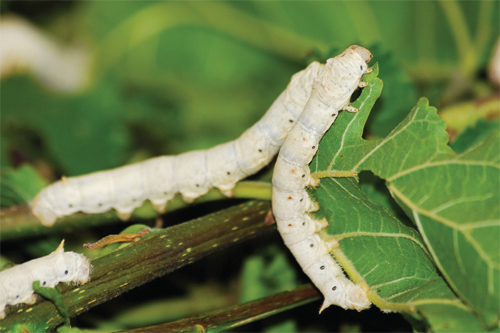
Larvae of the silk moth Bombyx Mori chomping on leaves from the white mulberry tree at the Bornholm Butterfly Park.
The story goes that the discovery of silk weaving was the result of a happy accident that happened to Lady Hsi-Ling-Shih. She was the wife of the legendary Yellow Emperor, who is said to have ruled China around 2500 BCE, and as an empress she was considered at the time also to be one of the immortals. She was sipping tea under a mulberry tree when a cocoon plopped into her cup, and the silk thread began to loosen in the hot liquid. She, being a living goddess, at once understood the significance of the event and ordered her servants to turn the filament into thread, and then proceeded to design a loom on which a material could be woven. We may well doubt the story, and archaeological evidence suggests that in fact silk weaving dates back even further in time. Woven silk fragments and threads found in the Zhejiang province of China have been dated to around 3000 BCE, which almost accords with the legend, but a small ivory bowl carved with a silkworm has been dated to at least a thousand years earlier. What is astonishing about these dates is that no one in the West had the least idea where silk came from or how it was produced until thousands of years later.
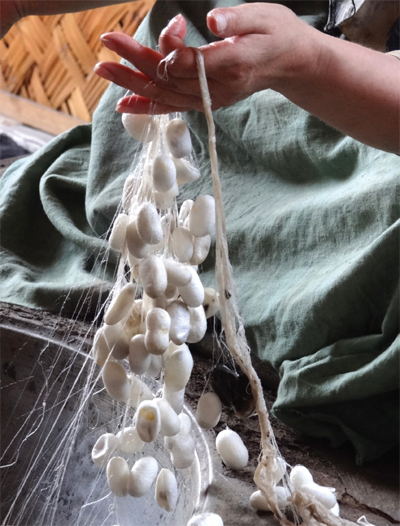
Silkworm cocoons at a silk factory in Margilon, Uzbekistan.
Whatever the date when silk production commenced, what we do know is that the development period would have been very long. The moth family Bombycidae has many wild members in many different countries, and the Chinese must have spent many generations cross breeding the wild moths to produce the domestic moth we know today, heavy, flightless and blind, which produces a fine, smooth filament. Having developed a moth that only existed to provide them with raw material, they then had to work out the best way of rearing the creatures.
The method established in China has scarcely changed over the centuries. The eggs must be kept in controlled conditions, with a starting temperature of 18°C gradually raised to 25°C. After the eggs have hatched, the baby worms are placed in trays in vertical racks and fed on hand picked mulberry leaves every hour until they form cocoons. After eight or nine days, the cocoons are then either steamed or baked to kill the pupae – if they were allowed to start emerging, they would damage the silk. When I shake my little cocoon in front of me, there is a rattle, which is the dead pupa. They are then dipped into hot water to loosen the filaments. When they emerge, the filaments are still coated with sericin, the gummy protein that held the threads together to form the cocoon. This will later be removed by washing, but at this stage the filaments are known as raw silk. This is very intensive cultivation, as it requires around 2,500 silkworms to produce a pound of raw silk. Not all the pupae were killed, some being retained to provide the next generation of breeding moths. And the broken silk that was left when the moths emerged from the cocoon was not wasted. Although it was broken into short lengths it could be used, for example, as a stuffing for padded jackets. It was to be many centuries later before anyone found a better use for it.
We do not know precise details of the processes used in ancient China in creating silk fabrics, but the sequences that are required remain constant. First the continuous thread had to be unwound from the cocoon and fed on to some sort of spool. We do know that at some stage, several cocoons would have been unwound at the same time. The next step would be to twist the thread together to create yarn – the numbers of threads needed depending on how the thread was to be used in the loom, whether for warp or weft, the former requiring greater strength and therefore more twists. Reeling silk may sound quite straightforward, but in practice this was very far from being the case. No two cocoons produce threads of the same length, and the variation can be enormous – some producing a modest 300 metres, others four times as much. Care has to be taken not to take the silk from the inner part nearest the chrysalis as this is usually inferior in quality. When soaking the water has to be hot, but not too hot, or it could dissolve the silk, while hard water is liable to make the gum brittle instead of removing it. It was a task that called for some skill and a great deal of patience.

Chinese silk reeling; the cocoons have been immersed in hot water in the pot to the left and the filaments are being drawn out by hand and wound onto the rotating frame.
There is scant evidence of how silk was woven in the earliest times, but we do know some of the types of looms that were developed thousands of years ago. In ancient Egypt, around 3000 BC, the horizontal ground loom was in use. This consists of two parallel wooden beams, pegged to the ground, between which the warp threads are wound in a figure of eight. The warp is divided into two layers, the odd and the even. The odd threads are fastened to a stick, the ‘rod heddle’ above the warp. When this is lifted, it leaves a space – the ‘shed’ – through which the weft can be passed, either by hand or using a shuttle. The rod heddle is then lowered, and the even threads raised by means of another piece of wood, the ‘shed rod’ beneath the warp, to create the ‘countershed’. An alternative version is the vertical warp-weighted loom. In this device, the warp is suspended from an overhead beam, and tautened by hanging weights at the bottom of the loom. Weaving uses a similar system to that used in the ground loom.
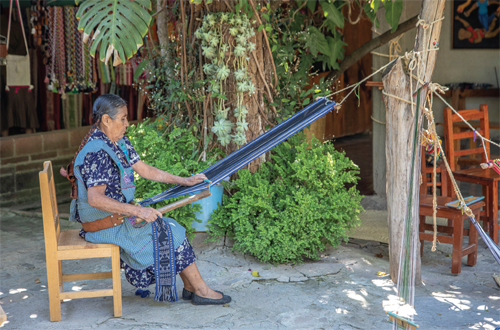
A woman weaving on a backstrap loom in Mexico.
There is one other type of early loom for which there is evidence of use in China at the earliest period. This is the backstrap loom, parts of which were discovered in Yuyao in Zhejiang Province and dated as being roughly 6,500 years old. In this type of loom, one end of the warp is attached to a fixed object, such as a post or tree trunk, while the other end is wrapped round the weaver’s waist. To create the shed, the weaver leans forward to slacken the threads and pulls a roller, set between the threads, towards her. To create the countershed, she leans back again to put the warp in tension and lifts the appropriate threads by means of a string. Surprisingly, this type of loom is still in use in many parts of the world to this day. The early looms produced a plain weave, but by the fifth century BCE, colour could be added by painting on the silk, either to produce works of art or to decorate material used for clothing. First the cloth was beaten against a stone to create a completely smooth surface, then the design was added using ink made of soot and glue and pigments, made from mineral such as malachite. The artists used animal-hair brushes.
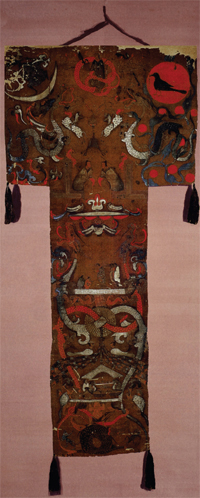
A painted Chinese silk banner from the tomb of Lady Dai, c.108BCE. The painting shows the movement of the human soul from the earth at the bottom of the picture up to heaven at the top.
One can only imagine the enthusiasm with which the first woven silk was greeted. No material like this had ever been produced before. It was light, yet warm in cool weather and cool in the heat. And it had a very special characteristic; it shimmered. As the material caught the light, so it seemed to undergo subtle changes in colour. We now understand how this happens. If you look at a silk thread under the microscope you will see that it is roughly triangular in cross section, so that the entire thread acts like an elongated prism. We know that when light is shone through a prism it is refracted and if it shines on a screen at the far side of the prism, one will see the spectrum of colours red to violet. With silk, the effect is muted but very real. This was an exotic material, and an edict was issued that only members of the royal family were allowed to wear it, though courtiers could be awarded the honour as a special mark of esteem. The emperor traditionally wore white silk inside the palace, but he, his principal wife and heir wore yellow robes when they went outside. To ensure exclusivity and to keep the secrets of silk manufacture, a law was passed forbidding anyone to reveal the details of manufacture or take the eggs out of the country on pain of death.
The ruling on imperial monopoly did not last forever, and gradually silk became more widely available. By the fifth century BCE, six provinces were involved in silk production, which was virtually all in the hands of the women. They were responsible for the tending of the silkworms, winding, spinning, dyeing and weaving. Six months of the year were devoted to this activity, and the start of the season was celebrated by the empress in person. By the time of the Han Dynasty that began in 206 BCE, silk was being produced on a wide scale. The finest silks were given as rewards to civil servants and other valued citizens. Values that had once been given in weight of gold were now using measures of silk. Taxes were paid in silk and the material now had a wide variety of uses. Beautiful paintings on silk were created and painted silks appeared in elaborate costumes. Not only did this increase production, call for the rearing of vast quantities of silk worms, but it also needed immense areas to be given over to cultivating mulberry trees, as it has been estimated that it takes a ton of the leaves to feed the silkworms and produce twelve pounds of raw silk.
Production was so widespread that the secrets of silk could not be hidden away in China for ever. It was only when the Han Dynasty began in 206 BCE that the rulers decided that it was all very well being exclusive, but a fortune was to be made by selling silk abroad – provided the secret of what it was and how it was made remained within Chinese borders. So, silk began to be traded with other countries and eventually left the great empire of the east and found its way to Rome, the equally imposing empire of the west. It intrigued everyone. It was naturally assumed that it was like very fine cotton and was probably grown on similar shrubs. Experts do not like to appear ignorant and baffled, so their wild guesses were bolstered by seemingly accurate descriptions of the plants and how they were processed. Pliny the Elder proved the most imaginative. He gave an elaborate account of the silk plant, how it was harvested and how the actual fibres were hairs on the backs of leaves that were removed by soaking in water. He had a few other things to say on the subject of silk as well. He did not approve. He found the sight of ladies in diaphanous silk garments morally repulsive and he was even more alarmed at the amount of gold that was leaving the country to buy the luxury. Many centuries later, Daniel Defoe used a similar argument when he railed at the importation of Indian cotton at the expense of native wool, but he knew he was fighting a battle he could never win:
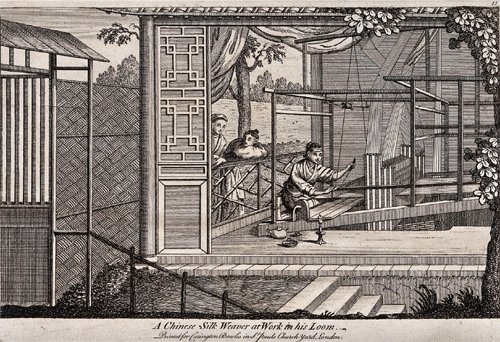
This early illustration of a Chinese weaver, shows him working on a vertical loom, with the warp threads running from top to bottom and the shuttle is being passed through by hand.
All the Kings and Parliaments that have been or shall be, cannot govern our fancies. They may make laws, and shew you the reason of those laws for your good, but two things are too ungovernable, our Passions and our Fashions.
The ladies of Rome were not very different from those of eighteenth century England; they would not, in Defoe’s words, ‘dress by law or clothe by Act of Parliament’. Depletion of gold reserves and balance of payments were not enough to outweigh the demands of fashion.
The more people discovered the delights of silk, the keener became the desire to wrench its secrets from the Chinese monopolists. If nothing could be learned directly, then subterfuge and cunning must do the job; it was time for some imaginative industrial espionage. Once again, the story has more than a whiff of legend.
In the fifth century, a prince of Khotan, a kingdom bordering China, wooed and won a Chinese princess. For her journey to her new home, she wore her finest clothes and jewellery, the effect completed by an elaborate coiffure – one thinks of a sort of 1960s style beehive. It needed to be piled high, because in it she concealed batches of silk eggs and cocoons. Khotan now had all that was needed to start its own silk industry but, like its mighty neighbour, saw no need to share the secrets with anyone else. The next act of subterfuge was even less likely; who would expect pious monks to be so devious?
Byzantium at the eastern end of the Mediterranean was the buffer zone between Europe and Asia. Its capital, Constantinople, now Istanbul, was a meeting place of trades and cultures. Goods flowed through, as did people, among them a Christian sect escaping persecution. The Nestorian church was founded in the sixth century and sent out pilgrims and missionaries to convert the Asian heathens. Among them were two felonious monks who made their way towards China. Dressed simply, with nothing more elaborate than bamboo walking sticks to help them on their way, they were the epitome of holy innocence. What no one knew as they headed back home was that those hollow bamboos were now stuffed with eggs. The silkworms hatched and were duly presented to the Emperor Justinian, and the Chinese monopoly was broken forever.