
CHAPTER THREE
Arguably the most useful and important invention to come out of China, and certainly one of the most beneficial, was the manufacture of paper. Inevitably, there is a story about how it first came about. A court eunuch, Tshai Lun, took his inspiration from watching wasps creating their papery nests. He realised that what was needed was finely chopped natural materials which, when soaked, would mat together, and when dried out would produce a material like that of the wasp’s nest. He apparently used a bizarre mixture of materials; tree bark, hemp, torn up rags and fishing nets, and when he had perfected the technique, he brought the results to the emperor in 105. The emperor was delighted, praised Tshai Lun and ordered paper making to begin on a large scale. It is a good story but unfortunately, we now know that paper existed already in China at a far earlier date. In fact, the earliest fragments date back even further. A sheet of paper in the museum in Xi’an was made around 100 BCE and is believed to be the oldest surviving piece of paper in the world. The fibres used in its manufacture were from hemp and nettle.
The name ‘paper’ comes from ‘papyrus’, the plant that was used in ancient Egypt to make a writing material. Thin strips were cut from inside the plant and laid side by side, then a second layer of strips was placed on top and the two pounded together to fuse into a usable material. It was quite thick and had an uneven surface but was certainly usable as a material for writing on. As the plant’s natural habitat was the Nile Delta, it was unknown in China. As a result, the earliest writing material had to make use of a local material – bamboo. Archaeologists have unearthed several documents written on bamboo strips, tied together with string to make a complete document. It appears that they were still in use after the invention of paper making, largely because the material was cheap and readily available. In fact, paper was considered so valuable, that letters and documents were reused for all kinds of purposes. For example, paper was used to make funerary garments, and papers of this sort recovered from tombs often record fascinating details. One fragment, dated to around 670, contains details of a claim by a Persian merchant for 275 bolts of silk owed to his deceased brother. The earliest fragments of paper that have been recovered were not even used for letters or documents, but as wrapping. It was inevitable, however, that eventually paper’s main use would be for writing. As production techniques improved, so the price would come down and more material would become available. A valuable use for paper – that was only followed up centuries later in the West – was for money. Paper notes were in circulation in the Tang dynasty (619-907).
Paper can be made from a wide range of organic material, but the commonest method was to use rags, discarded material that would have very little other use. In fact, the use of rags in paper making continued well into the twentieth century. In Britain, the rag and bone man was a familiar figure, collecting rags for the paper maker and bones for glue. The basic technique remained unchanged. Hand made paper still uses technology familiar to the ancient Chinese. First the rags have to be cut up and mixed with water to create a pulp. A fine wire mesh is dipped into the mixture and carefully withdrawn with a layer of pulp above the mesh. It is transferred to an appropriate material, such as felt and covered over, ready to take the next layer. The water is then pressed out and the individual sheets hung up to dry.
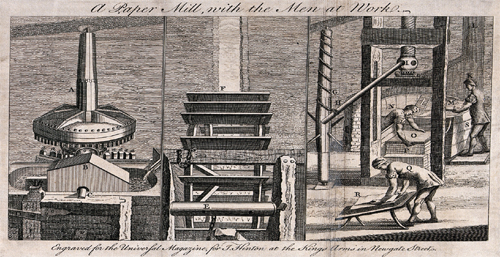
An eighteenth century paper mill. To the left is the mill that grinds up the rags with water. To the right, one man is pulling out the mould on which a sheet of paper has formed, while the other men are drying the paper and placing it in a press.
Paper making gradually spread west, and paper became an important commodity for trade along the Silk Road. The story of how the manufacturing methods became known in the Middle East is, like many such stories, dubious. But in this version, it all began with the attempts of the Chinese of the Tang dynasty to extend their empire westward. They were opposed by the Abbasid Caliphate and the Tibetans and the issue was decided with the defeat of the Chinese at the Battle of Talas in 751. Two Chinese prisoners revealed the secrets of paper making and a paper mill was established in Samarkand. Paper making made its way into Moorish Spain, and it is known that a paper mill was established at Toledo in 1150. The technology soon crossed the Pyrenees into France. One of the oldest surviving paper mills is the Moulin Richard de Bas at Ambert in the Auvergne, parts of which date back to the fifteenth century. It is very traditional, using a water wheel to power the machinery that chops up the rags. Otherwise everything is done by hand. Nothing here would have come as a surprise to a visitor from China travelling forward through time. The mill is the last survivor of several that were once strung out down the valley. One important Ambert mill owning family was the Montgolfiers, and if the time-travelling Chinese would have found much that was familiar he would surely have been astonished to find the paper from their mill being used to make a balloon that would carry men up into the sky. Paper had come a long way since its first use as a humble wrapping material.
Paper was a valuable commodity that was traded down the Silk Road, but its true importance depended on another Chinese invention – block printing. This was originally used for printing designs on silk, but was later adapted for printing on paper, for both text and illustration. For text, the scribe would write the words on paper, which was then glued to a block of wood. The writer would then carefully follow round the outlines, cutting through the paper into the block. This could then be inked and pressed onto paper for printing. Illustrations could either be produced in the same way or carved directly into the block. The advantage of the system is obvious; once a block has been completed, it can be used several times to create a whole series of identical pages. It can be used to make books.
The Hungarian born British archaeologist Aurel Stein made four expeditions along the Silk Road but his greatest discovery was at Dunhuang in 1907:
In this valley there is a vast number of old Buddhist temples and priests’ quarters; there are also some huge bells. At both ends of the valley north and south stand temples to the Rulers of the Heavens, and a number of shrines to other gods; the walls are painted with pictures of the Tibetan kings and their retinues. The whole of the western face of the cliff for a distance of 2 li (two thirds of a mile or one km) north and south, has been hewn and chiselled out into a number of lofty and spacious sand caves containing images and paintings of Buddha.
In these caves Stein found vast quantities of written documents, tied up in 1,050 bundles, among which was a book, known as The Diamond Sutra. It was produced by a Buddhist devotee and consists of seven sheets, glued together. It was dated as having been made on the 15th day of the 4th month in 868. Where other documents were hand-written, this was produced by woodblock printing, making it the world’s oldest known printed book. Stein took the book and other documents away; an act which, to the western world, was essential for their preservation but to the Chinese it was simply theft. Both versions have more than a little truth to them.
The problem with the early printing was that each book had to be written by hand before the blocks could be created. The monk Zhang Tuxin, for example, set himself the task of reproducing all the essential Buddhist texts. It took him ten years. Later the Chinese were to improve on the system by developing moveable type. This was first developed in the eleventh century, using clay to form the individual characters. This is a complex business because Chinese does not have an alphabet, but instead thousands of ideograms. Nevertheless, it meant that books could be printed comparatively quickly, and as the demand for books grew, so too did the demand for paper.
Just how important these developments were becomes obvious when one considers the situation in Europe before the arrival of paper manufacturing from the Far East. Books in the Middle Ages were produced using parchment, which was created from animal skins, mainly sheep or calves. After the hair is removed, the skin is soaked to clean it and then stretched. To produce a folio of two hundred pages required the skins of about 25 sheep. The cost of this alone made books valuable items, mainly hand-written and one-offs. Books were so rare and expensive that the great church institutions kept them in chained libraries, such as that which still survives in Hereford Cathedral. Because of the huge expense of the parchment, there was no incentive to develop printing techniques to make multiple copies in the Middle Ages. It was only with the arrival of paper and the development of printing with moveable type in the fifteenth century that book production became a large-scale operation in Europe. Yet printed books were being sold in the marketplace in Xi’an as early as 762. It had taken the West a long time to catch up, as technology moved down the trade route from China through the Muslim world to Europe. The invention of paper and printing are known as two of the four great inventions, of the other two, one probably saved many, many lives – the other destroyed even more.
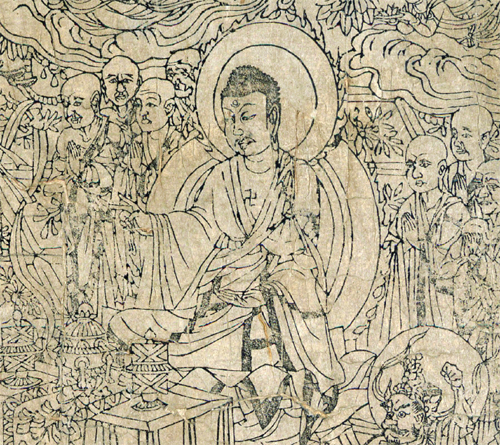
An illustration from the Diamond Sutra, a Chinese translation of the Buddhist text produced in the Tang dynasty, and the oldest known printed book.
Among the other commodities traded down the Silk Road was jade, and it was sent westward from Khotan. A less likely material was described by Marco Polo, which he called ‘salamander’. The Italian traveller told his readers that a salamander was not, as they might have thought, a creature – because no creature could actually survive in a fire, but a substance mined from the earth. It was taken and pounded in a great copper vessel, then washed, forming a fibrous substance, which was then made into cloth, and then fired. The result was the fireproof material, which we now know as asbestos. In Marco Polo’s time, the manufacture and trade was controlled by a lord appointed by Kublai Khan. He pointed out its value; ‘I will tell you, too, that one of these cloths is now in Rome; it was sent by the Great Kahn as a precious gift, and for this reason the holy shroud of our Lord Jesus Christ is wrapped in it.’ Asbestos mines can still be found at work on the southern route round the Taklamakan desert. It hardly needs saying, but mining asbestos remains a lethal occupation.
So far, we have been looking at the Silk Road as the main trading route for silk and other commodities, but there was also a considerable trade by sea and the Chinese developed the instrument that is now considered absolutely essential to navigation – the magnetic compass. The first evidence for using lodestone to point to the magnetic poles comes from the third century BCE, where it was used mainly for divination. Actual use for navigation is not mentioned until the eleventh century, when a simple compass consisted of the magnetic needle floating in a bowl of water – but that is a hundred years before the first mention of any form of compass in Europe. Unlike paper and printing, however, there is no real evidence that it was trade that brought it to the attention of Europeans. It is, however, another indication of ways in which China was ahead of the West in so many aspects of technology.
The fourth of the great inventions was gunpowder. It is first mentioned in the first century, but there are no accounts of it being used by the military until 1044, when gunpowder was used to create fire arrows. While useful materials like paper only spread slowly westward, news of new and terrifying weaponry moved far more rapidly. Once the formula for gunpowder was known, its use spread throughout Europe. There are arguments as to whether the information was passed down the Silk Road or whether it was through the warlike actions of the Mongols on the fringes of Europe. It was first described by the monk Roger Bacon in his Opus Majus of 1267. At this stage it seems that gunpowder was only known through Chinese firecrackers, but Bacon does list the appropriate ingredients – saltpetre, charcoal and sulphur.
The development of printed books had an immense influence on the spread of knowledge, and innovations in the Far East were to have a profound effect on the development of ideas, and on the sciences in particular. So far, we have been looking at the main line of the Silk Road as it stretched from China to the Mediterranean, but an important branch turned off south into India, where a system was developed that would revolutionize the world. The Indians invented a new system of numbers, which may not sound very exciting until one looks at the way numbers had been used in the West for centuries. The Greeks named their numbers after the letters of the alphabet with alpha the equivalent of 1, beta of 2 and so on for all 27 letters. They did not think large numbers useful, so anything over 10,000 was simply a myriad. But by far and away the most common system throughout Europe for many centuries was based on the Roman numerals. These went from I to V, X, L, C, D, M for 1, 5, 10, 50, 100, 500, 1,000, a lot less complex than the Greek 27 numerals but extremely difficult to manipulate. Alex Bellos in his highly entertaining Alex’s Adventures in Numberland (2010) explains how Roman numbers can be manipulated. I do realise that, having written this, many readers may think the words ‘highly entertaining’ and ‘mathematics’ can hardly go together, but in this case they really do. He gives an example of how a Roman would multiply 57 and 43 – or as the Romans would have written the sum LVII and XLIII. To us it looks impossible to even know how to start. The method used would be to break the numbers down into doubles – so 57 comes out as 1 + 8 + 16+ 32. You now use doubling to get the results. So 1x43 =43. To get 8 x 43, double 43 three times and so on and add up the results, so that the only processes involved are addition and doubling. Now that’s bad enough using our system, but with the Romans it looks pretty incomprehensible. This is the breakdown of 57 – LVII = XXXII + XVI + VIII + I which still looks pretty useless and the final addition of the doubles reads MCCCLXXVI + DCLXXXVIII + CCCXLIV + XLIII = MMCDLI. It is not, readers will be relieved to know, necessary to follow this through step by step let alone try and understand it or do a Roman sum for themselves. Which is why I have taken the liberty of using Alex Bellos’ sum. I have quoted it at some length merely to show just how horrendously complex the Roman system is. In practice, few even tried to work out sums on paper, but relied on the abacus for calculations – and for complex calculations, including multiplications, professional abacus operators were needed. But if I was asked to multiply 57 and 43 myself using our present-day system, this would be completely straightforward, with the simple system of long multiplication I first learned in primary school. The Roman system is also counter-intuitive – the number of letters used to represent a number bear no relation to its value – so 8 is VIII but 80 is XXC. With our numerals, a number with more digits than another will always be larger – assuming of course there is no decimal point involved. That we do not mercifully have to wrestle with; this Roman system is all down to the fact we use what we call Arabic numbers, which aren’t really Arabic at all. We use Indian numbers.
The Indian system was developed into its present form at some time in the seventh century. The original Indian symbols look very similar to those we now use, but the crucial point was the inclusion of the number 0. It is the 0 that enables us to move along smoothly, from 0 to 10, from 10 via 11 and eventually 99 to 100 and so on. The Indian system was carried by traders into the Islamic world, where it was rapidly adopted. Leonardo Fibonacci, an Italian whose father was a customs officer in Béjaia in modern Algeria, was impressed by the system and published a book Liber Abaci in 1202. He described the numbers 1 to 9 and added that 0 was known in Arabic as ‘zephyr’, from which we get ‘zero’. Although the advantages of the system seem obvious, it was met with solid resistance. Mathematicians would not accept the idea that there could be a numeral representing nothing. All the other numbers made sense – two pigs were two pigs, but what was the point in counting no pigs? This was also the age of the Crusades, and there was suspicion of anything that came from the Islamic world. Florence actually banned their use in 1299, because it was claimed they were easy to forge. The Church also opposed their use, because of that devilish zero. Abacus professionals spoke against them for the very simple reason that they were likely to put them out of business. In fact, Indian numerals only came into general use in Europe in the seventeenth century. Of all the ideas and commodities that made their way down the Silk Road, it could be argued that none were as important as the introduction of the Indian system of numbers.
One mathematical system which did actually develop in the Arab world was algebra, the basis for which was first described in a book published in Baghdad in the ninth century. It explained the use of symbols to represent letters and used equations, such as x+ y = z, which can be manipulated, by changing one symbol to the other side and changing the sign, so that x = y-z. This was a powerful tool, which combined with Arabic numbers enabled complicated relationships in the real world to be expressed in equations. One of the most famous set of equations represent Isaac Newton’s laws of motion. They can easily be used to solve problems. Here is a very simple example. You are standing by a well and you would like a rough idea how deep it is. One of Newton’s equations is;
S = ut + ½gt2
Where s is the distance travelled, u is the initial velocity, g is the acceleration due to gravity and t is time. So all I need to do to find the depth of the well is drop in a pebble and time how long it takes before I hear it hit the water. If it was 2 seconds, then the answer is simple. There is no initial velocity; we know g is roughly 32 feet/ sec/sec and t is 2 - so the answer is one half of 32 x 4, or about 64 feet. That is algebra at its simplest, but it is by working with equations of motion that physicists can work out the trajectories needed to put a satellite into orbit or land an astronaut on the moon. Modern science would not be possible without the ideas that developed along the Silk Road, nor could they be easily transmitted until they were printed on paper and distributed in books and pamphlets.
Arabic numerals were not the only devices to be attributed to that part of the world that had their origins in India. Damascus became famous for the sharpness and toughness of its swords, but their quality was dependent on a special material imported from India – Wootz steel. This was first made in Southern India in the sixth century BCE. It was generally manufactured by smelting the ore to create wrought iron, then heating the iron in sealed ceramic crucibles with organic material, plant leaves such as bamboo and beans. The wrought iron is very pure, but the crucible process introduces carbon into the iron. Modern metallurgy has shown that the carbon in Wootz steel appears as nanotubes threaded through the metal. The Wootz steel was sold as metal cakes, and it was in this form that it would have reached Damascus and the armourers. Amazingly, the secret of making crucible steel was more or less unknown in the West until it was reinvented by Benjamin Huntsman of Leeds in 1740, who slightly refined it by using charcoal instead of leaves as the organic material. His method was used at the scythe manufacturers of Abbeydale, Sheffield, which is now an important industrial museum. It had taken some 2,000 years for the West to catch up with the East. The traffic of ideas, however, was not all in one direction.
One of the most significant stopping places on the Silk Road was Samarkand, home to the Sogdian people, who had their own language and customs. The Chinese who visited them were not impressed. The monk Xuanzang, who arrived in the seventh century, described them as dishonest traders who only cared for profits. He said that when a son was born, they put honey in his mouth so that he could speak sweet words and glue on his palm so that coins would stick to it. He also said that they would go anywhere for profit, and indeed they did, for they travelled all the way to China, taking with them their own religion, Zoroastrianism. Marco Polo encountered the religion on his way to China, but merely remarked that he had come across a people who worshipped fire; Zoroastrians did have fire temples, but they did not worship fire as such. No one is certain when the religion first appeared, but it could have been as early as 1500 BCE but is more likely to be rather later. What everyone agrees is that it was first formulated by a man known variously as Zoroaster or Zarathustra.
At the heart of the religion is dualism, an endless fight between good and evil, which good will eventually and inevitably win. But it is up to individuals to make their own contribution to the fight, with the help of an omnipotent god. They were not necessarily monotheistic, but they did believe in one supreme being. Fire and water were considered as purifying elements – hence the fire temples – but dead bodies could be corrupted and could corrupt. While an essentially rational religion that places the emphasis on good deeds and truthfulness, it does have ritualistic elements of which the most obvious is the treatment of the dead. Burial was considered to contaminate the earth and cremation to corrupt the purity of fire, so bodies were exposed to scavengers on special buildings known in English as ‘towers of silence’. The religion thrived in what is now Iran until the country was taken over by Islamic forces after the decisive battle of al-Qādidisiyyah in 635. It was after this that many Zoroastrians left the country, making their way eastwards to northern India, where they established their own community, known as Parsis. They brought with them their funerary rites, so that today there are still towers of silence at Malabar Hill, Mumbai, in the heart of one of the most exclusive and expensive areas of real estate in the world. Residents have the daily sight of vultures descending to feast on human remains – which may sound disgusting to us, but it is just good, fresh meat to the vultures.
Today, the most striking buildings in Samarkand are the magnificent mosques with their stunningly beautiful decorative tiles, but there are still reminders of Zoroastrianism to be seen. In 1965, while constructing a new road, bulldozers broke the ceiling of a room that had once belonged to a wealthy merchant who in the seventh century had covered the walls with murals. One part shows a Zoroastrian priest in a face mask, and four geese, destined to be slaughtered in a religious ritual. But on other walls, the paintings show the business life of the area. Four Chinese are shown as ambassadors to King Varkhuman, bearing gifts – rolls of silk cloth, skeins of silk thread and cocoons.
If there are few traces of Zoroastrianism left in Samarkand and the surrounding area, there is ample evidence of Sogdians settling in China, in particular in the capital of the Tang dynasty, Xi’an. There are remains of at least five Zoroastrian temples and of towers of silence, but some Sogdians adopted Chinese burials, though the tombs were covered with Zoroastrian symbols. The tomb of An Jia, who died in 579, was discovered by archaeologists in 2001. Among the scenes depicted is one with heavily laden camels, though it is not clear whether they were trade goods or diplomatic gifts. Shi Wirkark also died in 579 and his Chinese-style tomb has a multitude of Zoroastrian symbols, such as winged horses, but the most striking illustration shows the progress of Wirkark and his wife from this life into the next world by crossing the Chinwad bridge that carries them over a raging torrent and into Paradise. The tombs also suggest that many Sogdians were moving steadily towards assimilating the Chinese lifestyle – the two tombs show the characters in Chinese dress, and although the Zoroastrian symbols are everywhere, the fact that they have opted for Chinese entombment is significant. Zoroastrianism had little impact on Chinese culture, but its appearance right along the Silk Road is significant as an indication of the movement of people and ideas.
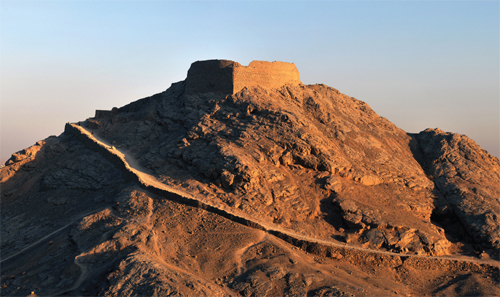
A Zoroastrian tower of silence in Yazd, Iran. The dead were placed on the tower and left for carrion.
The other great religion which would eventually travel the Silk Road was Buddhism. It originated with the son of a wealthy family, Siddhartha Gautama, in the fifth century BCE, who was to become known as the Buddha. He was moved by what he saw as the suffering of the world around him and decided to renounce his wealth and live in poverty. After a long period of abstinence and fasting he became ill and felt that this was not the answer to living a good life. He argued instead for what he called The Middle Way – neither opting for extreme poverty nor great wealth, but living life by a set of precepts, which were basically a moral code. There was no mention in his teaching of an omnipotent god, but instead there was the notion of karma or fate. In this life one should live as well as possible in the less than perfect world, and at death one would be reborn – and the nature of the rebirth would reflect the life already led. The cycle would continue until the individual reached a state of complete enlightenment, nirvana, when the cycle and suffering would end.
An essential element of Buddhism was that the doctrine should be taken as far as possible by missionary monks. It began to spread from India to the east, eventually reaching China during the Han dynasty around 50. At this period, the most important religion in the country was Confucianism which, to greatly simplify a complex subject, concentrated more on the needs of society as a whole than those of the individual, in stark contrast to Buddhism. Inevitably, it took time for the new religion to have an effect, and it was not until 178 that the first Buddhist texts were translated from Sanskrit into Chinese. It was only after the collapse of the Han dynasty in 220 that Buddhism really began to thrive. Among the more spectacular results were grottoes such as the Longmen grottoes created in the fifth century with immense statues of the Buddha. The situation changed in the Tang dynasty, 618-907, when Buddhism was attacked, with some 4,500 monasteries closed and thousands more temples destroyed. Over the years, the religion changed in China, where the Buddha came to be regarded as a god rather than merely a great teacher, but it survived and grew to the point where today China has the largest Buddhist population of any country in the world, with around 245 million followers.
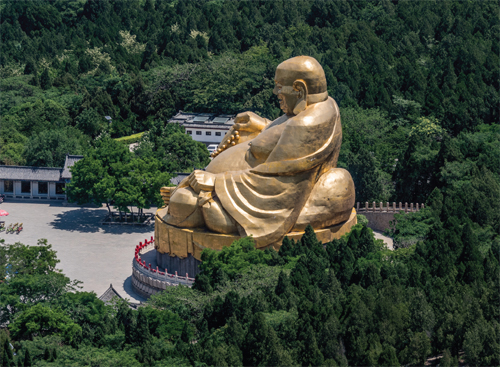
Giant statue of the Buddha on ‘Thousand Buddha Mountain’, Jinan, China.
There is ample physical evidence that the early missionaries from India followed the Silk Road as their main route into China. When Aurel Stein made his tortuous way through the mountains, he described finding stones with Buddhist inscriptions along the way. This must always have been a difficult route to follow, and travellers could well have been held up for long periods, waiting for the weather to improve to let them continue their journey – plenty of time to carve inscriptions to note their passage. With the opening of the Karakorum Highway in 1970, many of these stones became accessible for the first time. One of the earliest depicts a stupa, a mound containing a relic of the Buddha, which pilgrims would have walked round to show respect. It is thought that this inscription might have been made as early as the first century. Later inscriptions show the Buddha himself. It says a great deal for the zeal of these early travellers that they were prepared to undertake such a hazardous journey to bring their teachings to the wider world. Of course, not all the inscriptions need to have been made by pious monks, for many were carved by other travellers, merchants and migrants who came to China down the Silk Road.
The third religion to travel east along the Silk Road was Christianity, but not quite the religion that we know today. This was Nestorianism. In the fifth century, the patriarch of the Eastern Church, Nestorius, proclaimed a dual characteristic for Jesus, partly human and partly divine. He was at times given his divine status by God, but he was born a normal human being. Mary was no longer the Mother of God. This caused a deep schism in the church and the Nestorians were forced out of their original homeland in Turkey and settled in Persia. It was from there that they sent missionaries to the east. In the sixth century, the priest Aloban travelled to China, carrying the scriptures. Here he was received by the Taizhong who enthused over his teachings, which were ‘mysterious, wonderful, full of repose’. In a Confucian temple in Xi’an, there are over 2,000 stone stelae, each of which stands around 8ft high. They record ancient texts, but among them is stele erected in 781, recording the arrival of Aloban and his doctrines. A Nestorian community did develop with its own monasteries near Xi’an but was short lived. Christianity has never had the same impact as Buddhism in China.
The fourth religion to travel east was Islam. It became firmly established in northern India, and then in China. According to tradition, Sa’d ibn Abi Waqqar, a companion of the Prophet Muhammad, visited the country with two associates between 616 and 618. There is no actual evidence for this, but it is known that Islam certainly was practiced in China in the seventh century. Muslim merchants from the Middle East, who originally travelled down the Silk Road, and later settled in China, came to play important roles in the country. During the Song dynasty (960-1279) they regularly held an important government post as Directors of Shipping. There is still a large Muslim population in the country.
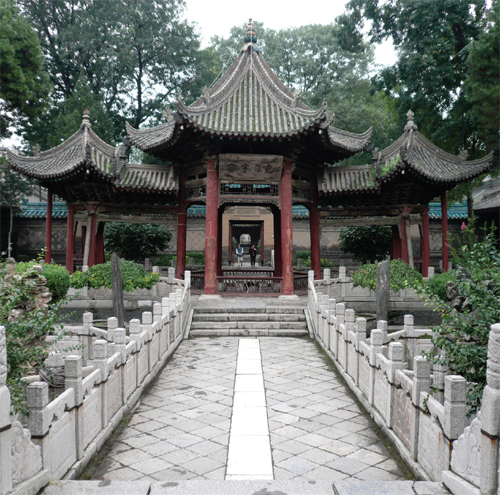
Although the style is obviously Chinese, this is, in fact, the Great Mosque at Xi’an.