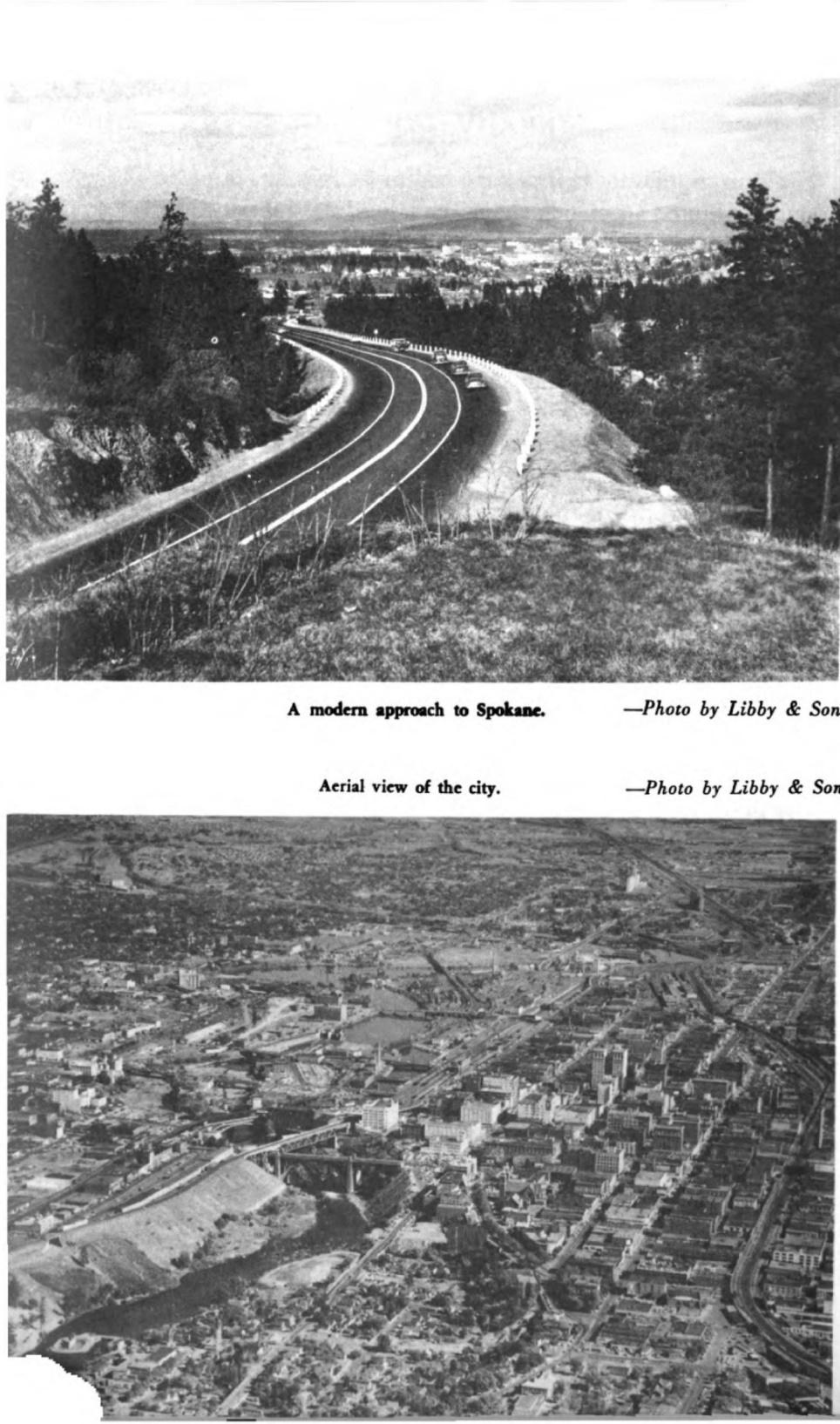
SPOKANE’S DEVELOPMENT, as seen by one of its best-known citizens,{116} falls into four epochs: pioneer days; wide open town; service center; industrial center. All overlap; but in general it may be said that the narratives of the present book come mainly under the first two headings, while providing a springboard into the growth yet to come after the boys came back along “the long, long trail a-winding”—a trail put into verse, be it known, by a Spokane poet and columnist, Stoddard King.
As the book ends, the still youthful municipality is well launched on its service era. It has become a transportation center, a jobbing, marketing, and shopping center for the entire Inland Empire, a materials center exporting the products of mine, forest, and field to the manufacturers and consumers of the East and Middle West and, in a small way, to lands across the sea. It is a publishing center, from whose presses emerge the most widely read daily in the area, as well as farm journals that reach into all nooks and crannies of the Empire; a health center supplying hospitalization and medical care to an equally wide region; a city of churches; of varied social and charitable agencies of which the Hutton Settlement is but one; a city boasting a well-housed and up-to-date public school system and opportunity for advanced education through privately supported colleges within or neighboring its own boundaries, and state institutions of higher learning easily accessible.
Many significant stories have had to be left out, or at best, merely hinted at; among them, the tale of the forests and the story of the development of the Spokane valley through irrigation into a land of blooming fruit trees sprinkled with small villages bearing such hopeful and come-hither names as Opportunity.
All these are matters for another book, as is also the city’s plunge headfirst into a suddenly expanded industrial era brought about by the exigencies of World War II and powered by the white coal of electricity. The book will be a lengthy one, strewn as in the present instance, with the names of men and women unique of character or original of mind, or both, and touched with an independent spirit. It will also be filled with colorful incident. For though the folk who today walk Spokane’s sunlit streets are predominantly home loving, home owning and in many ways middle class conservative, the city has never been a stodgy one. It still has a way with it that is different. It sends “Bundles to Congressmen,” when the national lawmakers appear to be leaning too far in the direction of federal philanthropy.{117} It starts a Henry J. Kaiser, hardware clerk, on his amazing and unpredictable business career, and sends an Eric Johnston to New York, to Washington, D.C., and to Moscow as president of the United States Chamber of Commerce, and later to Hollywood as tsar of the film industry. It boasts a college graduate and successful investment broker, who takes his vacation playing clown in a circus; an ex-Chronicle newsboy, Bing Crosby, on the radio; a Gothic cathedral set on a hill; a people predominantly housed in one-family dwellings privately owned; no slums and no tenements; an efficient public library headed by a woman; flying farmers who arrive in their own planes. There will be plenty to write about.