
Answer Sheet For Multiple-Choice Questions
1. |
21. |
41. |
61. |
2. |
22. |
42. |
62. |
3. |
23. |
43. |
63. |
4. |
24. |
44. |
64. |
5. |
25. |
45. |
65. |
6. |
26. |
46. |
66. |
7. |
27. |
47. |
67. |
8. |
28. |
48. |
68. |
9. |
29. |
49. |
69. |
10. |
30. |
50. |
70. |
11. |
31. |
51. |
71. |
12. |
32. |
52. |
72. |
13. |
33. |
53. |
73. |
14. |
34. |
54. |
74. |
15. |
35. |
55. |
75. |
16. |
36. |
56. |
76. |
17. |
37. |
57. |
77. |
18. |
38. |
58. |
78. |
19. |
39. |
59. |
79. |
20. |
40. |
60. |
80. |
PRACTICE EXAM 1 AP U.S. HISTORY
Section I
Time—55 minutes
80 questions
Directions: Each of the questions or incomplete statements below is followed by five suggested answers or completions. Select the one that is best in each case and write your answer neatly on the answer sheet.
1. The headright system
A. enabled wealthy property owners to acquire more land by paying the passage of indentured servants
B. gave farmers in New England a greater share of the town commons for each head of cattle they raised
C. placed restrictions on the mobility of slaves in colonial Virginia
D. outlawed capital punishment for most criminal offenses in British North America
E. made women in colonial New England subordinate to men in all legal matters
2. The Eisenhower Doctrine attempted to
A. improve relations with Latin American countries
B. undermine the government of Fidel Castro
C. arrest the spread of communism in the Middle East
D. funnel millions of dollars of business investments into Africa and Asia
E. lower international tariffs
3. “Abolish slavery in all its forms and aspects, advocate universal emancipation, exalt the standard of public morality, and promote the moral and intellectual improvement of the colored people, and hasten the day of freedom to the Three Millions of our enslaved fellow countrymen.” The preceding quotation comes from the masthead of the abolitionist newspaper The North Star. Its founder was
A. William Lloyd Garrison
B. Frederick Douglass
C. Phyllis Wheatley
D. Harriet Tubman
E. Angelina Grirnke
4. Demonstrating a significant shift in government policy toward organized labor, which of the following presidents sided with anthracite coal miners in their strike against mine owners?
A. Grover Cleveland
B. Woodrow Wilson
C. William H. Taft
D. Theodore Roosevelt
E. Benjamin Harrison
5. Which of the following was a women’s rights advocate who published The Feminine Mystique in 1963?
A. Phyllis Schlafly
B. Geraldine Ferraro
C. Shirley Chisolm
D. Gloria Steinem
E. Betty Friedan
6. Which of the following best explains why President Andrew Jackson resisted annexing Texas during his administration?
A. He feared that annexation would strengthen the Whig party.
B. He knew annexation would lead to war with France, which possessed land along the Texas border.
C. He believed that the addition of another agricultural state would hurt the developing commercial economy.
D. He had consistently opposed westward expansion.
E. He feared that debates over annexation would exacerbate sectional strife.
7. The Nineteenth Amendment achieved one of the goals of the Progressives by
A. granting women the right to vote
B. establishing Prohibition
C. providing for the direct election of senators
D. ensuring citizenship rights for African-Americans
E. establishing term limits for elected officials
8. Which of the following statements best captures public sentiment about the Great Railroad Strike of 1877?
A. The strike only affected people along the Pacific Coast and thus only met with regional opposition.
B. The American public sided with the African-American sleeping car porters.
C. Applauding the intervention of President Theodore Roosevelt, the American people sided with the railway workers’ union throughout the strike.
D. Public opinion shifted from sympathy to condemnation as people blamed the strikers for looting and violence.
E. Rendered apathetic by their belief in “laissez-faire,” the American public expressed no opinion on the strike.
9. The Chesapeake Incident (1807) involved
A. the sinking of an British ship off the coast of Maryland
B. an Anglo-American conflict over the issue of impressment
C. an investigation of illegal smuggling of slaves into the United States
D. the seizure of an American merchant ship by the French navy in the English Channel
E. an attack by the Iroquois on an American fort near the Great Lakes
10. During the Civil War, the Peninsular Campaign (1862) revealed
A. Ulysses S. Grant’s determination to destroy Robert E. Lee’s Army of Northern Virginia
B. Henry Halleek’s jealousy of Grant’s success on the battlefield
G. George McClellan’s tentativeness
D. William T. Sherman’s application of “total warfare”
E. the Confederate resolve to keep New Orleans and Vicksburg from falling under Union control
11. Which of the following methods of colonial resistance achieved the greatest success in reversing Parliamentary legislation before the Revolutionary War?
A. Petitions to King George III
B. The Sons of Liberty
C. Boycotts of British goods
D. The intercession of colonial governors
E. Contradictory legislation passed by the colonial assemblies
12. The “Saturday Night Massacre” refers to
A. the death of four students at Kent State in 1970
B. President Hoover’s attempt to remove the Bonus Marchers from Washington, DC in 1932
C. the assassination of President John F. Kennedy
D. the clash between civil rights marchers and the Alabama state police on the Edmund Pettus Bridge
E. President Richard Nixon’s attempts to remove special prosecutor Archibald Cox from the Watergate investigation
13. The Dred Scott decision
A. undermined the authority of Congress to limit the expansion of slavery into the territories
B. overturned the Fugitive Slave Law
C. emphasized the supremacy of civilian courts in response to President Lincoln’s suspension of habeas corpus in Maryland
D. silenced the abolitionist press by limiting the proliferation of antislavery newspapers in the South
E. expanded Congress’s naturalization powers
14. As governor of the state of Wisconsin, which of the following instituted Progressive reforms such as the initiative, referendum, and state income tax?
A. Charles Evans Hughes
B. Woodrow Wilson
C. Eugene Debs
D. Hiram Johnson
E. Robert La Follette
15. The Constitution provided for both the federal government and the states to share the power to
A. coin money
B. regulate interstate commerce
C. establish post offices
D. control the state militias
E. admit new states
16. Which of the following statements best describes Chief Justice Roger B. Taney’s decision in Charles River Bridge v. Warren Bridge (1837)?
A. Taney overturned John Marshall’s decision in McCulloch v. Maryland.
B. Taney expanded economic opportunity and the powers of a state government.
C. Taney supported Jackson’s opposition to using federal funds on internal improvements.
D. Taney granted the Charles River Bridge Company exclusive rights to control toll bridges into Boston.
E. Taney rejected the principle of nullification.
17. At the turn of the nineteenth century, the emergence of Wild West shows and vaudeville demonstrated
A. an effort by wealthy Americans to recapture a mythic past
B. the rejection of the early movie industry
C. a declining emphasis on outdoor recreation
D. the growing importance of popular culture
E. a popularization of immigrant traditions brought to the United States
18. Which of the following presidents sent federal troops to Little Rock, Arkansas, when Governor Orval Faubus attempted to stop the integration of Central High School?
A. Harry S. Truman
B. John F. Kennedy
C. Dwight D. Eisenhower
D. Lyndon R. Johnson
E. Richard M, Nixon
19. Which of the following technological innovations contributed the most to the economic development of the United States during the first four decades of the nineteenth century?
A. Cotton gin
B. Rubber
C. Chilled steel plow
D. Electricity
E. Barbed wire
20. Which of the following statements best supports Charles Beard’s interpretation of the Constitution?
A. The authors of the Constitution emphasized libertarian over conservative interests.
B. The Constitution reflected the interests of the upper class of American society.
C. The authors of the Constitution remained deliberately vague on the issue of slavery.
D. The Constitution reflected the local or regional interests of the signers.
E. The Constitution captured a broad consensus of American society.
21. Which of the following statements best summarizes Abraham Lincoln’s views on John Brown’s raid at Harper’s Ferry in 1859?
A. He distanced his party from Brown and his followers.
B. He criticized Southerners who wanted to execute Brown.
C. He supported Brown as a fellow Republican.
D. He supported Brown’s method but not his goal.
E. He praised Brown’s goal but criticized his failure to motivate more slaves to join him.
22. “Stagflation,’’ an economic problem characterized by high inflation at a time of slow economic growth, plagued the administration of
A. Dwight D. Eisenhower
B. Richard M. Nixon
C. franklin P. Roosevelt
D. Harry S Truman
E. Ronald Reagan
23. In an effort to thwart Progressive state legislation, the Supreme Court reinterpreted
A. its original ruling in Plessy v. Ferguson
B. the theory of Social Darwinism
C. its earliest antitrust suit in the E. C. Knight v. United States case
D. the property clause of the Sixteenth Amendment
E. the “due-process” clause of the Fourteenth Amendment.
24. Which of the following best describes the Hartford Convention?
A. It expressed Southern concerns over the Fugitive Slave Act.
B. It established the foundations of the Whig party.
C. It produced a series of nonimportation agreements among Britain’s North American colonies.
D. It led to the demise of the Federalists.
E. It nominated Andrew Jackson for president.
25. Medicaid provided
A. medical insurance for the elderly
B. medical relief under the Marshall Plan
C. medical insurance for the impoverished
D. a regulatory agency of the health profession
E. a medical corps for soldiers during the Vietnam War
26. During the first half of the nineteenth century, the expansion of suffrage increased popular interest in presidential elections. Partisan politics often shifted the voters’ attention from issues to images. The “log cabin, hard cider” campaign helped which candidate win the presidency?
A. James Monroe in 1820
B. John Quincy Adams in 1824
C. Andrew Jackson in 1828
D. William Henry Harrison in 1840
E. James K. Polk in 1844
27. McCarthyism spawned a hysteria that swept over the nation during the early Cold War. Accusations of links to Communism ruined numerous people and their careers. The decline of Joe McCarthy came after his televised hearings with
A. the House Un-American Activities Committee
B. the Army
C. Edward R. Murrow
D. the State Department
E. the FBI
28. All of the following statements about President Thomas Jefferson’s administration are true except
A. Jefferson waged an undeclared war on the Barbary pirates
B. Jefferson sought to influence the conviction of Aaron Burr for treason
C. Jefferson kept in place many Federalist economic policies
D. Jefferson moved to cut government expenditures
E. Jefferson consistently acted as strict constructionist
29. In 1676, Bacon’s Rebellion signaled that
A. colonial taxes fell more heavily on eastern counties than western counties
B. Nathaniel Bacon’s extremist views were only supported by the younger sons of Virginia’s wealthy planters
C. supposedly docile, loyal slaves could, in fact, turn on their masters
D. colonial governors struggled to contain domestic unrest
E. excise taxes on whiskey were unpopular with western farmers
30. Although criticized by 1960s conservatives, the Supreme Court case of Gideon v. Wainwright ensured that those accused of crimes
A. were informed of the specific charges drawn against them
B. were entitled to a lawyer even if they could not afford one
C. had the right to remain silent
D. did not have to testify against family members
E. were protect against illegal “searches and seizures”
31. The paintings of Charles Willson Peale and Gilbert Stuart
A. represent the emerging nationalism of the post-Revolutionary era
B. reflected the sentiments of the Transcendentalists of the 1840s
C. were connected to the Ashcan school of painting
D. were sponsored by the Works Progress Administration (WPA)
E. focused upon classical rather than modern themes
32. In response to the sinking of the USS Panay and three American commercial vessels in 1937, the American public urged President Franklin Roosevelt to
A. impose economic sanctions on Japan
B. declare war on Germany
C. withdraw American ships from China
D. prohibit the sale of arms and munitions to belligerent nations
E. extend Lend-Lease to the Soviet Union
33. Which of the following statements best expresses the outcome of the French and Indian War (1754 to 1763)?
A. It restored a balance of power between the French, British, and Native tribes of North America.
B. It ended Indian resistance to white expansion cast of the Mississippi River.
C. It opened the trans-Appalachia west to American trade.
D. It demonstrated the political unity of Britain’s North American colonies.
E. It forced Great Britain to reevaluate the administration of its colonial affairs.
34. Jane Addams was significant for
A. voting against a congressional declaration of war in 1917
B. writing the book Silent Spring, which raised concerns about the pollution of American waters
C. founding Mull Mouse, a settlement house in Chicago
D. establishing the National Organization of Women
E. helping organize the Populist party in Kansas
35. In order to limit opposition to his liberal domestic programs, which of the following presidents attempted to expand the size of the Supreme Court from 9 to 12 justices?
A. Theodore Roosevelt
B. Woodrow Wilson
C. Harry S Truman
D. Franklin D. Roosevelt
E. John F. Kennedy
36. As settlers from various nations arrived in North America, they interacted differently with the native tribes. A major difference between French and British settlers was that
A. French treated natives with more respect and intermarried with some tribes
B. the French fur traders waged more bloody wars with native tribes before 1720
C. British settlers were less interested in establishing permanent settlements
D. only the French attempted to convert the natives
E. the French outnumbered the British before 1754
37. Which of the following individuals founded Standard Oil Trust, which dominated the oil refining industry in the late nineteenth century?
A. Leland Stanford
B. Andrew Carnegie
C. J. P. Morgan
D. Henry George
E. John D, Rockefeller
38. Which of the following statements about the antebellum mining frontier is not true?
A. Few miners were interested in permanently settling in the West.
B. In spite of the hardships, women flocked to California in large numbers.
C. Miners persecuted the native tribes of the West.
D. Mining towns were often disorderly, lawless communities.
E. Some foreign miners competed with Americans for gold.
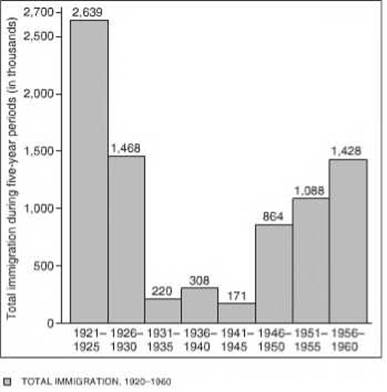
39. What best explains the decline in immigration during the years pictured in the following graph?
A. Postwar recession ruined the agricultural economy.
B. Slow industrial expansion limited available job opportunities.
C. Nativistic legislation restricted immigration from certain nations.
D. Government land policy favored speculators over individual purchasers.
E. Better employment opportunities existed in Europe rather than in the United States.
40. Which of the following was a foreign affairs issue during the administration of President Jimmy Carter?
A. Iranian hostage crisis
B. Iran-Contra affair
C. North American Free Trade Agreement (NAFTA)
D. Invasion of Panama to arrest Manuel Noriega
E. Fall of Saigon
41. The Annapolis Convention succeeded in
A. resolving a boundary dispute between Maryland and Pennsylvania
B. uniting British colonists against the French
C. convincing Confederation leaders to call a constitutional convention
D. resolving tariff issues
E. settling disputes over the slave trade in North America
42. In the antebellum period, the largest number of women working outside of the home could be found in which of the following professions?
A. Nursing
B. Education
C. Secretarial
D. Textiles
E. Law
43. As part of his “Square Deal,” which president signed the Pure Food and Drug Act and the Hepburn Act?
A. Benjamin Harrison
B. Grover Cleveland
C. William McKinley
D. Woodrow Wilson
E. Theodore Roosevelt
44. The Dawes Severalty Act of 1887 attempted to
A. provide economic aid to war-torn European nations
B. force Native Americans to assimilate into white society
C. set lower railroad rates
D. promote western land sales to railroad companies
E. lower tariffs on foreign industrial goods
45. Arthur and William Levitt were responsible for which of the following icons of the 1950s?
A. Standardized suburban communities
B. Polio vaccine
C. Leave It to Beaver
D. Hydrogen bomb
E. Electric refrigerators
46. When Congress gained control of Reconstruction policy, Radical Republican leaders
A. hastened the readmission of the seceded states according to President Abraham Lincoln’s “10 Percent Plan”
B. redistributed thousands of acres of land formerly owned by slave masters
C. divided the South into military districts to be occupied by the Union army until loyal governments could be created
D. sought only to limit the involvement of the highest Confederate leaders in postwar governments
E. prohibited Northern business investments in the Southern economy as a means of punishing the former Confederacy for secession
47. The “Sussex pledge” was
A. President Nixon’s promise to release the Watergate tapes
B. President Franklin Roosevelt’s promise to provide relief to American farmers
C. a protest statement written by the SDS (Students for a Democratic Society)
D. a plan for postwar Europe stemming from the Yalta Conference
E. a statement by Germany promising to stop unrestricted U-boat warfare
48. Which of the following statements about the Whig party is true?
A. Party members universally opposed the expansion of slavery into the territories.
B. The party succeeded in winning only one election.
C. Party members tended to advocate nationalistic economic policies.
D. The party emerged immediately after the demise of the Federalists.
E. Party members sought to enlist the votes of immigrants.
49. In the late nineteenth century, the growth of cities was caused in part by the
A. settlement house movement
B. rise of public education
C. absence of nativism
D. expansion of industry
E. increasing importance of political machines
50. Racial tensions and fears of espionage led President Franklin D. Roosevelt to issue Executive Order 9066. As a result, which of the following groups were forced into “relocation” camps?
A. Italian-Americans
B. Japanese-Americans
C. German-Americans
D. Mexican immigrants
E. Socialists
51. The Tet Offensive (1968)
A. demonstrated that the United States was no closer to ending the Vietnam War
B. revealed the success of Nixon’s Vietnamization plans
C. temporarily reversed the rising popular opposition to the war
D. improved Johnson’s bid for reelection
E. enabled American forces to enter North Vietnam
52. American colonists opposed the passage of the Stamp Act (1765) primarily because it
A. severely limited colonial commerce
B. followed the passage of the unpopular Townshend Acts
C. was too expensive for average colonists
D. did not receive the endorsement of the king
E. imposed a revenue tax
53. Beginning in 1872, mail-order catalogs
A. ruined small businesses
B. promoted the sale of industrial goods in rural areas
C. replaced billboards as the primary means of business advertisement
D. expanded American markets overseas
E. caused the reorganization of the postal system
54. Which of the following statements best asserts the principle of “popular sovereignty?”
A. Congress has the authority to decide where slavery may or may not exist.
B. Political parties provided the best forum for the resolution of the slavery issue.
C. The American people shall decide where slavery will exist by creating a national law in a special legislative convention.
D. The settlers in a given territory have the sole right to decide whether or not slavery will be permitted there.
E. Individual states have the right to reject congressional decisions concerning slavery.
55. All of the following were means of slave resistance during the antebellum period except
A. running away
B. breaking tools and slowing down the pace of work
C. field songs
D. adaptations of slave religion
E. frequent bloody slave revolts
56. The Servicemen’s Readjustment Act, popularly known as the GI Bill of Rights, granted financial assistance and opened new educational opportunities for veterans. It was passed by
A. Woodrow Wilson.
B. Warren G. Harding
C. Franklin D. Roosevelt.
D. Harry S Truman,
E. Richard Nixon.
57. The Monroe Doctrine (1823) intended to
A. reverse George Washington’s neutrality policy
B. eliminate British influence in North America
C. restrict European involvement in the Western Hemisphere
D. facilitate the expansion of American trade in the West Indies
E. open South America to American colonization
58. The federal government promoted the settlement of the Great Plains in the nineteenth century through the passage of the
A. Reclamation Act
B. Homestead Act
C. Gadsden Purchase
D. Webster-Ashburton Treaty
E. Soil Conservation and Domestic Allotment Act
59. One difference between the Middle Colonies and the other British colonies in North America was that
A. residents of the Middle Colonies represented more diverse nationalities
B. the Middles Colonies outstripped their neighbors in the production of tobacco
C. the Middle Colonics developed a primarily industrial economy
D. the residents of the Middle Colonies had little interaction with the native tribes
E. no settlers in the Middle Colonies owned slaves
60. Which of the following was not an issue associated with the Kennedy administration?
A. Integration of the University of Mississippi
B. Bay of Pigs Invasion
C. Construction of the Berlin Wall
D. Trade Expansion Act
E. U-2 incident
61. At the turn of the century, the United States favored the Open-Door policy in order to
A. encourage trade among its overseas colonies
B. protect the governments of Latin America
C. ensure that it would have its share in China’s trade
D. promote the use of the Panama Canal
E. cripple the Nazi war effort
62. The Northwest Ordinances
A. provided a means to establish new states in the territory ceded in the Treaty of Paris (1783)
B. admitted Oregon and Washington to the Union
C. sanctioned the exploration of the Louisiana Purchase
D. restricted westward expansion
E. were supported mostly by farmers and railroad companies seeking the removal of Indian tribes
63. Breaking with precedent. President Woodrow Wilson went abroad to negotiate a treaty to end World War I. He supported the Treaty of Versailles because it
A. banned submarine warfare
B. blamed Germany for starting the war
C. divided Germany into occupation zones
D. provided for the creation of the League of Nations
E. gave the United States trading privileges in Great Britain
64. The intent of the Alien and Sedition Acts was to
A. weaken the opponents of the John Adams
B. expand the meaning of the First Amendment
C. protect the rights of recent immigrants
D. expel French residents of the Louisiana Purchase
E. require ail newspapers to be printed in English
65. Which of the following statements about the First Great Awakening is true?
A. It led to the founding of new colonies in North America.
B. It splintered existing congregations and churches.
C. It found most of its converts in the commercial cities of the East Coast.
D. It strengthened the authority of established religious figures.
E. It cemented the ties between colonial governments and religious denominations.
66. The WPA
A. supported Prohibition during the 1920s
B. was a conservation organization started by John Muir
C. promoted rationing during World War I
D. addressed unfair hiring practices during World War II
E. attempted to revive the economy by creating jobs in the 1930s
67. Harriet Beecher Stowe was notable for
A. organizing an early women's rights convention
B. promoting the reform of prisons and asylums
C. writing the abolitionist novel Uncle Tom's Cabin
D. leading slaves to freedom along the Underground Railroad
E. founding a utopian community at New Harmony
68. Which of the following statements is true about the election of 1972?
A. Nixon was the first Republican candidate to carry the “Solid South."
B. Nixon’s opponent. Democrat George McGovern, had reunited a party divided since 1968.
C. Nixon benefited from the first economic boom since 1945.
D. Nixon placed Gerald Ford on the ballot to win votes from the Midwest.
E. Nixon struggled to defeat challenger Ronald Reagan in the Republican primary.
69. The term “Dust Bowl” refers to which area of the nation ravaged by drought during the Great Depression?
A. The West Coast
B. South Carolina to Mississippi
C. New England
D. Texas to the Dakotas
E. The Mississippi Delta
70. After the War of 1812, the United States government sought to
A. stimulate trade by lowering tariffs
B. improve commerce with Great Britain in a series of favorable treaties
C. slow the pace of westward expansion
D. redistribute British property seized during the war
E. renew the charter of the Bank of the United States
71. The passage of the first graduated income tax enabled the federal government to rely less upon which of its traditional sources of income?
A. The sale of public lands
B. High tariffs
C. Sale of war bonds
D. Bank loans
E. Corporate taxes
72. In the post-Reconstruction South, white Southerners attempted to circumscribe the citizenship rights of African-Americans by restoring the social customs of the “Old South.” Which of the following means of limiting black freedom found its predecessor in the antebellum period?
A. The Ku Klux Klan R. “Grandfather clause”
C. National legalized segregation
D. “Black Codes”
E. Literacy tests for voting
73. The Strategic Defense Initiative (“Star Wars”), which intended to use lasers and satellites to counter Soviet nuclear weapons, was proposed under
A. Gerald Ford
B. Jimmy Carter
C. Ronald Reagan
D. George Bush
E. Bill Clinton
74. “It was the best of nationally advertised and quantitatively produced alarm clocks, with all modern attachments, including cathedral chime, intermittent alarm, and phosphorescent dial. Babbitt was proud of being wakened by such a rich device. Socially, it was almost as creditable as buying expensive cord tires.”
In Babbitt, which of the following authors criticized the shallow materialism of his or her contemporaries?
A. Sinclair Lewis
B. John Steinbeck
C. Ida Tarbell
D. Bruce Barton
E. Jack London
75. The intent of British mercantile legislation before 1750 was to
A. cripple the colonial economy in North America
B. promote favorable trade between Great Britain and its colonies
C. give special trade privileges to its North American colonies
D. limit the growth of a merchant class in the colonies
E. prevent the founding of new colonies west of the Appalachian mountains
76. Which of the following diplomatic initiatives during the Cold War best matches the goal of Franklin D. Roosevelt's “Good Neighbor” policy?
A. Eisenhower Doctrine
B. Alliance for Progress
C. Mann Doctrine
D. SALT II
E. Warsaw Pact
77. Reform legislation, including stricter building codes and factory inspection acts, followed a horrendous fire in 1911 that claimed 146 lives at the
A. Triangle Shirtwaist Company (New York)
B. International Harvester Corporation (Chicago)
C. Swift meatpacking plant (Chicago)
D. U.S. Steel Corporation (Pittsburgh)
E. Bessemer Steel Corporation (New York)
78. Which of the following was not a provision of the Compromise of 1850?
A. Admission of California as a free state
B. No congressional restriction on slavery in the Mexican Cession
C. Settlement of the Texas and New Mexico boundary issue
D. Prohibition of the slave trade in Washington, DC
E. Appropriation of federal funds for railroad construction in the Southwest
79. Which of the following Supreme Court cases could be viewed as a victory for the opponents of reform?
A. Swift and Company v. United States, 1905
B. Lochner v. United States, 1905
C. National Securities Company v. United States, 1904
D. Standard Oil of NJ v. United States, 1911
E. American Tobacco Company v. United States, 1911
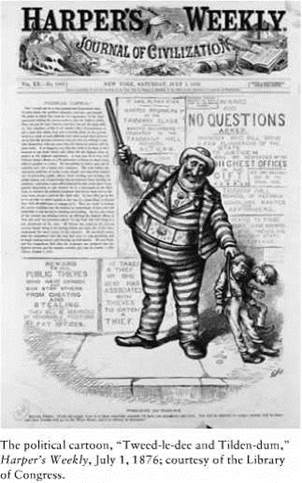
80. The following cartoon by Thomas Nast
A. called for reform of American prisons
B. opposed imperialism
C. attacked political corruption
D. demanded improvements in the educational system
E. criticized new child labor laws
END OF SECTION I