
CHAPTER TWO
Spending less than you earn is the cornerstone of financial stability. It makes possible the elimination of money stress and is the beginning of wealth creation. Once you’ve disaster-proofed your life to guard against emergencies that could happen tomorrow to completely derail your financial life, the next thing you have to focus on is running a surplus: having some money left over at the end of the month instead of some month left over at the end of the money. I can’t emphasize enough the importance of this simple rule.
If you want to create wealth, the fundamental formula is as follows:
Surplus × Time = Wealth
Where is that whimpering party favour that sounds like a dying duck? This formula is about as unsexy a concept as you’ll find in any personal finance book. People want to know how to pick stocks, what ETFs to buy, how to keep costs low, and so on. Should they invest in a TFSA? Or an RRSP? Or both? And if both, then what percentage goes into what? Those are all great questions to ask, but only after you realize the importance of this simple formula, and how it is ultimately much more important than the answers to all those other questions put together.
If you don’t run a surplus, you won’t ever have to worry about what to put in your investment portfolio because there won’t be one. Who cares about the difference in taxation of dividends and capital gains in your portfolio? What portfolio? If you want to become more fit, you have to work out and eat healthy foods. In order to become an investor, first you must become a saver. Both propositions are equally boring and equally true. There’s another parallel between physical and financial fitness. That is that while the concepts are simple, they can be incredibly hard to implement. We know what we have to do. It’s not rocket science. All it takes is willpower.
I’ll talk about the motivational aspect of running a surplus in Chapter 5. For now, I’ll show you some practical ways to actually run a surplus. First, you need to learn how to budget—either with a spreadsheet or, for those who find spreadsheets scary, without one.
HOW TO BUDGET WITH A SPREADSHEET
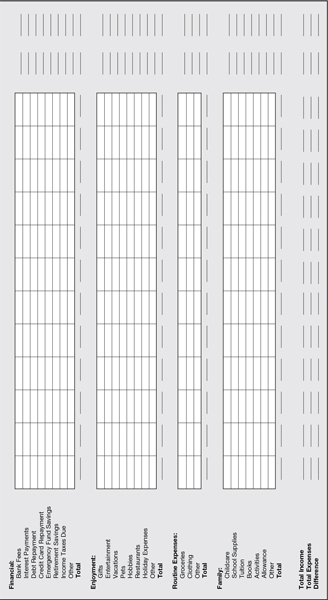
There is no shortage of spreadsheet templates on the internet. They are all pretty much equal, but some are more equal than others. I’ll save you some time. The next two pages show an example of budgeting spreadsheets. If you would like this in electronic format, just go to Squawkfox.com (written by Kerry K. Taylor) and in the top right-hand side of the page there will be a “search” box. Type in “how to make a budget.” The search engine will take you to a listing of pages on Kerry’s site. Any of the first few non-advertisement links will take you to her ridiculously awesome section titled “Financial Planning Series: How to Make a Budget.” It will walk you through the process of creating a proper budget, but here’s what you have to do:
1. Figure out your old budget.
2. Figure out a new budget.
3. Start tracking your spending more diligently.
4. Save the savings.
5. Plan for non-monthly expenses.
1. Figure Out Your Old Budget
The budget itself is simply what comes in the door (income) compared to what goes out the door (expenses) over a set period of time (usually a month). Your old budget is easy to figure out. You probably have a good idea what your income is, especially if you get a regular paycheque, as most people do. And figuring out your expenses is pretty easy these days. Just gather up your credit card and debit card statements and plug in all the transactions for each month for as far back as you like. I recommend aiming for at least 3 months. Create as many categories as you like, or use Kerry’s spreadsheet. Now add up all the expenses. If the expenses are more than your income, you are running a deficit. If they are the same, your budget is balanced. And if they are less than your income, you are running a surplus. If you make a lot of cash transactions, you can mark those transactions as “cash” for the time being. Mark any automated teller machine (ATM) withdrawal in the cash category, unless you have a receipt that tells you exactly where it was spent.
Figure 2.1: The Squawkfox spreadsheet makes starting a budget easy.

Source: Kerry K. Taylor, Squawkfox.com
I want to urge caution here. Some people will find it frustrating to go back in time to add up expenses because they may know they are missing items. Not to worry: you can afford to be a bit sloppy here. It’s about the process at this point rather than the exact numbers. Budgeting is an ongoing endeavour and you’ll get better at it. Especially once you start diligently tracking expenses going forward.
So now you’ve figured out your old budget. It can be a sobering experience.
Even as you fill in all the items you have purchased in the various categories, you will probably be disgusted to see just how much money gets spent on what you might have thought were minor luxuries. Think: coffee, lunches with people at work, dinners out and meals ordered in, movies, etc. When you’re not tracking these things, a few dollars here and a few dollars there seem harmless. But the daily consumer of a latte or cappuccino can be spending $80 per month if he or she grabs one on the way to work every day. Some days you skip breakfast and grab a snack with your morning drink. If you do, then that sum might average closer to $100 per month. Someone who eats at a food court near their office every day might easily spend a few hundred dollars per month. The little indulgences add up in a hurry.
Don’t forget all your debt payments. Are you paying $500 a month in credit card bills, but your balance isn’t going down? (Or worse, is it going up every month?) Do you have an interest-only payment on a line of credit? Student loans? When you add up all your debts (mortgage, credit cards, loans, etc.), if that number isn’t getting smaller every month, you are not running a surplus (assuming you are not stockpiling cash at the same time as your debts are increasing).
Especially if it’s the first time they’ve ever done it, most people are flabbergasted by what they see in at least one category, if not more. I promise you will instantly cut back your spending simply as a result of tracking it for the first time and becoming more aware of what’s happening.
2. Figure Out a New Budget
The real magic comes when you decide to create a new budget. As you look at each category, you have to pause and ask yourself how you can reduce that number.
There are some payments you can’t modify easily, such as a mortgage or rent payment, but there are many others you have immediate control over. Maybe you have a bundled TV, internet, and phone package. Call up your provider and ask how you can save money. You would be surprised how often this results in savings without much effort. A new package may give you all the features you want at a lower cost.
If you are spending $500 on restaurants, figure out what your new budget should be and how you plan to achieve it. Do you go out less often? Eat at less expensive restaurants? The same thinking can be applied in every category. How much are you paying in bank fees? How much do you spend on groceries? Everything. Your new budget should be a guide for what you allow yourself to spend in these various categories every month.
3. Start Tracking Your Spending More Diligently
As mentioned earlier, you may find that going back in time to figure out your spending is tedious and perhaps imprecise. But it will be much easier going forward if you keep these tips in mind:
a. Get a box, bowl, folder, jar, or whatever, and put it near your front door in a spot you always walk past. This is where you are going to dump all your receipts and bills every day.
b. From now on, don’t hand someone cash, a debit card, or a credit card without getting a receipt back. Collect your receipts. Even if you are buying a pack of gum for 98 cents, get a receipt for it. Put it in your receipt jar.
c. Anytime a bill comes in the mail, even if it is a notice to let you know a payment was made automatically, put it with all your receipts for the month.
d. At the end of the month, enter all your expenses in your spreadsheet. Was there a big change from the previous month? Also, remember that if you have a cash withdrawal for $20, and receipts showing where that $20 was spent, don’t enter the expense twice.
It should go without saying that if you were spending $500 per month on restaurants, and you set a new budget of $300 per month, and then managed to spend just $200 per month, that’s fantastic! There are some cases where the goal of saving money becomes exciting. (Yes, I wrote that with a straight face. You’ll see.)
You’ll note that my simple approach to budgeting is to figure out your old budget, create a new budget, start tracking expenses more diligently, and then to save the savings. “Save the savings” means exactly what it says.
4. Save the Savings
I have often heard of people who save money by cutting back on one unnecessary expense only to use the savings for something else that is just as frivolous. For example, they might reduce that spending on clothing from $100 to $50 a month. But all of a sudden, $50 a month is now being spent on upgrading their cable package.
Consider someone who starts a new fitness regimen. Maybe they are lifting weights or running for 30 minutes three times a week. But if they feel famished after their workout and head off to grab some fast food, also three times a week, they might not notice any change in their physical appearance. Had they not been working out, perhaps those treats would have added a chin. On the flip side, adding the workout while skipping the additional junk food might have resulted in a positive change to their physique.
It’s the same with money.
Maybe you have negotiated the interest rate on your next mortgage to be 0.5 percentage points below the renewal rate you were initially offered. But unless you have a concrete plan for those savings, they may get spent without you even noticing. In order for your sacrifices and hard-fought-for deals to mean something to your bottom line, you need to put the savings to productive use. Paying down debt, investing, and purchasing insurance you have been procrastinating about are all good examples.
Everyone has seen those opportunity-cost calculations that show you how reducing your expenses on activity X could turn into $100,000 in 25 years if you put the money in an investment portfolio. Generally speaking, the rate-of-return assumptions are on the high side to motivate you. That’s all fine and dandy, but again, it assumes you save the savings.
As a teenager, I remember seeing a commercial that showed a smoker blowing up a Porsche 911 Cabriolet as a high-impact visualization of the opportunity cost of smoking. According to the Smoking and Health Action Foundation, the average carton of cigarettes currently costs between $70.18 and $106.09, depending on the province or territory you live in. If we average those extremes, and take into account that a carton contains 200 cigarettes, we can calculate the cost of a cigarette at about 45 cents. I’ll make some simple assumptions for my own high-impact analysis: a smoker starts smoking a pack a day at 15, paying $9.00 for a pack. If, instead of smoking, he or she directed that money to a moderately aggressive investment portfolio, the long-term, after-inflation rate of return would have been 3%. That works out to more than $375,000 of opportunity cost in today’s dollars by the time he or she reaches 65. That kind of money buys a nice car. But this kind of financial return is possible only if you save the savings.
If you are making a sacrifice to truly improve your finances, you must set up automatic transfers from your chequing account to your savings account that mimics your old spending pattern. For example, if you are giving up a pack of cigarettes a day, you can set up a daily $9 transfer. If you are skipping ordering wine when eating out on Friday nights, you could set up a weekly $25 transfer. (Make sure that your banking package covers all the extra transactions before setting these up.)
Not everyone is ready to go cold turkey by giving up their pricey habits, but unless you actually save the savings, you’re not making progress. It’s like eating a bacon double cheeseburger after a 10K run: that’s a lot of pain with no real gain.
5. Plan for Non-Monthly Expenses
Your surplus should go mainly to paying down high-interest debt aggressively (see Chapter 3). But part of it can be used to build up a short-term savings fund for the non-monthly expenses we always encounter, such as holidays and birthday gifts. If you forecast these expenditures on your calendar, you can set aside cash to pay for them when the time comes. For example, if you’ve forecasted that you will spend an average of $1,000 per year for various holidays, birthday and anniversary presents, then one twelfth of $1,000 needs to be put away each month into your short-term savings fund.
Note that until your high-interest debt is zero, you need to cool it on what you think you can spend on presents and anything frivolous. Cutting back on giftgiving is difficult to do when it comes to the children in your life, but if you and your spouse have high-interest debt, the best present you can give each other is paying down debt. It’s a tough sell if you’re not both on board, so talk it over, and make sure to say it was all my idea.
HOW TO BUDGET WITHOUT A SPREADSHEET
There’s no shortage of how-to-budget resources in the world. And everybody knows they’re not supposed to spend more than they earn. So one could assume that a low savings rate is not due to an inability to add and subtract, given that most Canadians have the Grade 3 skill set required. So what exactly is the problem?
For a lot of people, meticulously formulating and tracking a household budget works about as well as me on a dance floor. Believe me, it ain’t pretty! But I’m a veritable Fred Astaire with a spreadsheet.
There was a time when I would indeed grab a receipt for every single thing I purchased and enter it into my spreadsheet. It was great for finding out where I was spending more than I thought, and it allowed me to save some money by consciously cutting back where appropriate. Cutting back meant that I had cash left over at the end of the month. Which was great. But for those of you who are bad on the budgeting dance floor, take solace. Here’s why I abandoned spreadsheets and never looked back: human beings have an uncanny ability to adapt.
If you receive notice of a rent increase from your landlord or your mortgage payment goes up on your next term, you’re not likely to move. You’re more likely to stay where you are and suck up the increase. Ditto for gas. The price of gasoline has skyrocketed, and yet we still have traffic jams. People adapt. Remember when gas first hit $1 per litre on the way up? People went crazy. If it hit $1 per litre today, we’d be dancing in the streets. But if gas did in fact fall to $1 per litre, not many of us would suddenly start saving the savings. We would simply spend the extra money elsewhere.
So, for many people, the trick to saving may be to force yourself to adapt. Instead of waiting to see if there is a surplus at the end of the month, have your desired savings taken out of your bank account automatically on the day after you get paid, and focus on not getting into the red before the next payday. You will adapt.
Let me reiterate this simple two-step plan for budgeting without a spreadsheet:
1. Save at the beginning of the month.
2. Don’t let your bank account sink below zero by the end of the month.
Avoid using your credit card if you have an unpaid balance. Remember, you have to cut back until all your high-interest debt is gone. Sometimes we think we need something when in fact it is simply a want. Be vigilant! If there is no alternative except to use your credit card when you’re out shopping, you had better be able to transfer an equivalent amount from your chequing account to your credit card when you get home. If you can’t stick to this short-cut plan, then sorry: you’re gonna have to suck it up and use the spreadsheet after all.
To make the no-spreadsheet system work, you need to save an amount at the beginning of the month that feels like it would be a bit of a stretch. You can’t get lazy about it. Well, not any more lazy than not having to use a spreadsheet. If you are worried because you’re already stretching your income, the worst-case scenario is that, after a few months, you have money in your savings account and an offsetting amount of money owing on credit cards. You can take the cash from the savings and pay down the money owing. But I would be willing to bet that most people who think they are stretched already will suddenly find they have savings without extra money owing simply because they adapted to the new normal.
Some people do fine with spreadsheets and that’s great. But for others, simple budgeting problems seem insurmountable because they over-think them. Stop thinking, and just do. Some call it “pay yourself first,” others say “make it automatic.” I say, “Dance, cowboy!”
How much should you save? Here are a few pointers:
1. The traditional recommended savings figure is 10% of gross income, but that is for long-term savings. If you save only 10% of income and end up spending the accumulated savings once a year, you will have done nothing to prepare for retirement.
2. Given that 10% should be the minimum to invest for the future, you need to determine the percentage you’ll need to tuck away as short-term savings for the year.
3. Short-term savings covers lump-sum expenses such as vacations, birthday and holiday presents, and other non-monthly items. If you can earn interest on saving up for these expenses ahead of time, instead of paying interest to finance them after the fact, you’ll be one step ahead of the game.
4. Increase your automatic savings every January first. Remember to increase it just a little bit more than you think you can handle. You can always pare back if it’s too tough. But be honest about whether it is too tough, or you aren’t tough enough.
5. Be sure to increase your savings when your income goes up.
BANK ACCOUNTS FOR COUPLES
One of the questions I am asked most often is how to arrange bank accounts for a couple. Should they be separate? Should you just have one joint account?
Rarely is there a one-size-fits-all answer for any question about money, so I’ll preface this by saying that if you have a system that works well for you, more power to you. One big joint account might be fine ... for you. Completely separate bank accounts might also be fine ... for you.
But, if you have never really thought about it before, then here is what I suggest for people who have made a long-term commitment to each other and don’t feel confident that they have a handle on things: three bank accounts. One joint account for your regular household inflows and outflows, and two separate personal accounts for your “mad money.”
The Joint Account
Setting up one joint account into which both your paycheques are deposited is Step One. All your regular expenses, such as the mortgage payment, utilities, phone bills, insurance premiums, car payments, and so on, are paid from this account. That’s Step Two. Step Three is to make sure that at the end of each month there is a surplus. If not, you have to fix that before you do anything else. Your monthly long-term investment or savings contributions should come from this one joint account as well.
Separate Personal Accounts
The personal accounts are for your indulgences. The point of these accounts is that you don’t have to be accountable to your spouse or partner for what you spend this money on—so long as you don’t go over your “allowance.” As a couple, you should determine how much money gets transferred to these accounts in the first place.
Perhaps you’ve decided that each person gets $300 transferred monthly to the personal account. One person uses that $300 by buying fancy coffees and going out for lunch at work. The other person might not use it up at all, and their account builds up slowly over time. The person with the savings should feel fine about using them to buy big-ticket items every once in a while, such as electronic gadgets, jewellery, etc.
This three-account system is a good starter system, especially if you haven’t been talking about your personal finances with your significant other before. You’ll both have a better handle on the household finances as you establish the overall budget in the joint account, but you’ll also make those guilty pleasures feel a lot less guilty.
CRASH TESTING YOUR FINANCES TO START SAVING MONEY
Christmas happens every year. And every year people pile up debt on their credit cards.
One area of household budgeting that tends to catch people out are the non-regular expenses. People are less likely to spend $100 per month on clothing than they are to spend $600 twice a year. It’s the same for holiday expenses. We don’t spend $10 per month on toys. We buy toys worth $120 in December.
The problem is that many people are making ends meet only for their monthly expenses, so these non-monthly expenses can catch them out. We have the gifts to shop for before the holidays and the sales to tempt us after they’re over. Alcohol consumption rises in December with all the family get-togethers (perhaps to survive the family get-togethers) and then, as we enter January, we are tempted by the prospect of tanning on a beach at an all-inclusive resort.
Taken together, you could have two or three consecutive months in which you find yourself spending upwards of $1,000 per month more than usual.
The norm is to spend the money and then pay it off after the fact. We suffer from debt remorse for a while, which usually means the debt gets paid off, but every time that happens, a new cause for celebration appears just around the corner. Think, for example, of Valentine’s Day and the reverse sale on flowers that goes with it (it’s the one time all year when you can be sure the price of petals goes up). The temptation to make exceptional expenditures never ends. But we keep treading water.
If we can save up ahead of time, instead of financing a purchase after the fact, then we can earn interest instead of paying it. Our overall cost comes down, not to mention our stress level. But, of course, flipping that switch is easier said than done. Mostly it means you have to delay gratification for something, at least for a little while.
If you find you’re not really motivated to put off spending, think about this: some experts believe a worldwide recession is in the cards. Pretend you lost your job today and you won’t find work again until the end of the year. Your immediate response would be to tighten the purse strings, take any leftover money, and put it into a savings account. You might switch from name to no-name brands and buy cheaper items at the grocery store. There would be no going out to fancy dinners or movies. No buying songs on iTunes and no lattes. If there’s no penalty incurred for putting the movie channels on hold, you could try that too. Only spend on needs, not wants. Try this and see how far you can take it.
Think of it as a kind of fire drill. No one knows if and when they might lose their job. It could happen for a variety of reasons beyond your control. Perhaps the prospect of such an occurrence is enough to motivate you to flip the switch from spender to saver though a temporary crash test. If you try it, and if you are successful, the key is to continue to be one step ahead by constantly saving up for the next event instead of always paying off the last one.
It would be tough to actually simulate a total loss of income, but try to cut as much spending as you can on a temporary basis. There are some expenses that simply can’t be cut on a short-term basis. Write them down so that you have an idea what your actual minimum expenses would be if you had a significant loss of income. Here are some other tips:
• Pinch your pennies hard for 3 months on luxuries and actually cut out some fat. That money goes into a savings account.
• Calculate what you would change in theory if you really did lose your job. Could you downgrade your car? House?
• What penalties would you face for cancelling long-term contracts (think: cellphones, gym memberships, everything).
• After you’ve figured out your minimum living expenses, calculate how long you could survive.
This exercise might provide the motivation you’re looking for to switch from financing to saving. We can hope it will only ever be a drill.
TO SAVE OR NOT TO SAVE?
To save or not to save? That used to be the question. But given that the economy has been weak ever since the credit crisis, some observers are debating a different question: to spend or not to spend? Because more spending is better for the economy.
The problem is that the average Canadian household has been gradually spending more and saving less. The Vanier Institute of the Family’s research reveals that the ratio of debt to income has been steadily increasing for the past 20 years, from 93% to 150%. The savingsto-income ratio shows the opposite trend, decreasing from 13% to 4.2%.
Some might suggest people are spending more solely because the necessities of life have increased in cost. And while it’s true that housing costs more, food and gas are on the rise, and incomes don’t seem to be rising as quickly as they once were, that’s only part of the story. Lower interest rates have made it cheaper to borrow and less rewarding to save. And that’s only given some people more rope with which to ultimately hang themselves if something goes wrong. They might lose their jobs. Or maybe debt payments will increase with interest-rate hikes leaving them with even less money to spend.
But not all spending is bad spending. We need people to spend to generate sales for business. If these companies don’t have sales, they could lay off workers, which means even lower sales, which could lead to more layoffs, and so on.
Ironically, some people argue that too much saving is bad. The paradox of thrift is that a higher average saving rate leads to lower overall savings. This is because higher saving means lower spending, which means a curtailment in job growth. Those potential new workers—the ones not hired—could be saving part of their income too, but since they don’t exist, their savings don’t exist either.
So do you spend to do your bit for the economy? Or do you rein it in to save yourself?
If present trends continue, eventually we’ll get to a point where we can’t spend anymore at all. A rising debt-to-income ratio means we are spending future income today. That can only go on so long before there’s a rude awakening. Just ask the U.S. government about their recent fiscal-cliff and sequester fiascos. So perhaps the question should be rephrased: to save yourself or not to save yourself? Then I think the answer becomes apparent. The best thing you can do is to save yourself. If you run out of the ability to spend one day, that is worse for the economy than being able to spend a little for a long, long time.
Are interest rates too low to make saving worthwhile? Low interest rates have led many people to wonder if they should bother saving their money. While anemic returns on short-term guaranteed income certificates (GICs) and savings accounts provide little growth, present conditions aren’t actually as different from what some regard as the heyday of higher savings rates.
As I write, the going rate on a one-year GIC from a big bank is about 1%. Assuming the investor is in a 35% tax bracket, an initial investment of $1,000 would grow to $1,010 by the end of the year, lose $3.50 to tax, and an additional $26.17 to inflation (currently running at 2.6%). So this low-interest rate environment leads to a decrease in purchasing power of 1.97% overall, and the original $1,000 can now buy only $980.33 worth of goods.
Back in 1980 interest rates were higher, but so was inflation. You could’ve picked up a one-year GIC paying perhaps 13%, while inflation was running at about 10%. Assuming the same marginal tax rate of 35%, an initial investment of $1,000 grew to $1,130 before losing $45.50 to tax. The remaining $1,084.50 then lost $108.45 to inflation to leave you with a decrease in purchasing power of 2.4%. Your original $1,000 could buy only $976.05 worth of goods at the end of 1980.
Saving inside a registered plan, such as an RRSP or TFSA, negates the tax drag, and, because these tax-sheltered accounts are more prevalent now than they were in the early 1980s, one could argue that saving money now makes more sense than it did back then. You can disregard the math though. People whom I would consider to be financially successful grasp a few simpler money-management concepts. One of those concepts is simply to be a habitual saver.
I know many individuals who are well versed in financial theory, read all the books, and who could quite frankly run rings around the average financial advisor with respect to their knowledge of the nittygritty details of investing, but that doesn’t necessarily translate into financial success. To be an investor, first you must be a saver.
Once saving has become a habit, if you are still unhappy with the growth of your money, the low returns on safe investments can be exchanged for potentially higher returns with riskier investments, if you so desire. But until you are a saver, there’s no point in counting those chickens: the eggs have not yet hatched. You don’t have to worry about putting all your eggs in one basket when there are no eggs to begin with.
Speaking of developing good habits, it never hurts to start young. Rob Carrick, a personal finance columnist with The Globe and Mail, wrote a great book, How Not to Move Back in with Your Parents: The Young Person’s Guide to Financial Empowerment. This is on my recommended list and is actually appropriate for parents too, because it can help them to help their children navigate their personal finances.
If you would like to learn about a whole bunch of specific ways you can cut your expenses, pick up 397 Ways to Save Money by Kerry K. Taylor (yes, the same person behind Squawkfox.com). She is one of the most widely read personal finance bloggers in the world. Read her blog and buy her book. You can thank me later.