APPENDIX 6.1
Elementary Example of a Graduate Profile
The Katherine R. Smith School is a public elementary school in San José, California, serving predominantly Latinx students, that has been recognized as both a California Distinguished School and a National Blue Ribbon School of Excellence. An innovator and early adopter of project-based learning methods, Katherine Smith’s leaders developed a graduate profile that conveys to families and students the importance of thinking, learning, working, communicating, collaborating, and contributing to their community. All of their professional learning, curriculum planning, and student engagement is oriented toward this framework.
Kevin Armstrong and Rachel Trowbridge, co-principals of Katherine R. Smith, reflected with me on the impact of the graduate profile:
When our school went through a significant reinvention eight years ago, our staff became anchored in a shared belief about the learning and overall school experience we wanted for our students. What we didn’t have was specific language describing measurable outcomes that could not only bring our initial vision to life but provide guidance for the direction of adult learning, cohesion across all classrooms, and a fully embraced sense of purpose for everyone on campus.
The beauty of the K Smith Habits is that they are easily built into our projects as learning targets—academic, social-emotional, and personalized—and they translate across grades and school systems, such as PBIS (positive behavior interventions and supports), so they never become “just another thing.” Some might call it brainwashing, but we spend significant time in every classroom and collectively helping our staff to internalize these attributes, beliefs, and skills. In essence, if a piece of work is not focused on the profile outcomes, we know we can take it off our plate.

Reprinted from Street Data: A Next-Generation Model for Equity, Pedagogy, and School Transformation by Shane Safir and Jamila Dugan. Thousand Oaks, CA: Corwin Press, Inc., www.Corwin.com. Reproduction authorized only for the local school site or nonprofit organization that has purchased this book.
APPENDIX 6.2
Student-Authored Descriptors of the Art of Social Justice Teaching
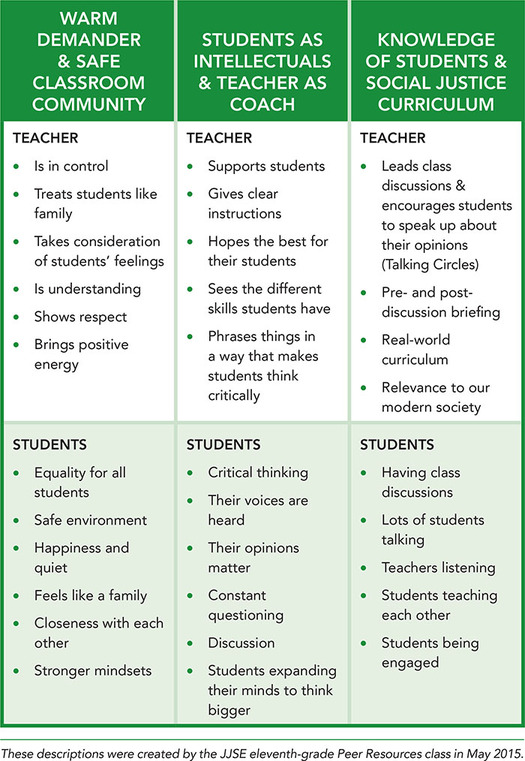
|
WARM DEMANDER & SAFE CLASSROOM COMMUNITY |
STUDENTS AS INTELLECTUALS & TEACHER AS COACH |
KNOWLEDGE OF STUDENTS & SOCIAL JUSTICE CURRICULUM |
|
TEACHER
|
TEACHER
|
TEACHER
|
|
STUDENTS
|
STUDENTS
|
STUDENTS
|
These descriptions were created by the JJSE eleventh-grade Peer Resources class in May 2015.
Reprinted from Street Data: A Next-Generation Model for Equity, Pedagogy, and School Transformation by Shane Safir and Jamila Dugan. Thousand Oaks, CA: Corwin Press, Inc., www.Corwin.com. Reproduction authorized only for the local school site or nonprofit organization that has purchased this book.
APPENDIX 8.1
Empathy Interview Transcript With Teacher Think-Aloud
Note: This interview is adapted from a real transcript from a middle school teacher’s empathy interview with his student. The student’s name has been changed to protect anonymity. I added the third column to show how the teacher might analyze the rich street data presented.

|
Question |
Quote |
Think-Aloud Analysis |
|
Can you introduce yourself? |
Hi. My name is Alejandro. Me and my class are currently working on this project about doing a podcast. We are also including interviews. I would like to include my mom in this interview because she is the one who I will be interviewing. I want to ask her about her culture or any tradition she’s had, basically, her past life. I would like to learn about this because I would like to know her strengths, her hopes, of what she has done back in the past, and what made her achieve herself to where she is today. |
I love that Alejandro is intuitively tapping into his mom’s community cultural wealth. He is using such a strong asset frame on his own. |
|
What are some important activities you have done in this project? |
Some important activities that I’ve done in this project is writing an introduction, choosing some song intros. Also, practicing my work that I’ve done with fellow peers. Let’s say I wrote an introduction and to make sure there are no mistakes to try and correct myself to better it, I practice reading it out loud to a fellow peer or teacher. I’m trying to gain feedback from others to see what I can improve or change. |
This street data tells me that Alejandro values and actively uses practice and feedback as strategies for improvement. He does not approach learning as a one-and-done, which is a huge strength. Specifically, I can infer that reading a piece of writing out loud to a peer or teacher helps him hear his own writing voice and get feedback. |
|
What’s something in this project that you feel you have been successful in? |
I feel I’ve been successful in two things. One, finishing a sheet filled with questions that I may include during the interview, and also preparing myself an introduction for the beginning, and what I have planned for a start. |
This helps me see Alejandro’s growing sense of efficacy as a key element of agency. He uses two verbs to signal efficacy: “finishing” and “preparing.” I want to help him continue to build on these things. |
|
What has helped you be successful? Why do you think you’ve been successful with those things? |
Well, one thing that I don’t occasionally get; I just need to complete any assignment that I may struggle with, perhaps. What I need is time and patience. That could benefit myself to see how I can be better in these activities. |
Here, Alejandro is giving me insight into two growth areas: time and patience with himself. He understands that to improve on assignments that he is struggling with, he needs to slow down his pace and be patient with himself. |
|
What have you found challenging in the project? |
I found it challenging in trying to start a song intro … podcast intro. When we created it in our computers, I didn’t really have any time to try finishing one of those. I struggled to find the right way of trying to see what could be useful and what could be negative. I haven’t finished my podcast intro on the computer because I can’t seem to find … I can’t find the right theme that could fit properly into my intro. |
Here again, the theme of time and pacing comes up in Angel’s narration. I can see how important it will be to reassure him that I value quality and process over quantity and product. I also may need to do a mini lesson with him and other students around theme. |
|
What’s something you learned in this project that you’re proud of? |
Well, to be honest, there isn’t really anything I’m proud of this. I just feel great about it but not proud. |
This makes me wonder if “pride” is an individualistic trait and not culturally congruent for Alejandro. Maybe pride is part of Western epistemology, and I should think about how to reframe that question! |
|
Okay what’s something you learned? |
Something that I knew already was trying to find an intro. Just to start the beginning of my topic to try and drag people’s attention to it. Yes, that’s something that I’ve already learned and pretty much accomplished well. |
Alejandro is really tuned in to the “hook” for this podcast project, and I love his description of “dragging people’s attention to it.” I can sense his growing confidence and agency in his final sentence. Going forward, I want to help him build on his many strengths and feel comfortable slowing down and being patient with himself as a learner. |
Copyright © 2021 by Shane Safir. All rights reserved. Reprinted from Street Data: A Next-Generation Model for Equity, Pedagogy, and School Transformation by Shane Safir and Jamila Dugan. Thousand Oaks, CA: Corwin Press, Inc., www.Corwin.com. Reproduction authorized only for the local school site or nonprofit organization that has purchased this book.
APPENDIX 8.2 PROCESS GUIDE TO INSTRUCTIONAL ROUNDS

|
|
|
|
School’s Problem of Practice Example: How are students reading, writing, and engaging in academic conversations?
|
|
|
Time |
Topic |
|
Facilitator Welcome & Overview (8 min.) Time: _____________ |
Welcome 1. Introductions 2. Objective Provide a learning space that is evidence based and structured by using a common protocol to investigate a school’s problem of practice using the insights of a diverse team comprised of school administrators, which can support the hosting school with new insights into how to continuously improve. 3. Norms
4. Agenda Overview Introduction (30 min.)
Classroom observations (60 min.) Debrief (120 min.)
|
|
Presentation of Problem of Practice & Preparing for Observations (15 min.) Time: _____________ |
Problem of Practice (POP): Host reviews the POP and identifies the focal questions for the team. What is the current context? When we think of this POP, our school is working to hone in on __________________________________. Building Shared Understanding: Facilitator guides the team and charts responses to these questions. Participants take notes in their agenda packet.
|
|
Preparing for Observations (5 min.) Time: _____________ |
Classroom Observation Logistics
|
|
Observations (60 min.) Notes about the classrooms I will visit or campus logistics: Time to report back: _____________ Instructional Rounds Debrief |
|
|
Prepare for Debrief (8 min.) Time: _____________ |
Partner Discussion: What was it like to observe in classrooms using this problem of practice as a focus. How was it helpful? How was it challenging? Facilitator outlines the steps of the debrief. 1. Individually sift through all of the evidence from each classroom observation that relates to the POP. 2. In small groups
3. In small groups
4. Facilitator uses group input to summarize all ideas from the buckets into one overall summary poster. |
|
Description of Evidence & Finding Patterns (40 min.) Time: _____________ |
Description Individual review of evidence (8 min.)
Is my evidence specific, descriptive, and non judgmental? Is it useful? Analysis How can we organize our ideas to make sense of what we saw? Which could be a high level pattern that might help the school get unstuck? Small groups construct pattern statements (30 min.).
|
|
Summary of Patterns (15 min.) Time: _____________ |
Summary of Patterns Each team shares their poster. In small groups
Overall summary poster |
|
Discussion on Next Steps (25 min.) Time: _____________ |
Discussion and Reflection Participant Discussion: All principals discuss while facilitator takes notes. (20 min.) Participants, including host principal, use the guiding questions in this section to support their fishbowl conversation. What suggestions can we offer our host school that can support these hack mindsets in the following list?
Hosts Reflection (5 min.)
What resonated from the discussion? Use the prompts that follow to guide your reflection.
|
|
Closing (10 min.) Time: _____________ |
Appreciations and Personal Learnings (5 min.) What is something you appreciated about our time learning together today? What are you taking away from today that connects to your own work? Feedback Online Form (5 min.) |