
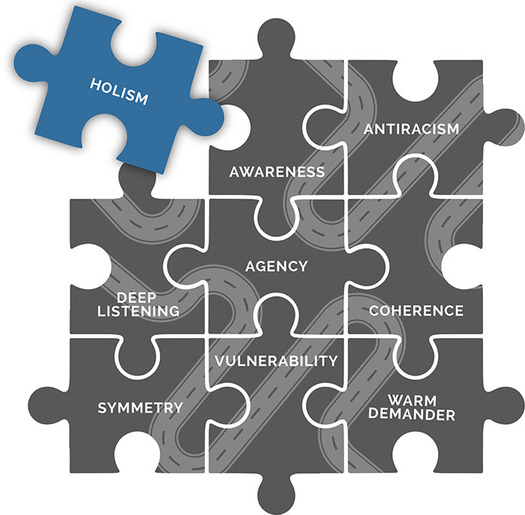
Reimagine our ways of knowing and learning.
Another world is not only possible, she is on her way. On a quiet day, I can hear her breathing.
—Arundhati Roy
RECLAIMING THE VILLAGE: CHILDREN AT THE CENTER
I am seated in a circle, nested among other circles, inside a former boarding school for Indigenous Canadian girls in Duncan, British Columbia—a small town on Vancouver Island. A white cross tops the brick-red steeple on this building, a relic of the Sisters of St. Ann and detail I barely noticed when I walked in. Within these concentric circles sit forty other educational leaders from the United States and Canada, joined by a desire to transform their school districts into spaces of equity and deep learning. I have been asked to speak to the group about listening leadership tomorrow, but for today, I am a learner.
Our guides are First Nations elders and a non-Indigenous woman named Michelle. Tousilum, our main teacher, shares that just entering this building makes his heart heavy: The cross takes him back to being ripped from his family at the age of five to attend a residential school where his music, language, and humanity were robbed from him. Like other elders here, Tousilum discloses that he was abused in the institutions he was forced to attend. He talks about the unimaginable pain his mother must have felt to have her youngest child stolen from her arms. To support his healing, Tousilum pulls out a drum and begins to sing a prayerful song in Hul’q’umi’num, the language of the land, calling us to stop and listen, to be still, to remember, to be grateful. I weep silently.
As an educator from Oakland, California, I feel the weight of the history Tousilum invokes—my complicity in knowing so little about Canadian residential schools; my own country’s near-erasure of Native American genocide and settler colonialism as well as its deep denial of slavery, lynching, and Jim Crow. As the mother of biracial children whose lives straddle histories of immigration, oppression, racism, and privilege, I feel trauma in my bones at the thought of my child being ripped from my arms. Having taught U.S. history for many years, I am sitting with the ways I both succeeded and failed to address these histories.
After opening rituals, our teachers direct us to form a Western, colonial society. They position a middle-aged white man at the front of the pyramid. Four men sit staunchly behind him in a row, then another ten men behind them. Women under forty assemble the next row, then myself and other women under fifty. Michelle tells all the “old ladies” over fifty to go to the back room, along with those role-playing the “children,” where they can barely see or hear the rest of us. We shape a rigid triangle. “How does it feel to be in this society?” she asks the group.
The older women shout from the back, “Shut out! Isolated!”
Women from my row whisper, “Invisible.”
The men ahead of me murmur, “Like I have to clamor to get up front …”
Several participants observe, “I can only see the backs of people’s heads. I can’t communicate with anyone from another group.”
Michelle points out that this hierarchical system—a symbolic representation of Western society—fosters not only competition but lateral violence. People are encouraged to transfer their experience of oppression across and down the power structure.
Next, we are directed by our teachers to re-form as a pre-colonial Indigenous community. We pull the chairs to the edges of the room as the elders lay a patchwork of woven blankets in the center. An elder named Linda places a candle at the center of the cloths to symbolize the fire, the heart of the community—the light that shines in each of us and that we must all strive to bring forth in each other. The children of our village are asked to visit a nearby table and choose a “gift” before sitting in a circle around the fabrics. One chooses a canoe for paddling and navigation. Another selects a woven cedar basket for tending, harvesting, and preserving foods like smoked salmon, dried clams, and stinging nettle tea. Others choose a hand-carved rattle for healing and a drum for remembering and singing family histories. The “old ladies” are retrieved from the other room and asked to encircle the children. Next, the aunties, uncles, mothers, and fathers (I’m in that group now) surround the elder women, and finally, the spiritual warriors surround us. I am once again moved to tears, this time by the centering of children and the felt sense of connection.
Rob, or Qwiyahwultuhw in Hul’q’umi’num, lifts an abalone shell filled with burning cedar and begins to walk around the room, using an eagle feather to gently blow the fragrant smoke into the space. He moves the shell behind him to signify that we must always remember where we come from—our path, ancestors, parents, grandparents, villages—and in front of him to symbolize the future. He later tells me, “We are the future of whatever we do to the earth around us. Whatever we do today is going to affect our grandchildren” (personal communication, May 19).
Our teachers explain that in this village, every child has a distinct gift—an aptitude for old words that aren’t used very often, an intuition for the medicinal qualities of plants, an affinity for genealogy—and each child will be paired with mentors who will pass their gifts to the next generation. Some will become language keepers, others medicine keepers, other holders of the community’s history. The elder women have become the revered center of village life, those who hold community wisdom and are turned to rather than banished.
“Every one of you came from a village like this somewhere back in your history,” says Michelle. “How does it feel to be in this community?”
“I feel safe,” says one woman.
“Held.”
“Like I belong.”
“Like I matter.”
“I can see everyone.”
As we make meaning of our transformation from a rigid hierarchical society to a circular village, the group is overcome by emotion. There is no attempt to contain or “professionalize” it. This is what it means to confront our shared histories of racism, oppression, pain, and possibility. This is what it feels like to connect with each other’s humanity.
A Canadian superintendent of mixed ancestry talks about warring between her Indigenous side that wants to feel and express her emotion and her European/Western side that keeps things “buttoned up.” She reflects that the educational system taught her to suppress her feelings in order to get to the top of the pyramid. The white man up front tears up as he talks about being a first-generation child of Italian immigrants whose father had a second-grade education: “I too came from a village like this.” And the lone researcher in the room, from an American organization that prizes quantitative metrics, reflects, “I’ve read about ‘student-centered learning’ for a long time, but this experience completely transformed my understanding.”
I reflect on how my life intersects with the societies we formed. I am a white woman of Irish and Jewish descent, married to a Filipino immigrant. I’ve had the privilege to visit the seaside village in County Galway where my great-great grandfather was born in a stone hut that still stands, overgrown by brush. He was the only sibling of five to immigrate to America and arrive in my now-hometown of Oakland, California, in the late 1800s to raise twelve children. My Irish great-grandmother grew up in the urban village of West Oakland, and my grandfather and mother grew up in Oakland and similar urban villages. My paternal Jewish family hails largely from villages in Eastern Europe that no longer exist, wiped from the earth by pogroms and eventually a Holocaust that scattered Jews to the diaspora. The fact that I can’t picture these villages pains me, my only connection being a few words of Yiddish I learned from my grandfather.
Though I will never know what it means to inhabit this world in a Black or brown body, structural racialization and the federal government’s policy of redlining urban communities and establishing white suburban enclaves defined my upbringing. In the suburbs, nothing felt real. I experienced deep disconnection—from myself as an aspiring feminist and antiracist with a secret LGBTQ identity, from my peers who largely wanted to remain in the same community, even from my family in many ways. My early efforts to disrupt racism were met not with deaf ears but with outright resistance and rejection at times. I am certain I participated in racism and white supremacy without being aware of it: buying into the white supremacist structure of schooling hook, line, and sinker; earning the grades and test scores to attend an elite university; subscribing to the myth of the meritocracy. My large public school smacked of the Western society: hierarchical, segregated, exclusive rather than inclusive. My brilliant younger sibling dropped out of school after his ways of learning and being were pathologized one too many times.
As a child, I yearned for a village where I would feel seen, known, and loved. It took me many years to find that—to create it really—and many more to dismantle my own internalized racism, sexism, and homophobia (in truth, an ongoing project). Raising children at the intersection of these forces and others continues to shape my understanding of educational equity. I have written this book as an offering: May we dig up the roots of our deepest beliefs about education that have never served children at the margins. I have written this book as a healing: May we nourish a process of truth and reconciliation that frees us all from the grip of white supremacy and restores the inherent dignity and worth of every human being. I have written this book as a promise: May I recommit daily to each of you, to the ancestors, and to the long arc of struggle for justice. I view schools as possibility spaces in which to reimagine society. I don’t have “answers” for you—rather ideas and provocations and stories that I hope will ground you in the expansiveness of this moment. As things fall apart, maybe the answers to our deepest challenges lie not in test scores and curriculum guides but in the cultural wealth and wisdom of our villages—both current and ancestral.
I am transported back to the room in Duncan, BC, where I am filled with gratitude for this experience, the wisdom of our guides, and the vision of a child-centered village that manifests my hopes and dreams for education. Looking around me at the faces of leaders from across the United States and Canada, I take in a simple truth: Another world is possible.
THE STREET DATA PARADIGM
The master’s tools will never dismantle the master’s house.
—Audre Lorde
What would an educational system based on this village look like, and how would we create it? It would require a radical reimagining of what we value, what we believe about learning and knowledge itself, and how we think about data and “success.” With this book, I hope to tip over the sacred cows that have been overfeeding on the fertile terrain of our school communities: first and foremost, the fixation on big data as the supreme measure of equity and learning.
In a sense, this is an ecological project. We have over-farmed the land and undernourished our students and educators while failing to water the roots of a healthy system: student voice, multiple ways of knowing and learning, and community cultural wealth, defined by Chicano/a Studies scholar Tara J. Yosso (2005) as an array of knowledges, skills, abilities, and contacts possessed and used by communities of color to survive and resist racism and other forms of oppression. For all our talk of being student centered, we have bought into a success paradigm that robs many children of their voices, marginalizes their gifts, and prioritizes measurement and incremental improvement over learning and transformation.
How do we reorient public education around another set of values and approaches? We begin by reclaiming the village, centering the experiences of children—particularly children at the margins—and working to heal the wounds of racism and oppression in our schools. Educators are hungry for an actionable framework for equity that transcends our current toolkit. This book offers fresh ideas and innovative tools to apply immediately. The test-and-punish era incarcerated our collective imagination, and many schools and districts continue to seek off-the-shelf instructional programs rather than build internal capacity and entrust teachers with the art of pedagogy. By contrast, this book will offer you a way to rethink teaching and learning and make your equity visions a reality through the use of street data. The test-and-punish era left behind wounded adult cultures—communities fractured by a blame-and-shame climate and riddled with mistrust, skepticism, and initiative fatigue. Street Data will provide you with concrete strategies to listen to and heal your communities.
Street data is a next-generation paradigm that roots equity, pedagogy, and school transformation in what matters most: human experience. Street data reminds us that what is measurable is not the same as what is valuable. In the United States, parents and educators have stomached twenty years of a rotating cast of policy characters that focus on “standards,” “percentages,” and “metrics”: No Child Left Behind (2001), Race to the Top (2009), Common Core State Standards (2010), Every Child Can Succeed Act (2015), and dozens if not hundreds of local and state counterparts. What has been the result of all these policies?
Despite billions of dollars spent to close purported achievement gaps, the performance of American teenagers in reading and math has flatlined since 2000, and the achievement gap in reading between high and low performers is widening, according to the latest results of the Program for International Student Assessment, or PISA (Goldstein, 2019a).1 How do we make sense of the fact that other countries, relying far less on high-stakes testing and embracing progressive pedagogical approaches like performance assessment and play-based learning, continue to blow the United States out of the water? How do we understand seemingly intractable equity gaps?
1 It’s worth noting that PISA itself is criticized for overemphasizing testing, and there is a movement afoot inside the Organisation for Economic Co-operation and Development, or OECD, to ask students questions about their well-being, including their sense of belonging and life satisfaction.
To paraphrase the late self-identified Black lesbian warrior poet Audre Lorde, we keep trying to dismantle and rebuild the “master’s house” with the same faulty set of tools while failing to dismantle the rotten foundation at its base: systemic racism. The theory of systemic racism addresses individual, institutional, and structural forms of racial inequality and was shaped over time by scholars like Frederick Douglass, W. E. B. Du Bois, Oliver Cox, Anna Julia Cooper, Kwame Ture, Frantz Fanon, and Patricia Hill Collins, among others. Sociologist Joe Feagin built on this legacy to offer this framing (Cole, 2020).
Systemic racism includes the complex array of antiblack practices, the unjustly gained political-economic power of whites, the continuing economic and other resource inequalities along racial lines, and the white racist ideologies and attitudes created to maintain and rationalize white privilege and power.
While this definition focuses on anti-Black racism in the United States, we can apply many of the ideas to diagnose how racism functions to oppress Indigenous peoples and other people of color, both within the United States and globally. In short, systemic racism is built into the foundation of U.S. society and infuses all aspects of it: law, policy, economy, politics, media, social institutions, beliefs (conscious and unconscious), and certainly education. Despite our talk of “equity” and “culturally responsive education,” we continue to base policy and success frameworks on a data model that is narrowly Western, Eurocentric, and racist.
We have written this book for teachers, educational leaders, and policymakers who recognize that their current approaches are not bearing fruit where the tree is most barren. We hope that whether you are an educator, coach, principal, assistant principal, or superintendent, you will resonate with a data framework that brings you closer to the action, embraces an explicitly antiracist stance, rebuilds depleted reservoirs of trust and good will, and closes the gap between espoused equity values and day-to-day actions. We recommend that you engage the book in study groups, discussing it chapter by chapter as a professional learning community.
STREET DATA: HOW DO WE KNOW WHAT WE KNOW?
To understand street data and its potential for transformation, we must first understand the ways in which our current beliefs about learning and equity have been formed. We must explore questions of epistemology, or theories of knowledge: How do we know what we know? Why do we value what we value? What constitutes knowledge, and where does the implicit hierarchy of knowledge come from? Let’s demystify the ingrained ideas about data that have become normalized in education and orient ourselves to a different conception of knowledge.
In Decolonizing Methodologies, Maori scholar Linda Tuhiwai Smith sheds light on the Western theory of knowledge known as empiricism—which emphasizes the role of sensory evidence and patterns in the formation of ideas rather than innate ideas or traditions—and its relative, the scientific paradigm of positivism. In Western epistemology, “Understanding is viewed as being akin to measuring. As the ways we try to understand the world are reduced to issues of measurement, the focus of understanding becomes more concerned with procedural problems … and of developing operational definitions of phenomena which are reliable and valid” (Smith, 2012, p. 44).
Western approaches to knowledge building via research and data collection (often called, in Indigenous critiques, “white research” or “outsider research”‘) emerge from a larger idea of “the West,” which scholar Stuart Hall breaks down into four components:
1. Allowing researchers to characterize and classify societies into categories (think “subgroups” in our current data system)
2. Condensing complex images of other societies through a system of representation (think “dashboards”)
3. Providing a standard model of comparison (think “valid and reliable assessments” that allow us to compare the performance of “subgroups” from year to year)
4. Providing criteria of evaluation against which other societies can be ranked (think “standards”) (Hall, 1992, pp. 276320)
Africana Studies scholar Serie McDougal III discusses the science of knowing, cautioning against scientific colonialism, “which occurs when the center of gravity for the acquisition of knowledge about a people is located outside of that people’s lived reality” (McDougal III, 2014, p. 15). He cites Wade Nobles’s explanation that scientific colonialism leaves many researchers conceptually incarcerated (a stark image) by using non-African concepts, ideas, and perspectives to study people of African descent. This leads to a host of interpretive problems, including ahistorical analysis, deficit thinking, and failure to give adequate weight to the cultural perspective of the people being studied—the essence of our modern educational data system.
Does this start to look and feel familiar? Can you trace the shadows of the Western hierarchical society from our opening story? Since the birth of standardized testing in the mid-1900s, the field of education has validated an empirical distance when it comes to data. We value knowledge and by extension, data that can be verified by measurement and that is viewed as neutral and “scientific.” By the same token, we reject the legitimacy of spiritual, social, and story-centered forms of knowledge.2 The language of this Western data system has become so naturalized in our discourse that many of us no longer question its legitimacy. Of course, we’re talking about the “achievement gap,” “grades,” and “subgroups”! It’s the air we breathe.
2 My colleague Denise Augustine, a secondee for Indigenous Education with the Ministry of Education in British Columbia, challenges educators to stop using the qualifier “just” before talking about stories and other forms of qualitative data. She names that these are central data points in Indigenous and other non-Western cultures, with profound, unmitigated value.
What if, because of what we’ve deemed valid and reliable, we have been asking the wrong set of questions? What if the achievement gap itself is a mythology? In reality, we rely on test scores and other quantitative metrics that are deeply entwined with our histories of racism, exclusion, and even eugenics—the movement for controlled selective breeding of human populations born in late nineteenth century England and made famous through Hitler’s genocidal master-race theory. While this history may seem a far cry from today’s high-stakes tests, we can find echoes of pseudo-scientific beliefs in genetic difference throughout American educational history that have been used to justify exclusion and inequity.
In 1779, Thomas Jefferson proposed a two-track educational system, with different tracks for “the laboring and the learned.” Scholarship would allow a very few of the laboring class to advance, Jefferson said, by “raking a few geniuses from the rubbish.” By the 1830s, most southern states had laws forbidding teaching enslaved African Americans to read. Still, around 5 percent became literate at great personal peril. By 1870, the state of California had devised a formula of ten: When African Americans, Asian Americans, or Native Americans numbered ten students, a school district was empowered to create separate schools for whites and non-white children. (Note the emphasis on classification and separation, a precursor to “subgroups.”) (Applied Research Center (ARC) Timeline, 2011)
Fast forward to 1932 when a survey of 150 school districts revealed that 75 percent were using so-called intelligence testing to place students in different academic tracks. By 1948, we see the Educational Testing Service merge with the College Entrance Examination Board, the Cooperative Test Service, the National Committee on Teachers Examinations, and other entities to continue the work of eugenicists like Carl Brigham (originator of the SAT), who did research to “prove” that immigrants were feeble minded. The list goes on and on. Race Forward (previously the Applied Research Center) has a historical timeline of public education available on their website (https://www.raceforward.org/research/reports/historical-timeline-public-education-us).
As we reckon with these histories, we must interrogate our assumptions about knowledge, measurement, and what really matters when it comes to educating young people. What if there were a completely different way to think about all of this? What would a more expansive and culturally sustaining epistemology yield?
HOLISM: A CORE STANCE FOR STREET DATA
On our globe today, there are two predominant worldviews—linear and relational. The linear worldview is rooted in European and mainstream American thought. It is very temporal, and it is firmly rooted in the logic that says cause has to come before effect. In contrast, the relational worldview sees life as harmonious relationships where health is achieved by maintaining balance between the many interrelating factors in one’s circle of life.
—National Indian Child Welfare Association (NICWA), 1997 May/June
How might we begin to reimagine our deep-seated ways of meaning-making and knowing? Indigenous and Afrocentric epistemologies offer powerful worldviews, a term used to describe the collective thought process of a people or culture. Indigenous ways of knowing place value on relationality, intergenerational wisdom, experiential learning, and holism, or holistic learning. (Think of the opening story, in which the children were nested inside a circle of elders and surrounded by the adults of the community.) Holism is a core stance that integrates all aspects of learning—the emotional (heart), spiritual (spirit), cognitive (mind), and physical (body)—which are “informed by ancestral knowledge … to be passed to future generations” (Blackstock, 2007, p. 4).
 Description
Figure 1.1 Holism
Adapted from the work of Cindy Blackstock and Terry Cross.
Copyright © 2021 by Shane Safir. All rights reserved. Reprinted from Street Data: A Next-Generation Model for Equity, Pedagogy, and School Transformation by Shane Safir and Jamila Dugan. Thousand Oaks, CA: Corwin Press, Inc., www.Corwin.com. Reproduction authorized only for the local school site or nonprofit organization that has purchased this book.
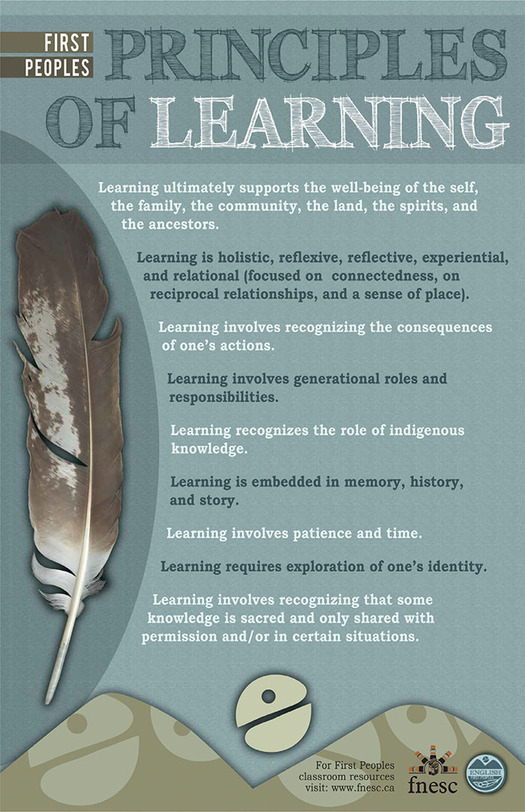
In this knowledge system, well-being (not incremental metric progress) is the ultimate goal, and the four elements of heart, spirit, mind, and body cannot be separated. Furthermore, “accountability” connotes public accountability to the community, not to a disembodied state or provincial entity. It is much easier for schools to be accountable for student learning and redressing historical harm when surrounded by elders and community leaders rather than anonymized in a “data set” (Blackstock & Bennett, 2007). The First Peoples Principles of Learning, developed by First Nations leaders in British Columbia (First Nations Education Steering Committee, 2015), embody holism and provide a compelling counternarrative to the dominant Western paradigm.
 Description
Figure 1.2 First Peoples Principles of Learning
Source: First Nations Education Steering Committee. https://www.fnesc.ca.
Fulbright scholar Ronald Sentwali Bakari writes of an Afrocentric epistemology [that] “is rooted in spirituality, communalism, cooperation, ethics, and morality” (Bakari, 1997, p. 20). Bakari situates the idea of African American liberation at the center of this system of knowledge. This idea of the struggle for the liberation of the mind in the face of racism and oppression is an essential concept we will revisit throughout the book and is inextricably linked to deep learning. Bakari reminds us that critical consciousness—a hard-to-measure outcome of deep learning—emerges from collective struggle, the eradication of powerlessness, and being centered in African tradition, thought, and behavior.
It feels important here to note my subjectivity as a white female writer invoking scholars and thought leaders of color, as well as non-European epistemologies. To be clear, my intention is to honor the work on whose shoulders this book stands and to approach these discussions from a place of cultural humility. Throughout the book and in partnership with coauthor Dr. Dugan and contributing writers, I hope to decenter myself as an expert and position myself more as a co-conspirator in the long arc of struggle for social and racial justice.
Street data is a decolonizing form of knowledge that honors Indigenous, Afrocentric, and other non-Western ways of knowing. Street data emerges from human interaction, taking us down to the ground level to see, hear, and engage with the children and adults in our school communities—particularly those at the margins. With this book, we offer you an actionable framework for school transformation. Each section explores a different application of street data, from its capacity to help us flip the dashboard and diagnose root causes of inequity (Chapters 3–4), to its potential to transform learning (Chapters 5–7), to its power to reshape adult culture (Chapters 8–9).
At the heart of the book lies an existential question: Why do we rely on current forms of data, and what would happen if we simply stopped … and embraced a new model? To that end, we offer you three beliefs to guide your journey:
· Data can be humanizing
· Data can be liberatory
· Data can be healing
A ROAD MAP FOR YOUR JOURNEY
 Description
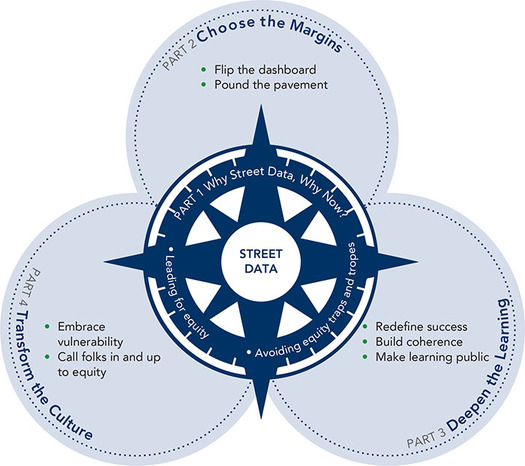
Figure 1.3 The Street Data Framework
Copyright © 2021 by Shane Safir. All rights reserved. Reprinted from Street Data: A Next-Generation Model for Equity, Pedagogy, and School Transformation by Shane Safir and Jamila Dugan. Thousand Oaks, CA: Corwin Press, Inc., www.Corwin.com. Reproduction authorized only for the local school site or nonprofit organization that has purchased this book.
The book is organized into four sections that provide an integrated framework. In Part I, including this current chapter, we unpack why street data leads to equity and why we should embrace this model now. Having examined questions of epistemology and a vision of holism, we shift our sights in Jamila’s beautifully written Chapter 2 to traps and tropes that undermine our well-intentioned equity efforts. We deliberately placed this chapter early in the book because Jamila discusses some of the most common barriers to progress in dismantling inequitable practices. She also helps us consider what it means to develop awareness of the complex dynamics of systemic racism, white supremacy, intersectionality, implicit bias, stereotype threat, and other foundational concepts.
In Part II, we explore what is street data and how to leverage it in pursuit of equity. We consider what it means to “choose the margins” by centering the voices of the most disenfranchised in our communities. In practical chapters on how to “flip the dashboard” (Chapter 3) and “pound the pavement” (Chapter 4), we break down street data fundamentals: what it is, how to gather it, and how it can complement other forms of data to guide a school or district’s equity journey. Part II offers an antidote to the pyramid approach: Invert top-down models of data collection and rehumanize the system by collecting and responding to a robust array of street data, in partnership with people at the margins.
In Part III, we consider how street data can transform student and adult learning, positing that equity work is first and foremost pedagogical. We braid together critical pedagogy, project-based learning, authentic performance-based assessment, and culturally responsive education into a vision of equitable pedagogy. In Chapter 5, we outline a pedagogy of voice in which student experiences drive instruction and student agency becomes our central metric. In Chapter 6, we discuss the conditions that need to cohere for a pedagogy of voice to take root. And in Chapter 7, contributing author Carrie Wilson lays out a model of public learning for educators that will foster symmetry between adult and student experiences.
Finally, in Part IV, we look at how street data can transform school culture and build momentum for equity. Chapter 8 offers concrete ways to move through equity transformation cycles with a stance of vulnerability and a commitment to antiracism. We close with Chapter 9, which outlines the type of day-to-day “warm demander” conversations that serve to disrupt systemic racism and bias and ensure that deep learning is accessible to every child. This aspirational chapter teaches us how to call each other in and up to the promise of equity.
Each chapter includes a principle and a core leadership stance to guide your journey (see Table 1.1). Throughout the book, you will find us toggling between the micro and the macro—from the small interactions between teacher and student or colleague and colleague, to the big implications of street data on how we pursue school and systems transformation.
Table 1.1 Street Data Principles and Stances

|
Chapter |
Guiding Principle |
Core Stance |
|
Part I: Why Street Data, Why Now? |
||
|
1 |
Reimagine our ways of knowing and learning. |
Holism |
|
2 |
See the barriers; imagine what is possible. |
Awareness |
|
Part II: Choose the Margins |
||
|
3 |
Center voices from the margins. |
Antiracism |
|
4 |
Seek root causes over quick fixes. |
Deep Listening |
|
Part III: Deepen the Learning |
||
|
5 |
Equity work is first and foremost pedagogical. |
Agency |
|
6 |
Less is more; focus is everything. |
Coherence |
|
7 |
Mobilize a pedagogy of voice for educators. |
Symmetry |
|
Part IV: Transform the Culture |
||
|
8 |
Break the cycle of shame. |
Vulnerability |
|
9 |
Every moment is an equity moment. |
Warm Demander |
In order to rebuild the current system, we must acknowledge the wounds we carry from decades of misguided reliance on big data. As educators, many of us have tried to do the right thing inside a broken paradigm and failed. The history of deflating data walks and under-resourced school buildings runs deep, and the wounds we carry are fractal in nature—patterns that replicate across every level of the system, just as the tiniest broccoli flower mirrors the largest floret. At the classroom level, the emphasis on Western ways of knowing has colored our vision of what’s possible and reinforced transactional, often-oppressive pedagogies. At the school level, it has stripped many teachers and students of a sense of agency and efficacy. At the systems level, it has reinscribed racial hierarchies and white supremacy by trapping us all inside a false construct of an “achievement gap” that perpetuates a deficit story about students of color.
Until we fundamentally rethink the purpose of accountability, we will continue to rebuild the master’s house with the same faulty tools. The big data paradigm privileges a narrow, dysfunctional pedagogy: students in rows “ingesting” content, anxiety over grades (a signature Western classification system), a narrowing of the curriculum in high-poverty schools where children most need access to deep learning. It’s going to take a radical shift in approach to inspire the instructional transformation we need: deep, equitable, culturally sustaining learning.
We hope this book will offer you rich ways to describe what you see, hear, and experience every day. Fractal challenges require fractal solutions. Street data can act as a healing balm at every level of the system. This book will explore concrete ways to leverage street data in service of school transformation, from listening campaigns, to performance assessments, to exhibitions of learning, to a pedagogy of student voice. Join us on this journey. Our children and in many ways, our democracy, depend on it. Let’s embrace a new way of being, learning, and doing.
GETTING UP CLOSE AND PERSONAL: REFLECTION QUESTIONS

1. “For all our talk of being student centered, we have bought into a success paradigm that robs many children of their voices, marginalizes their gifts, and prioritizes measurement and incremental improvement over learning and transformation” (page 12). What are your reactions to this quote? Do you agree, disagree, or something in between?
2. How has the press for big data and “results” impacted you and your community? What have you gained and/or lost?
3. In the section on epistemology (“How do we know what we know?”), what jumped out at you and why? Where did you find your ideas about data and knowledge challenged?
4. Do you believe the “achievement gap” is a mythology? Why or why not?
5. What resonates with you about the core stance of holism? What might a more holistic approach to teaching, learning, and school culture look like in your context?

Descriptions of Images and Figures
Back to Figure
The four components of holism are described as follows:
· Cognitive: An illustration of a human head with cog wheels followed by the text: self and community actualization, role, identity, service, esteem.
· Emotional: An illustration of a heart followed by the text: belonging and relationship.
· Physical: An illustration of a person exercising following by the text: food, water, housing, safety and security.
· Spiritual: An illustration of isolated arms with flames followed by the text: spirituality and life purpose.
A text to the right of the infographic reads: relationality: everything is connected, nothing can be separated.
Back to Figure
The page is titled First Peoples Principles of Learning and shows the image of a feather on the left below the title and the following text on the right:
· Learning ultimately supports the well-being of the self, the family, the community, the land, the spirits, and the ancestors.
· Learning is holistic, reflexive, reflective, experiential, and relational (focused on connectedness, on reciprocal relationships, and sense of place).
· Learning involves recognizing the consequences of one’s actions.
· Learning involves generational roles and responsibilities.
· Learning recognizes the role of indigenous knowledge.
· Learning is embedded in memory, history, and story.
· Learning involves patience and time.
· Learning requires exploration of one’s identity.
· Learning involves recognizing that some knowledge is sacred and only shared with permission and/or in certain situations.
At the bottom of the page is a text that reads: For First Peoples classroom resources visit: www dot f n e s c dot c a followed by the logos of First Nations Education Steering Committee and English First Peoples.
Back to Figure
The diagram is described as follows:
At the center is a star shape with the text: Street data with Part 1 shown in a circle over it. The other parts are shown in three overlapping circles around the star. The details of each part are as follows:
· Part 1: Why Street Data, Why Now?
o Leading for equity
o Avoiding equity traps and tropes
· Part 2: Choose the Margins
o Flip the dashboard
o Pound the pavement
· Part 3: Deepen the Learning
o Redefine success
o Build coherence
o Make learning public
· Part 4: Transform the Culture
o Embrace vulnerability
o Call folks in and up to equity.