
The following is, as far as we are aware, the first chronological list of Sinan’s surviving buildings to be attempted. It is intended to be complete as far as buildings in Istanbul are concerned; but buildings not in the Tezkeret-ül Ebniye are excluded unless they form parts of külliyes or other buildings which are in the Tezkere, or unless there is other unimpeachable documentary evidence for them; also excluded are a certain number of buildings originally constructed by Sinan, but so completely reconstructed at a later date as to contain little or nothing of his work: such, for example, are Kasım Paşa Camii and Cihangir Camii, and a few others. The list may have minor omissions or inaccuracies, almost inevitable in a pioneer attempt, but we believe it includes all Sinan’s surviving buildings of any importance in the city.
The great majority of Sinan’s works can be dated accurately by historical inscriptions on the buildings themselves; others may be dated by documents in the Divan archives or by their vakfiyes (charters of foundation). A few dates in the list are conjectural, based either on descriptions by foreign travellers or on the floruit, or else the date of death of the founders. In a very few cases we have not been able to suggest a date. For the Tezkeret-ül Ebniye, the list of Sinan’s works drawn up by his friend Mustafa Sa’i, we have used the text as given in Ahmet Refik’s Mimar Sinan (Istanbul 1931); the text given in Rıfkı Melül Meriç’s Mimar Sinan Hayatı, Eseri (Ankara 1965) is a mere conflation of various undated and unidentified manuscripts and is exceedingly misleading. For the relevant Divan archives see Ahmet Refik’s Türk Mimarları (Istanbul 1936); and for various vakfiyes and other documents see Ibrahim Hakkı Konyalı’s Mimar Koca Sinan (Istanbul 1948) and the same author’s Koca Mimar Sinan’ın Eserleri (Istanbul 1950).
HASEKI HÜRREM
On the Seventh Hill: Cami, medrese, şifahane, imaret, mektep; Insc. 945 (1538–9)
DRAĞMAN YUNUS BEY
Near Fethiye Camii: Cami, mektep; Insc. 948 (1541–2)
HAYRETTIN BARBAROS
Türbe at Beşiktaş; Insc. 948 (1541–2)
Hamam near Zeyrek Camii; before 1546 when he died
ŞEHZADE MEHMET
At Şehzadebaşı: Cami, medrese, türbe, imaret, mektep, tabhane; Insc. 950–5 (1543–8)
HÜSREV PAŞA
Türbe at Yeni Bahçe; Insc. 952 (1545–6)
MIHRIMAH SULTAN
At Üsküdar: Cami, medrese, mektep; Insc. Zilhicce 954 (Jan.–Feb. 1548)
RÜSTEM PAŞA
Han at Galata; about 1550 (see Gyllius De Topographic Constantinopoleos, lib. IV, cap. 11)
Medrese near Mahmut Paşa; Insc. 957 (1550–1)
SÜLEYMANIYE
On Third Hill: Cami, seven medreses, imaret, şifahane, dar-ül kura, hamam, türbe of Süleyman, türbe of Hürrem, kervansaray, mektep; Insc. 957–64 (1550–7)
IBRAHIM PAŞA
At Silivri Kapı: Cami, türbe; Insc. 958 (1551)
SÜLEYMAN I
Six aqueducts in the Belgrad Forest; 1554–64 (Divan archives)
KARA AHMET PAŞA
At Topkapı: Cami, medrese, türbe, mektep; Vakfiye dated 2 Ramazan 962 (21 July 1555)
SINAN PAŞA
At Beşiktaş: Cami, medrese; Insc. 962 (1554–5)
HASEKI HÜRREM
Hamam at Haghia Sophia; Insc. 964 (1556–7)
CAFER AĞA
Medrese at Haghia Sophia; Insc. 967 (1559–60)
HACI MEHMET PAŞA
Türbe at Üsküdar; Insc. 967 (1559–60)
ISKENDER PAŞA
Cami at Kanlıca; Insc. 967 (1559–60)
IBRAHIM PAŞA
Medrese at Isa Kapı (a ruin); 1560, see Öz, Istanbul Camileri, I, 100
RÜSTEM PAŞA
Türbe at Şehzade Camii; Insc. 968 (1560–1)
Cami at Uzun Çarşı; 969 (1561–2), see Vakfiye
MOLLA ÇELEBI
Cami at Fındıklı; Insc. 969 (1561–2); inscription on hamam now destroyed
FERRUH KETHÜDA
Cami at Balat; Insc. 970 (1562–3)
SELIM I
Medrese at Yeni Bahçe; erected in memory of Selim by Süleyman; 970 (1562–3); inscription on minaret
HÜRREM ÇAVUŞ
Cami at Yeni Bahçe; 970 (1562–3); inscription in Hadika now lost
MIHRIMAH SULTAN
At Edirne Kapı; Cami, medrese, mektep, hamam; (970–3); Evkaf documents: see Konyalı, Eserler, 161–5
YAHYA EFENDI
At Beşiktaş: Türbe, medrese; about 1570 when he died
SOKOLLU MEHMET PAŞA
At Kadirga Limanı: Cami, medrese; Insc. 979 (1571–2)
At Eyüp: Türbe, medrese, dar-ül kura; about 1572
PERTEV PAŞA
Türbe at Eyüp; Insc. 980 (1572–3)
ŞAH HUBAN
At Yeni Bahçe: Türbe, mektep; about 980 (1572) when she died
MIMAR SİNAN
Mescit at Yeni Bahçe; 981 (1573–4), see Öz, Istanbul Camileri, I, 105
HAGHIA SOPHIA
Two minarets and other repairs; 981 (1573), Divan archives
TOPKAPI SARAYI
Kitchens, reconstructions and additions; 982 (1574), Divan archives
SELIM II
Türbe at Haghia Sophia; Insc. 982–5 (1574–7)
ZAL MAHMUT PAŞA
At Eyüp: Cami, two medreses, türbe; probably about 1575, Zal’s floruit
SOKOLLU MEHMET PAŞA
Cami at Azap Kapı; Insc. 985 (1577–8)
TOPKAPI SARAYI
Salon of Murat III; 986 (1578), dated tile in room
SEMIZ ALI PAŞA
Türbe in garden of Mihrimah Camii, Edirne Kapı; 988 (1580), date of his death
KILIÇ ALI PAŞA
At Tophane: Cami, türbe, medrese, hamam; Insc. 988 (1580–1)
MURAT III
Row of shops below Beyazit Camii; 988 (1580), Divan archives
ŞEMSI AHMET PAŞA
At Üsküdar: Cami, medrese, türbe; Insc. 991 (1583–4)
ATIK VALIDE (NURBANU)
At Üsküdar: Cami, medrese, imaret, kervansaray, şifahane, tekke, dar-ül kura, dar-ül hadis, hamam; Insc. 991 (1583–4)
RAMAZAN EFENDI
Cami at Koca Mustafa Paşa; Insc. 994 (1585–6)
MIMAR SİNAN
Türbe and sebil at the Süleymaniye; Insc. 996 (1587–8), though probably built earlier
For the following buildings which appear in the Tezkere we have not been able to find definite dates: Ahi Çelebi Camii and Bali Paşa Camii (repairs or construction only: probably very early work before he became Chief Architect, since after 1538 he would hardly have undertaken repairs to relatively unimportant buildings); Hüsrev Kethüda Hamamı; Kapı Ağası Hamamı (a ruin with no indication of date); Nişancı Mehmet Bey Medresesi (a complete ruin); Semiz Ali Paşa Medresesi (perhaps between 1561 and 1565 when Ali was Grand Vezir); Siyavuş Paşa Türbesi (built for some children who predeceased him; he was buried there himself when he died in 1601); Şehzadeler Türbesi (a problematical building perhaps not by Sinan though it appears in the Tezkere).
In the above list there are about 120 buildings mentioned, practically all of which can safely be attributed to Sinan in whole or in part. Of these 24 are mosques, 27 medreses, 20 türbes, eight hamams, four imarets and three hospitals. This is a phenomenal amount of work for one man to have accomplished even in a career of more than 50 years, and even with the help of an atellier including many skilled architects. And one must add to it a large number of buildings which have perished entirely or been totally reconstructed, not to mention many others in various parts of the Ottoman domains, some of them of great grandeur and importance.

Endnote
*. The present description of Kariye Camii is based almost entirely on the great publication of this work by Paul A. Underwood, The Kariye Djami, 4 vols; Bollingen Series 70; copyright 1966 by Princeton University Press; excerpts adapted by permission of Princeton University Press. Also on the Preliminary Reports in the Dumbarton Oaks Papers (1956–60). These have completely superseded all previous work on the church.
Plates

Topkapı Sarayı on the skyline above the Golden Horn
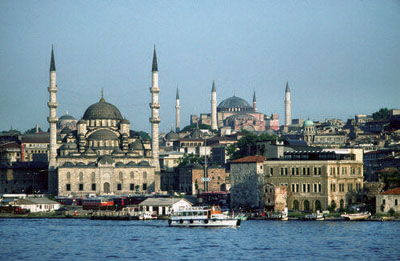
Yeni Cami, with Haghia Sophia above and to the right on the skyline
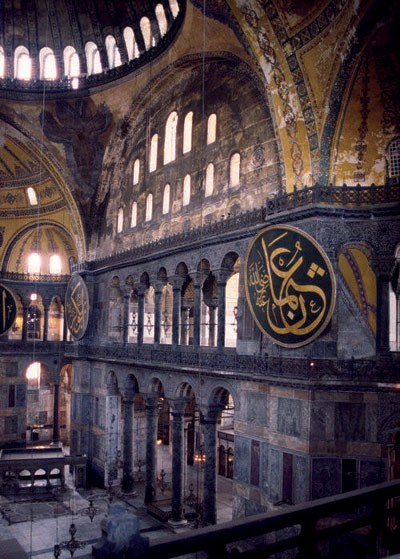
Interior of Haghia Sophia from the north-west
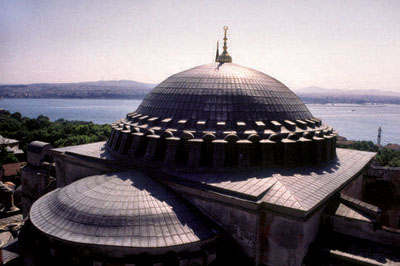
Dome and western semidome of Haghia Sophia

Topkapı Sarayı: Throne Room in the Third Court
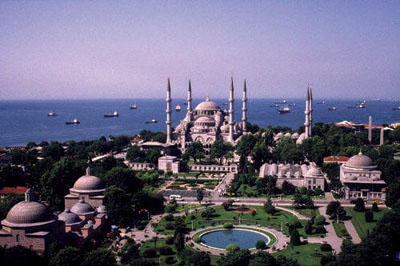
Mosque of Sultan Ahmet I

Interior of SS. Sergius and Bacchus (Küçük Aya Sofya Camii)

The Süleymaniye on the skyline, Rüstem Paşa Camii below and to the right
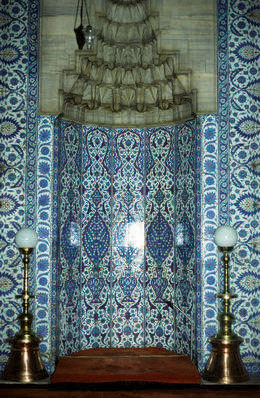
Tiles in the mihrab of Rüstem Paşa Camii

Kariye Camii (St. Saviour in Chora)

Kariye Camii: mosaic of the Virgin and Child in the dome; below are 16 kings of the House of David
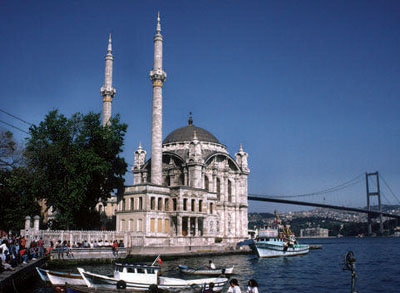
Ortaköy Mosque and the first Bosphorus bridge
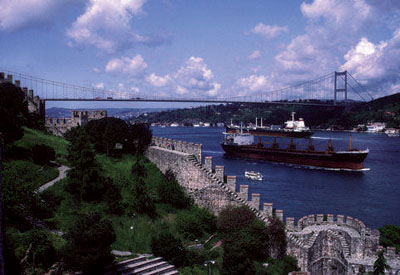
Fortress of Rumeli Hisari and the Fatih Mehmet bridge

Köprülü Yalı

Mosque of Şemsi Paşa