
|
GERNIKA! |
GUERNICA! |
|
Xoratzen iluntzen daut |
This name inflames |
|
hitz horrek bihotza. |
and saddens my heart |
|
Mendek jakinen dute |
Centuries will know its misfortune . . . |
|
haren zorigaitza . . . |
We can no longer say |
|
Numanze ta Kartagoz |
the names Numancia and Carthage |
|
ez gaitezke mintza. |
Without saying in a loud voice |
|
Goraki erran gabe |
In Euskadi, |
|
Euskadin, han, datza: |
lying in its ruins: |
|
GERNIKA! |
GUERNICA! |
—Jean Diharce, a.k.a. Iratzeder, 1938
EVEN THOUGH IT BEGAN in 1931 as, at last, Spain’s first democracy, only the most optimistic of dreamers could have believed the new Spanish republic would end up well. It was called the Second Republic because there had been a first, but that had only lasted a wink of an eye between dictatorship and monarchy in the nineteenth century.
Today the cause of the Second Republic and that of the Basques are so closely linked that to say someone was a Basque Republican seems redundant. But in 1931, at its birth, the Second Republic had few Basque supporters. Steeped in a traditional leftist ideology, the Republic was too socialist and too anti-Church for most Basques. Across Navarra, including Pamplona, the majority voted against the Republic. The only strong support for the Republic in Basqueland was among the urban population of San Sebastián, Bilbao, and Vitoria.
Carlists were never likely to be Republicans. Their doctrines had far more in common with those of that other twentieth-century Spanish movement, the Falange, or Fascists. Many Carlists were close to another far-right group, the monarchists. However, Basque Carlists had one fundamental disagreement with both Fascists and monarchists: They wanted Basque self-determination.
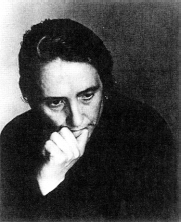
La Pasionaria, Dolores Ibarruri during the Spanish Civil War by David Seymour. (Magnum Photos, Inc.)
On the eternal other side were the Liberals. But they were linked to the industrialists, whose main concern, in addition to resisting the leftist labor movement, was protectionist tariffs for their industries. By the time of the Second Republic, Basque iron fields were already showing signs of decline, but Vizcaya was still producing half of the iron and three-fourths of the steel in Spain. Basque banks controlled one-third of all investment in Spain. Basque industrialists worked closely with Catalan industrialists, not because they shared the issue of local autonomy, but because Catalonia was the only other important industrial center in Spain and the Catalans too wanted to stop the wage-and-working-condition demands of organized labor.
The ruthless capitalism of Vizcayan and Guipúzcoan industrialists produced strong labor movements and Communist and Socialist parties in those two provinces. Such leftist figures as Vizcaya-born Dolores Ibarruri made up a third group of Basques who passionately supported the Republic. Ibarruri, always dressed in black, with her sculpted Basque face—the strong nose, deep-set eyes—had been a young sardinera, a woman who sold sardines from town to town in Vizcaya from a tray carried on her head. Until the twentieth century these women, covering as much as twenty miles in a day, selling on foot, were the primary distributors of fish in Basqueland. Ibarruri had married an Asturian miner and was elected to the Republican legislature as a Communist representing Asturias. During the Spanish Civil War she would become a symbol of the entire Republican cause. Known as La Pasionaria for a speaking style that brought tears to the eyes of thousands of listeners, she turned the World War I battle cry of Verdun, “They shall not pass,” into the motto of the Spanish republic. But she and other Basque leftists, for all their Basqueness, had little connection to Basque nationalism, its leaders from elite industrialist families, or its conservative Catholic ideology.
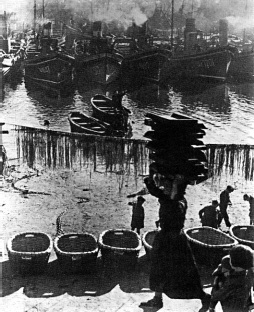
A sardinera in Bermeo, Vizcaya, by David Seymour. (Magnum Photos, Inc.)
The heirs to Sabino Arana, the Basque Nationalist Party, were avowed enemies of socialism. The party leader, José Antonio Aguirre, once theorized that Basques became socialists when they lost religious faith. In 1931, the Basque Nationalist Party was still racist and anti-Spanish, working toward the day when the Castilian language would no longer be spoken in Euskadi, disapproving of Basques who married Spaniards. Basque nationalism was strongly backed by the Basque Church, which rejected the anticlericism of the Republic and rejected the Spanish language as “the language of Liberalism.” The Basque deputies had protested the prevailing anticlericism of the legislative debates on a new constitution for the Second Republic by walking out.
Later that year, after the Republic had been established, General Luis Orgaz, a perennial conspirator for the monarchist cause, having witnessed a Basque nationalist demonstration in Bilbao, tried to persuade José Antonio Aguirre to participate in a coup d’état against the Republic. “If you put at my disposal the 5,000 young Basque nationalists who marched at Deva the other day, I would quickly make myself master of Spain.”
The monarchists understood, as did so many of their predecessors, how to obtain Basque cooperation, and a few days later, the exiled King Alfonso sent an envoy to Aguirre with the old proposition: Support us, and we will back the Fueros. “The means of restoring the Fueros are being studied,” Aguirre was informed.
But this Basque leader, Aguirre, did not snap at the Fueros being dangled before his eyes. Once rejected, the monarchists reacted with what would prove to be an enduring animosity toward Basque nationalism.
AGUIRRE WAS BORN in Bilbao in 1904, shortly after the death of Sabino Arana. During Aguirre’s childhood, Basque culture— language, literature, choral music, and painting—prospered. Like Basque youth of today, Aguirre’s generation could express their Basqueness with a natural fluency of both language and culture that thrilled and astounded older, more oppressed and assimilated Basques.
The first ikastola, a primary school that taught in Euskera, was opened in San Sebastián in 1914 by Basque nationalists as an alternative to the Spanish-only educational system. Many communities in Guipúzcoa and Vizcaya soon followed. Aguirre’s Euskera-speaking parents sent him to Bilbao’s first ikastola. Later, like Sabino Arana, Aguirre was educated by Jesuits. Also like Arana, he had come from a traditional Basque industrialist family and he studied law. When his father died, he took over the family business, a chocolate factory called Chocolates Bilbaínos. Aguirre was a handsome man and, though small, a great athlete, a star soccer player for the Athletic Club of Bilbao at a time when soccer was the exciting new sport in the city. Because Aguirre is a very common Basque name—it means “an open field cleared of weeds”—shouting fans distinguished him by the nickname “Aguirre, chocolate maker.”
Though his athletic success contributed to his popularity, so did his looks and an undefinable charisma. He is still remembered for such traits as “the liveliness of his eyes” and the quality of his smile. A natural leader, as a teenager he headed the Catholic youth movement. At age seventeen, he joined the still-underground Basque Nationalist Party and became its youth director. Though it may be true, as Pío Baroja once observed, that Basques produce great poets and singers but no great orators, with the exception of Ibarruri who seldom spoke on Basque issues, Aguirre was as close to one as there is in Basque history. In private he had a calm, soft voice that gave little hint of the booming tones of which he was capable. But it was difficult to identify anything in his oratory style that explained his ability to hold the attention of Basque crowds. George Steer, the British correspondent who often covered Aguirre during the Civil War, observed that Aguirre’s leading gesture was shoving his hands in his pockets.
But Aguirre could project himself to the world as “the Basque”—not only a Basque speaker, with a Basque face, who could appear in a beret with a makila, the Basque walking stick, but someone who contradicted the outside world’s Basque stereotypes by being moderate and nonbelligerent.
He was a devout Catholic but believed in a gentle Christianity, disavowing self-proclaimed defenders of the Church such as the Carlists and the Falange. “I dream with all the nostalgia of a Christian,” he wrote years later in exile after having endured the assaults of Franco and Hitler, “in the evangelical precepts of the Sermon on the Mount, a return to primitive Christianity which would have nothing in common with the opportunistic and spectacular affiliations with which we Christians rush to disfigure the most august of doctrines.”
He also preached a gentler Basque nationalism: “Our nationalism should be universal: if we don’t want to become selfish and petty, it should not be turned into a source of discord between peoples.” Unlike Arana and many other Basque nationalists, Aguirre never spoke badly of Spain or the Spanish.
In 1931, Aguirre understood that the Republic, for all its leftist anticlericism, might still be friendly to Basque nationalists. The new Republican government had been elected with the nationwide expectation that it would bring Spain into the twentieth century, into Europe. To accomplish this, it needed the Basques and the Catalans, the only Iberians who enjoyed a European standard of living. Catalan nationalists were closer, politically and culturally to the leaders of the new leftist government than were the Basques, and the Catalans had already negotiated their own statute of autonomy at the start of the Republic.
While polarized Spain was splitting even farther apart into a leftist and a rightist camp, Aguirre had the political courage to lead his conservative Basque Nationalist Party toward the leftists in Madrid. Neither the leftists nor the rightists of divided Spain could understand the seeming contradiction of this party—a conservative, pro-business, Catholic movement that in calling for Basque independence was embracing what to other right-wing movements was the worst of all heresies. To this day, the position of the Basque Nationalist Party, known in Spanish as the PNV, is little understood, but it was never more clearly articulated than in 1931, when Aguirre addressed the Cortes in Madrid:
I am affiliated with the Basque Nationalist Party, founded by Sabino Arana Goiri. The PNV has for a motto: Jaungoikua eta lagizarra, God and the ancient laws. In naming God in the first word, we understand that the party wishes to be religious, and in the phraseology of the left and the right, ridiculous phraseology, we have a well defined position: We are Catholics, virile and upright, in a human Catholicism, not a bigoted sentimentality. For us, in this phraseology to which I have alluded, if you are on the right, you are opposed to the legitimate progress of democracy, since it opposes absolute power. If that is what being on the right means, then we are leftists. If being on the right means defending any kind of regime, as long as it is identified with religion, and against the absolute separation of powers of church and state, than we are leftists. And if by being rightist, it is understood that in social matters we oppose progress for the working class, if that is what is meant by being on the right then we are leftists. But, on the other hand, if to be a leftist means we are going to be against family, against the holy principles of the Catholic Church, whose rules we observe, then in this phraseology which I find ridiculous, we are right-wingers.
THE NEGOTIATIONS FOR a Basque autonomy statute were difficult. The composition of the Republican government was constantly shifting, and becoming more authoritarian, less friendly to regional autonomy. In 1934, Madrid reduced the Basque taxlevying rights and, realizing the angry reaction this would probably provoke, canceled Basque municipal elections.
But then, on July 18, 1936, something happened that turned negotiations in the Basques’ favor—a coup d’état attempt.
The conspirators were not simply Fascists. Francisco Franco, who because of both political and military skills gradually came to be the leader of the uprising, was not a member of the Fascist movement. Because Franco was so nimble with ideologies, because he managed to direct a diverse coalition, not only of Fascists but of Carlists, monarchists, rightists, and clergy, historians have labeled his side in the Civil War after their founding act—the Rebels. His adversaries, those who refused to go along with his attempted putsch, have been labeled the Loyalists.
The uprising was largely a failure. Most senior officers remained loyal to the Republic, as did the great majority of the Spanish population. But the Assault Guard and the Guardia Civil were solidly behind the uprising, and in areas where these two armed factions were strong—a few pockets of the south and in Galicia and León in the north—the rebels prevailed. In Catalonia the Guardia Civil remained loyal, and the rebellion failed. Vizcaya and Guipúzcoa were safe because Aguirre, having foreseen the questionable loyalty of the Assault Guard and Guardia Civil, had managed to have them both disbanded in his region before the rebellion had occurred.
But the rebels did succeed in splitting the two Basques. Alava and Navarra supported the coup. Through the strange contortions of Spanish history, the Guardia Civil, which had been established to repress Carlist veterans was now allied with the Carlists, for whom the Republic was an unbearable assault on the Catholic Church. The Carlist stronghold, Navarra, may have been the zone where the rebels enjoyed the most solid backing.
The day after the coup, the two generals who had best established themselves were Francisco Franco, who ruled by terror with Moroccan tribal troops who looted towns, killed any men they captured, raped any women, and left behind sexually mutilated corpses, and General Emilio Mola, who took Navarra by popular acclaim. Mola was cheered in Pamplona, with Carlists lining the streets shouting “Long live Christ the King.” It was the kind of Catholicism from which Aguirre had tried to disassociate himself.
Securely behind rebel lines was Miguel de Unamuno, now seventy-two, master of sixteen languages—according to legend, he learned Danish because he wanted to read Kierkegaard—the venerated leading intellectual of Spain. He was professor of classical languages and rector of the university in rebel-held Salamanca. Franco’s headquarters was in the nearby bishop’s palace. Columbus Day, or “the day of the race,” as the newly empowered Spanish ultranationalists liked to call it, was observed in October 1936 at the University of Salamanca. A war hero was on the dais: General José Millán Astray of the Foreign Legion, veteran of too many Moroccan colonial campaigns, some fingers missing from his one remaining arm and wearing an eye patch. Also present was Salamanca bishop Enrique Plá y Deniel, who had taken to calling the Fascist rebellion “a crusade”; Doña Carmen, the wife of Franco; and assorted other Fascists and monarchists.
And with them, officially taking the place of General Franco, who was unable to attend, sat the slender, gray-bearded, bespectacled Rector Unamuno.
He didn’t want to be there, but he had gotten himself into this unlikely position. Many of the generation of ‘98, including Pío Baroja, initially supported the Republic. But Unamuno, who had opposed the previous dictatorship, refused to support the new republic that had allowed him back into Spain from political exile. He had reached the height of his international fame by opposing the dictatorship. The daring rescue of Unamuno from prison in the Canary Islands by means of a boat sent by a Paris newspaper, Le Quotidien, had been covered by much of the international press including the New York Times. But once back in Spain, Unamuno, the international literary hero, had openly admired leaders of the Falange and even contributed money to the Fascist cause. Several months after the rebellion, the ideophobic intellectual began to realize that he had made a mistake. He called the uprising “an epidemic of madness.” The previous week he had visited General Franco to plead, without success, for the release of several of his friends whom Franco’s forces had taken prisoner.
After numerous rousing speeches on Spain’s lost imperialist glory, Professor Francisco Maldonado, perhaps forgetting in whose company he was speaking, told of Spain’s epic struggle to preserve traditional values against the scourges of contemporary Spain: the reds, the Catalans, and the Basques. The Catalans and the Basques, argued Maldonado, were “cancers in the body of the nation.” Fascism was the surgeon that would cut into the body and exterminate these cancers. From the back of the university hall came a seemingly spontaneous cry, the slogan of the Foreign Legion, “Viva la muerte!” Long live death. What remained of Millán Astray, the battered Legion commander, then shouted “España!” to which he received the formulaic reply “Una!” The general shouted again, “Spain!” and got the reply “Great!” and to the third round the audience shouted back “Free!”
Several young, dark-shirted Fascists, stirred beyond self-control, rose, and facing photographs of Franco above the dais, gave the stiff-armed Fascist salute.
The room fell silent. It was time for the rector to close the meeting. But what would he say to all of this?
His exact words are unknown, because the press, which reported all of the other speeches the following day, made no mention of Unamuno’s words. But a number of accounts were later pieced together by historians of the Spanish Civil War.
Among other remarks, he said, “Let us waive the personal affront implied in the sudden outburst of vituperation against the Basques and the Catalans. I was myself, of course, born in Bilbao. The bishop, whether he likes it or not, is a Catalan from Barcelona.”
He turned to watch the bishop squirm. According to some versions, he now faced Millán Astray and said, “I am a Basque, and I have spent my life teaching you the Spanish language which you do not know.”
But that was not enough. “Just now, I heard a necrophilistic and senseless cry: ‘Long live death.’ And I, who have spent my life shaping paradoxes which have aroused the uncomprehending anger of others, I have to tell you, as an expert, that this outlandish paradox is repellent to me. General Millán Astray is a cripple.”
He corrected himself: “Let’s say it without any pejorative undertone. He is a war invalid. So was Cervantes. Unfortunately, there are too many cripples in Spain just now. Soon there will be even more, if God does not come to our aid. It pains me to think that General Millán Astray should dictate the pattern of mass psychology. A cripple, who lacks the spiritual greatness of a Cervantes, is likely to seek ominous relief in causing mutilation around him.”
The general had heard enough. “Mueran los intellectuales!” Death to intellectuals, he shouted. Falangists boisterously approved. Unamuno went on to explain: “You will win, because you have more than enough brute force. But you will not convince.”
His words were prophetic.
Had it not been 1936 in Spain, this farce might have been remembered as a comic moment. But this was the end of Miguel de Unamuno, a sad end for the Basque who loved Spain. Franco’s wife escorted him out of the hall where he was being booed, while the general’s men angrily trained weapons on him. He lost his university position and spent the remaining months of his life at home, rarely going outside, isolated, ostracized, and guarded. He died in December.
A large number of Falangists attended his funeral. In the 1960s, Franco was still expressing his annoyance with Unamuno over the incident. But in the official school primer for the third grade level, from which all schoolchildren learned Spanish history and culture in the 1960s, only four Basques are mentioned: Ignatius Loyola, Francis Xavier, Sancho III, king of Navarra who fought the infidels, and Don Miguel de Unamuno. The second-level book mentions only two: Felix María Samaniego from Alavan Rioja, who, children were taught, traveled a great deal and “corrupted his soul” but “at the end of his life repented and died a good Christian,” and Zumalacárregui, who died for Don Carlos. With none of the six was it mentioned that the man was Basque. About Unamuno, the primer said, “He was born in Bilbao in 1863. Professor and rector of the University of Salamanca for so many years, it could be said that Unamuno was a Salamancan. His style was proper, energetic, and impassioned.”
IN DESPERATE NEED of support, the beleaguered Republic at last came to terms with the Basques on a statute of autonomy. Navarra, under rebel control, narrowly rejected the proposed autonomy. The other three provinces approved it by 459,000 votes in favor to 14,000 opposed. The statute even got the make-to vote. The results were approved by the Cortes on October 1, 1936, the day the rebels declared Francisco Franco head of state.
In accepting the statute, Aguirre had made clear that it was only a “partial” victory, that the statute did not restore all the autonomy of the Fueros and that more would be demanded later. But for the moment, he pledged, “Until Fascism is defeated, Basque Nationalism will remain at its post.” Through horrors, defeat, and exile, he would steadfastly keep that promise.
On October 7, a Basque government was installed with Aguirre as lehendakari, leader. The vote for the thirty-two-year-old Basque Nationalist Party mayor of Getxo was unanimous.
Even the leftist representatives of the Spanish Socialist Workers Party and the Popular Front supported him. Explaining his youth, Aguirre later wrote, “The oldest people of Europe had on that day a 32-year-old head-of-government, as though to demonstrate that the years do not age a nation that remains young in its faith and hope.”
He took his oath under the oak tree at Guernica, saying in Euskera,
Humble before God
Standing on Basque soil
In remembrance of Basque ancestors
Under the tree of Guernica, I swear
to faithfully fulfill my commission.
It was a historic moment, one that had been dreamed of for several generations: the lehendakari, heir to Sabino Arana’s underground movement, standing in public, under the oak, pledging in Euskera to serve a Basque government.
And that is the way it is remembered. But the event was thickly veined with ominous signs. It is forgotten that the participants slipped into Guernica in secrecy, fearing an attack from armed Fascists who had been spotted in the mountains less than thirty miles from Bilbao. Days before the ceremony, the government-elect had procured arms and ammunition to put down the rebellion, purchased with gold from the Banco de Vizcaya. During the ceremony, a lookout was placed in a tower to warn the participants in the event of an attack.
There is a dreamlike quality to the 1936 Basque government, the fulfillment of a historic longing that was to be crushed only nine months later in carnage the scale of which had never before been seen on Earth. Aguirre, a man said to have perfect manners, who never made decisions without listening to his ministers, gave the appearance of a “good guy” struggling against the Fascist enemy, who so clearly appeared to be “bad guys.” Because the government lasted only nine months, snuffed out while still on its honeymoon, there was not time to go astray the way governments do, and so for decades it was remembered that in the worst of times there were nine months of good Basque government.
As soon as the Autonomous Basque Government was formed, it was ready with ideas for a budget, taxation, and extensive cultural and educational programs. For the first time in history, a Basque government ruled with a policy of promoting the Basque language. Even the Fueros of the Middle Ages had been written in Spanish, and Foral administration had encouraged the use of the Castilian language as a sign of culture and learning. But in 1936, the Basque Renaissance was in its sixtieth year. Ikastolas were well supplied with textbooks and dictionaries. In 1918, the Basque Academy of Language had been founded, and it was working on defining a standard Euskera from its eight spoken dialects. The new government’s cultural policy pursued what was called the “Sabinian school of Bascology,” following the linguistic ideas of Arana, which rejected Latin words and even Latin letters. C was changed to k, ch to tx, v to b, and s to z.
The Association of Basque Schools was formed with parallel organizations for Basque teachers and for Basque students. Publishing houses were established for nationalist books. In 1935, the Basque Nationalist Party published for the Juventud Vasco de Bilbao, the youth group headed by Aguirre, an official biography of Sabino Arana. The author, Ceferino de Jemein, presented in biblical Spanish the life of a saint. The darker sides of Sabino were carefully airbrushed. The book of some 200 pages spared no expense, from its green, red, gold, and chocolate Art Deco endpapers, to hundreds of photographs, etchings, and color reproductions of old Carlists, including several portraits of Tomás Zumalacárregui, numerous photographs of Carlist units in Vizcaya during the second war, documents and photos of Arana’s life, a reproduction of Sabino and Luis’s rough design for the ikurriña, and ending with 1930s photographs of rallies in support of the Basque autonomy statute.
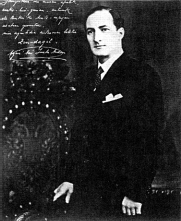
Official portrait from the swearing in of Aguirre as lehendakari. The oath, in Euskera, is printed on the portrait. (Sabino Arana Foundation, Bilbao)
Children who grew up in the 1930s in Basque Nationalist Party homes studied the Jemein book like a bible and revered the name Sabino Arana—not the troubling memory of the actual nineteenth-century man, but the Basque saint created in the twentieth century by Ceferino de Jemein and the Basque Nationalist Party. Anton Aurre, today president of the Sabino Arana Foundation, a key cultural wing of the modern Basque Nationalist Party, was born in 1933, in Aiangiz, a village near Guernica. Until Franco established his regime when Aurre was six years old, he lived in a completely Euskera-speaking world. “Sabino Arana was a constant reference. His photographs were around the house and there were wooden carvings of his likeness. As children, we use to do drawings copying photographs of him.”
A flowering of Euskera poetry in the 1930s was led by José María Aguirre, known as Lizardi, who died in 1933, and Esteban de Urquizu, known as Lauaxeta, who worked directly for the Basque Nationalist Party. Euskera theater, traditional dancing, and Basque choirs became popular entertainment. Basque sports, not only the always popular pelota but regattas, wagon lifting, sheep fighting, tug-of-war rope contests, wood chopping—the entire array of ancient rural Basque sports, once again drew enthusiastic crowds. The Basque Nationalist Party published its own sports magazine, which was widely read throughout Spain.
But the Basque government had come to power at the outbreak of a war, and one of the primary challenges facing the new government was to ensure public order through the creation of a Basque police force, known by the traditional Euskera name, the Ertzantza. Telesforo de Monzón, the new Basque minister of the interior, was in charge of the force. Monzón, an aristocrat from Guipúzcoa, the same age as Aguirre, was one of the most hated figures among Basque haters, especially the Fascists. He was well known because he had been a Basque Nationalist Party deputy in the Cortes. The Fascists hated the idea of a Basque nationalist aristocrat—someone whose last name was a Castilian title, who had enormous landholdings in Guipúzcoa and an elegant family estate in Vergara, as well as an unmistakably upper-class bearing and accent, and yet was a nationalist of strong conviction, author of patriotic songs. In Basque nationalist circles, he was known as a pleasant young man who loved arguing about affairs of state.
Monzón organized the police very quickly, recruiting from among pelota players, boxers, and other athletes, mostly from Basque Nationalist Party families. Monzón created Spain’s first motorized police force, under the direction of José María Pikazar, an aeronautic and electrical engineer who had studied police forces in Britain, France, Germany, and the United States. Pikazar recruited 400 men to do a kind of policing never seen before in Spain. Originally, they were to be issued patrol cars, but when the war made this impossible, many were supplied with fast motorcycles instead. Modeled after American police, they communicated by wireless radio. Dressed in brown leather jackets, caps, knee breeches, and high boots, armed with revolvers, they swiftly maintained order even when Vizcaya was on the verge of panic. Finally, their skills were enlisted in the war effort because they could intercept enemy communications on their radios and could rapidly dispatch orders to the front by motorcycle.
OF THE TWENTY-ONE major-generals on active service in the Spanish military, Franco was one of only four who were not loyal to the Republic. A squeaky-voiced, insecure little man, forty-four years old, Franco had an ability to lead and inspire that is hard to explain. Perhaps it was his confidence, his almost naive belief in his ability to prevail. Among his few admirable qualities, he had demonstrated great physical courage as a young officer in the endless Moroccan war. With a keen sense of the power of terror and little knowledge of modern warfare, he loved bayonet charges, because they were frightening. He was both ruthless and heartless, using fear as his favorite weapon. As a field officer, leading charges, mounted on a white horse, he was known for brutality both in Morocco and, in 1917, when he was in command of one of the units putting down a miners’ strike in Asturias.
Franco had cunning rather than analytic intelligence, and an instinct for self-preservation rather than an ideology. He was capable of the most dramatic reversals, if they served his needs, fawning over Hitler when he thought Germany would win and then becoming pro-American to save himself. Acutely sensitive to symbolism, he wore clothes that reflected complex alliances and fantasies. When in the north, he often wore the red beret of Carlism, with the black shirt of fascism, and sometimes added a white admiral’s jacket.
He had never been in the navy but had always wanted to be. Born in a military town in Galicia, he had been prevented by navy cutbacks caused by the “Disaster of 1898” from pursuing a naval career. His obsession with 1898 was typical of his generation of military. He talked about El Desastre regularly throughout his long life. It was for him a source of deep anti-American sentiments, as well as hatred for Basque and Catalan nationalists. In his 1960s school primer, the loss of Cuba and the Philippines is presented as an American plot. In the question section that follows this discussion, the student is asked: “What country caused the defeat in Cuba?” The United States, the student was supposed to answer.
In the winter of 1937, the campaign was going badly for the rebels, and the Vatican urged Franco to seek a negotiated peace. It was suggested that at the least, he might be able to make peace with the Basques, since they were such devout Catholics. Given the Basque history of negotiating, this might have worked. Many Basque nationalists saw the Republic as simply another government in Madrid. Luis Arana, Sabino’s now aging brother, saw the conflict as the problem of foreigners, of Spaniards. Still sounding like the Carlist general Muñagorri, he asked, “What do we owe to this fight which is not ours, that is not about our race, that is not about our ideology?”
But Franco told the Vatican that he would not negotiate, since such an agreement would simply defer the problem. The only possible solution to the Basque problem, according to Franco, was the complete annihilation of Basque nationalists. Mola, commanding a northern army from Navarra, and German general Hugo Sperrle urged an assault on Bilbao.
Franco had courted the Germans, and they had sent troops, planes, and weapons. But German officers, including Sperrle, were not pleased with the way these resources were being used. Investigating Franco’s failure to take Madrid in the fall of 1936, they found that he had little understanding of how to deploy ground forces in coordination with the air force that, thanks to the Germans and the Italians, he had at his disposal. Franco was a tactician for the nineteenth century, but there were to be no more calvary charges or officers on white horses.
As a condition for continued support, the Germans insisted on a consolidation of all German forces, known as the Condor Legion, under Sperrle’s command. Once Franco agreed to this, a war machine of which he had little understanding arrived in Spain. It included the newest German bombers and fighter planes, tanks and motorized artillery, and an additional 12,000 troops, including armored, artillery, and air force upits. A twentieth-century force arrived to fight a nineteenth-century civil war.
On March 24-26, 1937, the campaign was plotted by Francoist air force and ground troop commanders, Mola’s chief of staff, and the Condor Legion’s chief of staff, Colonel Wolfram von Richthofen, cousin of the World War I ace known as “the Red Baron.” Richthofen explained to the Spanish how aircraft could be used to destroy the morale of the enemy before a ground assault. The commanders arranged for close coordination between ground and air forces and agreed that no attempt was to be made to spare civilians. Italian troops as well as Requetés, Navarrese units, were included in the battle plan. Once again, Basques would fight Basques.
How were the Basques preparing for the first full-scale assault by a mechanized, ground and air, twentieth-century army?
In Guipúzcoa the militia that was formed clearly confused warfare with Hollywood romanticism. They armed themselves with revolvers—an almost useless weapon in combat—holstered to their hips, and many sported checked wool shirts and red bandanas. They were Basque cowboys going to war. When the rebels showed off the fire-power of their Italian airplanes and the heavy artillery from ships at sea and threatened to destroy the beautiful resort of San Sebastián unless the population surrendered immediately, the loyal locals raided the better hotels and took vacationing fascist sympathizers hostage, creating a standoff that saved the city. As warfare spread along the Bidasoa in view of the French side, the French Basques along the border rented telescopes, binoculars, and rooms on upper floors with a view.
But warfare does not stay picturesque for long and within weeks these same towns were crammed with refugees. In Hendaye, anxious parents went from hotel to crowded hotel looking for scraps of news from the besieged towns where their sons were fighting.
As the twentieth century came to a close, Juan José Rementeria, a tall, fit-looking Basque who wore a dark blue beret, was living in Guernica. Though he appeared to be no more than sixty-five years old, he was born in 1910, in the nearby town of Muxica. Coming from a Basque Nationalist Party family, he was one of the many who heard Aguirre’s call to defend Vizcaya. He was given a single-shot, bolt-action rifle and five cartridges for ammunition. He never did learn the make of the weapon. He had no military training. “We should have had some training,” he said, “but there was no time.”
The Basque arms industry made small arms, grenades, and munitions, but no bombs. The Basques avenged one of the first air attacks by dropping rocks on enemy troops.
“IF SUBMISSION IS NOT immediate, I will raze Vizcaya to the ground, beginning with the industries of war. I have the means to do so,” declared Mola in a March 31 broadcast, the text of which was dropped in leaflets from airplanes. But he did not begin with industry. He began using artillery and aerial bombardment to destroy Durango, a rural town by the jagged, rocky gray crests of southern Vizcaya. And so began this new kind of warfare, a war waged against civilians. Durango was a town of ancient churches, rambling cobblestone streets with a river running through it lined by buildings with flower boxes. Once during the Carlist wars, it had served as Don Carlos’ headquarters. This traditional town was attacked at 7:20 A.M. while the churches were filled for mass. The air raid lasted thirty minutes. Two hundred and fifty-eight civilians were killed. Franco’s headquarters in Salamanca denied that the attack had taken place. But Durango was undeniably leveled. The Basques must have done it to themselves, headquarters explained to the international press. Communists must have attacked the churches and killed worshippers, they claimed.
The Germans were still displeased with their ally. After three days of attack, little ground had been taken. Mola proposed destroying the factories in Bilbao. The Germans asked him why he would do this, when he needed the industry and would soon capture it. Mola’s reply to this pragmatic German question was redolent with all the festering hatreds of nineteenth-century Spain. First was the military resentment of Basques and Catalans: “Spain is totally dominated by the industrial centers of Bilbao and Barcelona. Under such domination, Spain can never be set right.” Then came the Carlist hatred of urban industry: “Spain has got too many industries which only produce discontent.”
It seems never to have occurred to Mola how a war machine such as the one placed in his hands was built and maintained. Sperrle replied that he would only bomb industries under direct and specific orders from Franco. But Franco wanted to preserve the industry for his future use. While the commanders argued over targets, an air and artillery campaign of terror was moving across Vizcaya. Franco and Mola had expected a three-week campaign. But they had not understood the determination of Basque resistance nor the long Basque history as outnumbered guerrilla fighters. All the Basques could do was retreat, but they did so slowly and made every foot of territory cost rebel lives.
Franco was perplexed at why this dazzling new force, more power than he had ever imagined commanding, made such slow progress. The Germans too were perplexed. After Durango, Ochandiano was bombed. As the ground forces advanced, town after village was destroyed. The Germans were trying a new tactic of warfare that could later be used elsewhere in Europe. But it wasn’t working. Basque history and character had not been factored into the German equation. To the Basques, the bombardment was new and it was terrifying, but it was not breaking their morale. To the Basques, this was a new variation on an old story—the invader, more numerous and better armed, trying to take their land.
Frustrated by the slowness of their advance, Mola and Franco’s headquarters started talking about razing Bilbao. The army was bogged down, but the air force could chose its targets with impunity because the Basques had little defense against airplanes. At command centers, angry Spanish and German officers looked at maps to pick the town to destroy next.
The Basques, with their bolt-action rifles, having been pounded daily by artillery and aircraft, were in an increasingly disorganized retreat in the Guernica area. Franco, Mola, and the Germans agreed on the need to cut off the Basque retreat. But they wanted more than that tactical victory. They wanted to carry out Mola’s threat, to symbolically “raze Vizcaya.” Later, all parties tried to distance themselves from the decision, but given the scale of the operation, it is all but certain that the attack on Guernica, like all other attacks in the Basque campaign, was a joint decision of Franco, Mola, the Germans, and the Italians.
GUERNICA WAS, AND still is, a market town where the farmers of the region sell their produce on Mondays along the riverfront in the center of the medieval town of stone buildings. The Basque government had suspended the market because of the war, but the peasants had to sell their products. Not only did the attackers choose a market day, Monday, April 26, 1937, but they began their attack at 4:40 P.M. when the center of town was bursting with peasants displaying the first crops of spring carried in ox-drawn carts, with livestock, with shoppers from throughout the area, and with war refugees whose homes in other Basque towns had been bombed.
A church bell warned of approaching planes. There had been such warnings before, but Guernica had never been hit. One Heinkel 111, a new bomber just developed by the Germans for speed and payload, flew in low from the mountains. Since Guernica had no air defenses, low-altitude daylight bombing, the ideal situation for accuracy, posed no danger to attacking aircraft. The plane dropped its bombs and flew away and returned with three more of the new Heinkels. Then came a sort of deadly air show, displaying all that was new in German and Italian attack aircraft: twenty-three Junkers, Ju 52s, the old bombers that the Heinkels were to replace, appeared along with the four Heinkel 111s, three Savoia-Marchetti S81s, one of the new, fast Dornier Do 17s, a bomber so sleek the Germans called it “the flying pencil,” twelve Fiat CR32s, and, according to some reports, the first Messerschmitt BF 109s ever used. This new fighter was a marvel of modern warfare, flying up to 350 miles an hour with bulletproof fuel tanks and a 400-mile range.
In the preceding months, only three of the old Ju 52 bombers, flying tight, low formation in the Vizcayan sky, their triple engines thundering, had terrified civilians below.
The Germans and Italians had unveiled their new modern air force with the market in Guernica as its only target. The bombers dropped an unusual payload, splinter and incendiary bombs, a cocktail of shrapnel and flame personally selected by Richthofen for maximum destruction to buildings. As people fled, the fighters came in low and chased them down with heavy-caliber machine guns.
At 7:45 the planes disappeared, leaving the blackened forms of the few remaining walls silhouetted against the bursting flames, which glowed into the night sky.
The cratered streets were cluttered with the entrails of bombed out buildings—blackened bricks and twisted wires and pipes. In the rubble were the charred corpses of people, sheep, and oxen. The Basque government estimated that 1,645 people were killed in the three-hour attack. Guernica’s population was only 7,000, though between refugees and the market, there may have been another 3,000 people in town that afternoon. The only ones who had a chance to accurately count casualties were Franco’s troops, who occupied the town three days later. Records of what they found have never been released. At first they said it never happened. Later, they admitted to possibly two hundred casualties. But given the intensity of the attack and the population of the town, the number of dead must have been far higher than the 258 deaths in the much briefer bombing of Durango.
Fortunately, four foreign journalists—three British and one Belgian—were in the area. George Steer, correspondent for the Times of London, filed a story that ran two days later in both his paper and the New York Times. The world was horrified—outraged at the ruthless massacre of unarmed civilians but also terrified at its first glimpse of the warfare of the future.
Pablo Picasso, commissioned to paint a mural for the Spanish pavillion of the 1937 Paris World’s Fair, chose as his subject the horror of the Guernica bombing. Europeans began to realize that the Germans could attack their cities in the same way they did Guernica. George Steer pointed out that a similar raid could level the North Sea port of Hull or Portsmouth. Too late, the British government started to understand that the fate of the Basques was directly relevant to its own security. The Germans were only practicing in Spain. Even the Catholic Church in Spain showed signs of being less comfortable with their Fascist defenders after Guernica, and there was evidence of declining morale in Franco’s troops.
From Franco’s office a statement came explaining that due to bad weather, the planes under his command had been unable to fly on April 26, and therefore the attack could not have been theirs. As for the Germans and Italians, Franco’s headquarters explained that no foreign aircraft were in the territory they held. He presented as proof a flight log, but it was for the wrong day.
It didn’t work. There were thousands of witnesses. Franco arrived at an explanation. The Basques had dynamited and set fire to their own city, just as, according to him, they had done in Durango.
Franco’s staff tried to give controlled press tours of the destroyed and occupied town. James Holburn, Steer’s colleague who covered the Francoist side for the London Times, reported that the craters he inspected were caused by “exploding mines.” But Franco’s troops could not stop the weary survivors from talking. A London Sunday Times correspondent, in the presence of a Francoist press official, went up to an elderly man who was slowly removing bricks from the interior of his ruined home. He asked him who had done this and the man replied, “Italians and Germans.” The press officer explained that the man was “a Red.” Others told the same story, that the town was bombed for hours by Germans and Italians. “Guernica is full of Reds,” was the only official explanation for this testimony. But one frustrated officer finally said, “Of course it was bombed. We bombed it, and bombed it, and bombed it and, bueno, why not.”
George Steer was informed that if he were captured by Franco’s troops, they intended to shoot him for the stories he had been writing. Steer started carrying a machine pistol with him though he later admitted that he never fired it and, like many of the Basque troops, no one had ever explained to him how to operate his weapon.
Even today there are people who remember what happened at Guernica. Anton Aurre says he remembers very well, though he was only four years old. He remembers it as a beautiful, clear April day.
I remember you could see the heads of the flyers. You could see they were German planes, see the numbers, the pilots, everything.
Then there was a huge explosion. It was the beginning of the bombing. We could see the fire in Guernica. You could hear them machine gunning. They came in groups of three. I don’t know how many or if the same ones kept coming back, but always three at a time.
We could see the fires all night. The next day we went in to town. There were holes in the street. I could stand in them and they were higher than my head. The town was still burning in some places and there were corpses in the street.
It was a warm spring, and Aurre’s father was among the volunteers It was a warm spring, and Aurre’s father was among the volunteers who buried hundreds of mangled and decomposing who buried hundreds of mangled and decomposing corpses. Anton remembers his father acting strangely and being told that his father was ill. All Anton remembers of this illness was that his father was very quiet and did not eat for a week.
Others remember that the incendiary bombs gave off a sapphire blue light when they exploded, that people were running through the streets screaming, fleeing the town and getting machine-gunned on the mountain slopes as the planes circled back, over and over again.
Juan José Rementeria was fighting in the defenses outside Bilbao when he heard that Guernica was bombed. “We came back during the night. There was almost nothing left of Guernica and we took trucks and loaded survivors and their furniture and moved them to Asturias.”
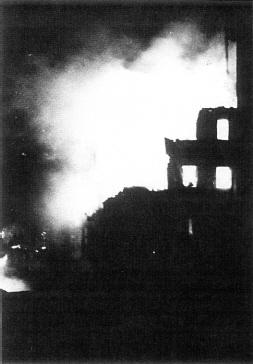
Guernica, after the attack, the night of April 26, 1937, photographed by the Basque Government (Sabino Arana Foundation, Bilbao)
In 1970, Franco’s government admitted for the first time that Guernica was bombed from the air. In 1998, the German government finally apologized to the Basque people, but the Spanish government never has, and it continues to deny Basques access to military records of the incident. In 1999, the Spanish legislature passed a resolution admitting that Franco had lied about Guernica.
THE BASQUES WERE still fighting. Rementeria went back to defend Bilbao. “Everybody thinks it was over with Guernica but it wasn’t There were a lot of fronts, we went to them and fought on.”
In the rubble that was Guernica at the end of April 1937, the ancient stone bridge over the river remained intact, as did a few archways in the center of town. The rest was blackened heaps and collapsing walls. But at the edge of town where the mountains begin, a pillared nineteenth-century building still stood, with a straight oak tree in front. In the days after the bombing hundreds of homeless survivors, mostly women, gathered in front of the oak, sleeping on mattresses soaked from the effort to put out the fires. George Steer and other correspondents listened to their stories. “They conversed in tired gestures and words unnaturally short for Spain,” Steer later reported. “And they made the funny noises of bombers poising, fighters machine-gunning, bombs bursting, houses falling, the tubes of fire spurting and spilling over the town. Such was the weary, sore-eyed testimony of the people of Guernica, and it was only later that people who were never in Guernica thought of other stories to tell.”
The pillared building with the oak tree in front of it are both still standing. Farther up the mountain, Juan José Rementeria can see the top of the tree from his apartment window.
Among the mysteries surrounding the attack is the question: Why Guernica? Many believe it was because of its symbolic importance. Yet the oak was not touched. Some theorize that the Requetés, the Navarrese troops, had asked the command not to damage that place. Or maybe it was just missed because it was at the edge of town. Maybe the Germans, not knowing Basque history, thought it was just a tree.