
In people’s lives and in social history there is always a first mistake, a little mistake, which happens almost imperceptibly, a momentary slip-up, but this first mistake creates others, and these mistakes follow each other, accumulating little by little, one on top of another. Eventually, this creates a growing and fateful error.
—Joseba Sarrionaindia, NI EZ NAIZ HEMENGOA,
(I Am Not from Here), 1985
FRENCH POLICY TOWARD “the Basque problem” has always been to keep it in Spain. As long as the problem stayed in Spain, ETA members could stay in France. The French government’s support of Spanish Basque refugees had long helped to keep peaceful relations between Paris and French Basques. But after the death of Franco, French foreign policy changed. Being an enemy of Spain no longer gave a Spanish refugee automatic legitimacy in France. Since the Spanish government was no longer unquestionably the villain, Basques were no longer unquestionably the victims. Political refugee status and work permits for Spanish Basques were no longer automatically granted. Increasingly, French police rounded up Basques, not all of them ETA members, for questioning, broke into homes, and searched without warrants. Suspected ETA members were arrested and sometimes spent months in prison without being charged with a crime. In 1979, the French government ended political refugee status for newly arrived Basques. But it still refused to extradite Basques to Spain.
In 1980, an international conference on terrorism sponsored by the Council of Europe meeting in Strasbourg concluded, to the approval of human rights groups, that suspects should not be extradited to countries that practiced torture. The two examples cited were Turkey and Spain.
In May 1981, Mitterrand was elected president of France. The following year, on October 28, 1982, Felipe González came to power in Spain expecting a special relationship with France, since the president was his old colleague from the Socialist International. To his great frustration and disappointment, Mitterrand would not cooperate. To head his law enforcement team, González chose as minister of interior a fellow Andalusian of his generation, a forty-two-year-old son of a policeman of Carlist sympathy, José Barrionuevo. The day the new government was announced, El Pais noted that Barrionuevo was “considered by those who know him as a man capable of imposing authority because he knows how to legitimize it.”
The new Socialist government was to be “tough” like past regimes, but unlike its predecessors, it would operate by the legitimate rule of law. Yet on December 15, with the new Spanish Socialist government only two weeks old, Barrionuevo announced that he was reviewing antiterrorist policy. The result was the Socialists passed laws limiting the right of an accused to legal assistance and giving police the right to hold prisoners incommunicado—without access to lawyers and without presenting them to a court—for up to ten days. Known in legal language as the suspension of habeas corpus, this is considered a violation of basic rights in all Western law because it gives law enforcement the liberty to commit even worse crimes. That is exactly what happened with Spain’s new antiterrorist laws. Suspects detained under these new laws were routinely beaten and tortured, and then released in a few days without ever being charged. Journalists were arrested and convicted of “insulting the Spanish government and the King.” Especially targeted was the pro-Herri Batasuna paper Egin.
Egin, meaning “to act,” began publishing in 1977 with small investments from 25,000 backers. As the constant object of government repression, the paper gathered a following. The Spanish government’s attempt to shut it down seemed to be almost a reenactment of the Franco era. In 1983, an Egin columnist, Sanchez Erauskin, became a popular hero when, while serving time on charges of insulting the king, he used a hunger strike to force the government to reclassify him as a political prisoner. The editor of the paper, José Felix Azurmendi, was regularly arrested by the González government. Columnists, journalists, even people who were quoted in articles, were arrested and sometimes convicted for insulting the government or “apology for terrorism.”
THE NUMBER OF Basque prisoners in Spanish prisons began rising steadily, with more than 100 arrests in some months. It was becoming apparent that government by Felipe, despite his endearing smile and years of antifascism, was not going to offer an improvement in human rights.
In 1983, Amnesty International, after sending observers to Spain, reported: “The torture and ill-treatment of detainees, principally people detained under anti-terrorist laws, continues to be Amnesty International’s main concern.” The observers found that 691 people, mostly in Basque country, had been arrested under the antiterrorist laws, and gave examples of prisoners who had been tortured. In replying to the report, Barrionuevo said, “At this point it should be noted that it is normal for terrorist groups to accuse the authorities of torture and ill-treatment as a way of interrupting incommunicado detentions and hindering police investigations.” He went on to say that harsh measures were “justified by the grave threat that is posed by terrorism.”
Barrionuevo went to the legislature and got approval for a project costing almost $100 million. Called ZEN or Zona Especial del Norte, it was intended to transform the politics of the Basque region by winning support for the Guardia Civil and National Police and turning the population against ETA. Among the proposed techniques to accomplish this was the planting of false stories in Basque newspapers. After Basque municipalities passed measures against the plan and it was condemned by the Basque government, ZEN was quietly dropped—at least as far as is known.
Other plans proceeded, including sending more Guardia Civil to Basqueland and transferring Basque prisoners to special prisons outside Basque country, where they could be held by Guardia Civil instead of the usual prison guards.
González was faced with a decrease, not an increase, in ETA activity. But the government encountered constant accusations from the opposition Alianza Popular, the Popular Alliance Party, that the Socialists were soft on terrorism. The Alianza Popular was an alliance of former Francoist factions headed by former Franco minister Manuel Fraga Iribarne. When the government proposed laws suspending basic civil liberties, Fraga said they were not enough, that Basqueland should be put under a state of siege, the way Franco used to do, suspending all civil liberties. Fraga once said, “When the innocent blood of citizens is running, a government should prefer to have blood on its hands than water like Pilate.”
ON OCTOBER 16, 1983, two Basque refugees, José Antonio Lasa and José Ignacio Zabala, were kidnapped in France. No one claimed responsibility for the kidnapping, and neither the two men nor their bodies were ever found.
On December 4, Segundo Marey, fifty-one, was sitting in his home in Hendaye, shoes off, watching The Benny Hill Show on television, when two hefty men broke in and took him, still in socks, to a mountain hideaway in Spain. The Red Cross received a note that Marey could be exchanged for four Spanish policemen being held by the French government in connection with an unsuccessful attempt to kidnap a Basque.
The four policemen were released, and Marey was found near the border, fifteen pounds lighter after ten days in captivity. A note was found in his pocket saying, “You will have more news from GAL.” GAL, it was to be learned, was a Spanish acronym for Antiterrorist Liberation Groups. It appeared to be an extreme right-wing vigilante death squad that attacked Basque militants in their safe refuge across the border. Still, the Marey case was odd because he seemed to be nothing more than a furniture dealer without any known political involvements.
On December 19, GAL struck again, killing a Basque refugee, Ramón Oñaederra, in a Bayonne bar.
It was widely rumored in Basqueland that GAL worked for the Spanish government. After the Oñaederra killing, Arzalluz came out and said it “I am personally persuaded, although I cannot prove it, that the GAL and that ‘dirty war’ have ties to government measures in Madrid.”
This was vintage Arzalluz. The head of the Basque Nationalist Party was always making wild accusations and later admitting that he had no proof. His party lived in terror of his next statement. Herri Batasuna made the same allegation as Arzalluz, but it too was always making accusations against the Spanish state. Another rumor was that wealthy Vizcayan businessmen sponsored GAL. There were always rumors in Basqueland.
The killings went on. The brother of the most wanted ETA leader was killed. The French state became more concerned about terrorism in Basqueland now that it was spreading to their provinces. In September 1984, after a series of meetings between the two governments, France agreed to extradite to Spain seven alleged directors of ETA. More extraditions followed. ETA responded with a campaign against French interests in Spain, not in France. ETA has always tried to keep the war out of France so that commandos would have a border to escape across.
On November 20, 1984, Santiago Brouard, a pediatrician, was killed in his Bilbao office by GAL. Brouard was the perfect go-between, both a respectable professional and a well-known leftist nationalist who had once gone into exile rather than betray a wounded ETArist he had treated. At the time of his killing, he had been trying to arrange negotiations between ETA and Madrid.
The public outrage over this assassination seemed to slow down GAL activities. Or was it a more cooperative France that made the difference? In 1986, France increased the number of Basque extraditions to Spain, even though it had been documented that Basques turned over to the Spanish on previous occasions had been tortured.
In 1986, after killing perhaps twenty-seven people, GAL vanished.
In 1987, the Madrid magazine Tiempo conducted a poll in which 52 percent of respondents said they believed the Spanish government had been behind GAL. But in what may offer a more telling insight into Spanish democracy, 51 percent approved of GAL’s killings.
WHERE WAS THE system of checks and balances that González had confidently predicted would prevent his abuse of power? For five years he was able to govern without any such impediments. Then the mystery of GAL began to unravel. After a traffic accident, incriminating documents were found in the car of José Amedo, a senior Spanish policeman. It appeared that he and another high-ranking officer, Michel Dominguez, had traveled frequently to French Basqueland with false identification papers. Arrested by Spain and wanted in France, the two confessed. Their 1989 trial, inevitably labeled “GALgate,” resulted in sentences of 108 years for both of them for organizing GAL and its killings.
GAL agents turned out to be mercenaries: an assortment of right-wing French military left over from the Algerian war, underworld hitmen from organized crime in Marseilles, former Portuguese colonialists, and Italian neo-Fascists. Once, in 1984, the French had even caught a GAL operative and identified him as a former member of the OAS, an infamous right-wing French military group from the early 1960s Algerian independence war. He was known to have been working for the Spanish government since Franco’s time.
Citing security concerns, Barrionuevo refused to make any comments on the case. He was widely thought to be the true author of GAL. The Amedo and Domínguez trial revealed that the two convicted GAL organizers had operated with money from the Ministry of Interior. Felipe González insisted, even in the 1990s, when the trail finally led to Barrionuevo, that he himself had known nothing about GAL. Although a member of his own party in Vizcaya as well as several GAL members implicated González, no one was able to mount a successful legal case against him. González claimed that the case was being pursued as a political attack against his party, which may be true, but would still not establish his innocence.
Barrionuevo’s undoing was that early Marey kidnapping. The reason Marey was taken was that the GAL kidnappers had mistaken him for an ETA suspect named Mikel Lujúa. Once they realized that the shivering victim carried away from his television was not Lujúa the terrorist, but Marey the furniture dealer, they contacted the number two Spanish law enforcement official, Rafael Vera, the director of state security. Vera called police officials in Bilbao, who consulted with Julian Sancristóbal, the civil governor of Vizcaya, who in turn got approval from Barrionuevo to try to exchange Marey for the four Spanish policemen.
Barrionuevo, Vera, and Sancristóbal each received ten-year prison terms, and nine other defendants received lesser sentences. The prosecution had asked for sentences of up to twenty-three years, the penalty for belonging to an armed terrorist group under Barrionuevo’s antiterrorist laws. But the judges ruled that the prosecution had failed to prove that GAL was an armed terrorist group.
THE EXACT NUMBER of law enforcement officers in Spanish Basqueland is a state security secret. The Guardia Civil, which admits to 5,000 officers there, also has an undisclosed number of Basque-speaking undercover agents, as does the National Police. According to the Spanish government, there are about 15,000 uniformed police, including Basque police, Ertzantza, who are patrolling the 2.1 million inhabitants in the three provinces of Euskadi—more than seven police officers for every 1,000 citizens. This makes Spanish Basqueland the most policed population in Europe, although the ratio is probably similar in Navarra and may be even higher in the three French provinces.
One of the reasons for the high numbers of police is Madrid’s lack of confidence in the Ertzantza. “The Ertzantza are reluctant to go to certain lengths,” explained an adviser to the Spanish government. The Spanish government claims that the Guardia Civil and National Police have an arrest record four or five times higher than that of the Basque force. This is not necessarily an accomplishment, considering that most of those arrested are released after a few days without ever having been charged. According to Gestoras Pro-Amnistía, the Basque human rights group founded to campaign for amnesty after the death of Franco, in the twenty years since it achieved the 1977 general amnesty, 8,000 Basques have been imprisoned for political reasons, and the majority of them never had trials. Most human rights monitors believe Gestoras Pro-Amnistía’s estimate to be extremely conservative.
The Basques do not credit their police force with gentleness. The Ertzantza has created tough antiterrorist units. Human rights monitors have found that all three groups practice torture, though they use different techniques. Josu Barela, head of Gestoras Pro-Amnistía, said, “What is worse? Do you want to be nearly asphyxiated with a plastic bag by the Guardia Civil, interrogated all night by the National Police, or threatened with death by the Ertzantza?”
More cases of psychological torment than physical torture have been found among those held by the Ertzantza. But Barela said, “We often find that physical torture does not leave victims as damaged as psychological torture. We often find that people who have hardly been touched physically are the most scarred.” Insomnia, unreasoned fear, low self-esteem, a deep sense of guilt are among the symptoms.
The Ertzantza, from its inception, had been concerned about its public image. The Basque government had turned to Ramón Labayen to design a uniform for the new Basque police force. Ramón’s passion is toy lead soldiers. He designs them, creating his own molds. For the new Ertzantza’s uniforms, his only instructions had been to make them look as different from Spanish uniforms as possible. Labayen gave them red berets.
For all its Basqueness and its bright berets, the public had always been a little distrustful of yet another police force. When the new Basque security force began training, rumors spread that the Israelis were doing something in Alava. The Israeli-Basque connection, mostly imaginary, was a chronic topic of rumors.
Basque youth called Ertzantza cipayos, a pejorative used in the Indian independence movement for Indian troops that served the British. Armed with sticks and rocks, groups of youth called encapuchados, hooded ones, because they wore ski masks, staged seemingly disorganized attacks. The Spanish government believed that they worked with ETA, but in early 1998, ETA leadership publicly denounced them as “very young people ready to do anything,” who interfere with ETA’s overall strategies.
The Spanish government has always seemed to be either unwilling or unable to distinguish among widely diverse Basque groups. But in fact everyone was starting to look alike. Few faces were seen. ETA commandos wore knitted ski masks to conceal their identity. Then, in the 1990s, pro-ETA demonstrators began wearing them too—perhaps to show solidarity with the commandos, perhaps because the police started videotaping demonstrations, perhaps because the rebels in the Chiapas region of Mexico had popularized ski masks as a revolutionary symbol. Guardia Civil and National Police also began wearing masks to protect themselves from being singled out for reprisals. The Ertzantza’s antiterrorist units adopted the same practice. Judges and court officials started wearing them too, for especially controversial sentencing.
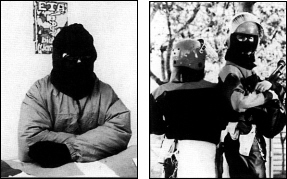
An ETA commando. Ertzantza officers on the street. (Both courtesy of the photography archives of Egin, Hernani)
IN MARCH 1996, Felipe González’s Socialist Workers Party was defeated. Manuel Fraga’s Popular Alliance, originally an alliance of Francoist politicians, had changed its name to the Popular Party, the PP, and came to power with José María Aznar as prime minister. The PP, with its Francoist roots, had promised to take a harder line with the Basques than had the Socialists. In spite of muzzling the press, imprisoning thousands, and engaging in torture, kidnapping, and murder, the González government was still vulnerable to the accusation of being “soft on Basques.” To demonstrate the sincerity of its stance, the new government decided to have the entire twenty-three-person directorate of Herri Batasuna arrested.
During the election, in which each party had an allotted television airtime, Herri Batasuna had used its time to run a video from ETA. This party again won its usual 12-15 percent of the Basque vote and two seats in the Madrid legislature, which it again refused to fill, along with hundreds of offices in the Basque legislature and municipalities. The video had shown three men, faces concealed in ski masks, who, having been identified as ETA members, explained the demands of the organization for an independent Euskadi. This tape was a response to the Spanish government’s often-stated view that “nobody knows what ETA wants.”
Aznar’s camp was divided on the impending arrests. Some thought that it would be a mistake to isolate Herri Batasuna, which represented almost 200,000 people; and it would be more useful, they thought, to try to win over its supporters. They also worried that other European countries would strongly criticize the new government for attempting to silence a legal political party that had the backing of voters.
Nevertheless, the twenty-three were arrested by masked men in front of press cameras. On December 1, 1997, the Supreme Court of Spain, also with masks on, sentenced the twenty-three politicians to seven years each.
Successive Spanish governments have learned that it is easy to ignore criticism from human rights groups. Numerous human rights groups have regularly protested the practice of torture in Spanish prisons, but they have also, often in the same reports, protested the violence and intimidation of ETA. The Spanish government does not deny the existence of torture, which is frequently corroborated by prison doctors. It has prosecuted and convicted officers and then sentenced them to two or three months in prison. A 1997 United Nations Human Rights Committee report on Spanish torture noted that when the Spanish government was confronted with allegations of torture, it often did nothing; and in cases where it did take legal action and obtained convictions, the torturers were “often pardoned or released early, or simply [did] not serve the sentence.”
“The prisons are worse now than under Franco,” said Eva Forest, human rights advocate and former prisoner. “Torture is more directed, more institutionalized. The Franquistas [Francoists] were not only not purged from the system, they have been promoted.”
The Spanish government counters by repeatedly claiming that ETA has killed more than 800 people since Txabi killed the first Guardia Civil. But in that period of time, the Guardia Civil and others answering to the Spanish government have killed hundreds of Basques. Some have been presumed guilty and shot down in the streets, often in an alleged act of self-defense that none of the witnesses could verify. Some have died of “accidents” while in custody.
The persistent reports on Spanish abuse by human rights groups have little impact because European governments do not respond to them. What the Spanish government fears is condemnation from Western democracies, especially those of Europe. Their nightmare is condemnation from the broadest European forum, the Council of Europe. Founded in 1949, this was the first pan-European political organization.
Outside Spain, despite years of continuing human rights reports, it is widely believed that arbitrary arrest and torture in Spain are things of the past No one noted the paradox when in October 1998 a Spanish judge, Baltazar Garzón, requested the extradition of Chilean leader Augusto Pinochet for the torture and killing of Spanish citizens during his rule. The irony was even underlined when aged Franquistas, unpunished and unrepentant, showed their support for Pinochet by a rally in which they gave the Fascist salute. Garzón indicated that his quest for justice to be served to torturers might not even be limited to Chile. He was considering Argentina, Brazil, Bolivia, Paraguay, and Uruguay. Garzón was unmoved by the argument from these South American countries that they could not bring the crimes of the past to justice without provoking a military rebellion that would end their struggling new democracies. Nor did he appear deterred by the fact that regimes had often attempted to justify these crimes by saying they were fighting dangerous terrorists. Both arguments have been standard fare for Spanish governments.
El Mundo, a conservative Madrid daily, was among the many enthusiastic voices of support for Garzón’s new approach. El Mundo and Judge Garzón were both key players in uncovering the GAL. El Mundo broke the story, and Garzón built an impressive case alleging that Felipe González was the director of GAL, which the Supreme Court refused to hear, citing a lack of evidence.
El Mundo excitedly termed Garzón’s new policy of pursuing human rights cases in Latin America as “justice without borders.” But an older concept that might be termed “justice within borders” seemed forgotten. Neither El Mundo nor Garzón had showed much concern for human rights abuse by Spanish officials unless they were Socialists. Even as the Spanish judge moved to try a Chilean leader for his regime’s abuses, the fact that Spain had not brought to trial a single perpetrator of the many crimes committed in the thirty-six-year dictatorship was never raised in Spain. Neither the politically motivated arrest of at least 8,000 Basques, nor the fact that the majority of these victims were tortured while under arrest, that hundreds were killed by law enforcement, and that political leaders and journalists were jailed, has provoked the kind of legal scrutiny of the GAL scandal.
Garzón was concerned with torture in South America, not in Spain. Basque victims have tried taking their complaints to Garzón with little success. Enkarni Martínez, who was arrested in 1994 because her husband was not home when the police came to arrest him, went to Garzón with more than thirty bruises still evident on her body. “I was tortured from June 5 to June 8, 1994. When they set me free, I went to the doctor to be examined. As soon as they read the results of the tests they were alarmed and ordered my immediate hospitalization . . . If not for the test, they told me, I could have lost my kidney. I denounced it all in front of Judge Garzón. I told him, ‘Do you want me to show you the marks?’ He replied: ‘No. No. No.’”
THE SPANISH GOVERNMENT, along with the Madrid press, have successfully dominated Spain’s and the outside world’s view of Basques. The Spanish celebrate the great Basque soccer players and bicyclists, the great Basque cuisine. The adjective Basque on a restaurant in Spain implies quality. Traditional Guipúzcoa taverns, selling fermented cider from barrels, salt cod omelettes, and steak, are being imitated throughout the country. Atxaga, whose writings have been translated into Spanish, has a large following. Massive Chillida sculptures are planted like great iron Basque anchors on the wide boulevards of Madrid. Yet the first thing Spaniards think of as Basque is what the Aznar government estimates to be seventy ETA commandos and their 800 killings, without much reflection on what 15,000 police were doing to thousands of Basques.
The Basques provoke a deep insecurity in Spain. The legal charge that Basques have “insulted” the country is one expression of that insecurity. Spain has never gotten past 1898, the year of “the Disaster.” The centennial of it was an enormous event: Bookstore windows were filled with new books on 1898; the newspapers ran special feature series; television had special programming. The Spanish still feel theirs is a country that has failed or is somehow unworthy of nationhood. This is why the government so fears a condemnation from European governments.
But European governments accept without question the Spanish government line that ETA, whose primary demand for several decades has been negotiation, refuses to negotiate. In 1998, the U.S. State Department placed ETA on a short list of thirty “terrorist” organizations for whom it is illegal to provide funds. Neither the Irish Republican Army nor the violent Corsicans were on the list, but ETA was, along with Egypt’s Holy War, Iran’s Mujadeen, Peru’s Shining Path, which had killed thousands, and the Khmer Rouge, which had murdered a million Cambodians.
One recent study by Iñaki Zabaleta found that 85 percent of all articles on Basques in the U.S. press made a reference to terrorism. The outside world knows little of the 2.4 million Basques except those seventy faceless commandos. The Spanish government has learned, as did Franco, that international opinion can be managed.
The standing of ETA among the Basques is difficult to measure. In recent years there have been huge demonstrations against ETA violence. But there have also been significant demonstrations of support for ETA. ETA is not trying to be popular. It is trying to cause the breakdown of the status quo. Practices such as extorting money from Basque businessmen and killing Basques thought to be collaborating with the enemy were always certain to be unpopular. A campaign unleashed in the mid-1990s to assassinate local PP officials, Basques who belonged to the ruling party, both angered and mystified fellow Basques, who saw this as purposeless violence. Just when the Guardia Civil was becoming demoralized and receiving hundreds of requests for transfers out of Navarra and Euskadi, it was suddenly being ignored while small town mayors were instead becoming targets.
The PP, aside from the tragedy of seeing their colleagues murdered, coldly found the new ETA strategy to be to their advantage. The killing of PP officials, especially when they were Basque, was extremely unpopular with Basques. Charles Powell, an adviser to Aznar, said, “These attacks have enabled us to play the victim. The victim! Here we are the party in power, but we are also made to look like the victim. That is not a bad political position.”
The great majority of Basques had grown weary of the violence. If a vote for Herri Batasuna—renamed Euskal Herritarok, We, the Basque People, after the jailing of its leaders—is a vote supporting ETA, that would still mean an overwhelming majority of Basques are not ETA supporters. But there may be many ETA supporters who do not vote for Herri Batasuna, including some who do not vote at all, while, on the other hand, not everyone in Herri Batasuna supports ETA violence. Patxi Zabaleta, an Herri Batasuna representative in the Navarra legislature, said, “HB is divided on armed struggle. Some think it’s not furthering political goals. But at least ETArists are people who sacrifice for what they believe. They are not mercenaries like in GAL.”
Herri Batasuna was finding that most of its supporters were angry young people, children of workers and farmers, often not even of Basque racial origin. These supporters were typically between eighteen and twenty-five years old. Once they turned thirty, they began to drift away from the party. “Once people start settling down, HB is seen as far from the problems of daily life,” said Zabaleta. “Self-determination is not the bread and butter of daily life.”
The Basque Nationalist Party has been unambiguous in its condemnation of ETA violence. While various Spanish governments discussed, debated, agreed to, and refused to negotiate with ETA, no government ever showed interest in negotiating with the nonviolent Basque nationalists who represented the largest portion of Basques. Not only did they refuse to allow a referendum to test the popularity of Basque nationalism, but they would not enter into talks with the Basque Nationalist Party on increased autonomy. It is only the tiny violent minority to whom they responded.
According to Arzalluz, “The problem is that there are people in Madrid who only want a victory. If auto-determination was negotiated, if Spain let Basques go their way—not independence but freedom to go their way—ETA would disappear.”
JUST WHEN ETA seemed cornered and the Spanish government was plausibly claiming that the commandos were few and unpopular, ETA changed the rules of the game. In September 1998, it announced that it had decided to unilaterally and unconditionally give up violence.
The Aznar government, caught completely by surprise, at first tried to do what it always had done with ETA announcements: dismissed it as insincere. But in spite of the government’s refusal to respond, ETA kept to its word. Local elections were coming up, and the government began to realize that the PP would not be forgiven for ignoring this opportunity. So, for the first time since the transition, the Spanish government began talking to Basque leaders about their demands. It still refused to talk with ETA or even Herri Batasuna. But Aznar met with Arzalluz and leaders of other Basque nationalist parties.
Conservatives, leftists, and moderates—all the Basque nationalists told him the same things, the same things ETA had been saying. They wanted the Guardia Civil to leave. Beyond that, they all wanted the relationship of Basqueland to Spain to be revised. The constitution had to be amended.
Things got even worse for Madrid. The Catalans and the Gallegos, the people of Galicia, informed the government that they too wanted the constitution to be revised. Twenty years earlier, the constitution had been ratified without a majority in these regions either, and time, it seemed, had silenced no one. This was the first instance in many years when Basques, Catalans, and Gallegos were united. If things continued this way, regional parties might soon make up a decisive block in the legislature.
For as long as its rulers had been calling it Spain, this had been Madrid’s fear of the Basques, that they would lead a movement that would quickly unravel the entire Spanish state. Government officials and Españolist intellectuals started appearing on television asserting that Spain did exist “Spain is a country. It has been one for a long time,” declared one Madrid supporter.
France had been far more clever than Spain in its repression, using economic forces more than military. France did not tolerate regional economic powers like Vizcaya. Today, France could lose Brittany, the Basques, and Corsica and still be the same country, possibly even save some money. But without the Basque and Catalan provinces, the two most productive regions, Spain would become an impoverished third-world nation.
Faced with ETA’s cease-fire, Madrid almost immediately revealed its Achilles’ heel, the Aznar government went to the Council of Europe and asked Europe not to become involved in the peace process. Madrid then retreated to talking of not “rewarding terrorism.” But Basques, Catalans, and Gallegos were not going to be satisfied with that posture. While the government struggled for a lofty position, shunning the wayward, violent Basques who had not turned in their weapons or in any way repented for their years of violence and 800 victims, José Antonio Ardanza, the retiring lehendakari, a resolutely undramatic politician, suddenly came to life in the way lame-duck politicians often do. “It would be nice if everyone who committed acts that caused pain to others asked for forgiveness,” he said. But then he pointed out that no one had ever apologized for the thirty-six-year Franco dictatorship, nor for the violence against Basques after Franco’s death, nor for GAL.
Nonviolence would be a new tactic, an anomaly in Basque history. All of Basque history is violent. Nationalist literature praises violence and men of violence. Sabino Arana’s first writings on Basque nationalism were an analysis of four battles. “Violence is not for the fruit it will bear. It is a consequence, an expression,” said Patxi Zabaleta.
To the conservative businessmen of the Basque Nationalist Party, an end to violence would mean a greatly enhanced ability to attract foreign investment. To the left, it would mean more friends and supporters.
If ETA could control its ranks and keep its non-violence pledge, it would in time disappear. But could Spain exist without ETA? In order to have a Spain, did there not have to be enemies? This was why Franco, trying to perpetuate his rule with his last breath, insisted that “the enemies of Spain” must not be forgotten. And why the PP always claimed to be the party that fought better and harder against the enemies of Spain.
What was to be done with the soldiers of the Reconquista, the warriors against “the enemies of Spain”? How would Spain justify its huge armed forces, Guardia Civil, and police if it no longer had enemies? Why was a Guardia Civil needed?
ETA was, after all, a necessary evil.
IN JANUARY, a cold wind from the mountains drifts into San Sebastián. Sudden icy sprays of rain are followed by blinding white sunlight. With the weather that way, San Sebastián families like to make cocidas, a bean dish that is between a soup and a stew. Different areas have their own cocidas. A Labourd cocida, known as an eltzekari, is sometimes made with duck or goose fat. But a good San Sebastián cocida uses pork fat and has to have a ham bone. Heavyset, tough-looking housewives go to the market at the end of the medieval section of town to buy split pigs’ feet and the stump of a ham. They test the patience of the shopkeeper, choosing just the right stump—the leftover bone and foot. Some want it old and dried and very cured, some less cured, some saltier, some less salty. After choosing the optimal old foot, they insist it be cut exactly as they specify. Some want three pieces, some four. Certain pieces short, others longer. One woman wanted the dried foot, hard as a weathered tree stump, split vertically. The shopkeeper sighed and then whacked it fiercely with a heavy hatchet for a few minutes until it split.
January 20, at the heart of cocida season, is the Saint’s Day of Sebastián. The bars put out their best pintxos, the city’s bar snacks. Angulas are traditional for this day.
Gastronomic societies march through the streets. There is considerable debate about the origin of this institution known as a txoko, which means “a cozy place.” Though San Sebastián is the city most known for them, some theorize that the first of these gastronomic societies began in nineteenth-century Bilbao as company social clubs, possibly even inspired by the British. They try to be exclusive, voting on new members, restricting kitchen entry to members. Originally, most of these gastronomic societies did not allow women even to enter their clubhouse. Now some will allow them to come to dinner, but since only members are allowed in the kitchen, the women cannot cook. Only a very few allow women members. Txoko members periodically get together and cook feasts in what are usually professional-quality kitchens. The wine cellars are restocked every year with a pilgrimage to the Rioja.
The seventy-five gastronomic societies in San Sebastián are considered important enough that the mayor is expected to eat in each of them at least once a year. Constant meals at these men’s clubs was one of the things Ramón Labayen said he liked least about being mayor of San Sebastián.
On Saint Sebastián Day, half of the members of the local gastronomic societies dress as chefs in white with toques, aprons, and even towels on their hips. These potbellied chefs pursue the other half, who are wearing Napoleonic military uniforms. Throughout the evening, groups of chefs pursue Napoleonic soldiers through the streets. The soldiers in tall cylindrical hats beat drums, and the chefs, led by a conductor-chef using a giant knife, spoon, or whisk for a baton, clank out the same on their barrels. The seemingly vexed soldiers then pound even harder and more elaborately on their drums. Only to get a flat echo from the barrels at the rear of the column.
When Napoleon’s troops occupied San Sebastián, Basque citizenry taunted them by following behind and beating on barrels. But then, when it was daring, it was mostly women doing it.
The festival lasts from midnight on January 19 until the following midnight. The chefs pass around bottles and get progressively red faced and bloated looking, but both chefs and soldiers beat out their rhythms and responses with great seriousness.
By 10:30 P.M., the crowds go into the restaurants to eat txangurro a la Donastiarra, San Sebastián-style stuffed spider crab. The dish is all in the stuffing, since the crab is a leggy but scrawny animal that many cultures have ignored because it requires a gastronome’s heart and a surgeon’s hands to extract its meat.
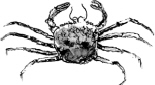
TXANGURRO A LA DONASTIARRA
Use sea water, or else water with salt and yeast. Once the water boils, put the crab in for 15 minutes. After it has chilled, remove all the meat from the legs and the center, and whatever water is there, to pass through a food mill.
The preparation is as follows: put some olive oil in a skillet with minced onion and a finely minced clove of garlic; when they start to brown add a glass of wine (some prefer brandy), reduce and pass through a food mill with a little white pepper, a teaspoon of English sauce and a litte mustard, according to taste, and a couple of spoonfuls of previously prepared tomato. When all this is reduced, add a spoonful of bread crumbs. Once you have made the preparation, add the crab meat, and when all this is seasoned, put it in the shell and add a little butter just before serving and a little more bread crumbs and slip it into the oven.
—Nicolasa Pradera, 1933
ON SAINT SEBASTIÁN NIGHT, 1998, by the central market at Nicolasa Pradera’s famous old restaurant, the contemporary chef-owner, Juan José Castillo, from Bermeo, surveyed the crab dishes coming out of the kitchen. Meanwhile, the chefs and soldiers were marching through town saluting the police station and various other institutions. When they came to Casa Nicolasa, Castillo ran out to the balcony and bounced up and down on his toes, waving his arms to the drum cadence in unconcealed boyish glee as his waiters ran below distributing bottles of champagne. Then he suddenly decided it was too cold for champagne and ran downstairs to distribute coffee and brandy, then charged back up to his balcony to listen some more.
As the gastronomes got increasingly merry and plodding, toques and high Napoleonic hats starting to slide to one side, another group began to form. They were marching for amnesty for political prisoners—accused ETArists in Spanish prisons around the peninsula. Each one carried a sign on a stick showing a photo of a prisoner. Many of the demonstrators were relatives of these prisoners, but rather than carry photos of their own family members, the group shuffled their signs, each carrying one selected by random to make the point that they were not asking for amnesty for a relative, but rather for freedom for all Basque political prisoners.
Among those carrying a sign was a professorial-looking man in a blue duffel coat with his white hair disarranged in the clear winter night’s air.
It was Txillardegi, whose son was among the twenty-three sentenced to seven years in prison for being on the board of directors of the Herri Batasuna party.
In 1997, the New York Times asked Felipe González how it was possible that GAL could have come from within his government without him ordering it. He replied that the state, after thirty-six years of dictatorship, might still have elements that he could not control. “People don’t want to understand that we inherited a state apparatus in its entirety from the dictatorship,” said the man who is credited with leading his country to democracy.
“There is always a first mistake,” wrote Joseba Sarrionaindia, a Basque writer accused of being an ETA member, currently in hiding.