A property in the valley
A house on the property
And in the house, bread and love
Jesus what happiness!
—Antonio de Trueba, “The Basques,” 1870
IT IS CALLED a txarriboda, and the whelping dog, straining at his chain a distance from the house, knew this was not going to be good.
The pig, purchased the previous spring for almost $80, was named Pepe. He was only slightly more than ten months old, and yet after six months of overeating corn, he weighed 290 pounds, an enormous, rounded, awkward, pinkish white squealing beast that it took seven men to drag out and hold down.
He was an unlucky pig, a castrated male who had been a last-minute replacement for a female who shortly before her planned execution had gone into heat and was saved for breeding.
Txariboda is the Basque name for the annual family slaughter of a pig, generally done during the winter when it is cold. Neighbors take turns helping out at each other’s txarriboda. In the village of Muxica, three miles from Guernica, it was Felisa Madariaga and Julián Gabikaetxebarria’s turn.
Theirs is a small and struggling farm. Julián, in addition to working the farm with his wife, holds a job in a factory in Guernica. Felisa sells their products every Monday morning in the Guernica market, the same weekly event that the Condor Legion had chosen for a target in 1937. On the farm, they have a few dairy cows and some chickens. They also grow lettuce and are one of the principal producers in the area of choricero peppers. A Vizcayan sweet pepper that ripens to a brilliant red and is then dried, the choricero is used in a number of dishes such as the stuffing for chorizo sausages. It is also used in bacalao Vizcaína, the salt cod dish that is the most internationally renowned of all Basque dishes, though most foreign imitations are inauthentic because the choricero is hard to find outside Vizcaya and is almost never to be found outside Basqueland. Choricero peppers ripen in the summer and are tied together on strings like garlands of large, deep red blossoms, then hung to dry for two months.
Julián and Felisa hang the peppers on the front of their traditional farmhouse of oaken beams and massive stone. Their house is named Igertu, which in old Vizcayan dialect means “drying,” but this appears to be a coincidence since the house predates the sixteenth-century arrival of peppers. Carvings on a stone windowsill in the front of the house, a Christian cross with Basque solar stars on either side, have been dated back to Roman times. Julián has received offers from people who want to buy the house because of its archaeological significance, but it has always been in his family and he will not sell. It is the etxea of his fathers.
In the fall, Igertu turns bright as a New England hillside, because the choriceros are hung on the house to dry. They are also hung from pipes in the white tile kitchen, forming red drapery that completely covers the ceiling. The peppers that are dried outside keep their brightness, but almost half are lost to rot. The indoor ones are not as colorful, but the losses are only 10 percent. The next year the dried seeds are replanted in the fields across the road.
THE SEVEN MEN held Pepe down on his side across a wooden bench, and one of them placed a green plastic basin on the ground under the pig’s neck. The knife went into the neck as the pig squealed even louder and struggled harder. But the men held him. Slowly the squeals turned into growls and then descending grunts. As the wound was worked with the knife and the blood poured out, one man kept the basin stirring to avoid clotting. After five minutes, the pig was only making low grunts and sighs and the blood was still pouring.
An ancient belief of Hebrews and some other cultures that an animal that dies an agonizing death is less edible has been upheld by modern science, and so commercial slaughterhouses avoid this kind of killing. In industrial pig slaughter, the animal is stunned and then the unconscious animal is bled. But these farmers insisted that the industrial way of killing was “not as beautiful.” They explained that the blood was darker and not as good. This blood was brilliant red.
The pig was then dragged to the edge of the field, for the long process of burning off the hairs by covering the carcass with pitchforks full of dried ferns and grasses and setting it on fire. It took more than an hour of turning and burning before the skin was completely blackened and hairless. Then the pig was washed and scraped with a knife. It now seemed like a huge, jellylike brownish object.
Meanwhile, the women were chopping guindillas, the slightly hot, thinner red peppers, cutting out the stems, opening the peppers with scissors, carefully removing the seeds and saving them, and chopping only the shiny red skin. They also chopped parsley. During this entire day of working and talking, there was never a moment of discussion about who would do what. There were the men’s jobs and the women’s jobs and no mixing of them.
They joked as they worked, speaking in Euskera and Spanish, mostly in Euskera. They talked about a recent soccer match. The referee had not been a Basque speaker and angrily told the players to speak in Spanish. Finally, he gave a yellow card, a penalty warning, to the Basque speakers. The team later protested. Some of the pig scrapers thought they should have protested; others thought that since the referee asked them to speak Spanish, they should have spoken Spanish.
With a long steel hook, the toenails were yanked off, and then the four feet were cut off and saved to make pigs’ feet. Julián worked with surgical precision, opening the stomach with long, sure knife strokes, cutting through larger bones with a hatchet.
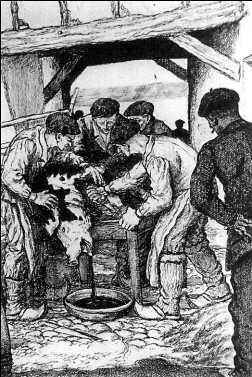
Etching by Jean Paul Tillac, 1937. (Collection of the Musée Basque, Bayonne)
Julian was born in 1931 and was seventeen years old the first time he butchered a pig. As he chopped, he talked about what he had seen when Guernica was bombed. “Planes buzzed overhead and you could hear the bombs,” he said, laying aside the bloody hatchet and working close to the bone with his knife, “but what I remember more was over there.” He pointed to the wooded hills beyond the harvested pepper fields. “By the next town, there were German soldiers in tanks, and the reds and the Fascists were fighting, and a lot of people were killed.”
Felisa also remembered. She was only three but recalls standing on a mountain watching the planes. “Then my Grandmother took us to the soldiers and they took us away.”
The lard from around the kidney was carefully removed, the lacy lining, the caul, was set aside, as was the liver, and the heart. The lungs were hung on a hook by the esophagus, eventually to be fed to the dog who had by now lost all interest in the former Pepe because he no longer detected the scent of fear or death— or Pepe; there was only food.
The intestines were taken out and handed to the women, who received them with unhappy smiles. After Julián removed all of the organs, he opened the back and the men hoisted the legless carcass on a chain and hung it from a beam. While Julián carefully carved the fillet into thin medallions, the women were working on the intestines: emptying them, washing them over and over, soaking them in salted vinegar.
Then they went to the kitchen, where only a single row of last fall’s choricero still hung from the ceiling. The men sat at the long table, where crusty bread and bottles of Rioja wine had been placed. The kitchen had both an electric and a wood-burning stove, but only the wood burner was used. First, porrusalda, a hot leek and potato soup, was served, followed by salt cod and red pepper salad with slices of garlic in olive oil. Then came slices of Pepe’s grilled liver, followed by grilled sliced fillet of victim, and then brazo gitano, a custard-filled sponge cake. Then coffee, brandy, Cuban cigars.
They laughed and joked in Euskera and in Spanish. One of the neighbors complained that he could not understand “these Euskaldunberri and their Batua.” He could understand Guipúzcoan or any of the other dialects, “but this Batua, maybe if I listen to something twice I could get it.”
The neighbor’s son, Igor, with his dark hair and black eyes, his long straight nose, his thin face, strong chin, and thick eyebrows, looked like a portrait of a Basque by a romantic painter. Igor had no intention of a life on the farm. He worked in a factory where he made as much money in a month as he could in three months of farm work. But he learned his part at the txarribodas. Julián worried about preparing someone to take his own place so he could be certain that a time would not come when there would be no more txarribodas in the community.
After lunch, the women chopped the greens off twenty leeks, then cooked the chopped whites over a slow fire so that they poached in their own juices. They did the same with five chopped onions. Then they cooked three and a third pounds of rice until it was overboiled porridge. They diced the lard and put it in a basin, mixing it with the cooked and drained ingredients, a pound of chopped parsley, a dozen chopped guindillas, two large handfuls of coarse salt, and they slowly added the pig’s blood until the basin was filled with a bright red mush.
Then the women crossed themselves. They say this is the only insurance against the intestine skins breaking. With the help of an aluminum funnel, they stuffed the skins and tied them off into sausages. They then cooked them for twenty minutes in a pot with the leek greens, which help protect the blood sausage from breaking. Cold water was constantly added to keep the boiling down, since a strong boil also would break the skins.
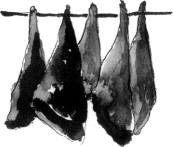
Meanwhile, with the skillful use of Julián’s knife, the men reduced the former farmyard animal into a series of cuts of meat. The head was removed, and the ears and cheeks were cut off for eating. They had slabs of fatback, slabs of bacon, legs ready to cure into ham, chops, loins. The meat for the chorizo would soak for a day, and then the sausages would dry for another week by wood-burning fires.
They had a week of continuous pork feasting ahead of them. To sell any of this would be a violation of health laws. The entire txarriboda might be illegal; it’s not certain. But they just eat among themselves with their neighbors once a year.
The blood sausages were grilled on a wood-burning hearth in the living room, and when they were done, it was time to sit once again at the long table in the kitchen where the choriceros were drying overhead. The Rioja and bread were distributed again. They joked in Basque about the large behind of Felisa’s sister, Estafanía, who was plump and round and had a contagious laugh.
Estafanía’s husband presented his theory that all Basques go to heaven because they don’t know how to curse, a hypothesis that met with snickers. There are no swear words in Euskera. The only one anyone could come up with was madarikátue, which means “damned.” The others thought you could still get to heaven if all you said was madarikátue. But Estafanía said, “No. It won’t work. We Basques swear all the time. It’s just that the words we use are maketos.”
They all laughed. After chorizo, there was the blood sausage, which had a fresh vegetable taste unlike any commercial blood sausage. Next came slices from a cut just above the leg.
Well fed and contented, Estafanía sighed and said, “You see, the best times in life are the first year of marriage and the week you kill the pig.”
THE SIXTEENTH-CENTURY Guipúzcoan Esteban de Garibay, the first scholar of Basque history and the first to attempt to trace the origin of the Basque people and language, told the Castilian crown in the clear simplicity of the ancient language, that which Basques have been saying ever since: “Garean gareana legez,” Let us be what we are.