
Many say that the first to take on this harrowing adventure must have been fanatic—eccentrics and dare-devils. It would not have begun, they say, with reasonable Nordics, but only with the Basques, those giddy adventurers.
—Jules Michelet, on whaling, LA MER, 1856
IN 1969 a cave with drawings of fish dating back to the Paleolithic Age was discovered in Vizcaya. The fish appear to be sea bream. A sea bream drawing was also found in a cave in Guipúzcoa, and drawings of a number of other fish species have been discovered as well. These drawings are remarkable because Paleolithic man, living in natural caves 12,000 years ago, usually chose to depict mammals, such as deer and horses, and not fish. He had not yet gone to sea. But these same caves are also significant because the remains of fish bones and shells reveal an unusual prehistoric diet.
A reverence for sea bream, bixigu, has been conserved through millennia on the coast of Vizcaya and Guipúzcoa. It is a traditional Christmas dish, and in Guipúzcoa, a pastry shaped in the form of a sea bream is served on Christmas Eve. On that night, the people of San Sebastián gather by their perfectly curved, elegantly lamp-lit bay, and climb Mount Igueldo, the steep little mountain at the harbor entrance, carrying a large effigy of a sea bream. This is because the fish is associated with Olentzaro, a pre-Christian evil sort of Santa Claus who slides down chimneys on Christmas Eve to harm people in their sleep. Fireplaces are lit for the holiday to keep him away.
In the early twentieth century, when Basques who had migrated to Madrid formed a gastronomic society, they named it Besuguin-a Lagunak, Friends of the Sea Bream. In San Sebastián such gastronomic societies make a near ritual of fishing sea bream on Saturday nights in January.
The following recipe from the gastronomic society Donosti Gain, which means “in San Sebastián,” was collected by the well-known Guipúzcoan chef José Castillo.
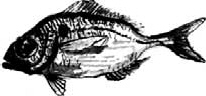
SEA BREAM
(for two)
1 beautiful sea bream
6 tablespoons olive oil
4 tablespoons vinegar
2 slices guindilla pepper (a dried red, slightly hot, local pepper)
4 cloves garlic
Put the sea bream in a casserole.
Roast it well in an oven.
Put the vinegar in a skillet and turn up the heat. When the vinegar is reduced to half, add the juice from the fish that is left in the casserole and let it simmer a little.
In another skillet put the olive oil and the garlic cloves cut in slices. Heat the skillet with the oil and garlic. When the garlic begins to turn golden, add the guindilla and turn off the heat. Add the reduction of vinegar and fish juice.
Bring to a boil for 1 minute.
Uncover the sea bream and add the liquid.
This leaves the question: What is meant by a “beautiful sea bream”? The answer was suggested in a 1933 book about fish written by the pseudonymous Ymanol Beleak, a native of Bilbao who lived many years in San Sebastián and whose real name was Manuel Carves-Mons. Beleak, an entrepreneur who, among other projects, manufactured chocolate boxes and created his own label of sparkling wine, wrote, “A sea bream of quality has a small head and thick back. It does not need to be large to be good.”
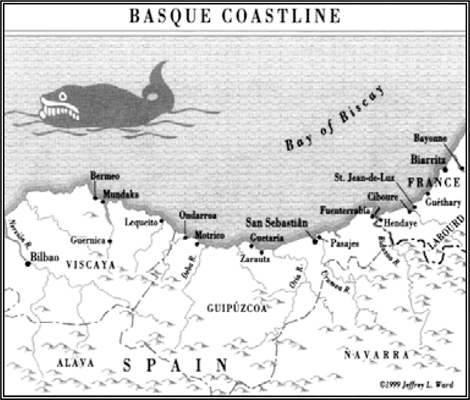
ORIGINALLY,THE BASQUE idea of the sea, itsaso, was the Bay of Biscay, that part of the Atlantic between France and Spain that on some medieval maps is marked El Mar de los Vascos, the Basque Sea. This, by Atlantic standards, is a relatively unfertile corner of the ocean, because while fish tend to cluster in the relatively shallow water over continental shelves, the Iberian shelf is short, dropping off steeply close to shore.
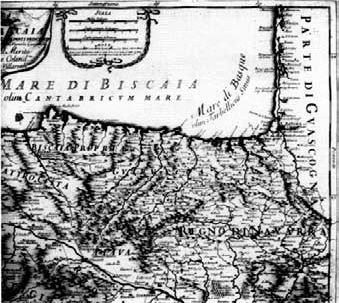
Detail of a map by Giacomo Cantelli entitled “Vizcaya is divided into four major parts,” from Mercurio Geográfico, Rome, 1696. Note that the gulf is labeled Mare di Basque, the Basque Sea. (Photography archive of the Untzi Museoa-Maritime Museum, San Sebastián)
With flair and imagination, the Basques have created great dishes out of even the least fleshy little creatures of their unfruitful Basque Sea: txangurro, the scrawny spider crab of winter; txitxardin, tiny baby Atlantic eel caught in the rivers, also in winter; antxoa, the spring anchovies; txipiron, small squid caught off the coast in the summer; and sardina, the fat summer sardines that were a specialty of the Bilbao area before the pollution that came with the industrial revolution.
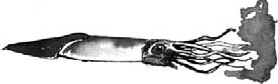
Txipiron
Basque fishermen invented ways of cooking inexpensive local catch. Ttoro is a dish traditionally prepared by Labourdine fishermen based in towns at the mouth of the Nivelle: St.-Jean-de-Luz, Ciboure, and the village at the harbor entrance, Socoa. It is made from locally available fish, and the recipe varies from cook to cook. The following recipe is from Casinto De Gregorio, a Guipúzcoan who established a cozy little restaurant in St.-Jean-de-Luz in the 1920s. The restaurant, Chez Maya, is still in the family, and the cook, his grandson, Freddy, still uses his ttoro recipe.
TTORO
(for six)
|
6 hake steaks |
2 large onions |
|
6 very small monkfish |
2 leeks |
|
3 rascasse (a local redfish |
1 3/4 pound tomatoes |
|
in the same family as ocean |
4 garlic cloves |
|
perch, which is not a |
1 pint white wine |
|
substitute) |
1 bouquet garni |
|
2 large red gurnard |
(thyme, bay leaf |
|
(a bony European fish) |
and parsley) |
|
1 1/3 pound mussels |
pepper |
|
6 nice-sized langoustines |
Clean the fish. Cut the gurnard in slices. Filet the rascasse. Keep the bones.
Sauté the chopped onions, minced leek, and chopped garlic in olive oil for 15 minutes; add the heads and bones of the fish and cook slowly. Add the tomatoes, crushed, the wine, a quart of water, the bouquet garni, and pepper. Cook 90 minutes.
Clean and open the mussels, adding the juice to the pot.
Strain the liquid.
Flour the fish and sauté for 1 minute in olive oil.
Combine everything and cook slowly for 10 minutes.
Serve in soup bowls with garlic croutons.
Despite their inventive cooks, the Basques did not stay in their little sea, content with its little creatures. What first drove them out farther than the known world was the pursuit of a deadly but profitable giant: the Basque whale.
PLINY, THE FIRST-CENTURY Roman naturalist, described whales as creatures that lived off the north coast of Iberia. Until the Basques overhunted them, giant whales, along with porpoises and dolphins, made the Bay of Biscay their winter home.
Several varieties of whale, including the huge sperm whale, could be seen off the rocky coastline. The most valued one has the scientific name Eubalaena glacialis, referring to the fact that it spent its summers amid the icebergs, cruising past pale blue glacier faces off Norway, Iceland, Greenland, and Labrador. When these waters began to freeze for the winter, it would come down to the Bay of Biscay. Some scientists had proposed the Latin name Balaena euskariensis after its popular name, the Euskera or Basque whale.
An important feature of the Basque whale was that, like the sperm whale, but unlike many whale species, it floated when dead. The whale’s back shone obsidian black in the water, though the belly was a brilliant white. Averaging about fifty to sixty feet in length, a quarter of which was the huge head, a single animal could weigh more than sixty tons. Such a whale would yield thirty tons of blubber, which could be cooked down to an oil valued for centuries as fuel. Most coastal Basque communities established facilities along their beaches for cooking down whale blubber. As with most things Basque, it is not certain when this oil trade began, but in 670, at the end of the age of the Visigoths, there was a documented sale in northern France by Basques from Labourd of forty pots of whale oil.
Whalebone was also valuable, especially the hundreds of teeth which were a particularly durable form of ivory. The tons of meat were a profitable food item. Whale meat had been eaten by the ancient Greeks and Phoenicians, who probably took beached whales since there is no record of commercial whaling. Romans also wrote of whale meat. Pliny wrote that eating whale meat was good for the teeth.
The first commercial whale hunters were the seventh- and eighth-century Basques, who found an eager market for this meat in Europe. Whale meat became a staple of the European diet partly because the Catholic Church forbade the eating of “red-blooded” meat on holy days—about half the days on the calendar including every Friday—arguing that it was “hot,” associated with sex, which was also forbidden on holy days. But meat that came from animals—or parts of animals—that were submerged in water, including whale, fish, and the tail of the beaver, was deemed “cold” and therefore permitted. So with the exception of beaver tails and the occasional seal or porpoise, whale was the one allowable red meat. The Basques became the great providers of this holy red meat. They sold the leaner meat fresh or preserved in salt. Fattier parts were cured like bacon. In Paris, where these cuts were a lenten specialty, they were known as craspois. Tongues, fresh or salted, were regarded as a particular delicacy and served with peas. Being the choicest part, the only good part, according to some medieval writers, whale tongues were often demanded by local church or government officials as tribute. The port of Bayonne jealously guarded its monopoly on the tongue trade.
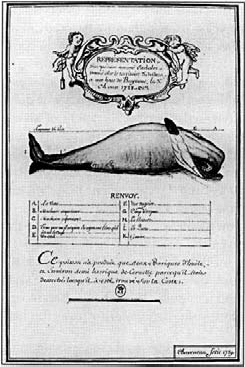
A beached whale brought to Bayonne in 1728. The caption says that the whale only produced two casks of oil because it had dried out from lying on the shore. (Collection of Charles-Paul Gaudin, St.-Jean-de-Luz)
In the seventh century, the Basques, no longer content to wait for ailing whales to beach themselves, built stone whale-spotting towers along the coast from Bilbao to Bayonne, manning them between October and March. One still remains on a mountaintop near San Sebastián and another in Guéthary in Labourd. The whale’s undoing was the fact that it is a lunged mammal and must rise to the surface to breathe. When it does, a tall column of vapor is released. Spotting the spout of an approaching whale off the coastline, the lookout in the tower would let out a prolonged yell. His shouts were actually coded signals that told whalers the exact type of whale sighted, and whether it was a single whale or in a group. Five oarsmen, a captain, and a harpooner would then row out in a lightweight vessel.
The oarsmen would row as silently as possible, muffling the oars in their locks and even the oar blades in the water with oiled cloth. Then, having sneaked up on the unsuspecting giant foundering along the coast, they would strike suddenly with wooden-handled spears and harpoons. The oarsmen had to row close enough to the whale for the harpooner to plant the harpoon deeply into the body just below the head. Harpooning became the trade of the largest, strongest men. After harpooning the whale, the oarsmen had to row furiously in reverse, turning a fast circle, for an enraged whale could kill a dozen men with a flick of its huge tail. Or, instead of turning on its attackers, the whale might try to dive to the safety of great depths, dragging men and boats with it. The whale would dive with harpoon, line, and buoys until, out of breath, it had to furiously resurface, only to be harpooned again. The process was repeated numerous times until the whale spouted blood and died or the whalers capsized and drowned. Sometimes the boat and fishermen would just sink under the weight of the wet ropes.
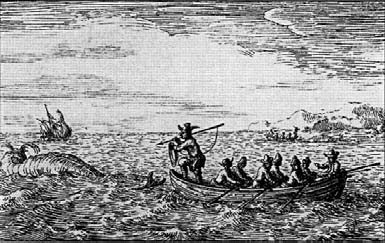
Basque whalers. (Collection of Charles-Paul Gaudin, St.-Jean-de-Luz)
By the late thirteenth century, whales marked the town seals of Bermeo and Fuenterrabía. Among the other towns that included whales in their town seals were Biarritz, Hendaye, Guetaria, Motrico, and Lequeitio. Not only did these towns keep the whale on their seals, but, from the use of whaling launches, they developed an early and enduring passion for rowing regattas. The eighteenth-century British are generally credited with having invented this sport on the Thames, but it may be the Basques who originated it. Their first recorded contest, a legendary Mundaka-versus-Bermeo regatta, was in 1719, though they may have held many competitions before that with the fishermen of one town challenging the fishermen of a second town to a twenty-minute race. Even today, the Basque fishing towns compete every summer. The home team rows out to meet the visitors, in launches whose design has not changed in at least three centuries. After holding their oars vertically in a salute, they begin the race.
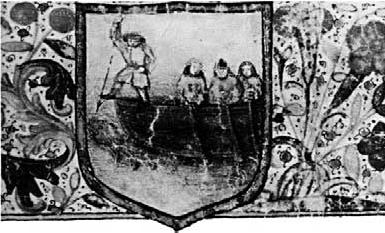
Harpooning a whale. Shown on a Seal of Motrico, 1507, Municipal Archive of Motrico. (Untzi Museoa, San Sebastián)
IN THE NINTH CENTURY, the Basques skirmished with yet another intruder, the Vikings who occupied the banks of the Adour River. The Basques always tried to learn from interlopers, and the Vikings, who had traveled farther by sea than anyone else at that time, became an important influence on Basque seamen. Instead of simply planking a frame, Basque shipbuilders began to use the Viking hull construction, overlapping the edge of planks horizontally and then fastening them with iron rivets.
Better-built ships meant the possibility of longer voyages, but despite the increased seaworthiness of vessels and even improved navigational skills, voyages were only able to last as long as the shelf life of the ship’s provisions. Since most fish are found on continental shelves, a long voyage beyond the European shelf could not be provisioned by catching fresh fish alone. With no refrigeration, food spoilage was the undoing of many voyages beyond coastal zones. By the tenth century, Vikings were able to undertake longer voyages than other people of the time, able to travel between continents, because they provisioned their long journeys through the North Atlantic with cod that had been dried in arctic air. By the late tenth century, a century after leaving the Adour, they were crossing the North Atlantic to North America.
The Atlantic cod, a white-fleshed bottom feeder of the North Atlantic that was unknown in the waters off northern Iberia, has almost no fat, which enables it to preserve unusually well. The Basques refined the curing process by not only drying but first salting the cod, as they did with whale meat. Because cod were found in the northern summer whale grounds, the same rowboats that were launched from ships to chase whale were also used to fish cod. These Basque boats were the origin of the fishing dory that was later used in the North American cod fishery by most Atlantic fishing nations until the 1950s.
The Basques had extended their range in pursuit of the whale from the Bay of Biscay, across the northern coast to Galicia. But by pursuing northern cod, and provisioning their ships with salt cod, they then were able to start chasing the whale into its summer grounds, up to Iceland, Norway, the Hebrides, and the Faeroes.
By the year 1000, whales that had returned to safe northern waters, the snort of their spray echoing in silent fjords, were suddenly being pounced on by Basques, who had sailed more than 1,000 miles to hunt them down. The dangerous business became even more deadly with the move to subarctic waters where a fisherman, tossed into the icy water, would die in minutes. But long-distance whaling had the advantage that it avoided tributes demanded by local government and church, tributes which sometimes included the tongues, and often the entire first whale of the season or a strip from head to tail. Such tributes were inhibiting whaling. In 1334, to redress the declining fishing population of Lequeitio, Alfonso XI of Castile declared a five-year period during which whalers of that port were taxed a tribute of only one in eighteen whales, instead of the usual one in fifteen. In 1498, the whalers of Labourd rebelled and refused to pay the tongues demanded as tribute by the cathedral in Bayonne. But at times a more effective escape from tributes was to go far away to unknown corners of the globe, where their catch could not be easily monitored.
Salted and dried Basque cod lasted better than the Vikings’ dried product and, through soaking, restored to something resembling a piece of fish. The dried Viking fish felt like a piece of balsa wood. To prepare it, the cook would break it into chips with a hammer. With salt cod, called bacalao in Spanish or maikalao in Euskera, the Basques further enhanced their whaling fortunes. While fresh fish was easily spoiled and expensive, the Basques had a cheap, long-lasting food for peasants—even inland peasants—that was Church-approved for holy days and that, unlike whale, seemed to be in inexhaustible supply. The Basques were so successful at marketing this product far from the fish’s northern range that in Basqueland, Catalonia, Mediterranean France, Italy, Greece, North Africa—throughout the Mediterranean region—this northern import has remained a traditional food.
The Basques gradually became not only the world’s purveyors of whale and cod products but the leading shipbuilders, pilots, and navigators. Capitalists before capitalism, Basques financed most of their shipbuilding through private venture capital. Typically, a single ship would have three or four investorowners. Under the most common Basque contract, the crew worked for one-third of the profits. Basque ships, large and beamy and known for their exceptionally large hold capacity, were sought after by Europe’s maritime peoples.
Shipyards emerged in the fifteenth and sixteenth centuries over the entire Basque coast from Bilbao, where the extensive waterfront of the Nervión River afforded many sites, to the fishing villages and riverfronts of Vizcaya, Guipúzcoa, and Labourd, all the way up to Bayonne. Villages with populations of a few hundred were producing what were considered the best ships in the world. Pasajes, a Guipúzcoan whaling port near San Sebastián with a village-sized population crowded onto a single street between the long waterfront and the steep mountains, developed some of the finest port facilities of the fifteenth century. Basqueland had not only the harbors but the iron fields and oak forests for this industry.
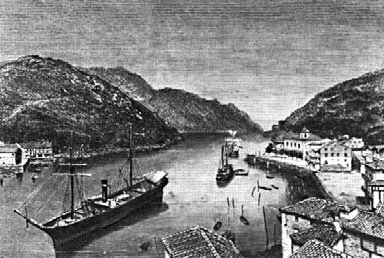
A nineteenth-century view of Pasajes.
Basques built all kinds of ships: fishing, whaling, merchant, and warships. In 1505, a Basque General of the Fleet, Juan Lope de Lazcano, commissioned a ship with metal plating on the ribs; the precursor by centuries of ironclad warships. In 1543, a Basque engineer, Blasco de Garay, showed Carlos I a new idea: a ship powered by a giant wheel that was moved by vapor from boiling water. Though Carlos had a great interest in inventions, he was unimpressed with this one, and the idea was ignored for centuries, until the late-eighteenth-century dawn of the industrial revolution.
Maritime skill and engineering innovations were supported by legal prowess. In 1351, the Vizcayan fishing port of Bermeo signed a treaty with Edward III of England that was the first international accord to establish the principle of freedom of the high seas.
ONE OF THE GREAT Basque mysteries is: When did Basque whalers and codmen first reach North America? Although the pre-Columbian journeys of the Vikings are described in the Icelandic sagas, for centuries such anecdotal evidence was dismissed as legend, myth, or exaggeration. Then in 1961 the remains of eight Viking-built turf houses dating from A.D. 1000 were found in Newfoundland in a place called L’Anse aux Meadows. The Basques also left a trail of tales and myths but no physical evidence that they were in North America at an early date. Some have even speculated that the Basques were there before the tenth-century Vikings, a claim with very little basis. The more widely believed and more carefully reasoned theory is that the Basques arrived in North America, along the Newfoundland or Labrador coast, in the fourteenth or fifteenth century, that they visited, perhaps with some regularity, perhaps even had people working there, substantially before John Cabot’s 1497 “discovery” of Newfoundland and Christopher Columbus’s 1492 Caribbean find.
Throughout the century leading up to Columbus’s and Cabot’s celebrated voyages, widespread rumors persisted, especially among fishermen and maritime people, that Basque fishermen had found “a land across the sea,” perhaps only an island. The Bretons even attempted to follow Basque fishermen.
In the early fifteenth century, many Europeans believed that two ships from Guipúzcoa, one captained by Juan de Echayde and the other by Matais de Echeveste, had reached land across the Atlantic at the end of the previous century.
But no physical evidence has been found of the Basques in North America before Cabot. Historians and archeologists who have searched for it and failed insist that the rumors are false. But the search for pre-Columbian Basques in America has yielded ample evidence of a surprisingly large-scale Basque presence in Newfoundland and Labrador soon after Cabot. The remains of extensive Basque whaling stations dating to 1530 have been found. It is now thought that by the 1560s the Basque population may have been as high as 2,000, and yet, until 1976, no physical proof of this had been found either.
Jacques Cartier saw Basques in abundance on his voyage of discovery thirty-seven years after Cabot. And Basque journals record seeing Cartier. Few of Cartier’s place-names from the Gulf of St. Lawrence side of Newfoundland have survived because fishermen continued to use bastardized Basque names. Bonne Bay comes from the Basque name Baya Adhere, Beautiful Bay; Ingornachoix Bay comes from the Basque name Aungura Charra, Bad Anchorage; and Port-au-Choix from Portuchoa, Small Port. In 1594, Bristol merchant Sylvester Wyet observed that of sixty fishing ships in Newfoundland’s Bay of Placentia, eight were Spanish and the rest were Basque.
The two leading arguments for placing the Basques in pre-Columbian America are both based on deductive reasoning. The first is their catch. The Basques landed enormous quantities of cod and whale products throughout the Middle Ages. And yet their fourteenth-century competitors were convinced that the known fishing grounds alone could not explain the number of cod they brought to European markets. After Cabot, when Newfoundland and Labrador grounds became widely known, it could be seen that these were the principal Basque whale and cod grounds. Was that not the case before Cabot as well?
The second deductive argument is the improbability that the best sailors, with the best ships, the best navigators, and a tradition of sailing the longest distances could have missed North America during centuries of clearly being so close. There is evidence of the Basques in the Faeroe Islands as early as 875. This was a 1,500-mile journey, which, if they did not make landfall along the way, was a remarkably long distance to sail at that time. Is it possible that in all the following six centuries, working in the narrow area of the North Atlantic where the continents are not far apart, having known and learned from the Vikings, that the Basques never ventured the relatively shorter distance to North America? In 1412, an Icelandic account records that twenty Basque whalers passed by the western tip of Iceland off Grunderfjord, which is a 500-mile crossing to Greenland. From there another 1,200-mile voyage would have taken them to Newfoundland, or a much shorter crossing would have taken them to the northern Labrador coast. The total crossing from the Faeroes to Newfoundland is not much farther than from San Sebastián to Iceland. Most fishermen had little reason to cross the Atlantic, since the catches vanish with the end of the European continental shelf and do not pick up until the other side. But the Basques chased whales that traveled to subarctic waters and then dropped down along both the European and American coastlines.
Numerous reports claim that when Cabot and other early explorers arrived in North America, they encountered native tribesmen who spoke Basque. In other accounts, the tribesmen and the Basques learned and intermingled each other’s languages. In the sixteenth century, there was much speculation about the relationship between indigenous North American languages and Euskera. Esteban de Garibay used this as evidence that both North America and Basqueland were homes to survivors of the Flood. According to accounts from the late fifteenth and early sixteenth centuries, including those of Peter Martyr, cleric of the court in Barcelona, who reported on the early discoveries, the tribesmen encountered by Cabot were already using the word baccallaos. Even if this were true, however, they did not necessarily learn the word from the Basques. In this period the Basque word for cod had numerous variations in different dialects of Euskera, including bacallau, bakaillo, makaillo, and makallao. According to one theory, the word bacalao was originally Euskera and comes from the Euskera word makila, which means “stick.” The cod were cured on sticks, and the Scandinavian word for dried cod, stockfish, has the same derivation, with stock meaning “pole.” But other linguists point out that Euskera frequently converts b to m when adopting foreign words, and the word makallao was probably borrowed from Spanish, Catalan, or Portuguese. The tribesmen could have learned the word from any of these languages. The critical issue is: When did they learn it?
A St.-Jean-de-Luz merchant wrote in 1710, some 150 years after the fact, that when the French were first exploring the rivers of Nouvelle France, they found indigenous people already speaking a patois that was part indigenous and part Euskera. There were many accounts that the indigenous language “had come to be half Basque.”
It has even been suggested that some indigenous words appear to be of Basque origin. The local name for deer is orein, which also is the Basque word. Pierre Lhande-Heguy, who became the first secretary of the Basque Academy of Language when this institute was established in 1918, observed a remarkable Basqueness in proper names of the Huron’s language. Among the Huron names that suggested Basque origin to him were the men’s names Anonatea, Arhetsi, Ochelaga, Ahatsistari, Andekerra, and Oatarra and the women’s names Arenhatsi and Ondoaskoua. But the similarity could be a coincidence, and some historians who concede an Euskera influence on local languages argue that it could have happened after 1497 when Newfoundland became known and a large Basque presence there was well documented. If so, the difficult language was assimilated in only a few years.
On the other hand, if the Basques had been in America for decades, possibly centuries before Columbus, why would there be no record of it? Some say, as is always said about the Basques, that they keep secrets. But the real answer might lie not in the nature of Basques but in the nature of fishermen. When fishermen find an unknown ground that yields good catches, they go to great lengths to keep their secret. In most fishing communities, there are boats with notably better catches, and the crews are silent about the location of their grounds. The cod and whale grounds off the coast of North America was a secret worth keeping, the richest grounds ever recorded by European fishermen.
ANOTHER SIGN THAT Basque fishermen preceded explorers is the fact that when the fifteenth- and sixteenth-century Age of Exploration unfolded, the Spanish and Portuguese turned to Basque ships and mariners because the Basques were considered the people with experience. The Basques hunted voraciously and traveled restlessly. As the world became better known, Basque whalers were found everywhere. They were seen whaling off the coast of Brazil, far north in the Arctic, and down to the Antarctic. Many of the early European ships that explored Africa, America, and Asia were built by Basques and often piloted by Basques as well.
The Santa María, one of the ships used for Columbus’s first voyage, in 1492, was probably built by Basques. Among its crew were numerous Basques, including the boatswain Chanchu, who died on the voyage; the shipwright Lope de Erandio; and a carpenter from Lequeitio named Domingo. Among the Basques on the Pinta were two Guipúzcoans. Columbus’s second voyage was organized in Vizcaya by two Basques, shipowner Juan de Arbolancha and naval commander Iñigo de Artieta. For that voyage, six Basque ships were built and ready to sail from Bermeo, in July 1493, with Basque pilots Lope de Olano and Martín Zamudio and many Basque crewmen. One of the ships, with eighty-five men, was outfitted by Juan Pérez de Loyola, the future Saint Ignatius’s oldest brother. In 1494, Columbus’s third voyage was also manned by Basques, and in 1502, the fourth included the Vizcaina, a ship out of Guetaria with a Basque pilot and many Basque crewmen.
Juan de La Cosa, a Basque explorer usually known as Juan Vizcaíno, which in the language of the time meant “Juan the Basque,” was probably with Columbus on his first voyage and definitely on the 1493 second voyage. He continued to explore the Caribbean basin and in 1500 drew the first map of the world to include the Americas. In 1509, he was killed by tribesmen in what is now Colombia. Another Basque to be dubbed Vizcaíno, Sebastián Vizcaíno, was one of the early explorers of the California coast, exploring San Diego Bay, discovering Monterey, and sailing north of San Francisco Bay, giving California many of its present-day names.
Magellan, it is commonly taught, was the first man to circumnavigate the globe. But this is contradicted by the other well-known fact about Magellan: that he was killed on his voyage by tribesmen in the Philippines. The expedition with five ships and 200 men, of which at least 35 were Basque, left Seville in August 1519 under the command of Magellan, Ferñao de Magalhães, a tough and burly Portuguese in the service of Spain. Only three ships made it to the Philippines. At Cebu, Magellan waded ashore with a few dozen men to attack a force of 1,500 tribesmen, enemies of a local sultan with whom he had made an alliance. He did not even bring his ship’s cannons into firing range. When it became clear that the attack was a disaster, he stood with a handful of men to cover the retreat of his forces and was overwhelmed and slashed to death.
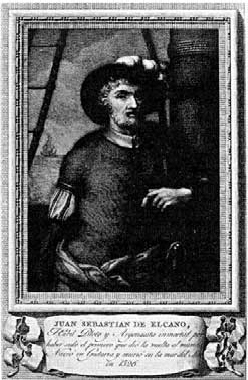
Juan Sebastián de Elcano from an engraving by L. Fernández for “Portraits of illustrious Spaniards” commissioned by the Calcografía Nacional, 1791-1814. (Untzi Museoa, San Sebastián)
He had lost only eight of his men in the engagement. But by the time the expedition left the Philippines, fighting and starvation had reduced the crew to 110, and they scrapped one ship for lack of crew. Two continued, the Trinidad and the Guipúzcoan-built Victoria, under the command of Juan Sebastián de Elcano, a Basque from Guetaria, who learned his trade first on fishing boats and later, exploring the coast of Africa.
Elcano had already commanded larger ships than those of the Magellan expedition. But prior to Magellan’s death, Elcano had not been a commander on this expedition. Early in the voyage, Magellan and Elcano had become bitter enemies, and Magellan had condemned Elcano to death for his part in a mutiny on the coast of South America. The only injury caused by the mutineers had been the stabbing of a fellow Basque loyal to Magellan, Juan de Elorriaga. Elcano had spent five months, a long gray winter, in chained hard labor in Patagonia while the crew waited for spring to find the straits to the Pacific.
Now in command, Elcano and the two ships engaged in the spice trade for some months, and then the Victoria continued around the world while the Trinidad was left behind for repairs. The latter was eventually stripped by the Portuguese and destroyed in a squall.
On September 8, 1522, almost nine months after leaving the Trinidad, three years and one month after setting sail from Seville, Elcano, the first man to circumnavigate the globe, sailed the Victoria up the Guadalquivir River and tied her up at a pier in Seville. On her decks was the surviving crew of eighteen men, including at least four Basques. In rags, carrying candles, the barefoot crewmen walked a mile to the cathedral, where they offered thanks at the shrine of Santa María de L’Antigua.
Elcano was given an annual pension and honored with a coat of arms featuring a globe with the words Primus circumdedisti me, Thou who first circumnavigated me. But many of the surviving eighteen received nothing. One, Juan de Acurio, stated two years later that all he had earned from the voyage was “glory, experience, and a bale of cloves.”
The Victoria went on to the merchant service, making one voyage to the Caribbean and going down with all hands on the second. To the enormous profit of the Basques, this was an age when an unprecedented number of ships were being lost at sea, and the demand for shipbuilding seemed limitless.
Basques returned to the Philippines. Andrés de Urdaneta, became the second man to circumnavigate the globe, completing a nine-year expedition in 1536. Then Miguel Lopez de Legazpi y Gorrocategui, who had gone to Mexico in 1528, where he amassed the fortune every adventurous Spaniard of the day was dreaming of, sailed to the Philippines, took Luzon, and established Manila as the capital of the new colony in 1571. Centuries later, when Spain lost its colonies and conflicting nationalisms divided the Spanish and the Basques, the angry Spanish military would no longer remember that it was the Basques who had secured much of Spain’s global empire in the first place.