
To be a true Basque, three things are required: to have a name which bespeaks Basque origin, to speak the language of the descendants of Aïtor, and to have an uncle in America.
—Pierre Lhande-Heguy, first secretary of the
Basque Academy of Language, BASQUE IMMIGRATION , 1910
EVEN IN THE SIXTEENTH CENTURY, the rural Basques, isolated in mountain villages such as Zugarramurdi and Ituren, were not the mainstream of the Basque population. While most Europeans were focused on their region, their country, their crown, the successful Basque was a man of the world. He was interested in Africa and Asia and especially passionate about the lands Basques called Amerika. Like the character in the Pío Baroja witchcraft novella, an ambitious man could improve his station in life by going to Amerika and returning with, if not wealth, at least experience. Amerikanuak, Basques who returned from the Americas, were people worthy of respect in the community. This is a recurring theme in Basque literature, especially among the early twentieth-century Basque writers, who tried to reassess Spain after it lost its empire. In Miguel de Unamuno’s short story, “Every Inch a Man,” a special masculinity is ascribed to the lead character because he had made a fortune in America.
Amerikanuak bezain, good, like an American, is an Euskera expression meaning “generous.” Ez gira Amerikanuak, you’re no American, is a way of calling someone cheap. In both expressions, the Americans referred to are Amerikanuak.
A people are shaped by their land, and the mountains of Basqueland, the green slopes that no one else would fight as hard for, could not support a population. Despite a lush appearance, the land is not fertile, and Basques always needed to look beyond Basqueland for food. It had been this special need for imports that had induced Castilian kings to exclude the Basques from the Spanish customs zone. Goods that landed in Basque ports paid no Spanish customs. If the goods were bound for Spain, they were taken through Alava to Miranda de Ebro, a river town, to enter the Spanish zone and pay duties. But goods could also be landed in a Basque port and reshipped to Europe without entering the Spanish customs zone.
Both the need for food and the customs arrangement were incentives to trade. The Basques bought Castilian wool and sold it to the rest of Europe, where it was a highly prized commodity. By the fifteenth century, Basques were producing and supplying one-third of Europe’s iron from Vizcaya’s huge deposits. They also produced swords, musket barrels, and ship’s anchors. Using the Euskera name for Bilbao, Shakespeare referred to “Bilbo swords.”
Long accustomed to looking abroad, the Basques were among the first Europeans to realize that the unique products of the new American lands could become as valuable as the silk and spices of Asia. Not only did Basques trade new American products, but they were also open to using them. From rubber balls to tobacco, the Basques pioneered American products in Europe.
THE CHILI PEPPER was easy for Europeans to understand. In a sense, it was what Columbus had gone looking for, a spice. Exotic spices were already one of the most lucrative trades in the world. Columbus must have immediately recognized that hot peppers were valuable because he named them after the already high priced black pepper, pimienta. The new spice was called pimiento—masculine pepper, like black pepper but stronger. “Mejor que pimienta nuestra,” Better than our pepper, he reported.
The chili pepper was sold by Basques, Spaniards, and Portuguese to Africa, the Middle East, the Asian subcontinent, and the Far East. Its trading value soon declined because the plant was easily cultivated in these climates. Most Europeans ate only the mild sweet peppers. Basques were the only Europeans to have adopted a taste for hot peppers directly from America.
Guindilla peppers, grown in the Spanish Basque provinces, are pickled green or chopped into food when dried and red. Espelette, a whitewashed town next to St. Pée, is famous for its peppers. The small thin ones and the slightly hotter larger ones grow green but turn bright red in September, when they are harvested. The peppers are then strung through their stems and hung from the southern side of houses to dry, the lines of peppers echoing the traditional red trim of the white buildings. These peppers are used in the local sausage and many other dishes to give a subtle heat, nothing comparable to the fire of Caribbean or Mexican food, but the hottest burn of any cuisine in France. On the last Sunday in October, worshipers in Espelette are given a blessing and a string of dried peppers at Mass.
The following recipe is from Itxassou, the town next to Espelette that is famous for its cherries. The sauce is served by Jean Paul Bonnet at the Hotel du Fronton over skewers of grilled duck hearts.
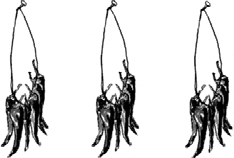
ESPELETTE PEPPERS AND DUCK HEARTS
Brown shallots in duck fat, add 2 powdered Espelette peppers, and reduce to a sauce with créme fraîche for 8 minutes. I cannot say how much pepper powder. In Epelette every bunch of peppers is different depending on where it is grown and the weather. You have to taste it and decide. If the peppers are too strong, add a pinch of sugar.
The European distaste for burning-hot pepper is in perfect balance with nature because hot American peppers when grown in Europe give off little heat. The burning taste comes from a substance called capsaicin, whose burn increases when the pepper is grown in strong sunlight. Capsaicin is a failed chemical defense for plants. Most animals won’t eat plants that contain capsaicin, but many non-European humans are not deterred. The large red choricero, so called because it is used in chorizo sausage, has little heat when grown in Vizcaya on the wet fields near Guernica. When picked young and green, it is called a Guernica pepper. The same Guernica or choricero peppers, grown in the much sunnier Rioja, will begin to take on the sting of a chili. If Basqueland were sunnier, the Basques wouldn’t like their peppers. The great mid-twentieth-century Guipúzcoan chef and food writer José María Busca Isusi wrote of hot peppers, “This sting, if it is strong is bad, but when mild is very digestible and even aids digestion.”
In 1930 the Azcaray y Eguileor family published a book that promised to reveal the secrets of their Bilbao restaurant, El Amparo. It offered two suggestions for pimientos de Guernica, which have long been the popular ways of serving these peppers in Vizcaya.
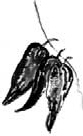
PIMIENTOS DE GUERNICA
Rub the peppers with a cloth and fry them in sizzling oil, turning them so they cook on all sides.
or
Heat the peppers in an oven dish, peel them, and put them whole in a casserole with garlic and oil, simmer awhile, salt and serve them.
BEANS ARE ANOTHER American product easily understood by Europeans because of their resemblance to European species, such as the broad bean, grown in Navarra and Alava, and peas, which, until the sixteenth century, were only used as a dried bean. American beans were quickly transplanted to most of Europe. In Vizcayan Euskera beans are called indibabak, Indian beans. Every Basque region prides itself on its own beans: red, pinto, black, white, or the unripened, soft, greenish white beans that Basques call pochas. Because pochas are picked exactly at the moment they ripen from green to white, Tirso Rodrigañez, a Spanish government minister in the 1880s, called them “pubescent beans.” In Tudela, in southern Navarra, pochas are served with eel for holidays. In the Alava section of Rioja, they are cooked with lamb tail. But because the optimum time for picking pochas coincides with the fall game bird season, these beans are most commonly associated with quail. An article in a 1967 Basque food journal pointed out that pochas are so highly regarded that the dish is always called “pochas with quails” and never “quail with pochas.”
Before the Spanish Civil War, Nicolasa Pradera was the chef of a still celebrated restaurant, Casa Nicolasa, by the market in San Sebastián. This traditional recipe uses both beans and hot pepper.
POCHAS FOR QUAILS, GAME BIRDS, AND OTHER ROASTS
Put water in a stew pot with both lean and fat pork fatback or ham. [Cook the fatback or ham.] Let the water cool in the pan where the pork fat was cooked, and once cooled, add the pochas, chopped onions, raw peeled tomatoes, a hot pepper that is between red and green and is also peeled, a peeled, finely minced garlic clove, chopped parsley, a little white pepper, and a few drops of olive oil, and cook it slowly. Season with salt.
—Nicolasa Pradera, LA COCINA DE NICOLASA, 1933
The most celebrated Basque bean from America is the red bean of Tolosa, alubias de Tolosa. Borrowing even further from native American agriculture, the farmers in this mountainous part of Guipúzcoa plant beans in the shade between corn rows exactly as Central American farmers do. Busca Isusi wrote in 1972, “In the firmament of Guipúzcoan gastronomy there are many shining stars and alubias de Tolosa are generally considered one of premier magnitude.”
These red beans actually are black, but when they are cooked they turn red and produce a thick, chocolate-colored sauce. Tolosans believe the beans must be cooked in earthen crocks. Basques have done elaborate studies involving gelatinization of starches and the breaking down of cellulose to explain why beans should not be cooked in metal. They also believe that Tolosa is an ideal bean town because the surrounding area has noncalcareous soil, soil without calcium or lime, which produces the best beans. But at the same time, the calcareous water of Tolosa is thought to be the optimal liquid in which to cook the beans. Though currently the forty-seven officially recognized producers of Tolosan red beans sell them to be used elsewhere, it is believed that the true dish can only be made with Tolosan water. Busca Isusi suggested that cooks elsewhere try using rainwater.
One weekend each year, Tolosa has an alubias contest. About twenty-five producers make the dish, each with the same recipe but with their own beans, and a panel of judges chooses the best one. The following day chefs using identical ingredients, including the winning bean, have their alubias judged. A famous place for alubias is the Fronton Beotibar, named after the 1321 battle in which Guipúzcoans defeated the Navarrese with the help of seven Loyola brothers. The Fronton Beotibar was built for barehanded matches in 1890. In 1935, a club and restaurant of elegant Art Deco design was built in front of the court. The accompanying recipe for alubias comes from Roberto Ruiz Aginaga, chef of the Fronton Beotibar.
The dish is always served with cabbage. Old-time Tolosans, who recall an era when there was little but beans to eat, believe the heaviness of the bean dish can be moderated by the addition of vinegar, which seems to horrify the modern Basque gourmet, who will nevertheless add guindilla peppers pickled in vinegar.
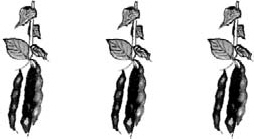
ALUBIAS DE TOLOSA
(for eight)
1 kilogram (2.2 pounds) alubias de Tolosa
4-5 liters (quarts) water
1/2 an onion
2 tablespoons olive oil
salt
For the frying:
4 cloves garlic
olive oil
1/2 onion
For garnishes:
1.5 kilograms (3.3 pounds) pork ribs
1 cabbage
3 blood sausage
guindillas de Ibarra (pickled green peppers)
Put the alubias de Tolosa in an earthen casserole with Put the alubias de Tolosa in an earthen casserole with cold water. Add oil and the onion and heat to boiling. Stop the boiling with a litle cold water, and cook slowly over low heat. Halfway through, heat a skillet with oil, add the peeled garlic cloves, and remove them when they are golden. Add chopped onion. After they brown, add the beans from the crock. When the cooking is finished, after about four or five hours, add salt and let the beans rest a half hour.
Garnishes: Chop the cabbage fine, and put it in to cook with the ribs over a lively fire for two hours. Salt and set aside. After poking them with a fork, cook the blood sausages for 15 minutes.
Serving: Place the cabbage, well drained, in the center of a platter. Cover with beans and place the ribs and blood sausage around it. Serve the guindillas on a separate plate.
AN INDICATION OF the Basque regard for corn is the fact that rather than adopt a Castilian word, they gave the grain its own name in Euskera, arto.
On his first voyage of 1492, Columbus encountered corn, first in Haiti and then in Cuba. He did not seem to appreciate that the plant he termed a “sort of grain” was a marvel of agricultural breeding. Thousands of years of experimentation by Meso-American farmers had developed a high-yield hybrid more evolved than any European grain. Corn is one of the few plants that has lost the ability to reproduce on its own. An ear of corn fallen to the ground remains sealed in sterility within its protective husk, but that husk makes it adaptable to almost any climate.
The men who traveled to America with Columbus, the Basques and Andalusians, brought corn to their farmers, who quickly realized what Columbus had not. Through trade and exploration, corn was spread around the world. Basques took corn to Asia, and by 1530, corn was growing in China.
The first mention of corn in France dates to 1523, when the governor of Bayonne complained about the husks. Apparently, Basques had been eating corn for some time by then because the city demanded that people stop throwing corn husks in the Adour, where they were accumulating by bridge pilings, posing a threat to navigation. Fishermen also learned to use corn husks to mask a hook, creating a squidlike lure. Labourdine tuna fishermen used corn husk lures until the 1930s, when a collaboration between a lighthouse keeper and a jeweler in Biarritz produced the spoon, a curved metal lure.
North of the Adour, the French eventually accepted the grain for livestock but would not eat it themselves until the second half of the twentieth century. Unlike almost all of the rest of Europe, Basques used corn not only to feed livestock but also as a staple of the peasant diet. Every town had its own corn mill. Peasants made, and still make, a flat bread similar to a Mexican tortilla but slightly thicker. Farmers wrap this Basque tortilla, known as talo, around the food they take with them to the field, much as a Central American farmer does. The talo was also eaten by miners and later by factory workers.
IN 1502, on his fourth voyage, Columbus sailed to Pino, an island off present-day Nicaragua, where he was offered a drink that the natives called xocoatl. He was not impressed, even when it was explained that it was made from beans grown by gods in the Garden of Life. For the sake of thoroughness, he took some of these small, hard, brown, bitingly bitter beans back with him.
The Castilian court agreed that the beans were unusual but of no particular use. Then in 1519, the year he conquered Mexico, Hernán Cortés negotiated the release of a Spaniard, Gerónimo de Aguilar, shipwrecked in the Yucatán and held slave to a Mayan chief. Aguilar told Cortés of many curious foods including cocoa, and Cortés, apparently blessed with a greater gastronomic curiosity than Columbus, had the locals demonstrate how to use it. In 1528, when he returned to Spain, he had the foresight to take with him not just the beans but also three recipes: a drink, a “soup,” and a paste. Understanding very well how to attract the interest of the crown he served, he pointed out that the local tribesmen so valued these beans that they sometimes used them as money.
The soup was a sauce known in Mexico as mole, and it had enough appeal so that the Basques still have a tradition of cooking game birds in chocolate, just as the Aztecs had made wild turkey in mole. Basques in Alava sometimes make hare instead of game birds with chocolate, which may explain why the Caltagirone region of central Sicily, once occupied by the Spanish, has a tradition of rabbit in chocolate.
In the 1980s, a noted Guipúzcoan chef, José Castillo, decided to document the recipes of elderly Basque women. Seventy-eight-year-old Emilia Sáenz de Vicuña from Alava gave him the following recipe.
HARE WITH WALNUT AND CHOCOLATE
Cut the hare in pieces and fry them. In the same oil, fry an onion cut in slices and a few garlic cloves. When the onion is tender, add a sliced apple, a little flour, a little chocolate, a glass of red wine, a glass of white wine, another of water.
Shell a dozen walnuts and crush them in a mortar, then throw the paste into the casserole with the hare. Simmer together very slowly, and when the hare is tender, remove it to an earthenware dish. Run the rest through a food mill and pour it around the hare. Let the whole thing simmer a little, then toss in a little chopped parsley and serve.
The drink that Cortés brought back also quickly became popular in Spain, and when both Louis XIII and Louis XIV married Spanish princesses, their brides brought the drink to the French court. Louis XIV’s bride, María Theresa, the same bride who was served macaroons at her St.-Jean-de-Luz wedding, did little to dispel the belief that chocolate was a toxic and evil addiction. She could not stop drinking chocolate every day, and this was thought to be the reason that she lost all of her teeth.
Chocolate’s bad reputation may have come in part from reports from Mexico, where chocolate seemed a potent drug because the Aztecs mixed it with hallucinogenic mushrooms to drink in religious ceremonies. In any event, for chocolate’s first European century, its unsavory reputation grew along with its popularity. In 1628, the Spanish poet Francisco de Quevedo wrote, “There came the devil of tobacco and the devil of chocolate, which . . . avenged the Indies against Spain, for they had done more harm by introducing among us those powders and smoke and chocolate cups and chocolate beaters than the King had ever done through Columbus or Cortés and Almagreo and Pizarro. For it was better and cleaner and more honorable to be killed by a musket ball or a lance than by snuffing and sneezing and belching and dizziness and fever.”
Time has shown him right about the tobacco, though more than a little unfair to chocolate. But in the sixteenth and early seventeenth centuries, both were regarded as vile habits the Basques had picked up in America. A seventeenth-century Englishman in San Sebastián wrote that the locals “wake up and have a chocolate, and wouldn’t leave without it even if their house were on fire.”
What happened to Cortés’s third recipe, the paste? When he returned with beans and recipes, the court entrusted them to a monastery. The monks of Guajaca softened the beans and mixed them with cane sugar, which was itself a new food at the time. The Spanish crown immediately realized the commercial value of this new confection and attempted to keep the formula secret. For almost a century the Spanish were able to keep chocolate making exclusively Iberian.
Their secret chocolate was a peculiar brick-red block. Since chocolate was American, the Spanish seasoned it with other new American foods including hot peppers and vanilla. The reddish color came from annatto, the dye that Caribbeans rubbed on their bodies, giving birth to the term redskins. And since chocolate was an exotic food, they added other exotic foods to it such as cinnamon, anise, and nuts.
It was the Inquisition that ruined the Spanish monopoly on chocolate confection. During the sixteenth century the Portuguese had quietly discovered chocolate making in Brazil, but they were not sharing their discovery with the rest of Europe either. However, Jews, driven to Portugal by the Inquisition, learned the craft while there. From Portugal, the Jews migrated to Bayonne—St. Esprit, the ghetto across the river and out of Basqueland.
The fame of the Jewish chocolate makers of St. Esprit spread throughout both sides of Basqueland and into the rest of France. At first the town fathers thought chocolate making was a low and immoral trade and barred it from Bayonne proper. But the chocolate makers were already barred from the city because they were Jews. Those who wanted the evil chocolate went to St. Esprit. After the French Revolution guaranteed Jews the full rights of citizenship, Jews moved into town, and the city of Bayonne has been boasting of its “Bayonne chocolates” ever since.
In the 1970s, Robert Linxe, a native of Bayonne, became one of the leading chocolate makers of Paris, founding the Maison du Chocolate. He offered this recipe from his native city:
Take 1 liter of heavy cream and bring it to a boil. Pour it slowly over 3 pounds 12 ounces of semibitter chocolate until the chocolate melts. Whisk it like mayonnaise until thickened. Add 3 1/2 ounces of softened, high-quality butter.
Remove pits from Itxassou cherries and put the cherries through a food mill until a fine pulp is produced. Heat the pulp, add a little alcohol (brandy or local fruit alcohol), and reduce the liquid. Incorporate in the chocolate mixture. Chill it. Then cut it in pieces and dip in melted couverture (covering chocolate). That’s a bit difficult. But you can always shape it into balls and roll them in cocoa powder as truffles.
[Linxe sometimes mixes this filling with citrus juices from Spain and forms it into little flat rectangles that he hand-dips in dark satiny chocolate. He calls his creation an Arnéguy.]
THE BASQUES GROUND the cocoa beans with a stone roller against a stone block, the metate. The tool, a copy of the ones used by the Aztecs, remained the Basque way of grinding chocolate until into the twentieth century. Perhaps it remained in use because it was so much like a Basque tool: chunky, made of rough-hewn stone, either unadorned or with very simple ornamentation. From prehistoric ruins, to early grave markers, to ancient and enduring tools, to the huge cornerstones on houses, to the modern sculpture of Eduardo Chillida and Jorge de Oteiza, massive, rough-hewn stone has always been the Basque look. “Bai./Harri eta herri,” Yes./The stone and the people, wrote the Basque poet Gabriel Aresti. Kneeling and leaning over a rough stone metate, grinding husked beans, just as the Aztecs had done for pre-Columbian millennia, became a part of Basque life.
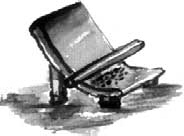
Metate
A FEW AMERICAN products were rejected. “Not very good” was the judgment of Antonio Pigafetta, who sampled cassava on Magellan’s voyage. The Basques, like other Europeans, were cautious about eating roots and tubers. The Arawak taught Columbus to make bread from grated cassava root, but Spaniards and Basques yearned for wheat. Perhaps they were put off by the fact that a poison had to be extracted from cassava before it was edible, and that the Caribs who attacked them poisoned their arrow tips by dipping them in cassava juice.
The potato did not get any better reception. Peruvians who introduced potatoes to Pizarro lessened their appeal by leaving them to dehydrate on brown bald mountaintops above the timberline, which produces bland and blackish things called chuños. Today, Peruvians still mystify outsiders by savoring such potatoes. But even fresh, these dull-colored, irregular lumps did not look promising. Europeans believed that the physical appearance of food indicated hidden properties. Red food cured anemia but caused lust, which led to the Friday ban on red meat. Walnuts enhanced intelligence because they resembled the brain. The potato, it was reasoned, caused leprosy.
Neighboring Galicians were the only ones in Iberia to be excited when the new discovery was brought back to Spain by Pizarro’s men in 1539. They popularized it in Italy but nowhere in Spain. Even after most Europeans had given in and were eating potatoes, though still feeding corn only to pigs, the Basques were doing just the reverse. Basques do not seem to like any tubers. They feed turnips to pigs and seldom eat beets. In 1783, a Bayonne chemist wrote to Antoine-Augustin Parmentier, the French nutritionist who finally persuaded his country to eat potatoes, informing him that the Basques eat corn, not potatoes, and “no province produces healthier, more vigorous people.” The Basques of Alava were broad bean eaters before American beans had arrived, and it was taken as a sign of their Castilianization, along with the decline in the Euskera speaking there, that they tended to replace broad beans with potatoes rather than American beans. Nevertheless, the Basque pejorative for an Alavan, babazorro, broad bean eater, has endured. Alava aside, it was only in the 1940s, during a time of famine following the Civil War, that the potato became a common food in the rest of Basqueland.
ACCORDING TO A popular story, potatoes were introduced to Ireland when some washed ashore from ships of the Spanish armada, blown off course and wrecked on shoals. The story is probably not true because the men of the armada, being predominantly Basque, would not have provisioned with potatoes.
By the late sixteenth century, armadas, fleets of warships, were usually crewed by Basques. Many of the ships of the 1588 Spanish armada that headed for England were Basque whaling vessels requisitioned by Felipe II. One of the commanders, Miguel de Oquendo y Dominguez de Segura, was a Basque from San Sebastián who had begun as a shepherd and then worked his way up at sea as a shipwright. A second commander, Martines de Recalde y Larrinaga, was a Basque shipbuilder.
Martines de Recalde managed to make his way back from the debacle but died of exhaustion soon after. Oquendo, after a long struggle, arrived back in Pasajes with a few surviving ships, including his own Santa Ana, said to be one of the finest ships of the epoch. He also died of exhaustion a few days later.
The Spanish defeat by British gunners in the English Channel was not as decisive a blow as is often thought today. The battle gave the British confidence and weakened that of the Spanish, but it did not alter the naval balance of power, which had already favored the British because they had better gunners. The engagement simply destroyed the myth of Spanish naval power. The Spanish quickly rebuilt their fleet, but so many Basque fishing vessels had been lost that Guipúzcoan long-distance fishing was diminished for a decade.
As wars and treaties reduced fishing and whaling opportunities, the cultivation of corn provided work and drew many maritime Basques into the landed rural life. By the seventeenth century, growing corn, a crop that easily adapted to the mediocre farming conditions of Basqueland, became so profitable that it was thought to be creating a manpower shortage in the fisheries.
It was a hard life onboard Basque ships. Cod fishermen worked months off the Newfoundland and Labrador coast, while whalers went to the Davis Straits between Greenland and Baffin Island. They navigated around uncharted shoals and icebergs, rode out gales, chopped ice off the windward rigging to keep from capsizing. As with all professions of hardship and danger, a distinctive machismo developed. It was considered cowardly to “waste” deck space by stocking lifeboats. Basques in home port would wear a ring-and-chain gold earring to indicate that they had fished a spring-to-fall cod campaign in Newfoundland.
Adding to the danger was the Basques’ peculiar status as an unrecognized nation. Basques pursued their far-flung fishery during centuries in which the French and Spanish were repeatedly at war with each other and with the Dutch and British. While French and Spanish warships were squaring off on the high seas, Basque fishermen, some from French ports such as Biarritz, St.-Jean-de-Luz, Ciboure, and Hendaye, and others from Spanish ports such as Fuenterrabía, Pasajes, and Bermeo, were shipping out together, speaking their common language, in pursuit of whales and cod and the enormous profits they brought. They had little interest in the affairs of France and Spain.
But no one else saw it that way.
The Dutch and British navies attacked and sank Basque fishing boats on their way to and from the North. In 1625, the Compañia de Ballenas de San Sebastián was formed. This San Sebastián Whaling Company built an armed fleet of forty-one ships with 248 rowing skiffs and 1,475 fishermen. But the British continued to seize Basque fishing boats in Canadian waters and force the fishermen into what amounted to slave labor. When the Danish navy could find Basque ships off Iceland and Norway, it would expel them from those waters. As the North Atlantic opened up and became more competitive, North American fishing was increasingly difficult for the nationless Basques. Their 1351 treaty that established the principle of freedom of the high seas had been long forgotten. St.-Jean-de-Luz fishermen turned to the French government, which based four heavily armed warships in their port to protect Basque fishermen going to and returning from North America. In the mid-sixteenth century the Spanish, hoping to destroy French competition for Newfoundland cod, began attacking French Basque ships. Heavily armed ships out of St.-Jean-de-Luz began defending their fishermen. Eventually these ships, Corsaires, became privateers, operating independently but harassing Spanish ships in the service of France. Basque mariners were increasingly being separated into French and Spanish camps.
Spain regarded Basque maritime skills as a valuable strategic commodity to be controlled by the crown. In 1501 the Spanish crown had prohibited Basques from building ships for other nations. The same measure was tried again in 1551. The crown also declared it a capital crime for a fisherman to serve on a foreign ship.
But in 1612, England’s King James I petitioned the Spanish crown to allow Basques to go to England and teach whaling. The first British whaling fleet was established with six Basque officers under contract. The Dutch also recruited Basques, who defied threats by Madrid of both the death penalty and confiscation of all property.
The Basques would have done well to have obeyed the Spanish crown. Instead, by the seventeenth century, the Basques had lost their monopoly on whaling. Once numerous countries had fleets, the European powers gained control of the whaling grounds.
Then, in 1713, the Treaty of Utrecht dealt a blow to the Basque long-distance fishing fleets, from which they never recovered. This treaty, ending the war known in Europe as the War of Spanish Succession and in the Americas as Queen Anne’s War, attempted to give something to each power. The Bourbons got to keep Spain. The Hapsburgs were given smaller nations to make up for the Bourbon victory. The British gained control of Newfoundland and Nova Scotia at the expense of the French, who were only compensated with limited fishing rights.
The result was that the Basques lost access to Canadian waters. They argued for historic fishing rights as the discoverers of the continent and the first to fish it. But power politics, not right of discovery, mattered in the Utrecht negotiations. The Basques who lived in France could use the limited French fishing grounds, but if they were from Spanish ports, as most Basque fishermen were, they had nothing. The king of Spain, having won Spain, did not have to be offered fishing concessions.
But in the long view of Basque history, a more important outcome of the war was that the Basques saved their homeland. The Bourbons, more than previous monarchs, wanted central power over their Iberian realm. They stripped Catalonia, Valencia, and Aragón of their regional privilege. But unlike these provinces, the Basque provinces and Navarra had supported the Bourbons in the War of Spanish Succession and, at this critical era in the formation of Spain, the Basques were allowed to keep their Fueros.
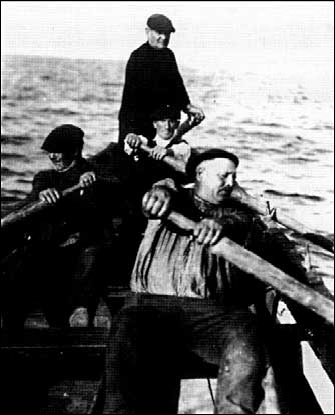
Fishermen off the coast of Guipúzcoa, 1910. (Kutxa Fototeka, San Sebastián)
The old commerce, salt cod and whale, was over. The Basques were driven back to whaling in the Bay of Biscay. In the sixteenth century, Basques had landed several hundred whales a year in Newfoundland and Labrador. Between 1637 and 1801, Zarautz, a major whaling town in Guipúzcoa, landed only fifty-five whales from the Bay of Biscay. By 1785, when the Spanish government decided to form a whaling company and sent an emissary to find a Basque harpoonist, he could not find one.
By then, the Basques had found new opportunities in America. New products would be made into Basque fortunes, and the whale would be forgotten. Whales themselves were vanishing from “the Basque Sea.”
THE HOT PEPPER or the bean may be the American product that best shows the Basques’ genius for cooking, but the cocoa pod is the one that reveals their commercial skills. By the end of the seventeenth century, affluent Europeans craved chocolate, were addicted to it, some said. The leading producer of cocoa was the Spanish colony of Venezuela, and the principal purveyors were the Dutch, who, enjoying a near-total monopoly, were able to demand extremely high prices.
In 1728, in yet another example of the confidence and ambition of the Basques, a group of wealthy Guipúzcoans, led by Francisco de Munibe, the count of Peñaflorida, formed a Basque company, the Real Compañia Guipúzcoana de Caracas, the Royal Guipúzcoan Company of Caracas, to compete in the Venezuelan cocoa trade. The seventeenth-century Dutch West India Company had built a trade empire along the Atlantic coasts of Africa and the Americas. The British had established trading companies to dominate North America. If the British and the Dutch could have trading companies dominating sectors of American commerce, why not the Basques?
The company attracted private investors as well as the city of San Sebastián, the province of Guipúzcoa, and even the Spanish crown, which was enthusiastic about the idea of breaking the Dutch cocoa monopoly in a Spanish colony. But it was essentially a Guipúzcoan company. The five directors were required to have San Sebastián residence, and most investors were from the province, as were the majority of sailors.
At first the Real Compañia Guipúzcoana de Caracas struggled to find suppliers and the necessary contacts in Venezuela. The first ships were not sent for two years, until 1730. But once the company secured enough cocoa, it was able to get an ever-increasing share of the world market, and as its business strengthened, so did its standing in Venezuela, until it became the company with which producers sought contracts. Because Basque ports were not in the Spanish customs zone, they could operate like a free zone for trade in the rest of Europe.
This had a huge impact on the Basque economy, especially at the ports of San Sebastián and Pasajes. Stores, warehouses, commercial houses prospered. Shipbuilding boomed, especially in the company’s own shipyard in Pasajes. The Royal Company alone operated forty-eight ships. In the first decade, it paid the investors dividends from 20 to 25 percent.
From cocoa, the Real Compañia Guipúzcoana de Caracas expanded to leather, coffee, and tobacco. It was the company’s shipments of Venezuelan red beans that made them a staple in Tolosa. It also shipped turkeys, which became a mainstay of the Guipúzcoan diet. In 1751, it even tried to bring back whaling, resurrecting the seventeenth-century Compañia de Ballenas de San Sebastián and sending two armed whalers to the South Atlantic and the Pacific. One returned empty, and the other was forced to turn back for repairs.
But the company was not only concerned with bringing goods to San Sebastián and Pasajes. It also sold Basque goods in the colonies. A fundamental concept was that the ships should be full in both directions. It was still a dangerous fifty-to sixty-day crossing. Basque iron products, weapons, chemical products, sardines, and construction wood were shipped to Caracas. Other Basque provinces, and especially Navarra, began to see the opportunity the company offered. Navarrese wine was shipped to Latin America. Other regions of Spain began to do business with the Royal Company. Valencia shipped silk and ceramics; Aragón shipped cotton; Catalonia shipped textiles and manufactured goods. And ports all over Spain received cocoa and other goods from the Royal Company.
In 1751 the company seat was moved to Madrid. But it did not operate as a Spanish monopoly. Its owners were the first pan-Europeans, caring little about the arbitrary borders that split up the continent. At the dawn of capitalism, the Royal Guipúzcoan Company of Caracas became a multinational. Deeply involved in inter-European trade, it had relations with the French, Dutch, and Germans and even operated some ships out of French ports. And French ships brought hams, flour, and other agricultural products to Pasajes to sell to the Royal Company. The company shipped a great quantity of French flour to the Latin American market.
Wanting a share of all profitable commerce of the epoch, the company even attempted to enter the slave trade but, finding the monopolies by European powers in their own Caribbean colonies to be unbreakable, it had to give up this plan.
In 1766, Xabier María de Munibe, the son of one of the founders of the Royal Guipúzcoan Company, founded the Real Sociedad Bascongada de los Amigos del País, the Royal Basque Society of Friends of the Country, an eighteenth century think tank that, in addition to studying everything Basque from science and engineering to gastronomy, discussed and promoted the precepts of modern capitalism.
In this new age of capitalism, the Basques were demonstrating what their British contemporary, Adam Smith, would write about decades later. It was Smith’s contention in his 1776 bible of capitalism, The Wealth of Nations, that the wealth of a country was not the gold that it held but the goods and services it provided. When Smith was articulating this theory, he took the example of Spain. The nation was in precipitous decline after centuries of trying to enrich itself by extracting wealth, often literally gold, from its Latin American holdings. What Smith, however, did not go on to say—but which illustrates his point exactly—is that while Spain was wasting its energies amassing American gold, the Basques generated affluence throughout the Iberian peninsula by providing goods and services to and from Latin America.
Another lesson in capitalism practiced by the Basques and later espoused by Smith: Having broken the Dutch cocoa monopoly, the Basques caused the price of chocolate to plunge. Far from causing a crisis, the almost halved price made chocolate more accessible and greatly expanded the market, making the trade far more profitable than it had been under Dutch price fixing.
The company produced spin-offs such as the Real Compañia de Habana for trade with Cuba and another for trading with the Philippines. Lasting fifty-six years, the Royal Guipúzcoan Company of Caracas had an enormous impact not only on Basqueland but on Latin America. It greatly facilitated the Basque dream of making a fortune in America, but the prosperity that it brought to Caracas, as well as the unbridled exploitation, also had much to do with the Spanish loss of colonies and the creation of an independent Venezuela. In 1749, a violent uprising against the Royal Guipúzcoan Company erupted in Caracas. To avoid further uprisings, producers were paid better, causing dividends to drop to only 5 to 10 percent.
Ironically, the aspirations of these South American rebels were realized a generation later by the father of Latin American independence, Simon Bolivar, El Libertador, who was born in Caracas in 1783 to a Vizcayan family that had grown wealthy in South America.
But it was in Basqueland itself that unrestrained capitalism and the emergence of a new wealthy class were creating a rift that would lead to more than a century of civil war.