
CHAPTER 7
INTRODUCTION
CHRISTMAS 1867 arrived in the midst of a depression. But that year the New York Times interrupted its standard admonition about remembering the plight of the city’s poor in order to offer a plea on behalf of a still worthier object of seasonal charity. There was already enough “ostentatious benevolence” directed at the urban poor in New York and other Northern cities, the paper admonished—“cities which, despite depression, are yet wealthy and happy.” So the arrival of Christmas might better serve to remind Americans of a forgotten portion of American society that was destitute indeed. It was the South—the defeated South. In that benighted region “a merry Christmas will not be known anywhere.” The newspaper painted a sorry scene: “Despair, or something like it, reigns in the mansions, and destitution is supreme in the hovels. Grim poverty makes its presence felt everywhere. Those who were once rich find themselves menaced by want, and those who, though always poor, were always provided for, now find themselves hungry and helpless.”
The Civil War had ended less than two years earlier, and a short-lived effort to force the “Radical Reconstruction” of the South was barely under way. But the New York Times seized this occasion to make a plea for sectional reconciliation between the vanquished South and the victorious North. More precisely, the plea was for reconciliation between the respectable white populations of the two regions. When the Times spoke of the South’s “poor” who lived in “hovels,” it was referring to ex-slaves. That was why it made the point that in the past the poor had “always been provided for.” Slavery itself had ensured the physical well-being of those in bondage; the system had generated a “bond of sympathy” that “held these classes together.” But emancipation had severed that bond. The result was racial tension that could, if it were not defused, easily exceed in severity any class conflict that existed in the Northern states.
In other words, it was not the poverty of the South’s black population that chiefly unsettled the New York newspaper writer. What really bothered him was the potential consequences of that poverty—consequences that might even involve racial violence. Southern whites were filled with “vague apprehension” about what might happen; for their part, the region’s black population was making demands—“demands that yield not to reason.” Those unreasonable demands were for social and economic justice. And the effect was a dark uncertainty: “Neither side knows what is coming. The blacks will not accept freedom as a substitute for food, and the whites are fearful of the excesses to which famine-stricken ignorance not seldom yields.”
It was Christmas that underlined this grim situation. Not only had Christmas been a time of charity and generosity on the part of white people in the slave South, it had also been a season of special joy for the slaves themselves—a time when the “bond of sympathy” between the races was most evident. The picture of harmonious Christmases under slavery offered an instructive contrast to the present state of things:
Slavery then put on its holiday garb. There was feasting and merrymaking everywhere [in the slave community]…. The bondsmen for the time forgot their bondage, and for a week gave themselves up to the rollicking enjoyment in which Sambo distances all competitors.1
It may seem insensitive for a Northern newspaper to argue that former slaveholders in the South required more sympathy than did unemployed workers in the North. And even that insensitivity might seem to pale in the face of the paper’s cynical use of Christmas as a way of pointing out the social benefits of slavery to black people. Still, this Northern newspaper was not alone in noting that the Christmas season was a time of special resonance in the slave South. For decades, Southerners themselves had been doing the same thing, and they would continue to do so for several decades more. And what makes the point even more striking is that it was made by black as well as white Southerners.
Many African-Americans wrote about their experience of Christmas under slavery, and it is difficult to avoid sensing the importance they attached to this holiday in clarifying what they had to say about slavery itself. Three of the best-known individuals who had been raised as slaves chose to focus an entire chapter of their autobiographies on a discussion of Christmas. Writing from very different positions on the ideological spectrum, both Frederick Douglass and Booker T. Washington described Christmas under slavery as an occasion on which slaveholders systematically degraded African-Americans by encouraging them to get drunk. And Harriet Jacobs, in her fictionalized autobiography, Incidents in the Life of a Slave Girl, poignantly described a Christmas she spent as a fugitive hiding in the crawl space of a house in Edenton, North Carolina, trying to evade an owner who desired to make her his concubine.
The fact that slaves themselves took their Christmas experiences so seriously suggests that we might, too. Indeed, by exploring the meaning of this holiday in a slave society, we can deepen our understanding of what happened when a familiar set of rituals were practiced under conditions of extreme inequality. For these rituals do turn out to be familiar, though they emerged from the very different world of early-modern Europe. The examination of Christmas rituals in a slave society therefore provides an intriguing lens through which we can view similar rituals in the peasant cultures of European society. It allows us to see more clearly how Christmas rituals there, too, could serve as underpinning for enormous inequalities of power and wealth. It brings us, in a sense, full circle from the place where we began.
A WHITE CHRISTMAS: HOLIDAY SEASON IN THE BIG HOUSE
When we think of Christmas in the Old South we commonly think of elegant dinners and romantic plantation balls. Just as Washington Irving’s evocative stories about Christmas on the fictional English estate at Bracebridge Hall helped define the image of a traditional Christmas for generations of Americans, so, too, did scores of postbellum Southerners write nostalgically of what Christmas had once been like in old Dixie. Several Southern writers actually used Irving’s sketches as their models. One even attempted to convey the flavor of a typical Christmas dinner in colonial Virginia by quoting verbatim a passage from Irvings picture of Christmas dinner at Bracebridge Hall!2
The romantic associations of Christmas in old Dixie are misleading not only because they usually ignore the experience of the slaves but also because they misrepresent the experience of white people. Like the inhabitants of early-modern Europe, or of any agricultural society in a nontropical climate, planters in the antebellum American South took late December as their major season of heavy eating, boisterous drinking, and letting off steam. The harvest was complete, there was relatively little work to be done, and plenty to eat and drink. Once again, the parallels to Washington Irving are telling. Irving’s account of Christmas at Bracebridge Hall, like the myth of Christmas in old Dixie, retained the drinking; but the drunkenness was gone. The elaborate paternalist rituals of the gift exchange remained, but the aggressive stepping out of ordinary behavioral bounds and social roles had been forgotten. Wassailing was preserved, but it had been transformed from a rowdy begging ritual into jolly songs of goodwill.
But Christmas meant carnival in the antebellum South. As early as 1823 a rural white Southerner attacked the Christmas season for being a “general scene of dissipation and idleness.” Some folk spent the time making “rough jokes.” “Apprentice boys and little negroes” fired guns and crackers. And everyone—“parents, children, servants, old, young, white, black, and yellow”—drank hard. “And if you inquire what it is all for, no earthly reason is assigned …, except this, ‘Why man! It is Christmas.’”3
At the time, everybody commented on how much Southern whites drank during the Christmas season. Northern visitors (especially those of a temperance bent) were particularly offended by it. One of them claimed that “[sjudden calls for the doctor to attend cases of delirium tremens … were numerous during Christmas.” But Southerners reported it themselves, in diaries, letters, and newspapers. It is clear that people—women among them—commonly began drinking at breakfast. Amanda Edmonds of western Virginia did so year after year in the late 1850s and 186os. In 1861 the first thing she did in the morning was to have “a joyful eggnog drink—I really got tight. The first signs of Christmas that I’ve seen.” Nor was the drinking restricted to adults, as one Northerner reported: “The good cheer of the occasion descended almost to dissipation, and I, unaccustomed to the conviviality that prevailed, looked on with apprehension, when egg-nog, punch, and toddy were freely served to the children.”4
The drinking was still going on in Norfolk, Virginia, in the 1870s, where the local newspaper regularly commented on the number of arrests made for disorderly conduct on December 25. Part of the reason was that alcohol (and food) was being served gratis, in an unmistakable example of the “open house” long expected of British landlords and tavern keepers at Christmas. Even the local newspaper was offended: “The various barrooms and restaurants in the city treated their customers to egg-nog, apple toddy, lunch, &c.”
The alcohol did its usual work, releasing the inner spring of ordinary behavioral constraint. “During the entire day crowds of men and boys paraded the streets—the former drinking at every bar they saw, and the latter firing crackers and torpedoes and blowing those inevitable horns.”5Noise-making was another essential ingredient of the Southern white Christmas, especially the firing of guns (and firecrackers, their symbolic representations). As early as 1773 one visitor recorded in his diary that “I was waked this morning by Guns fired all around the House.” Two generations later, the practice was still so common that the young Robert E. Lee was able to allude to it when asking a recently married woman friend a rather personal question about her wedding night: “Did you go off well like a torpedo cracker on Christmas morning?”6
The noise-making and the drinking were part of a larger picture, in which normal behavior was forgotten and normal social relationships were turned on their heads. Young women like Amanda Edmonds were permitted to step outside their gender roles and get drunk first thing in the morning; and young men were permitted to step outside their age roles and act as if they dominated space ordinarily allotted to their elders. This is how one Southerner described the scene in 1868:
It was the custom, and still is, in the more isolated communities, for a crowd of young men to band together, and with guns and every sort of instrument of music, or of noise, go “Christmasing” among their neighbors. It was great sport to frighten off the fiercest dogs with their racket. If the proprietor heard them coming and got the first shot it was their treat [i.e., they had to give him a gift]; but they generally stole up quite noiselessly, and opened fire and called out, “Treat! treat!” as they marched around his dwelling with their discordant music. This was called “serenading and shooting up.”7
The writer may not have realized this, but less than a century earlier the British would have given it another name: They would have called it wassailing.
William Nevison Blow, whose family had been the major landowners in an isolated county of antebellum Virginia, remembered from his boyhood the way Christmas transformed virtually every social relationship. The holiday would begin on Christmas Eve, with the preparation and consumption of eggnog. Then, at midnight, the boy would hear the sudden eruption of gunfire from every direction, and the responsive howling of many dogs. Soon “the [entire] County is awake and Christmas has come.” Christmas Day itself would begin with early-morning eggnog and culminate in a semidrunken fox hunt. This was no ordinary fox hunt but a promiscuous episode of misrule that attracted men and boys from the entire county—rich and poor, white and black: “the word Christmas is a talisman that levels all barriers.”
The fox was all but irrelevant to this hunt. The hunters, perhaps 100 in all, along with their 200-odd dogs, constituted a collective mob of noisy revelers, “yelping, howling, shouting, singing and laughing.” By midafternoon the exhausted participants would conclude the hunt and begin the first of an extended series of Christmas dinners that would go on for two full weeks. Each day was structured like the first—a hunt followed by a dinner, each accompanied by alcohol. But with every passing day the leveling process was taken even further. On the second day of Christmas, some of the fox hunters, instead of returning to their homes, would spend the night at the house where they had taken their dinner. Then, the next morning, that group would leave together “to continue the hunt, dine, sleep and dance with another member of the hunt and move on, so that at the end of a week they have visited half a dozen neighbors and find themselves twenty miles from home.” What resulted was a generalized open house that obliterated the boundaries of individual families and reconstituted the entire county as a single vast household.8
As in the North, such practices came under scrutiny, though less sharply. By the 1840s, and probably earlier, the Southern-plantation gentry had begun to reform their Christmas customs—to replace open houses with more exclusive parties for invited guests. But even among the gentry this change was slow and imperfect. Susan Dabney Smedes, the daughter of a Mississippi planter, remembered that her family’s plantation house “was crowded with guests, young people and older ones too,” and that “no one in the neighborhood invited company for Christmas Day, as, for years, everybody was expected at Burleigh [plantation] on that day.” But it is not wholly clear whom Smedes meant by the word “everybody,” since she quickly added that her father held a second party as well, this one intended specifically for the lower orders: “On one of the nights during the holidays it was his custom to invite his former overseers and other plain neighbors to an eggnog-party [emphasis added].”
In fact, Mr. Dabney used the preparation of the eggnog as a ritualized display of paternalist condescension: “In the concoction of this beverage he took a hand himself, and the freedom and ease of the company, as they saw the master of the house beating his half of the eggs in the great China bowl, made it a pleasant scene [even] for those who cared nothing for the eggnog.”9 Here was a quintessential ritual of Christmas social inversion, where the “master of the house” graciously makes a symbolic gesture of deference to his dependents: by inviting them into his house; by publicly helping to prepare the food he serves them; and by offering them a dish that was lavish, rich, and special. (Besides getting people drunk, eggnog was a luxury item, a blend of special ingredients—whiskey, eggs, sugar, and fresh cream.) We shall encounter another instance of the highly formalized preparation of eggnog, and for the same ritual purpose—although the recipients of that ritual will not be white.
CHRISTMAS IN THE QUARTERS: GESTURES OF PATERNALISM
The resemblance between Christmas in the antebellum South and Christmas in early-modern Europe is clear enough. Present in both cases is the same carnival atmosphere, the intense (and extended) season of public revelry, the lifting of ordinary behavioral constraints, the stepping out of ordinary roles in the social hierarchy, the face-to-face giving of presents by the high-in-status to their poorer dependents. But there is one striking difference between Christmas in these two societies: In the antebellum South, the axis along which all these holiday rituals were practiced was, above all, that of race.
Liberty
For the great majority of slaves, Christmas was marked by the same sanctioned relaxation of normal behavioral constraints that we have already encountered among whites. As the New York Times would point out in 1867, Christmas was the one time of year when slaves were released from the obligation to work, usually for several days. They became, in a sense, free—free from labor, free to do whatever they wished, free even to travel off their masters’ property. One Northerner, living on a plantation as a tutor to the owners’ children, reported that “[throughout the state of South Carolina, Christmas is a holiday, together with 2 of the succeeding days … especially for the negroes. On these days the chains of slavery … are loosed. A smile is seen on every countenance.”10
The three days of holiday this man noted were, if anything, at the low end of the normal range, which probably ranged from three days to a full week. But a number of slaveholders went outside this range. Some gave only Christmas Day itself as a holiday;11 a very few allowed no holiday at all.12 At the other extreme, in one part of Missouri (a border state) it was customary to permit more than five weeks of freedom—from Christmas Day until February 1. A slave from this area later recalled: “During Christmas time and de whole month of January, it was de rulin’ to give de slaves a holiday in our part of de country. A whole month, to come and go as much as we pleased and go for miles as far as we wanted to, but we had better be back by de first of February.”13
Of course, the very expectation of holiday leisure could easily be manipulated by slaveholders for their own purposes. The historian Eugene Genovese points out that slaveholders used the promise of Christmas as an incentive to help get the plantation cleaned up after the harvest had been gathered. And there was always the threat of withholding holiday privileges if the slaves displeased their master. But this was done very rarely. Genovese writes: “Throughout the South … the slaves claimed those arrangements sanctioned by local custom and generally got their way.”14*
Frederick Douglass, who had been raised as a slave, offered an explanation of why planters sanctioned this custom. He argued that planters were forced to offer Christmas holidays in order to prevent insurrection, and that the practice actually served white self-interest by providing a safety valve (his own term) to contain black discontent. Douglass wrote:
From what I know of the effect of these holidays upon the slave, I believe them to be among the most effective means in the hands of the slaveholder in keeping down the spirit of insurrection. Were the slaveholders at once to abandon this practice, I have not the slightest doubt it would lead to an immediate insurrection among the slaves. These holidays serve as conductors, or safety-valves, to carry off the rebellious spirit of enslaved humanity.15
Douglass was making a large claim for the importance of Christmas in slave society. Whatever the truth of his contention that without such a holiday the South would be gripped by a series of strikes and revolts, Douglass’s argument was based on a broadly shared assumption: Christmas was something that mattered a great deal in the slave community.
Misrule
Slaves made many uses of their “liberty.” They might merely rest from work or sleep in.16 They might travel, visiting family and friends on nearby plantations.17 They might spend the time attending religious revival meetings. Or they might use the time to take advantage of a rare moment of economic autonomy, making wares that they could sell in the market or selling whatever goods they had managed to produce or grow during the previous year. (This latter privilege was based on an informal tradition that any fruit of a slave’s labor at Christmas belonged to the slave himself—once again, an inversion of ordinary rules.)
But perhaps the activity that was most frequently reported and remembered involved revelry: eating, drinking, dancing, making noise, and making love. Solomon Northup, a free black who was kidnapped into slavery in Louisiana, later wrote of Christmas as “the times of feasting, and frolicking, and fiddling—the carnival season with the children of bondage … the only days when they are allowed a little restricted liberty, and heartily indeed do they enjoy it.” A white Southerner used the same term, calling Christmas “the time of the blacks’ high carnival;” while another white man described the period as “times of cramming, truly awful…. [?]hey stuffed and drank, and sang and danced.” The wife of ex-U.S. president John Tyler wrote in 1845 that the family’s slaves “have from now a four days’ holiday and have given themselves up completely to their kind of happiness—drinking, with nothing on earth to do.” An anti-slavery Northerner was less accepting of the situation and used his disapproval to point a finger: “Ah! white man! [at Christmas] the digger’ gets as drunk as you! Rum is an ultra-democrat—it levels down!” (What this man failed to recognize was that from the perspective of the white Southerner, such leveling-down was one of the ritual purposes of the drinking. And what he did not point out was that on most plantations slaves were forbidden to drink at any other time of the year.)18
It seems clear that the constant drinking and dancing—it often lasted through the night—led to intensified sexual activity. This matter was rarely addressed directly in the descriptive accounts, but it is suggested both by the surviving texts of slave Christmas songs and by the entries in plantation record books that indicate the phenomenon of “grouped” slave marriages during the Christmas season. Young John Pierpont of Boston confided to his diary that “[n]o restraint is imposed upon their inclinations, no lash calls their attention from the enjoyment of all those delights which the most unrestrained freedom proffers.”19
More than one visitor explicitly described the slave Christmas as a modern version of the old Roman Saturnalia. John Pierpont noted that it “might more than compare with the bacchanal feasts and amusements of antiquity.” A reporter publicly wrote that Christmas was “the great gala season of the negro. It may be likened to the saturnalia of the Romans.” (Then, not wishing to undercut his favorable picture of the slave system by going too far for middle-class tastes, he added that unlike the original Saturnalia, the slaves’ Christmas was “modified by decency and decorum.”) Another writer, too, termed the occasion a “grand Saturnalia,” and suggested something of what this amounted to in language whose euphemisms were not intended to conceal the author’s meaning: “From three to four days and nights are given as holiday, during which every indulgence and license consistent with any subordination and safety are allowed…. [A]ll society seems resolved into chaos….”20 Christmas in the quarters, it seems, was indeed a season of misrule.
Not all slaveholders tolerated such behavior. Some felt that it was unchristian; others considered it a threat to good order.21 But the great majority seem to have gone along, if only because they still accepted the notion that Christmas was a ritual occasion when normal behavior was supposed to change, and when even the “low”—in fact, the “low” especially—were expected to live well. Of course, as anthropologists are well aware, even that notion was based on the understanding that such ritualized inversions of ordinary behavior also served to affirm and reinforce the primacy of ordinary behavior at all other times. In the case of Southern slavery, “ordinary behavior” meant constant sobriety and hard work. Some white Southerners openly argued that allowing their slaves the liberty to engage in seasonal excess was actually a means of maintaining good order and productivity. One Alabamian, writing in 1852, argued: “Some will say that this plan will not do to make money, but I know of no man who realizes more to the hand than I.”22
It was Frederick Douglass who voiced the most powerful argument that owners allowed slaves to drink and lose their self-control at Christmas as a means of preserving white hegemony—indeed, that owners actively encouraged such revelry. Douglass acknowledged that the majority of slaves spent the Christmas holidays “drinking whiskey,” and he added that this, as well as other forms of excess, was just what their masters wanted:
Their object seems to be, to disgust their slaves with freedom, by plunging them into the lowest depths of dissipation. For instance, the slaveholders not only like to see the slave drink of his own accord, but will adopt various plans to make him drunk…. Thus, when the slave asks for virtuous freedom, the cunning slaveholder, knowing his ignorance, cheats him with a dose of vicious dissipation, artfully labeled with the name of liberty. The most of us used to drink it down, and the result was just what might be supposed: many of us were led to think that there was little to choose between liberty and slavery. We felt, and very properly, too, that we had almost as well be slaves to man as to rum. So, when the holidays ended, we staggered up from the filth of our wallowing, took a long breath, and marched to the field,—feeling, upon the whole, rather glad to go, from what our master had deceived us into a belief was freedom, back into the arms of slavery.23*
Frederick Douglass was by no means alone in believing that Christmas excess was demeaning to the slaves. But most of the African-Americans who shared his distaste chose to express their response in pious Christian terms. On plantation after plantation, religious revivals (run by Baptists or Methodists) vied with festive revels as the activities of choice among the slaves. Allen Parker, a former slave from North Carolina, recalled: “In some other cabin, perhaps on the same plantation, while the young people were dancing, the old ones would be holding a prayer ‘meetin’,’ notice having been sent out as in the case of the dance….” Susan Dabney Smedes recalled a wholesale religious conversion that completely put an end to dancing on her grandfather’s Mississippi plantation. She fondly recalled those Christmases when, all day and all night too, she would hear “the sound of the fiddles and banjos, and the steady rhythm of their dancing feet”:
But a time came when all this [slave revelry] was to cease. The whole plantation joined the Baptist church. Henceforth not a musical note nor the joyful motion of a negro’s foot was ever again heard on the plantation. “I done buss’ my fiddle an’ my banjo, an’ done fling ’em ’way,” the most music-loving fellow on the place said to the preacher, when asked for his religious experience.24
Some planters shrewdly feared that such evangelical reform could pose a threat to their authority, and they took steps to counteract it. James Hammond of South Carolina reminded his slaves that “[c]hurch members are privileged to dance on all holyday occasions; and the class-leader or deacon who may report them shall be reprimanded or punished at the discretion of the master.” The autobiography of ex-slave Jacob Stroyer suggests that some masters went even further: “A great many of the strict members of the church who did not dance [at Christmas] would be forced to do it to please their masters.” (And, he adds poignantly: “No one can describe the intense emotion in the negro’s soul on those occasions when they were trying to please their masters and mistresses.”)25
Not surprisingly, the religious meetings attended by slaves bore a certain resemblance to the very revels they were meant to replace. Like the Christmas dances, the Christmas revival meetings often lasted all night; like the dances, too, they were characterized by ecstatic feelings that were partly generated by rhythmic singing and the stamping of feet.26 It was for this reason that when New England reformers, attempting to assist liberated slaves during and after the Civil War, encouraged the freedmen to hold religious services at Christmas, these reformers were sometimes shocked by the result. One such person, spending Christmas, 1862, with Colonel T. W. Higginson’s black regiment at the newly liberated Port Royal, South Carolina, was startled at the soldiers’ 'text-align:justify;line-height:14.4pt'>The religion of these coloured people is very demoralising. It has no connection with moral principle. They have just had a “three days’ meeting” in the old stolen schoolhouse, and made night hideous with their horrible singing and prayers, and dancing in a wild, savage way. The noise and shuffling and scraping can be heard in every direction, and our house, though not very near, seems almost shaken by their dancing.27
Gifts
Christmas misrule entailed even more than leisure and “liberty.” It also meant a symbolic turning of the tables between masters and slaves. Christmas was the one occasion of the year at which plantation owners formally offered special presents to their human chattel—the high deferring to the low. It was a rare planter who did not give something to his slaves at Christmas. At a minimum, the gifts were small—the kind of things we might dismiss today as trinkets but which the slaves had good reason to value: sugar, tobacco, or hats; along with ribbons, bandannas, and other decorative items for the women. Some slaveholders distributed money. An especially lavish (and ostentatious) example of this practice was reported by Richard Jones, a former slave from South Carolina, whose account also reminds us of how demeaning such ritualized generosity could be:
Marse allus carried a roll of money as big as my arm. He would come up to de Quarter on Christmas, July 4th and Thanksgiving, and get up on a stump and call all the chilluns out. Den he would throw money to ’em. De chilluns got dimes, nickels, quarters, half-dollars and dollars. At Christmas he would throw ten-dollar bills. De parents would take de five and ten dollar bills in change, but Marse made dem let de chilluns keep de small change. I ain’t never seed so much money since my marster been gone.28
Often, slave owners provided much of the food and drink that made the slaves’ festive parties possible. Alcohol was standard at these frolics, often as much as the slaves could consume during the course of the holiday. William Aliston’s agent in Charleston wrote in 1815: “I send also two Demijohns of Whiskey for the Negroes at Christmas….” (Remember that alcohol in any amount was forbidden to slaves except on this occasion.) Gifts of food, often fine food, usually accompanied the liquor. Former slaves remembered with pleasure, even many years later, the special food they had received at Christmas. “Oh, what a time us Niggers did have on Christmas Day!” recalled Georgia Baker during her old age in the 1930s: “Marse Lordnorth and Marse Alec give us everything you could name to eat: cake of all kinds, fresh meat, lightbread, turkeys, chickens, ducks, geese and all sorts of wild game. There was always plenty of pecans, apples and dried peaches too at Christmas.” Solomon Northup, a free black who was kidnapped into slavery in Louisiana and later wrote an account of his misfortunes, was willing to wax nostalgic over the wonderful food with which he and his fellow slaves had been “furnished” on Christmas: In addition to biscuits, fruit preserves, and all kinds of pies, Northup remembered that “chickens, ducks, turkeys, pigs, and not infrequently the entire body of a wild ox, are roasted.” For one wealthy South Carolina planter a single ox was not enough: “On the morning of Christmas, Col. Alston gave orders that as many beeves might be butchered as to supply all with meat, which as a general thing is not allowed them. No less than 21 bullocks fell sacrifices to the festivity.”29
What these accounts make plain is that what many planters did for their slaves at Christmas was exactly what landed gentlemen in Europe had long been expected to do for their dependents on this occasion: offer them the best food, food from the private stock, the same food that would ordinarily be shared only with family and invited guests. An 1857 article on “Christmas in the South” that appeared in Frank Leslie’s Illustrated Newspaper was certainly exaggerating the picture, but not inventing it, when it reported that the slaves consumed the kinds of dishes “that would create a sensation at a palatial residence wedding party”:
On these occasions the culinary resources of the “great house” are brought into requisition, and “young mistress” spends many hours in the kitchen superintending the production of rich cakes and other delicacies which now garnish the plentiful board of festive plantation life.30
One former slave later recalled that “On Christmas de marster would give us chicken and barrels o’ apples and oranges.” (But he went on to put the matter in cooler perspective: “‘Course, every marster weren’t as free handed as our’n was…. I’se heard dat a heap o’ cullud people never had nothin’ good t’eat.”) Still, slaves eagerly awaited their Christmas gifts. One later recalled his feelings of intense anticipation in terms that almost had the ring of “A Visit from St. Nicholas”:
That night their slumbers were filled with dreams and visions of new suits, new shoes, new caps and new dresses. These things were not given out until Christmas morning. And while this glad day was perhaps only a month off, yet the month seemed longer, the days seemed longer and the nights seemed longer than at any other season of the year. The anxiety, the longing and the solicitude for the dawn of Christmas morning is indescribable.31
Of course, the intensity of that longing also suggests what the slaves’ diet was like the rest of the year. One slave made it plain that the meat he and his fellows received on Christmas constituted their entire annual allotment: “they never had meat except at Christmas, when each hand on the place received about three pounds of pork.” Another told an interviewer that he had “‘not tasted meat since last Christmas.’”32
And the expectation of special gifts (like the expectation of holiday time itself) raised hopes that could be used for purposes of social control, by the threat of withholding some or all the gifts if the planter’s rules were broken. The historian Kenneth Stampp notes that “the value and quantity of the presents often depended upon their conduct during the past year.” And planters themselves openly confirmed the point when they listed the rules they used to regulate the lives of their slaves. One noted that if he discovered any of his slaves drinking alcohol during the year, the standard punishment he imposed was “a whipping and a forfeiture of… five dollars next Christmas.” Another planter punished all his slaves at Christmas for petty thefts that had been committed during the previous year: “if a depredation is committed, no matter by whom, my negroes are [collectively] responsible for it, and double its value is deducted from the Christmas present.” This planter’s standard gift for his slaves consisted of corn, so he was able to boast that “a few barrels of corn are made the means of saving my property to perhaps ten times the amount the whole year; and I am also spared the painful necessity of frequent chastisements.”33
That dismissive comment about “a few barrels of corn” suggests another, equally cynical use of Christmas gifts—when planters used the ritual of Christmas gift-giving to provide their slaves with necessities (winter clothing, for example). The historian Norrece Jones has pointed this out, adding that “[p]lanters could thus arrange to appear loving and magnanimous before ’their people’—even when furnishing basic necessities.”34
But even when the presents were more special than that (and they usually were), some whites knew very well that this generosity also worked to protect their own interests. Here, again, the dynamics of Christmas in the slave South help to illuminate those in Europe, where, too, the landed gentry expected to get something in return for their generosity: the goodwill of their dependents. (Remember the verses of the old English wassail songs, wishing “master” and “mistress” good health and fortune in the coming year.) E. P. Thompson has shown that landed gentlemen could always try to use a generous handout at Christmas as a way of making up for “a year’s accumulation of small injustices.” In the slave South, one white overseer showed how clearly he understood the meaning of the Christmas gift exchange when he wrote to the planter who employed him: “I killed twenty-eight head of beef for the people’s Christmas dinner. I can do more with them in this way than if all the hides of the cattle were made into lashes.”35
Gestures of Deference
If anyone had cared to accuse Southern slaveholders of resorting to such a cynical strategy, most of them would certainly have rejected the charge. They would have insisted that their actions were wholly sincere, and that their gifts were intended as expressions of goodwill, a demonstration that they considered slaves to be members of their household rather than mere pieces of property. And to prove their paternalist sincerity, they could have pointed out that there was more to their generosity than the gifts themselves, and that the actual distribution of the gifts involved a significant set of gestures dictated by the special nature of the Christmas season—gestures of symbolic deference in which they momentarily became the servants of their own slaves. Ultimately, and in hindsight, the matter of “sincerity” makes little difference. But the gestures are worth examining nonetheless.

Slave Space and Free Space. On this North Carolina plantation (photographed in the twentieth century), the picket fence next to the Big House marked a racial boundary beyond which field hands were ordinarily forbidden to go. Records show, however, that on Christmas Day the slaves were permitted to cross that boundary and to shake hands with the whites—a gesture that signified equality. (Courtesy, North Carolina Division of Archives and History)
On many plantations slaves were asked to approach the Big House to receive their gifts in person from their master and his family (along with the family’s best wishes). Former slaves vividly remembered their childhood experiences. “Them Christmas Days was something else!” one slave recalled. “If I could call back one of them Christmas Days now, when I went up to the [big] house and brung back my checkered apron full! Lord, I was so happy! Great big round, peppermint balls! Big bunches of raisins, we put aprons full on the bed and then went back to the house to get another apron full.” Another reported: “Marse Alec would call the grown folks to the big house early in the morning and pass around a big pitcher full of whiskey, then he would put a little whiskey in that same pitcher and fill it with sweetened water and give that to us chillun.”36 On a few plantations the slaves were even permitted to enter the Big House. One Northern visitor to the Tidewater reported that “they take the kitchen for a ball room and dance all night and sing all day.” William Nevison Blow remembered that “the negroes form a procession leading to the dining room door to greet the ‘old Marster and Missus’ and ‘little Marster and little Missus’ and receive their presents, and the men a dram, for which each returned a toast.” Susan Dabney Smedes remembered that “the negroes in their holiday clothes were enjoying themselves in their own houses and in the ‘great house’ too.” And a former slave reported that on her plantation “on Christmas Day big dinners were given for all the slaves and a few ate from the family’s table after they [the whites] had finished their dinner.”37
More often, it was the other way around: Masters and their families visited the slave quarters to attend the slaves’ own party there. But wherever these scenes took place, in the quarters or at the Big House, some planters and their families used the occasion to make elaborate gestures of deference to their slaves. Frequently they themselves joined in the festivities.38 Just as often, they either prepared the party meal themselves or personally superintended its preparation. Occasionally a master even made the ostentatious gesture of serving the slaves part of the meal himself. One North Carolina slaveholder centered his version of the ritual around the preparation and distribution of eggnog: After the drink was “pronounced right,” it was ceremoniously placed out on the piazza (on a beautiful mahogany table that came from the Big House). At this point the slaves assembled and were ritually handed one glass apiece:
My grandfather knew every one of his negroes, big and little, by name; and his greeting was always personal to each. They came up in couples, according to age and dignity, and the unvarying formula was: “Sarvant, Master; merry Christmas to you, an’ all de fambly, sir!” “Thank you, Jack; merry Christmas to you and yours!”39
If the white men of the planter’s household sometimes prepared the alcohol for their slaves’ frolic, it was the white women of the household who helped to prepare the food. According to one report, the “‘young mistress’ spends many hours in the kitchen superintending the production of rich cakes and other delicacies which now garnish the plentiful board of festive plantation life.” More conspicuously, white women sometimes personally served the slaves the food at their dinner. One plantation diary contains the following succinct entry for December 25, 1858: “Spent the day waiting on the negroes, and making them as comfortable as possible.”40
Whites were aware of the symbolic significance of these gestures of deference. They often referred to the unprecedented degree of “familiarity” between masters and slaves on this occasion. One Tennessee slave owner claimed that at Christmas his “people” were “as happy as Lords.” Another man wrote: “Here all authority and all distinction of colour ceases; black and white, overseer and book-keeper, mingle together in the dance.” Another planter stressed how different Christmas was from the only other holiday he permitted his sixty slaves—the Fourth of July: “The one in July is celebrated with a dinner and whiskey. The Christmas holiday is a very different thing. It lasts from four to six days, and during this jubilee it is difficult to say who is master. The servants are allowed the largest liberty.”41

“Winter Holydays in the Southern States.” This woodcut illustrated a pro-slavery story that appeared in the December 1854 issue of Frank Leslie’s Illustrated Newspaper. The accompanying text offered this description of the activities shown in the picture: “[T]he [white] ladies of the family interest themselves in the amusements and entertainments of the negroes, giving superintendence to the making of pastry, the adornment of the tables, and whatever else will add to the refinement of the festivity. On such occasions, the ‘stately mistress’ and her ‘aristocratic daughters’ may be seen assisting, by every act of kindness, and displaying in the most charming way the family feeling and patriarchal character of our Southern institutions; while the negroes, on their part, never feel that they are duly and affectionately remembered unless the white family, or most of its members, are present, to witness and participate in their enjoyments.” (Courtesy, American Antiquarian Society)
It is difficult to say who is master. Of course, it was not difficult at all. But what is interesting is that these words were published in an article on the “Management of Servants,” not a propaganda piece but a set of rules intended solely as “in-house” advice, so to speak, for the use of the writer’s fellow slaveholders. Believing that such occasions of ritual inversion actually took place is not by any means tantamount to succumbing to nostalgia or pro-slavery ideology. Neither does acknowledging that this was the case mean that the slave system was benign or even fundamentally paternalist. What it does mean is that many slaveholders wished to believe that it was paternalist and benign, and that they were willing to act out their wish on this one, symbolically charged occasion—an occasion that lasted for only a few days each year.
In other words, it was far easier to act out a ritual that produced a symbolic representation of a paternalist society than it was to produce the actual society. And acting out the ritual brought real returns, not just material advantages (in the form of a more pliant workforce) but psychological benefits. By permitting a season of misrule, and performing the requisite gestures of deference, slaveholders were able to affirm that they had fulfilled their personal obligations within a paternalist order. In turn, this permitted them to affirm the paternalist humaneness of the slave system itself, in the face of external attacks (and, sometimes, of their own inner doubts). All this was a big payoff, and at relatively small cost. Consider this extraordinary passage, from a private letter written by a Louisiana slaveholder in 1836:
We have had a “right merrie” Christmas; and I do not know where I have seen such an expression of content and happiness, as my negroes exhibited during the festival. Some of them seem to have their countenances perfectly set to an expression of good humor, and all of them meet me today with a smile and a “happy new year to you, master.” I am much more reconciled to my condition as a slaveowner, when I see how cheerful and happy my fellow creatures can be in a state of servitude, how much I have it in my power to minister to their happiness, and when I reflect that most of the evils of slavery neither result inevitably from it, nor as a consequence, nor are invited by the interest of the master, which is always in accordance with the welfare of his subjects.42
Or this striking statement, presented to the 1824 North Carolina state legislature by Dr. James Norcom of Edenton, North Carolina:
During the Season of Christmas our Slaves … have been in the habit of enjoying a State of comparative freedom…. These festivities are not only tolerated by the whites, but are virtually created by them; for without the aid voluntarily contributed by their masters, their servants would be destitute of the means of making or enjoying them. At such a season, instead of driving these wretched creatures, with cold and unfeeling sensibility from our doors, the heart of charity dilates toward them, & the angel of humanity whispers in our ears that they are entitled to a part of those blessings which their labor has procured us….43
I cite Dr. Norcoms statement for an additional reason: One of his own slaves was none other than the aforementioned Harriet Jacobs, whose autobiography would later describe the Christmas she spent hiding in the crawl space of an Edenton house. And it was from Norcom himself that Jacobs was hiding—he was the man who had tried to force her into sexual slavery. It is not pleasant to think that people like James Norcom were “sincere” in their paternalist commitment to the “freedom” that slaves enjoyed during the Christmas season. But accepting such a possibility sheds some light on how real slaveholders were able to accept the slave system.

Dr. James Norcom. This resident of Edenton, N.C., plays two roles in our story: He was the impassioned defender of the right of slaves to perform the John Canoe ritual, and he was the owner of Harriet Jacobs, a woman he pursued relentlessly in an effort to force her to become his mistress. (Courtesy, North Carolina Division of Archives and History)
And it also serves to illuminate the larger meaning of Christmas. For it is worth wondering whether this was not the same role that Christmas has played in other societies as well, nonslave societies from early-modern Europe to present-day America. A key reason for the enduring popularity of this holiday may well be that it has provided a profoundly ritualized means of helping people to come to terms with their own complicity in a larger system that they realize must breed injustice. That may be as true for a member of the seventeenth-century English landed gentry as it is for a Southern planter. Or, for that matter, for a modern plutocrat who makes generous Christmas donations to a deserving cause.
CHRISTMAS IN THE QUARTERS: SLAVES AS ACTIVE AGENTS
In most of the cross-race rituals I have just described, the slaves themselves appear to be little more than the passive objects of their owners’ largesse. But there is more to it than that. What is intended by the patrons is not always what is taken by the clients. And it should not be surprising that slaves attempted to play a more active role in those rituals, to turn symbolic privileges into real ones—to “appropriate” them, in modern parlance. Two distinguished scholars who have examined similar forms of popular revelry and carnival misrule in early-modern Europe—Natalie Zemon Davis and E. P. Thompson—have shown how European peasants and apprentices appropriated similar rituals, in a process that involved tacit “negotiations” carried on in the context of an unequal set of power relationships. There are indications that the very same thing happened on the slave plantation.
“Christmas Gift!” and Other Games
The form taken by the slaves’ “appropriation” usually involved the dynamic of the gift exchange itself, the exchange of gifts for goodwill. There is a spectrum of ways in which such a ritual can be sealed—from the meekest expressions of thanks and goodwill upon the receipt of a gift (“Sarvant, Master; merry Christmas to you, an all de fambly, sir!”) to the most aggressive combination of demands and threats, in which goodwill is contingent upon one’s demands being met (“Come, butler, draw us a bowl of the best / … /But if you draw us a bowl of the small, / Then down will come butler, bowl, and all.”) While slaves in the antebellum South were not in a position to operate at the most aggressive end of that spectrum, they were sometimes able to approach it.
In the most inoffensive form, slaves (house slaves, at least) might simply enter a room in the Big House on Christmas morning, wish the their masters family a “Merry Christmas,” and wait, becomingly, for their gift. As early as 1773, a Northerner temporarily employed in Virginia recorded such a practice (making it sound—and the parallel is surely no coincidence—much like a bellhop who has just shown some guests to their hotel room):
Nelson the [slave] Boy who makes my fire, blacks my shoes, does errands &c. was early in my Room, drest only in his shirt and Breeches! He made me a vast fire, blacked my Shoes, set my Room in order, and wish’d me a joyful Christmas, for which I gave him half a Bit [i.e., 5½ shillings]. Soon after he left the Room, and before I was Drest, the Fellow who makes the Fire in our School Room, drest very neatly in green, but almost drunk, entered my chamber with three or four profound Bows, & made me the same salutation; I gave him a Bit, and dismissed him as soon as possible.—Soon after[,] my Cloths and Linen were sent in with a message for a Christmas Box, as they call it; I sent the poor slave a Bit, & my thanks.—I was obliged for want of small change, to put off for some days the Barber who shaves and dresses me.44
Slaves commonly made gestures that were more overtly aggressive, if still ostensibly friendly. Often this involved startling the master’s family by making noise in front of the Big House, generally at the crack of dawn. Typically, they did so by shouting “Merry Christmas!” The goodwill latent in that phrase could always be subverted by the manner in which it was expressed. Indeed, this seems to have been a ritually sanctioned way for slaves to get away with rousing white people from a night’s sleep. One white visitor reported in Harpers Monthly:
Just as the light appears they form themselves into a procession, and preceded by a fiddle and a variety of rude instruments, above all of which is to be heard boisterous singing and laughing, they march round the house, crying out at intervals, “Wake up! wake up! Christmas has come!”45
But the commonest form of this ritual was the game of “Christmas gift!” This was essentially a variant of the wake-up call. A former slave described one version of the game: “The cock crowing for sunrise is scarcely over when the servants steal into the Big House on tiptoe so they can catch everybody there with a shouted ‘Christmas gift!’ before the kitchen fire is even started or the water put on to boil for the early morning coffee.” In response, each member of the white family who is thus “captured” must hand over a gift to the slave who has “caught” him or her. Susan Dabney Smedes describes the game with similar affection:
On Christmas mornings the servants delighted in catching the family [i.e., the owner’s family] with “Christmas giffl Christmas giff!” betimes in the morning. They would spring out of unexpected corners and from behind doors on the young masters and mistresses. At such times [she adds in explanation] there was an affectionate throwing off of the reserve and decorum of every-day life.46
The recollections of a onetime Georgia field hand named James Bolton suggest that the custom was not always limited to house servants: “We runned up to the big house early Christmas morning and holler out, ‘Morning, Christmas Gift! Then they gave us plenty of Santy Claus, and we would go back to our cabins to have fun till New Year’s Day.”47
Unlike the practice of simply waiting for gifts to be distributed on Christmas Day, the game of “Christmas gift!” offered the slaves a symbolic moment in which they themselves actively turned the racial hierarchy upside down—an opportunity to step outside their servile roles, to shout at their owners and make a direct demand for gifts. Within the extraordinary limits imposed by the system of chattel slavery, this must have seemed a powerful, if brief, gesture of autonomy.48
What gives the ritual even more interest is its malleability. Within the black community, for example, it became something of a game between the generations rather than the races, with children using it to beg from their elders. And the game also moved from the black to the white community, from the slave quarters to the Big House, as white children imitated black children, waking their own parents on Christmas morning by shouting the words “Christmas gift!”
By the 1830s “Christmas gift!” had become a common intergenerational ritual between white children and grown-ups even outside the South. We have already encountered it in Philadelphia, in Mrs. G.’s story “The Christmas Tree” (see Chapter 5). In the South, Thomas Nelson Page recalled it as a chief pleasure of Christmas in antebellum Virginia. Amanda Edmonds, who lived in Virginia, participated in the practice regularly over a ten-year period, and recorded it in her diary (we have met her before, in connection with getting drunk on Christmas morning). In her 1863 entry, for example, Edmonds wrote: “‘Christmas Gift’ rings louder this morning than for several years. I catch everyone and set the most complete and successful trap for my friend, Mr. Triplett; after his saying last night, he knew I could not catch him for he had a trap for me.”49
Amanda Edmonds was no child at this point; in 1863 she was 24 years old. But—and this is the key—she was still single, and for that reason she continued to occupy the role of a “young person.”50 For the sole determinant of who could appropriately go “begging” at Christmas seems to have been that of dependent status. (For a more detailed discussion of this subject, see Chapter 3.) “Christmas gift!” was, after all, a “domesticated” version of that rowdier, more public custom—which was itself a variant of the old wassail ritual—in which roving bands of youths startled householders at night with gunshots and shouted demands for food and drink. That may be why it proved to be so malleable.
SLAVES SOMETIMES WENT beyond even this ritual in stepping out of character. Planter’s daughter Susan Dabney Smedes phrased this in idealized terms: At Christmas “there was an affectionate throwing off of the reserve and decorum of every-day life.” To demonstrate her point, Smedes herself offered the following anecdote: “One of the ladies of the house had heard an unfamiliar and astonishingly loud laugh under her window, and had ventured to put an inquiring head out [emphasis added].” What the woman saw didn’t quite make sense. It was “one of the quietest and most low-voiced of the maidservants.” The quiet maidservant, realizing that her mistress wished to know what was going on, replied to her tacit question “in a voice as loud as a sea-captain’s.” The words she used only confirmed the point already made by the unfamiliar sound of her voice. They were: “Hi! ain’t dis Chris mus?”51
“Putting on Airs”
Christmas also offered slaves an opportunity to openly imitate—even mimic—white behavior. Stories abound that tell of slaves “dressing up” at Christmas. For the most part this was surely a matter of looking their best at a time when they did not have to dress for work (and when they had often just received gifts of finery). In 1853 one planter noted that as Christmas approached his slaves were all “brushing up [and] putting on their best rigging.” Whites were characteristically amused by the sight of their slaves dressing like genteel white folk. But it could also become a parody of white manners. To grasp what may actually have been happening, we need to penetrate the invariably patronizing tone in which white reporters described these situations. Rebecca Cameron recalled a family slave known as Uncle Robin, who at Christmas “dressed in my greatgrandfathers regimentals, and looking, of course, supremely absurd.”52 We don’t know what was going on in Uncle Robins mind, of course. But putting on the master’s clothing was surely a gesture that carried profound symbolic implications. One example will make the point. In the course of the Nat Turner rebellion, several black men who had just murdered their owners employed the first moments of their freedom to perform this very ritual gesture—they dressed themselves in the clothing of their dead masters, whose bodies were even then lying in the same room.
We can get a hint of what “putting on airs” sometimes meant to slaves by looking at the way they sometimes behaved under those circumstances, imitating the manners as well as the dress of genteel white people. A Northern visitor, listening “to the Christmas revelry that sounded from the negro quarters,” summed up her reaction by writing, simply, that “it seemed almost a burlesque of the performances inside the mansion.”53
The “burlesque” was surely a complex gesture, a mixture of high spirits, mockery, and envy. One patronizing account of Christmas on the plantation, written by a white man in 1854, describes the “assumed refinement” of slaves during the “holiday festivities”:
In these imitations of “white folks,” some “sable [black] wild flower,” that it was supposed had never looked into a parlor, will put on airs that would be quite impressive amidst ton [i.e., high society] at Saratoga or Newport; while a “field nigger” will hit off some of the peculiarities of master, or of an eccentric visitor, that are instantly recognized, but had never been noticed before.54
We might well ask, Who is really getting the last laugh here? And what was really going on in this story, told by Bessie Henry, a white woman from Salem, Massachusetts, in an 1832 letter to her sister back home (Henry was teaching school on a Tidewater plantation near Richmond). After saying the usual things about how slaves behaved at Christmas (“they take the kitchen for a ball room and dance all night and sing all day”), Henry concluded her report by recounting a scene she had just witnessed: “Yesterday I saw one of them pick up an old leaf of a book and fold it up very carefully. I asked him what he was going to do with it. [He replied,] Oh Missus, I jest goin in there [referring presumably to the slave quarters] to hold it up and make tence [i.e., pretense] read and [hear] all the niggers say ‘See, he like white folks, he read.’”55
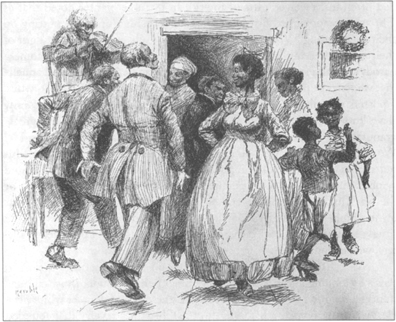
“High Life” at Christmas. A white Southerner’s later recollection of the Christmas dance performed by her family’s slaves. The couple in front have dressed in high style and are imitating—or parodying?—the elegant and coy gestures of the white gentry. A report in one antebellum magazine described the slaves’ “high life” at Christmas in this way: “They now drop their plantation names of Tom, Bill, Dick, and Caesar, Moll, Kate, and Nancy, and use, in addressing one another, the prefix of Mister, Mistress, or Miss, as the case may be; and the highest compliment that can be paid them is to be called by the surnames of their masters.” Interestingly, the very same reversals are described in a 1759 British play, High Life Below Stairs, that was often performed at Christmas in England and America well into the nineteenth century. (Courtesy, American Antiquarian Society)
Bessie Henry reported this story without trying to explain it. The man she wrote about did not do this in order to be observed by white peopie; Henry came upon him as he was taking the sheet of printed paper into the slave quarters. When he was discovered, the slave said simply that he was going to pretend to read. There may have been envy or even ambition in his purpose, but surely there was parody in it (even, perhaps, if this slave really did know how to read). The mimicking of white manners was something whose meaning the whites failed to grasp—just as they failed to grasp the meaning of black spirituals. Both involved what might now be termed “signifying”—a gesture that was intended to appear “cute” to white observers but was laden with an irony that only fellow slaves were able to appreciate.
“John Canoe”: Wassailing Across the Color Line
Finally, in some places the veil of irony was dropped altogether and replaced by ritual encounters that bordered on direct confrontation. Those encounters make up the single most intriguing and aggressive Christmas ritual practiced by American slaves.
“Christmas is coming,” wrote the editor of the Wilmington (North Carolina) Daily Journal on December 23, 1851, and he proceeded to warn his readers to expect “the little and big niggers begging for quarters.”56 What the editor was referring to was a ritual known by the name “John Canoe” (or “John Kooner”). This ritual was practiced only in a single region of the South, the coastal area of North Carolina, from Edenton (near the Virginia line) in the north to Wilmington in the south. (A similar ritual, with the same name, was practiced—and still is—on the islands of the British West Indies, especially Jamaica.)
The John Canoe ritual was described at length by a number of contemporary observers, and it has subsequently been analyzed at some length by modern folklorists. Essentially, it involved a band of black men—generally young—who dressed themselves in ornate and often bizarre costumes. Each band was led by a man who was variously dressed in animal horns, elaborate rags, female disguise, whiteface (and wearing a gentleman’s wig!), or simply his “Sunday-go-to-meeting suit.” Accompanied by music, the band marched along the roads from plantation to plantation, town to town, accosting whites along the way and sometimes even entering their houses. In the process the men performed elaborate and (to white observers) grotesque dances that were probably of African origin. And in return for this performance they always demanded money (the leader generally carried “a small bowl or tin cup” for this purpose), though whiskey was an acceptable substitute. One of the best accounts of a John Canoe ritual was written by a Northern woman—an abolitionist, in fact—who was shocked and embarrassed by what she took to be a degrading display of unabashed begging. Her account was published in 1837 in William Lloyd Garrison’s abolitionist magazine The Liberator:
I was passing to church on this morning [December 25], with a party of ladies in an open carry-all, when we perceived a rabble advancing. The sound of bells, clashing of tin plates, and blowing of stage horns, were all heard, accompanying a loud screaming voice to these words, sung in the peculiar negro accent:—“We bees Jonny Cooner, good masser, missus, chink, chink, and we drink to Jonny Cooner, Cooner.” The gesture to these words was the extending and passing round a hat for the collection of pence.
John Cooner was represented by a slave in a mask, with a tall, hideous figure, twice the length of a natural man, with patches of every shade and color hanging from him, and bells attached to him to gingle [sic] at all his grotesque motions….
Such uncouth gestures, shrieking, dancing, and fighting of boys, who were ragged and without hat or shoes, were enough to frighten our horses as they passed. We were filled with pity and disgust, and felt it a relief, when our little black driver turned down a bye-way, for very shame at the sight. There are grades amongst the slaves, as in all other classes of society; and those who rank highest, will not join in this species of beggary and frolic combined…. My heart sickened when I thought to myself, “Is this the happiness of slaves at Christmas?”57

John Canoe in Whiteface. Also from Jamaica, this eighteenth-century picture shows John Canoe performing a mocking parody of white fashion: He has donned whiteface and is wearing a gentleman’s wig and fancy gloves. (The houseboat on his head was part of the John Canoe ritual in Jamaica, though not in North Carolina.) (Courtesy, American Antiquarian Society)

John Canoe Band. This picture comes from Jamaica, but it suggests something of the aggressiveness of the John Canoe marchers. (Courtesy, American Antiquarian Society)
But Southern slave owners generally did not take offense. In 1824, Dr. James Norcom of Edenton, the future “owner” of Harriet Jacobs, personally defended the custom against the charge that it led to disorder:
Although trifling evils sometimes result from these extraordinary indulgences, they continue to be tolerated and practiced. It is so to be regretted that drunkenness is too common on these occasions; but this also is habitually overlooked and never punished, unless it becomes outrageous or grossly offensive.58
Writing to his daughter thirteen years later, Norcom even suggested that the John Canoe bands provided the only manifestations of Christmas cheer: “Had it not been for the John Koonahs that paraded through the town in several successive gangs[,] Christmas day would have pass’d without the least manifestation of mirth cheerful joy or hilarity.”59
As it happens, Harriet Jacobs, too, left a positive account of the John Canoe ritual (conceivably of the same 1837 bands that Dr. Norcom described so affectionately). Like her owner, Jacobs remembered the John Canoe bands as the single “greatest attraction” of Christmas (although, like the Northern woman who found the ritual so degrading, Jacobs wrote that the slaves who performed it were “generally of the lower class”—mostly field hands, she noted). Jacobs, too, provided a detailed description of John Canoe:
Two athletic men, in calico wrappers, have a net thrown over them, covered with all manner of bright-colored stripes. Cows’ tails are fastened to their backs, and their heads are decorated with horns. A box, covered with sheepskin, is called the gumbo box. A dozen beat on this, while others strike triangles and jawbones, to which bands of dancers keep time.
And she stressed the elaborate preparations made by the participants:
For a month previous they are composing songs, which are sung on this occasion. These companies, of a hundred each, turn out early in the morning, and are allowed to go around till twelve o’clock, begging for contributions. Not a door is left unvisited where there is the least chance of obtaining a penny or a glass of rum. They do not drink while they are out, but carry the rum home in jugs, to have a carousal [there]. These Christmas donations frequently amount to twenty or thirty dollars.60
I would love to see the texts of the songs that the John Canoe bands spent a month preparing. But we do have something that’s every bit as good, thanks to Harriet Jacobs. In her account of the John Canoe bands, Jacobs notes that “[i]t is seldom that any white man or child refuses to give them a trifle.” But she adds that “[i]f he does [refuse], they regale his ears with the following song”—and here she records words to a song that ridicules the ungenerous individual by making him out to be a poor man (that is, poor rather than stingy). The strategy is brilliant, as is its tactical execution (especially the sarcastic refrain so dey say):
Poor massa, so dey say;
Down in de heel, so dey say;
Got no money, so dey say;
Not one shillin, so dey say;
God Amighty bress you, so dey say.61
In fact, a twentieth-century folklorist has retrieved another such verse, and it is identical in its tactic of employing ridicule to shame the object of its attention:
Run, Jinnie, run! I’m gwine away, Gwine away, to come no mo’.
Dis am de?’ house,
Glory habbilulum! [i.e., hallelujah]62
Such tactics may even cast some light on an ostensibly very different begging song, one from the British wassail tradition. It is the familiar song that concludes with the lines: “If you haven’t got a penny, a ha’penny will do; / If you haven’t got a ha’penny, then God bless you!” In the context of the John Canoe songs, it is possible that this final “blessing” was intended to convey similar sarcasm—that it was, in effect, a curse.
Anthropologists have argued inconclusively about the origin of the John Canoe ritual. The general nature of the debate is whether John Canoe was an African ritual or an English (or American) one.631 would argue that it was both, and that what is striking is how many elements were shared by African and English traditions. One contemporary observer casually referred to the band as “mummers.” The John Canoe ritual may well have been African in origin, but it surely found its mark in antebellum America, where Christmas begging was still commonplace, and specifically in the South, where the wassail tradition itself was still being practiced by those roving bands of young white males who startled prosperous householders with nocturnal gunfire and entered their houses demanding food, drink, and money. At the very least, there was a convergence of African and European traditions, and the John Canoers understood that convergence and exploited it. Its origins and “exotic” content aside, what makes the John Canoe ritual so fascinating is the degree to which its structure and its content were almost wholly comprehensible to the white people who were its immediate objects.

Winslow Homer, Dressing/or the Carnival (1877). American artist Winslow Homer painted this oil canvas in southern Virginia at the very end of Reconstruction. An immensely respectful and dignified representation, it shows John Canoe being dressed by his wife and another woman as the children watch in fascination. Behind the group stands a picket fence—presumably there for the same purpose as the picket fence in the illustration, to divide black space from white space. (Homer made this painting in the summer—thus the leafing trees—but records suggest that it was a Christmas ritual that the black family was reenacting for the artist.) (All rights reserved, The Metropolitan Museum of Art, Lazarus Fund, 1922. [22.220])
Take, for example, the “ridicule song” that was recorded by Harriet Jacobs. In writing about this very song, one folklorist argues that “the parallel with African songs of derision is evident.”64 But so is the parallel with the wassail songs of English begging bands, or at least the part of those songs that contained a threat (“Down will come butler, bowl, and all”). To be sure, instead of the threat of physical damage characteristic of the wassail songs, the John Canoe songs resorted to ridicule. But it is easy to see why. The ridiculing strategy could be (as this folklorist implies) an expression of ongoing African traditions, but it could also indicate that the John Canoers knew that they were not in a position to threaten their white patrons with physical harm. Ridicule was as far as they could go. In any event, it is easy to see how songs of ridicule would have been not merely understood but even brilliantly effective in white Southern society, where generosity was a sign of gentility (and the lack of it a sign of vulgarity). The overt message of such a song was not that its object was stingy but that he was poor. And such an announcement, even if it was meant sarcastically, amounted to a direct charge of low social status. In any case, the very prospect of being subjected to ridicule was an implicit threat, a threat that could have been just as effective as the threat to do damage. In that sense, the song of ridicule was a threat song. The song (like the entire John Canoe ritual) constituted behavior that must have marked the very limit of what was acceptable among slaves.
WAITING FOR THE JUBILEE: THE “CHRISTMAS RIOTS” OF 1865
John Canoe marked the limits of what was permissible, but not of what was possible. On occasion slaves used Christmas to take control of their lives in ways that were far from symbolic. For example, the season offered them unique opportunities to escape slavery altogether by running away, taking advantage of the common Christmas privilege of traveling freely (and along roads that might now be crowded with unfamiliar black faces).65 Christmas also presented a tempting occasion for more aggressive forms of resistance. Sanctioned disorders could always overstep the bounds and edge into violence, riot, or even revolt. A striking number of actual or rumored slave revolts were planned for the Christmas season—nearly one-third the known total, according to one historian. Accounts of Christmas insurrections were especially rampant in 1856, when they were reported in almost every slave state.66
But the most serious rumors of planned insurrections at Christmas—rumors that amounted, in the end, to very little—came just after the slaves were finally emancipated, with the end of the Civil War, in December 1865. That is the point at which the memory of the traditional rituals of the Southern Christmas converged with a moment of serious political crisis in the lives of both black and white Southerners.
Some political history, then. If ever there was a time when the hopes of African-Americans were at fever pitch, it was in 1865. Those hopes had been raised by a set of executive orders and congressional acts, passed during the war itself, and for essentially military purposes. The Union army of General William Tecumseh Sherman had marched irresistibly through Georgia late in 1864, finally taking Savannah in late December. (Sherman telegraphed President Lincoln a famous message offering him Savannah as a “Christmas present.”) Sherman’s march had created a refugee army of slaves, tens of thousands of newly liberated people who were now impoverished and homeless, and who turned for assistance to the Northern troops. To deal with this army of refugees, General Sherman issued, in January 1865, a proclamation that would have important consequences: Special Field Order No. 15. This proclamation set aside for the freedmen any lands (in the area of his recent march) that had been confiscated by the Union army or abandoned by their white owners. These lands, to be divided into forty-acre lots, included some of the best real estate in Georgia and South Carolina.
Two months later, in March, the United States Congress established a new federal agency, the Freedmen’s Bureau, designed to deal more systematically with the slaves’ difficult but imminent transition to freedom. The Freedmen’s Bureau adopted Sherman’s policy and extended it to the entire Confederacy. In late July, the head of the Freedmen’s Bureau, General Oliver O. Howard, issued to his staff “Circular No. 13” (a circular was a memorandum intended to circulate to all agents of an organization). The circular contained a set of procedures that would divide abandoned or confiscated Southern plantations into forty-acre lots and distribute them to black families. Each of these families would receive a written certificate of possession. (The policy became associated with the catch phrase “forty acres and a mule.”)
But in the summer of 1865, with the war over, Lincoln dead, and Andrew Johnson in the White House, federal priorities in Washington underwent a significant change. President Johnson decided that the most important task facing the United States was not that of dealing with the freed slaves but rather that of reestablishing the loyalty of white Southerners. To accomplish this it was necessary to “restore” abandoned lands to their former owners. The President now instructed General Howard to reverse his policy and to withdraw Circular No. 13. The Freedmen’s Bureau was ordered to persuade the former slaves to abandon their hopes for land—and instead to sign labor contracts for the coming year with their former masters.
Both blacks and whites knew this was a crucial issue. Each side knew that the key to the future lay not just in legal freedom from slavery but also in the linked questions of land and labor. Whoever was able to own the one would also be able to control the other. Without working on land that belonged to them (or that they could later purchase), the freedmen and their families would be at the mercy of their former owners. And both sides knew that plantation owners would never voluntarily sell their land to blacks. Without land reform, the freedmen could never control their own labor. They would be working under conditions that were almost identical to those imposed under slavery.
The situation was profoundly muddled during the fall of 1865. Most agents of the Freedmens Bureau—though not all—were then dutifully engaged in trying to extinguish the very hopes they had earlier helped to spread.67 In reality the cause of land reform was lost. But many freedmen could not bring themselves to believe that they were being betrayed by the very people who had just liberated them.
At this time of mixed and confusing messages, large numbers of Southern blacks came to pin their lingering hopes on the coming Christmas season. Word passed through the African-American community, often spread by Union soldiers, that when Christmas arrived the government would provide them with land and the other necessities of economic independence. An ex-slaveholder from Greensboro, Alabama, wrote to his daughter that the Union troops who were stationed near his plantation had assured his former slaves “that our lands were to be divided among them at Christmas,” and he added in frustration that they had already ceased doing any work: “Almost all are living along thoughtless of the future [and paying no attention to] what they will do after Christmas, when all will be turned adrift.”68
It should not be surprising that the freedmen chose to hold such high hopes for the Christmas season, since for African-Americans Christmas had long been associated with a symbolic inversion of the social hierarchy—with grand gestures of paternalist generosity by the white patrons who had always governed their lives.69 In 1865 those white patrons happened to be the government of the United States. To intensify black hopes still further, the Thirteenth Amendment to the U.S. Constitution (abolishing slavery) was due to take effect on December 18, one week to the day before Christmas.
By mid-November of 1865, Southern newspapers were publishing stories about these Christmas dreams. One story insisted that blacks throughout the South continued to believe “that about Christmas they were to have lands partitioned among them; and their imaginations have been heated with the expectation of becoming landholders, and living as their old masters used to do without personal labor.” Another story (titled “The Negroes at Christmas Time”) reported that blacks throughout the South entertained expectations of “being furnished, about Christmas, by the Government, with the necessities of ‘housekeeping’… waiting in a life of ease and idleness, for the jubilee….” And a newspaper in Mississippi reported that “wildly credulous and wildly hopeful men are … awaiting the millennium of the 25th of December, who expect a big division of land and plunder on that day.”70
Without personal labor… a life of ease and idleness … awaiting the millennium … waiting for the jubilee. For white Southerners these were also code words. What they meant was that many blacks had not returned to work for their old masters at war’s end (in fact, the crops of the 1865 season had largely gone unharvested), and that they were refusing to sign degrading labor contracts with their former masters for the coming season. Alabama landowner Henry Watson reported that “Not a solitary negro in the country has made a contract for next year. The soldiers told them not to make them, that if they did they would be branded and become slaves again!”71 Their refusal posed a serious threat to the regional economy and especially to the well-being of the planter class.
It also indicated that the freedmen might be politically organized. Whites tended to interpret the hopes of the freedmen as aggressive and threatening, a sign that they were ready to turn to violence. And whites, like blacks, looked to the Christmas season as the time when matters would finally come to a head. Interpretations varied as to precisely how, and for what reason, violence would break out. Some whites thought it would happen spontaneously.72 An Atlanta newspaper warned that the holiday might start out as a “frolic,” but that it would soon turn into something considerably more menacing. Emboldened by alcohol and encouraged by “bad white men,” the blacks could be easily “persuaded to … commit outrage and violence.” A planter from South Carolina told a visiting reporter that “some families will be murdered and some property destroyed,” and he concluded ominously, “It will begin the work of extermination.”73
The fears of the one race commingled in a volatile fashion with the hopes of the other. As December approached, an increasing number of Southern whites became convinced that the freedmen were actively plotting an organized insurrection. All across the South, “apprehensions” of such an insurrection during the Christmas holidays were reported (and spread) by newspapers. In mid-November a Louisiana newspaper reported that “there is an increasing dread of what may turn up in the future. The negroes are, by some means, procuring arms, and are daily becoming more insolent.” Toward the end of the month the Cincinnati Daily Enquirer headlined a story “A NEGRO CONSPIRACY DISCOVERED IN MISSISSIPPI” and explained that “a conspiracy had been organized among the blacks, extending from the Mississippi River to South Carolina, and that an insurrection was contemplated about Christmas.”74 Such stories were printed and reprinted by newspapers throughout the South. Some of the rumors were quite detailed. A letter printed in the New Orleans True Delta cited a “reliable” report that blacks would collectively revolt “on the night before Christmas” and “wreak their vengeance” on whites whose names had already been chosen. The victims were to be identified to their attackers “by signs and marks placed on each house and place of business”—these marks would consist of coded numbers, as well as the letters X and O “set in chalk marks.”75
IT WAS largely to the Freedmen’s Bureau that there fell the task of persuading the freedmen that Christmas would not be ushering in the “jubilee,” that further disruption of the Southern economy would harm them as well as whites, that the signing of labor contracts was now their best available recourse—and that insurrection would be futile. Under orders from President Johnson himself, the head of the Freedmen’s Bureau, General O. O. Howard, spent the late fall touring the South in order to communicate these points. On November 12, General Howard sent a policy statement to his staff:
It is constantly reported to the Commissioner and his agents that the free [d] men have been deceived as to the intentions of the Government. It is said that lands will be taken from the present holders and be divided among them on next Christmas or New Year’s. This impression, wherever it exists, is wrong. All officers and agents of the Bureau are hereby directed to take every possible means to remove so erroneous and injurious an impression. They will further endeavor to overcome other false reports that have been industriously spread abroad, with a purpose to unsettle labor and give rise to disorder and suffering. Every proper means will be taken to secure fair written agreements or contracts for the coming year, and the freedmen instructed that it is for their best interests to look to the property-holders for employment….76
On another occasion, General Howard warned the freedmen directly that there would be “no division of lands, that nothing is going to happen at Christmas, that… [you] must go to work [and] make contracts for next year…. [I]nsurrection will lead to nothing but [your] destruction.” Most agents of the Bureau dutifully (if reluctantly) passed along the word that the freedmens Christmas hopes were nothing but a pipe dream—or, as a Memphis newspaper put it, “a la mode Santa Claus.” Colonel William E. Strong, the bureaus inspector general, addressed a group of Texas freedmen in plain language:
I have been sent here from Washington, to make a speech to the colored people. I have little to say, and that is in plain words. Winter is coming on—go back to your former masters, work, be obedient, and show that you are worthy of freedom. You expect the Government to divide your late master’s lands out to you, and about the first of January you will get buggies and carriages; but you are mistaken. You will not get a cent. It all belongs to the former owners, and you will not get anything unless you work for it. It is true that rations have been given to some of you, but you will not get any more. You have had good masters, I know. I have been through here long enough to find out for myself.77
But white Southerners were skeptical about whether such a cautionary message would be heeded by the black community. What was needed, one newspaper argued (in a sarcastic reference to the abolitionist leanings and the New England background of many Freedmen’s Bureau officials) was straight talk from “imposing” men “who were born at least one thousand miles distant from Cape Cod.” Of course, the planters themselves reiterated the message to their ex-slaves. But the slaves would not heed their warnings, either. As one Mississippi newspaper conceded, “It amounts to nothing for former masters and mistresses to read these orders to negroes…. They do not believe anything we can tell them.”78
Some whites consciously manipulated the fear of an insurrection as a way of convincing state and federal authorities to allow Southern whites to rearm themselves—and to disarm (and harass) the freedmen. An Alabama official used just such an argument in a letter to the governor of that state: “I am anxious to organize the local company. It is feared the negroes will be troublesome about Christmas unless there is some organization that can keep them in subjection.”79
But many whites were truly fearful. The mistress of one plantation near Columbia, South Carolina, later recalled how she was terrified by the nocturnal singing that came from what until recently had been her slave cabins—singing that evoked “expectations of a horde pouring into our houses to cut our throats and dance like fiends over our remains.”80
It is possible that some African-Americans were indeed harboring thoughts (if not making plans) of a Christmas revolt. But those plans could hardly have amounted to a coordinated conspiracy. What is far more likely is an explanation that places both white fears and black hopes in the context of the intense expectations that normally surrounded Christmas on the slave plantarions. For if Christmas was a time when slaves expected gestures of paternalist largesse, it was also a time when they were used to “acting up.” (In that sense, the Atlanta paper may have been shrewd in suggesting that the Christmas insurrection might begin as a “frolic”)
What was happening in late 1865 was that a serious, contested set of political and economic issues—issues involving the radical redistribution of property and the radical realignment of power—chanced to converge with a holiday season whose ordinary rituals had always pointed, however symbolically, to just such a redistribution of property and just such a realignment of power. On both sides of the color line there was a shared mythos about Christmas that made the holiday loom with ominous weight in the watershed year of white defeat and black emancipation.
THERE WAS no insurrection. Confrontations, yes—even, in a number of cities, violent riots. The most serious of these was in Alexandria, Virginia, where two people were killed. But it soon transpired that the Alexandria riot was actually initiated by whites, and that both victims were black. By December 28 or 29, it was clear that the danger had subsided. “The ides of Christmas are past,” one Southern paper proclaimed, “without any insurrection of the colored population of the late slave holding states. There is no probability of any combination of freedmen for hostile purposes; neither are they likely to combine, at present, for political or industrial objects.” Another paper simply reported that “some cases of collision between blacks and whites occurred on Christmas, but there was no organized demonstration on the part of the former.”81
It was now possible to reinterpret the events of December 25, to put them back into the old, familiar antebellum categories. Newspapers reassured their readers that such “collisions” as did occur were “isolated” events, and that they were not even political in nature but merely a function of old-fashioned Christmas rowdiness—occasioned by alcohol, not ideology. The Virginia correspondent of a Washington newspaper reported with relief that “a few brawls in Norfolk and Portsmouth were the result of whiskey, and had no political significance whatever.” “Too much whiskey,” claimed one paper; “much bad whiskey,” added another; “some colored men, very much under the influence of bad whiskey,” chimed in a third.82 And the newspapers now reported arrests for drunkenness and disorderly conduct by placing their notices in the police log, not the political columns. The racial identity of the offenders now hardly mattered. On December 27, the Richmond Daily Whig reported that “Christmas was celebrated in this city with unprecedented hilarity.”
It was more a street than a home celebration. “King Alcohol” asserted his sway and held possession of the town from Christmas eve until yesterday morning. Liquor and fire-crackers had everything their own way. A disposition was manifested to make up for lost time. This was the first real old fashioned Christmas frolic that has been enjoyed in the South for four years. The pent up dissipations and festivities of four Christmas days were crowded into this one day….83
By December 29, the New Orleans Picayune even chose to use humor as a way of marginalizing the racial content of the violence that had indeed erupted in that city on Christmas Day. Under the heading “EVERY ONE OUGHT? BE ELOQUENT IN HIS OWN DEFENSE,” the paper reported that one white man, arrested on Christmas for rowdy behavior, testified in his defense: “‘Your honor, I am charged with being a disturber of the peace. It is a mistake, your honor. I have kept more than a hundred niggers off the streets these Christmas times. May it please your honor, I have a bad cold.’”The man’s case was dismissed.84
?HE CRISIS had passed, and it was now possible for white Southerners to return to the underlying problem—the collective refusal of the freedmen to work for their old masters. That would take care of itself, the New Orleans Daily Picayune explained, as the freedmen came to understand that their “true friends” were the Southern planter class and not the Northern demagogues who had falsely promised them land. When that truth at last dawned upon them—as it inevitably would—“they will learn where to learn their own true interest and duty.”
The same editorial went on to explain bluntly just what that would mean:
As the season passes by without bringing them the possessions they coveted, and the license to be idle, which they expected with them, and they learn that they must look for support to themselves—for the government will decline to help those who do not help themselves—the relations of labor to capital will begin to be freed from one of the most perplexing of the elements that have kept them unsettled; and to adjust themselves upon the natural basis of the mutual dependence of planter and freedmen on justice to each other for their mutual prosperity.85
In other words, the freedmen would soon be forced back into virtual slavery. A newspaper in Richmond even resorted to a nostalgic evocation of the old interracial Christmas rituals, along with a rueful acknowledgment that the planters were unable to perform the role of patrons in the gift exchange. Not only would the freedmen fail to receive their masters’ land, but they might even have to do without the “usual presents” they customarily received on this occasion. But that was an aberration, indicating only that the planters were temporarily impoverished and not that race relations had changed:
Heretofore every one of these four millions of beings expected and received a Christmas present, and partook of the master’s good cheer. Now, alas, that former master is penniless, and he who depended upon his bounty is a homeless wanderer. The warm blanket, the cheerful fire, the substantial fare, the affectionate greetings, and the gifts they have been accustomed to receive at the hands of old and young will, we fear, be sadly missed.
The Richmond editor summed up the prospect by referring to the eclipse of an old tradition: “The familiar salutation of’Christmas gift, master,’ will not be heard.” But the real object of this nostalgia was the master’s loss, not the disappointment of his former slaves. That point came across clearly enough in the editor’s concluding shot, an expression of hope that in another year or so things would be back to normal for the freedmen—“that their future condition may be better than their condition is at present, and that the next Christmas may dawn upon a thrifty, contented and well regulated negro peasantry.”86
Even now, with the Civil War lost and the black population legally free, the capital city of the Confederacy continued to link rituals of Christmas misrule with the maintenance of the antebellum racial hierarchy. A “contented and well regulated negro peasantry” was, after all, just what was needed to sustain a prosperous class of white planters. The cry of “Christmas gift!” would be music to their ears.
* On the other hand, Charles Ball, a freed black who had for many years been a slave in South Carolina, suggested in 1831 that masters had the upper hand, and that slaves had lost their traditional privileges as a result of the introduction of large-scale cotton production in the early nineteenth century. Ball observed that in South Carolina, Christmas “comes in the very midst of cotton picking. The richest and best part of the crop has been secured … but large quantities of cotton still remain in the field, and every pound that can be saved from the winds, or the plough of the next spring, is a gain of its value, to the owner of the estate. For these reasons, which are very powerful on the side of the master, there is [ca. 1830] but little Christmas on a large cotton plantation. In lieu of the week of holiday, which formerly prevailed even in Carolina, before cotton was cultivated as a crop, the master now gives the people a dinner of meat, on Christmas-day, and distributes among them their annual allowance of winter clothes….” Ball remembered exactly how and when the change had come about: “As Christmas of the year 1805 approached, we were all big with hope of obtaining three or four days, at least, if not a week of holliday [sic]; but when the day at length arrived, we were sorely disappointed, for on Christmas eve, when we had come from the field with out cotton, the overseer fell into a furious passion, and swore at us all for our laziness, and many other bad qualities. He then told us that he had intended to give us three days, if we had worked well, but that we had been so idle, and had left so much cotton yet to be picked in the field, that he found it impossible to give us more than one day; but that he would go to the house, and endeavor to procure a meat dinner for us, and a dram in the morning…. We went to work as usual the next morning, and continued our labor through the week, as if Christmas had been stricken from the calendar.” Charles Ball, Slavery in the United States: A Narrative of the Life and Adventures of Charles Ball, A Black Man (Lewiston, Pa., 1836), 206–208.
* Francis Fedric, an escaped slave, claimed that his master actually forced his slaves to get drunk, and that he explicitly told them he did so in order to force them to internalize their enslavement: “About Christmas, my master would give four or five days’ holiday to his slaves; during which time, he supplied them plentifully with new whiskey, which kept them in a continual state of beastly intoxication. He often absolutely forced them to drink more, when they had told him they had had enough. He would call them together, and say, ‘Now, you slaves, don’t you see what bad use you have been making of your liberty? Don’t you think you had better have a master, to look after you, to make you work, and keep you from such a brutal state, which is a disgrace to you, and would ultimately be an injury to the community at large?’ Some of the slaves, in that whining, cringing manner, which is one of the baneful effects of slavery, would reply, ‘Yees, Massa; if we go on in dis way, no good at all.’ Thus, by an artfully-contrived plan, the slaves themselves are made to put the seal upon their own servitude.” (Francis Fedric, Slave Life in Virginia and Kentucky; or, Fifty Years of Slavery in the Southern States of America. By Francis Fedric, an Escaped Slave (London, 1863), 28.