
CONCLUSION
Dull, inert cities, it is true, do contain the seeds of their own destruction and little else. But lively, diverse, intense cities contain the seeds of their own regeneration, with energy enough to carry over for problems and needs outside themselves.

JANE JACOBS,
conclusion of The Death and Life of
Great American Cities
But how do you recognize the seeds?
I have tried to identify in this book some of the seeds, the precursors, of the regeneration process. I have tried to show that these often modest efforts requiring little public investment but worthy of considerable public respect and encouragement are the real generators of urban resurgence. They should not be carelessly lost. Precursors contrast completely with the highly promoted, unseemly expensive, oversold big-bang projects like stadia, casinos, malls, mega mixed-use developments, entertainment complexes, and the like, all erroneously offered as urban anchors and revitalizers.
What makes the seeds illustrated in this book as interesting as they are effective is the diversity of form they come in, all good examples of Urban Husbandry: community-based action in defense against erosive change; new infill construction of varying scales that weaves into the existing fabric rather than replacing it wholesale; conversion of vacant or underused old buildings whether architecturally distinctive or just solid, irreplaceable quality; historic preservation efforts of community landmarks; multiple small changes in transportation preferences leading to mass-transit improvements and vehicular traffic containment; new people and businesses moving into gritty old neighborhoods that officials label as slums to justify demolition plans; artists seeking cheap space adaptable as work space and residences; farmers’ markets, community gardens, infill agriculture, locally improved public spaces, self-organized activities transforming vacant neighborhood spaces; small innovative arts and entertainment activities emerging in quirky, off-beat places far from establishment circles; environmental justice efforts in low-income, racially diverse communities; new and expanding manufacturing companies, including green manufacturing, adding real substance to the city’s economy; community organizing to defeat a road widening, a highway exit ramp, or, even still today, a highway through a neighborhood; and coalitions opposing a megadevelopment threatening neighborhood scale, social cohesion, economic networks, and architectural character. All these occurrences reflect local citizens’ investment of time, energy, and money to make an area grow and contribute to the larger city. The number and variety are endless. But stakeholders don’t care about a place if they don’t have a role in the process.
These seemingly small, spontaneous actions preview things to come; they are the precursors to positive, often large-scale, change. More numerous and varied precursors exist than indicated here. The challenge is to recognize them in any form, to permit the gradual process of their maturity to unfold, and to nourish them where possible.
Most critical is not to interfere with the precursors, not to mislabel as a slum the emerging but still shabby neighborhood, not to misjudge as blight the weathered, run-down structures and vacant spaces being slowly upgraded and reoccupied with new uses, not to underestimate the self-organizing capacity of local people to respond appropriately to need. Solutions crafted in response to need are very different from formulaic solutions designed from above or afar and alien to local character. The former advances the urban process and promote resilience; the latter fulfills political and real estate agendas unrelated to the place and stifles authentic growth.
This is where a real understanding of the teachings of Jane Jacobs comes in. “Too many people,” she said, “think the most important thing about anything is its size instead of what’s happening.” This requires the appreciation of the small, the new, the start-up, the oddity, the things that could lead eventually to “the next big thing,” she added. When it finally evolves into that “next big thing,” having grown organically, its significance will be about substance, not bigness.
New York City—and cities across the country—lost a wealth of socially viable communities and renewable industrial neighborhoods in the Moses era of massive clearance. This was not because those districts lacked precursors with regeneration potential but because recognition of precursors and their regenerative value was lacking. The focus was on the new, the big, the efficient, and the planned.
But in the 1970s, when the excessive gush of federal funds ceased and when Moses and his imitators lost power, everything changed. Money was not available for new megaprojects requiring demolition of precursor-filled existing places. Community resistance to excessive clearance was increasingly successful. New Moses wannabes also lost power and funding sources.
In the face of these reversals, a new ferment took hold. While the powerful forces that interfered earlier were focused elsewhere, the seeds of innovation sprouted in the most derelict neighborhoods, as identified earlier—from the Lower East Side to the South Bronx. Unrecognized and left alone, those seeds of regeneration took hold. And without the big money for sweeping change, fertile neighborhoods were left to emerge organically. As Harry DeRienzo, citizen leader of the revival of the truly blighted, burned-out section of the South Bronx, said: “We could do it because no one cared or was really paying attention and there was no big money to do anything else.” Such is no longer the case. Progress has been duly noted, celebrated, and expropriated. In fact, in the past decade especially, developers have been cashing in, building on the citizen efforts, in some ways appropriately and beneficially but in others out of character and out of scale.
The lost lesson is this: what local doers did to repair, heal, and regrow their communities and the larger city was tackle the problems and challenges with what Jacobs called “adaptations, ameliorations, and densifications.” Local doers conceived of these “adaptations, ameliorations, and densifications” and made them happen.
Opportunities for this kind of urban resilience are the most important things lost under the bulldozer of large-scale demolition. Nurturing self-organized local efforts is rare. These resilience opportunities are invariably found in the derelict old neighborhoods, not the spiffy new ones. Precursors are difficult, if not impossible, to find in an imposed order, too regimented and costly for the quirky, experimental new. The order that Jacobs argued naturally exists in a vital city comes in the form of a perpetually unfinished, intensely interactive, and informal web of relationships. “Everything interesting happens on the edge of chaos,” Jane said.
Today we observe precursors leading the way to positive urban change where they are able to survive, thrive, and mature. Those precursors reflect the enduring strength of the Jacobs legacy. But lest one be deceived to think Jacobs’s legacy has triumphed, we also observe precursors crushed under the old Moses-style bulldozer of oversized, urbanistically destructive, excessively dependent on public assistance, and economically unjustified. Both legacies survive.
PART I: THE JACOBS LEGACY
Urban Agriculture, Transportation, and Historic Preservation One could look in many directions to understand precursors. I have chosen three to focus on here: urban agriculture, transportation, and historic preservation. The differences among them are many, but one singular feature unites them: citizen efforts are central to their function as catalysts for positive change. The precursors in all three areas mature into significant agents of change from the bottom up, not the top down. Policies enhancing the precursors changed at the top in response to the actions initiated below, the best kind of political leadership. The beginnings were modest, scattered, and, yes, God forbid, ad hoc, not “planned.” As defined earlier, the smart political leadership and planners recognize the precursors, encourage and nurture them, and allow them the opportunity for full growth. “The cities and the economies we have,” Jacobs observed, “have been created by ordinary people who didn’t have to have a big plan. It is good to remember in the culture that ordinary people can do these things and still do.”
Observation continues to bear this out. All Jacobs’s ideas are, after all, based on observation of what is, what works, and what doesn’t. So whether we look at the diverse assortment of new industries around the city, the rebirth of divergent neighborhoods, or the small, purpose-driven efforts like urban agriculture, environmental justice, or ethnic food production, at the center of the effort invariably is an individual or group of like-minded citizens. None of these or similar efforts were anticipated in any future-directed official document. If a smart, responsive government official or private funder has signed on as a partner, the initiative gains an often unbeatable strength and new momentum.
Most of the popular bromides for urban rebirth reflect little understanding of the fundamental economic process, the underpinning of any strong city. That process encompasses many individual “doers,” many components—often unpredictable—and is always fluid and ongoing. “Those with daring and imagination and no money,” Jacobs said, are the pioneers of regeneration.
If the organic process is working, the city will give birth to the creative class—whether new entrepreneurs or artists—and not need to attract it. If the process is working, the city will grow and expand its middle class, not need to attract it. If the process is working, existing businesses will grow and new business formations will increase, not need expensive tax incentives to attract them from afar. If “adaptations, ameliorations, and densifications” are happening organically, a city won’t need a new edited version of a city to replace the enduring old one.
It is too easy to oversimplify the revitalization process in response to the public desire to understand that process. Thus come the sound-bite or formulaic solutions like “Technology, Talent, and Tolerance,” “Skills, Sun, Sprawl,” “Attracting the Creative Class,” “Transit-Oriented Development,” and “New Urbanism.” These can be useful clues to positive change, but they are not reflective of the larger urban process in which many interdependent elements function. None of these solutions, however, puts as much faith in the ordinary local people—the social capital of our society—as Jacobs did.
I’ve done a little bit of this oversimplification myself. In many question-and-answer sessions following a lecture I’ve given, I’m asked what are the most important things to do to stimulate urban rebirth. The expectation usually is that I’ll get into the stadium versus concert hall versus enclosed mall versus museum debate. But that is only about projects, all of which have only one-shot big-bang impacts and branding value, if they have value at all. A collection of visitor attractions, as I’ve said elsewhere and can’t repeat often enough, does not add up to a real city. Jacobs said it even better, as quoted earlier in this book, about the goslings that don’t come from the eggs of the golden goose.
I could answer the question in many ways. I often choose as the most critical first steps investing in public schools and public transit and rebuilding urban density. Provide those, I say, and the rest will take care of itself. That also may seem too facile a response, like other formulaic-sounding responses. Yet without the first, middle-class families won’t stay or come; without the second, the suburban dependence on the car prevents genuine urbanization; and without density, none of the features of an urban neighborhood, including local retail, services, and entertainment, will have reason to evolve. A low-density collection of car-dependent destinations and commercial sites functions like a large suburb, even if within a city’s borders. A suburbanized city is an oxymoron. Hybrids don’t work. Undo what the traffic engineers did after World War II, I often add. None of it respected urbanism.
While I still think this is valid, today I would answer the question another way. The critical first step is to recognize the precursors and then to know what to do about them. Successes offer the best clues to new solutions. And if you accept the centrality of the idea of people being the best engine of change, then what is critical is removing the kind of impediments that thwart the capacity of people.
Agriculture Reborn in Cities
Again Jacobs: “The past is a very good revealer of precursors. Cities, for example, are reinventing agriculture again. Dropping of chemicals for weed and pest control, composting instead of only adding to landfills, and creating mobile kitchens to harvest local gardens are all city inventions leading to new innovations and growth.” Jacobs observed this in 2004, two years before her death. Even before and certainly since then, variations of urban agriculture have multiplied exponentially around the country. Each unique occurrence is a precursor of positive change and rebirth. Picking up Jacobs’s earlier description of good change and bad change—change that builds up the land versus change that degrades it—these precursors are refertilizing urban neighborhoods, adding strength block by block, community by community.
If ever there was an issue that connects all the others, urban agriculture is it; economics, culture, public health, community strength, and more all feel the impact of the explosive change in food that is heavily rooted in cities. And if ever there was an example of big, in fact enormous, change that comes in small doses, starting locally with citizens, it is the current food revolution.
This is as illustrative as one can be of the self-organizing process that Jacobs describes. And don’t underestimate these precursors. “There are decisions that we make every day about what we eat that can really change the way we live our lives and the way the world operates,” Alice Waters has said.
I’ve tried to keep a list of all the inventive new forms I hear or read about and have been unable to keep up. New ones emerge daily. Rooftops, backyards, flower boxes, empty building lots, parking lots, apartment terraces—every conceivable place has become a garden.
The significance of the extraordinary growth of urban agriculture is enormous. It goes far beyond cities themselves. In The Economy of Cities, Jacobs goes to great length to demonstrate that agriculture was born in cities. Farm production moved out of the city center, as that center evolved and grew. Farm tools, machinery, and even chemical fertilizers were all invented in cities, all of which helped farms outside of cities grow. The cities provided markets for the farms. The farms fed growing urban populations, became efficient, and eventually were bought up by the corporate farms that dominate today.
The Food Landscape Is Changing
If you absorb what Michael Pollan has been writing in recent years,1 the state of our food supply, now dominated by agribusiness, is so compromised that it is hard to recognize the food production we once accomplished so well. That is changing, slowly, to be sure, step by small step, starting locally in small increments but expanding exponentially. The food landscape today is not what it was even a few years ago when one almost had to go to Europe to find farm-fresh food not mass produced.
This new landscape is having a most dramatic impact on inner-city neighborhoods where fresh food is the hardest to find, decent supermarkets rarely exist, and food- and environment-related health problems are the highest. But in Brooklyn and the Bronx what is available are patches of city-owned undeveloped land.2 From East New York to the South Bronx, community- and privately run gardens are increasing, obtaining immeasurable help from city agencies and private groups.3 Some of the urban farmers are producing more than for personal consumption and selling at local markets. One Jamaica-born couple cultivates four sites in East New York and last year sold more than $3,000 worth of produce at a nearby market. In Red Hook, the high school students who run the Added Value garden on an abandoned three-acre asphalt ball field last year sold more than $25,000 in goods. About 135 students have steady after-school jobs, earning money and free vegetables. More than 5,000 kids have visited with their classes.
This is a national inner-city trend with gardens increasing in number in Detroit, Philadelphia, West Oakland, Milwaukee, and elsewhere. Food from the Hood in South Central Los Angeles is probably the most advanced of all.4 After the 1992 civic unrest when Crenshaw Boulevard, the commercial spine of South Central L.A., went up in flames, students at the local high school decided to aid the community-healing process by planting a garden at the school. Soon they were selling produce at a local farmers’ market and selling a salad dressing made to go with the produce. They used their favorite herbs, parsley and basil, to create their “Straight Out the Garden Creamy Italian Dressing” that grew in popularity, with more than 2,000 stores, including some major supermarket chains, carrying it. More than $250,000 earned goes to support college scholarships for the participating students.
Ten years ago, when I was writing Cities Back from the Edge, I devoted a whole chapter to the explosive growth of greenmarkets in cities. I illustrated their value in giving birth to new value-added businesses, some of which filled empty downtown storefronts, attracting more customers and more new businesses, adding new economic and social life to moribund downtowns. I noted then that in the 1970s, fewer than 200 markets existed. From 1994 to 1996 alone, their number increased from 1,775 to 2,400, a 38 percent increase. Today, there are more than 5,200 markets, and more than 25,000 growers depend on them.
When planner Barry Benepe and agricultural specialist Robert Lewis conceived of and started the Greenmarket in Union Square, a primary goal was to save upstate small farms, too many of which were being sold to developers because they were no longer financially viable. Today, many of those farms would not exist without the urban outlets that markets provide.
But more than saving farms, markets are often precursors of larger urban change. This pattern was apparent around the Union Square neighborhood and is also apparent in similar forms in market districts everywhere. Restaurants open nearby, taking advantage of fresh produce direct from the farmer. Run-down, empty, but solid buildings get fixed up and reoccupied. New social relationships develop at the market and, in the process, strengthen neighborhoods. Public space is enlivened, and often created for the first time. Regional family farms are given a new lease on life. Young people once again find reasons either to stay on the family farm or to buy farmland and start anew. Many expand their product offering based on customer requests. Some nearby dormant farms are bought not by subdividing developers but by new farmers producing dairy products once only imported from afar, raising goats, sheep, and even alpacas, or growing a wide assortment of once hard-to-find fruit and vegetables.
In the past decade, beyond farmers’ markets, many small and larger things have been happening that from the bottom up are not only changing eating habits, restaurant menus, and supermarket offerings but also neighborhoods and lifestyles. Empty, rubble-strewn lots of all sizes in urban neighborhoods are converted to local gardens. Some have become valuable community gathering places. School districts around the country have initiated “farm-to-school” programs to include local foods in school lunches. Fresh foods are slowly becoming available in poor neighborhoods where processed foods dominate. Poor kids are learning how to farm, where food comes from, and how eating affects health, all having an impact beyond measure, sometimes in neighborhood gardens, other times in school gardens. The “buy local” food movement—“a thousand miles fresher”—of which this is all a part is forcing awareness about transportation choices, environmental conditions, and neighborhood health. An increasing number of students seek to be interns on farms as a way of participating in the sustainable food movement. Food has become the political movement of the day. “Opportunity, not necessity, is the mother of invention,” Jane said.
Every imaginable esoteric food-related operation seems to be cropping up in New York. Workshops in kitchen composting are increasingly popular. And Brooklyn, already the city’s hippest borough, is a hotbed of locally produced foods—from handmade pickles and chocolate to grainy mustard and exotic cheeses—sold in local shops or the back of trucks. Last May, a Brooklyn Food Conference held more than two dozen workshops under the categories of Food and Economic Development, Access to Food, and Growing Food. Hundreds attended, learning how to start everything from a food co-op to a new farm.
The Precursors Are Maturing
Like never before, our industrialized global food and distribution system is being challenged. The sands are shifting, even if slowly. In the United States the number of farms increased by 4 percent from 2002 and 2007, with most of the new farms being small part-time operations. Today, the number of U.S. farms is between 2 million and 2.5 million, including 100,000 new ones in recent years. Until recently, that number had been diminishing since the number of farms peaked at 6.8 million in 1935. And what is even more encouraging is the diversification of farming and increase in organic farms from 12,000 in 2002 to 18,200 in 2007. Congressman Earl Blumenauer (D-OR) wants to institute small diversions from the agricultural budget to encourage sustainable agriculture, create farmers’ markets in every community, develop year-round farmers’ markets, and nurture small-scale agriculture in other ways.
Promoting local and sustainable food and healthy eating has become a mission of the first lady, Michelle Obama. Before a state dinner in February 2009, she gave a kitchen tour for reporters and culinary students, as Marian Burros reported in the New York Times on February 23, 2009. “The first lady took the opportunity to put in a pitch for local and sustainable food and for healthy eating, a recurring theme of hers during the campaign and since she arrived in Washington. When food is grown locally, she said, ‘ofttimes it tastes really good, and when you’re dealing with kids, you want to get them to try that carrot. If it tastes like a real carrot, and it’s really sweet, they’re going to think that it’s a piece of candy,’ she continued. ‘So my kids are more inclined to try different vegetables if they are fresh and local and delicious.’” She is also encouraging serving local foods at soup kitchens.
All these small, seemingly unconnected occurrences are precursors of positive change, gradual growth, and an urban resurgence that is hard to fully appreciate before it is full-blown. Understanding how these issues relate to one another forces one to look at a city holistically. Only then do you understand urbanism as a process, not a series of projects.
For forty years, whenever I extolled the virtues of these kinds of small precursors of change, experts and professionals dismissed them as too ad hoc or inconsequential. How wrong they have all been! Community-based efforts were dismissed as too inconsequential to make a difference citywide. The early establishment of farmers’ markets had to be fought for to overcome disbelieving and resistant city officials and professional experts. The observation that more people were moving into downtowns to live was dismissed as of minimum consequence since it was mostly young singles and empty nesters, although a funny thing happens to young singles: they have a habit of getting married and having children. Witness Tribeca, where several schools exist that didn’t in the 1970s. All such movements of big change start ad hoc and small.
Recognizing Precursors Is Key
It is not as important to be able to measure, explain, or applaud regeneration after the fact; it’s more important to recognize, respect, and nurture it in its earliest stages. This is where professionals and policy makers need to observe and listen more carefully to local citizens, to recognize the value of the precursors, to observe closely and not make judgments from afar. If you look closely at what people are doing or what they are identifying as needed in their community, appropriate corrective measures that are under way and new ones to be initiated reveal themselves.
Citing poet Robert Frost’s famous quote that “Nature’s first green is gold,” Jacobs noted in conversation about the positive value of the urban agriculture trend: “That gold is a different kind of chlorophyll than an infant plant needs to start off. It is a very powerful kind of chlorophyll. Largeness has nothing to do with it. It is a different quality and it permits larger things later, but it doesn’t overwhelm the chlorophyll; it’s a precursor to it. I began to see this when I realized I was looking at the wrong phase of the business cycle, not at the nature’s first green gold part of it.” Precursors are important to all areas, she added. “Ecologists have to think of precursors when they study the aftereffects of a fire. They not only have to see what has been destroyed but what is left to regenerate.” This was true in the aftermath of the St. Helen’s 1980 volcano eruption as well as the 1970s burned-out condition of the South Bronx.
This is the fundamental error—a tragic one, in fact—of Moses’s urban philosophy and why, as we will see later, this error keeps getting repeated. Moses mistook precursors—often messy at best and hidden in deteriorated and dormant areas, at least—as blight. Actually, precursors didn’t fithisvision of what the city should be. He was incapable of recognizing the precursors that stood in the way of his bulldozers, incapable of valuing their rebirth potential, and, worst, incapable of knowing how to deal with them other than through elimination. If even half of what he destroyed were nascent precursors or mature but growing contributors to the social, physical, and economic health of the city, one can begin to understand what the city lost and why it took so long to recover from the damage.
Historic Preservation: A Visually Obvious Precursor
If you look at any revived urban neighborhood today, you would be hard-pressed to find a more potent catalyst for its early regeneration than historic preservation. Historic preservation never starts in a big way. Sometimes the first upgraded building may be ahead of its time. Years may pass before other properties are similarly upgraded. Chances are, however, that things—often, small, creative, and productive things—are occurring in neighboring unrestored buildings of primary importance. Yet occasional and scattered upgrading, whether to official historic preservation standards or not, can be an important clue that precursors to more positive change exist. Wherever there is activity, close observation of its nature is called for to understand future possibilities.
Most people don’t even know or remember that such celebrated neighborhoods around the country as the French Quarter and the Garden District in New Orleans, Georgetown in D.C., the Battery in Charleston, Rittenhouse Square in Philadelphia, the Victorian District in Savannah, the King William District in San Antonio, South Beach in Miami, Telegraph Hill in San Francisco, Manhattan’s Upper West Side, the North End of Boston, Brooklyn’s Park Slope, and many more were at one time considered “slums.” And those are just the transformed residential districts. Likewise, many of today’s viable former industrial neighborhoods, now popular loft neighborhoods, all over the country were once declared slums. Slum, in these instances, meant deteriorated, seemingly empty, occupied by unimportant activity, abandoned, or absentee-owned, properties that owners were thrilled to sell.
But many of the buildings in all of these districts also were occupied either by precursors that went unrecognized or offered an opportunity for new small enterprises and start-ups or by new residents. If such areas survived to grow and thrive while upgrading occurred around them, it was only because no larger replacement agenda existed to threaten them or a replacement plan was thwarted either by civic resistance or by failing economic conditions. Many of the empty buildings had a value often invisible to experts but not to potential buyers looking for affordable space. Many were scheduled for demolition that hadn’t happened yet (remember the Civil War-era piers Gregory O’Connell rescued from demolition plans in Red Hook). The historic nature of the architecture was probably not the first point of appeal, but the quality of the design, construction, and space added up to a good package. Now if the neighborhood was hopeless, if the problems so overwhelming a newcomer would stay away, then one could assume any hidden precursors wouldn’t last and no new ones would appear.
Every neighborhood in New York that was once judged hopeless has turned the corner, from Brooklyn’s Bushwick (site of terrible riots) to Hunts Point in the South Bronx. The regeneration that started in the 1970s in the South Bronx, Park Slope, Bedford-Stuyvesant, SoHo, Astoria in Queens, and Stapleton on Staten Island has steadily gained momentum, and as each neighborhood gained value, appreciation of the adjacent areas took hold. That is the way the regenerative urban process works when it is allowed to do so. The precursors survived and evolved into full-bloom regeneration. This process was visible across the city in gentle waves.
In each of those neighborhoods, the renovation of historic, often architecturally unbeatable, residential and industrial buildings was early in the process. The uses within the upgraded buildings were often innovative and small, and the local businesses that follow the growing population, whether residential or commercial, are also varied and reflective of that new population.
It is safe to say that any neighborhood in which people are willing to go through the expense and endless headaches to restore old, deteriorated buildings absolutely cannot be reasonably judged “blighted” or a “slum.” If a business invests private money in an area, no matter how shabby it appears on a windshield survey, how can such an area be considered dead? In those same neighborhoods, longtime residents and businesses that remain also reinforce the inappropriateness of the “blight” tag. We’ll see how that applies in three specific projects later.
While historic preservation is greatly appreciated in contrast to twenty or thirty years ago, the understanding and appreciation of existing buildings are still too narrow. Preservation is not fully recognized as a precursor of broad regeneration. Nor is it valued as a serious contributor to a city’s local economy and to the national economy as well, nor as a fundamental building block of environmental conservation. (See the epilogue.)
The Economic Contribution Is Huge
The multiple but invisible economic contributions of historic preservation are buried in assorted statistics that cover more than preservation. The federal government, for example, has a category for all jobs; it is called the SIC code, which stands for Standard Industrial Classification. The individual categories covered do not include specialized preservation work. The masonry category, for example, does not identify as a masonry subset the specialized brick masons required for historic buildings. The plaster group doesn’t break out ornamental plaster work. And faux painting or wood graining is not identified as a painting specialty. No measurement exists within the SIC code or any other statistical category to even begin to calculate the enormous impact the historic preservation movement has had on the national economy.
Restoration is not recognized as a big contributor to the national economy. It is not easy to measure collectively and is surely below the radar in conventional analysis. But like the big impact in small doses that preservation has had on the regeneration of cities, it has had a similar impact economically. That impact can be observed in logical ways.
This clearly is not the standard way of measuring impacts, but consider this. In 1967, a tall, already balding man with a twinkle-eye smile named Clem Labine (not the ballplayer) bought a four-story brownstone in Brooklyn’s Park Slope when the brownstone movement was just beginning to fuel the renaissance of that borough. “That movement,” Labine observes, “was totally grass roots with help from no one and nowhere but it helped build Brooklyn’s caché as a wonderful place to live.” He started on the restoration of this house, a job that never is totally finished because, he says, “there’s always something that needs to be upgraded.” Labine knew nothing about old houses or how to restore them. The restoration was “a painful self-learning process,” he recalls, but he realized that similar buyers of old houses were in the same boat.
In 1973 Labine started the Old House Journal in the basement of that brownstone. A twelve-page offset newsletter, it was a how-to primer for new brownstone owners and quickly expanded to cover owners of old houses across the country. Paint-stripping techniques, wood-window repair, and fixing cracked plaster are all similar in an urban row house or freestanding wood-frame building. Labine printed 1,000 copies to give away at flea markets and preservation meetings. He had no mailing list, but each issue included a coupon to subscribe for twelve dollars. He also created a pamphlet, Field Guide to Old House Styles, which was a give-away with a subscription.
By 1985 he had 60,000 subscribers across the country and converted the newsletter to a magazine format. With the new format, Labine started taking advertisements. By the time he sold the publication in 1987, there were 65,000-70,000 subscribers and growing, and it had gone from 25 to 100 advertisers but did not go on newsstands until after he sold it. Now it has 150,000 subscribers plus newsstand sales and is thick with ads for businesses and products, most of which did not exist before the preservation movement emerged.
Then in 1976 Labine published the first Old House Journal directory, getting listings from “every artisan and supplier we could find,” which totaled 256. The catalog inspired Claude and Donna Jeanloz to start Renovators Supply Company, individually soliciting those artisans and suppliers to carry their products in the catalog or by mail order. When Labine sold the Old House Journal directory in 1988, 1,800 preservation-related businesses were listed in the directory. From 256 to 1,800 listings is another reflection of the growth in preservation-related businesses in twelve years.
In 1988, Labine started Traditional Building Magazine with about 30 ads and sold it in 2002. At its height, before the Internet and recession intervened, approximately 330 advertisers filled the pages. In 2000 Labine started Period Homes Magazine for professionals, starting with 25 advertisers, which went to 250 in no time and from 0 subscriptions to 12,000. “What amused me was the architectural profession,” Labine says. “They held their noses at preservation because it wasn’t ‘creative.’ Now the majority of firms all have preservationists on staff. They can’t afford not to.”5 The preservation market and the economy it represents are now huge.
Another measure of preservation’s growth and impact is reflected in a seemingly minor change in the title of Sweet’s Catalogue. Sweet’s is the bible for construction contractors and architects looking for products, building materials, and manufacturers to use in their work. About twelve to fifteen years ago, its publisher, McGraw-Hill, discovered that about half of the work done by its users was renovation, not just new construction. The title was changed to Sweet’s Construction and Renovation Catalogue . “This was about the same time that architects added preservation to their work categories,” Labine observes.
Preservation has also revived a variety of the traditional building arts that were almost lost and, in the process, created a host of new professions. “There is nothing that can’t be done today but that wasn’t the case only 30 years ago,” notes Labine. He cites wood graining, ornamental plaster work, stone carving, slate-roof installation and repair, and faux painting and scagliola (the painting of layers of plaster to imitate marble), to name just a few. Many of these were almost lost arts.
The Transportation Link
In Death and Life, Jacobs made clear that increasing accommodation of vehicular traffic in cities was a surefire way to guarantee deterioration, whether in a residential or a downtown district. It was a slow process, she said, made in many small moves that don’t always easily reveal themselves as destructive to the urban fabric. “Erosion proceeds as a kind of nibbling, small nibbles at first, but eventually hefty bites. Because of vehicular congestion, a street is widened here, another is straightened there, a wide avenue is converted to one-way flow, staggered-signal systems are installed for faster movement. . . . More and more land goes into parking, to accommodate the ever increasing numbers of vehicles while they are idle. No one step in this process is in itself crucial. But cumulatively the effect is enormous.”6 That was 1961, and although New York did not suffer in this regard as much as many other American cities because of its size, Moses’s successes around the city clearly led to the erosion to which Jacobs refers. In the name of improving traffic flow, the streets of American cities were remade street by street to favor vehicular over pedestrian mobility.7Couple this with the disinvestments in mass transit and the picture is clear on how New York’s decline advanced over time.
Jacobs also outlined the counteraction strategy of “attrition,” defined as “action taken to diminish vehicular traffic.” Attrition happens, she noted, “by making conditions less convenient for cars. . . . If properly carried out, attrition would decrease the need for cars simultaneously with decreasing convenience for cars.”8 Attrition is now happening across the country and certainly reflects the increased popularity of Jacobs’s principles, even if the promulgators of attrition are unaware of her teachings and simply come by their understanding instinctively. Nevertheless, that attrition is occurring in a multitude of ways, some more advanced than others, but all working to reknit the nation’s urban fabric piece by piece.
Jacobs’s Ideas Happening Big Time
Jacobs’s critics like to perpetuate the myth that she was against anything big. She definitely was against big highways for all the reasons elaborated earlier in this book. But she was definitely for big networks of mass transit that move people and freight, instead of cars. Infrastructure that supports cities was certainly something big that Jacobs viewed as critical for government support. The key to the size here is network, a network of different modes of interconnected transportation systems that create the lifeline for moving people and goods.9
Mass transit knits a region or a city together. And if dense enough, as it once was, a national rail system knits the country together and facilitates the economically and socially productive movement of people and goods without the excessive polluting and congestion-causing dependency on rubber-tire vehicles of any size. The proliferation of re-created transit routes within cities, from Fort Worth and Sacramento to Denver and New York, definitely reflects the increasing ascendancy of Jacobs’s urban values over the previously dominant values of Moses.
Elevated highways are coming down, freeways are giving way to boulevards and avenues, traffic through downtowns and city streets is being calmed, parking capacity is being diminished or at least made less expansive, and even garage-front houses (called “snout houses” in some places), where the garage door is more prominent than the front door (if you can find it), are being zoned out. Zipcar facilities (short-term rentals) are proliferating, easing the need for multiple, if any, car ownership. Bike trails are multiplying exponentially, offering alternative commuting possibilities. And bike lanes in cities are increasing as well. Even the availability of “self-serve” rental bike programs has grown. Paris is the leader in this with more than twenty thousand “Velib” bikes available on the streets all over the city. Any balanced transportation system must include the bicycle. All kinds of isolating forms that separated, segregated, and isolated places and people are also coming down or being reconsidered, such as skywalks that drain life from streets. The car is being tamed, not eliminated. That’s an important distinction. Elimination of the car strikes terror in the heart of Americans. No balanced transportation advocate is suggesting such a thing.
I have experienced people terrorized by this fear firsthand. In many forums where I have spoken, I am frequently challenged. “You just want to get rid of the car,” accusers have declared. “No, I don’t,” I respond. “In fact, you can happily keep all three cars. I just want you to be less dependent on them.” I also add something that appeals to their self-interest. “You don’t have to give up your car,” I say, “but wouldn’t it be good for you if the guy driving next to you does and leaves more room on the road for you?”
Others ask in a similarly challenging way, “Do you have a car?” “Yes,” I say, “but I rarely use it to get around the city, mostly for out-of-town trips.” In fact, I’d prefer on many occasions to take the train, but, unlike in Europe, we are not allowed to take a dog on the train in most places in this country.
Then comes the kicker: “That’s such a New York point of view.” I love this one. “The funny thing is,” I say, “people west of the Mississippi think everyone east offers nothing to learn from, and everyone east of the Mississippi thinks no lessons for them exist west, and you’re all wrong.” Taming the car is a national imperative.
One of the bonuses of the improved New York subway system, in fact, is the increasing number of city dwellers giving up the car. Driving around New York City is to be avoided at all costs. People who do, for reasons other than sheer necessity, get what they deserve. It is too easy to get around this city by subway, bus, or taxi to require a car. As other cities and regions improve their transit infrastructure, car dependency will similarly diminish.
A balanced transportation system has a chance to emerge in the future. In many places, a highway’s construction started the decay in a neighborhood. Its removal can jump-start its rebirth.
Remember What Was Lost
It is useful to remember what was lost—and how it was lost—in order to understand what is imperative to re-create in a contemporary way. This is not about going backward and re-creating the past; it is about learning from the past what worked and adapting the lessons for today.
Considerable focus today is on high-speed rail, and the Obama administration is appropriately pushing for the re-creation of a national rail system that more effectively connects both regional and more distant destinations. Among other things, this would relieve the excessive pressure on air travel and diminish the dominance of airlines. But the most important form of transit for the regeneration of urbanism is the modern streetcar or bus rapid transit. This transit mode makes frequent stops, like New York’s subway, and is easily accessible, comfortable, and reasonably priced. It must be all those things to compete with the car.
We once had an extensive network of streetcar systems, one of the world’s finest. And we didn’t lose it naturally. It was destroyed to give automobiles more road room. Bradford Snell, a government researcher, first detailed this sorry tale in a 1974 Senate committee report.10 The story has been told many times, including in the 1998 film Who Framed Roger Rabbit?, but it is always worth telling again to understand future possibilities.
In 1921 General Motors lost sixty-five million dollars. Then GM head Alfred P. Sloan decided to do something to turn that around. Stephen B. Goddard, in his revealing and extraordinarily detailed book, Getting There, puts it bluntly: “In the 1920s, General Motors, under the leadership of Alfred P. Sloan, and his fellow automakers decided to do nothing less than reorder society to alter the environment in which automobiles are sold by replacing light rail systems with cars and buses. So in the early 1930s, GM approached railroads and electric utility companies, which owned most urban trolleys, and offered to buy their electric streetcar lines, which GM would then replace with buses.”11
Resistance was strong. Buses were a hard sell. They jolted, smelled, and were not nearly as comfortable as trolleys. Trolleys were smooth, efficient, and frequent. But they were badly in need of repair after World War II. During the war, all the effort that might have gone into maintenance and upkeep of many things like public transit was directed, instead, to military needs. GM and its cohorts could not even pursue a plan of replacing trolleys with buses until after the war, when manufacturing could switch to a domestic focus.
Sloan was undaunted. If the streetcar systems would not willingly sell, they would be taken over and dismantled. With Greyhound and Yellow Coach bus companies, Standard Oil, Phillips Petroleum, Mack Truck, and Firestone Tire Company as partners, GM secretly formed the National City Lines, which bought up streetcar lines in eighty-three cities. NCL cut services, left repairs undone, raised fares, and took money out of each system instead of rebuilding it. Disinvestment in transit was as devastating nationally as it had been when Moses practiced it in New York. The transit systems that had served dense, functional cities so well were sabotaged. Economic life still depended on proximity, and once that critical infrastructure deteriorated, urban economies faltered as well.
As Snell points out, a 1947 court case later confirmed that this secret partnership had “schemed to create a motor monopoly in nearly four dozen cities across the country, taking over more than 100 electric transit systems in the process.” Goddard notes: “Yet for their roles in concocting and perpetrating a criminal conspiracy—which helped change the dominant urban energy from electricity to less-efficient petroleum and to alter American urban life forever—the Court fined the corporations five thousand dollars each and the individuals one dollar.”12 The pattern was set. The momentum was in high gear. The direction was unstoppable. In a stark case of twentieth-century waste, the light rail systems either built today or on the drawing boards in many communities are re-creating the earlier transit systems that were so tragically destroyed.
With streetcars, pedestrian needs were still paramount. Building a fifteen-minute walk from a streetcar was a builder’s rule of thumb. This is still visible today in so many surviving and desirable former streetcar neighborhoods nationwide. With automobiles ascendant, building highways and moving vehicles became the priority. Furthermore, streetcar lines were built by private land developers and electric utilities. The Interstate Highway System, however, was and still is the largest public works project ever initiated in this country.
Until this dramatic reshaping of the national landscape for the car, Americans managed well with forty-four thousand miles of passenger rail routes run by twelve hundred companies employing three hundred thousand people who ran fifteen billion annual trips, generating an income of one billion dollars. As Snell reported, “Virtually every city and town in America of more than 2,500 people had its own electric rail system.”
So the lessons exist to learn from, if the repair and rejuvenation of cities are serious goals. But it is not all about looking to the past; contemporary success stories also exist, providing confirmation and new lessons.
Highways to Boulevards and Avenues
Former Milwaukee mayor John Norquist is a tall, fair-haired man with the Nordic look reflective of the immigrant history of that region. It took him five years to demolish a segment on the north side of downtown of the never-completed elevated Park East Freeway that divided the city, as had been done by through-the-city highways across the country. It would have cost eighty million dollars to rebuild but thirty million to take down. The area, Brewers’ Hill and the Italian neighborhood known as the Lower East Side, was reconnected to downtown. Streets that had been disconnected for decades were reconnected. And with the demolition in 2003, developers scrambled to build mixed-use buildings on a major portion of the reclaimed sixteen acres of city land, filling it in the most productive way. “The traffic nightmare that was predicted never happened,” observes Norquist, “because the traffic now goes where it wants to go more efficiently.” With highways, he points out, drivers are forced either to overshoot or undershoot their destination since exits are spaced so far apart. The avenue that replaced the freeway segment connects directly into the city grid, giving drivers more routing options and allowing them to go directly where they want to go.13
Urban Husbandry at its best.
A highway ramp came down in the Coliseum Square neighborhood of New Orleans, and the neighborhood ruined by it in the 1950s has been vibrantly renewed.
In 1974, Portland, Oregon, closed Harbor Drive and created an appealing waterfront park that draws people year-round, way ahead of most of the country.
San Francisco’s creation of a tree-lined boulevard with bike trails, parks, and public exhibits where the Embarcadero Freeway—two levels of elevated concrete—once stood is perhaps best known, probably because, more than ever, the waterfront became a popular and economically productive district, one of the city’s greatest attractions for both locals and tourists. Nearby real estate values rose 300 percent.
The 1989 earthquake also damaged Central Freeway, a spur into the city. Designed by the renowned boulevard advocates and designers Allan Jacobs and Elizabeth MacDonald, it was rebuilt smaller, as Octavia Boulevard. A San Francisco Urban Designer writer wrote in January 2007 that it “feels like it belongs . . . keeps cars moving while making the neighborhood around it a better place to be.” New shops and housing developed on the periphery, and a once highway-destroyed neighborhood was revived.
In such cases, as with the rebuilding of Manhattan’s West Side Highway, necessary traffic is managed differently through adjustments to traffic lights and other measures. As first observed in the Washington Square Park Moses road defeat, drivers adjust accordingly, and some traffic simply disappears.
Many more cities are grappling with this issue as the deterioration of original highways, elevated or not, demands increasing attention. Chattanooga has also taken down an elevated highway segment. Toronto, Seattle, New Haven, Trenton, Baltimore, Buffalo, Syracuse, New Orleans, and Overton in Miami are just a few either already seriously considering such a move or just beginning to do so.
New York took down the elevated West Side Highway, defeated the Westway replacement plan, and is now getting a well-functioning quasi-boulevard replacement. But the state and city are taking years to recognize the similar wisdom of taking down the Sheridan Expressway in the Bronx, the 1.25-mile highway built in 1963 and never completed on the west shore of the Bronx River. The state wants to fix it at about three hundred million dollars (plus overruns, of course). A well-organized community plan developed with the help of planner Joan Byron of the Pratt Center would remove it and create a wealth of new parks and affordable housing opportunities. This citizen-led battle is a clear precursor of the continued revival of the South Bronx.
Streetcars Too
The urban healing process is even more visible in the proliferation of light rail systems in a variety of traditional and contemporary forms. San Diego was first, installing a light rail link to Tijuana, going through mostly commercial districts. It was a hard sell at the time, and none of the residential areas wanted it in their neighborhood, fearful of the intrusion of strangers that it would bring. Once up and running and a great hit, however, everyone wanted it, and the San Diego system has been expanding ever since.
Portland, Oregon, of course, is ahead of everywhere else, having first traded in highway funds decades ago to build the light rail system that goes through the city and beyond. In recent years it added a traditional streetcar imported from the Czech Republic that stops more frequently and is more like the streetcar system we lost but most European cities still have, most efficient for shorter downtown trips.
More than seventy cities have followed since, and more have plans on the books. Cities that have already put in the first leg immediately plan for expansion. The successes persuade even the strongest skeptics. Everywhere, ridership exceeds expectations. Developers and increased retail activity have followed. This should not have come as a surprise to anyone.
Now there is talk of reviving a leg of the once vast Brooklyn streetcar system with a leg from Red Hook to downtown Brooklyn, something citizen advocate Bill Diamond started years ago, stopping only when money was not available.
Converting Car Space to People Space
When Janette Sadik-Khan cut the ribbon with Mayor Bloomberg on the immediately successful Times Square pedestrian plaza created in the spring of 2009 by closing Broadway from Forty-second to Forty-seventh Streets to cars, she was hailed by New York Magazine and others as a combination of Jane Jacobs and Robert Moses. Not one inch of what she made happen was out of Robert Moses’s file drawer; it was totally Jacobs and, to be sure, William H. Whyte as well, who also advocated more street space for people and transit and less for cars. But what Sadik-Khan was doing, and had been doing all over the city by eliminating lanes of traffic to make room for bike lanes and street plazas, was huge in its impact on the city.
Clearly, the enormity of the scale is what observers thought was out of the Moses file drawer, even though Jacobs clearly was an advocate of big, dense transit systems in cities. Many assume that if it is big, it must be Moses. Surely, this was thinking big but big in small bites and without erasing swaths of urban fabric. Not Moses’s style at all. And, as has been noted earlier, size is not the defining issue; substance is. And in substance, what Sadik-Khan had done and was continuing to do was pure Jacobs. “The good news about the Moses legacy,” she says, “was that he widened so many streets and created so much pavement, there is much that can be reclaimed for people, bikes, and bus-rapid transit. We’re showing that our streets can do more than move cars quickly from point A to point B. For too long, we’ve looked at the city’s six thousand miles of streets from behind the windshield and not at what happens on the street.” This is the ultimate undoing of one area of Moses’s excesses and of the overzealous transportation engineers who followed him with the automobile-is-everything approach to cities. This is the most dramatic example of the piecing back of the abused and undervalued precincts of our cities.
The pattern is now set for the twenty-first century. If the twentieth century was the Age of the Automobile, the twenty-first is the Age of Mass Transit. All of these trends—highways coming down, boulevards replacing in-city highways, re-created transit lines, and street reclamation for public spaces—are bound to continue expanding in the years to come.
This is stitching back the urban tears with strength renewed for the surrounding fabric. For sure, urban agriculture, transportation, and preservation are only three of many areas on which Jacobs’s principles prevail. An observant student of her writing can find many more. But Moses, too, remains with us today in a big way, as the following stories illustrate. Both legacies remain strong.
PART II: THE MOSES LEGACY
Atlantic Yards, Brooklyn: Moses Redux
From day one there was nothing urbanistically right about the proposal to build over and beyond the Atlantic Avenue railroad yards adjacent to downtown Brooklyn. The grandiosity alone would have made Moses blush. The combination of Moses-style elements would have prompted him to say, “I taught you well.”
Almost every aspect of this one-developer (Bruce Ratner),14 one-architect (Frank Gehry), 22-acre scheme (8 acres of rail yards, 14 acres of neighborhood), 16 skyscrapers and a 19,000-seat basketball arena, is a Moses descendant, a clone of the outdated 1960s urban renewal model: clearance only; erasure of precursors of regeneration; gigantic scale; a state authority overriding the city planning and zoning review process; absence of democratic process with public input; threat of eminent domain to take private property for a private development; incalculable public funding of more than an acknowledged $300 million public investment up front, and hundreds of millions more over the years to come; isolating design disconnected from existing urban grid; traffic-choking parking capacity for more than 3,600 cars; destruction of architecturally appealing and functional historic buildings; displacement of 33 businesses, 235 jobs, 169 homes, 334 residents (209 tenants, 125 owners); declaration of “blight” of an area with some vacant buildings and empty lots scattered in the larger regenerating district; constant escalation of private and public costs; and public benefits promised (questionable from the start) diminishing with time.
The list could go on. As with many Moses projects, what could be considered blight (no real standard exists) has mostly been created by purposeful neglect of city-owned or MTA-owned property, or developer-purchased and -created vacant lots. The threat of eminent domain, as we’ve seen in prior chapters, is the surest way to create blight. In this and other cases, blight is simply the purposeful withholding of new investment. Despite this planned blight, condos were selling directly adjacent for $1.5 million in upgraded industrial buildings and for nearly $1 million within the project footprint itself.
As with most of Moses’s projects, the mainstream press supports Atlantic Yards. And, as with some Moses projects like the Cross Bronx Expressway, a viable alternative plan exists that would build an arena and redevelop the areas of the district legitimately needing it without destroying what is viable. This case illustrates why there rarely is a real case of NIMBY (not in my backyard). Only if there is no alternative offered can one accuse a community of NIMBY. Usually, there is a viable alternative, proving once again that the opposition is not against change, just against change that is antithetical and out of scale to the neighborhood. Under the alternative, the many recognizable precursors would have the opportunity to run the course of organic change, involving many private investors and minimum public investment. This is the same framework for change that has positively transformed so many of the city’s once forlorn districts since the 1970s, from the far West Village and the South Bronx to the Upper West Side, the Lower East Side, and countless areas of Brooklyn and Queens.
In 1953, Moses was declaring as slums viable neighborhoods with potential for new development and growth:
If we don’t clean out these slums, the central areas are going to rot. And it’s all nonsense, for some of the people who are interested in this subject, and doubtless they are sincere, to say that the problem can be solved in rehabilitating and fixing up, slicking up, old-law tenements, by repair jobs. Can’t be done. You’re simply pouring good money after bad. There are very few cases where genuine slums can be fixed up in any other way than by tearing them down entirely and rebuilding, on a smaller coverage, taller buildings, with light and air and modern conveniences. That problem we’ve got to face. I’m not disturbed myself about the movement into the outlying sections and into the suburbs, that was bound to happen and it isn’t unhealthy at all.
He would most likely have said the same thing about Atlantic Yards. Wrong on both counts. Many districts have revived in exactly the way he said was not possible, as this book has shown. His words ring hollow.
Highlighting the Precursors
The first step in the review process, after the Atlantic Yards proposal by Forest City Ratner was unveiled in December 2003, was for the state to declare the targeted area blighted. The state complied. In reality, this so-called public process was the last step in a privately worked-out deal with a predetermined conclusion. But let’s look at the area designated as “blighted.”
Near the commercial center of Brooklyn, the project site forms a thin triangle at the intersection of Atlantic and Flatbush Avenues where four neighborhoods come together—Fort Greene, Prospect Heights, Park Slope, and Boerum Hill—around the eight acres occupied by the Long Island Railroad yards. The site is adjacent to Atlantic Terminal, the third-largest transportation hub in the city where nine different subway lines and the Long Island Railroad converge.
In terms of transit access, this is an even better site for a sports facility than either Yankee Stadium or Citi Field, both of which have subway lines going to them. So when Ratner unveiled the proposal with a 19,000-seat basketball arena as its centerpiece, many cheered. After years of expensive, publicly funded sports complexes built around the country were proven to be poor economic engines, little support could be found for any sports facility dependent on public funds that they all inevitably are. But by attaching this one to a huge mix of new residential and commercial development with exaggerated promises of affordable housing, new jobs, and tax revenues, Ratner skillfully steered attention away from a singular sports facility. This is what Jacobs identified in the Lower Manhattan Expressway debate as “changing the subject.”
Ironically, this area is directly adjacent to the site that could have kept the Brooklyn Dodgers in New York, if Robert Moses had not refused Dodgers owner Walter O’Malley the request to build a new stadium on the site in the 1950s.15 This also would have been a perfect place to limit access to mass transit, although team owners (in this case also Bruce Ratner, owner of the Nets) love parking facilities from which they reap big financial gains. Thus, more than 3,600 proposed parking spaces—more than just for the arena—in the most congested traffic section of the borough defies urban-design or transportation-planning logic. Madison Square Garden, for example, has no parking garage and reaps no such benefit. Attendees either come by transit or park in nearby office building garages that empty out at night.
The entire plan alone would lack the urban qualities that could evolve into an authentic and fluid urban place. But even worse, the neighborhoods around the development site reflect perfectly the potential for regeneration when multiple and varied precursors are undisturbed. Revitalization was occurring despite the blighted properties owned by either the city or Ratner.
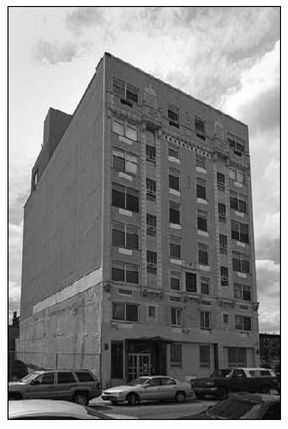
10.1 The Atlantic Arts Building, formerly 31 high-end condos, empty since 2005 except for one holdout, Dan Goldstein, co-founder of Develop Don’t Destroy Brooklyn, fighting the project. Tracy Collins.
Regeneration Was Already Happening
In the decade from 1990 to 2000 the area within a half-mile radius, according to a thorough study by the Pratt Center for Community Development, experienced widespread new incremental investment with higher-income, better-educated, and younger residents moving in from other areas of the city.16 It was revitalization despite the proximity of the rail yards. The income for the area rose from 45 to 65 percent of the median income for Brooklyn. Home ownership increased from 12.8 percent to 24.7 percent. Row houses and small apartment buildings were renovated. Industrial buildings were converted to expensive condominiums. Modest-scale new luxury residences were built with million-dollar condos. Rooftop and backyard additions were added to brownstones. New small local businesses and some chains opened. All of this was happening with the retention of both public and subsidized housing, and both rent-regulated and unregulated low-income housing. More than 8,000 residents, or almost 15 percent of the area’s population, live below the poverty level. In other words, precursors to regeneration were maturing into the real thing. One neighborhood resident told Charles V. Bagli of the New York Times that he had watched his block “evolve from a strip packed with working man’s bars to a desolate eyesore and back to a thriving street.”17
A neighborhood door-to-door survey, conducted by local resident and trained researcher Patti Hagan, found 864 people living in the six blocks slated for demolition and 200 jobs. Ratner guessed there were 100 residents. A classic case of regeneration in motion, what Jacobs called “unslumming.” In the middle of this is the Atlantic Yards site designated BLIGHTED! I don’t think so!
Among the rationalizations for the blight designation, interestingly, was the existence of about 50 percent vacant lots or structures built to only 60 percent of allowable density. Many of the empty lots, as noted, were owned by the city or the developer and kept empty (or made empty through demolition) in anticipation of the new development. What better example of “planners’ blight”? As for the buildings built to 60 percent or less of allowable bulk, that refers to brownstones, small retail spaces, modest-scale apartment houses, industrial buildings, the very combination of structures that revived the surrounding districts. In 2007 a nearby four-story double-duplex private house was selling for $2 million.
By the definition of “blight” allowed on this site, most of Brooklyn and a good deal of the rest of the city could be declared blighted—exactly Moses’s point. This allows wrongheaded projects to be rationalized anywhere in the city, stopped only by successful civic resistance, financial implosion, or occasional court victories.
Historic Preservation Sacrificed
Preservation and restoration of historic buildings have been, as noted, one of the leading precursors of the area’s upgrade in recent decades. But that didn’t stop Ratner, with the complicity of the city and the state, from slating for demolition some noteworthy but undesignated landmarks, the kind that have been the star revitalization performers in New York and every city across the country.
The most egregious loss has been the six-story 1911 Ward’s Bakery with its white terra-cotta facade and colorful Greco-inspired ornamental arches. The owner was planning to convert it to a hotel until he took a nice profit and sold this and another building to Ratner for $44 million in 2005. Closed in 1995, “this factory helped create a market for mass-produced bread,” wrote Sam Goldsmith in the Brooklyn Paper. “Thanks to new machinery and techniques that mechanized the process, the factory turned out 250,000 loaves—a lot in those days—and employed hundreds of employees.”18
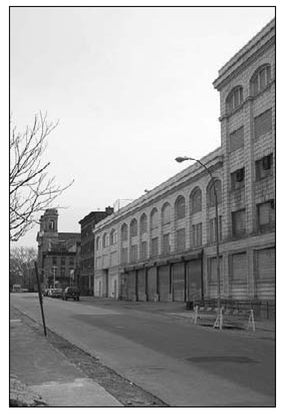
10.2 Ward’s Bakery, with its terra cotta façade and large arched windows, would have been a designated landmark on any other site. Now demolished. Tracy Collins.
Ward’s Bakery was on the footprint of a planned superblock on a corner of the whole twenty-two-acre site. Its preservation would have meant moving the location of the arena. Of course, if preserving the building were a goal to begin with, the site planning might have evolved differently.
Ironically, the bakery had a historic sports connection, too. George S. Ward, bakery president, was vice president of baseball’s short-lived Federal League, a failed attempt to create a third professional league from 1913 to 1915. His brother, Robert Ward, owned the Brooklyn Tip-Tops, one of the league’s eight teams, named after a Ward’s bread brand. They played in Washington Park, in nearby Park Slope, where the Dodgers played until moving to Ebbets Field in 1912.
To add insult to the injury of losing this building, Ratner will get credit under the LEED19 green building standards for eventually incorporating elements of this needlessly lost landmark into his new structure (if the stored elements even survive). The LEED standards are weighted almost entirely in favor of new construction, despite the fact that, as the now well-known saying goes, “the greenest building is the one already standing.”20
Public Relations and Politics Win Out
Ratner’s public relations effort has been amazingly effective from the start, especially succeeding in focusing the spotlight on the virtues of a new sports facility, the one thing even opponents agree is a legitimate goal, but distracting attention from the enormous public cost required. The arena, noted Daily News columnist Jimmy Breslin on January 22, 2004, “would be a nice addition to Brooklyn, if you had it . . . someplace that disturbed no human beings who contribute a lot more to the world than a foul shot.” Ratner is also a generous philanthropist, strategically donating money to scores of organizations and institutions that just coincidentally results in minimum public debate.
The arena focus leaves in the shadow the debate over sixteen new glass and steel towers ranging in height from approximately 150 to 500 feet, 15,000 new people, gridlock traffic, overcrowded schools, overwhelming transit usage, and more. As Chris Smith wrote in New York Magazine in 2006:
In his push to make Atlantic Yards a reality, Bruce Ratner has crafted the most sophisticated political campaign the city has seen in a very long time, better than any professional politician has mounted to win elective office, complete with gag orders and aggressive polling. And even if Atlantic Yards was wildly disproportionate to the surrounding neighborhoods, its pillars seemed laudable (the subsidized housing) and potentially cool (Gehry; having the NBA’s Nets nearby). The developer, Ratner, seemed downright enlightened: a commissioner of consumer affairs under Ed Koch who’d gone out of his way to hire women and minorities to build his other projects.21
Smith might also have noted the deceptiveness of the affordable-housing promise. Not only has the promised number of units shrunk since first announced, as predicted, but the money to construct them would be coming from normal public funding sources, not from Ratner’s development coffers. In other words, those units could be built now, elsewhere, without Atlantic Yard’s construction. If Ratner really cared about creating affordable housing, he could do it now elsewhere in the city. And if such housing is constructed in the future and those public funds still exist, money used here will not be available for similar housing elsewhere in the city. That funding source is finite. And since any affordable units built here will be more expensive to construct than elsewhere, a disproportionate share of the citywide resource will get used here.
So, since its announcement in December 2003, where does the project stand? In light of the current economic crisis, this is hard to say. Ratner tried and failed to get a bailout from the stimulus package to build the
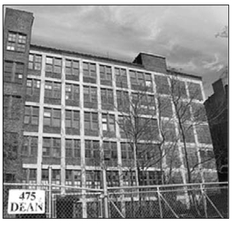
10.3 Dean Street loft co-ops on the Atlantic Yards site, formerly fully occupied. The building has been empty since 2005 and is scheduled for demolition. Tracy Collins.
arena. Mayor Bloomberg has denied any increase in city funds. Court challenges continue. In September 2009, Russian billionaire Mikhail Prokhorov agreed to buy 80 percent of the money-losing basketball team and to invest in the larger project. The details remain unclear. One cannot predict what will finally emerge from this overblown proposal. Cynics could easily observe that building the arena for his own team, the Nets, was Ratner’s goal to begin with, the rest being window dressing. If anyone really thought that the Gehry-designed development had a chance of evolving as presented for state and public approval, well, then, I have a bridge to sell them.
Ratner would have undoubtedly sold off parcels to other developers to design as they saw fit within the zoning. He still can. Wrote New York Times critic Nicolai Ouroussoff, who had high praise for Gehry’s design: “New York has had a terrible track record with large-scale planning in recent years. Look at Battery Park City. The MetroTech Center.22 Donald Trump’s Riverside South. All are blots on the urban environment, as blandly homogeneous in their own way as the Modernist superblocks they were intended to improve on.”23 Ouroussoff points to Rockefeller Center as a prime and glorious example of what this city was once capable of producing. Yet Rockefeller Center evolved. It started as a planned site for an opera house, changed with the times, was designed by thirteen different architects, connected seamlessly to the existing grid (even adding a street), is totally geared to pedestrians and mass transit, not cars, and did not overwhelm the airspace of its site.
The alternative to Ratner’s proposal had smaller and more manageable components and relied on more than one developer. This could have produced some notable new buildings. The most critically acclaimed buildings designed and built around the city in recent years are on single infill sites, mostly in historic neighborhoods. The scale of the alternative would be more compatible with the existing urban fabric, even including reasonably tall buildings. The surrounding neighborhoods thus would not be overwhelmed. Viable buildings would not be lost nor current residents and businesses displaced. Development and new growth could have continued as they had in the prior decade, step by step, in modest doses. Transportation and pedestrian connections to its surroundings and to the downtown core would be more reasonable. All of this would add up to the kind of development in small or modest doses that leads to big but appropriate change. The alternative design would have had a better chance of genuine public approval and of getting off the ground. What a missed opportunity.
In fact, one of two Dean Street resident architects who offered alternative plans suggested razing the Atlantic Center mall, a much maligned suburban-style enclosed shopping complex built in the 1990s by Ratner just north of the arena site. (A few government agencies occupy space here. This is a typical way government helps economically challenged developer projects.) “If Mr. Ratner were willing to condemn his own property, he would be able to build his arena without displacing anyone from their homes,” architect Karla Rothstein, a Dean Street resident who worked on an alternative development, told Times reporter Bagli. “It would be an improvement on the existing mall,” she added.
Another important consequence of the alternative should be noted. The city would not lose the taxes, residences, businesses, and jobs of the site for the decades that most of this land will lie fallow, just like so many earlier Robert Moses clearance projects did. The losses on these sites is never calculated, just the promises of the new taxes and jobs to come eventually. Those jobs may not even materialize as promised. Seldom does the city or anyone go back after a project is finished to see if promises have been met. And in how many projects have we seen fewer jobs created than promised and then seen those jobs disappear within a short time after completion? The tax incentives that came with those promises are rarely removed.
Measuring the taxes and jobs is fundamentally the wrong way to evaluate a plan, in any case. One must consider how it affects a wide area, including the whole city, and not just the site. Otherwise, everything will continually be suitable for replacement, no matter how well the site still functions. “Just replacing a dime store with a larger five and ten doesn’t benefit the city in the long run,” notes Ron Shiffman. “Rather, the point is to enable those facilities, like the dime store, to improve themselves. One is a replacement strategy; the other is how an economy grows by nurturing from within.”
What Would Jane Jacobs Say?
Jacobs’s name was reportedly invoked in the early presentations of the Atlantic Yards proposal. Apparently, the Jacobs qualities included a web of streets and sidewalks, although winding suburban style and not connected to the city’s existing grid; ground-floor retail for some of the towers, something every developer now does because it is good business but is also used to claim a Jacobs imprimatur; and, of course, mixed use, which, as shown earlier in this book, is not the Jacobs definition of mixed use but contrasts with Moses’s separation of uses. Since her name was involved, it is appropriate to examine the project against her writing.
First, let’s dispose of the idea that Jacobs was against change or against big buildings or, indeed, a sentimentalist. First, go back to her letter to Mayor Bloomberg about Greenpoint-Williamsburg. That is a ringing endorsement for change, just a different kind of change than what the city was proposing. In addition, one can look at her enthusiastic championing of the planning and zoning changes in the old garment center of Toronto known as the King-Spadina area. Toronto city officials consulted with her and followed many of her suggestions there, today considered that city’s SoHo equivalent. New innovative uses occupy both old and new buildings. New buildings coexist comfortably with old. Once empty or underused old buildings are now full. This is change in a big way. That Toronto district was in no better shape than our city’s so-called derelict old neighborhoods.
And, of course, a true reading of Jacobs’s books versus a pseudounderstanding would indicate her disapproval of everything about Atlantic Yards but also her expectation for continued change and growth, just not Ratner’s idea of change and growth, any more than a Moses plan. A basic Jacobs precept is complexity: no complexity is possible in a monolithic development of this scale by one developer and designed by one architect.
Another basic Jacobs precept is opposition to “cataclysmic” money and development. Surely, this project qualifies as cataclysmic change. The proposal is so inimical to the character of the district and, in fact, the whole borough of Brooklyn that it is off any chart of Jacobs’s principles.
Trying to show how Atlantic Yards contradicts every Jacobs principle can be tiresome. And, in fact, she was too unpredictable for such an exercise. Furthermore, Jacobs was never about how to develop or design as much as how to think about development, how to observe and understandwhat works, how to respect what exists, how to scrutinize plans skeptically, how to nurture innovation, new growth, and resilience. That says it all.
As it happens, I had a brief conversation with Jane about Atlantic Yards in one of my last visits with her before her death. The development had only recently been proposed, and she agreed that it was right out of the pages of old, discarded development models derivative of Moses. There was not much to discuss. She shook her head and said, “What a shame.”
On to Columbia University
Atlantic Yards may be the poster child for current Moses-style development in New York, but it is not alone. Columbia University on the Upper West Side gained city approval for a second campus north of its historic 110th Street site that would provide 6.8 million square feet in eighteen new academic and research buildings on seventeen acres in West Harlem and an underground network six stories deep for tunnels, two power plants, parking, garbage collection, and loading docks. The site encompasses more than eight blocks north of 125th Street between the phenomenal architectural structures of two elevated trestles for Riverside Drive and the Broadway IRT subway. Though lacking in gates or fences, this second campus will feel separated and segregated from the neighboring city. Under single ownership and patrolled by a private security force, this academic island will undoubtedly feel isolated, even if connected to the actual grid and planned skillfully by an accomplished city planning team under the leadership of Marilyn Taylor of Skidmore, Owings, and Merrill.
Like Atlantic Yards, Columbia targeted a semi-industrial, seemingly derelict neighborhood that to the contrary combined regenerative precursors interspersed with opportunities for infill development of varying scale. And like Atlantic Yards, both Columbia’s purchase and emptying of properties along with the threat of eminent domain blighted the area, although new businesses, especially restaurants, kept opening in the neighborhood, despite their location under and within sound impact of both viaducts. In fact, enough new restaurants have opened in reclaimed warehouses along Twelfth Avenue to be dubbed “restaurant row” and “a culinary hot spot” for West Harlem.
Unlike Atlantic Yards, however, Columbia could have achieved 85 percent, if not all, the expansion that it says it needs (predicting future needs is always a guessing game) in the next thirty years without erasing a Harlem neighborhood, once known as Manhattanville. That expansion, however, just would not have happened in the same form, with the same design, and according to the same plan as Columbia insisted on.
Forest City Ratner, a private-sector entity with the purpose of making money, is best known in Brooklyn for its two large suburban-style projects, the Metro Tech office park and the Atlantic Center Mall. That is Ratner’s style of development, not an urban vision reflecting a real understanding of how a city—its neighborhoods, economy, and public spaces—really works. But from Columbia University, one of the most prestigious in the country, something different was to be expected. Columbia should not behave like a private developer with a suburban view of the city. This 254-year old institution is home to a highly respected planning program, the first historic preservation program at any university in the country, and an impressive roster of urban experts, such as Mindy Fullilove, mentioned earlier, a professor of clinical psychiatry and public health who has written so extensively about the impacts of the ruptured social bonds in communities decimated by urban renewal.
So when Columbia unveiled its proposed new academic enclave necessitating the total clearance of a neighborhood, Moses style, urbanists were correct to be stunned. The individual glass-covered, almost transparent buildings were designed by the world-renowned architect Renzio Piano. The pattern of enlisting “starchitects” merely for the purpose of advancing otherwise troublesome plans had become familiar in recent decades. Both Atlantic Yards and the Columbia plan are perfect examples of this trend.
Expansion Idea Not Disputed
It is very important to understand that no one was denying Columbia the right to expand. No one was denying that its expansion could be good for the city. No one was even questioning if Columbia would really need eight million additional square feet of space in the next thirty years, although such projections are tricky at best. And no one was opposing change. Once again, quite simply, it was the form of the change that was legitimately challenged, not change itself.
Columbia’s well-illustrated material presents the proposal as “a new hub of education and economic opportunity, culture and community—weaving together the urban fabric of West Harlem with a revitalized Hudson River waterfront.” Ironically, by the way, the revitalized waterfront is something the community has been fighting for for years. It is finally happening without Columbia. Three new piers along the waterfront have been built by the city and state. Sadly, however, the community that fought for and achieved this will not remain to enjoy it or will have to come from afar to visit. Notes the brochure: “The plan would transform what is now a largely isolated, underutilized streetscape of garage openings, empty ground floors, roll-down metal gates, and chain-link fences in the blocks from West 125th to 133rd Streets into a cohesive, reanimated center for educational, commercial, and community life.” These are the conditions Columbia fostered and now wants to repair.
Like Ratner at Atlantic Yards, Columbia started buying property in the area and removing tenants well before the announced proposal, again causing much of the blight it decries. Anyone reading the above description would think the proposal is entirely beneficial. No mention is made of the displacement of 400 residents occupying affordable units, including 160 low-income families, 70-odd businesses, and 1,200 jobs. While areas in the city available for blue-collar work dwindle, it is difficult to estimate how many of the displaced businesses will survive in New York or at all. And considering, as well, the shortage of affordable housing, the relocation of low-income families from here, years before new units are built, only puts more strain on the citywide supply. Columbia’s description of the site also fails to mention the removal of 150 artists and their studios, a window manufacturer, several film editing studios for cable TV, a wholesale bakery, a catering business, a pharmacy, a furniture restorer, one framing and gilding business, a stone fabricator, a boilermaker, several electricians and plumbers, assorted restaurants, an architectural ornament fabricator, Tools for Schools (an electronics repair and reuse operation), a few construction companies, moving and storage facilities, auto-body businesses, and two gas stations. Six sizable family-owned businesses were included in this mix.
One family-owned business, Hudson Moving and Storage, housed dozens of small businesses in two buildings, from a woodworker to an electrician to a refinisher. Hudson’s multiple interior spaces functioned as an incubator for new and growing businesses. Until Columbia started buying up occupied buildings, the area was home to a veritable agglomeration of small businesses that were both part of the citywide economy and servicing it. The value of this network is beyond measurement. Individually and collectively, they add up to hidden links in the city’s supply chain and are almost totally ignored and undervalued.
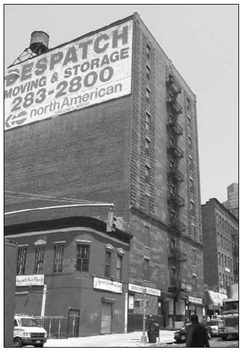
10.4 Hudson Moving and Storage, on the Columbia site and purchased by Columbia under threat of eminent domain, had been converted into an assortment of creative small businesses.
Ron Shiffman.
The diversity of businesses present in this “blighted” area is not quite what Columbia would like the public to believe. Of course, many of these uses began disappearing when Columbia started buying properties.
It is worth repeating: Columbia University’s expansion needs are real. No one disputes that. Expansion would be a good thing for the city as a whole. Elements of the proposed design are appealing. One could never judge the architectural plans, however, because the only sure thing about them is that they will change dramatically as the project moves forward. But whatever its design, it could all happen without erasing, Moses style, a viable piece of the city that would have revived economically, socially, and physically if not demolished.
The fundamental flaw preventing a compatible Columbia expansion was the university’s insistence on the six-story underground space covering the whole site, known as the bathtub. This enormous, really enormous, underground space will take approximately seven to ten years to build and requires an estimated ninety-eight thousand or more truck trips in and out of the neighborhood, transporting debris to landfills. Underground tunnels, parking, loading, and power plants will fill this space. Its creation requires demolition of everything above it on the street level—except, of course, a few buildings Columbia has chosen to retain for its own use.
Serious technical questions were raised, especially by disaster experts, concerning the environmental safety of this “bathtub.” The site is located on a fault line and in an evacuation zone for hurricane surges, and it will include labs that work with biohazards. Experts, including some on the Columbia campus, questioned whether the bathtub space could be constructed with adequate safeguards.
The environmental and economic costs were never clearly addressed. But the point here is not to take issue with a very challenging engineering issue; the point is to indicate, yet again, how an alternative was available. Rockefeller Center, for example, brilliantly created a vast underground space in the 1930s that would permit the requisite underground uses24 and connections without requiring the same underground scale. The university totally rejected the idea without serious consideration. “Cities are bound to change, you have to accept it,” the architect, Renzio Piano, was quoted as saying in one news story. “This area is going to change, and should change in significant ways. You can’t embalm a city,” Columbia president Lee Bollinger was quoted as saying. Neither comment reflects the reality that, yet again, it was not about stopping change or embalming a city but about what kind of change is appropriate. Embalm is a favorite word used in recent years by people whose proposals met stiff public resistance. One had to wonder what city—or, indeed, what planet—they were talking about. New York City, for sure, has been in an almost permanent state of construction and change for years, the most dramatic transformation in decades.
It should be noted that Columbia’s plan, even if a Moses-style, nonintegrative, demolition-only one, is a better one than Atlantic Yards in terms of street layout, connections to the surrounding grid, and central open space. Nevertheless, it destroys viable urban assets instead of building on them, claims a green building philosophy while erasing environmentally viable existing buildings, replaces instead of enriches an existing neighborhood, and boasts a community involvement process that permitted tinkerings, not meaningful impact.25 In both places, the critical web of social and economic relationships that reach beyond the immediate borders is shattered. The upheaval in many cases is causing irreparable harm. And like Atlantic Yards, the specter and willingness of Columbia to abuse the potential for eminent domain resulted in a totally undemocratic process.26Moses would be pleased.
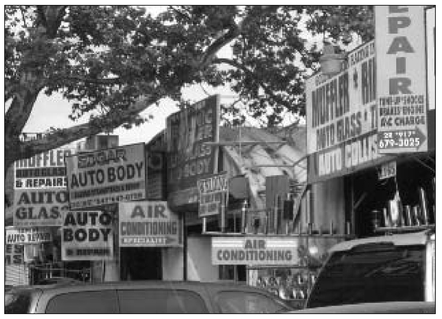
10.5 Willets Point. Not the view officials want to see when they go to Citi Field. Norman Mintz.
Willets Point
Willets Point is probably the most challenging site to demonstrate both the existence of regenerative precursors and an alternative to a Moses-style clearance strategy. Bleak is a mild term for the appearance of this desolate and isolated thirteen-block triangle directly across from the Shea Stadium replacement, Citi Field, in Queens. Its worst sin, in fact, is that it is a visual offense to city officials who deem it imperative to clean up and sanitize the site directly in the eye path of visiting sports fans. The idea of a view of gritty economic life is apparently unacceptable.
This sixty-one-acre site at the geographic center of the city is surrounded by two highways and a subway line. The area is literally bereft of most city services. No basic infrastructure exists here. No sidewalks, no sewer lines, no paved streets, and no street lights are to be found. Pond-size potholes are everywhere. Huge oil-slick puddles collect after a rainfall. Dust rises from the unpaved roads running past and between the waste transfer stations and recycling facilities. And to add insult to injury, police give tickets for parking on sidewalks even where there are no sidewalks. Many of the ramshackle structures are built in unconventional ways, mostly of corrugated aluminum. They are interspersed with reused manufacturing and warehouse buildings and empty lots. A more dismal piece of New York City real estate is hard to find. A pile of “toxic filth that is the result of the government’s failure to provide adequate infrastructure in the first place,” wrote economist Sanford Ikeda on his blog critiquing the city demolition plan.
So when the city Economic Development Administration announced in 2006 a plan in which the city would buy out all the property owners to clear the site for future development, one can understand why there was a more muted off-site voice in opposition than for either Atlantic Yards or Columbia’s new campus. But this is a real case of more than meets the eye.
The miracle is how anything exists on Willets Point at all! The curious must ask why. What can be observed and learned here? Actually, quite a bit.
A Moses Survivor
Ironically, this was the site of an earlier, rare successful battle against Robert Moses. In the 1960s Moses wanted the site for parkland. A then little-known lawyer but future governor, Mario Cuomo, successfully represented the land and business owners to resist this takeover. A later Donald Trump effort to redevelop the area also failed.
But even as a takeover target for decades, with probably the worst physical conditions of any city site, Willets Point is home to 260 businesses and 1,700 to 1,800 jobs.27 Little vacant or unused land can be found. Property values are comparable to values in other industrial areas of Brooklyn and Queens. Willets Point businesses—mostly auto parts and recycling related—paid approximately $1.1 million in city real estate taxes in 2005.
Twenty businesses are run by landowners, many second- and third-generation family owned. More than 80 percent of the businesses are renters. Most have been in business more than five years at the same location, an indication of long-term stability. Statistics for Willets Point are more revealing and relevant than in many places because it is so difficult for the average eye to observe true economic and urban value here.
But consider carefully what economist Sanford Ikeda also wrote on his blog, in January 2008:
Old, worn-out buildings (or garages) are often good places to incubate ideas, but you can’t build old buildings. Places like Willets Point (and Dharavi in India) offer cheap space for poor entrepreneurs who tend in turn, at least initially, to serve poor patrons. Willets Point is a good, though perhaps not perfect, example of an “unslumming” commercial slum, that is, a slum that is bootstrapping its way to economic development. Okay, it doesn’t appear on the surface to be all that innovative. But in among the mostly grungy auto shops are a few shinier and larger establishments. So, the most successful either leave for less-toxic pastures or, if they stay, help to unslum the slum.
The Dharavi reference is an interesting one. Mumbai’s sprawling Dharavi is the primary so-called slum depicted in Slumdog Millionaire that actually patched together scenes from various slums in that city for the film. Like Willets Point, the reality of Dharavi contradicts the perception. While the largest slum in Mumbai, “Dharavi is probably the most active and lively part of an incredibly industrious city . . . including having set up a highly functional recycling industry that serves the whole city,” wrote Matias Echanove and Rahul Srivastava, community activists affiliated with PUKAR,28 in a New York Times op-ed piece. Dharavi, they noted, “is all about resourcefulness. Over 60 years ago, it started off as a small village in the marshlands and grew, with no governmental support, to become a million-dollar economic miracle providing food to Mumbai and exporting crafts and manufactured goods to places as far away as Sweden.”29 Estimates of the number of informal businesses and cottage industries are 5,000 to 15,000, with revenues totaling tens, if not hundreds, of millions of dollars a year.
Economist Edward L. Glaeser agrees. “The defining characteristic of Mumbai is not crime or Bollywood, but entrepreneurship even in the city’s slums,” he wrote in the New York Times Economix Blog, on May 26, 2009. Dharavi, he noted, “is a place of remarkable economic energy where poor people are managing to eke out a living as entrepreneurs.”
Willets Point is also all about resourcefulness. It looks like sheer chaos but has its own economic rationale. And like Willets Point, the Indian government is preparing to flatten Dharavi and build high-rise towers and business parks, à la Robert Moses, in the mistaken notion that building an economy on real estate instead of entrepreneurship works.
10.6 Rahul and Matias loved the license plate. Rahul Srivastava.
On their trip to New York last year, I took Matias and Rahul to Willets Point. They were stunned at the similarities with Dharavi, the big difference being that in Dharavi, people live where they work as well. The same lack of infrastructure exists, as does the creative patching together of small buildings with corrugated tin and other materials. Residents role up their mattresses each morning and get to work.
“Here is a slice of urban life that connected New York to other cities around the world in which raw economic necessity and a tougher set of choices shaped the landscape more than the luxury of planned architectural interventions that is otherwise New York’s signature,” they wrote in a blog report of their visit. “From the outside,” they also observed, “you would never guess the immense ferment going on beneath.”
Effectively, at Willets Point—like Dharavi—over many decades, poor businesses have congregated for mutual support and networking. This is a fundamental and critical component of genuine economic development, in contrast to a publicly subsidized, developer-driven construction project. What evolved on Willets Point is totally self-organized, cannot be “developed” or “planned for,” and is invariably overlooked entirely and undervalued by professionals. Many longtime establishments have been doing very well and serve a low-income community while providing jobs for a mostly Spanish-speaking workforce from nearby Corona. Many workers walk to work. Firms here “provide a wide range of auto-related services, have longstanding linkages with one another, and both compete and cooperate with one another,” noted the Hunter College study.
10.7 Artistry and ingenuity not just reserved for cars. Norman Mintz.
In effect, this is a classic agglomeration, a natural concentration of interrelated businesses that cluster organically to gain strength from proximity to each other. New York’s fur district, jewelry district, garment district, flower district, financial district, gallery district, computer alley, and meatpacking district are all examples of a similar urban economic process. Such agglomerations cannot be relocated. They only happen naturally. Thus, the impact of dispersal would economically weaken the full network and probably some of the individual components fatally.
It is too easy to dismiss the unglamorous existence of scrap-metal yards, auto-body shops, and other messy concerns (41 percent of the total), as happens usually in the press and official descriptions. But this unappealing description masks an assortment of specialized individual auto businesses, including parts, body, glass, tires, muffler, salvage, sales, and one parts supplier specializing in antique cars. There are even brokers who will direct you to the exact business that specializes in your problem. This is a more complex network of businesses than meets the eye, with a wide range of specializations. And, as the Hunter report notes, “auto parts suppliers in the area make access to parts economical and relatively swift.” This is real economic efficiency, the organic urban kind. The report adds: “The relations among the operators of auto-related businesses are often cooperative and mutually supportive, and they form a network that strengthens the attractiveness of the area as a specialized district.”
One anomaly exists at Willets Point that happens to be the largest employer. House of Spices is the largest manufacturer and distributor of Indian foods in the country, with one hundred full-time employees. But there is even more diversity that includes a number of businesses that manufacture or distribute steel products, oil and grease absorbents, utility pipes, safety and surveillance equipment, bakery supplies, and ethnic foods.
Willets Point has served as a classic incubator of new businesses. Many here started small and even with a different business mix. Tully Construction Company, for example, has grown from its 1988 start as a highway contractor into a diverse engineering and construction firm handling a wide range of infrastructure, waste management, and environmental projects in the city.
If one understands the essential, though often hidden, natural process of a vibrant urban economy, one understands why Willets Point businesses are resistant to leaving. Replicating the physical conditions that nourish this increasingly rare and vital network is difficult, if not impossible, as discussed in chapter 6.
Aside from questioning the wisdom of wiping out such an economic concentration, one might also question if the city needs yet another combination of housing, offices, restaurants, shops (i.e., malls), a school, a park, a convention center, and a seven-hundred-room hotel. And, to boot, this is in the flight path of La Guardia Airport! How desirable is it to live under low-flying planes? And because of the highways that encircle the area and serve as barriers now, any new development is going to be auto dependent. One thing is for sure. The city will spend endless public funds now, but the site will remain unbuilt and unproductive until the economy rebounds, or longer. Or the area closest to Citi Field will get force-fed new development to create the pretty face officials want visitors to see.
The bottom line for Willets Point is no different from that for Atlantic Yards and Columbia. This should not be an all-or-nothing Moses-style plan. The wisest strategy, if legitimate urban growth is the goal, would be to install the infrastructure and let the real estate market take care of itself.
First of all, the city’s public investment would be a fraction of the cost of buying out all these landowners at great public cost and putting in the infrastructure and preparing the site (probably toxic) for a private developer. Current annual tax payments and critical jobs would not be lost in the meantime. Owners could sell and move or stay, as they see fit, and decide what is best for the future of their businesses. What new development would then occur would not be the force-fed kind heavily subsidized by the city; it would be the kind that responds to both local and larger city market demands. Logically, with infrastructure installed, this could be a desirable relocation site for some of the small manufacturing businesses pushed out from other areas of the city where upzonings are taking their toll. “This eagerness to build anew, however, brings with it an impatience to clear away impediments or, as Moses infamously put it, ‘hack your way with a meat ax,’” wrote Karrie Jacobs in a Metropolis Magazine Cityside column, “Demolition Man.” She was referring to then Governor Pataki’s willingness to “tear down whatever is in the way” of developers’ plans and to use eminent domain to clear the way. She pointed out how New York is one of the states most willing to use that power meant for a public purpose to advance a private plan.
Clearly, the redevelopment plan is what Jane Jacobs would call a “manicuring job.” The image of the auto-parts store with hubcaps, tires, and decorative items covering the facade is considered an “iconic American image” when embalmed in a Walker Evans photograph (Cherokee Parts Store—Garage Work, for one) taken in the South during the Depression. But it is another story when it is real and of today.
As this book goes to press, deals are being struck with the landowners closest to Citi Field, the area of primary official attention. Chances are that land will be rapidly cleared and left empty. At the same time, deals are being struck for businesses, like House of Spices, at the back end of the site to remain, reasonably visually removed from the stadium, or to leave with a generous buyout. How transparent is that?
Lost Precursors
Atlantic Yards, Columbia’s new campus, and Willets Point all exemplify the remaining strength of the Moses legacy and the continuing loss of precursors to urban regeneration. In each case, precursors of regeneration went unrecognized, devalued, and destroyed. City officials may argue, as always is done, that all Willets Point businesses, for example, will be relocated. Assuming that promise is even partially fulfilled, scattering such businesses near and far always destroys the efficacy of their clustering location and diminishes their numbers, productivity, and economic contribution to the city, something New York cannot afford to keep losing.
No chance exists in a Moses strategy to demolish selectively. This was the pattern during Urban Renewal and why I argue the city lost so much more under Robert Moses than is yet understood. The Moses approach still prevails too often, even if fewer homes and businesses are being demolished with each project. The many productive individual initiators visible around the city, whether Jacobs inspired or not, get considerable attention and distract the public from the impact of the Moses-style projects. It can be deceptive, seducing people to believe Jacobs’s precepts prevail.
The fundamental flaw in the Moses approach is its simplicity. It is a formula-based doctrine that oversimplifies what it takes to create enduring places, requires a clean slate, and ascribes no value to what came before. A city is much too complex, too multilayered, too filled with interwoven threads to be sustained by singular, simplistic, self-contained, homogenizing projects. And while many of Moses’s parks and swimming pools were beautifully designed and are much admired today even when totally deteriorated and closed, they are inseparable pieces of a whole Moses vision and strategy that sees the city as a series of physical projects rather than the economic, environmental, historical, social, and physical system that it is.
Nor is it correct to say that a Moses is needed to achieve public infrastructure and amenities, since countless cities, including New York, boast similarly important achievements not “done” by him. And many more big ones are currently under construction, as we’ve seen, without a construction czar to move them forward. Not only has this book shown that big things do get done, but it has also shown that many of the projects that don’t get done shouldn’t.
The idea of Moses as a model for implementation is a scary one as well. That, too, has simplicity at its core. Top-down, take-no-prisoners, my-way-or-the-highway—this is no way for things to get done in a democratic city.
And while there may be no point replaying the battles of Moses and Jacobs, I would call on the wisdom of former Salt Lake City planning director Stephen A. Goldsmith, who argued instead that “replaying the lessons learned from those battles will serve the public discourse very well indeed. More importantly, these lessons will advance the ideas Jane Jacobs placed in front of us and hopefully save many places from repeating old mistakes.”
Throughout this book, we have seen where modest-scale initiatives are making big change citywide. Some are citizen initiated; some are initiated by city officials. There is nothing simple about any of them, other than that they work. They reflect Jacobs’s principles even though initiated by people who may never have heard of her. The authentic city changes and grows slowly; it resists acceleration. Authenticity is the common thread of the stories in this book.
Gregory O’Connell’s innovative development in Red Hook, David Sweeney’s rescue and rehabilitation of former factories for new industrial start-ups and small manufactures, Janette Sadik-Khan’s transformation of the streets of the city, Eddie Bautista’s leadership in transforming how the city disposes of solid waste, the citywide landmark preservation movement’s impact on both designated landmarks and undesignated but recyclable buildings and resultant revitalization spur—all is vintage Jane, all big change in small incremental steps.
We’ve seen the citywide impact of the defeat of Westway and its positive consequence along the Hudson waterfront, on the subway system, and in neighborhoods throughout the city, and Joan Byron’s technical assistance work with an energetic coalition of South Bronx organizations that will, hopefully, achieve the same broad healing with the proposed tearing down of the Sheridan Expressway. We’ve seen the resilience of the local industrial economy reinforcing a basic Jacobs economic principle that local economies drive the growth of cities and ultimately the regional and national economies.
If there is one overarching Jacobsian lesson, it is how complex cities are. Her observations of Greenwich Village only appear simple and are too often misinterpreted as advocating similarly scaled and designed neighborhoods everywhere.30 Instead, her observations are a fractal for understanding thousands of streets and districts. A fractal is simply something that may look and perform the same at all scales of magnitude. So when Jacobs wrote about Hudson Street and the Village, she wasn’t suggesting every community need mirror that singular place. Instead, that Village neighborhood must be understood as a fractal to help observe and understand the components of thousands of streets and neighborhoods everywhere that have the potential to function in similarly vibrant ways but have their own local character, context, and unique qualities. In fact, a fractal at a larger dimension can take on a different character and look and perform differently.
Through Jane’s local lessons, the greater public has come to understand the components of a particular neighborhood or whole city, and to understand how a city’s—or any size community’s—streets are the spine of any vital, vibrant city. That same public has come to understand their right and value in being a part of the process that leads to change. This is vintage Jane. Public process, on the other hand, was anathema to Moses.
Greenwich Village, Harlem, Boston, and Manchester and Birmingham, England, were for Jacobs lenses for understanding places and economies around the globe. The socially and economically productive spontaneous order that distinguishes vibrant places arises where Jacobsian principles prevail and Moses-style projects fail. Spontaneous, creative order can’t exist in a monoculture. Spontaneous order works; imposed efficiency leads to stagnation.
This book has shown how Jacobs’s principles are woven into many aspects of urban life. Often, however, they come only after the battle against yet another Moses-style proposal. Ultimately, cities will thrive where Jacobs’s lessons shape both the civic debate and the urban process of growth and change. Only through building on local assets, weaving in the new with the old, pursuing new growth through innovation, only with the success of these paths, will localized efforts, which may or may not be Jacobs inspired, prevail; they will not prevail easily. The good news is that New York City’s assets are many; much here exists to build on. Many cities are not so lucky and wastefully, sadly, keep demolishing the diminished number of assets they have.
The Moses impact will not disappear. Projects detailed in this book will emerge in varying forms in cities everywhere. Their defeat depends on a vigilant, successful citizenry; the compromises offered are never even close to adequate to mitigate the damage. Invariably, appropriate alternatives exist to achieve pronounced goals.
Citywide, one could debate which philosophy, Moses or Jacobs, was victorious. Evidence can be found for both, often simultaneously, as shown here, in the same city and, surely, in all American cities. Planners and developers would like us to think they follow most of Jacobs’s principles. Observation and scrutiny of their plans and designs reveal a different picture. When one looks at where many city governments’ primary attention and investment are directed, when one observes the plans and designs being promoted, when one looks at the cataclysmic scale and enormous cost of many proposals, nobody would be foolish enough to claim that her teachings are settled doctrine. Jacobs-style battles are still being fought, not always with success. But she certainly helped frame today’s debate about urban development and change. And that alone is an enormous change from when it was Moses’s way or no way.
The shadow of Robert Moses and Jane Jacobs still looms large over New York City and all cities. The battle for Gotham continues through the best of times and the worst of times.