

Part Six
Besides Roland, there were eight condemned men in the death house at Sing Sing. Of these the most notorious was Dr. Samuel Kennedy, whose case—thanks to its irresistible mix of sex, scandal, and gruesome violence—had generated intense lip-smacking coverage in the New York City press. A darkly handsome young dentist with a thriving practice, a loving wife, and a newborn son, Kennedy had been convicted of killing his twenty-one-year-old mistress, Emeline “Dolly” Reynolds, whose brutalized corpse, the skull crushed with an iron bludgeon, was found in a Manhattan hotel room in August 1898.1
The other death row cells were occupied by a motley assortment of killers, awaiting execution for the kind of small-time savageries that make the headlines for a day or two, then disappear from the news: stabbing a man in a bar fight, strangling a jealous wife, shooting a dry goods clerk during a holdup. A convict named Fritz Meyer—a denizen of the Bowery slums who had gunned down a policeman while robbing a church poor box—had been there the longest, slightly more than two years, while his appeal made its way through the courts. The others—Edward Wise, William Neufeld, Joseph Mullen, Benjamin Pugh, and two recent emigrants from Italy, Lorenzo “Larry” Priori and Antonio Ferraro, nicknamed “Shorty”—had been languishing in their solitary steel cages for periods ranging from three to twenty-one months.
Though conditions at Sing Sing had improved considerably since its earliest days—when prisoners were forced to march in lockstep, forbidden from making eye contact or uttering a sound in each other’s presence, and routinely subjected to such medieval tortures as the “Chinese water cure” and the “crucifix”2—life in the Death House remained unrelievedly grim. Each man was confined to a tiny, windowless cell—three stone walls and an iron-barred door—barely large enough to accommodate a cot, a table, a hard wooden chair, and a chamber pot. Outside the bars hung a net of steel to ensure that no visitor could make physical contact with the prisoner.
It was always light in the Death House. Glass skylights provided illumination by day. At night, gas and electric lights burned continuously, throwing their beams into every corner of the cell. A pair of keepers, wearing felt-soled shoes to maintain a sepulchral silence, patrolled the corridor day and night. Privacy was impossible, even for a moment. It was, as Roland put it, like living, eating, sleeping, and going to the bathroom “in a searchlight.”3
The monotony was crushing. No newspapers were allowed. Mail, both incoming and outgoing, was inspected by an official and strictly censored. Once a day, for a half hour, each man was allowed to walk up and down the narrow corridor, while curtains were drawn in front of the other cells to prevent the inmates from setting eyes on one another. Meals were barely palatable—some tasteless hash or glutinous stew or unidentifiable meat, precut so that it could be eaten with the only utensil permitted to inmates, a pewter spoon. Cigarettes and cigars were prohibited, though the men were provided with coarse “State” tobacco and corncob pipes in which to smoke it. For excitement, there was the weekly bath and shave.
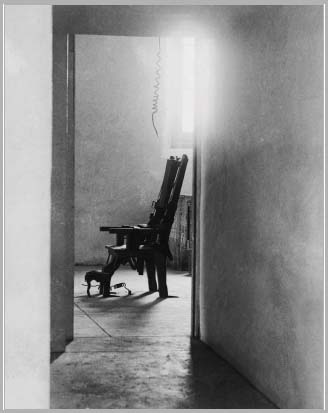
For Roland, it was “like being alive, yet buried in a glass coffin.” Each newly condemned man would be brought into the Death House, exist for a year or so “in a noiseless purgatory,” and then—if his appeal failed—be led one morning through a door at the opposite end of the corridor from which he never emerged. The inmates, who passed and repassed that door each day during their thirty-minute exercise, did their best not to think about the terrors it concealed, and never referred to what lay on the other side by its proper name: the execution chamber.
They called it “the room with the little door.”4

There were some consolations. Though reading matter from the outside world was strictly forbidden, the condemned men had access to all the books in the prison’s extensive library. And while the wire nettings outside their cells kept their loved ones just beyond reach—“no hand clasps, no kisses,” sighed Roland—the prisoners could receive extended biweekly visits from their relatives.5
Within twenty-four hours of Roland’s incarceration, his brothers, parents, and chief counsel, Bartow Weeks, had already come to see him. Several days later, General Molineux announced that he had “engaged quarters” at a house within sight of the prison, where his wife and daughter-in-law would live for the duration of Roland’s internment.
It was Blanche, so the General intimated to the press, who had insisted on renting rooms in the village, so that she could visit her dear husband as often as possible and lend him her loving support during his darkest hours.6