

Part Two
Like Colonel Beriah Sellers—the lovably feckless hero of Mark Twain’s The Gilded Age, who hatches one ridiculous get-rich-quick scheme after another—Blanche Chesebrough’s father, James, had a brain that fairly crackled with supposedly surefire moneymaking ideas. Not all of them were completely worthless. He held a number of patents and sold the rights to one of his inventions—a hydraulic washing machine—for a decent sum. He even made some money from his device for curing diseases of the nose and throat. “He was either a crank or a genius,” opined one New York City newspaper.1
Time would make it abundantly clear which of those two categories he fell into.
In pursuit of the pot of gold that always seemed to lie just beyond the horizon, he was constantly uprooting his family—his uncomplaining wife, Harriet, and six children. No sooner were they settled in a new home than James’s wanderlust would seize him, and off they’d go to some distant place where his long-elusive fortune presumably awaited. At times, when one of his deals bore fruit, they enjoyed a fair degree of comfort. As the years progressed, however, their circumstances grew increasingly straitened, even desperate.
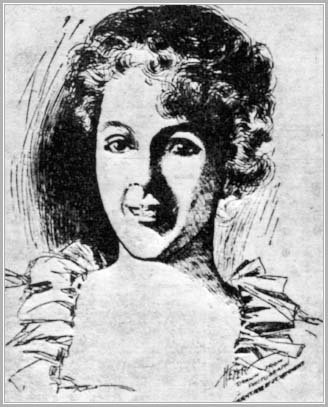
Blanche—the second-youngest child, born in 1874—spent her earliest years in Westerly, Rhode Island. It was there, according to later accounts, that she lost an eye when an unruly playmate threw a rock at her head. She was fitted with a glass eye and remained so sensitive about it that, for the rest of her life, she refused to be photographed except in profile—and only then at an angle that hid her left eye from the camera.2
Toward the end of her long life, Blanche—who would survive the other principals in the Molineux affair by many years—finally set down her memoirs. It is a work written in the sentimentalized style of the Victorian romances of her youth. (“In looking back, I see a girl—a young woman—who is now at a great distance…. She was in love with life—the life which her imagination painted in glowing colors. Naive, credulous, and filled with illusions, she did not recognize nor understand its verities until the enchanting rose color had turned to gray.”) In her recollections of her childhood, she glosses over some of the most painful episodes. Beyond lamenting her father’s lack of “sagacity in relation to money matters,” for example, she does not dwell on the hardships that his family was made to endure as his behavior grew increasingly erratic.3
She was still a young girl when he dragged them from New England to the Midwest on another hopeless business venture. They were living in Minneapolis when Blanche experienced the “first stirrings” of the ambition that would dominate her life for many years to come. Her neighbors were a family named Beatty, whose youngest daughter, Louise, was Blanche’s best friend. One day, while the two girls played jacks on the front stoop of the Beatty home, Blanche heard Louise’s older sister practicing her singing lessons inside.
“It was then that an intense desire took possession of my childish fancy, some day to become a singer,” Blanche would record in her memoirs.4 The dream was not entirely unrealistic. Blanche was blessed with a lovely voice. Her little friend Louise—under her married name, Louise Homer—would herself grow up to be one of the great operatic contraltos of the early twentieth century.
Following his family’s sojourn in the Midwest, the footloose James moved them to the South, where they lived for a time in Louisville, Kentucky. Then it was on to a rambling old house in North Carolina. Blanche would always remember the lush, tangled flower garden, “growing and blooming in riotous disorder, with a sun dial and purple and white wisteria climbing over an old porch and wall.”5 She formed a close friendship with the little girl down the road, the daughter of the former governor of the state, who lived in an “old and stately mansion” that had been used as a makeshift hospital in the waning days of the Civil War. Once, Blanche’s little friend lifted a rug and showed her the bloodstains of the dying Confederate soldiers, still visible on the oaken floors.
Their stay in North Carolina lasted only six months. When summer came, James took them to a cottage on Long Island Sound, so remote from the nearest village that the only noises to be heard were “the night song of the inarticulate creatures of grass and trees, the bark of a dog, or the call of a bird to its mate.”
By then, only Blanche and her younger sister, Lois, were still at home. Their brothers—Frank, John, and James, Jr.—were married and living in different parts of the country. The oldest of the three Chesebrough sisters, Izcennia (“Isia,” as Blanche always called her), had also recently wed. And she had done quite well for herself, landing as a husband Waldo Harrison Stearns, scion of a wealthy lumber family.
Toward the end of Blanche’s summer stay on rural Long Island, Izcennia came for a visit. A “proud and ambitious” woman (according to Blanche), Isia had already made up her mind to take her little sister under her wing. She would see to it that Blanche developed her talents, met the right people, and—most important—found a rich husband. Blanche was to come live with her in Boston, where Isia and Waldo would sponsor her musical studies.
In short order, Blanche was comfortably ensconced in Isia’s lavish Longwood home, enjoying “an atmosphere of affluence which developed in me a rather lofty idea of living.”6 With Isia (or rather, Waldo) footing the bills, Blanche took private vocal lessons from the eminent George L. Osgood, director of the Emmanuel Church choir, the Boylston Club, and the Singers’ Society of Boston; learned to read music from a young piano instructor; studied French and Latin diction; and attended concerts of the Boston Symphony Orchestra, along with other musical events. By the time the following spring came around, after months of practicing scales and doing endless breathing exercises, she was finally prepared to essay her first aria for the demanding Mr. Osgood—Gluck’s “Che farò senza Euridice.” She would remember the thrill of that moment for the rest of her life.
She would also remember—even more intensely—another experience that happened to her a short time later. It was the last week in June, “the day before school closed for the summer.” Even as an old woman, the moment would remain vivid in her mind:
On the way home that afternoon, I cut across a little park where there were spots of dim shadowy shelter from the sun. A few benches were scattered here and there, and some ducks were floating around on a pool nearby. I was hot and tired and sat down on one of the benches to rest. I laid my books down beside me, took off my hat and fanned myself.
Across from me in the shadow of the trees were a boy and girl. They were both much older than I. I remember them as being quite grown and I was envious of their added years. They must know so much more about things than I did!
At first, I only glanced in their direction. Then I noticed they gave up their seats on the bench, and the boy pulled the girl down beside him on the cool shaded grass. They sat there for a few moments. Suddenly, the boy put his arms about the girl and pulled her into his embrace and down beside him on the ground. I watched—fascinated. He leaned over and kissed her. He drew her face and held it with both hands, close to his own. They lay there oblivious to everything, clasped in each others’ arms.
His gesture—when he drew her toward him and in a sort of masterful way held her—did something to me. My breath came in little gasps. Something stirred within me that made me feel first hot and then cold. I shivered and a little chill ran up and down and all over me.7
Blanche desperately “wanted to go home and tell Mother about having watched that boy making love to that girl.” She wanted “to ask her why I felt so funny; why it affected me so.” But she knew that she couldn’t. Her mother—whose “outlook on life reflected the Puritan attitudes of her time”—would have been “horrified.” Beyond cautioning her daughters that they must be “ever on their guard” against the coarse familiarities of men, Mrs. Chesebrough had never spoken a word about sex.
And so Blanche was left in confusion. She had no way of defining the erotic sensations that had been awakened in her. She knew, however, that something had changed forever. On that summer day in Boston, shivering with pleasure at the sight of the young couple embracing on the grass, “my childhood days ended.”8