


A sixth-century BCE bronze statue of the Greek hero Heracles (National Museum, Athens)
And though thou hadst small Latine and less Greeke, From thence to honour thee, I would not seeke For names.
BEN JONSON (seventeenth-century English playwright and poet)
“To the Memory of My Beloved, the Author, Mr. William Shakespeare” (1623)
Prefixes formed from Latin and Greek prepositions are most often adverbial, that is, they qualify or modify some action that is described by the word to which the prefix is attached.
I. LATIN PREPOSITIONS
|
Latin Preposition |
English Meaning |
English Combining Form |
Example |
|
ab, a |
from, away from |
ab-, a- |
abduct, avert |
|
ad1 |
to, toward, for |
ac-, ad-, af-, ag-, al-, |
accept, admit, affirm, |
|
an-, ap-, ar-, as-, at- |
aggression, allocate, |
||
|
announce, applaud, |
|||
|
arrive, assume, attack |
|||
|
ante |
before |
ante- |
antecedent |
|
cum2 |
with, together |
com-, col-, con- |
compose, collect, |
|
cor-, co-3 |
convene, correct, cohere |
||
|
circum |
around |
circum- |
circumnavigate |
|
contra4 |
against |
contra- |
contradict |
|
de |
down, from, about |
de- |
depose |
|
ex, e |
out of |
ex-, e-, ef- |
except, edict, effort |
|
extra |
outside |
extra- |
extraordinary |
|
in |
in, into, on |
in-, il-, im- |
incur, illusion, import |
|
inter |
between |
inter- |
interact |
|
intra |
within |
intra- |
intravenous |
|
ob |
to, against |
ob-, oc-, of-, op- |
object, occur, offer, |
|
oppose |
|||
|
per |
through, by |
per-, pel- |
permit, perfect, pellucid |
|
post |
after |
post- |
postpone |
|
prae |
before |
pre- |
predict, prefer |
|
pro |
in front of, |
pro- |
propose, provide |
|
on behalf of |
|||
|
sine |
without |
se- |
secure, secluded |
|
sub |
under, |
sub-, suc-, suff-, |
submit, success, suffer |
|
in addition to |
sug-, sup-, sus- |
suggest, suppose, |
|
|
suspend |
|||
|
super5 |
above |
super- |
supervise |
|
trans |
across |
trans-, tra- |
transmit, tradition |
|
ultra6 |
beyond |
ultra- |
ultrasonic |
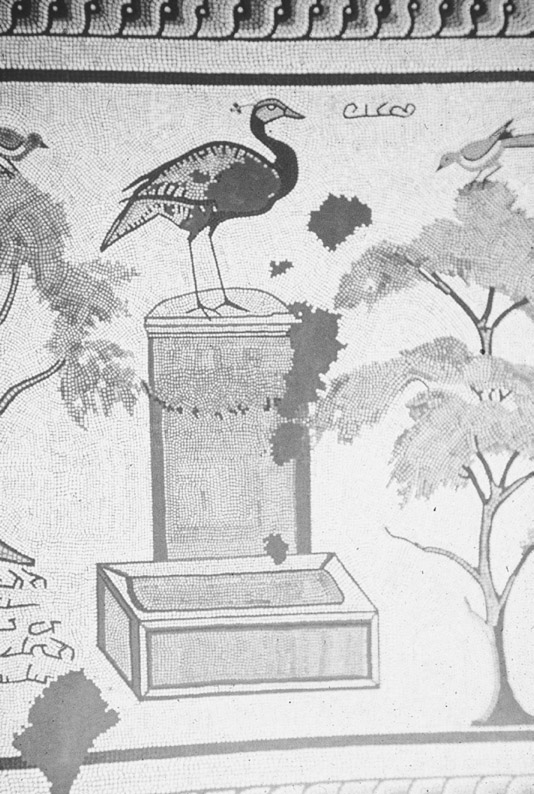
Phoenix mosaic. The phoenix was a mythical bird that was said to live for 500 years, then consume itself in fire, only to be reborn out of the ashes. Third century CE (Urfa, Turkey)
II. GREEK PREPOSITIONS
|
Greek Preposition |
English Meaning |
English Combining Form |
Example |
|
amphi (άμφί) |
around, on both sides; |
amphi- |
amphitheatre |
|
of both kinds |
amphibious |
||
|
ana (άνά) |
up; backward; again |
ana- |
anagram, analogy |
|
anti (άντί) |
against |
anti- |
antidote, antipathy |
|
apo (άπό) |
from, away from |
apo-, aph-* |
apology, apostle, |
|
aphorism |
|||
|
cata (κατά) |
down, away; concerning |
cata-, cath-* |
catalog, catastrophe, |
|
catholic, catheter |
|||
|
dia (διά) |
through |
dia- |
diameter |
|
en (ἐν) |
in |
en-, em- |
endemic, empathy |
|
ec (ἐκ) |
out of |
ec-, ex- |
ecstasy, exodus |
|
epi (ἐπί) |
on, at, to; in addition to |
epi-, eph-* |
epistle, epidemic |
|
ephemeral |
|||
|
hyper7 (ύπέρ) |
over, beyond; excessively |
hyper- |
hyperbole, |
|
hyperactive |
|||
|
hypo (ύπό) |
under, below; slightly |
hypo-, hyph-* |
hypothesis, hyphen |
|
meta (μετά) |
with, after, beyond; change |
meta-, meth-* |
metabolism, method |
|
para (παρά) |
beside, beyond; contrary |
para- |
paradox, parallel, |
|
to; irregular |
paranoia |
||
|
peri (περί) |
around, about, near |
peri- |
perimeter, periphery |
|
pro (πρό) |
before, in front of |
pro- |
problem, prophet |
|
pros (πρός) |
to, toward, in addition to |
pros- |
prosthesis |
|
syn8 (σύν) |
with, together |
syn-, sym-, syl-, |
synthesis, sympathy, |
|
sym-, sys- |
syllable, symphony, |
||
|
system |
|||
|
* When placed before a word that begins with a rough breathing mark, the final vowel is dropped, and π changes to a ϕ, and a τ changes to a θ. |
|||
III. PREFIXES DERIVED FROM GREEK AND LATIN ADJECTIVES AND ADVERBS
Most English compound words formed from the following Greek and Latin adjectives and adverbs are learned borrowings.
Words of Measurement
|
Greek or Latin Word |
English Meaning |
English Combining Form |
Example |
|
acron (άκρον) |
topmost |
acro- |
acropolis |
|
aequum, aequi |
equal |
equi- |
equilateral |
|
auto (αύτό) |
self |
auto- |
autograph |
|
homeon (ὁμοι̑ον) |
similar |
homeo- |
homeopathic |
|
homon (όμόν) |
same |
homo- |
homogenize |
|
ison (ἴσον) |
equal |
iso- |
isosceles |
|
macron (μακρόν) |
large, long, excessive |
macro- |
macrocosm |
|
magnum, magni |
large |
magni- |
magnify |
|
mega (μέγα) |
large, great |
mega- |
megaphone |
|
megalon (μεγάλον) |
large, great |
megalo- |
megalomania |
|
micron (μικρόν) |
small |
micro- |
microphone |
|
multum, multi |
much, many |
multi- |
multiply |
|
omne, omnis |
all |
omni- |
omnivore |
|
pan (πα̑ν) |
all |
pan-, panto- |
pantheon, |
|
pantomime |
|||
|
poly (πολύ) |
much, many |
poly- |
polygamy |
|
tele (τη̑λε) |
at a distance, far |
tele- |
telephone |
Words of Praise
|
Greek or Latin Word |
English Meaning |
English Combining Form |
Example |
|
bene |
well |
bene- |
benefactor |
|
eu (εὐ̑) |
well |
eu- |
eulogy |
|
orthon (ὀρθόν) |
straight, right |
ortho- |
orthodox |
|
philia (φιλία) |
love |
phil-, philo- |
philanthropy, |
|
philosophy |
|||
|
rectum, recti |
straight, right |
recti- |
rectify |
Negatives
|
Greek or Latin Word |
English Meaning |
English Combining Form |
Example |
|
a-9 (ἀ-) |
not, lack of, absence |
a- |
abyss |
|
in-10 |
not |
in-, il-, im- |
innocuous |
|
illegal, |
|||
|
immoral |
|||
|
non |
not |
non- |
nonresistant |
|
dis- |
apart, away, reverse |
dis- |
disappear, |
|
dismiss |
|||
|
malum, mali |
bad |
mal-, male- |
malefactor |
|
cacon (κακόν) |
bad |
caco- |
cacophony |
|
dys- (δυσ-) |
bad, difficult |
dys- |
dyslexia |
|
miseo (μισέω) |
hate |
miso- |
misogynist |
|
heteron (ἕτερον) |
other, different |
hetero- |
heterogeneous |
|
retro |
backwardy |
retro-, re- |
retrograde, |
|
regress |
Odds and Ends
|
Greek or Latin Word |
English Meaning |
English Combining Form |
Example |
|
archeon (ἀρχαι̑ον) |
old |
archeo- |
archeology |
|
paleon (παλαι̑ον) |
old |
paleo- |
paleolithic |
|
neon (νέον) |
new |
neo- |
neophyte |
|
crypton (κρυπτόν) |
hidden |
crypto- |
cryptogram |
|
quasi |
as if, resembling |
quasi- |
quasi-official |
No Wonder I'm Confused
Mastering the orthography of English can be a difficult business because of the various influences on the language over time, and the existence of both homographs and homophones only add to the confusion.
Homographs are words that have the same written forms but different meanings (and sometimes different pronunciations). They may or may not have the same etymological root.
1. orient is derived from orior-oriri = rise
morbid is derived from morbus, morbi = sickness
Check your dictionary for different meanings of these words and how these meanings developed.
2. Host can mean either a very large army, or a person who greets and entertains you. The former is derived from hostis, hostis = enemy; the latter from hospes, hospitis = guest or host.
Here are a few others to confuse you:
You are not qualified, so I will give you only qualified approval.
I wind my watch as I stand in the wind.
I hope that my will will reflect my will.
I wound my watch although I had a terrible wound.
Homophones are words that sound alike but that are spelled differently (and have different meanings).
Examples
1. I threw the ball through the window.
2. Don't whine, he said, as he drank my glass of wine.
3. She knows where her nose is.
Impress Your Friends
Some words are just fun to know. Here are a couple:
obfuscate = confuse or bewilder, especially in regard to the truth.
“The governor tends to obfuscate even when asked a direct question.”
obsequious = overly willing to follow the will or desire of another, especially one's superiors.
“His obsequious behavior toward his boss made everyone think he was her servant.”

NAME _______________________________________________________________________
A. In Exercises 1–29, fill in the blanks with the literal meaning of each italicized word or part of a word. Make sure that your sentences are grammatically correct. If you are not sure of the derivation, check your dictionary.
Example
A promotion moves you in front; a demotion moves you down.
1. At a colloquium, individuals __________ __________ one another.
2. An extraterrestrial being come from __________ the earth.
3. Circumstances are the events that __________ __________ an event.
4. Your supervisor is __________ __________ __________ your work.
5. An introvert is an individual who has __________ __________ himself.
6. A supposition is a statement that is __________ __________ an argument.
Can you figure out a Greek-based word that has exactly the same meaning? __________
7. In American history, “ante bellum” usually refers to the period __________ the Civil War.
8. To intervene in an argument is to __________ __________ the two sides.
9. If someone grabs you __________ the throat, you may suffocate.
10. An agenda is a list of things to be __________.
11. A person who interferes in your business __________ himself __________.
12. When the onus of responsibility is placed upon you, it becomes your __________.
13. A sinecure is a job __________ real responsibilities or duties.
14. An obstacle __________ __________ you.
15. An aqueduct __________ water from one place to another.
16. A person who lives in seclusion is closed __________ from the world.
17. A circumlocution is a polite way of __________ __________ an unpleasant topic.
18. Contrary individuals are inclined to go __________ whatever the majority says.
19. A postscript is __________ __________ the body of a letter.
20. A permeable substance allows other material to pass __________ it.
21. A permanent stain is one that will remain __________.
22. An advertisement __________ your attention __________ a product.
23. A deposition is a statement that has been __________ __________ about an event.
24. What does circa 1920 mean? ___________________
25. I came to work via public transportation. In other words I was __________ __________ town __________ city streets.
26. An aggressive person walks __________ you in a hostile manner.
27. I was given a bonus because I did __________ job.
28. He lived in squalor; his apartment was so __________ I couldn't stand it.
29. He claimed he was a pauper, but he certainly didn't live like a __________ man.
B. Fill in the blanks in the following sentences with the literal meaning of the italicized word or part of a word. Make sure that the sentence is grammatically correct.
30. An amphitheatre has seats all __________.
31. An apostate is an individual who has __________ __________ his faith.
32. A peripatetic individual likes to walk __________all the time.
33. When you make a synthesis of various ideas, you __________ them __________.
34. An antidote is __________ __________ a poison.
35. A diagonal line is drawn __________ an angle.
36. An epitaph is written __________ a tombstone.
37. Metamorphosis indicates __________of shape or form.
38. A paramedic works __________ the doctor.
39. A hypercritical individual is __________ judgmental.
40. In a state of ecstasy, you may experience a psychological sensation of __________ __________ your body.
41. A disease that is endemic is widespread __________ the population.
42. A prophet speaks the true outcome of an event __________ it happens.
43. There was an exodus toward the doors as the audience looked for a way __________.
44. In a symphony, all the sounds blend __________.
C. As we have already seen, some Latin words changed their function when they entered into English. Here are some more Latin verb forms that have become English nouns. What are the current meanings of these Latin verbs?
|
Latin Verb Form |
Literal Translation |
Current Meaning |
|
45. credo |
I believe |
______________ |
|
46. affidavit |
he has sworn |
______________ |
|
47. deficit |
it is lacking |
______________ |
|
48. ignoramus |
we do not know |
______________ |
|
49. caveat |
let him beware |
______________ |
|
50. caret |
it is lacking |
______________ |
|
51. fiat |
let it be done |
______________ |
D. Fill in the blanks in the following sentences with the literal meaning of the italicized word or part of a word. Make sure that the sentence is grammatically correct.
52. An omnivorous animal _______ ______ kinds of food.
53. If you are a neophyte at tennis, you may make mistakes because you are ______ to the sport.
54. A creature that is macrocephalic has a __________ skull.
55. A misogamist _______ the very thought of marriage.
56. The population of New York City may be described as heterogeneous because it is made up of many __________ nationalities and ethnic groups.
57. A benevolent individual wishes you ___________.
58. A dyspeptic individual may be irritable because she has ________ digestion.
59. A polygynist has _______ wives at the same time.
60. The Pantheon was an ancient temple in Rome dedicated to _______ the _______.
61. To be magnanimous means that you are generous and therefore have a ________ spirit.
62. If you are abysmally ignorant, your lack of knowledge is _________ any measure or depth.
63. A retrospective exhibit looks _________ at the whole of an artist's work.
64. A musical composition that is euphonious _________ _________ to the ear.
65. A micrometer is an _________ _________ distances.
66. An Anglophile _________ all things English.
67. An autonomous state is one that is ____________ ____________.
68. A cryptogram is ________ whose meaning is __________.
69. An archaeologist _________ _________ cultures.
70. A rectilinear argument moves along a __________ line.
71. The speech of an incoherent individual does _________ hold together.
72. “Please do not desert me in the desert” provides an example of a _____________.
73. “He jumped into the air when he found out that he was heir to a fortune” provides an example of a ___________.
74. What is the difference between an immigrant and an emigrant? ______________________.
E. What's in a name? Onyma (ὄνυμα) is the Greek word for name. Give the current meaning of each of the following compounds of onyma and cite an example of each.
|
Meaning |
Example |
|
|
75. acronym |
_________ |
_________ |
|
76. homonym |
_________ |
_________ |
|
77. antonym |
_________ |
_________ |
|
78. synonym |
_________ |
_________ |
|
79. anonymous |
_________ |
_________ |
|
80. eponym |
_________ |
_________ |
F. How many of these words can you use to construct a coherent essay or story? Whatever you write must make grammatical and logical sense. If you are unsure of a meaning, check your dictionary. In addition, give the etymology of each of the words that you use.
|
abhor |
deviate |
pervert |
|
accost |
emancipate |
post mortem |
|
adhere |
exacerbate |
prevaricate |
|
antediluvian |
extrovert |
pro tempore |
|
avert |
internecine |
seduce |
|
collude |
introspective |
superstitious |
|
compassion |
oblivious |
traitor |
G. Construct sentences that contain one of the following words and that demonstrate you understand the meaning of the word. You need use only one word per sentence but extra credit for using two or more. Make sure that your sentences are grammatically correct.
|
anachronism |
empirical |
hypothesis |
|
antithesis |
ephemeral |
paradigm |
|
catastrophe |
hyperbole |
protagonist |
Footnotes
1. Certain consonants (such as b, m, and n) often take on the sound of the following consonant: e.g., sub + pono (place) > suppono-supponere-suppositum (place under). This is called assimilation. Sometimes there is only a partial assimilation of sounds: e.g., n before p becomes m, as in compose.
2. Sometimes the Latin prefixes cum and per (as well as the Greek διά) serve merely to intensify the word to which they are affixed: e.g., per + facio > perficio-perficere-perfectum = do thoroughly, finish; or cum + cedo > concede-concedere-concessum = yield completely, give way.
3. The prefix co- is most often used as a learned borrowing, meaning “together” or “jointly”: e.g., coworker.
4. When the Latin word has first passed through French, contra most often becomes counter: e.g., contra + mando (order) > countermand.
5. When the Latin word has first passed through French, super most often becomes sur: e.g., super + vivo (live) > survive.
6. Ultra is never used as a prefix in Latin. It appears in English only as a learned borrowing.
7. Almost all uses of hyper- and hypo- in English compounds are learned borrowings.
8. In compounds, the n of syn- is often assimilated to the consonant that follows it.
9. When a- is added to a word that begins with a vowel, an n is placed between the prefix and the root of the word: e.g., a + arche > anarchy.
10. There is, unfortunately, no way to distinguish between the use of in- as a prefix meaning in or on, and its use as a negative.