
Michelangelo was lucky with his subject, for not many battles include pastoral moments of naked bathing. Whether he himself found the most suitable battle in Bruni’s History of Florence or it was selected by someone in the Palace, the choice must surely have been deliberate, for it offered a rare opportunity to portray an army with its clothes off.
All his life studies drawn in the autumn of 1504, all those men who look like they’re at the baths, are exact designs for figures in his agitated army. These painted heroes would tower in the Great Council Hall just as David towered outside the Palace. On the Piazza, the gigantic statue stood stone in hand, eyes on the prize, ready to act. In the Great Council Hall, a few steps away, the Florentine army would leap out of the river, rushing to put on armour, stretching and twisting and running to see the enemy. David and the bathers have something else in common. The Florentine army in The Battle of Cascina aches and strains to see the enemy. But that enemy is invisible to us, just as there is no monstrously vast Goliath for David to look at. There is a particular unease to the way these heroes face a danger urgent yet invisible: perhaps what it does is to transfigure Michelangelo’s heroes from the real world to a larger cosmos of the imagination. Yet what it also does is destroy complacency: to prevent any resolution of the moment the work—portrays? No, “portrays” is not the word—enacts. David and the bathers of Cascina enact alertness. They are awake. And because the source of their wakefulness is unseen, it is also unfixed—it might be tyranny, it might be death. What matters is the wakefulness, the fully conscious state, that Michelangelo’s unclosed heroic drama creates.

Antonio Pollaiuolo Battle of Naked Men, 1465. Pollaiuolo’s eerie vision of muscular nudes fighting in a rural clearing was a powerful antecedent of Michelangelo’s naked history. (illustration credit 10.1)
So he was not only competing with Leonardo but also setting out to complete his conquest of Florentine public space. The citizen approaching Piazza della Signoria would first see David framed against the Palazzo Vecchio, its white form casting a long shadow; then would go through this Palace to the Great Council Hall, where the colossal bathers rushed to fight the invisible enemy. The entire sequence would be a monumental theatre, in which the citizen was the true actor: for all these nudes urged a state of mind identical with theirs. They were not mere depictions of primed energy. They were talismans to awaken the beholder. To experience them was in some sense to become like them.
The Battle of Cascina portrays a real moment in history, is scrupulously close to a written source—and yet it comes from deep within Michelangelo’s artistic personality. At the very beginning of his life as a sculptor he created a work that already contains it: the giant nudes he drew that winter, as 1504 became 1505, on his vast sheet of paper in the Hospital of the Dyers, grew directly out of a work he had sculpted when he was a teenager. If you look at the stains on a wall, said Leonardo da Vinci, you may see various forms, including battles. When he was about seventeen, Michelangelo cut into a slab of marble and found a writhing mass of human bodies. It is as if they had welled up in the shallow pool he carved out of the rectangular vertical block, as if they are swarming from the stone and taking shape under the beholder’s mystified gaze. Base matter becomes form, yet in the very moment of assuming recognisable shape, these creatures strangle, stone, club, and crush one another.
The poet Angelo Poliziano started it. When Michelangelo was living in the Medici Palace, this erudite author suggested to his young friend that the Battle of the Centaurs might make a good subject for him. He told Michelangelo the story from Ovid’sMetamorphoses of how the centaurs, those half-human, half-horse monsters, were invited to a wedding by their human neighbours the Lapiths: how it all went fine until the centaurs got drunk and tried to carry off the Lapith women; how a frenzied, savage battle broke out. It was a myth richly suited to art, full of visual challenges: the impossible centaurs to portray realistically, as well as the vast variety of poses that battle unleashes, which had been studied so powerfully by another artist in the Medici orbit, Antonio del Pollaiuolo, in his print The Battle of the Nudes.
In Pollaiuolo’s engraving a group of nudes have met in a forest clearing to fight one another: it is a dream of struggle, almost an image out of a folk tale or an uncanny mass vision like the army seen in the sky over Arezzo in 1494. The men fight with swords, bows and arrows, axes and daggers: like gladiators, they slaughter one another for our delectation. The battle displays the authority and excitement of the nude: the men are seen from different angles, in poses that mirror and complement one another, revealing the artist’s ingenuity in manipulating the human figure. Yet it is disturbing: the full beauty of the nude seems only to be revealed in violence; the strength and agility of these men’s bodies is at its most heightened in the moment they kill one another. This print is one of the few works that can meaningfully be said to have “influenced” Michelangelo. Engraved in 1465, it would certainly have been available to consult in the Medici Palace, where he could also see more monumental works by Pollaiulolo—his three large-scale paintings of the Labours of Hercules, done in about 1460, lost now but remembered in two small panels by Pollaiuolo in the Uffizi Gallery. In one of these paintings, Hercules lifts the giant Antaeus, whose strength derived from the Earth, right off the ground: this wrestling scene is even more Michelangelo-like than The Battle of the Nudes. The tremendous compression of Hercules’ powerful back as the body of Antaeus presses down on him from above must surely have been studied fervently by the young sculptor in Lorenzo’s house—it is exactly the kind of sensual suffering he discovers in the marble as he hews out his Battle of the Centaurs.
The close-quarters fighting in The Battle of the Nudes and, even more, the grappling, lifting, and squashing together of bodies in Pollaiuolo’s Hercules and Antaeus gave the young Michelangelo something he needed. Pollaiuolo saw that nudity in art did not have to mean beauty. It could also mean terror, cruelty, pain, and death. Michelangelo, when he was seventeen and for the rest of his life, could relate to that. His Battle of the Centaurs takes up the compression and claustrophobia of Pollaiuolo’s cruel nudes. Just as the older artist’s naked men battle in a clearing that is cut off by tall vegetation behind them—a natural arena—Michelangelo’s struggling bodies are trapped in a shallow basin with no room for manoeuvre. They can only throttle and pull hair—and hug. For there is an ambiguity here that has nothing to do with Pollaiuolo: where his battling men only battle, some of the grapplings in Michelangelo’s relief are more double-edged. Embraces become strangulations, assaults marriages. The intertwined struggles are somehow larger, more universal than Pollaiuolo’s. Where his predecessor had studied the nude in a new and harsh way, Michelangelo transfigures it into an allegory of life. The Battle of the Centaurs is manifestly an image of life as mortal combat; the world as a battle in a locked room, humans as helpless lovers and enemies condemned to grapple one another in this world’s stony prison. At the heart of the battle of life is a man with his back to us. His spine is a deeply cut line rising diagonally as he stretches to the left. Exactly the same back will appear in the same pose, reversed in direction, in the cartoon for The Battle of Cascina.
Michelangelo’s most moving preparatory work for his cartoon is an almost invisible sketch in misty black chalk that survives in the Uffizi Gallery, its figures as if fading before your eyes into the heat haze of that day beside the Arno. Some of them reach forward, away from us, in a sloping pyramid of foreshortening whose dynamic sense of the body moving in three-dimensional space potently transliterates Michelangelo’s sculptural genius into pictorial art: the spectacular dispositions of the Sistine Ceiling are already here in a nutshell. The bathers in this little drawing are, unequivocally, bathers: the men climbing out of the Arno onto the shore frankly show their buttocks, and one man bends over just like Diana or Susannah in later bathing scenes by Titian or Tintoretto. In other words, it is both sexually charged and feminising—and emotional. Michelangelo portrays in this little drawing a community of nudes who help one another, rely on one another, and are collectively imperilled. Their alarm is like that of a herd of gentle animals—they seem more boyish than heroic, they seem vulnerable.
The visitor was handsome and courtly, with fine, long hair and the manners to match. He had come there to learn from the best, to watch Michelangelo and Leonardo at work and assimilate their styles into his own. That very desire shows how different a person Raphael was from either of his elders. He was an orphan, brought up in the painting workshops of his native Umbria. His father, a painter and poet at the court of Urbino, had died when he was eleven, and Raphael’s lifelong quest for grace and harmony, in art and life, might be seen as a search for reassurance, for a structure to his existence. He was calm and confident in his internalisation of other artists’ styles: first his father’s, then that of Perugino, the most famous artist in Umbria at the turn of the sixteenth century. Raphael could afford to relax about his own individuality. He was a prodigy, like Mozart. The perfection of his touch is there from the very start, and by the time he was twenty-one he could create a work as sublime as The Marriage of the Virgin, his heavenly vision of a piazza in the open countryside that recedes towards a many-sided domed temple, with an airy loggia all round it and a view through its interior of the clean, bright sky beyond. It is a place you want to visit, but it is more perfect than any real building—although Raphael’s friend Bramante did try to create perfections like this.
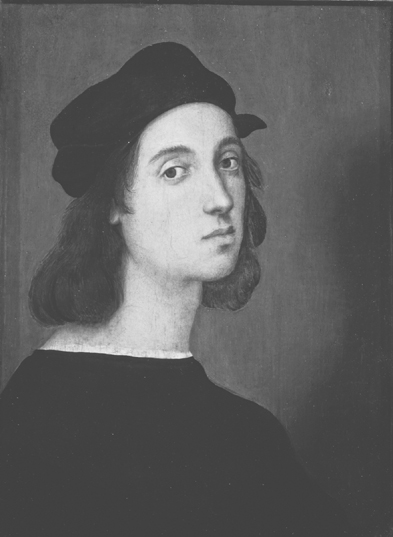
Raphael, Self-Portrait, 1504–6. Raphael here seems a model of good looks, style, and manners, in contrast to his two troublesome elders. (illustration credit 10.2)
Raphael was hypnotically drawn to the competition between Leonardo and Michelangelo. He visited the workshop at Santa Maria Novella and drew works in progress by Leonardo—including Leda, in the alternate version of this long-nursed composition that shows her standing upright, embracing her swan. He looked long and hard at the Mona Lisa, the Virgin and St. Anne, and the unfinished cartoon for The Battle of Anghiari. He also followed Michelangelo around, presumably at a safe distance from the volatile man who was eight years his senior, and drew David from behind. He sketched other sculptures and paintings Michelangelo was at work on, the constellation of sculptures and paintings that were born, or not, at the same time as the cartoon of The Bathers.
For the Cathedral Michelangelo had accepted a contract in April 1503 to sculpt twelve gigantic Apostles as his follow-up to David. He only ever made much headway on one, St. Matthew. For a family of Flemish cloth merchants he was carving a statue of the Madonna that is another brutal riposte to Leonardo’s melting Madonnas—the mother of Christ sits coldly upright, her son is a nude boy who also stands, leaning on her lap, already conscious of who and what he is. Leonardo’s childish intimacies of John and Christ and his enfolding maternal couples are replaced by a vertical shaft of strength.
Raphael saw the serious game the two artists were playing, the feints and insults as they rivalled and rejected one another’s poses, tones, mentalities, and he replays it in his own art. In paintings that he made as he internalised this spectacle, he brilliantly juxtaposes, and unifies, the contemporaneous works of the two masters. In his Madonna of the Goldfinch, a Christ visibly adapted from the infant hero in Michelangelo’s Bruges Madonna rests against Mary’s lap and looks, in a Leonardesque way, into the eyes of his friend John the Baptist as they play together with a pet bird; Mary puts her arm on John’s back and looks tenderly downward, smiling gently, just like the Madonna in Leonardo’s St. Anne cartoon. Raphael’s Madonna of the Meadow contrives a very similar synthesis; and in his Bridgewater Madonna, the flying, fleeing Christ child of Michelangelo’s Taddei Tondo is placed in the arms of a mother of Leonardo-like tenderness.
What does Raphael identify as the contrasting traits of the two competing artists? He was an eyewitness to their struggle for supremacy, after all, and we are not—and besides, he looks at them with the eyes of genius. In these paintings by Raphael it is not simply different poses that are borrowed from Michelangelo and Leonardo. He identifies them with two different principles. Michelangelo is energy. The sideways, soaring movement of the child in Mary’s arms in the Bridgewater Madonna, the determination of Christ to stand upright—the strident, passionate fluency of Michelangelo’s art—is unmistakable in Raphael’s quotations. But this is balanced by the courtly Raphael with the softness of Leonardo, the yielding, enveloping quality of his compositions and his painterly delicacy of tone. It is no mere simile to compare Raphael with a courtier, intelligently recognising the best qualities in both older painters and weaving their antitheses into a civilised synthesis. He was famous for his social graces, for being a model courtier as well as a great artist. One of his closest friends was the diplomat Baldassare Castiglione, whose Book of the Courtier, published in 1528 and widely translated in the following decades, became the guide to civilised behaviour for every socially ambitious sixteenth-century European. In it Castiglione—quoted here in the Tudor translation that introduced Leonardo and Michelangelo into the English language—encourages the courtier to take a tolerant and pluralistic attitude to artistic style: “Behold in painting Leonardo Vinci, Mantegna, Raphael, Michelangelo, George (Giorgione) of Castelfranco: they are all most excellent doers, yet are they in working unlike … everie one is knowne to bee of most perfection after his manner.” In Florence in the early years of the sixteenth century Raphael is visibly reaching the gracious view later to be expressed by his friend Castiglione that each great artist excels equally “after his manner.” Neither Michelangelo nor Leonardo is the “best”: in talents of this order you can only compare their differences, and recognise their aesthetic personalities. Raphael does that in his paintings.
This is a powerful insight into the true nature of the competition between Leonardo and Michelangelo: it was a recognition that such a thing exists as a personal artistic style. There had been artistic competitions before. But what sense of the two artists’ personalities does one get from Brunelleschi’s and Ghiberti’s rival reliefs of the Sacrifice of Isaac in the Bargello? None at all. They are simply competing craftsmen: the better work is the more technically proficient. The judge can’t for one minute conclude that Ghiberti was more emotionally involved in the scene, that he identified more deeply with the boy waiting to die or the father ordered by God to carry out this terrible deed—there is absolutely no sense that either artist personally engaged with the story in that way.
A century later, the competition between Leonardo and Michelangelo was fundamentally different. Personality was at stake. The two artists were being compared and contrasted in their dramatically dissimilar styles, rather than being given points for technical merit.
This was really something new. It was unimaginable before, among painters and sculptors. Artistic personality was coming to the fore for the first time in history. Leonardo da Vinci and Michelangelo Buonarroti did have something in common: their works’ wilful singularity. Leonardo and Michelangelo were “themselves,” and themselves alone, as artists, in a way no one had ever been before. The confrontation that came about in Florence in 1504 was the consequence and acknowledgement of this. Leonardo’s notebooks, his misty painting style, his very evasiveness and complexity in his working habits, set him apart—and Michelangelo’s gravitas, strength, and self-consciousness set him apart, in parallel with his rival. Their competition arose because Florentines could see this and were enthralled.
It was the recognition of Leonardo’s inner mind, his imagination on view, in Florence at the start of the sixteenth century that had begun this new way of looking at art. In flocking to see a mere drawing for an unfinished work at the Annunziata, people were admiring the personal nuances of Leonardo’s style, the “genius” of the artist, rather than welcoming one more addition to the city’s collection of beautiful images. He took the same approach to his commission in the Great Council Hall, setting out to design a vast cartoon at Santa Maria Novella. People could witness his mind, his fantasy, the process of his art, even before he began to paint. And when Michelangelo entered the fray with him in the autumn of 1504, that was the challenge he took up: he threw himself into drawing, and composed a cartoon at the Hospital of the Dyers so people could see that he was just as personal, just as manifestly himself, as the older man. It was a competition in idiosyncracy.
If this was the history of a battle, one might say that Leonardo was the first onto the field, had his choice of territory and time to prepare his positions, but that he diffused his forces over the landscape and failed to prepare any defences. Michelangelo, coming late in the day but with his army of nudes superbly trained and resolute, thrust straight into the middle of Leonardo’s scattered ranks with a crushing, devastating attack. While Leonardo was away from Florence in November, Michelangelo was massing his men. By the time Leonardo returned in time for Christmas 1504, the daring raid on his camp was well under way.
Michelangelo, to look at it another way, had more to prove. David was a sensation, but its maker was still regarded essentially as a brilliant sculptor. Leonardo was seen as a great artist in a much larger way. “And those capons of Milanese really believed in you?”—Michelangelo’s bitter question was also a reluctant recognition that an aura of enigmatic genius hung around Leonardo. The real challenge Michelangelo took on in 1504 was to show that he too was a thinker, a visionary, to make the personal nature of his art impossible to ignore. His entire conception of himself as an artist evolved during his competition with Leonardo. In these years he was working on a spectacular range of sculpture commissions: as well as the Apostles in Florence there was a series of statues for Siena Cathedral. But these projects fell by the wayside. Only one Apostle was even begun. For Siena he turned out hack work. He didn’t care. Why? Because these were old routines. It might seem as if he rejected everything about Leonardo. In reality he was learning from Leonardo, and what he saw was a bigger, bolder way to be an artist.
To Michelangelo, the notebooks with which Leonardo’s workshop and camera at San Lorenzo was stuffed must have looked like what their editor J. P. Richter called them in the nineteenth century: The Literary Works of Leonardo da Vinci. It cannot be coincidence that it was during their competition that Michelangelo started to produce his own “literary works.” His first fragments of poetry are on sheets that also carry drawings for The Battle of Cascina. Not only that, but on some sheets of paper he seems to be deliberately mimicking the heterogeneous richness of Leonardo’s notebooks. Verses are juxtaposed with drawings of grotesque architectural decoration and, on the sheet’s other side, a statue design with a battle sketch and stray, mysterious lines of poetry. The fact that he’s imagining architectural details is itself significant: Michelangelo was not yet an architect, but here, as he confronts the polymath genius of Leonardo, he is imagining forms that in fact do resemble the masks and grotesques that decorate his later interiors. He’s thinking big, expanding his idea of the artist’s role.
The greatest lesson Leonardo had to teach Michelangelo was also the most dangerous. The supposed flaw in the older artist’s character that made him delay and evade and fail to finish his works was a succinct way of differentiating genius from mere craft. The products of genius are worth studying even if they are only notions, rough drafts, sketches: that was what Leonardo proved when he won acclaim for “mere” cartoon drawings. It was also the lesson of the Horse, and for all his coarseness about it, Michelangelo understood this. During his stand-off with Leonardo he became less the efficient artisan and more prepared to leave works unfinished. He had failed to finish things before, it’s true, but for practical reasons. However, his statue of St. Matthew, begun for Florence Cathedral during the years of competition, is a masterpiece whose very poetry lies in its being unfinished. It is the first of his sculptures in which, as Matthew’s form emerges in fragments and feints from the mottled block, raw stone becomes part of the work’s poetry. It is the sculptural equivalent of Leonardo’s tantalising drawings: a stone schizzo, a sublime sketch.
Michelangelo’s supreme sketch was the gigantic cartoon he was drawing at the Hospital of the Dyers. There is no explanation for the way it turned out except sheer competitiveness. In his great drawing he took Leonardo on intimately, on his own ground—as a draughtsman and as an eccentric. If Leonardo was putting his own preoccupations into his design at Santa Maria Novella, well, Michelangelo would push the personal preoccupations of his own work to the edge of complete self-indulgence. His cartoon trumpets individual passion and disdains explanations.
At Santa Maria Novella the personal nature of Leonardo’s battle cartoon had been clear from the start. His sketchbook of horses records his continuing quest to understand nature—and that completely individual quest continued into the cartoon itself. As he drew it, two massive horses’ rumps took shape on the great sheet of paper, parallel to one another, like two planets. The horses were rearing up—like the first design he’d submitted, long ago, for the Sforza monument, and like the rearing, thrashing horse he drew so brilliantly from life in his sketchbook. The horses in his cartoon were the wild children of his spectral bronze steed: they were fearsome beasts, ogres of the equine—not the grace but the power of the horse. It was not an aspect of his cartoon dictated by history, or by the Florentine Republic, this monumental revelation of frenzied horses. It was part of his artistic biography and a reassertion of his reasons for making art.
But if Leonardo could draw these horses like great signatures at the heart of his battle picture, Michelangelo would go further. He would relentlessly concentrate on his own personal subject, the male nude. He would draw vast nudes, a whole crowd of them—and nothing else. No battle. No fighting. Just men getting out of the water, naked, and struggling to put on armour, racing to see the enemy. The oddity of it was the entire point. The Battle of Cascina was an essay in individuality: a declaration of independence. It was a deliberately grotesque exercise. Not grotesque because it was ugly, but in its fanciful freedom. It was a kind of joke. It was hyperbolic. It set out to leave no confusion. In all his works Michelangelo was drawn to the nude. Here, he flaunted it as an obsession—drew attention to his habit, dramatised his penchant.
To this day, The Battle of Cascina is a confusing title; hence its alternative moniker of The Bathers. The drawings of men fighting that he made early in his thinking are, I believe, essentially responses to Leonardo—as soon as he found his own idea he stopped drawing fighters and concentrated entirely on nudes. The Battle of Cascina was to be portrayed through this vast scene of naked men. Michelangelo sought to outdo his rival in sheer abstract wilfulness.
In the Strozzi Chapel at Santa Maria Novella, in 1502, Filippino Lippi had finished a work of surpassing strangeness. Lippi’s fresco St. Philip Exorcising the Demon in the Temple of Mars portrays a dragon being driven by an early Christian out of a hole in the steps of a classical temple. This temple is an architectural phantasmagoria: trophies of armour, jagged, violent statues, offerings and living sculptures decorate its weird semicircular niche inside which the god Mars—not a statue but the god himself—stands on a plinth, raising a broken lance above his head, a wolf at his side. Around the surreal temple, colossal painted pilasters are covered with intertwining abstract creatures, garlands, and foliage in white relief on a dark background. Even the people in the crowd watching the exorcism are out of the ordinary, with exotic faces and headgear.
Lippi, like Michelangelo, had been in Rome, where in the last years of the fifteenth century the buried corridors of the Golden House of Nero were rediscovered beneath the Esquiline Hill. This vast villa connected by a subterranean passage to the Palatine palaces was Nero’s indulgent whim, a pleasure house that so shocked the Romans they consigned it to a damnatio memoriae and built over it. When a way into its underground passages near the Colosseum was found, artists lowered themselves on ropes to study by torchlight its curious paintings. These were the first ancient Roman paintings to be seen by Renaissance artists: up to then any knowledge of Roman painting, as opposed to sculpture, had come from descriptions by authors like Cicero and Pliny. Now, ancient frescoes could be compared with modern ones, and the artists were confounded by how utterly unlike they were. The murals in the Golden House were free-flowing fantasies of colour and design: monstrous creatures, ornate tendrils, masks, and foliage were strung together in random shapes juxtaposed with planes of pure colour. These monstrous fantasies were found in a cave, a grotto, so they were named grotteschi. Lippi’s painting is one of the first to import the grotesque to Florence.
It is especially striking because the grotesque is not confined in it to the playful decorations on the painted pilasters. The entire painting is grotesque: a spirit of disordered fantasy has entered every aspect. The repulsive Temple of Mars, the living statues, the piles of armour and clutter of offering vessels—it is all pleasantly deranged. Lippi’s painting reveals how thoroughly the idea of the grotesque could be applied by a Renaissance artist—it wasn’t just masks in the border. It was a release of disorder into the very core of a work of art.
Michelangelo had an appetite for the grotesque. Drawings of ornate capitals for columns that he did in 1503–4 have empty-eyed masks and interlocking gryphons in a free architectural play absolutely indebted to the Golden House and taking it, as Lippi does, as a licence to imagine monstrosities within a classical idiom: this would one day result in the extravagant freedom of his architectural masterpiece, the Laurentian Library. This new understanding of art also destabilised his cartoon. Its bathers weren’t ugly; but their arbitrary and self-pleasing display showed grotesque freedom.
The men in the cartoon were arranged in a complicated serpentine group whose convolutions created a tremendous sense of energy and panic. They were rushing and reaching in all directions. Some had staffs. Some put on armour. An old man sat on the rocks pulling on his clothes, a garland in his hair. Two hands rose tragically from the river, as if someone had panicked and was drowning in the rush to reach the shore. The drawing of a nude sitting on the rocks, twisting round to face into the group, grew into a huge chalk figure in the cartoon. So did the man with his back arched, a deep black spine engraved into his jagged form. There was a dramatic creation of three-dimensional space, not in the landscape (which was just perfunctory rocks) but in the revolving figures: they forcefully materialised as they veered towards or away from the beholder. There was no consistent direction to their energy: they cut across one another, contradicted one another.
Michelangelo made his point. The Battle of Cascina was so personal it was befuddling. The subtleties of Leonardo’s drawings were shoved aside by a bravura display of one man’s manner.
Raphael’s civilised idea that the differences between Leonardo and his competitor could be gracefully elided, that each man was perfect in his own style and these styles might be blended in an ideal harmony, was utopian. What he failed to see was that Leonardo and Michelangelo’s opposition went deeper than style. It was as if they had been born for this moment, so absolutely did they negate each other’s personalities. They saw the world and humanity in radically different ways.
As Leonardo came back to Florence from Piombino in mid-December 1504, his rival was speeding ahead. By the following February, when Michelangelo received a payment from the Signoria for his work on The Battle of Cascina, it seems the young contender had drawn much of his nude composition. And yet, the records contain a surprise. Leonardo, too, was satisfied he’d done enough on his own cartoon to start painting in the Great Council Hall. In February 1505 work began to erect his scaffolding there. It would take until June for him actually to set his brush to the wall—and as well as building a scaffolding as complex as the one he’d created at the monastery, he was still buying more cartoon paper. But now history, in the person of Pope Julius II, intervened to make Leonardo’s life a bit easier.
Il Papa sits melancholically on a throne decorated with the massive gold acorns that symbolise his family, the della Rovere, in his portrait by Raphael. Huge emeralds and rubies decorate his fingers; a long white gown falls like a waterfall over his knees. His new-grown white beard bristles beneath a face of compassionate authority. Raphael’s reverence for order finds its perfect expression in this painting of the Father of the Church that was to provide a template for later portraits of seated Popes by Titian, Velázquez, and Francis Bacon—but few written accounts of Julius II make him seem so gentle. When Giuliano della Rovere, Cardinal of St. Peter in Chains, was elected Pope in his sixtieth year in October 1503, he set out to restore the might and prestige of the Church—a work he interpreted as secular and indeed military. In Italy’s age of war, he was the warrior Pope. Where the Borgia Pope had placed his son at the head of the Papal armies, the new Pope would lead his own campaigns. Julius set out to reconquer Italian cities, including Bologna. From this springboard he attempted to forge a grand alliance to drive the French out of Italy, to expel these “barbarians” and restore Italian liberty under the leadership of Rome. This imperial Pope, who took the name Julius to identify himself with the greatest Roman soldier of them all, also took grandiose steps to renew Rome itself, to restore the city to a glory that matched and even outdid the Caesars: the seat of the Popes would become a truly imperial and impressive place, a city to overwhelm pilgrims and amaze ambassadors, not just with ancient ruins but with brand-new structures that revived the antique.
The process of rebuilding had begun under Sixtus IV, who had created a gracious new bridge over the Tiber with advice from Alberti. It continued under Alexander VI, who transformed Hadrian’s mausoleum by the river into a richly appointed papal fortress. With Julius, however, a truly ostentatious new Rome began to rise. The architect to whom he entrusted his stupendous ambition was Bramante, who had been one of Leonardo’s friends at the Milanese court; they shared ideas just as Leonardo did with Francesco di Giorgio. When their employer Ludovico Sforza was driven out of Milan and both men had to flee, Leonardo listed Bramante’s architecture in a fragmentary kaleidoscope of this sorrowful moment:
The small hall above for the apostles [i.e. The Last Supper]
Buildings by Bramante
The castellan made prisoner
Visconti dragged away and then his little son killed
Gian della Rosa robbed of his money
Borgonzo began and … his fortunes fled.
The duke lost his state, his things, and his liberty, and
none of his works were finished by him.
While Leonardo painted The Last Supper in the refectory of Santa Maria delle Grazie, his friend Bramante was rebuilding the choir of the monastery’s church, right next door to the long Gothic hall where Leonardo was working. Indeed, their conversations on architecture, perspective, and illusion are nakedly recorded in their works that survive in Milan. Bramante’s choir resembles some of Leonardo’s architectural drawings, while The Last Supper’s eye-fooling perspective is intimately related to Bramante’s architecture. In the Church of Santa Maria Presso Santo Spirito in Milan, in the late 1470s, Bramante had created an exactly parallel effect, a barrel-arched chancel that delights you when you realise it is an illusion, a shallow stone theatrical device that creates the fiction of a far larger space. Leonardo and Bramante were both, in Milan, experimenting with architectural fictions and dreaming of temples.
In 1502, the Spanish monarchy commissioned Bramante to build a small chapel to St. Peter where he was said to have been crucified, on the Janiculum hill in Rome. The architect created a circular temple with a dome, an upper storey of recessed niches, a balustraded parapet, and a lower storey of smooth colonnades surrounding a circular room with four doors. It is not so much a building as a vision of what buildings might be like, a manifesto for classical harmony and perfection that mirrors Bramante’s young friend Raphael’s intoxicating vision of the ultimate temple in his painting The Marriage of the Virgin. Bramante’s Tempietto has a lot in common with Leonardo’s drawings of centrally planned churches. It was the first full-fledged Renaissance “temple” to have been built in Rome, and right at the start of a new age of building it introduced a form this city would take on to bigger things—a form Bramante, like Leonardo, loved: the dome. Bramante’s Tempietto impressed the new Pope. In 1505 Julius gave him a magnificent task—to build a new palace, the Belvedere, that would take up a sprawling area of the Vatican, with three gargantuan courts, so large that a niche in one of them can hold a colossal pine cone found on an ancient Roman chariot course and make it seem entirely appropriate and in scale. The Belvedere would transform the Vatican into a secret city of power and mystery. Its scale and audacity announced a direct attempt to rival the vast palaces of the Roman emperors on the Palatine Hill.
Raphael’s portrait of Julius contains a truth. Julius was sensitive—at least when it came to art. It went with his rage, was the obverse of his mercurial temperament. Machiavelli characterised the Pope whose election he witnessed as a man of unstable, emotional character who was lucky enough to rule at a moment when spontaneity was the right stuff: “Pope Julius II proceeded impetuously in all his actions, and found times and matters so suited to his way of proceeding that things always turned out well for him.” This “impetuosity” led him to start wars overnight, but it also made him a generous and enthusiastic patron with an eye for the very best. Before he became Pope he had employed Giuliano and Antonio da Sangallo as his architects, and in 1505 Giuliano moved from Florence to Rome, expecting the relationship to continue: but Julius saw that Bramante was better. He made an instinctive decision to give Bramante one of the biggest architectural jobs in history, and he was right. The secret of Raphael’s portrait is that Julius really did have an inner life: there is no other way to explain his patronage. In February 1505, it was Michelangelo who got the call.

Raphael, Portrait of Pope Julius II, 1511. The “warrior pope” who led his own armies into battle and menaced Michelangelo seems benign in this tender portrait. (illustration credit 10.3)
It seems likely that Sangallo had praised the young sculptor to the Pope and urged him to hire his fellow Florentine citizen, but there was also of course physical evidence in Rome to persuade Julius it was worth commissioning this young artist he had not yet met. Just as Bramante’s Tempietto was a sublime calling card, so were the sculptures Michelangelo had carved in Rome in the 1490s—his Bacchus and Pietà. In fact, Pope Julius was the uncle of the cardinal who first brought Michelangelo to Rome and commissioned the Bacchus. Maybe word spread through the della Rovere family. However it happened, by the end of March 1505 Michelangelo was in Rome squaring up to a project as stupendous as anything Julius had yet imagined. Julius wanted the young artist to build his tomb. Giuliano della Rovere rose to the Holy See at sixty; he knew time was short. As Machiavelli saw it, this was part of his success, for “the shortness of his pontificate did not permit him to taste failure.” As he paced up and down inside the awe-inspiring stone drum of the emperor Hadrian’s tomb, which was now a Papal fortress, the Warrior Pope craved a mausoleum of his own. Michelangelo in the city below was eyeing the Tiber, thinking how he might bring great blocks of marble down the river for this gargantuan work.