
Thunderclouds hung above Piazza della Signoria, black and blue phantoms low over the pink tiles. The very statues shivered. The long finger of the Palace tower pointed high into the thickening air, daring lightning to strike. Through the courtyard, through the apartments, was the door into the gloomy Great Council Hall. Its low vaulted ceiling and inadequate window lighting made the darkness gather, the day’s ill omens congeal, around Leonardo as he climbed the ladder to begin his painting on Friday, 6 June 1505. The cartoon had been brought into the Hall, carefully transported across Florence from the monastery so he could use it as the template for his wall painting. He had assistants with him to help with the actual work, but still, it was Leonardo who stood up there on the scaffolding, brush in hand, when suddenly the great bell of the Palace shook his bones with its sonorous clang.
On the vast drawing suspended in the sepulchral Hall, hell had already broken loose. A horse’s wild eyes stared out as it sunk its teeth into its enemy’s forequarters, its lips sucking on the smooth equine flesh like some monstrous lamprey’s mouth. These beautiful beasts, these cavalli, were behaving like blind creatures in the depths of the sea, like heartless, brainless hunters. They had gone mad in the heat of battle. Beneath their frenzied forms men fought desperately on the ground, in the blood and mud, about to be trampled together into the same mire beneath the mighty hooves. One man screamed desperately as he lay pinioned by his enemy, who, even as a vast war horse reared murderously right above them, stared into his enemy’s eye and prepared to plunge a dagger into his throat. Another fallen man held up his shield against the lashing hooves, sheltering terrified in its shadow, as high above, the riders yelled and cursed in their fanatical struggle for possession of a shaft of wood hung with a fluttering cloth. One man twisted around with a mighty grimace, in his fantastical armour decorated with a ram’s skull on the breastplate, a spiralling spiky sea-shell on his raised shoulder, reaching around so that he could grasp with both hands the lance-like pole behind his head, as his enemies riding in from the right, one of them in a helmet whose raised visor was a grotesque mask, tried to take this standard away from him. At the heart of the struggle, his face a contorted scream of fury, an old warrior gripped the pole and raised his sword high over his head, ready to scythe his enemies’ grasping arms. From his black, wide-open mouth a silent scream of hate filled the Hall.
It was the distilled essence of battle, this infernal mêlée. Looking at it was to fall towards the very heart of darkness, the deadly centre of some immense whirling struggle. While knights and horses and foot soldiers howled all about, invisible, these riders fixed every fibre of their being on their desolate fight for possession of the symbol of victory or defeat, the old warrior’s proud standard. They saw nothing but each other. They knew nothing but loathing and fury.
The painting Leonardo finally began in the Great Council Hall that brooding June day was a horrific revelation of the essence of war. In spite of all the diversions, all the delays, this was perhaps his greatest masterpiece. It was, no question, the work of his that would cry out most keenly down the ages to artists who felt the need to witness the ferocity of war in their own times. In it Leonardo distilled what battle is, for all time. The Battle of Anghiari reached back to the imperial art of antiquity and the chivalric art of the Middle Ages, but what makes it different from its models and precedents is its conscious truth-telling. This is what it is really like, Leonardo says. This is the face of battle. It is a face frozen in a hopeless howl.
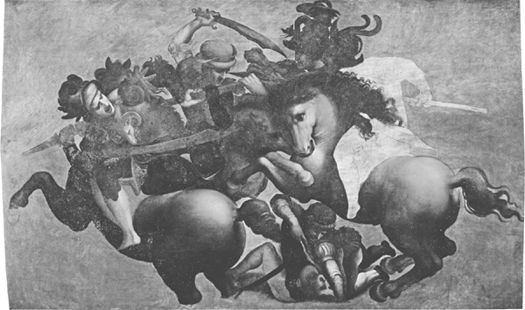
Unknown sixteenth-century artist, The Battle of Anghiari. This early copy may give a strong impression of how the unfinished painting looked on the wall. (illustration credit 12.1)
The greatest of all Leonardo da Vinci’s surviving designs for his painting of the Battle of Anghiari is a study of the head of the old warrior he visualised at the bloody heart of the struggle. In the frenzied composition he started to paint in the Hall, this man raised his sword over his head in his right hand while he screamed hate and defiance at his enemies. While he was planning the picture, Leonardo made an emotionally devastating drawing of the man’s head, with an old man, perhaps a soldier, as his model, that is one of his supreme drawings. The man glares downward from eyes with sharp black pupils beneath a mountainous rumpled brow. His nose is wrinkled in rage. The muscles around his mouth are distorted and strained in great crevices as he opens it wide, a dark hole fringed with stubs of teeth. Old creatures, as Lorenzo de’ Medici had long ago observed, always have some of their teeth missing, and in Leonardo’s desperate portrait this man has just a few square molars in his cavernous mouth. A very large-scale copy in Oxford that may exactly reproduce the scale of the wall painting—it has even, implausibly, been identified as a scrap of the lost cartoon—makes the fewness of the teeth even more prominent.
It is a face of acute concentration as well as rage—a face fixed on battle. In this, it is a direct reply to the gigantic face that went on view outside the Palazzo Vecchio in 1504. This is Leonardo’s antithesis to the noble gaze of Michelangelo’s David. In David’s eyes there is keen attention, readiness, an anger that is life-giving: the eyes of Leonardo’s warrior are just as keen and glaring as he, like David, attains almost supernatural consciousness in the excitement of battle. Look at the drawing of the warrior and his brow is a massive, furrowed fact: with its two lines deeply sculpted by passion above the nose, and its flaring eyebrows, it is a quotation of the brow of Michelangelo’s David.
Michelangelo, the artist still in his twenties who had never seen a real battle, portrays heroism in his statue of David as the elevation of human consciousness. His statue was installed outside the government Palace because it was the perfect symbol for the Republic—an image of courage and defiance. David is getting ready to kill a tyrant. He poses calmly, stares intently. Has a soldier ever looked like this in battle? That is the question asked so acutely by Leonardo, the man in his early fifties who had seen wars and known warriors. A lifetime’s experience of military matters lies behind his riposte. If David is a hero, Leonardo’s furious warrior is an antihero. And if David tells the old lie that it is sweet and decorous to die for your patria, the warrior Leonardo was about to paint in the Great Council Hall had in his eyes the desolate truth that is left when we are done with lies.
Leonardo’s face of a warrior is a systematic response to the David. There is a force, a sharply etched strength, to the warrior’s head that resembles the Giant on the Piazza. Even his long, flared nose is like David’s. But the antitheses are extreme. Where David is young, this soldier is old. Where David is beginning, he is ending. And where Michelangelo’s statue has a face of caricatural simplicity, characterful and yet not in the slightest real—no actual face looks like this—in his drawing Leonardo gives equally battle-roused features a tender, subtle realism. What make this face so great are the nuances in Leonardo’s use of chalk: the leathery texture of skin on the delicately vibrating right cheek; the muzzy grey muffle of the tongue inside that awful mouth; the supple delineation of creases in the distorted flesh and masses of wrinkled folds under the eyes; the white, bloodless lips and stiffened tendon in the neck. Michelangelo gives beauty itself a grotesque boldness in the face of David. In this drawing Leonardo gives a grotesque expression the same microscopic accuracy and delicacy he put into the face of the Mona Lisa.
The face of the David is not real. This face is real. This is the true “fury,” furia, that Leonardo knew from experience was the face of battle. All the science and technology in the world didn’t change that face—in the end the decisive moments in war were fought at close quarters by soldiers worked up into a heat of hate.
There is an overwhelming truth to Leonardo’s drawing. Its disillusion is so absolute that it attains the grandeur of tragedy. The nineteenth-century historian Jacob Burckhardt observed that Renaissance Italy did not give birth to great tragedy. He reckoned without Leonardo.
The Battle of Anghiari in 1440 was a victory for Florence. It was also a defeat, the great defeat, for a soldier who had risen to fame on Italy’s battlefields and hoped to end as prince of some petty state. The contracted commander, the condottiere, a freelance expert in war, became a powerful type in Italy in the fifteenth century, when states relied almost exclusively on mercenaries to fight their wars. In the wake of fearsome individual soldiers like the Englishman John Hawkwood, the condottiere became admired as a muscular hero whose prowess in arms and strategy made him the modern equivalent of the great Roman soldiers of old. Some condottieri ruled their own small cities, like Federico da Montefeltro, duke of Urbino; others aspired to. In Italy’s chaotic political map these mercenary leaders who ranged the landscape had a lot to play for.
Francesco Sforza, whose equestrian monument in Milan occupied Leonardo for nearly twenty years, was a spectacular instance of the hired warrior who became ruler of a state. His rival in the early fifteenth century was Niccolò Piccinino, who came from Perugia and started his career as lieutenant of a powerful warrior named Braccio di Montone. On the reverse of a medal of himself, Piccinino has as his emblem the griffin, heraldic beast of Perugia, suckling two children—him and Braccio—just as the she-wolf suckled ancient Rome’s founders Romulus and Remus. Braccio was killed in battle by Sforza, leaving Piccinino as the toughest soldier in central Italy, under contract to the Florentine Republic before he abandoned it to enter the employ of Milan. As Machiavelli writes in his Florentine Histories, “There were at that time two sects of arms in Italy, the Braccesca and Sforzesca: the head of this last was Count Francesco Sforza; of the other the prince was Niccolò Piccinino … to these sects nearly all the other armed men in Italy were drawn.”
Francesco Sforza had the upper hand, not least because he was promised to marry the daughter of the duke of Milan. But Niccolò was a powerful warrior, and in 1440, at the head of the armies of Milan, he stood poised to enter Tuscany and threaten the very survival of the Florentine Republic. At Anghiari he met his nemesis. The Florentines took his standards and he ran for his life; afterwards the duke of Milan kept employing him, but Sforza’s rise continued at his expense. As Machiavelli tells it, the duke of Milan recalled Niccolò on a pretext so that Sforza could isolate and defeat Piccinino’s son: “Niccolò arrived in Milan; and seeing he had been tricked by Filippo, and having learned of the rout, and the taking of his son, he died of grief in 1445 at the age of sixty-four years, having been a captain more talented than lucky.”
Leonardo’s picture of the Battle of Anghiari concentrated on the despairing figure of Piccinino. The scene he prepared to paint in the Hall on 6 June 1505 shows a frantic last-ditch struggle for Piccinino’s standard; at the heart of this fight the old warrior himself prepares to inflict a last cruel wound, to take revenge. But how did Leonardo find such depth of emotion and truth in the face of Piccinino?
He looked hard at the sources, for a start. The passion for historical research that he showed in his preparations to paint The Battle of Anghiari matched his more famous love of scientific research. History was the favourite literary genre of the Humanists. It was what Florentine intellectuals such as Leonardo Bruni, Poggio Bracciolini, and (in the early sixteenth century) Machiavelli and Guicciardini specialised in. Depicting a historical event was a great chance for Leonardo to demonstrate to such people the intellectual seriousness of painting. In his notebooks he argues, with literary Humanists in his sights, that painting can narrate a complex event like a battle more immediately than any written description: “But I ask no more than that a good painter should depict the fury of a battle and that a poet should write about it, and that they might be put in public where many people could see them and then we would see where the witnesses would look more, where they would give the most praise and which would satisfy them more; certainly the painting would please more, being more useful and beautiful.”
Here the painter and engineer challenges Humanists who value the literary arts over the scientific, word over image. The commission to paint a historical battle in the public heart of Florence, in the Palace where classically trained political characters like Machiavelli and Agostino Vespucci were steeped in the ancient histories of Livy, Tacitus, and Xenophon, was a chance to prove that painting was serious by these literate intellectuals’ own criteria. Leonardo read the histories of Bruni and Bracciolini to learn about the Battle of Anghiari, but he went further. He searched for visual evidence of what the battle had really looked like.
The Battle of Anghiari was a richly visualised event. A few years before it took place, Paolo Uccello painted three big panels illustrating another recent fight, between Florentine and Sienese mercenaries, really just a skirmish that his paintings elevate into the noble pageant that is The Battle of San Romano. Clad from head to foot in heavy plate armour with florid plumed helmets, waving long banners that flutter in the breeze, charging one another with coloured lances, the knights in Uccello’s lovely paintings seem to be participating in a tournament rather than fighting to the death. Huge rearing horses, crossbowmen in particoloured costumes hunting hares, oranges in the trees, and the sweet face of a page boy add to the vibrant life and joy of these paintings of battle as a gaudy rite of spring. Uccello’s happy paintings lend credence to Machiavelli’s claim that mercenary cynicism and the theatre of chivalry combined to make war in fifteenth-century Italy, fought (as Machiavelli sneered) only in the spring and summer as if it were a sport, harmless because the condottieri treated war as a craft instead of a matter of life and death.
When Florence made its stand before Anghiari in 1440, however, something real was at stake, and the seriousness of the struggle was remembered in images. A memorial survives, worn by time, on the battlefield itself. The earliest wall painting of the struggle may also be in the immediate area, in the Church of San Francesco in Arezzo. In the 1450s or thereabouts—his work is notoriously hard to date—the local master Piero della Francesca painted his calm and monumental fresco cycle The Legend of the True Cross in this church. It includes two powerful battle scenes that have a gravity quite unlike Uccello’s tournament. In one battle, the Christian emperor Constantine defeats his enemy Maxentius. In the other, The Battle of Heraclius, warriors fight desperately and murderously at close quarters.
Piero came from the town of Borgo San Sepolcro, which faces Anghiari across the plain of the Tiber. It was from this town that Niccolò Piccinino charged across the broad valley in 1440. It is very possible that Piero, who seems to have been in Borgo San Sepolcro at the time and who indeed spent most of his life there, witnessed the fight. If so, his paintings of battle may incorporate his memories of that day. The Battle of Constantine was fought across the Tiber at the Milvian Bridge outside Rome; Piero’s painting moves the scene to his own landscape of the upper Tiber valley. The army of Constantine, stately and confident with its lances aloft and banner high, slowly chases the fleeing Maxentius across a narrow, glassy river that looks like the tributary of the Tiber over which the Battle of Anghiari was fought. The pale, rocky landscape with patches of scrub and the reflective river are those of Piero’s own immediate locality, also portrayed in his Baptism of Christ. Here, the location is unambiguous. As Christ stands in the river’s shallow mirror, the walls of Borgo San Sepolcro can be seen in the distance on the far side of the valley. It seems Christ is being baptised on the very site of the battle. In these paintings the Battle of Anghiari is remembered with the compassionate stillness that makes Piero such a great artist.
So there is every reason to think that Piero’s paintings remember the most dramatic event that happened in his landscape in his lifetime—but no reason to think Leonardo would have understood this. He certainly knew about this painter, because Piero was a mathematician as well as an artist, who wrote manuscripts on geometry. Leonardo’s friend the mathematician Luca Pacioli knew Piero’s mathematical works well and was even accused of plagiarising them. In 1502, when Leonardo was with Cesare Borgia and Borgia’s captain Vitellozzo Vitelli was fomenting rebellion in Arezzo, this Vitelli promised to get the artist and engineer a copy of a work by Archimedes that was in Borgo San Sepolcro. It could easily have been a book that had belonged to Piero. And if Leonardo visited Arezzo at that time, he could have seen The Legend of the True Cross.
Piero’s landscape, that dry, scrubby plain of the upper Tiber valley between the walled towns of Borgo San Sepolcro and Anghiari, is recognisable in a painting Leonardo definitely does seem to have looked at: a long wooden panel that survives in the National Gallery of Ireland, Dublin, made for a piece of furniture in Florence in the 1460s and decorated with an epic painting of the Battle of Anghiari. This richly detailed history has colour and pageantry and a vivid sense of the landscape. In the distance, the walled cities of Tuscany—the entire region was Piccinino’s potential prize that day—stand on their hilltops. In the foreground, the walls of Borgo San Sepolcro—white as in Piero’s Baptism—face fortified Anghiari on its hilltop, the houses inside its grey walls honeyed in hue just as they are today. The painting shows different moments in the battle simultaneously: the Florentines march up the hill to Anghiari and simultaneously stand massed for battle below it, while Piccinino musters his men outside Borgo San Sepolcro.
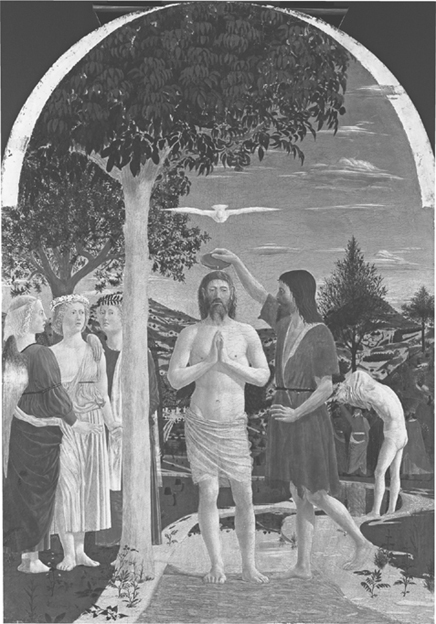
Piero della Francesca, The Baptism of Christ, 1450s. The landscape here is the plain of the Tiber between San Sepolcro—seen in the distance—and Anghiari. (illustration credit 12.2)
There are rich details. Women wait beneath the walls of Anghiari with big earthen jars full of water—the Florentine forces were fresher and less physically stressed as they fought on their own ground, said Leonardo Bruni, who was chancellor of the Florentine Republic in 1440, and here we see that illustrated. The scene of the water carriers is a very immediate detail that chimes with Bruni’s contemporary written account: it is so homely that it raises the possibility that, like Piero della Francesca, this unknown artist was an eyewitness of the battle. Who but an eyewitness or a painter with access to very immediate details would include that touching detail or depict the local landscape just as it is in Piero’s paintings?
Leonardo reached the same conclusion. He appears to me to have treated this painting—or a lost version of the same “eyewitness” picture—as an historical source. Here was a picture that, as far he knew—and he may have been right—portrayed the battle from direct observation, and so he looked at it very carefully.
At the heart of the dusty landscape, between two branches of the Tiber, the battle is fought in a passionate clash of men, horses, and arms. As in Uccello’s and Piero’s battle paintings, knights go to war in full plate armour with elaborate helms, wooden lances, and swirling banners. Their war horses are mighty beasts bred to carry all the steel plate their riders wear. It is a spectacular clash—and at the heart of the tangled fray, a man who must be Niccolò Piccinino, his head uncovered and bandaged, looks downward in grim, grey-faced determination as he raises his baton or club high over his head in a steel-gauntleted hand, just as he will raise a sword in Leonardo’s painting. Around him, the banners of his army are falling. The loss of Piccinino’s standards was still remembered in Florence in the 1500s, and the tattered banners were kept in the Gonfalonier’s chambers in the Palace. The griffin standard of Perugia and the serpentine banner of Milan topple in the Dublin painting: in the struggle, hands grasp the poles of banners as they fall; men are tangled up in the cloth; in front of Piccinino, two horses charge into the fray, their massive hindquarters parallel.
The figure of Piccinino in Leonardo’s painting was apparently adapted from this scene—the similarities are too close for coincidence, and not just in the way the desperate old soldier raises his right arm above the fray. The two horses, the tumble and tangle of banners—the elements of Leonardo’s painting are all here in a primitive form. There is a close relationship between this and his gory compositional drawings that survive in Venice: the way banners swirl as an old warrior raises his arm is very similar. But in the final version he composed as a cartoon at Santa Maria Novella and at last began to paint in June 1505, he isolated just four riders, concentrating on Piccinino’s struggle for the banner with leaders of the Florentine army.
Was this scene meant to be part of a larger composition? Leonardo had already shown with The Last Supper how ruthlessly he was prepared to isolate a single dramatic moment and tell a story entirely in one scene, compressing past and future into a pregnant present, and so giving art a new eloquence. The Last Supper strives for emotional truth, and so did The Battle of Anghiari. Leonardo found an eyewitness record of the battle and sought to preserve that truth even as he heightened the power and poetry of it through radical simplification. He aspired to paint a Florentine history as authoritative as the Humanist literary works of Bruni and Bracciolini. His martial spectacle would not be fiction but harsh reality. He even sought out the bronze medal of Piccinino cast by Pisanello in the condottiere’s lifetime. Portraying the proud warrior in profile as if he were a Roman emperor, this contemporary image shows Piccinino as a tough-faced man in a tall, soft hat. In his painting, Leonardo gave him the same headgear. All these exact visual details add to the sense that he is seeking the truth of this battle.
But Leonardo had more than one way to discover the truth. He looked at old pictures of the battle, read the chronicles, and compared these documents with his own experience of war. All that makes it seem a very sombre exercise. It was nothing of the sort. When he tried to build a mechanical “bird” shortly before starting to paint in the Great Council Hall, science slipped into a realm of dream. We have noticed how he seems in his observations of bird flight to imagine himself becoming a bird and how, in a similar way, his drawings of galloping and rearing horses done in preparation for The Battle of Anghiari identify with the energy and frenzy of the excited animals. The riders he started to paint now in the Hall were not rationally controlled emblems of war but something more demonic and potent. They were the other side of Leonardo’s fantasy of becoming a bird. Human beings become beasts in The Battle of Anghiari—not symbolically but actually. The men merge with their horses. Their armour sprouts organic forms; their faces are bestial masks. These apocalyptic centaurs are the monsters lurking in the stain on the wall. In visionary experience the traveller through fantastic realms risks meeting evil as well as benign beings.
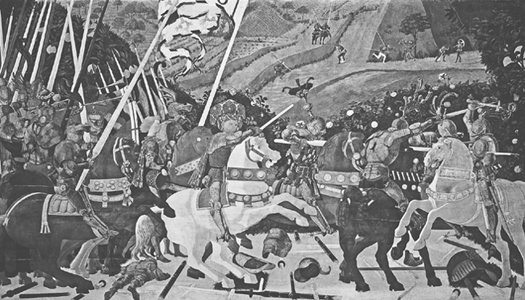
Paolo Uccello, The Battle of San Romano, probably circa 1438–40. War resembles a tournament and a rite of spring in Uccello’s joyous painting steeped in chivalry. (illustration credit 12.3)
If it is Piccinino’s story it is also Leonardo’s own. The artist had good reason to identify with the mercenary’s acrid disillusion. He too was a kind of mercenary. Like Piccinino he had served a ruler of Milan. He was a veritable condottiere of science, a mercenary engineer who just in the last few years had tried to sell a stratagem to Venice before entering the employ of the notorious Cesare Borgia. Just before or just after returning to Florence in 1503 he wrote a letter offering his services to Sultan Beyazit in Istanbul: emissaries from the Ottoman ruler, whose father had conquered the ancient capital Constantinople in 1453, visited Borgia, and Leonardo must have spoken with them. In his letter he recommends himself as an engineer to build a bridge from Pera to Constantinople. He invokes Allah enthusiastically. In the culture of the time there could hardly have been a more blatantly mercenary gesture than to sell his Christian birthright.
In 1504, as Leonardo worked on The Battle of Anghiari, his pupil Salaì wore a cloak that had belonged to Borgia. In the summer of 1503 the Pope and his son suddenly fell ill in Rome. It was rumoured that they accidentally swallowed poison they meant for others. Alexander died. Cesare survived, but the Pope’s death fatally weakened him. The election of Julius II, an old enemy of the Borgias, as Pope that autumn sealed Cesare’s fate. As Leonardo worked on The Battle of Anghiari the soldier who had so recently seemed destined to conquer Italy and drive out the French, the sinister man of arms whom Leonardo had personally known and worked for, was ruined. By August 1504 Cesare was in prison in Spain; he would escape in 1506, but die the following year without ever getting back to Italy. The haunting portrait of Niccolò Piccinino is a study in defeat, the tragedy of a bloody man. It surely also suggests Borgia, the malevolent warlord whose fall was so swift in the end. Borgia’s sudden destruction happened just as Leonardo took on the commission for the Great Council Hall. And other fates, too, haunt his portrait of Piccinino. He had known soldiers who were modern versions of the fifteenth-century mercenary. There was Borgia’s captain and Leonardo’s friend Vitelli, killed horrifically at Senigallia. Machiavelli’s account of this murderous night reads like a Jacobean tragedy—especially in the Jacobean prose of a translation published in 1640. After being trapped, the captains were held in the palace Borgia had taken over:
But the Dukes souldiers not satisfy’d with the pillage of Oliverotto’s Souldiers, began to sacke Senigallia. And had not the Duke by the death of many, stopd their insolence, they would utterly have sackt it. But night being come, & all stirres quiet, the Duke thought fit to put Vitellozzo and Oliverotto to death, and having brought them together, causd them to be strangled.
This was the kind of scene that happened not in the pages of history but in Leonardo’s own lifetime, to people he knew. It was fresh in his mind when he was working on his painting of desperate violence. So was the fall of his patron in Milan, the soldier and schemer Ludovico Sforza, whose plot against Naples encouraged the French invasion in 1494 and led by the end of the fifteenth century to his own destruction: “The duke lost his state, his personal possessions and his liberty …” commented Leonardo.
The Battle of Anghiari does not suggest he found soldiers attractive close up. The warriors whirling in dead space are the visual equivalent of the bleak vision of humanity he put into words in one of his “Prophecies,” “Of the Cruelty of Man”:
Animals will be seen on the earth, who will always be fighting among themselves, with the greatest harm and many deaths on either side; these will have no limits to their malignity …
O world, why do you not open and precipitate them into the deep fissures of your chasms and caves, and no more exhibit to heaven so cruel and ruthless a monster!
To call it the “tragedy” of Niccolò Piccinino is not to imply that Leonardo’s battle painting was sentimental. Rather, it glimpsed the last shreds of self-knowledge in warriors whose mask-like grimaces and brutal actions take them to the very limit of sympathy and fellow humanity. This is what makes Leonardo’s drawing of the face of Piccinino so incredible. It manages to be at the same time utterly monstrous and hauntingly human. In his desperation the warrior opens his mouth in a scream of hate and rage, and Leonardo’s drawing portrays his contorted visage. And yet, in his eyes there is a dim spark of memory and life: inside his leathery hide there is still a human being, and you see the humanity in those eyes, callous and despairing as they are. The tragedy in this scene is that of the damned souls we encounter in Dante’s Inferno and Shakespeare’s Macbeth. The desolation and hopelessness of Piccinino’s eyes as he prepares to bring down his sword in a futile blow could almost be a premonition of the final self-knowing moments of Macbeth: tomorrow, and tomorrow, and tomorrow.
The portrait drawing reveals a last pulse of humanity in the hardened hide of the warrior, and yet at the same time Leonardo’s design questioned the full humanity of the men on their mighty horses. He became absorbed in the details of their elaborate armour, but this was not fancy for its own sake. In portraying it he let grotesque imagination run riot. This had as clear a function in the drama as the noble robes worn by the disciples in The Last Supper. The robes stress their dignity and the grandeur of their spirits. The armour of the warriors in The Battle of Anghiari made them into misbegotten beings, “so cruel and horrible,” part-man, part-beast, part-metal.
Leonardo, the connoisseur of clothes, had seen his share of real armour, had even designed it. The armour he gave the warriors of Anghiari was not that much odder than actual armour you would see in tournaments, where knights wore extravagant costumes and fantastic masks. Leonardo had designed costumes of savage “wild men” for a tournament in Milan. Masked, ornate armour was not purely decorative. When Roman cavalrymen wore bronze masks—uncanny metal replicas of faces—for training games, the alienating device must have made it easier to forget they were fighting friends. The same estrangement is fundamental to the masked helmets of samurai warriors, bristling warrior faces that transfigured the wearer into a personification of war. In Renaissance Italy, as the history of earlier civilisations was studied and revived, armour became a self-conscious dramatisation of the martial persona. Drawings done in Florence in the 1470s show crests of dragons and monsters sprouting from helmets; a surviving example of a fantastic Italian helmet, made towards 1480, encloses a metal sallet—a protector for the upper head—inside the golden head of a lion. It would have transformed the wearer into a brave beast.
Verrocchio’s workshop, where Leonardo was trained, specialised in fantastical images of armour. Marble reliefs of ancient heroes in profile made by Verrocchio and his assistants—one was reputedly sent by Lorenzo de’ Medici to King Matthias Corvinus of Hungary—portray them in an imaginary version of ancient armour with Medusa breast ornaments and dragon helmets. Leonardo’s early drawing of an old warrior, today in the British Museum, is manifestly related to these reliefs but has far more power: his soldier’s leathery face is an ancestor of Niccolò Piccinino’s. The man’s armour threatens to mutate him into a dragon as bat wings sprout from his helmet, crocodilian scales cover his shoulder (ancient Roman armour did, in fact, include suits of crocodile hide), and a lion—not a sculpted beast but the head of a living lion—roars on his chest. This drawing is oddly reminiscent of the story Vasari tells of how Leonardo made a composite monster from dead animals and painted its image on a shield. Another early drawing by him is of a helmet with a visor that is a mask of a human face. He was not merely observing the rise of new fashions in armour: he helped create them. The Battle of Anghiari in turn would encourage the ornate grotesques and satyr-like visors invented by sixteenth-century armourers such as the Negroli family.
The armour of the warriors in Leonardo’s battle painting was so laden with bizarreries that it twisted their very identities. One man wore gigantic coiling sea shells on his shoulders and a huge ram’s skull on his chest. Both were skeletal remains of exhausted nature. Leonardo studied fossilised sea shells and wrote of the skeleton of an immense animal he identified as a whale, discovered in a cave. He wondered at the aeons of time the fossil had witnessed, and marvelled that its bare bones now seemed to support the mountain above, as if its ribs were pit props. Death leaves a skeleton or shell that becomes a fossil; in such passages it is clear how much fossilisation interested Leonardo. The rider at the left of his battle scene, his flesh invisible within a skin of chain mail encrusted in bony growths, with the horns of a ram’s skull suggesting at once potency and death, masculinity and desiccation, was turning into a fossil even as he twisted around and grimaced at his enemies, grabbing onto the shaft behind his head as his body transformed into a freakish spectacle of dead forms, fit for a cabinet of curiosities. Beside him Niccolò Piccinino raised a sword arm encased in plate armour, while two Florentine captains confronted them, both wearing splendid helmets. One helmet was crested with a writhing serpentine dragon. The other had a visor in the shape of a bearded satyr mask, a second face, half-human and half-goat, to be lowered over the real flesh as the rational, normal personality disintegrated in battle’s fury. This mask was the emblem of war’s alterations, its transfiguration of men into monsters.
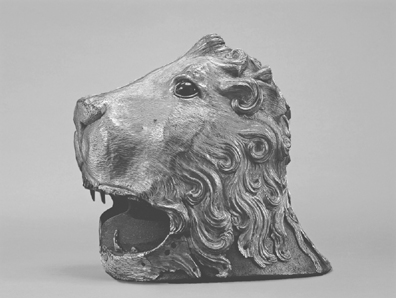
Lion’s head helmet, Italy, circa 1475–80. Fantastic helmets like this surviving example were worn at tournaments and parades and won as jousting prizes. (illustration credit 12.4)
As they screamed and grabbed at the wooden shaft of Piccinino’s standard, the warriors’ horses cannibalised each other. A horse sunk its teeth into another’s neck, locking its mouth in place. The men and their horses formed centaur-like allegories of war’s nature. The men with their arms and armour embodied technological warfare, the horses the savagery beneath—the unconscious of war. Where the men at the top of the painting—literally higher up, mounted on the backs of the horses—clothed their violent instincts in chivalry, dressed as knights, with heraldic crests and finely wrought weapons, their horses manifested their lower, base selves, their driving instincts. Below the lie of civilised warfare, the reality of primitive cannibalism.
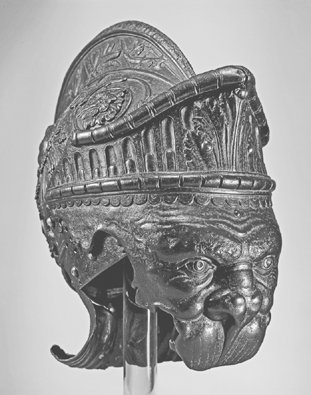
Helmet (Burgonet) alla Romana antica, Milan, circa 1550–5. The grotesque armour in Leonardo’s Battle of Anghiari resembles real designs manufactured in sixteenth-century Italy. (illustration credit 12.5)
The idea of an original, primitive “state of warre,” as Thomas Hobbes was later to call it, held Florence spellbound at the start of the sixteenth century, for news had reached the city from a Stone Age society, and it was unnerving.
The little wooden ships with their high rear castles bobbed on the undulating ocean. The men on board, who had sailed so far, as far surely as any human beings in history and certainly as riskily, waited uncertainly while their captain looked with interest at the strange people on the land mass ahead: a crowd of men and women as naked as newborn babies, parading longhaired beneath the palms.
Later he would sit in his house in Portugal, dazed by what he’d seen, wondrous and awful things: the desolation of the mid-Atlantic that made him feel like Ulysses on his last hellish voyage, as he knew it from reading Dante, then the mighty forests of the western shores, but most of all the people, at first sight so innocent, in reality so bestial—cannibals, as he discovered. He couldn’t get the horrible images out of his head: feasts at which everyone gorged on a mother and her children, battles fought with stone-headed weapons after which the enemy dead became food. The horror; the horror. And yet that land was so rich, so promising—and it seemed to go on so far south it could not, after all, be just an outpost of the Indies. It was a continent apart, a Mundus Novus.
Troubled as his mind was by nightmare scenes of New World savagery, as he took up his pen at his desk in Lisbon, he was cheered by thoughts of the lovely far-off republic of which he still considered himself a citizen. His exhaustion and the salt in his skin, the beauty and terror of all that he’d seen, did not stop him from wanting to express his sincere admiration for the Magnificent Gonfalonier and that Sublime Republic with whose affairs Piero Soderini was perpetually busy.
Such is the burden of the “Letter to Soderini,” sent to Florence by the Atlantic navigator Amerigo Vespucci from his base in Lisbon in 1504, and rapidly issued to the city’s printing presses.
It is a book built on water. Even its frontispiece is misleading. It starts with an engraving of Vespucci and his men in their three ships observing the naked people of what this explorer’s previous report, published in Florence in 1503, had already named (in Latin) the New World. But this is a recycled engraving originally produced to illustrate Christopher Columbus’s account of his discoveries. The theft of the image is of a piece with what follows. Vespucci claims that he sailed to the mainland of the new continent in 1497, a year before Columbus reached tierra fierma in 1498. This is probably a lie. But was it Vespucci’s lie? Or did editors in Florence concoct the “Letter to Soderini” without his knowledge?
Vespucci was a Florentine citizen—the cousin of the Agostino who worked with Machiavelli—who went to Spain as a business agent of the Medici, was excited by the voyages of Columbus, and in 1499 (assuming the 1497 voyage to be fiction, as most historians of exploration insist it was) sailed westward himself. Whatever the real origin of his letter, its appearance in Florence in 1504 undoubtedly influenced The Battle of Anghiari, for it portrays the New World as a place of perpetual war between cannibal tribes. These people go to war, it seems to Vespucci, essentially to catch prisoners to eat: “They eat little flesh, other than human flesh, for Your Magnificence should know that in this they are so inhuman that they outdo every custom of the beasts, because they eat all the enemies they slaughter and capture, women and men, with such savagery that to tell it seems a brutal thing; how much worse to see it, as I was fated to see it many times and in many places.”
The raw primitive warfare of Vespucci’s New World was instantly reflected in Florentine art. Piero di Cosimo’s paintings in these early years of the sixteenth century imagine a world of primitive humans and half-human hybrids, a wild Stone Age whose frenetic violence is surely marked by Vespucci’s report. In his Battle of the Centaurs, humans and monsters do battle with improvised weapons as a wedding degenerates into savagery. The knot of frenetic fighting at the centre of the picture suggests the intense grouping of Leonardo’s horse-borne furies. Piero, as it happens, painted some of his primitive scenes to decorate one of the houses of the Vespucci family.
Piero may have been inspired by news from the Americas, but he got his knowledge of the Stone Age from a Latin poem. When Poggio Bracciolini discovered a manuscript of the Roman poet Lucretius’ philosophical epic De rerum natura—On the Nature of Things—in 1417, he brought to Florence not just a text whose details of myth enriched those known from Ovid’s Metamorphoses but an ambitious vision of human development. Lucretius is positively Darwinian in his materialist explanations of how humans advanced from savagery to civilisation. The first people lived like wild beasts. They had no agriculture, laws, or fire. Their lives were tough, says Lucretius, but they did not know the “civilised” cruelties of war. Slowly, people learned to use fire and live in simple communities, and language evolved. One day lightning caused a forest fire and in the hot earth humans saw molten metals: the arts of metalworking were born, and with metal came weapons. Piero di Cosimo’s painting The Forest Fire, done in Florence around 1505, evokes this epochal fire.
Leonardo too was reading Lucretius. In a suggestive note he misquotes the Roman author’s claim that “the first weapons were hands, nails and teeth.” In Leonardo’s note the original is slightly embellished: “Lucretius in the third of The Things of Nature: hands, nails and teeth were the weapons of the ancients. Also they used as a standard a bunch of grass tied to a pole.” He works in a satirical image of his own, introducing the notion that primitive humanity went to war behind a bunch of grass fluttering from a pole; it adds another dimension to the struggle for possession of a standard in The Battle of Anghiari. The desperate struggle in the painting is for something as worthless as any savage totem—the standard that Piccinino fought so savagely to save was no more intrinsically valuable than the primitives’ bunch of grass on a pole. The armoured warriors were technologically advanced, clothed in metal and armed with sharp blades, and Leonardo revealed how close their fury made them to the cannibal rage of their horses. War was just armed barbarity. The wretched images of the New World spread by Vespucci deeply informed Leonardo’s vision of war as a grotesque ornamentation of primitive instincts, but it only confirmed the evidence of his own eyes. What he saw of battles and tournaments had convinced him that deep down, whatever technology it uses—a tank, or just the dagger a man on the ground thrust at an enemy’s throat—war is no more elevated than mauling someone with your teeth.
This image of fighting with one’s teeth, of using the most basic of weapons, is one that Leonardo kept returning to. It was at the very centre of The Battle of Anghiari in the disturbing spectacle of a horse biting into another horse’s throat, its eyes maddened. It struck him to find this image in Lucretius—that the first weapons were nails and teeth. And in his passionate essay “How to Paint a Battle,” he dwells on it again: “Make dead men, some partly covered with dust, others completely … others as they die grinding their teeth, rolling their eyes, tightening their fists against their bodies, their legs distorted; some might be shown, disarmed and beaten down by their foes, who turn on the enemy to take a cruel and bitter revenge with teeth and nails.” Unarmed and defeated, the men take a cannibal revenge. This image of disarmed soldiers biting and scratching their enemies was probably composed late in Leonardo’s life. It surely draws on his battle picture for the Great Council Hall and the experiences and ideas that forged it.
Leonardo’s cartoon, which he now began to transfer to the wall, embraced anthropology as well as history, incorporating the reports—however inaccurate—of life in the Americas that had just been published in Florence, and distilling an evolutionary view of human violence inspired by his reading of Lucretius. We are all at heart animals with animal instincts, and when we are cornered we fight like maddened beasts, says Leonardo in his disturbing masterpiece.
If his image of cannibalism reached across the Atlantic to the new world being discovered in his day, it also struck close to home. For all true Florentines knew the most compelling horror story in the Divine Comedy of their city’s great poet Dante. Deep in the pit of Hell, on the frozen Lake Cocytus, Dante and Virgil see Count Ugolino—whose story will end with Dante’s call for the destruction of Pisa. A spectacle of cannibalism holds their gaze:
… I saw two frozen in one hole,
so that one head was a cap to the one below;
and as the starving gorge on bread,
just so the one on top put his teeth to a human meal,
right there—where the brain is joined to the neck.
The vengeful biting horse of The Battle of Anghiari called forth Dante’s infernal feast. You didn’t need to cross the world to find the heart of darkness.
It is always with us, it is history’s curse. For everything that is built, every beauty that is nurtured, there is a destructive warrior waiting in the wings. In the dead spaces of pitiless time, horsemen fight forever on a dusty plain. So Leonardo da Vinci suggests in his early unfinished marvel of a painting The Adoration of the Magi. Of all his surviving works this is the most intellectually ambitious. He began it in 1481 for the convent of San Donato a Scopeto outside the walls of Florence, but left it incomplete when he moved to Milan. Even so, this painting, or honeyed drawing, leads us deep into his imagination. As the dark-eyed Magi proffer gifts to the Christ Child and sensitive horses look melancholically at us, a vision of history unfolds in the painting’s distance. A fabulous classical architecture rises into the sky, ruinous and unfinished at the same time: trees grow on broken walls, staircases ascend to nowhere. Amid the ruins of human ambition spectral armies fight. And far away, in an empty, sterile no man’s land, two horsemen are locked in mortal combat, their horses rearing, their faces masks of fury.
The image that Leonardo began to paint in the Great Council Hall in June 1505 had lain in his mind for a long time. It went back, at least, to The Adoration of the Magi. And yet to compare the two works is to compare a dream and a nightmare. The battle in The Adoration is just one aspect of life’s wonder and mystery; the one he started to paint in the Great Council Hall blotted out every good thing. Claustrophobic despair greys the eyes of the warrior.