
The antagonism between Leonardo and Michelangelo did not arise out of thin air. It was not that dapper Leonardo disliked young Michelangelo’s scruffy appearance, or that the avowedly celibate Michelangelo frowned on the older man’s confident parading of young assistants in front of everyone’s eyes—or rather, it was not only these personal differences. The tensions that exploded at the Spini were sparked by competition. It would have been miraculous had the two men liked one another, for in 1504 the two greatest artists of the Renaissance became direct rivals.
Pull back from the two men standing there yards apart, one turning away in contempt, the other blushing; broaden the view until the old palace of the Spini no longer forms a backdrop to an intense encounter, but is simply a big brown cube surrounded by smaller pink and white boxes, and further back again—until it takes time to identify it among the hundreds of buildings that stuff the city walls of Florence on both sides of the Arno. The political centre of this walled city was to the east of the Spini, along narrow, dark streets overshadowed by tall medieval houses. Eventually an alley opened out onto the great space of Piazza della Signoria, the ceremonial public square of Florence, where crowds met to acclaim leaders and threaten trouble. Above its pink tiles with their white grid design growled the government building of the autonomous city-state that was Renaissance Florence.
Everyone just called it “the Palace.” No one doubted which palazzo was meant; the most potent building in Florence was not to be confused with one of the classically inspired residences rich families kept building for themselves. No matter how many cornices the Strozzi, Rucellai, or Pitti put on their rooftops, their great houses would never be as central to the life of the city as the stronghold of state that soared over the salmon-pink piazza, its slender square watchtower crowned with a bronze lion balancing on a ball. Made of rugged, irregular blocks of stone whose sheer quantity becomes a poem of force, on what was a precise rectangular ground plan before it encroached eastward to form a more mystifying shape, the serious defensive intentions of the Palazzo della Signoria were apparent from the fact that it had only the narrowest of barred windows on its lower floor. Its massive walls were perforated by secret passages and hidden escape routes, its upper windows with their elegant arches notorious as the openings from which not a few traitors had been launched to their deaths.
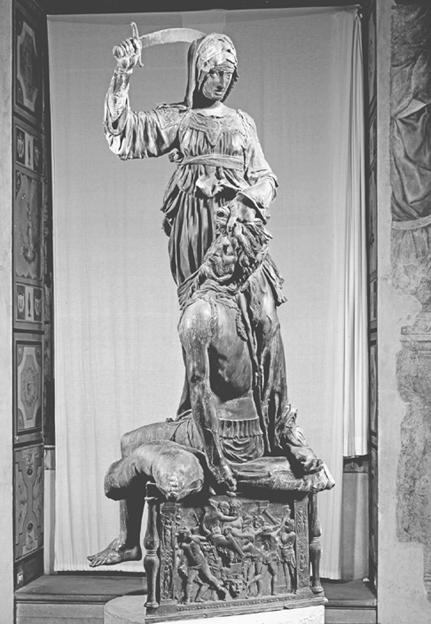
Donatello, Judith, circa 1446–60. Donatello’s fiercely expressive sculpture did not so much emulate as outdo the heroism of ancient Roman public art. (illustration credit 2.1)
A bronze woman stood guard outside its arched doorway at the start of 1504. Donatello’s Judith glowed yellow and reflective on her undulating marble column, raising a curved sword that resembled a Turkish scimitar. Her head was covered in a heavy cloth and her figure wrapped in a long, loose dress—all bronze. Her eyes had no pupils and her face seemed blank and masklike, impassive, as she firmly gripped her victim, the sleeping drunkard Holofernes, by his mass of twisted hair, one long finger of her powerful hand hooked over the locks she pulled back from his forehead. Holofernes, his body as passive as if he were already dead, hung from her strong hand, his head twisted grotesquely on his trunk, his arm swinging and his legs dangling off the cushion he rested on as he waited, half-buried in her dress, for her to bring down the blade and decapitate him.
Donatello’s Judith could tell a thing or two about the history of Florence.
To the north of Piazza della Signoria, past the cathedral, on Via Larga (today’s Via Cavour), was the one house that for fifty years had threatened to displace the Palace as the true centre of power in this small but arrogant polity. Now it stood despoiled, its owners in exile. Cosimo de’ Medici had commissioned his townhouse to a revolutionary design from the architect Michelozzo in the 1440s: behind its deliberately restrained façade—whose precisely shaped stone blocks were smooth to connote civilised ways on the upper storeys, rusticated to communicate strength at street level—was a luxurious and spacious inner world that for a while stood fair to become the court of Florence. A chapel fit for a king was adorned by Benozzo Gozzoli’s pageant-like Procession of the Magi. AnAnnunciation by Filippo Lippi decorated a doorway. Antonio Pollaiuolo’s Hercules raged on the walls and Cosimo’s grandson Lorenzo the Magnificent kept Paolo Uccello’s Battle of San Romano in his bedroom—among the other treasures of this private house that outdid for taste and probably for comfort the residence of any monarch of the day. In its courtyard stood Donatello’s statue of Judith, together with his bronze David. Both bore patriotic inscriptions identifying the Medici with the cause of Florentine freedom.
The wealth of the Medici came from banking; their fortune was made when they won the Pope’s account. Cosimo il Vecchio translated money into influence to make himself, by 1444, the effective ruler of a city that nevertheless still considered itself a republic. On his tombstone Florence acknowledged him as “Pater Patriae,” Father of His Country. The triumph of the Medici was a crafty political achievement. Alliances and loyalties were nurtured, largesse distributed, ballots rigged—and enemies who couldn’t be bought ruthlessly crushed. Part of the game was to flatter republican illusions. Florence had grown from not much to become a great city in the thirteenth century. In Northern Europe at this time strong monarchies were unifying what would eventually become nations, but Italy lacked central authority. The Papacy and the Holy Roman Empire fought for dominance, but neither ever achieved it, instead dividing cities into pro-Papal Guelf and pro-Imperial Ghibelline factions, adding to the bloody lottery that was medieval urban life.
Guelf or Ghibelline, the one constant in Italy’s political and social history was the city. The Mediterranean world has a propensity for cities that can be traced back into prehistory. Italy’s can be small or large, but they are never provincial, because each sees itself as a little world apart, even today, with all the cultural confidence and communal self-respect that implies. In the Middle Ages, cities created their own governments and their own little empires. Tuscany threw up a particularly dazzling constellation of neighbouring city-states: Pisa, Siena, Lucca, San Gimignano, Arezzo—and Florence. In paintings of the landscape of Tuscany, these warring communities were portrayed as fortified enclosures crowded with houses and towers on rival, rounded hilltops. The most seductive of all medieval visions of city life is a wall painting in the Palazzo Pubblico in Siena. Ambrogio Lorenzetti’s Allegory of Good Government depicts Siena as a colourful cluster of pink houses and soaring towers inside walls dividing it from its surrounding countryside, itscontado, where peasants happily toil to provide it with everything it needs. On the city streets people are so happy they dance in a circle in front of shops laden with food. This is all the result of good government, and the best government, medieval Italians tended to believe, was a republic. In a republic all citizens had a say in the running of the state and all in principle might be called to hold office. In Florence, to be a political citizen a man had to be over thirty, and have at least one ancestor who had held office. But there were so many offices, all with comparatively brief terms of appointment, that most families who’d been settled long in the city were led by men who were cittadini.
The antithesis of republican “liberty” was tyranny, the rule of one individual. In most Italian city-states in the course of the Middle Ages, tyrants took over. Wealthy families were happy to have a despot secure their property. By the early 1400s Florence was almost alone in maintaining its republican freedom, fighting a bitter war against the Visconti, despotic rulers of Milan, to defend it. Cosimo de’ Medici and his successors emerged as de facto hereditary rulers of Florence without appearing to end its republican tradition because the Palazzo della Signoria remained the seat of government, separated from their house, and because they supported and shared the rhetoric of republicanism. Judith stood witness to this: she had originally done her killing in the courtyard of the Medici house above fierce inscriptions, put up by the potent family, hoping that “citizens … might return to the republic.”
In proclaiming their own love for the Republic, the Medici masked their destruction of Florentine freedoms. There were difficult moments, but for most of the fifteenth century their hegemony was complete. Then it crumbled overnight. Judith saw it, felt it. When the Medici fell in 1494 she was physically dragged from the Medici courtyard and placed outside Palazzo della Signoria, a symbol of revolution.
When Lorenzo de’ Medici died, still only in his forties, in 1492, he was succeeded as capo of Florence by his son Piero. Unfortunately Piero lacked finesse, intelligence, and cunning. In 1494 the king of France invaded Italy, crossing the Alps with an army equipped with cannons. The French cannons were invincible. One Italian city after another fell as the French headed southward to contest the crown of Naples. As they entered Tuscany the hapless Piero rode out from Florence to cut a deal, without consulting the Palace. His attempt at flamboyant diplomacy had the disastrous result of surrendering important fortresses and allowing the French to give Pisa its freedom from Florentine rule. Returning home, Piero found the bells of the Palace ringing to call the people to arms against him. He and his brothers fled. Suddenly the Republic actually was a republic.
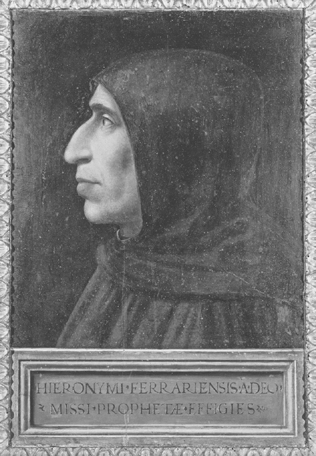
Fra Bartolommeo, Portrait of Fra Girolamo Savonarola, circa 1498. This painter was a follower of Savonarola and has portrayed him heroically. (illustration credit 2.2)
There was instant debate about what to do next. Some patricians wanted this republic to be carefully managed with methods like those the Medici had used. Others argued for broadening the government. The most influential voice turned out to be that of a prophet who got his political advice direct from God. For years now in his sermons in the Cathedral, the terrifying preacher Girolamo Savonarola had denounced tyrants and the abuse of wealth. Rich, tyrannical Lorenzo nonetheless promoted him to be prior of the city’s Dominican monastery, San Marco. Savonarola’s sermons were more than merely fiery; he claimed he was able to speak directly with God, who informed him of future events.
The French invasion in 1494 seemed to vindicate Savonarola’s prophecies. He’d spoken of a “great scourge” coming into Italy—and here it was. He’d spoken of a sword, and here it was. Savonarola’s audiences now accepted him not just as an eloquent man of God but as an authentic prophet. This gave him extraordinary power. As the city’s political élite debated what to do after expelling the Medici, he spoke for God—and for the People, the Popolo, who loved him. He said he agreed with those who argued for establishing a Great Council, an assembly of all citizens. There was such a thing in Venice, and the divinely harmonious Venetian constitution seemed good to him.
Savonarola’s word—God’s word—was law. The Great Council was born. It was not really like its Venetian equivalent, because Venice was an aristocratic society with a rigorously limited citizen body. In Florence, shopkeepers and craftsmen suddenly found themselves entitled to approve taxes and elect officials alongside wealthier citizens in the Great Council.
Revolutions eat their children—this one burned its father. Savonarola’s preaching became too divisive, and by 1498 not everyone believed he was a true prophet. He kept denouncing Pope Alexander VI, repeating terrible rumours about the Borgia family from the pulpit, all but calling the Pope an Antichrist. His followers, scathingly nicknamed by their enemies Piagnoni—Weepers, Cry-babies—went around in pious adolescent fraternities burning “vanities.” He even spoke of giving women a political voice—for women were among his most devoted followers. Cynical anti-Savonarolan factions arose. With the Pope threatening reprisals and the republic breaking apart, the Signoria ordered the monastery of San Marco to be attacked. After a brief, riotous siege Savonarola was arrested and brought to the Palace, where he was tortured until he confessed that he was not a genuine prophet. He and his two closest lieutenants were then taken out onto a wooden platform erected on Piazza della Signoria, shriven by priests who’d come specially from Rome, and led along a pier that jutted at an angle from the northwest corner of the Palace to a scaffold towering above the tightly policed crowds. The three men were hanged until they were dead and then a great fire was lit beneath them. It was kept blazing until their charred skeletons fell from the scaffold, and still longer, until there was nothing left but ashes. The ashes were carefully collected and taken to the Ponte Vecchio, where they were scattered into the Arno to prevent anyone retrieving relics. Even so, some people waded weeping into the river to try and skim the black dust off its surface.
With the ground still warm in the middle of Piazza della Signoria, the Florentine Republic, in no mood to welcome back the Medici, lurched from crisis to crisis as it tried to protect its liberty in an Italy descending into chaos. The French invasion of 1494 turned out not to be a passing storm but one of those events that define an age. Great changes followed. One fatal consequence for Florence was the rebellion of its subject city Pisa near the mouth of the Arno. Pisa proved agonisingly difficult to reconquer, and by 1504 Florence had been at war with its Tuscan neighbour for a decade. This was just one of the wars of Italy. By the time the entire cycle of conflicts ended, the very idea of the city republic would lie in ruins.
Florence at the beginning of the sixteenth century was a republic bereft. It had driven out the Medici and executed Savonarola. With the former it extinguished a glamorous court, with the latter a countervailing force of religious charisma. Its moderate new government faced a timeless dilemma: how to make the middle course exciting. Keeping the Republic free from a return to Medici rule yet also safe from the tyranny of religious fanaticism was a tricky course. How to give compromise a glorious face? That was the problem confronting Piero Soderini, the Republic’s new head official, and his counsellor Niccolò Machiavelli.
The defence of liberty is not what the name Machiavelli suggests. For five centuries it has been synonymous with political ruthlessness and skulduggery; in Italy the heirs of Machiavelli might appear to have been Mussolini and the Mafia, and all over the world, to this day, he lends his name to cynical and manipulative behaviour. There is even a school of primate research that claims to discern “Machiavellian”—that is, thoroughly competitive and ruthless—social traits in chimpanzees. Machiavelli is infamous not for his actions but for his words. A few years after his death in 1527, his books The Prince and The Discourses were published. Brief, brilliantly phrased, and deliberately shocking, The Prince was soon translated into all the major European languages and remains a thrilling read to this day. It disturbs and provokes because it appears to offer, with disarming candour, advice to a ruler on how to bamboozle and gull ordinary people and isolate, weaken, and if necessary kill rivals and enemies. Its longer companion volume, The Discourses, was if anything still more shocking to early readers, because it coolly analyses religion as an opiate of the people. Machiavelli was once as notorious for his atheism as he still is for his Machiavellianism.
In Elizabethan England the spy and dramatist Christopher Marlowe popularised Machiavelli’s ideas, having him appear on stage to speak the prologue to his violent play The Jew of Malta (c. 1590). Shakespeare seems to have discovered Machiavelli through Marlowe and, within a year or so of his appearance in The Jew of Malta, had the tyrant Richard III swear to outdo the ruthless Florentine, boasting that he would “set the murderous Machiavel to school.” The real Machiavelli was as fascinating as the stage monster the Elizabethans made of him, and a lot more complicated. His attraction to the amorality of power was real, and without it his writings would not live as pungently as they do. But closer readers discover the subtleties and ambiguities of his thought, the richness of what he is really getting at. If his words are much more nuanced than the caricature of an evil counsellor, his life was practically the direct opposite of the fictional self he invented in his books.
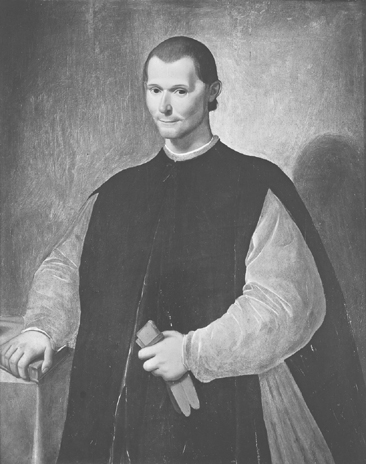
Santi di Tito, Portrait of Niccolò Machiavelli, later sixteenth century. The sweet smile of the Florentine political thinker in this posthumous portrait contrasts with his image in Elizabethan theatre as a diabolical malcontent. (illustration credit 2.3)
Machiavelli wrote his greatest works, The Prince, The Discourses, Florentine Histories, The Art of War, and his comic play La Mandragola while in forced retirement after the complete failure of a career dedicated to defending and preserving the Florentine Republic. Far from advising a prince, he got his political experience as second chancellor of the Florentine Republic and secretary to its military committee, the so-called “Ten of War”; he was a civil servant fired by the idea of republican government. He first came to office after the death of Savonarola in 1498, when he was twenty-nine, but his golden moment was the election of Piero Soderini as Gonfalonier for Life in 1502.
Florence was edgy. The élite wanted to weaken the popular government established in 1494 and to present a more authoritative face to the outside world. Everyone envied Venice, the changeless maritime jewel of European states, whose republican constitution had endured for centuries. The stability of Venice owed much to its unique office of an elected duke, or doge, a role that combined the dignity of regal ceremony with the equality of a citizen among citizens. Florence decided to ape this institution by creating its own doge, known as the Gonfalonier, or Standard-bearer, for Life, and Soderini, an adept politician from a respected family, won the election. One of the ways in which he quickly proved his suitability for the job was by singling out the young Machiavelli as one of his most trusted agents and advisors. Machiavelli soon became a leading voice in the affairs of the Florentine Republic.
Politics in sixteenth-century Florence was a man’s world—from ruling right down to citizenship itself. There was a stir when, shortly after Soderini moved into the Palazzo della Signoria, his wife, Argentina Malaspina, went to live there with him. “It seemed a very new thing to see a woman inhabit the Palace,” the diarist Luca Landucci observed wonderingly. Machiavelli’s correspondence with male political friends is full of dirty jokes and machismo, and when he was away on political missions his wife, Marietta Corsini, was often the last to get a letter. But in 1503 a woman changed the course of Florentine political history.
She is both mortal and goddess, lover and mother, smiling archaic personage and merchant’s wife. Her pose has an eternal inevitability, as if she contained within her a serpentine column, revolving heavenward in a perfectly calibrated spiral: this effect of torsion means that she is in energetic motion even as she sits still in her chair. The relief of shadow on her strong features gives her feminine beauty a masculine counter-life. She is a hall of mirrors, a shrine of paradox.
The crowd presses towards her, and to study her for any length of time means holding fast to a position jammed against the crash barrier in front of the glass box inside which the Louvre displays its most famous treasure. The Mona Lisa dwells in a painted atmosphere so thick she might be suspended in tinted liquid. Reality melts in her world. Mountains dissolve, roads wind to nowhere. Soft rocks sink into primeval seas. The power of this painting owes a lot to the strangeness and universality of its landscape, which feels like some kind of summation, some kind of conclusion about the nature of life on earth. At the heart of that conclusion sits a woman resting her left hand on the arm of a chair turned almost at ninety degrees to the surface of the picture, while her right hand spreads out gently on top of the left wrist, fingers fanning over a coppery sleeve. Bones and muscles and veins lie just beneath the translucent, glowing wax of those hands. The same hypnotic accuracy sculpts the smooth contours of the face that rotates towards us. Beneath her high, bright forehead the perfect symmetrical arcs of her brows graduate as precisely as if they’d been calculated to illustrate some geometrical theorem, curling superbly into the long perfection of her nose. Her lips are cool pink against the warmth of her skin, their clarity as still and eternal as fixed stars. The tautening of the muscles at their corners into a smile is sweetly life-giving.
Her portrait is drawn with shadows. The darks that deepen her features are so bold that Andy Warhol was able to lift them off and reproduce them as a black template. A single stream of shadow starts at the corner of her eye and flows calmly under her rounded eyebrow, into the recess between eye and nose, right down the side of her nose and over her mouth, where it meets the ocean of shade that laps on her cheek. This dramatic yet exact use of shade deepens the Mona Lisa’s beauty by giving her superbly made features still greater fullness, smoothness, and symmetry; then it mutates into something more tantalising. The shadow on her cheek grows darker until it descends into a black mystery between her head and her hanging coils of brown hair; the blackness below her right cheek is deeper still, almost resembling a cavern or grotto that metaphorically connects her body with the mountain landscape beyond.
The shadows that swarm the Mona Lisa have the effect of diminishing the distance between foreground and background. The colours of the landscape bring it forward as her shadows draw her back. This optical effect heightens the psychological and poetic sense that somehow she contains grottoes and rocky recesses within her. The tenebrous voids that darken her beauty make one unconsciously recognise that one cannot interpret this as merely a portrait with a landscape in the background. The vista beyond her, with its coiling road, arched bridge, rocks, rivers, lakes, mountains, and sea, is as much part of her as she is part of it.
The Mona Lisa—Mona or Monna being short for Madonna, the reverent way to title a married woman in sixteenth-century Florence—started life as a portrait commissioned by Francesco del Giocondo, a textile manufacturer and merchant who had business dealings with Leonardo’s notary father. But the picture of Francesco’s wife that Leonardo showed his fellow citizens that autumn must have looked very different from today’s unfathomable mystery. She must have looked like a real woman.
“What was the relationship of a living Florentine to this creature of his thought?” asked the Victorian critic Walter Pater in 1873. The question resonates. Leonardo worked on the Mona Lisa for years—perhaps until the end of his life. He never let the painting go, never handed it over to Francesco and Lisa del Giocondo. The poplar-wood panel was with him in France when he died. It is impossible, as the aesthetically intoxicated Pater rightly divined, to see this as a “portrait” in any normal sense. As her shadows deepened and her landscape ramified, so Lady Lisa was transfigured into a being of myth and fable. Yet Leonardo’s rhapsody really did start out as a portrait of a “living Florentine,” and what amazed the first people who saw the picture was its brilliant verisimilitude.
“In this head anyone who wanted to see how art has the power to imitate nature, could easily understand it; for here were counterfeited all the minutiae that it was possible with subtlety to paint … the eyes had the lustre and moisture always seen in life …” So wrote Vasari in 1550. He praised the curve of the eyebrows, the graceful nose, the mouth that “seemed, in truth, to be not colours but flesh.” The use of the past tense is significant. Vasari hadn’t himself seen the painting, by then in the French royal collection at Fontainebleau, and relied on older Florentine artists’ memories of it. They remembered the name of Lisa Gherardini del Giocondo, an otherwise obscure name that has only recently been rediscovered in the archives, confirming his identification of her: they remembered how in the pit of the woman’s throat, if you looked long enough, you’d see “the beating of the pulse.”
One way to glimpse the woman they remembered, the real Lisa Gherardini del Giocondo whose lifelike portrait became an instant icon in Florence in 1503, is by looking at Maddalena Strozzi Doni. In about 1506 the young Raphael, who came to Florence from his native Umbria to learn from the latest works of Leonardo and Michelangelo, was commissioned to paint portraits of Maddalena and her husband, Agnolo Doni, which hang today in the Pitti Palace in Florence. This wealthy couple—she belonged to the powerful Strozzi clan—collected art, and Raphael gratified them with a visual game to delight the trained eye. He painted Maddalena with a shadow of the Mona Lisa on her. It’s not just that she adopts the same pose as Leonardo’s model, turning towards us in her chair. She also crosses her hands in the same position. Most startling of all, the deep, clean shade that sculpts Lisa del Giocondo’s bone structure is reproduced along Maddalena’s brow and nose.
Because it was painted so early in the life of Leonardo’s masterpiece, Raphael’s picture reveals what the Mona Lisa looked like before the older master’s imagination had finished transfiguring a living Florentine into a fantastic being. It shows what survives in today’s painting from the very first sessions in the Giocondo household in the spring of 1503. One can see that Lisa must have actually held that pose, the pose Maddalena would imitate—hand over hand, turning to her side while seated in a pozzetto chair (called a “little well” from its low, rounded back)—her eyes looking over to the left at Leonardo.

Raphael, Portrait of Maddalena Strozzi Doni, circa 1506–7. The shadows on the Mona Lisa’s face, her pose, and the arrangement of her hands are subtly imitated in this painting. (illustration credit 2.4)
So that’s how she sat, holding the pose with infinite grace. Women in Florence were trained to look beautiful, after all. In drawings and paintings by Leonardo and by Sandro Botticelli models wear, for the artist’s benefit, extraordinarily complicated hairstyles, the time needed for the elaboration of which suggests something of the boredom of women’s lives in this city that did so much to create the Western idea of beauty. Lisa’s family, the Gherardini, came from the Chianti hills, but the wine of wealth had long since gone sour, and her marriage, at sixteen, to the silk manufacturer and dealer Francesco del Giocondo was economically an upward move. It is quietly symbolised in the painting, for she wears a transparent veil of raw silk that glosses her hair in the very stuff of Giocondo’s wealth.
“Leonardo da Vinci could not have portrayed you better,” wrote one Luca Ugolini to his compare—his co-father, a term of intimate social bonding—Niccolò Machiavelli on 11 November 1503. While Machiavelli was away in Rome observing the election of a new Pope, his wife gave birth to a son. With raw wit, Ugolini was assuring Machiavelli that there was no danger he had been cuckolded because the baby was his spitting image—the child looked as like its father as a portrait by Leonardo looked like its sitter. It would seem that within months of the first drawings being done, the Mona Lisa’s fame had reached the managers of the Florentine state.
And so it hung there, a stray, indirect allusion to what might be the Mona Lisa in Machiavelli’s correspondence, until the announcement by Heidelberg University Library in 2008 that it had discovered something amazing. In the margin of its early printed volume of the ancient Roman Republican politician Cicero’s Letteres ad familiares, in handwriting believed to be that of Agostino Vespucci, who worked for Machiavelli in the Florentine Chancellery, a note about Leonardo mentions the Mona Lisa directly. Dating his comments October 1503, Vespucci says Leonardo is working on a picture of “Lisa del Giocondo.” It’s a vindication for Vasari, whose identification of this painting as a portrait of the wife of Francesco del Giocondo was never universally accepted as simple truth—after all, he has such a reputation for making things up.
Nor is this the only claim in Vasari’s “Life of Leonardo da Vinci” that Agostino’s comment vindicates. The Mona Lisa, says Vasari, brought Leonardo’s fame in Florence to fever pitch. He started it after returning from his long sojourn in Milan, where he had attempted to cast a colossal bronze horse and succeeded in painting the sublime Last Supper. On his arrival back in Florence, he amazed people with a cartoon—a full-sized drawing for a painting on many sheets of cartone, the largest sheet of paper manufactured in Renaissance Italy—for a group that included the Virgin, her mother, Anne, and the infant Christ. This work may well survive as Leonardo’s only extant cartoon, which hangs in the National Gallery in London.
Looking at the National Gallery’s cartoon—which also includes a young John the Baptist—it is clear how rectangular cartone sheets were stuck together to construct the vast drawing surface. On the soft paper, Leonardo used black chalk to create a group of figures born of shadow. The Virgin Mary and Anne sit in an arrangement so peculiar it takes a while to understand that Mary is sitting on her mother’s lap. Their legs, under sculpturally massive robes, are immense. The grouping of two figures so close together has the power of some massive fragment of marble statuary. This monument comes to spontaneous life in the childish energy of Christ and St. John, as the little future Baptist with his curly hair and soft, round face looks up at Christ, who, though but a baby, blesses him. Mary looks down tenderly and happily at this scene. Her mother points heavenward and, also smiling, gazes at her daughter out of a face of cavernous revelation. Anne has profound shadows under her throat and shading that finely maps every muscle in her face. Most imposing of all, she has recesses of darkness for eye sockets, into whose ashen pits it is necessary to stare to make out her eyes at all.
The London cartoon was probably drawn a year or so before the one Vasari describes, which he says was exhibited at the Santissima Annunziata, one of the holiest churches in Florence. People flocked to see it as if going to a festival: it amazed not only artists but all the people of the city. Leonardo soon followed up this triumph with the even greater success of the Mona Lisa. His miraculous portrait captivated the entire Republic:
And this work by Leonardo had a smile so pleasing, that it was a thing more divine than human to see; and it was held a marvellous thing, since it did not differ from life.
Through the excellence of the works of this most divine artificer, his fame had grown so much, that all persons who delighted in art, indeed the entire city, desired that he would leave them some memory. And it was being argued everywhere that he should be commissioned to do some notable and great work, by which the public might be adorned and honoured by the great intelligence, grace and judgement that were known in the works of Leonardo. And between the Gonfalonier and the great citizens it was decided, the Great Council Chamber being newly built, that he should be given some beautiful work to paint; and so Piero Soderini, then Gonfalonier of Justice, allocated him that room.
There’s no doubt this happened: records of payments and even a contract survive for the mammoth project Leonardo now took on.
What’s new about the recently discovered annotations by Vespucci is their confirmation that the commission was related to the Mona Lisa, just as Vasari said. In the letter to which Vespucci appended his comments, Cicero, writing in the first century B.C., describes a painting of Venus by the ancient Greek artist Apelles. No work by Apelles survives, but classical writers call him the greatest painter of all time. The old authors make him sound radical and brave: he once won a competition with another artist in which they merely painted lines on a board, a work so revered—says Pliny the Elder—that it was in the Roman Imperial collection on the Palatine until destroyed in a fire. In his letter, Cicero too stresses the aesthetic boldness of Apelles. He says that in one of his paintings this master meticulously delineated the head and shoulders of Venus but left the rest of her body “incohatam,” unfinished. Beside this passage in the margin of his copy of Cicero’s letters, Vespucci wrote, “so does Leonardo da Vinci in all his pictures.” He gives examples: Leonardo is working on two unfinished pictures, “the head of Lisa del Giocondo and Anne the mother of the Virgin.” In other words, when people first saw the Mona Lisa in Florence in 1503, it was an unfinished sketch, perhaps an uncoloured cartoon, like his design of St. Anne. This isn’t surprising, since he’d probably only begun it that spring. And Vespucci adds, “We will see what he does in the Great Council Hall …” Writing from within the Palace itself in October 1503, he confirms that Leonardo is preparing to decorate its grandest and most daunting space.
The best place to comprehend that hall today is from outside the Palazzo Vecchio, as the old Palazzo della Signoria has been known since the later sixteenth century. The pink tiles of its piazza have been replaced with blue-grey cobbles, on which crowds of visitors mill and horses waiting to give expensive carriage rides leave their droppings. Café terraces and a luxurious accretion of statues added over the course of the sixteenth century—Cellini’s bronze Perseus raising the green head of snake-haired Medusa and Giambologna’s frozen white contortion of Sabines and Romans beneath the stately arches of the Loggia, goat-legged satyrs disporting themselves around Bartolommeo Ammannati’s Fountain of Neptune close to where a plaque marks the site of Savonarola’s death—have transformed what was, in 1504, an austere, pristine space. But still it is a splendid arena, and the façade of the Palace has scarcely changed at all, whatever conversions went on within. This is in itself meaningful: a building that dates from the fourteenth century has been maintained in its original Gothic appearance as a manifest sign of the endurance of traditional Florentine values. The bell tower still soars, the windows still look like it would be quite natural to hurl somebody out of one. Along the north wall, there is a change in the stonework. It becomes more raw. There is a break where what must originally have been a separate building was added on, its slanting roof much lower than the tall fortress it adjoins. It is also easy to see, on the undressed façade, where it was later extended upward, towards the lofty heights. The archaeology of the Great Council Hall is plainly visible here: it is a separate hall built onto the eastern side of the original palace, and at some point its roof must have been raised.
It is far more difficult to discern this room’s history from within. In the vast hall in a silvery light the visitor walks among twisted, violent marble people. A nude Florence holds Pisa in chains at her feet. Hercules fights a whole series of enemies. A Michelangelo youth stands astride an older, bearded man. Chairs are set out between the statues for a concert or a meeting; the Palazzo Vecchio is still the seat of Florentine local government and this is a functioning hall, with a lectern on the raised ceremonial platform called the Udienza. Scalloped recesses and marble prelates dignify this chilly platform, conceived as a shrine to the Medici family. High above, the ceiling is heavily impressive, a system of immense gilt beams framing oil paintings of the Medici and allegories of Tuscany, including a homage to the vintages of the Chianti hills. It might appear that above this false heaven float royal apartments: only by taking the “secret tour” into the attic space, an ancient, dusty labyrinth of wooden beams supporting the ceiling’s grandiosities beneath a simple slanting roof, does it become apparent that in essence this hall is a simple shed. On its long, high walls innumerable soldiers fight and die. Armoured men raise blazing torches to attack Siena by night. A warrior rushes to dress as the Florentine army swarms into Pisa. Hosts of cavalry raise scything swords. Muscles, chain mail, a palette of bright orange, glowing green, and violet.
The frescoes, allegory-laden ceiling, display of sculpture, and raised galleries of this epic room date from the mid-sixteenth century, decades after Leonardo worked here. There is no sign of his mural among the works by lesser painters, but the visitor is likely to find assorted technological items and scaffolding along the walls, scanning for his lost work beneath the later frescoes. However, there is no need of hi-tech instruments to get closer to the past of this room. The floor is a sea of dark red tiles, like an ancient blood stain. They transport the imagination to a moment when the hall was new, when it was lower and darker than it is today, and bare plaster walls waited to be filled with images. The creator of the Great Council Hall still haunts it: a beak-like nose, a glittering eye, a stentorian voice linger in the room’s shadows.
In 1494, when Florence threw out the Medici, the voice of Savonarola called for the new Republic to be truly popular. It had to invest power in a Great Council of all its citizens. When this democratic institution was created, there was the immediate problem of finding a space to accommodate so many. Savonarola had the answer: he called for a special hall to be built for the new assembly. Architects and craftsmen, fired by faith, worked with a speed the Savonarolans dubbed miraculous. Angels must have helped, it was said, for the Great Council Hall was ready by 1496. Its construction had taken just nine months. The plain coffered wooden ceiling was far lower than today, but the ground plan was the same. Roofing and flooring a first-floor chamber on such a scale were no mean feats.
It opened with a mass, held by Savonarola’s lieutenant Fra Domenico da Pescia, for this was to be a sacred space, formally consecrated as if it were a chapel. Savonarola preached here to the Great Council. Naturally this holy place of the People needed to be ornamented with fine seating and works of art. In 1496 an order went out for anyone hiding treasures looted from the Medici during the revolution to hand them over “to honour and ornament the new great hall in honour of the Florentine People.” The hall honoured the People and it in turn needed honours.
After Savanorola’s death, citizens watched his ashes float away on the river but did not forget his words. The shopkeeper and Great Council member Luca Landucci recorded that on a festival day in 1500, “at the door of the Signori was placed a Christ of very beautiful relief, as if it appeared we wished to say ‘We do not have any other King than Christ.’ I believe that this was a divine permission, because many times Fra Girolamo said that Florence had no other King than Christ.” Soderini’s government had an instant way to preserve an image of continuity with the idealism and passion of Savonarola’s Republic and so please the People: decorating and dignifying the Great Council Hall. So in June 1502 it commissioned another representation of Christ, this time a marble statue, to stand above the wooden loggia where Soderini and other governing executives—the Signoria—sat. In the same sanctimonious spirit, Filippino Lippi had been commissioned to paint a religious altarpiece for the Hall shortly after Savonarola’s death—the symbolism was obvious. Even as it burned his body, the Republic was using public art to stress faith and fidelity. The Hall was in short not just bricks and mortar: it was the physical expression of the Republic, a sacred manifestation of the Florentine People itself. Machiavelli understood this well. Years later, after the Great Council Hall was closed for political reasons, he gave some advice to Pope Clement VII on how to govern Florence with consent: “It remains to satisfy the third and final class of men, who are all the universality of the citizens … and therefore, I judge that it will be necessary to reopen the [Great Council] Hall … Without satisfying the many, you cannot have any stable republic. Nor will the great mass of Florentine citizens be satisfied, if you don’t open the Hall: therefore, if you want to make a republic in Florence, open this Hall …” Both Machiavelli and Soderini knew that Savonarola had left them a secret weapon. Simply by giving the Great Council Hall its due, the managers of the Republic could reassure humble citizens of the integrity and sanctity of their policies.
Leonardo da Vinci, at this time, was famous among the entire citizen body of Florence. His exhibition of a cartoon at the Annunziata drew crowds as if it were a carnival. His portrait of Lisa del Giocondo was patently the most lifelike record of a person anyone had ever seen. Portraits were revered in Florence as simulacra of the living and relics of the dead. After Lorenzo de’ Medici survived an assassination attempt, he had lifelike models of himself placed all over the city; in a negative expression of the same impulse, portraits of conspirators were painted in public places to denounce, identify, and curse them. Families kept death masks of ancestors in their houses and, if they could afford to, paid for realistic portraits. Domenico Ghirlandaio’s picture of an old man with a misshapen nose looking down at his beautiful grandchild is a touching example.
Leonardo, by the early 1500s, was rarely finishing any of his paintings and avoiding commissions wherever possible so that he could concentrate on scientific research. In Mantua, meanwhile, the brilliant, beautiful Marchioness Isabella d’Este was assembling an erudite art collection. She was determined to have a work by Leonardo to go with her paintings by such contemporaries as Giovanni Bellini and Lorenzo Costa; specifically, she wanted her portrait painted. Isabella wrote to one of Leonardo’s previous portrait subjects, Cecilia Gallerani, asking to see her picture; she hosted Leonardo in Mantua and sat for a drawing. Yet he evaded all pleas to work it up into a painted portrait and never gave Isabella a work of art.
Soon after this, as we have seen, he took on a portrait not of a princely ruler or court beauty, but of the wife of a Florentine citizen. Not only that, but he worked fast enough to impress people within months of starting on the Mona Lisa in 1503. The explanation is unavoidable: he was deliberately honouring Florence and its citizens. He wanted to make a quick impact, to give the city his calling card. Look closer at the painting and patriotic suggestions rise from its mists. The landscape of rocks and river and distant sea is a fantastical version of Tuscany—compare it with the plainer Lombard landscape in The Last Supper. Sitting in front of this landscape, Lisa del Giocondo identifies the city with its surrounding region. Her pose is patriotic, too: she sits elegantly and modestly, the pious, polite wife of a sturdy citizen. Compared with the bohemian courtly manners of the artist’s much more dynamic painting of Cecilia Gallerani, who holds a pet ermine as she looks sharply out of the picture, the Mona Lisa is respectably bourgeois. Only her smile hints at subversive secrets.
Leonardo set out to awe and enthuse the Florentine People with a simple, beautiful picture of one of their own. Today, the Mona Lisa is the prisoner of fame, glimpsed between camera flashes in the Louvre like a celebrity on the red carpet. It’s tempting to imagine this intense fame must be a modern phenomenon, some bizarre by-product of the reproduction of images—as Marcel Duchamp joked when he drew a moustache on a postcard of the Louvre’s top star. But in reality this painting solicits the crowds. It is the great Renaissance inventor’s one machine that still functions—a fame machine. He painted it to get attention, and succeeded beyond all imagining.
In the autumn of 1503, the fame machine seduced its original intended audience. Florence was impressed. Hearing the enthusiasm (“Leonardo da Vinci could not have done a better portrait …”), the Republic’s canny leaders invited him to the Palace. He agreed to paint a mural in the Great Council Hall that would satisfy the People.
Soderini and Machiavelli were astute patrons. The Republic was a weak, threatened entity, a small city-state trying to preserve ancient ideas of liberty in a Europe of empires and potent monarchies—and yet here they were, commissioning an ambitious work of public art from the most famous artist in Italy. In October 1503 Leonardo collected the keys to an old hall off the cloisters of Santa Maria Novella in Florence where he was to be provided with a living and working space gratis by the Republic. There, his task was to design a picture worthy of the dignified communal meeting room that was the Great Council Hall.
That all the painting and sculpture commissioned for the Hall up to that time had been religious fitted in with the traditional decor of communal palaces throughout medieval Italy. In the Public Palace in Siena, government officials were reminded of the sacred nature of their responsibilities by Simone Martini’s painting of the Virgin enthroned in heaven. In ethos, there was no difference between this fourteenth-century fresco and the altarpiece of the Virgin and saints commissioned for the Great Council Hall from Filippino Lippi in 1498. Leonardo, however, embarked on the room’s first secular decoration. Out of his discussions with Soderini came an idea for a narrative painting on a vast scale that would tell the history of the famous Florentine military victory at Anghiari, which had taken place on 29 June 1440.
Machiavelli’s junior Agostino Vespucci, who watched Leonardo’s discussions with Soderini and noted that “we will see what he does” in the Great Council Hall, also seems to have been the Palace pen-pusher delegated to transcribe an account of the battle from the old Florentine chronicles. In this official history of the Battle of Anghiari compiled for Leonardo’s reference—it survives among his notes—there remains a piety towards the religious origins of the Great Council Hall. In a nod to the simple citizens who mourn Savonarola, it stresses a moment of spiritual vision on the eve of battle. On that early summer morning as the enemy approached, says Vespucci’s account, the patriarch who represented the Papacy at the battle addressed the army of Florence: “Having spoken he prayed to God with joined hands, and a cloud appeared from which Saint Peter emerged to talk to [him].”
The ordinary, pious citizens would undoubtedly be moved by this portrayal of a heavenly helper in the sky cheering on the Florentine army; it was a way for the government to pay homage to the power of talking to God that had enabled Savonarola to build the Great Council Hall in the first place. In its initial conception, Leonardo’s Battle of Anghiari was to be a pious history that would help erase the bitter popular memory of an inspired leader’s ashes floating to oblivion on the swirling waters of the Arno.