
There is another David, drawn on a sheet of paper that survives in the Royal Library at Windsor Castle. In many ways it is a perfect copy of Michelangelo’s statue. The hero stands in the same pose, his weight on his right leg, his chest sliding over to shift his balance, his right arm hanging at his side and his head turned in profile. To sit in the panelled Victorian Gothic study room above the trees of Windsor Great Park and hold this drawing in white-gloved hands is to contemplate Leonardo da Vinci’s direct response to the work of his contemporary, drawn when the David was first shown to the world in 1504.
It is unmistakably the David. Leonardo must have been deeply impressed by the statue to draw its muscles so precisely. The drawing’s right arm, for example, is dimpled and tapered in exactly the same places as the arm of the marble figure; the torso mirrors the statue even more scrupulously, its ribs and muscles and the slope of the shoulders all as carved by Michelangelo. With his consummate draughtsmanship Leonardo even captured patterns of shadow, the lights and darks that play on the statue’s richly nuanced surface.
The idea of perfect, ideal proportion is a theme that fascinated Leonardo. He expressed it in his own famous nude design for a “Vitruvian Man,” a naked male figure stretching out his arms in two alternate poses within a square transposed onto a circle, making himself into a shape like a star. This diagram illustrates the ideas of the ancient Roman writer Vitruvius, who argued that the standard of beauty in architecture and art originated in the proportions of the human body. Given Leonardo’s preoccupations, it is no surprise that in his drawing of Michelangelo’s David he got the ratios of distance between belly button and genitalia, between genitalia and head and feet, exactly as they are in the statue itself, as if analysing its quantifiable beauty.
But a glance at the loins of Leonardo’s David reveals something very odd.
Among the anatomical features of Michelangelo’s David is a stone penis that rests on stone testicles amid a corona of stone pubic hair. In Leonardo’s drawing the statue’s manhood has undergone a strange metamorphosis. It is effaced by a daub of bronze-coloured ink. This fig-leaf splash connects to a bronze belt around the statue’s hips. The hero has been emasculated.
Leonardo’s graphic attack on David is best understood by listening in on a debate that took place in Florence when Michelangelo’s statue was all but finished. The discussion started with harsh words for Donatello’s Judith, raising her falchione sword in her right hand outside the government Palace. With her glazed eyes she seemed intoxicated by her duty to kill. The First Herald of the Florentine Republic, a certain Messer Francesco, shuddered when he saw her—or so his words imply. One can almost imagine him flinching and shaking his head when he speaks, first of all the speakers, to a committee meeting held on 25 January 1504. Donatello’s bronze statue fills him with dread and revulsion, he confesses. Messer Francesco knows what he’s talking about, for his office of herald makes him Florence’s public censor of symbols. It seems to him, he says, that Donatello’s statue, for all its associations of the humble overcoming the proud, is not an appropriate image to stand right outside the gate of the Palace as a “sign” of the Republic. For “the Judith is a deathly sign, and it doesn’t seem right, when our emblems are the cross and the lily; and it doesn’t seem right that the woman kills the man, and above all it was set up under an evil constellation, for from then to now things have gone from bad to worse: it was then we lost Pisa.”
It is time to replace this statue’s black magic, its witch-like woman slaughtering a man, with something white in its magic, male in its significance, and—presumably—benign in its horoscope. There is only one candidate. Michelangelo Buonarroti’s new statue of David, now “as if finished” in the Cathedral workshop, should take its place.
Messer Francesco’s passionate words were the first to be spoken at this extraordinary meeting, which brought together some of the greatest figures in the history of Western art, together with many lesser-known craftsmen, on a winter’s day in Florence. Specialist committees, or pratiche, of citizens were an established part of this city’s political tradition; they were convened to advise on decisions rather than to vote, and served to build consensus informally. The purpose of this one, which took place in the premises of the Operai del Duomo—the Cathedral works—in the shadow of the red and white dome, built as it had been with cranes and scaffolding that emerged from these very workshops, was to advise on an “appropriate and acceptable location” for Michelangelo’s marble man. Freed the summer before from its hiding place behind wooden screens, the immense statue stood for all the speakers to look on as they came together that day in the workshops where everything was pale with marble dust, where fragments of angels and prophets lay around unfinished or removed from the cavernous Gothic edifice next door. Everyone was doubtless wrapped up against the freezing cold. That winter was so chilly that a couple of weeks after this meeting the Arno would freeze solid in the centre of Florence, marooning the stone pontoons of the Ponte Vecchio in a white iron world. It was a day for Leonardo to wear his purple cape with the wide lapels and velvet hood, or his heavy coat of crimson satin.
All of the artists had been summoned to the meeting by the consuls of the Arte della Lana guild and the officials of the Operai. Blowing on their hands and warming up at the fireplace—a city in winter, as Leonardo observes in his notebooks, has a permanent cloud of smoke above it from all the hearths—were Leonardo’s old friends and rivals: Sandro Botticelli, Filippino Lippi, and Giuliano Sangallo, all three aging now, Sandro nearly sixty, Filippino to be dead within months, the proud architect Sangallo massively powerful even as he aged, his family dominating military architecture and palace-building with their easy mastery of classical rules and strong technical abilities, his masterpiece the Palazzo Strozzi, the city’s newest, most impressive exercise in luxury tempered by gravitas. Giuliano’s brother Antonio was there, too, and the younger architect Simone del Pollaiuolo, nicknamed “Il Cronaca,” who’d overseen the Strozzi in its final stages. Il Cronaca was a relative of the Pollaiuolo brothers, renowned painters; another artistic dynasty of Florence was represented by Davide del Ghirlandaio, yet another by Andrea della Robbia, of the family whose painted ceramic sculptures gave such life to the city’s streets. Two lesser participants that day, the goldsmith Michelangelo Bandinelli and fife-player Giovanni Cellini, themselves had sons who would become famous artists. All were gathered both as artists and as Florentine citizens to advise on a matter of great importance to their community.
One outsider was the painter Pietro Perugino, from Umbria, who had recently been seen as the most original artist at work in Florence—until, that is, the full genius of Leonardo struck the city on his return in 1500. Francesco Granacci, a young friend of Michelangelo’s, was there. So were the goldsmith Andrea il Riccio, the painters Cosimo Rosselli and Lorenzo di Credi, and the miniaturist Attavante. Leonardo knew them all, even the lesser lights. The previous summer he’d lent Attavante four gold ducats.
Giovanni Cornuola, Biagio d’Antonio Tucci, Guasparre di Simone, the goldsmith Ludovico, the master-embroiderer Gallieno, the jeweller Salvestro, Chimenti del Tasso, and the wood-carver Bernardo di Marco della Cecca sat down to the meeting alongside the more famous artists. At the very edge of the group lurked the eccentric and brilliant painter Piero di Cosimo, admired for his strange pictures of centaurs and forest fires, notorious for his anti-social ways which reputedly included living entirely on boiled eggs, being afraid of the chanting of monks, and loving to stand outside in heavy rain. In the transcript of the meeting he is recorded as speaking last, as if he had to be cajoled to say anything. He too was a friend of Leonardo.
One of the most curious people invited to this meeting might seem to be the clockmaker Lorenzo del Volpaia. What did a horologist have to do with art? That the question arises is proof of the mental distance between the twenty-first century and Renaissance Florence. Volpaia was renowned for the great astrological clock he had created for Lorenzo de’ Medici. It was a wonder of the city and also an important scientific asset of the state: in 1504 it stood in the Hall of Lilies in the government Palace, a crucial civic resource in planning wars, votes, even the placement of statues. Instead of merely keeping time, Volpaia’s Clock of the Planets had dials showing the signs of the zodiac and the planets Saturn, Jupiter, Venus, Mars, and Mercury—not simply lumps of stone in space,according to the culture of the Renaissance, but celestial beings and astral powers whose positions determined events on earth. The phases of the moon, the timing of eclipses—every consideration of significance in the casting of a horoscope was catered for by the complex motion of Lorenzo’s clock and was studied by the officers of the Republic. This great mechanism was simultaneously evidence of the modernity of Renaissance Italy—signifying as it did a developing consciousness of space and time—and of a web of beliefs that to us may seem bizarre. The clock did not merely reflect a belief in astrology, however. According to the fifteenth-century Florentine philosopher Marsilio Ficino, who translated magical writings attributed to the fictitious ancient Egyptian sage Hermes Trismegistus, the planets signified powerful supernatural forces, and the Hermetic magus could perform “natural magic” by calling down their powers.
The reason Messer Francesco’s fearful opening speech has survived, along with everything else said at the meeting that January day, is that it was all meticulously recorded, verbo ad verbum—word for word—by an assiduous clerk. The transcript carries us to a world where the first thing to be said in considering where a new statue should stand had to do not with artistic style or physical practicalities but with magic. Donatello’s Judith had been erected on Piazza della Signoria under an “evil constellation.” Since then everything had gone wrong. Astonishingly, the First Herald blamed the statue for the rebellion of Pisa and the bloody, apparently unwinnable war to get this nearby city back under Florentine rule.
Messer Francesco’s denunciation of Judith is an expression of magical thought. The spectacle of a woman killing a man even summoned up the terror of witchcraft that was so much a part of this world. Judith had charmed and seduced Holofernes and then killed him. Yet Donatello’s statue does not portray her as seductive in any conventional way. She’s all wrapped up in her robes, her face a rapt mask. The man she holds by the hair is utterly paralysed and helpless, in a stupor. If not drunk, might he be under a spell?
Messer Francesco was right, of course. Judith in art is a curiously ambiguous figure—a heroine but also an embodiment of male nightmares. In Gustav Klimt’s knowing modern Judith, painted in Freud’s Vienna, she is explicitly an erotic goddess intoxicated by her own sexual power. In sixteenth-century Europe, however, the insights of Freud and Klimt lay far into the future. Women were profoundly excluded from power and authority. They were not citizens of Florence; they did not belong to the Great Council. So what the city’s herald said of Judith connects Donatello’s sculpture with the darkest terrors of a society of absolute inequality. From the fifteenth to the seventeenth century, thousands of women were tortured and killed in Europe for the crime of witchcraft. Most were poor, older women, a fact that amplifies the witch-like character of Donatello’s figure because, in the swathing, un-erotic robes the artist gave her as if to insist on her virtue, she looks like a peasant of indeterminate age. While many artists—such as Lucas Cranach in Germany—loaded their Judiths with finery and stressed the biblical assassin’s beauty, in Italian art there are subversively open acknowledgements that Judith might have been some sort of evil enchantress. The most shocking of all was painted by Caravaggio in late sixteenth-century Rome. His Judith is in the middle of decapitating a man who looks up at her out of shining, agonised eyes: in Caravaggio’s nightmare Holofernes is conscious as he is killed. But if conscious, why can he not resist? Has she put him under a spell so that he lies there unable to stop her cutting through his arteries towards his spine? Here Judith’s servant is portrayed as an old crone—the stereotype of a lower-class witch.
At least one of the artists who listened to the herald’s disturbing words was himself a master of this theme. In Botticelli’s painting of Judith, the hero and her servant are neither simple virtuous women nor sinister crones. As they walk home, the servant carrying a man’s severed head, they may well have something of the occult about them—but it is inspiring rather than evil.
Botticelli in 1504 was old and no longer fashionable. He came along to the meeting as an eminent craftsman and was one of the first artists to speak, but his works were no longer defining the look, the mentality, of Florence as they had twenty years previously. Still, the memory of his masterpieces perfumed the air. A few years older than Leonardo, he had come into his golden age in the 1470s and ’80s, the time of Lorenzo the Magnificent. Refined and highly educated, Lorenzo had little time for the Medici bank, source of the family’s wealth, and all he understood about money was spending it. But he was a good fighter, who beat all comers at a famous joust held on Piazza Santa Croce, and a brilliant politician. He spent freely but with a political purpose—to consolidate Medici prestige—commissioning or inspiring his friends to commission works of art that gave Florence an atmosphere of civilised grace unrivalled in fifteenth-century Europe.
In his Adoration of the Magi, Botticelli in about 1475 portrays himself in orange robes looking proudly—even arrogantly—out of a company that consists of portraits of the Medici and their close associates. While the dead Cosimo the Elder and Piero the Gouty pose as Magi, and Lorenzo looks down sensitively and strongly, thinking, his brother Giuliano—doomed to be stabbed to death by conspirators in Florence Cathedral—stands with Angelo Poliziano leaning sleepily on his shoulder as the poet talks to the philosopherPico della Mirandola, who argued that all religions are compatible and promoted the magical traditions of Hermeticism and the Jewish Kabbalah. In this powerful high-cultural company Botticelli cockily displays his own philosophical-looking figure as part of Lorenzo’s intellectual court with its occult interests; he too is a magus like Pico della Mirandola.
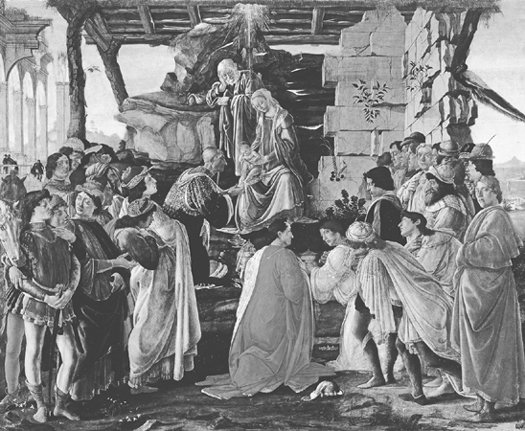
Botticelli, Adoration of the Magi, circa 1475. Botticelli, robed, looks out from among the portraits of the Medici and their courtiers. (illustration credit 4.1)
Much later, in 1500, when he inscribes a prophecy on a painting, it is written in Greek by “I, Alessandro.” So Leonardo da Vinci was not the only Florentine artist with a passion for ideas. In his “Life of Botticelli,” Vasari sniffs that pretension made the artist writea commentary on Dante. In fact Botticelli illustrated every canto of Dante’s Divine Comedy in drawings that rival Leonardo’s notebooks. He also painted, in the 1490s, a perfect archaeological reconstruction of the most famous lost painting of the ancient world, theCalumny by Apelles, based on textual descriptions. But for all these intellectual achievements, it is as a mystical weaver of impossible worlds, a visualiser of the invisible, that Botticelli rightly remains one of the world’s favourite painters. His famous mythological paintings—The Birth of Venus, Primavera, Pallas and the Centaur, Venus and Mars—gave the ancient gods new life to walk, or waft, abroad among the young men and women of Florence.
Botticelli’s world, in his paintings of the late 1470s and the 1480s, is a young, erotic, beautiful world. It’s the world of tournaments, parties, picnics, and carnivals in which Lorenzo and his friends existed. It is also a magical world. In Venus and Mars, probably created to decorate furniture in a palace bedroom, the goddess of love, in a diaphanous robe, props herself on one arm, calm but very much awake, while her lover, the war god Mars, lies, nude and asleep, beside her. In their woodland bower, cheeky little fauns play with the slumbering slaughterer’s lance and helmet. Venus’ elegant clothes stress her power over the nude man: her beauty has literally enchanted him. Mars lies under a spell, a benign spell, and it seems plausible (if unprovable) to see this painting as a talisman, an attempt to call down the influence of Venus according to principles of natural magic. Its very crispness and solidity—its crystalline quality—have something enchanting and transformative about them. You feel better for seeing it. You feel benevolently influenced.
Botticelli’s pacifying goddess has achieved some celestial effect: his Venus is the planet as well as the pagan personage, and the forces at work in this painting are the secret operations of spirit. It’s a benign version of the sinister power of women the Florentine Herald saw in Donatello’s Judith. Florentine natural magic worked by using materials associated with the desired planet—the right music, the right food; why not looking at the right painting? Talismans and incantations were above all supposed to conquer “melancholy.” Botticelli’s pictures are among the best cures for melancholy anyone has ever painted. They exude joy—and that joy is presided over by Venus, both the goddess of love and, as Ficino claimed, one of the happy, vital, fortunate planets that can defeat Saturnine melancholy.
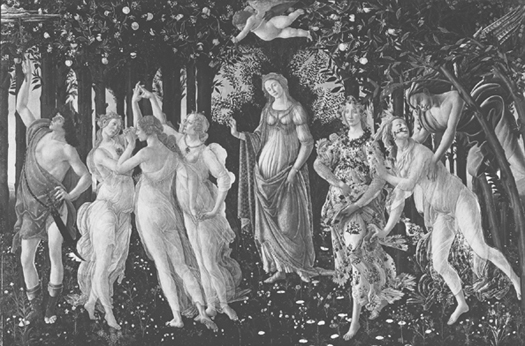
Botticelli, Primavera, circa 1481–2. The meaning of this expansive mythological scene is elusive, its power insidious. (illustration credit 4.2)
In The Birth of Venus she floats over the green sea, the inexplicable way in which her shell-boat clears the water, blown by wind gods who float in the air, itself suggesting some divine phenomenon. Everything is so firm and clear in Botticelli’s world: the faces so limpid, the eyes so sharp—and yet there’s a complete mystery to the way in which figures move through space, most purely expressed in the simple but ineffable flight of Venus over the waves. She comes towards you; the effect of joy is infectious; the gloom of Saturn disintegrates. In Botticelli’s Primavera Venus rules a woodland gathering of gods and spirits. There’s a new joy in the world—Spring, the rebirth of nature. Venus, the goddess of generation, rules the time of renewal, the new Golden Age. Mercury raises his wand heavenward, connecting the earth with the celestial powers, reaching between one reality and another. Airy spirits populate the glade: the Graces dance, a blue Zephyr chases the nymph Chloris, who transforms into Flora with her dress of flowers. At once hymn to spring, representation of the pantheon of Venus, and transfiguration of the May dances that were part of Florentine high and popular culture, it’s pointless trying to finally fix the meaning of the enigmatic Primavera and futile to deny that its feeling is supernatural.
The sheer reality of spiritual beings in Botticelli’s art populated Florence with occult forces. When he painted a centaur the centaur was real, solid, alive; the blue Zephyr blowing among the trees in Primavera is a personification of a demon. The world was self-evidently full of demons, spells, and planetary forces; there was no better theory available to explain how it worked. The difference between Florence and any village of the day where similar beliefs flourished was simply that Florentine artists, and none more enduringly than Botticelli, granted these superstitions beauty and grace.
The Botticelli who came to the meeting on 25 January 1504 was no longer under the influence of Venus. In 1494 he discovered a new guru. Savonarola attacked the “vanities” of sensual art, and yet the sensual artist Botticelli became his devoted follower, says Vasari in his “Life of Botticelli,” and there is dramatic visual proof of this. Savonarola’s books—cheap pamphlets relating his prophesies, interpreting the Bible, advocating personal prayer—were copiously illustrated with woodcuts, including some that anticipated paintings Botticelli had yet to create. For example, his later painting The Agony in the Garden has a spiked fence and mound that match the same features in a woodcut of this scene in a Savonarola pamphlet. The painting is a deeply original composition, almost painfully personal to behold. In other words, he designed the woodcut.
Botticelli’s devotion to Savonarola was in fact not a violent break with his magical paintings of myth, for prophecy was another variety of the occult. The spell Savonarola cast over Florence is the ultimate proof of the city’s hunger for the supernatural. Here was a man who spoke to God, and God told him the future. Everyone accepted that his foretelling was proved true by events. Men and women went to stand, in crowds segregated by sex, in the Cathedral and be shaken by his revelations. This was divination by another name: another way of making contact with the celestial. As Machiavelli wrote, the city’s credulity revealed a primitive stratum beneath all its sophisticated ways: “The people of Florence do not appear to themselves to be either ignorant or crude; nevertheless the friar Girolamo Savonarola convinced them he spoke with God.” The rise of Savonarola did not mark the end of Florence’s magical beliefs. Rather, it was the apotheosis of Florentine superstition.
At the moment of Savonarola’s death, Botticelli was one of the diehard Weepers who felt like strangers in their own city. He bravely asked a member of the Signoria, to his face, to justify Savonarola’s cruel death. In 1500 he wrote on his painting The Mystic Nativity his own prophesy of the Last Days and the imminent end of the world, to be replaced by a New Heaven and New Earth. He believed the visible world, on that cold January day as everyone discussed Michelangelo’s statue, to be on the very edge of dissolution. The angels were about to come down to the city and embrace and kiss mortals, while the Devil would be driven down into the depths.
Botticelli quietly disagreed with the caricature of Judith as a “deathly sign.” Michelangelo’s statue would stand well outside the Cathedral, he said, on the steps up to it at the right-hand side near the Campanile, “with a Judith at the other corner.”
Leonardo da Vinci sat doodling on a piece of paper. While the first speakers gave their opinions, he was drawing a great, hulking man with a beaky profile, a tremendous chest pulsing with shadows. He gave his sketch of the David a sling and a stone, and eyes that somehow were more stupid, less alive than those of the glaring giant in whose thrall everyone was speaking. It was an insidiously cruel caricature—at once true to the statue’s physical power and denying something about it. Leonardo refused to acknowledge the youth of David, let alone admire the figure’s vitality. His doodle transforms the alert hero into a muscleman, a thug. Leonardo was looking at the statue towering there and deliberately refusing to accept its claims for itself, to see the movement of spirit in this body.
As the artists and craftsmen began to give their opinions (What’s wrong with the buttresses of the Cathedral? asked the wood-carver Francesco Monciatto. Hadn’t the statue actually been commissioned to go up there on top of the building? His mind was not really made up, Monciatto confessed), the haunting words of the First Herald of the Republic hung in the air. Where had it come from, his denunciation of Donatello’s Judith?
It had come from the Palace, as would become clear in retrospect. Piero Soderini wanted Michelangelo’s statue for the city, for the state. The potent masculinity of the statue was its virtue. It stood colossally nude. Its stone phallus rested on immense stone testicles. Here was a man, and nothing but a man. Freed from the dishonesty of clothes, standing without shame in the light of the Piazza della Signoria, he would display his manhood as he took up arms: the vital masculine spirit of the Republic replacing the malign feminine black magic of deathly Judith.
There was, however, another possible voice lurking behind the herald’s, shaping his speech. After denouncing Judith, he went on to criticise Donatello’s David in the courtyard of the Palace, another spot the government favoured for Michelangelo’s work: “TheDavid in the courtyard is an imperfect figure, for its back leg is cracked; for all these reasons I’d put this [i.e., Michelangelo’s] statue in one of those two places, but preferably where the Judith is.”
Donatello’s bronze David is revered to this day as one of the supreme masterpieces of European sculpture. It was already recognised as such in Renaissance Florence—that was why it was taken from the Medici house to the government Palace, because it was such a public asset. But here Messer Francesco abruptly dismisses Donatello’s talent, saying his statue is “imperfect.” This is a familiar tone of voice, one strongly reminiscent of Michelangelo’s own in Condivi’s Life and in the artist’s letters. Always ready to criticise other artists, he rubbished Donatello to Condivi—saying that the sculptor never polished his works properly—before correcting the comment, taking it back, in a conversation with a friend.
So the sculptural criticism offered by Messer Francesco seems to reflect Michelangelo’s opinions. As, in truth, does his invocation of supernatural terror to damn Donatello’s Judith. For Michelangelo believed as firmly in planetary influences and ghosts as he did in God. Messer Francesco’s mixture of arguments—art criticism and the supernatural—makes it likely that Michelangelo advised him on what to tell the assembled artists to convince them of the need to place his David in front of the Palace.
In his biography of Leonardo da Vinci published in 1550, Vasari uses the language of astrology to praise the genius of the great polymath: “Truly celestial was Leonardo …” There is nothing casual about this language. He makes his meaning clear: “The greatest gifts are often seen to be rained by celestial infuences [influssi celesti] into human bodies naturally; and sometimes supernaturally one body is given beauty, grace and ability …” There was no rational explanation for a perfection as vast as Leonardo’s: he must have been shaped deliberately by God. When Condivi’s Life of Michelangelo appeared three years later, written under the direct influence of its subject, it made it clear that he could match and outdo Leonardo’s heavenly pedigree. With an accuracy worthy of theClock of the Planets, Condivi related how Michelangelo was born on “the sixth day of March, four hours before daybreak, being a Monday. A great nativity certainly, and it showed the kind of child he was to be, and of what ability, because, having Mercury with Venus in the house of Jupiter with a benign aspect, it was favourable, promising he would have the noble and high genius to triumph in everything, but principally in those arts which delight the senses, like painting, sculpture, architecture.”
Michelangelo himself must have been the source of this personal information. His line identifying himself with his statue—“David with his sling, I with my bow”—reveals that for its creator this was an intensely personal image. Messer Francesco’s indictment of Donatello’s Judith implies that the David was somehow astrologically superior. In Michelangelo’s mind it certainly was, for it shared his own excellent horoscope.
Michelangelo had carved the statue in secret, in seclusion, but its form determined its future. In turning his imagination away from oblivion towards action, in turning to face the world, it was as if Michelangelo dramatised his relationship with other people through his statue. Angry, difficult, lonely, he created an image that faced down dangers, and in facing Florence it demanded, as if in a dream, to move from the secrecy of the workshops to the very centre of the city, to stand on the Piazza della Signoria.
But very few of the artists at the committee meeting could see why this should be so. Cosimo Rosselli and Botticelli wanted it to stay in the neighbourhood of the Cathedral, as a religious work, perhaps on the steps facing the Baptistry. Then Giuliano da Sangallo spoke. He recognised that the David was a “public thing”:
My feeling was very much for the corner of the Cathedral, as Cosimo said, where passers-by would see it: but in the end this is a public thing, and recognising the imperfection of the marble which is tender and fragile, and if it stands in the open air, it doesn’t appear to me it will last, I thought it would be better under the middle arch of the Loggia della Signoria, either under the vault so you can walk right around it, or against the back wall, in the middle, with a black niche behind it as a kind of tabernacle, for if it is put in the open air it will truly deteriorate quickly. Better cover it.
This speech changed the entire meeting. Sangallo was the most experienced architect and engineer there. He was consulted all the time about practical building problems. His words were powerful. Instead of the airy language of the First Herald, all that occult hyperbole, here was plain technical reasoning. Even the First Herald’s nephew, the Second Herald, agreed with Sangallo. His comment sounds as if it was influenced by the chill of the month:
I’ve listened to all, and all have spoken good sense for various reasons. And considering these places from the point of view of frost and cold, I have thought about the need for cover, and the installation should be under the Loggia della Signoria as has been said but under the arch nearest the Palazzo della Signoria, and there it would stand under cover and be honoured by its closeness to the palace; and if you put it under the middle arch, it would break up the order of the ceremonies that the Signori and the other magistrates hold there.
The Loggia was a ceremonial stage at ninety degrees to the nearby Palace where the Signori stood during public events—they had stood there to witness the execution of Savonarola. It was an honourable location, especially if, as the Second Herald wished, the statue were placed under the arch nearest the Palace. When Andrea il Riccio added his voice, however, the argument shifted once more from the purely technical to something more mysterious. The David, he couldn’t help stressing, was a powerful, even a menacing figure that seemed to look at you as if it were alive. He made it clear that he wanted it under the Loggia in the same way that it’s best to keep a bear on a chain or a lion in a cage. The Loggia, he said in a way that perhaps naively revealed the other speakers’ hidden agenda, would neutralise the eerie power of the David: “I agree with what the herald has said, both because it will stand well sheltered there in the Loggia, and because it will be more estimated and looked at if it is not ruined, and it will stand better under cover, because then passers-by will go to see it, and it will not be as if it goes to meet them, and we will go to see it, and not have the figure come to see us!”
Here Il Riccio reveals something unstated in Sangallo’s argument, but obvious. Under the Loggia the statue would be less dominating. It would be muted, tamed. “We will go and see it, and not have the figure come to see us!”—this is a pungent image. Il Riccio imagines a scenario a bit like Pushkin’s poem The Bronze Horseman, in which an equestrian statue chases a man through the streets of St. Petersburg. In other words, he sees as much uncanniness in the David as Messer Francesco claimed to see in the Judith. TheDavid’s penetrating gaze is so lifelike—best keep it in the shadows under the tall Gothic Loggia instead of letting it rule the open space of the Piazza. Once again magic haunts the discussion as Il Riccio invokes popular superstitions about the evil eye.
The next three speakers—Lorenzo dalla Volpaia, Biagio d’Antonio Tucci, and Bernardo di Marco della Cecca—all agreed with Sangallo. Then Leonardo da Vinci spoke.
Had Leonardo really spent the meeting up to that moment sketching Michelangelo’s David in his notebook? He was certainly to add a feature that makes visible sense of what he said when called to speak about the statue. As with the other artists, the transcript records Leonardo’s actual words about Michelangelo’s youthful masterpiece. And what insidiously aggressive words they were: “I confirm that it should stand in the Loggia, where Giuliano has said, but on the little wall, where they hang the tapestries on the side of the wall, with decent ornament and in a way that will not spoil the ceremonies of the officials.”
Leonardo went out of his way to stress the need to hide the David away, to keep it at the edge of things. There isn’t much love for Michelangelo or his work in his words. Andrea il Riccio had already let the cat out of the bag and suggested that in the shade of the Loggia the potent statue could be kept under control. Leonardo similarly betrayed his desire to hide it away, to marginalise it literally: to shift it from the heart of the Piazza as it were an afterthought, an interloper in the public life of Florence. But that was not his most outrageous suggestion. He added that the statue should have “decent ornament,” “ornamento decente.”
If we miss the meaning of these words it is only because we no longer live in a shame-filled society. Until very recently the primary meaning of “decency” was the Christian one of modest covering and behaviour. In calling for David to be given ornamento decente, Leonardo meant that its genitalia should be decently concealed. This was a curious concern for a man who dissected human bodies and who, in that same year, in his sketches for his battle cartoon, drew a man on horseback in which he observed that the rider had an erection. But any doubt of his meaning is erased by the drawing of the David in his notebook. There he gives Michelangelo’s statue metal underpants, drawn in ink to resemble bronze.
Magic hung in the air that day. The First Herald had opened the meeting with talk of witchcraft and star signs; Il Riccio revealed that he saw the David as an entity with demonic aspects that might “come to see us.” Leonardo cast a spell of his own, a spell that worked by using the right words at the right time. In Tuscan the word for “spell” was incanto. Like an incantation or a talisman placed in the foundations of a building, Leonardo’s introduction of the phrase “ornamento decente” into the discussion sought to change reality by precise intervention. His words entered the transcript and were perhaps repeated in other discussions, maybe as he showed his drawing of what the statue would look like with a metal modesty-belt. No one else had used such language. No one else at the meeting took up Leonardo’s idea. But it stayed there malevolently.
To veil the statue’s nudity was an attack on its power. It resembled what witches did. The late-fifteenth-century demonological work Malleus maleficarum specifies male impotence and even the destruction of men’s penises as a crime of witchcraft. Perhaps that was what was in Leonardo’s mind. As if he were a witch, he cursed David, seeking to neuter Michelangelo’s statue—a statue that was a passionate expression of its maker’s own being. This assault on his rival’s virility was just as vicious as anything Michelangelo said outside Palazzo Spini.
On the night of 14 May 1504 Michelangelo’s statue was slowly rolled out of the Operai del Duomo, standing upright, suspended in a mobile scaffold devised by the Sangallo brothers. A team of forty men laboriously moved it forward on fourteen oiled tree trunks which had to be hefted in rotation to maintain the effect of a conveyer belt. To get the “marble giant” out of the workshops they had to smash the wall above the door. That night, the statue had to be guarded from mysterious assailants who threw stones at it.
Statues in motion are curious entities. In religious festivals which still take place in some Italian cities, a sacred statue—for example, the Virgin of Trapani in Sicily—leaves its home one night a year to move through the city streets, carried by devout young men. The effect is genuinely unearthly: the statue moves, it has come to life. The stillness of stone is suddenly animate. The crowd, at first onlookers at a spectacle, become increasingly involved and emotional. On its return the statue is applauded. It has proved that it is more than a dead thing.
Michelangelo’s statue did not, does not, need to prove its vitality by actually moving. His achievement is, precisely, to make David seem alive. That is magical—understand the word as you will. But as it moved through the streets, slowly, majestically, the colossus suddenly stopped being a work of art. The men who met to speak of it in January had been artists, and only Andrea il Riccio—and, coolly, Leonardo—realised that this work was somehow more potent than any other statue, more than an aesthetic curio. Its progress turned it into a popular legend. It entered the city’s soul. The apothecary Luca Landucci wrote in his diary of this extraordinary event, and it is he who calls the marble man “the giant.” Yet only at the end of his enthusiastic account does he say it was carved by one Michelangelo Buonarroti. For him it was more than art. This ordinary shopkeeper and member of the Great Council was constantly writing of sacred statues and paintings of the Virgin—for him the important images in the streets and churches of Florence were sacred idols like the Virgin of the Annunziata. He wrote of “the giant” in the same way.
When it finally reached the Piazza della Signoria the statue had to be painfully, slowly manoeuvred out of the Sangallos’ contraption onto its pedestal. In July, when all that had been done, it stood in front of the main entrance to the government Palace. The First Herald had after all been speaking for Soderini and Machiavelli. The artists’ advice to the contrary had no effect. Perhaps their spite was too obvious. Donatello’s Judith was moved, and the David took her place.
Only one thing said at the meeting in January, after the First Herald spoke, had any effect. Perhaps it was directly because of what Leonardo said, or perhaps he simply read the Republic well, but before Michelangelo’s David was installed outside the Palace, on whose wall it cast a long shadow, it was fitted with a brass thong very like the device in Leonardo’s drawing, with twenty-eight copper leaves to make it decente.
As the city assimilated its new symbol and took David to its heart as a marvellous being, the small victory of emasculating it was turning to dust for Leonardo, however. He had yet to start painting his battle scene in the Great Council Hall, the vast room just through the Palace past Michelangelo’s colossus. The young sculptor had conquered the public heart of Florence. He had projected his emotional life outward in a unique way. In carving David he imagined acting in the world: and the statue acted in the world. When it took up its grand vigil outside the Palace it instantly reshaped the public identity of Florence—transfigured the Republic’s self-esteem. Florence now had the greatest statue in the world as its symbol, a work that eclipsed even the Dome of the Cathedral as a universal icon. It does, to this day.
Luca Landucci’s awed account of the statue’s journey through the nocturnal city provides an insight into how ordinary Florentines immediately recognised this public sculpture as something intended for them. But it is more precisely significant than that. This pious shopkeeper and Great Council participant had watched the Hall being built, had stood in it in grief-stricken silence listening to the officers read out Savonarola’s confession. He represents the target audience for Soderini’s plan to decorate the Hall—and his diary bears witness to the fact that when it came to popular art, in Florence in 1504, it was Michelangelo who had the magic touch.