
Protest is when I say this or that doesn’t suit me. Resistance is when I ensure that what doesn’t suit me no longer occurs.
ULRIKE MEINHOF, Vom Protest zum Widerstand (From Protest to Resistance)
During the 1960s, perhaps more than any other decade in history, the world was party to some of the most violent, politically radical underground movements it had ever experienced. Governments were attacked were as the military – in fact, all mainstream institutions and ideologies came under fire, with 1968, in particular, coming to symbolize the whole of that decade. Left-wing rebellions broke out in all corners of the world: Paris was affected, as were Tokyo, Berlin, Saigon, New York, Prague and Mexico City. Militant direct action became commonplace, with predominantly middle-class students espousing the teachings not only of Karl Marx, but also, Mao Tse-Tung and Ho Chi Minh, in the hope of combating fascism, imperialism and capitalist exploitation. This was a revolution both an exciting, thought-provoking time, and yet a dangerous, heavily bloodstained one.
In Germany a group known as the Rote Armee Fraktion (the Red Army Faction) or RAF began their campaign of terror hoping to overthrow the government, only to be joined by other, smaller organizations such as the West Berlin Anarchists or ‘June 2 Movement’, as well as a group which called itself the Socialist Patients Collective (Sozialistisches Patientenkollektiv, or SPK), a gathering of psychiatric patients who had formed their own armed terrorist cell. But what was it that first drove seemingly privileged, middle-class men and women to such extreme lengths? Who were they attacking, and with what aim in mind?
In the 1960s, Germany’s fascist past was still a matter of deep concern, particularly to the New Left, whose younger members condemned their forebears’ involvement with Nazism and accused them of not facing up to the reality of what they had done. Students could see for themselves that there was a direct personal link between the old Nazi regime and the new German state.
As of 1965, fully 60 percent of West German military officers had fought for the Nazis, and at least two-thirds of judges had served the Third Reich. Students clamored to know the past of their professors and conducted research revealing that many of them had been affiliated with the Nazis.’1
The New Left generation felt disenfranchised and angry – an anger that rapidly translated itself into political activism. The Vietnam War was one of the first causes taken up by young Germans, determined to demonstrate their disillusion. Siding with the Viet Cong, they saw it as their duty to oppose the war and America’s imperialist stance. They also claimed that their government’s support for the conflict ably illustrated just how little Germany’s values had changed since the Nazi period.
The student protests escalated, particularly in West Berlin where the Cold War was at its zenith, with right-wing newspapers such as Bild and the Berliner Morgenpost stirring up anti-student hysteria, a campaign that eventually, on June 2, 1967, resulted in the death of a twenty-six-year-old protestor at the hands of an undercover policeman, Karl Heinz Kurras.
Benno Ohnesorg had been attending his first big, mass rally (organized to protest against the Shah of Iran’s imminent arrival in Germany) when he was shot and killed. Later that same night, Gudrun Ensslin – the future founder of the RAF – was quoted as saying:
This fascist state means to kill us all […] Violence is the only way to answer violence. This is the Auschwitz generation, and there’s no arguing with them.2
It was against this backdrop of brutality and fighting that the Socialist Patients Collective first came into being. The year was 1969 and the place was the Psychiatric Neurological Clinic at Heidelberg University where Doctor Wolfgang Huber had begun encouraging patients to see capitalist society as the root cause of their illness.
Doctor Huber, who had been appointed to his teaching position (as a scientific assistant) at the age of twenty-nine in August 1964, had already been warned several times by the Director of the university, Doctor von Baeyers, for refusing to collaborate with colleagues. Now he was taking his disdain of authority even further. In group-therapy sessions, Doctor Huber was outspoken in his opinion that the capitalist agenda of the Federal Republic was sick to its very core and was, as a result, responsible for producing physically and mentally sick people – a situation which could only be reversed through violent opposition to the government. His teachings left the university with no choice and, on February 21, 1970, he was dismissed without notice. Huber’s lawyer immediately lodged a complaint against the dismissal and on February 28 Huber rallied those of his patients who were psychiatrically fit enough to stage a sit-in in the offices of the university’s administration block. Doctor Huber also stated that some of his more fragile patients might well commit suicide if he wasn’t reinstated to his post. The university ultimately backed down and agreed to continue paying Huber until September 30, 1970, as well as giving him four rooms out of which to work. Relieved to have his old job back, Doctor Huber began formally to organize his patients into the Socialist Patients Collective. Margrit Schiller, Klaus Jünschke, Siegfried Hausner and Carmen Roll were just a few of the patients from this group who were more than willing to ‘cure’ their personal mental disturbances through violent action. In her book, Hitler’s Children, Jillian Becker also points out that although Huber’s university contract ran out in September 1970, meaning his work would no longer receive finance, he continued to be funded by the institution:
[ … the] university continued to support the organization well beyond this deadline, not out of its normal funds, as hitherto, but out of its special “charity funds”. In all DM 31,875 was made available by the “sick system” to those who planned to cure themselves by destroying it, from its inception to its dissolution, at which point the balance of the money was “distributed” to the private accounts of leading members.3
But Doctor Huber’s group was not the only organization taking up arms at this time. In 1968, another collective comprising Andreas Baader, Gudrun Ensslin, Horst Söhnlein and Thorward Proll – all of whom had previously been convicted and imprisoned on charges of arson – were given temporary parole while their case was sent to appeal. On their release Baader, Proll and Ensslin took up jobs working with troubled teenagers but in 1969, when their appeal was rejected, instead of returning to prison, all three decided to take flight. With the help of Proll’s sister, Astrid, they escaped to Paris, but Baader and Astrid Proll returned to Germany shortly afterwards, settling in West Berlin. It was at this point that Ulrike Meinhof (who already knew Baader through his work with the teenagers) helped house both fugitives while they in turn began trying to source weapons for use in forthcoming terrorist activities.
In many ways, Ulrike Meinhof was typical of the kind of white, middle-class, well-educated woman who was signing up to including Dr. Huber’s terrorist cause. Born in 1934, the year after Hitler came to power, her father, Werner, was the assistant director of a museum, while her mother, Ingeborg, stayed at home looking after the children. It was a comfortable, pleasant life in the type of leafy neighborhood so many films and novels represent as being the perfect place for a family to live in. Sadly, Werner died when she was only six years old – and with his death Ulrike’s mother was forced to take a job. Ingeborg coped well with the situation and financially the family wasn’t much worse off than before the death of her husband. Even during the war (which her mother survived as a silent critic of the Nazis) Meinhof continued to receive a good education and didn’t lack love and attention. Shortly after the war ended in 1945, however, Ingeborg was diagnosed with cancer and died soon afterwards. A close family friend, Renate Riemeck, now took over as Meinhof’s substitute mother. Well educated, with a strong maternal streak, she was the perfect candidate for the job. Riemeck ensured Meinhof received everything she required, and also introduced her to a wide range of subjects including philosophy, literature and politics – all of which interested the young girl, who had begun to show a real talent for writing. Soon Meinhof was enjoying the company of young left-wing intellectuals who shared her ideas and goals. In 1960 she joined a Hamburg-based magazine called Konkret, which heightened her interest in left-wing politics.Admittedly, Meinhof had experienced more than her fair share of trauma in her life up until this point, but there can be no argument that her parents, while they were alive, provided their child with a safe, happy home in which to grow up, and that she was given a good education. In this respect she was no different from many of the SPK members whose future reputation, though overshadowed by Meinhof’s, was equally violent. In Hitler’s Children Jillian Becker goes so far as to pose the theory that this post-war generation was indeed united in an unconscious desire to prove to themselves that they would have fought tooth and nail to defeat Nazism had they lived in that era. In effect, they were fighting Hitler ‘a generation too late.’
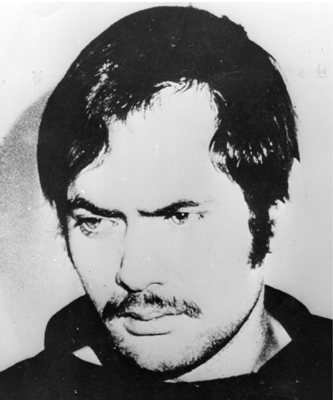
Andreas Baader was the leader of the Baader-Meinhof Red Army Faction terror group with which the SPK aligned itself. He committed suicide in prison in 1977.
But perhaps Meinhof would never have become involved in such extreme activities if she hadn’t come in to contact with the charismatic, incorrigibly rebellious Andreas Baader and his girlfriend, Gudrun Ensslin. The latter, like Ulrike Meinhof, had enjoyed a comfortable middle-class upbringing. Born on August 15, 1940, she was the fourth of seven children. Ensslin’s father, Helmut, was a pastor of the Evangelical Church of Germany (EKD), a group that was set up in 1945, the year Hitler was defeated. The EKD’s beliefs ran counter to those of the Nazis. More than this, the EKD actively encouraged its members to question authority rather than simply going along with the majority view and to oppose the Federal Republic’s plans to rearm. Helmut Ensslin, along with his wife, Ilse, also liked to encourage their children to discuss politics and social issues round the kitchen table and Ensslin was instilled with a good appreciation of world affairs. When she was eighteen years old, Ensslin was given the opportunity to study in America, in Pennsylvania, on a student exchange programme, a time she enjoyed even while harboring a certain disdain for the country’s obvious inequalities. Jillian Becker observed that:
She found much fault with America, its social injustice, its material inequality. But she had not arrived innocent of all prejudgment of the country, so this was not a case of any eye-opener or an education in social realities. She found what she was looking for, and what was certainly there to find.4
On her return, Ensslin enrolled in the University of Tübingen and afterwards in the University of West Berlin, there to study a combination of Philosophy and Germanics. The author Günter Grass, who knew her while she was studying at the latter institution later recalled, ‘she was idealistic, with an inborn loathing of any compromise. She had a yearning for the Absolute, the perfect solution.’5
Again it is easy to draw parallels between Gudrun Ensslin’s background and that of her SPK comrades and it is also easy to see why, when Ulrike Meinhof gave shelter to Baader and Ensslin, how the three of them immediately gelled and formed a strong bond. However, the two fugitives’ sojourn at Meinhof’s apartment was to be short-lived for, on April 3,1970, Baader was rearrested by the police, after which Meinhof’s fate was sealed.
No sooner had the courts despatched Andreas back to prison then his comrades began plotting ways to get him out. For Meinhof, this was to be her first foray into terrorist activity.
On May 14, Andreas Baader – who had been given leave to attend a state library (inside the German Central Institute for Social Issues) for the day – was set free by his friends, but only after two security guards were shot at and one elderly library staff member, George Linke, was so badly injured that he almost died from his wounds. Fleeing from the scene Baader, Ensslin, Meinhof and friends immediately went underground. Triumphant at what they regarded as a major coup (but regardless of the fact that they had nearly killed an innocent civilian) the group subsequently issued a statement which was printed in the May 22 edition of the far-left magazine, 833, under the logo of a black panther – a direct reference to the American terrorist organization of the same name.
Did the pigs really believe that we would let comrade Baader sit in jail for two to three years? Did the pigs really believe that we would forever fight with paintballs against bullets…? Did any pig really believe we would talk about the development of class struggle…without arming ourselves at the same time? Did the pigs who shot first believe that we would allow ourselves to be gunned down like slaughter-cattle? Gandhi and Martin Luther King are dead. The bullets that killed them, the bullets that hit Rudi [Dutschke]5 …have ended the dream of nonviolence. Whoever does not defend himself will die. Whoever does not die will be buried alive: in prisons, in reformatories, in the hovels of Kreuzberg, Wedding, Neuköln, in the stony wastelands of the new housing developments, in the overcrowded kindergartens and schools, in the perfectly furnished, newly built kitchens, in the mortgaged bedroom palaces…START THE ARMED STRUGGLE! BUILD UP THE RED ARMY!6
Although this was the first mention of the Red Army Faction or, as it quickly became known, the ‘Baader-Meinhof Gang,’ it was to be another full year before they issued their full manifesto, ‘Concept of the Urban Guerrilla’ ( Das Konzept Stadtguerilla) by which time RAF members had taken themselves off to Jordan where they trained at a PLO (Palestine Liberation Organization) camp. Here they learned the tactics of terrorism, how to use firearms, throw hand grenades and build bombs, after which they returned to Germany to begin stockpiling arms.
At this point the SPK were just beginning to commit their own acts of random violence. In mid-February 1971, Siegfried Hausner and Carmen Roll attempted to bomb a train on which the Federal Republic’s president was traveling. Their plans went completely awry, however, when Carmen Roll turned up late at the station, thus missing the opportunity of placing the bomb (a small, homemade device) on the train.
In June 1971, Doctor Huber, who had moved his offices to his home in Wiesenbach, became aware that the police had begun monitoring the comings and goings of his patients. Two of these, Ralf Reinders and Alfred Mahrländer, were of particular interest to the authorities, so when they were stopped by officers on their way to Huber’s home, it wasn’t surprising that one of them, Reinders, pulled out a pistol and shot one of the policemen in the shoulder. Reinders and Mahrländer both escaped, but were arrested shortly afterwards.
Following this incident, seven members of the SPK, including Doctor Huber and his wife, were placed under arrest on suspicion of forming an illegal organization as well as for buying weapons and explosives. Although present at the time of the police raid, Carmen Roll and Klaus Jünschke both managed to evade capture.
It was as this point that Jünschke, along with several other SPK members, staged a bank robbery during which a policeman was shot and killed. Then, on September 25, 1971, two police officers, Helmut Ruf and Friedrich Ruf (not related), approached an improperly parked car on the Freiburg-Basel autobahn. Inside sat Holger Meins and Margrit Schiller, both SPK members and both in possession of firearms. Knowing they would be arrested if the police searched them, both terrorists took the decision to fight and opened fire on the policemen. Friedrich Ruf was wounded in the hand, while Helmut Ruf was far more seriously injured. Schiller and Meins then made their escape, leaving the authorities to search their abandoned car – a search that uncovered two underground publications of some significance. The first was entitled, ‘Concept of the Urban Guerrilla,’ while the second had the seemingly innocuous title of ‘Road Traffic Ordinances,’ although its undercover title was, ‘Concerning the Armed Struggle in Western Europe.’ The former, of course, had been written by Ulrike Meinhof, a fact which led officers to believe that SPK members were now beginning to affiliate themselves to the RAF.
Shortly after the Freiburg-Basel autobahn shooting, on October 22,1971, Margrit Schiller was captured by the police in Hamburg, but not before she had spent some time in an RAF safe house which she described as being more than a little exciting. Here, all the higher echelons of the Baader-Meinhof group met up, talked politics, argued, laughed and rested amongst a general mayhem of guerrilla-style equipment, such as a radio that could monitor police frequencies as well as bomb-making equipment and guns.
Schiller’s arrest was itself by no means uneventful. She had been staying in Hamburg for a few days, trying to lie low but, on exiting a subway station one night, she noticed a police patrol car was following her. Schiller ducked into the basement garage of a nearby shopping complex, waited a while, then came out from an exit on the far side of the building, only to realize she was being followed once again by the police. Trying to avoid them she took shelter in an abandoned house, but later had to come out in order to meet up with two other SPK members, Irmgard Möller and Gerhard Müller. Naturally, the police were waiting and no sooner had Schiller begun to walk away from the house than two officers – Schmid and Lemke – drove their car onto the pavement in front of her. Schiller, who by this time had been joined by Möller and Müller, fled to a nearby park with the officers in pursuit. Schmid then grabbed Schiller by the arm at which point she pulled out a gun. Möller and Müller, seeing their comrade in distress, opened fire, hitting Schmid who fell unconscious to the ground. Lemke meanwhile had been wounded in the foot, but limped back to the patrol car to alert his colleagues, only to find that someone had stolen it. The delay cost Schmid his life, for by the time the two officers were taken to hospital, he was already dead.
Hamburg’s entire police force was put on full alert, a move that paid dividends for not long after two plainclothes officers soon spotted a woman in a phone box whom they suspected to be one of the fugitives. The officers waited outside the box for the woman to exit, at which point she was placed under arrest. Her name, according to her identity papers, was Dörte Gerlach, but what really gave the game away was the discovery of a fully loaded gun in her handbag. Gerlach/Schiller was taken to a police station, where she was formally identified and charged with murder.
Less than a week later, police raided an apartment in the same residential district as the phone box. What they found inside was a fully operational terrorist cell with approximately 2,600 rounds of ammunition, detonators, explosives, wiring, walkietalkies and even police uniforms. Yet despite the confiscation of all this equipment, the violence continued.
On December 22, 1971, SPK members (many of whom were now working for the RAF) were involved in one of the bloodiest actions taken by their organization when they robbed the Bavarian Mortgage and Exchange Bank, seizing DM 133,987. On that morning, a man entered the bank, placed a tape recorder on a desk and switched it on so that loud pop music blared out. Seconds later, three people dressed in anoraks with balaclavas covering their faces burst in. Two of them carried submachine guns, while the third carried a pistol. The three terrorists threatened bank staff and customers alike while ordering them to remain calm. Directly outside the building, a red Volkswagen minibus had parked illegally, something which drew the attention of a police officer called Herbert Schoner. Schoner approached the vehicle to talk to the driver, only to be met by a hail of gunfire. He was shot several times, one bullet blasting into his back, yet he still managed to crawl towards what he thought would be a safe haven, the Bavarian Mortgage and Exchange Bank. On entering the building, instead of finding sanctuary, Schoner was met by one of the robbers who shot him in the chest. He died at the scene.
The robbers, realizing they had just killed a police officer, took off in the red minibus along with their spoils. They had succeeded in pulling off a major bank robbery and, even though one of their number, Klaus Jünschke, had been identified by a witness to the robbery, all of the terrorists appeared to have got away with, quite literally, murder.
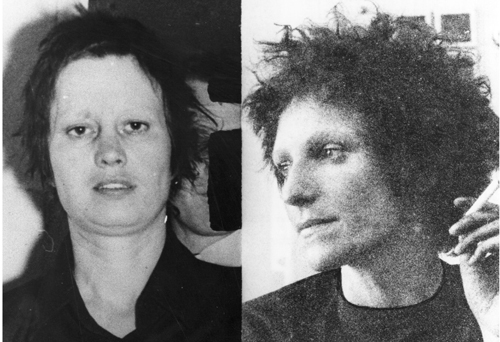
Ulrike Meinhof (left) and Gudrun Ensslin (right) had both enjoyed comfortable, middle-class upbringings, although Meinhof had suffered the trauma of losing both her parents at a very young age. Their privileged lives, however, were something that they certainly had in common with most of their SPK terrorist comrades.
At this point, though it was abundantly clear that the SPK were still operative, it was also apparent that many of their number had begun aligning themselves with the RAF, which was a much larger, more high-profile outfit. In 1972, the RAF decided to mount a ‘May Offensive’, which included the staging of not one but a string of major terrorist events over a two-week period. Two US military bases were attacked, as were police stations in two of Germany’s biggest cities and the offices of Axel Springer, who owned most of Germany’s conservative tabloids. The first bombing (carried out by, among others, Andreas Baader and Gudrun Ensslin) took place at the Headquarters of the US Fifth Army in Frankfurt and killed one soldier while injuring thirteen other American servicemen. The next day, a second bomb exploded, this time outside the Augsburg police station. Fortunately, no one was killed, but the bombing spree was not finished. Later that day yet another bomb exploded next to the Bavarian Federal Police Headquarters in Munich, demolishing at least twenty-five vehicles. Shortly afterwards, the RAF placed a bomb under the car of Wolfgang Buddenberg, a judge who had signed numerous arrest warrants against members of the group. Buddenberg did not get into the car on that day, but his unfortunate wife did, suffering extremely serious injuries in the blast. On May 19 the RAF bombed the Springer corporation offices, an attack that left seventeen workers injured. Finally, on May 24, a car loaded with 400 pounds of TNT was driven into the Headquarters of the US Army Supreme European Command site in Heidelberg, killing three American soldiers and injuring five others.
The RAF presented various ‘justifications’ for these attacks, but the main cause, so they said, was retaliation for the increased bombing of Vietnam by the United States. They maintained that West Germany should no longer be a safe place from which the American military could operate; indeed, the only way the violence would stop would be if the US withdrew from Vietnam altogether. Ultimately, however, the only people who found themselves unable to operate within Germany were the terrorists, for after the ‘May Offensive’ the police mounted a massive hunt for all RAF and SPK members. Over 130,000 officers were involved, patrolling the streets, checking border crossings and sifting through the mass of evidence that was coming in from the general public. The pay-off was enormous. In late May in Frankfurt, a resident alerted police, having grown suspicious of three of his neighbors whom he saw mixing an unidentified substance at the back of their house. On June 1, 1972 all three suspects were arrested; Andreas Baader, Holger Meins and Jan-Carl Raspe. The substance they had been mixing was an explosive. On June 7, a shop assistant in Hamburg noticed a young female customer acting suspiciously with what appeared to be a heavy object secreted in her handbag. Again, the police were alerted and the woman, Gudrun Ensslin, was placed under arrest. The object in her bag turned out to be a gun. Finally, on June 15, the authorities captured yet another major Red Army Faction player. The previous evening, a left-wing teacher had received a visit from a friend asking if he could accommodate two acquaintances for a short period. The teacher, though suspicious, agreed, and let the two stay, but later decided to call the police who immediately placed the apartment under surveillance. The next day one of the two guests, Gerhard Müller, left the apartment to use a telephone booth outside on the street, only to be pounced on by several officers, who then also placed the second fugitive, Ulrike Meinhof, under arrest. At first the police were unaware of the identity of either of their captives, and although they soon worked out who Müller was, it took a little longer to establish Meinhof’s identity.
There were no previous fingerprints from Meinhof to match up with those of their new captive but the police found an old copy of Stern magazine in which an article on Meinhof had appeared, accompanied by a photograph. The photograph was of an X-ray of her skull taken after an operation she had undergone back in 1962, when a metal clip was placed over an engorged blood vessel. The police now took an X-ray of their captive’s skull and, on comparing the two, found they were identical. The authorities were ecstatic. They had captured one of Germany’s most wanted terrorists. To cap it all, three weeks later they arrested Irmgard Möller and Klaus Jünschke.
It was at this time that a subtle change occurred within the RAF, SPK and even the ‘2 June Movement’ in that, rather than using their aggression as a protest against the Federal Republic and the United States governments, their terrorist activities were instead increasingly tied to the release of their comrades and to their hatred of the judicial system. With practically all of the RAF’s main players in prison, those left behind became known as second-generation terrorists – men and women who weren’t active during the late 1960s, but who were nonetheless determined to carry on the fight. And one subject exercised their minds more than any other – what they saw as the systematic mistreatment of their imprisoned colleagues.
For much of the time the detainees were kept in solitary confinement – a policy that took its toll on many prisoners, including Astrid Proll, who had been arrested in May 1971. Proll spent nearly five months in almost complete isolation in the Women’s Psychiatric Section of the prison. Starved of any kind of mental stimulation, confined to a bare white room with no pictures on the walls, with no one to talk to and with barely any outside noise to listen to, her treatment was likened to shock therapy.
Meinhof was also kept under similar conditions, for a period of eight long months, during which she wrote a poem, ‘From the Dead Tract’ (‘Aus dem Toten Trakt’) that put into words the extreme torture such a punishment exacted. ‘You can no longer identify the meaning of words,’ she wrote. ‘Visits leave behind no trace.’
Margrit Schiller, who was serving out a long stretch in Lübeck prison, believed she too was in the ‘dead tract’ and if there was any doubt as to how severe this punishment truly was, one only has to refer to an account by Heinz Brandt, (a survivor of Auschwitz) who in addition to his time in a concentration camp had also suffered long periods of solitary confinement in East Germany where he was imprisoned over a period of some years.
As crass and paradoxical as it may sound, my experiences with strict, radical isolation were worse than my time…in a Nazi concentration camp … [in] the camp, I still had the basis for human life, namely communication with my fellow inmates … We were able in the camps to see, not only outrageously fascistic and sadistic mistreatment, but also the possibilities for resistance and collective life among the prisoners, and, with this, for the fulfillment of the fundamental need of a human being: social existence.7
So severe was the treatment that the inmates’ only recourse was to stage a series of hunger strikes, starting in January 1973. These were extremely tough times for the detainees, but in respect of their mistreatment and their fight to improve prison conditions they were at least supported by their respective attorneys, and by legal organizations such as the ‘Committees Against Isolation Torture in the Prisons of the FRG.’
Now a new fight began – trying to forcefeed those prisoners who were refusing to eat. Doctors strapped inmates to their beds, clamped their mouths open and pushed tubes down their throats and nostrils into their stomachs. Again, SPK member Margrit Schiller was subjected to this institutionalized violence, stating that some doctors and prison guards were deliberately brutal in their technique, often leaving her and her fellow protestors bruised and bloodied.
Meanwhile, outside the prisons, ex-SPK members who had now fully integrated with the Red Army Faction mounted further guerrilla activities, most of which were designed to bring about the release of their comrades.
On November 10, 1974, the Federal Republic’s Supreme Court President, Günter von Drenkmann, was killed in a botched kidnap attempt. Then, on April 24, 1975, several former SPK members stormed the West German Embassy in Stockholm, Sweden, taking twelve hostages. Among the terrorists were: Siegfried Hauser, Hanne-Elise Krabbe, Karl-Heinz Dellwo, Lutz Taufer, Bernhard-Maria Rossner and Ullrich Wessel. They ushered their hostages – who included the Ambassador and the economics, military, cultural and press attachés to the embassy – into the library, then searched the rest of the building for remaining staff members, completely missing one of the secretaries who had hidden in a cupboard inside Room 306.
While all this was occurring, Swedish police, having been alerted to the situation, immediately moved into the ground floor of the embassy where they set up an operational center. This angered the terrorists to the point that they demanded the police withdraw otherwise they would shoot one of the hostages – the military attaché, Lieutenant Colonel Baron Andreas von Mirbach. The police refused and the terrorists bound Mirbach’s hands before leading him towards the top of the upper-floor stairwell, where they shot him, first in the leg, then in the head and chest, throwing him towards the police who dragged the dying man away. The authorities quickly evacuated the ground floor and took up a less antagonistic position outside the building.
With the police out of the way, the terrorists decided to place massive amounts of TNT explosive in the embassy’s basement. They then made contact with a German press agency and informed them of their demands. First and foremost, they wanted twenty-six of the Baader-Meinhof terrorists (including Gudrun Ensslin, Andreas Baader and Ulrike Meinhof) released. Back in Germany, however, the government, led by Chancellor Helmut Schmidt, was not prepared to be blackmailed by the terrorists and made it clear that they would not negotiate. This attitude prompted the terrorists to state that they would begin to execute one hostage every hour until the government started to release their friends. One hour passed by and nothing happened, but then Doctor Heinz Hillegart, the embassy’s economic attaché, was taken to a window and shot in the back. The attaché’s body was left hanging out of the window, a sign for everyone watching not to take the terrorists’ threats lightly.
What happened next was a freak accident. A short-circuit in the electrical wiring of the detonators caused some of the TNT in the basement to explode and two of the terrorists died. The others survived the explosion but in the ensuing mayhem were swiftly captured by the police. Terrorist Siegfried Hausner, who had suffered terrible burns after the TNT explosion, was flown directly to Stammheim Prison’s hospital wing, but died a few days later from his injuries.
In total the siege had lasted ten days, during which time two hostages had been killed and three terrorists had died. Some of the hostages later claimed that they had formed ‘friendships’ with their captors and even felt a certain sympathy for their cause. This was not an emotion shared by the majority of people living in Germany where, on May 21, 1975, the trial of Baader, Ensslin, and Jan-Carl Raspe began.
Spelling the beginning of the end of the Baader-Meinhof SPK movement, this trial ran for nearly two years, ending in April 1977 when the defendants were collectively found guilty of four murders and twenty-seven attempted murders, and of establishing an illegal criminal organization – for which they were each given life sentences. Shortly afterwards, Baader, Raspe and Ensslin all committed suicide in their cells in Stammheim prison, although controversy continues to surround the exact circumstances of their deaths, with some preferring to believe that the suicides were somehow ‘staged’ to cover up the unlawful killing of the prisoners. Ulrike Meinhof, who had been tried in 1974 for her part in the freeing of Baader and who had received an eight-year sentence, hadn’t fared much better, for on May 9, 1976 she was found hanging in her cell, also the apparent victim of suicide.
Although terrorist activities continued for several years after their deaths, the heart had been ripped out of the beast. Support for the movement gradually petered out. Ironically, given both the SPK and the RAF’s left-wing agendas, the effect their actions had on West Germany as a whole was quite the opposite to that which they had intended, with the electorate taking an increasingly conservative stance. Today, with East and West Germany reunited, for many the idea of following any kind of left-wing or communist philosophy would be simply unthinkable.