
6
‘…and what is the use of a book,’ thought Alice, ‘without pictures or conversations?’
Lewis Carroll, Alice’s Adventures in Wonderland
China’s first inventors were its first rulers. In the mythologies, they invented agriculture, established families and subdued the primal chaos. They were farmers, not nomads, and as they ploughed and settled, so they forged a patterned way of life. The Chinese character for ‘civilization’, pronounced wen, is at least 3,000 years old, and in its oldest usage it meant ‘order’ or ‘pattern’:
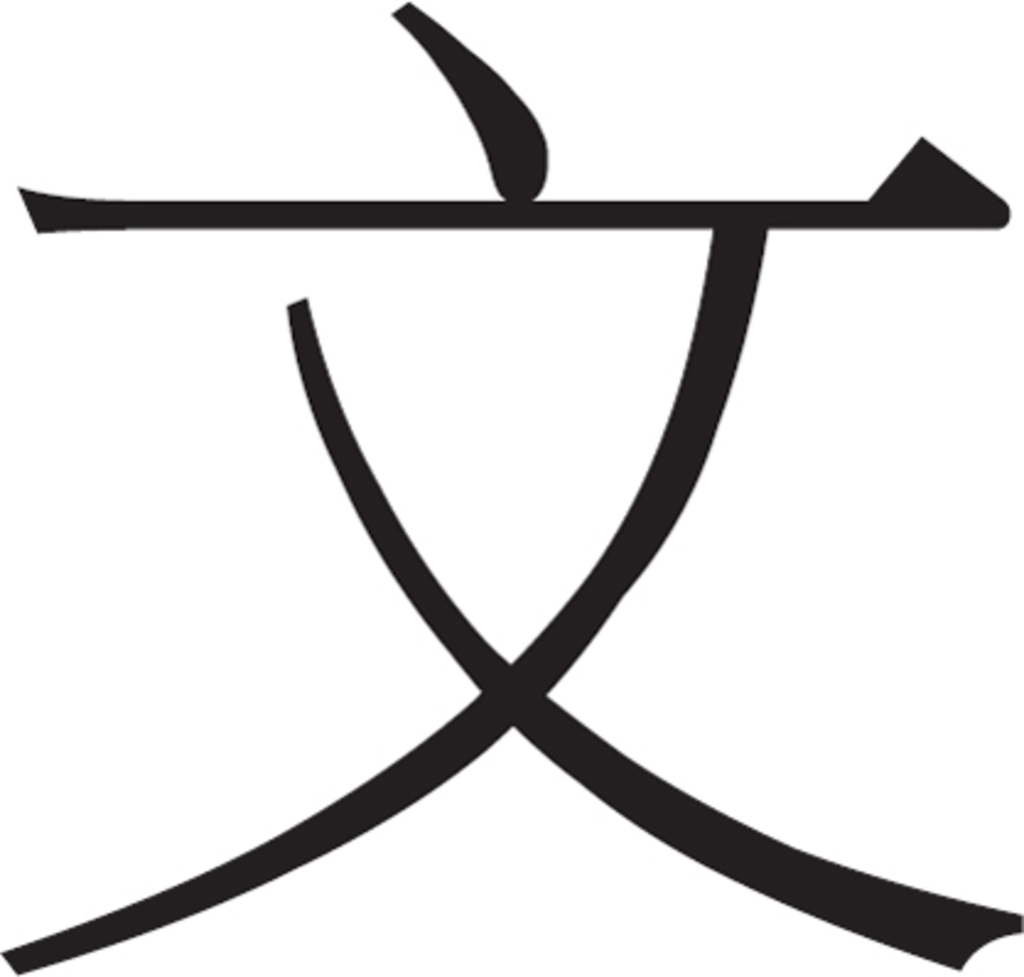
From the eighth century BC, that order began to drain away, spurred by political disintegration. The political centre failed to hold, and solutions were sought out to address the malaise. Confucius and Laozi were just two of those who sought to use their texts to restore civilization. Where some had argued simply for military might, wen now emerged as an alternative way to order the world. Indeed, written solutions such as theirs would redefine the very word for civilization. Thus the character wen soon came to mean ‘literature’ too.
Men like Confucius and Laozi wrote in high Chinese and most words were monosyllabic. Their sentences were spare and, as we have seen, they used bamboo, wood or silk – materials that favoured concision. These were hardly the everyday utterances of peasants working in the fields, yet as the spoken language developed in the centuries that followed, the written word grew still further removed from daily speech. This elite form became the written language of savants across China, Korea, Japan, Vietnam and beyond. But its failure to evolve alongside spoken Chinese would ultimately prove to be a weakness.
After the Han order fell apart in the early third century AD, nomads ruled over northern China. They picked away at the traditional political order and they saw literary Chinese and its Confucian doctors as part of the same weave. These nomad rulers may have sensed an opportunity to break with the Han past in the form of Buddhist sutras, since these texts began to arrive in numbers in the second century. As a religion of wanderers and outsiders, Buddhism carried alternative visions of paradise to replace Confucius’s failed earthly utopia. Aristocrats, frightened at events on the ground, found solace in visions of the afterlife, while peasants saw a new Buddhist salvation.
The new faith was spoken into being and its texts were recordings of human speech rather than repetitions of archaic written forms. Set out on Chinese papers, Buddhism continued to celebrate this spoken heritage: its words were polysyllabic and its grammar was often colloquial. It endorsed popular speech by setting it down in ink. It even inherited grammar and words from Sanskrit. The foreign monks who brought these scriptures to China did not know much of the Chinese script, still less hold it in high regard.
This new written style was still not simply a spoken language in ink, but it chose characters for phonetic reasons far more than the authors and editors of the clotted texts of Confucianism, which had not moved on with the spoken language. Thanks to Buddhism’s paper imports, the written language was now capturing sounds spoken at the time of writing. Monks sang psalms from manuscripts and they were often the songs of the dispossessed and the outsider, of those who were accorded only the lowest of statuses under the Confucian hierarchy and patriarchy. Arcane and elevated scripts were not the currency of widows and orphans; it was often such groups who flocked to Buddhism’s new lingua franca.
This switch towards the vernacular on the page did not merely make reading more accessible further down China’s social scale. It also embedded both Buddhism and paper in lands across East Asia, beginning with Korea, Japan and Vietnam. This eastern odyssey of paper, fuelled by Buddhism and populism alike, is a crucial step in paper’s global ascent. It is a story of new East Asian dynasties, cultures and invaders absorbing the practice of writing on paper for themselves, from Tibet to Mongolia to Vietnam. In the process, these cultures discovered paper’s ability to cement political identities through setting down their languages – and thus, often, their identities – more permanently. Paper’s role is easily obscured by the more obvious agents of change it partnered with: writing, Buddhism, the scroll trade, cultural exchange, the Chinese classics and the invention of new, local scripts, whether in the countries beyond China’s borders or under the non-Han dynasties that would rule China itself (the Xianbei dynasty in the fifth century, the Liao in the tenth to twelfth, the Jin which followed it, the Yuan in the thirteenth and fourteenth, and the Manchu from the seventeenth to the twentieth).
Yet paper was the silent facilitator for them all. Even back in the first few centuries AD, Chinese classics on bamboo strips were decidedly Han. That made them unlikely sponsors for the strengthening of non-Han identities. Buddhist paper sutras, on the other hand, used a spoken idiom, borrowed words from a number of languages and appeared on a cheaper surface. Across East Asia, vernacular scripts were forged or else chiselled out of a Chinese original. Paper was the spur to this movement, in partnership with its new ally, Buddhism. Had paper simply provided a way to parrot Chinese culture abroad, the shift might have been unremarkable.
Instead, paper’s travels through East Asia signalled a change. These were still lands within China’s cultural orbit (in fact, in certain periods Korea, Japan and Vietnam were viewed as part of ‘Greater China’ – or at least as vassal kingdoms – by the Chinese themselves), but their adoption of papermaking from China did not lead them to imitate all of China’s writing practices. As they received the technology of papermaking from China, they used it in different ways, a tendency that would only enhance their own, independent identities. Sometimes the physical form of the text changed, whether the quality of the paper or the layout of the text on the page. Far more importantly, the content changed too. Imported writings were Chinese, but native writings now took off as a result of China’s influence. Paper was no longer simply a Chinese product for Chinese purposes and ideas. Instead, it was discovering a far grander destiny.
—
It all began in Korea, where Chinese influence was especially strong. In 1931, archaeologists excavated a Korean tomb from the Naknang period (108 BC–AD 313). Inside, they found a piece of paper, the oldest yet discovered on the Korean peninsula. It seems likely, therefore, that papermaking had begun on the peninsula by the early fourth century AD. Such an early date is not surprising: in 108 BC China’s Han dynasty armies had conquered the capital of the dynasty that ruled northern Korea. Four military command centres were set up as a result, one of them remaining in Chinese hands until the fourth century. As a result, trade and cultural influence washed across the border.
Korean papers were made from hemp, rattan, mulberry, bamboo, straw, seaweed or paper mulberry. The moulds were made from bamboo or from Korean grass. Manufacturers invented coarser versions for raincoats, window shades and book-binding mounts. Sometimes they pressed several sheets together and oiled them to become floor mats. Single sheets were used on window panes and a tougher variety was used to make tents.
Ondol paper, formed by sticking several sheets of mulberry tree paper together and soaking them in rapeseed or sesame oil, is still used on the floors of traditional Korean homes, which are heated by an oven under the floor, from which smoke passes through a network of small tunnels. Ondol (which means ‘warm stone’) prevents water from rising through the floor and lasts for decades. The best Korean paper was Hanji, made from the inner bark of paper mulberry trees. It is still used for lanterns, for model flowers and as a writing surface.
The chief spur to papermaking in Korea was Buddhism, which also arrived from China. The results of this transfer of technology were seismic, perhaps greatest among them Korea’s eventual development of its own script. This script would be, as we shall see, an expression and crucible of Korean identity. Papermaking became seminal to the development of a culture of writing right down the peninsula; when Korea was reunified in the tenth century, paper writings were already the tools of bureaucracy and culture.
—
In 108 BC, Emperor Ming of China had sent troops to the peninsula to build command posts in the north. Chinese immigrants followed, doubtless bringing with them Chinese texts – texts set out on bamboo or wood, perhaps even a couple on silk. Both the Chinese language and its script had spread down the peninsula by the first century AD. By AD 75 local armies had defeated three of China’s four command posts (the other held on until 313) but China left an indelible mark. There are early peninsular examples of writings inscribed on stone slabs. But the turning point came in 372, when the ruler of Former Qin, one of the many states of what had become a divided China, sent a Buddhist monk to the Korean peninsula.
Sundo, the missionary who arrived in the northern kingdom of Goguryeo in 372, brought icons and paper sutras with him. There may have been a few papermakers operating at the margins of peninsular society but Sundo provided the impetus for Goguryeo to steer papermaking into the mainstream. As well as his gifts, Sundo brought news from the ruler of Former Qin that Buddhism could protect the state from foreign armies and local rebellions.
As a result, Goguryeo adopted the syncretistic Buddhism prevalent in northern China, one already domesticated and nationalized by China itself. To it were added the patchwork sutras and magic of a Chinese occultist called Fo Tu Deng. The old Korean gods and spirits found new homes in the Buddhist pantheon too. The Chinese monk Tan Shi arrived in Goguryeo at the end of the fourth century carrying a large number of Buddhist texts. More followed, and in both directions too: Sungnang, a senior Korean monk, made the journey from Goguryeo to Dunhuang, more than 1,500 miles, in the early sixth century, simply to read writings from the Three Treatises school of Buddhism.
Buddhism soon prospered in the south-west of the peninsula too, with the arrival of an Indian monk called Marananta in 384 in the kingdom of Baekje. The following year, ten Buddhist monasteries were built in the Baekje capital and monks took up residence inside. By the sixth century they, too, were travelling west in search of more sutras. One such monk, Kyomik, returned to Baekje from India in 526 with five versions of monastic law and the texts of one of the three ‘baskets’ of the Pali Canon, the oldest written Buddhist teachings. (‘Baskets’ is a reference to how they were stored; ‘volumes’ would be a modern equivalent.) In a team with twenty-eight other monks, he translated seventeen volumes of monastic law. After him, two other Baekje monks wrote thirty-six rolls of commentary on Buddhist monastic law. Baekje’s monks began to travel more regularly to the Chinese capital, while Chinese painters, artisans and monks travelled in the opposite direction.
Both these kingdoms, Goguryeo and Baekje, endorsed the written culture of China and of Buddhism, but Korea’s political future lay with neither of them. Instead, the unification of the peninsula would be achieved by Silla, the small, backward kingdom in the south-east corner of the promontory. Silla was the last of the peninsular states to adopt Buddhism officially, in 527, and it only began to keep written records in 545. (By this point both Goguryeo and Baekje were making official records on paper.) In an apparent deal with the king, a Buddhist monk and adviser called Ichadon agreed to die (on the pretext of building a temple without royal consent). He was executed in expectation of a miracle and news was spread that, after death, his blood had turned to milk and his head had flown to a mountaintop.
It was just the excuse that the king, who liked the Buddha’s teachings but faced opposition to Buddhism from a number of his advisers, had needed to justify the conversion of the realm. Buddha became the king’s double and in 551, at the first ‘Assembly of 100 Seats’, monks read out the magical Golden Light and Benevolent Kings sutras in support of their ruler. (Several of these political assemblies took place, created simply to read out and explain these sutras.)
Buddhism then washed into Silla like a deluge. In 565 a monk called Myonggwan returned to Silla with 1,700 rolls of scriptures. An imported bronze Buddha followed and, in 576, a party of Chinese and Indian monks arrived in Silla with Mahayana sutras and relics. Silla was like an apprentice being entrusted with masterpieces. Sutras were not simply to be read. Many were decorated with gold and accompanied by polychrome paintings of the Pure Land of Ultimate Bliss, a Buddhist heaven. Celestial garlands and parasols arrived from abroad too. Buddhist art, icons and ideas became a national heirloom which the people could own and enjoy. As for the aristocrats, many of them were drawn to the idea of a unified faith, one that held the promise of order, learning, beauty and civilization, to replace the hoary old myths and shamanist religions peppered across the peninsula.
Sol Chong, Korea’s greatest teacher of the Chinese classics, was a Buddhist priest. His translator father had coined a Korean Buddhist dogma and he knew literary Chinese, like several other Buddhist masters. Sol is thought to have been involved in the penning of a written language better able to express what had become a native faith. He regularized the nascent idu and gugyeol scripts, the first systems for representing the Korean language in Chinese characters. Sol would not simply choose Chinese characters for their meaning but, in some cases, for their sounds. His script would serve the whole peninsula when it was finally unified under Silla in 668.
Buddhism had laid a path for paper but Confucian and Daoist texts were popular within Korea’s aristocracy too. In 682 Silla established a National School to teach Confucian, Buddhist and Daoist texts. Reading classical Chinese literature became not just a Korean hobby but a focus for high culture and it lasted down the centuries. (Even as late as the nineteenth century, Korea’s Chinese literature ran to 10,000 anthologies and 200,000 books.) Koreans believed that a man’s knowledge of Chinese literature and his ability to compose it determined his true literacy. Silla had put paper at the service of the state.
—
Korea’s preoccupation with paper books took root. Silla’s rule came to an end in the eighth century, but under the Goryeo dynasty, which rose to power in 918, the culture of writing continued to prosper. Buddhism experienced a second Korean spring and codified laws were written down. Where Confucianism was Chinese and conservative, Buddhism could be transformed for a local audience; by the fourteenth century, Korean prepositions, conjunctions and auxiliary verbs had all appeared on the page, either taken from Chinese characters or reinvented as Korean characters instead, and some Korean texts now used punctuation marks. These written details were all enabled by paper’s form, availability and cost.
When a new dynasty took power in 1392, it switched the focus away from Buddhism and towards neo-Confucianism, and so the culture of writing on paper continued to prosper for entirely different reasons, as Confucian texts were copied out, studied and commented on.
In the early fifteenth century, an Office of Papermaking was established in the capital, employing almost 200 papermakers, mould-makers, carpenters and others under three supervisors. Politicians saw the uses of popular reading too; a fifteenth-century Korean king even wrote that books must be read across the country if government is to be effective. (Doubtless the works of Confucianism were not far from his thoughts.) Such dreams of reading across whole kingdoms were features of the age of paper, unimaginable when bamboo and wood were the cheapest surfaces available. Paper, it was understood, had the ability to make texts accessible to all.
In the middle of the fifteenth century Sejong, king of the Choson dynasty (which took power on the peninsula after the end of Mongol rule in 1392), created a Korean alphabet called hangul, which remains one of the most efficient in the world, thanks to the clarity and simplicity of its letters. The alphabet was a crucial development; paper had already delivered cheaper texts to the peninsula and in a far more portable, user-friendly format. With the invention of Hangul, Koreans now had an alphabet that was not only far more efficient for the scribes (in terms of time spent writing) but also more accessible to the people, since it was so much easier to learn. Hangul’s letters are gathered into a single block for each syllable and can be arranged horizontally or vertically, making it faster to read than the Roman alphabet. (It is possible they began as pictures of the shape of the mouth and position of the tongue when each word was pronounced.) Hangul’s signs each fill an invisible square, as in classical Chinese, but they are simpler, more like a collection of nuts and bolts spread across the page or building blocks in a toddler’s playpen than free-flowing characters.

Sejong wanted to produce local editions of neo-Confucian works he had ordered from China, and he used a Mongolian script, phagspa, as the starting point for his new script. No earlier Korean alphabets have been found; the fifteenth century was the peninsula’s golden age of inquiry and invention.
National sentiment propelled the new alphabet, allowing it to escape the censure of the Confucian bureaucrats, who preferred to keep writing and reading as elite practices. Hangul was an accessible and practical alphabet, one which could be more easily harnessed to the needs of Buddhism and agriculture than Chinese characters, the traditional stock-in-trade of government bureaucracy and Confucianism. The Korean Buddhist canon now grew and grew as paper imports arrived from China: from 5,048 scrolls in 730 to 6,197 in 1027. In 1087, Korea published a Tripitaka (or Buddhist canon) 6,000 books long. As early as 946, the Korean kingdom of Goryeo set aside 50,000 sacks of rice to fund the promotion and spread of Buddhism. Every Buddhist temple in the land was ordered to build a sutra treasury.
The great majority of these texts were, of course, set out on paper. Buddhism had blazed the trail for the peninsula but a similar movement would take place in the second half of the nineteenth century, when missionary translations of the Bible into Korean became rallying cries for a peninsula facing threats from larger powers. Not for the first time, it was paper that acted as the conduit for writings that would reshape the peninsula.
—
Even as an undecorated writing surface, paper has many associations. Since bamboo in China was loved as the surface of high Confucianism and high Chinese, paper became associated with mass production, an imported religion, wider reading audiences and more everyday uses, such as medicine labels, as well as non-writing uses, such as toilet roll. Although its status rose in China through the centuries, it had entered a writing world where bamboo and silk were revered. China has rarely been viewed as the producer of the finest papers in the world.
Paper (and the know-how required to make it) had probably reached Japan via Korea by the early fifth century. The Japanese were mentioned in an official Chinese history as early as AD 57; the Book of the Later Han refers to them as the ‘people of Wa’, and recounts that they regularly came over to China to pay tribute to the Chinese emperor. Those visits continued and, before the end of the Han dynasty in the early third century, Chinese were making the journey to Japan too, where they discovered a people who, they wrote in that century, ate raw fish and used clapping as part of their temple worship. As in Korea, papermaking was taken on enthusiastically in Japan and became the conduit of much more localized forms of writing and expression. Likewise, it enabled a native script to develop.
The Japanese did not write exclusively on paper: scribes also used wooden tablets called mokkan. This practice could stem from China’s use of bamboo strips, but mokkan were used for administrative or bureaucratic writings rather than for the great works of philosophy, prose or poetry. This may begin to answer why Japan, as no other country in any age, has been so deeply entranced by paper for centuries, producing it with such rare devotion and exquisite skill. It is a mistake to view the paper used for text (written or printed) as no more than a blank page whose sole influence is contained in the words it transmits. This lesson is especially apposite in the case of Japan, where form, quality and beauty have been a particular obsession for papermakers through the centuries.
In 1919, when there was a debate over what paper to use for the final copy of the Treaty of Versailles, it was Japanese paper that was chosen. Where the Chinese invented and used paper, the Japanese nurtured and adored it. For much of Japanese history, hand papermaking has been ubiquitous on the archipelago, even during the twentieth century. There is a shrine to the god Mizuha-Nome-no-Mikoto in Okamoto, in recognition of his supposed introduction of papermaking, by way of a vision, to Japan in ancient times. Japan’s own papers have since travelled worldwide and been put to the most ambitious ends.
—
In late 1944 a scattered handful of Americans saw hot air balloons in the skies over their homes. Balloons grounded across the country, from the Aleutian Islands to Mexico to Michigan. Each was white and thirty feet wide, and where the basket might have been, there was only a pack of explosives. Six people died when a thirteen-year-old girl pulled one of the balloons from a tree close to Bly in Oregon State.
Nobody else was killed but the balloons were an enigma – paper rain without a known sender. In an article in Newsweek, a journalist speculated that the balloons could have been launched from enemy submarines off America’s Pacific Coast. Others argued that Germans at POW camps in the US had aired them or that Japanese Americans might have released them from their American War Relocation Camps. Balloons continued to land in states across the country, from Texas in the south to British Columbia and the suburbs of Detroit, Michigan.
A few sandbags fell from some of the hydrogen balloons as they hovered over the country. The US Military Geology Unit took the bags away to discover the mineral composition of the sand. They successfully identified the beach that had supplied the sand. Like the paper the balloons were made from, it was Japanese. The roots of this strange attack go back to a major discovery made earlier that century.
In the 1920s a Japanese meteorologist had been standing close to Mount Fuji watching pilot balloons as they drifted into the sky. Their change in speed pointed him to a hitherto unknown fact of nature: air moves faster a few miles above the earth’s surface. He had just discovered the jet stream.
Two decades later the Japanese Ninth Army Technical Research Laboratory ordered 10,000 paper hot air balloons. Papermakers across the islands of Japan spent months mixing fibres before producing, pressing and drying sheets for the government. Nimble-fingered teenage girls glued the papers together with ‘devil’s tongue paste’ (an edible Japanese paste made from the Konjac plant), always three or four sheets thick. Theatres and sumo halls became assembly factories. But neither the papermakers nor the paste-mixers knew what it was all for.
In 1944–5, more than 9,000 hydrogen balloons were launched into the jet stream and across the ocean in the hope they might kill American civilians, create havoc in American cities, start forest fires and harm American infrastructure. Only a thousand reached the United States; they killed just six people. An entire national wartime production project, taking two years and costing more than $2 million, had brought harm to no more than a small church picnic. In 1945, Japan stopped production.
Washi, the paper used to build the balloons, has been made throughout Japan’s paper age for books, calligraphy, letters, envelopes, bags, umbrellas, lanterns, sliding screens, clothing, toilet paper and even a cannon. It means, simply, ‘Japanese paper’ (although it is certainly not the only paper Japan produces). Japan took a Chinese tradition and technology and then honed, studied, improved and standardized it, passing it through a thick, slow filter of quality control. It is the only paper many curators will use for backing or supporting ancient manuscripts. At the British Library in London, the frayed edges of ancient manuscripts are attached (with wheat starch paste) to sandy-coloured Japanese kozopaper made from the bark of paper mulberry trees. Japan may not have invented paper, but it cultivated it as no other culture before or since.
—
Before papermakers or scribes had arrived from the mainland, the islanders of the Japanese archipelago banked their stories with the kataribe, their storytellers. These stories retold animist myths in a culture that, according to the ChineseBook of Sui (completed in the 630s), used notches in sticks and knots on strings to make records and send messages.
Japan’s contact with China and Korea begins with stories of a gift of slaves and an invasion of Korea, both dated to the second century AD. By the fourth century, Korean artisans were emigrating to the Japanese archipelago. Japan bought Korean iron to clear the land and plough its fields. According to the Japanese histories, a monk called Atogi then arrived from the Korean kingdom of Baekje in 404, became tutor in the Chinese classics to the Japanese royal heir and in 406 sent for Wani, another monk from Baekje, to replace him.
These two Buddhist scholars opened the classics to the Japanese court and recruited the Japanese ruler for China’s cultural empire. In the story, Wani arrived with an improbable ten-volume edition of the Confucian Analects and a copy of the Thousand Character Classic, a sixth-century AD Chinese poem. Both would have been written on paper. The Japanese called him the scribe and he was credited, across the East China Sea from its birthplace, as the missionary of written civilization.
Thus Confucius and Buddha arrived in Japan hand in hand. When China descended into war, beginning in the third century AD, Korea became Japan’s tutor. In 552, the king of Baekje sent seven monks to teach the eight Chinese schools of Buddhism. In 588, a Buddhist painter and two Buddhist architects from Baekje arrived on the islands to build a monastery. Kwalluk, a monk who landed in Japan from Korea thirteen years later, brought with him a portable library of writings on astronomy, geography, calendrics and the art of invisibility. He is known as the founder of Japanese medicine.
Tamjing is the best-remembered emissary of all. The Korean kingdom of Goguryeo had sent monks to Japan before but Tamjing, who sailed to the southern Japanese city of Nara in the seventh century, is credited with introducing the five Confucian classics, ink-making, papermaking and brush-making to the islands, according to the eighth-century Chronicles of Japan. In Nara, a city under the thighs of the archipelago, Tamjing arrived at Flourishing Law Temple. Here he painted murals in the Golden Hall (possibly scenes of the Buddhist paradise) but they were soon lost to fire. The temple was rebuilt – it is now the oldest wooden building in the world – and the paradisiacal scenes that decorate its walls may well be the work of Tamjing’s own students.
Paper Buddhism became the conduit for literacy to grow in Japan, according to the Chinese Book of Sui, an official history. In 513, the imperial government launched a national programme to teach Chinese culture and Buddhism. Exchange students carried books, sculptures and paintings back to Japan from the mainland. The state kept paper records of diplomacy and domestic politics. A third of seventh-century Japanese aristocratic families claimed mainland blood; they welcomed the immigrant culture and so retooled their own. But there were patrons still further up the social scale, and two among them were crucial to the spread of paper and Buddhism in Japan: Shotoku and Temmu.
—
Shotoku was an early seventh-century ruler who dreamt of what the Buddha might do for Japan and what Japan might do for the Buddha. He was such a strong believer in the value of Buddhist writings that he penned his own commentary on the Lotus Sutra. Japan’s oldest written guide to governance, the Constitution in 17 Articles of 604, is also attributed to him. As he dripped Buddhist teachings into a land still swimming with clan gods and Shintoism, so those teachings began to dilute, gaining local colour. The Shotoku who survives in old Japanese accounts introduced every Chinese custom Japan adopted before the year 1000, including the use of chopsticks, but Shotoku’s chief legacy grew out of his pursuit of Confucian and Buddhist scrolls.
The second great patron in paper’s Buddhist appropriation of Japan was Temmu, who came to Japan’s Chrysanthemum Throne in 672 after ending a civil war. Temmu ordered regular readings of the Buddhist scriptures at his new temple of Kawaradera. The year before he died he ordered Buddhist chapels to be built in the houses of aristocrats across the islands and for paper sutras and images of the Buddha to be placed inside them so as to facilitate worship. Thanks in part to Temmu, Shotoku’s state-led Buddhism became the cud of emperors, and Japan’s paper culture expanded to fill libraries across the islands. The combination of Buddhism and imperial determination had ensured that paper was one of the pillars on which Japanese culture rested.
Moreover, the flowering of this written culture in sixth-century Japan led to increased organization of government, education and religion, thus setting paper writings ever-more firmly at the heart of Japanese politics and society. It also allowed Buddhism to flourish on the page and a copy of the complete Buddhist canon was completed in the emperor’s own Kawaradera temple in 673.
This attempt to record learning – and store it on paper – grew during the first half of the eighth century, with the first library established in 702 and a state scriptorium in operation by the late 720s. The library amassed Confucian and Buddhist works as well as recording state history. In the ninth century, its staff included four papermakers, ten brush-makers, four ink-makers and twenty copyists: by the late ninth century it was producing 20,000 sheets of paper per year, and in the tenth it was sourcing its paper from forty-two of Japan’s sixty-six provinces. As for the state scriptorium, it had more than a hundred employees. An enormous copying centre, it was home not only to scribes but to title-writers and proofers too. An experienced copyist could write seven sheets a day, amounting to around 3,000 characters.
Across the country, meanwhile, sutras were gathered and copied in more than 500 temples, aided by tax breaks. Sutras were even written to protect the state, like the Golden Light and Benevolent Kings sutras:
The four…Deva kings, wardens of the world, promise their countless followers [spirits] to protect the kings who carefully listen to this sutra and make reverent offerings, receiving and guarding this sacred text.40
Texts grew not only in number but in standing too, influencing more monumental arts. Japanese monasteries and temples built scriptoria as the central piece of their architectural jigsaws. Sutra repositories at the monasteries were soon outgrown by their libraries. The tight supply of secular texts kept these calligrapher-copyists in work. Fuelling it all, however, was the produce of the archipelago’s papermakers.
—
For most of paper’s history, papermaking has been a local venture. Local ingredients, local water supplies and local seasons have all played their part in determining the timing of the process, as well as its productivity. In Japan December has traditionally been a good time for a farmer to fell his paper mulberry trees, by means of a knife near to the root. He might then cut the branches to create small bundles, which filled a stack of wooden steamers for two hours, their lids fastened with ropes, over a cauldron. He would then pick out specks and stains with a knife, loosen the fibres further and place the bast (the flesh of the inner bark) into a vat of water and size (made from roots of trees and plants like the hollyhock) – size prevents the paper from absorbing all the ink. The winter air keeps the size stickier, so it does not sink to the bottom of the vat.
At this point the papermaker would then take a mould with a gauze surface, the gauze perhaps made from wild grasses he had picked locally and held taut by a wooden deckle (or frame), which also helped to keep the slurry from escaping before it passed through the gauze. The papermaker clasped the deckle in order to flush a charge of the paper suspension from the vat over the gauze by tilting it towards him and then away from him. He then peeled the page from the mould with a stick and laid it on a pile of drying papers behind him.
When his stack of papers reached several hundred, he would press them under a wooden board weighed down with stones. After several hours he would peel the pressed sheets from the pile one by one, laying them onto ginkgo boards and leaving them to dry naturally. Usually he would gather a team of family and friends to help with the process for two weeks over the early winter. In the nineteenth century, tens of thousands of Japanese family farms made washi in much this way every winter.
More professional papermakers, on the other hand, experimented with different vegetable fibres and produced luxury sheets they had coloured or decorated. In the eleventh century, shops appeared that sold only recycled paper, usually stained grey with inks. While Chinese papermakers made a priority of cost and efficiency, Japanese paper became the finest available. In the fifteenth century, a papermakers’ guild was formed and, by the seventeenth century, there were 121 papermakers based in Kyoto prefecture alone.
—
Through the second half of the first millennium and beyond, the rise in demand for sutras, Confucian classics and the papers of government bureaucracy fed the papermaking industry across the Japanese archipelago. In some cultures, paper has been largely limited to functional uses, from protecting windows to merely carrying words unadorned. In Japan, however, paper sutras became ornamental treasures in their own right. There was still the same appeal to magic as in the first sutras to be sold along China’s stretch of the Silk Road, but in Japan the page was a space for aesthetics as much as for grammar and spirituality.
In the twelfth century Taira Kiyomori, a Samurai general and politician, dedicated three sutras to Hiroshima Temple to thank the Buddha for his family’s wealth. In 1164, he handed them over to a temple on Miyojima Island, just outside the city. The Lotus Sutra was in a bronze box inlaid with a filigree of gold and silver dragons and clouds. The sutra runs to thirty-three scrolls, their pages also decorated with silver and gold. Painted images sit beneath the text and floral arabesques connect scenes. Zigzag walls and serpentine clouds flank columns of Chinese characters. These were sutras to be seen, and to be seen with; possessions that conferred status and an aura of high culture on their owners.
It was a form of Buddhism that was visual, rich and tangible. (By the twelfth century, sutra decoration in Japan had become a practised skill.) There was a strong emphasis on calligraphy: in the eighth century three renowned scribes known as the Three Brushes began to read calligraphic style as a guide to the philosophy, morals and personality of its scribe. Paper and ink were the partners of the scribe’s ideas and emotions, a study in thought incarnate. Calligraphy became so esteemed that it could even obscure the characters, just as paper patterns and paintings were already doing, filtering the text into a new union of word, image and fibre. A ninth-century Japanese monk saw the elements of writing in still grander terms, celebrating their power to possess all things:
Mountains are brushes, the oceans are ink,
Heaven and earth are the case preserving the sutras,
Each stroke of a character contains everything in the universe.41
Robes, chants, incense and processions showcased Japan’s fresh artistic eloquence and courtiers sponsored Buddhist paintings and sculptures. Amid this aesthetic onslaught, sutras became revered, not only as symbols of piety and learning but also as powerful relics and talismans – and sometimes as microcosms of the dharma realm, embodiments of the whole of nature. Antiquated and abstruse, they increasingly needed commentaries to unlock them although many were never read, instead being placed inside images of the Buddha, buried or even used as a means to converse with the gods. From the eighth century sutras were installed as warden gods in temples, and even viewed as the doppelgängers of their authors, especially when stories of the miracles performed by them began to spread. In such a context, textual inconsistencies became irrelevant as the scrolls themselves held spiritual power. It later became an offence to mistreat printed sutras, to place them on the floor or to sleep with your feet pointing in their direction. Armed with the correct writings on its surface, paper could hold material power.
—
Chinese characters, however, did not travel as well as papermaking. Chinese arranges and orders its monosyllabic words to determine a sentence’s meaning, but Japanese uses complex postpositions (in English, the ‘ward’ in ‘skyward’ is a postposition) after a polysyllabic verb instead. Japanese words agglutinate (they leech into one another), unlike Chinese words, and Chinese cannot express Japanese sounds accurately. They even come from different linguistic families.
Buddhist texts in China and Korea had introduced ways of using characters phonetically. When they were copied in Japan, scribes re-arranged some words and phrases to suit their readership. Aided by the growth of literacy in seventh-century Japan, soon many Japanese words were being represented by Chinese characters purely for their sounds. Japanese had a limited vocabulary and each word had a greater range of pronunciations than in Chinese. Hence several Chinese characters might represent just one Japanese word.
This method spawned Japan’s first native script, Manyogana (‘borrowed names’), in which Chinese characters were used for their sounds. It took its name from the Manyoshu or Collection of Ten Thousand Leaves. This anthology, which comprised more than 4,500 Japanese poems, opened with a poem written in 759 and worked back in time, ending with poetry written perhaps as early as the middle of the fourth century AD. Most poems are in Japanese (although some are in Chinese) and the anthology lists 530 poets in all, some of them peasants, others kings. The poems come from all regions, from the Tsushima Islands near Korea to the Pacific frontier. They appear in a germinal Japanese script and depict Japan in written verse for the first time, an image of a land that had come of age on paper.
Manyogana became known as ‘man’s writing’ but it was cumbersome, a lolloping script unsuited to an age of widespread reading. As more words were borrowed, Japanese writers invented two syllabaries, hiragana and katakana, and each used elements of Chinese characters to stand for whole syllables in Japanese words. Yet a full transition was not made and today’s Japanese script remains a mix of Chinese characters and these two syllabaries.
The hiragana syllabary became known as ‘women’s writing’, as poetry in Japan became dominated by female authors, who were excluded from studying Chinese. In 885 poetry contests even became part of the high life. Judges delivered anodyne, generous appraisals and poetry became festive, even desultory. Births and funerals were marked in verse and picnickers wrote poems about nature. Men vied for the emperor’s attention with the thirty-one-syllable waka(‘Japanese poem’). After lovers had spent the night together, a poem was expected.
The literati continued to compose these paper verses until the twentieth century but, during the ninth to the twelfth centuries, women dominated authorship. Their poems were free of Chinese writing and they spurred, more than anything, the evolution of a national script, just as Chinese characters were being fully domesticated. Hiragana, a script of women and children, boosted literacy and aided the writing of fictional stories, diaries, essays and poems, just as it abetted national identity.
For all its beauty, Japanese is perhaps the most convoluted and inefficient writing system in the world, yet it appears on the most carefully prepared paper available. Paper has had more important allies in its history, and not one of the ideas or religions that have best served paper in its global progress was born in Japan. Moreover, in traversing Japan, papermaking reached its eastern terminus.
And yet Japan’s contribution to the story of paper is exceptional. Paper had been useful in China since the first century AD and it had been the surface of exquisite calligraphy and artistry in China before papermaking was even practised in Japan. Japan’s innovation was to develop an obsession that delivered to paper new possibilities. Papermaking itself became an art form in Japan and the concept of the page as a portal of beauty found its most remarkable early expression in Japan too. It is an obsession that has survived the centuries, from origami (paper folding) to sumingashi (paper marbling), and from calligraphy to armed hot air balloons, drifting over the Pacific.
On croit qu’on va faire un voyage mais c’est plutôt le voyage qui vous fait, ou vous défait. (A man sets out to make a journey but it is instead the journey which makes – or unmakes – him.)42
—
The paper trails of East Asia thread south into Annam, west into Tibet and Chinese Turkestan, and north into the steppe. What China had sowed then blossomed in states across the region, but there were limits to its spread. Hinduism preferred speech to writing – the oral tradition of the Vedas emphasizes their tones and melodies in recitation and the conduit of the human voice, as well as their worded content; even today, printed editions of the Vedas are considered mere shadows of their chanted versions. Talipat (or ‘writing palm’) leaves were used as the Indian subcontinent’s surface for Buddhist and Jain texts from the fifth century BC. Although papermaking had spread to India by the seventh century (possibly via the use of diplomatic letters), it was the arrival of Islam, centuries later, that would normalize its use. The subcontinent’s own written religions continued to use Talipat leaves right up to the end of the sixteenth century. Moreover, parts of South-East Asia used Talipat leaves too, encouraged by the influence of Buddhism from India. This was especially true in today’s Myanmar, Laos, Cambodia and Thailand.
Vietnam, on the other hand, was as receptive to Chinese paper as it was to Chinese civilization. Largely under Chinese rule for a millennium from its absorption into China’s empire in 111 BC, Vietnam took on Chinese characters in the third century AD and, with them, papermaking, although Buddhism (and the use of paper) was present at least a century earlier. In the Tang dynasty (618–907), China established Annam (now Vietnam) as a frontier province for non-Chinese peoples and absorbed the local ruling classes into its bureaucracy. When the Tang weakened, Annam began to loosen its ties, and by the eleventh century it had a centralized state with a ruler at Hanoi. The ruler, Dinh Bo Linh, used monks as his lever of control. Monks – and their writings – helped him to manage his relations with China, with labour, with public opinion and with the masters of the national wealth. Under his successor, Chinese political theory was remodelled to fit local tastes. A growing national identity spawned a Vietnamese script. Supposedly invented by a poet in the thirteenth century, the script was in fact far older and would help to enable Vietnam’s independent identity.
To China’s west, Central Asia remained too poor and fragmented to turn to papermaking in earnest. The break-up of the Kushan empire in the third century AD heralded the end of unity in the region, and until the arrival of Islam, Central Asia remained divided up between larger empires or simply local princedoms. Paper did at least enter the region in this period, however, given the dates of documents found at Gilgit in Pakistan (on sixth-century paper) and Mount Mug in Tajikistan (written on early eighth-century paper). China itself was disunited between 220 and 589 and often beset by war. Distance, deserts and political fractures may explain why papermaking never travelled west in these years. Central Asia already had scripts which appeared on other surfaces, so Chinese characters would not have held the same appeal as in, say, the Japanese archipelago, where Chinese characters arrived in an illiterate culture.
Tibet, on the other hand, began to make its own paper in the seventh century, when it received a good working script from India (although which one remains disputed), as monastery scribes copied old texts and added to them, penning a plateau Buddhism that would be popular as far away as the Mongol steppe. Tibetan monasteries produced clay charms called tshatshas. The name comes from a Sanskrit word that means ‘copy’ and this was the work of scribes too, those men and women employed to accrue merit through imitation of a holy image or text. Meanwhile, power began to shift from the local aristocracy to the Buddhist clergy and history began to be described and recorded by Tibet’s Buddhist monks, who may also have eradicated many older texts. A fresh form of papermaking now spread across the Tibetan plateau, using the root of a Chinese stellera plant. The plant’s root contains enough poison to repel moths, mice and bookworms like the death-watch beetle. Tibetan paper was durable, light and flexible and it cemented a literate Buddhist community across the plateau and beyond. Tibet’s senior monks even played a role in domestic policy and foreign relations.
Tibet received new northern neighbours when the Uighur Turks conquered the Silk Road’s Tarim Basin in the mid-ninth century, leaving their capital of Ordu Baliq in the steppe to the north. They already had a script but, arriving in what is now north-west China in the 840s, they acquired the practice of papermaking too. By this time the Uighurs were settlers but their unusual role in the story of paper was played out through their influence on a nomadic people who came from the same steppe region the Uighurs themselves had left a few centuries before. Although this took place several centuries after papermaking had spread westwards and out of East Asia, it is a development that belongs to the same, East Asian story. And so, for a moment, it is important to depart from the chronology, stepping forward into the twelfth century.
—
As you approach the old capital of Mongolia, a square of evenly spaced white mounds looms in the distance, like gulls perched on the poles of a jetty. These are the 108 stupas that surround the extinct capital of Karakorum. Inside, a few temples remain but the overall impression here is of vacancy in what was once a city of canvas. As you enter, you are on a path once trodden by pilgrims from around Asia and by official envoys from as far afield as Western Europe. Aside from a few monks chanting sutras and fingering a line of prayer flags, there is little sign of the glories of what was the capital in the golden age of the Mongols, seven centuries ago. Karakorum tells an Ozymandian tale.
The old capital of East Asia was not only a city of tents but of clerks too. In the thirteenth century, each minister needed a scribe who could write decrees in the various principal languages of the empire – Chinese, Tibetan, Uighur, Tangut, Persian and Mongolian. There were departments for sacrifices and shamans, for managing the merchants, for postal relay stations and for the emperor’s treasuries and arsenals. All of them came under the supervision of the second most senior minister, a Nestorian Christian called Bulghai. Although senior officials were usually Mongol, the clerical staff tended to be from elsewhere and a third of Karakorum itself was set aside for these paper-pushers. In just half a century, the Mongols had grown from an illiterate tribe on the eastern steppe to the guardians of a world empire run almost entirely on paper, in several scripts and languages.
The change had come with a man called Temujin, who had spent much of his childhood as a fugitive trying to look after the family his late father had left behind. Temujin’s education was in subterfuge, cunning and strategies of attack as he rustled horses and fled early sufferings to raise the yak-tail flag, the ruler’s standard, at a giant meeting of the steppe tribes. This was the foundation of Mongolia and he would come to be known as Genghis Khan, Lord of the Oceans, in a land without a sea.
Genghis’s ambitions took him to Korea, northern China and to most of Turkestan. He conquered the glistening city of Samarkand, had his son release (according to a Persian historian of the day) cats and swallows, doused in oil and set alight, into the Persian city of Nishapur, preached that he was the scourge of God from the steps of Bukhara’s Friday Mosque, mutilated the residents and destroyed the buildings of Beijing, and hounded down Shah Muhammad, his last rival in Central Asia, until the shah died of exhaustion on an island in the Caspian Sea. His dynasty conquered Persia, added southern China to its empire, launched a naval attack against Japan, subjugated Tibet, swept through the Middle East and reached the gates of Vienna. The new Pax Mongolica that spanned Asia in the thirteenth century allowed products and religions to travel further than ever.
But the travels of Temujin were a journey in reverse. When he reached the oasis towns of Chinese Turkestan, he found the Uighur people scattered across them ready to accept membership in the Mongolian empire. The Uighurs were settled and ordered, and their administrative skills impressed their new ruler. (A Chinese official had already persuaded him that his new Chinese subjects were more useful as taxpayers than as corpses.) But when Temujin stayed with the Uighurs, it was their alphabet that particularly struck him and he commissioned Uighur scribes to pen a variation of it for the Mongolian language too. This was their first script.
As the Mongol empire advanced, the Uighur traditions of chancery and scribes were grafted into Mongol governance. Communications were the great strength of Pax Mongolica, with post stations at gaps of a day’s journey along the main trade routes, just twenty-five or thirty miles apart according to Marco Polo. Each post held stocks of horses and fodder so that a messenger with the appropriate tablet of authority could change horses immediately if he needed to. An express courier might cover more than 200 miles in a single day. But the written Mongol messages that zigzagged across Asia were only possible thanks to a handful of Uighur scribes.
The success of Temujin’s new empire owed much to what it borrowed: writing from the Uighurs, a postal system from the Khitans, government structures from China and elsewhere. Temujin did not impose a Mongol way of life. Instead, he reformed that way of life and it was reformed above all by his quest for a Mongolian script. Armed with a script, he was able to ensure that the founding myth-history of the Mongolian people was written down on paper in his own language asThe Secret History of the Mongols (although it initially appeared in Chinese). The myth of Mongolia was crucial to its survival, since the state itself was just an amalgam of different tribes, and the book survives today as testament to the power paper, ink and script enjoyed in forging the idea of the Mongolian people, who would conquer half of Eurasia.
Prior to the Mongol conquests, alien dynasties governing China from the early tenth century had adopted their own alphabets so that paper could keep and carry their own decrees, histories, poems, sagas and ideas. Under the twelfth-century Jin dynasty of northern China, when the country was ruled by the Jurchen people from Manchuria, the dynasty developed the ideal of the amateur gentleman-scholar, who could combine his literary training with dexterous use of the brush. A gentleman would never condescend to paint a mural; he would only write on silk or paper. Book printing (to which we shall return) expanded under the Jin too, resulting in inflation when the dynasty sought to print money to fund its deficits. When the Mongols attacked China in 1206, the Jin printed still more money to fund war and its currency again sank in value. After the conquest of China, the Mongol government kept some of its old hierarchies but never reverted completely to its steppe traditions. Instead, it allowed the scripted bureaucracy of China to become its umbrella of control over the country.
The late thirteenth-century Yuan emperor Kublai Khan, subject of Coleridge’s poem, chose to move his capital from Karakorum to Beijing, to wear Chinese clothes and to adopt the Chinese way of life, its books and letters and administrative documents. The khan’s move began a cultural outpouring that marked the rest of the Yuan dynasty, signalled by the founding of the Academy of the Pavilion of the Star of Literature in the first half of the fourteenth century, a centre designed to cultivate arts and literature. Toghun Temur, a later Yuan emperor, would spend hours in the academy practising his calligraphy and viewing his art collection.
The dynasty published and translated many books in the early fourteenth century, including a Song dynasty compendium, two works on the old Emperor Taizong, the huge Comprehensive Mirror for Aid in Government, the Classic of History, the Extended Meaning of the Great Learning, the Confucian Book of Filial Piety, Biographies of Women, studies of the Spring and Autumn Annals and an official Yuan dynasty work called Essentials of Agriculture and Sericulture. Confucian principles were laid down in books in the Mongol script to teach Mongolian bureaucrats how to run an empire whose administrative infrastructure was paper. As the Yuan dynasty settled, opera and drama thrived. Moreover, the Yuan dynasty’s interest not just in elites but also in the common man paved the way for the beginnings of the Chinese proto-novel as well as for new themes in poetry and literature. The written arts were claiming new subjects.
The Mongols were the least likely of paper’s subjects, and their adoption of paper for writing is not so much another chapter in the conversion of East Asia as a postscript to a later edition. They were centuries late in taking up paper and only a new way of life – as imperial settlers – could persuade them of its virtues. Yet persuade them it did. Even nomads could see the ability paper had to control and to legitimize, especially in the administration of an empire. In winning over the Mongols, paper had proved its extraordinary capacity to convert even the most alien powers to its use. Thus the Mongols act merely as an especially powerful illustration of what paper had in fact achieved across East Asia in the middle centuries of the first millennium AD. For it was during this earlier period that paper seeped into all the lands of ‘Greater China’, and so claimed half of Asia. Scripts attached themselves to local and ethnic identities and helped to set those identities down on paper. Texts multiplied and the technologies of characters, alphabets, brush, ink, bamboo-strips, paper, rubbings and woodblock-printing advanced and began to be shaped differently across East Asia and its borderlands. What had begun as an assertion of the Chinese way had been turned to new ends, from Buddhism to local independence movements. Paper was no longer simply a Chinese phenomenon. Its global quest had begun.