
13

From Lady Chatterley to Belle de Jour
When the Director of Public Prosecutions turned to the jury during the Chatterley trial and demanded, ‘Is it a book you would wish your wife or servants to read?’ he demonstrated extraordinary arrogance in his ignorance of popular opinion and modern life. The disastrous attempt to ban Lawrence’s novel represented the last desperate attempts of the establishment to police artistic expression and popular culture. It was a losing battle, and those waging it were soon to lose credibility themselves; in the wake of the Chatterley trial, the government and high society faced a series of scandals and revelations which made Lady Chatterley’s Lover appear positively tame by comparison.
In this journey into London’s sexual history, I will look at the Chatterley trial and its consequences, the high-society scandals of the 1960s and 70s, the links with organized crime, and subsequent developments in the sex industry, including the prostitutes taking control of it and the recent phenomenon of ‘Belle de Jour’, a call-girl who posted an account of her exploits on the internet, and her many imitators.
But first, let us revisit the Chatterley trial and try to understand, from the perspective of the twenty-first century, what all the fuss was about. Lady Chatterley’s Lover (1928) was Lawrence’s most famous novel but far from his best. The narrative follows the relationship between Constance, a sex-starved young aristocrat whose husband was crippled in the First World War, and Oliver Mellors, the gamekeeper on her estate. Lurking beneath the tsunami of swearing and coital grunts was Lawrence’s genuine moral message: the book is a plea for physical and spiritual intimacy between couples, rather than brutal animalistic sex or a retreat into lofty celibacy. Not for nothing was Lawrence’s alternative title ‘Tenderness’.
Lawrence’s graphic descriptions of sex meant he was no stranger to controversy. In 1915, police raided the offices of his publishers, Methuen, and seized and burned 1,011 copies of The Rainbow; in 1929, a book of poems, Pansies, was deemed so offensive that Lawrence had to withdraw twelve verses; an exhibition of his paintings was closed on the grounds of ‘indecency’; but this was nothing compared with the outrage following the appearance of Lady Chatterley’s Lover, which, when it did not find a British publisher, was printed in Florence in 1928, and seized at customs when attempts were made to bring it into England. Imported copies inevitably got through, however, and were available upon application from booksellers prepared to risk a prison sentence (one bookseller went to jail for two months in 1955) and from the many ‘sex shops’ which had sprung up in Soho.
Soho had replaced Holywell Street as the home of pornography, and while some of the magazines sold in the early days, such as Harrison Marks’s Spic and Span, would be regarded as mild by modern standards, most shops had a back room specializing in hardcore material, gay and straight, and Olympia Press editions of classic erotica such as Fanny Hill, The Story of O and The English Governess. It was in these unlikely surroundings that the aspiring novelist or Cambridge don might track down an unexpurgated edition of Lady Chatterley’s Lover.
When, in May 1960, Penguin Books proudly announced that they planned to publish a paperback of the novel, complete and unexpurgated, for 3s 6d (17.5p), the Director of Public Prosecutions, Mervyn Griffith-Jones, swung into action. He declared that the unexpurgated version was obscene and that ‘a prosecution for publishing an obscene libel would be justified. Indeed if no action is taken in respect of this publication it will make proceedings against any other novel very difficult.’1
The attorney general, Sir Reginald Manningham-Buller, had only to read the first four chapters before he agreed: ‘If the remainder of the book is of the same character I have no doubt you were right to start proceedings – and I hope you get a conviction.’2 The solicitor general, Sir Jack Simon, reached the same conclusion.
Just as Jonathan Cape had done in the 1928 Well of Loneliness obscenity trial, Penguin recruited a number of expert witnesses, in the form of eminent writers and academics. Under the Obscene Publications Act of 1959, it was possible for publishers to escape conviction if they could prove that a work had literary merit. While thirty-five witnesses, including luminaries such as E. M. Forster, Richard Hoggart, Cecil Day Lewis and Raymond Williams, were prepared to testify to Lawrence’s artistic genius, the prosecution desperately scrabbled around, intending to match the defence ‘bishop for bishop and don for don’. The DPP’s office approached Sir David Cecil, an Oxford don who had dismissed Lawrence back in 1932 as a ‘guttersnipe’, and Graham Hough, a fellow of Christ’s College, Cambridge, who had deplored the number of four-letter words in the novel, but they refused to testify. Noel Annan, Provost of King’s College, Cambridge, and Helen Gardner, Reader in Renaissance English Literature at St Hilda’s College, Oxford, were also approached, but also refused to appear for the prosecution, Gardner replying by return of post that she was ‘unwilling to give any assistance to those who are desirous of suppressing the work of a writer of genius and complete integrity’. Gardner subsequently appeared as a witness for the defence.3
The DPP’s staff were reduced to a page-by-page analysis of the book looking for ‘filth’ (an indispensable guide to any reader short of time but keen to find ‘the naughty bits’). A typical extract ran: ‘pp. 177–185. Connie goes to the hut the same day after tea. Intercourse unsatisfactory to Connie to start with but all right the second time (full details and four-letter words).’ Under the heading ‘Gratuitous filth’, the DPP’s office had tried to keep a running count of the offending words. It notes on page 204 a ‘fucking’, a ‘shit’, a ‘best bit of cunt left on earth’ and three sets of ‘balls’. At the trial, Griffith-Jones told the jury that the word ‘fuck’ or ‘fucking’ appeared no fewer than thirty times.4
The trial of Regina v. Penguin Books opened at the Old Bailey on 27 October 1960. While the literary establishment turned out in force for the defence, the prosecution called only one witness: Detective Inspector Charles Monahan, the police officer to whom Penguin had ‘published’ the book by sending him a copy. A major indication of just how ill-advised this prosecution had been was the moment when Mervyn Griffith-Jones rose to his feet and asked the jury: ‘Would you approve of your young sons, young daughters – because girls can read as well as boys – reading this book? Is it a book that you would have lying around the house? Is it a book you would wish your wife or servants to read?’5
The jury took just three hours to return a verdict of not guilty. Lawrence’s stepdaughter, Barbara Barr, summed up the popular response when she declared that ‘I feel as if a window has been opened and fresh air has blown right through England.’ Within a year,Lady Chatterley’s Lover had sold two million copies.
The verdict horrified the establishment. While The Times was appalled at the failure to produce witnesses for the prosecution, the Archbishop of Canterbury complained and fourteen Conservative MPs tabled an amendment to the Queen’s Speech (due the following month) demanding the repeal of the new Obscene Publications Act. This collective handwringing proved futile; the trial had been an expensive waste of time and taxpayers’ money and the authorities had misjudged the public mood.6
This was just the beginning. Within three years, the establishment would be rocked by political and sexual scandals which would bring down the government and leave the highest in the land without so much as a fig-leaf to preserve their modesty. The first, in 1963, featured all the vital ingredients for a major sex scandal: high society, sexual perversion, prostitution, violence and espionage. One of its principal players, Stephen Ward, deserves a place in our narrative as one of the few male bawds.
A society osteopath who numbered Winston Churchill, Ava Gardner and Douglas Fairbanks Jr among his clients, Ward was a social climber who ensured a constant stream of invitations by supplying a steady flow of attractive girls to the establishment. Ward sought out pretty working-class girls, claiming to be ‘sensitive to their needs and the stresses of modern living’. As he roamed the cafés and bars of the West End looking for new recruits, Ward’s technique would have been familiar to the wise old bawds of Covent Garden. And the rewards were considerable: a cottage on Lord Astor’s country estate and admission to the highest ranks of society. Ward appeared urbane and charming on a superficial level, although the actress Diana Dors saw straight through him, and referred to him as that ‘slick society doctor among the jet set’.7
In 1959, Ward met Christine Keeler at Murray’s Cabaret Club in Soho. Christine, an ‘exotic dancer’, was a beautiful 17-year-old with the face of a Madonna. Within weeks, she had moved into Ward’s flat in Wimpole Mews and befriended another of Ward’s party girls, Mandy Rice-Davies, whose lovers included the slum landlord Peter Rachman and Lord Astor.
In July 1961, Ward took Christine to a pool party at Cliveden, Lord Astor’s country estate, where he introduced her to Sir John Profumo, the Secretary of State for War, and his wife, the actress Valerie Hobson. Christine and Profumo enjoyed a brief liaison, although Profumo ended it after a few weeks. And that might have been the end of the matter but for an incident with a gun in December 1962. Christine had moved out of Ward’s flat but had returned to visit Mandy, who was still living there. On 14 December, one of Christine’s boyfriends, Johnny Edgecombe, a petty criminal, arrived at the flat in a jealous rage and tried to gain entry, firing at the door several times with a gun. As a result of Edgecombe’s subsequent trial, Christine and Mandy’s relationship with Stephen Ward and many rich and powerful men was exposed; there were juicy rumours in the Sunday papers about two-way mirrors, whips and canes, and kinky sex among the jet set, including allegations about a party in Bayswater attended by Keeler, Rice-Davies and Ward, at which a cabinet minister had served a dinner of roast peacock while wearing nothing except a mask and a bow tie…The man also had a card round his neck: ‘If my services don’t please you, whip me.’ Another rumour concerned a cabinet minister being fellated by a prostitute in Hyde Park, while further speculation included an orgy which involved eight High Court judges. ‘One, perhaps,’ groaned Harold Macmillan to a colleague, ‘two, just conceivably. But eight – I just can’t believe it.’8
Quite apart from the affront to public morality of the Secretary for War engaging in sex with a call-girl, another aspect of the affair propelled it into a different league altogether. This was the revelation that, while sleeping with Profumo, Christine had also been involved with Yevgeny ‘Eugene’ Ivanov, a senior naval attaché at the Soviet Embassy. It was the height of the Cold War and the security implications for Harold Macmillan’s Conservative government were catastrophic.
The public lapped it up, and Profumo was forced to make a statement to the House of Commons. In March 1963, he told the House that there was ‘no impropriety whatever’ in his relationship with Christine and that he would issue writs for libel and slander if the allegations were repeated outside the House. Christine, meanwhile, had become a celebrity; a photograph of her sitting astride a chair, with nothing but the plywood back to preserve her modesty, became an instant classic when it was leaked to theSunday Mirror. Endlessly republished, copied and parodied, the photograph has come to epitomize the Profumo affair.
It must have come as something of a relief to Profumo when another scandal hit the headlines in May 1963. This also took the form of a photograph, but far more graphic and sensational than ‘La Keeler’ posed on a chair. This photograph surfaced as the result of acrimonious divorce proceedings between the Duke and Duchess of Argyll, wealthy West End socialites. The Duke was divorcing the Duchess, a former Deb of the Year, on the grounds of her serial adultery, as revealed in her diaries and collections of photographs. One series of pictures in particular proved outrageous. Snapped in the bathroom of her home in Upper Grosvenor Street, Mayfair, these revealed ‘Marg of Arg’ wearing nothing but a string of pearls, performing fellatio on an unknown man, his head not shown on the photograph. Other pictures depicted the same ‘unknown man’ masturbating for the camera, with handwritten labels testifying to the different states of arousal, from ‘before’ to ‘thinking of you’, ‘during – oh!’ and ‘finished’. There was wild press speculation as to the identity of ‘the headless man’, including rumours that he was a government minister or a film star. Candidates for Marg of Arg’s lover included the Defence Secretary Sir Edwin Duncan Sandys (son-in-law of Winston Churchill) and the American actor Douglas Fairbanks Jr.
The headless man was one of many. It emerged that during the course of her marriage Margaret had sex with over eighty men, including two cabinet ministers and two members of the royal family. When asked to explain her behaviour, Margaret maintained that she had never been the same since plunging forty feet down a lift shaft during the war, this experience triggering off an extraordinary neurological condition which left her without the sense of taste or smell but with a voracious sexual appetite. The judge’s verdict was damning. He described Margaret as
a highly sexed woman who has ceased to be satisfied with normal sexual activities and has started to indulge in disgusting sexual activities to gratify a debased sexual appetite. A completely promiscuous woman whose sexual appetite could only be satisfied by a number of men, whose promiscuity had extended to perversion and whose attitude to the sanctity of marriage was what moderns would call enlightened, but which in plain language was wholly immoral.
As a result of the divorce, Margaret lost everything: her reputation, and her beautiful house in Mayfair.9
The scandal of Marg of Arg was overshadowed two weeks later on 5 June, when John Profumo was forced to stand up in the Commons once again. This time he confessed that he had misled the House and lied in his testimony. Profumo resigned from the cabinet and from his post as an MP. During a stormy cabinet meeting on 20 June, Duncan Sandys also offered to resign, admitting that he was in the frame as Marg of Arg’s ‘headless man’. An exhausted Macmillan, fearing further scandal, refused to accept his resignation. (The identity of Margaret’s headless lover was never fully revealed, although handwriting experts concluded in 2001 that he was Douglas Fairbanks Jr.)
In the wake of John Profumo’s confession to the House of Commons, Stephen Ward was arrested and charged with living off immoral earnings. When Ward went on trial at the Old Bailey on 22 July, Christine Keeler and Mandy Rice-Davies were called to testify against him. It was while giving evidence that Mandy Rice-Davies made her famous quip: when the prosecuting counsel pointed out that Lord Astor denied having an affair or having even met her, Mandy replied, with great spirit, ‘Well, he would, wouldn’t he?’
Mervyn Griffith-Jones (the unsuccessful prosecutor in the Chatterley case) turned his forensic skills against Ward in his closing speech, a character assassination so devastating that Ward went home and took an overdose of sleeping pills. Three days later, on Saturday 3 August, he died. The trial was formally closed the following Monday, with no sentence pronounced, although Ward had been found guilty of living off immoral earnings, a verdict which the writer Ludovic Kennedy later concluded was a miscarriage of justice. After all, Christine received more money from Ward than he did from her; if anyone had been living off immoral earnings, it was her. Christine did not escape prosecution. She was found guilty of perjury, and sentenced to nine months in prison. Ward’s lonely death was followed by an equally forlorn funeral: nobody came.
In September 1963, Lord Denning released an official government report into the Profumo affair. It was a best-seller, with hundreds of men queuing outside HM Stationery Office at midnight to get hold of a copy. A month later the Prime Minister, Harold Macmillan, resigned on the grounds of ill health.
The Profumo affair was the most spectacular example of the curious relationship between the establishment and the twilight world of the sex industry. (It was to have echoes a decade later, when Lord Lambton, a Tory MP, was forced to resign after evidence emerged that he had been seeing prostitutes and smoking cannabis with them. The revelations were enough to drive Lord Lambton into exile in Italy.) A more sensational revelation was to come in July 1964 when rumours of another compromising photograph began to circulate. The Sunday Mirror claimed that the photograph of ‘the peer and the gangster’ was ‘the picture we dare not print’ for fear of the libel laws. This was scarcely surprising: the paper’s outrageous claim was that ‘the peer’, a household name, was conducting a homosexual affair with London’s most notorious villain.
A day or two later the German magazine Stern published a photograph of the mysterious couple, comfortably ensconced on a sofa, accompanied by a handsome if rather feral young man, whose name was Leslie Holt. Holt was a cat burglar. The gangster staring into the camera with those troubling eyes was Ronnie Kray. And the ‘household name’ was Lord Boothby, an eminent Tory peer.10
When the photograph appeared, Boothby was faced with a dilemma. He admitted to having met Ronnie Kray during two or three business meetings, but flatly denied that they were having an affair. If he did nothing, it might seem as if he was admitting to the accusation; if he took the Sunday Mirror to court, he would endure a lengthy and expensive legal battle during which the tabloid hacks would rake up every aspect of his private life. And Boothby had a great deal to hide. He had fathered at least three children by the wives of other men, and conducted a long affair with Harold Macmillan’s wife. The resulting daughter was brought up as the long-suffering Macmillan’s own. Boothby was cheerfully unrepentant of his wicked ways. When Boothby’s cousin, Ludovic Kennedy, called him ‘a shit of the highest order’ to his face, Boothby merely rubbed his hands, chuckled and said, ‘Well, a bit. Not entirely.’ But while high-society adultery was not uncommon, accusations of homosexual flings with career criminals were potentially lethal. The cabinet trembled and there was a council of war at Chequers as ever more ludicrous rumours flew around the House. Two back-benchers claimed they had seen Boothby and the Labour MP Tom Driberg cruising at a dog-track; worse still, it was claimed the pair were involved in a money-laundering scam with the gangs which operated at the track. Driberg, blatantly homosexual (he went after anything in trousers and refused to take no for an answer), was also close to the Krays. He was a regular at Ronnie’s parties, where, according to his biographer, Francis Wheen, rough but compliant East End lads were served ‘like so many canapés’.11
With an election looming, the rumours about Boothby’s private life must have seemed like a gift to the Labour Party, but Harold Wilson’s shadow cabinet were in no position to take advantage of the situation. With a Labour victory on the cards, the last thing they wanted was to bring press attention to Driberg’s antics. Labour leader Harold Wilson set his personal solicitor, Arnold Goodman, on the case. Goodman, known as ‘Mr Fixit’, instructed Boothby to write an open letter to The Times denying the allegations in the Sunday Mirror, denying that he was homosexual and saying that he had met Ronnie Kray on only two or three occasions, by appointment, and in the company of other people. Boothby also wrote to the Home Secretary explaining that he had not known Kray was a criminal, and that he had responded to Kray’s request to be photographed with him because he was a celebrity; the Krays’ legitimate business consisted of running a string of nightclubs in the West End, and Ronnie adored having his picture taken with the rich and famous, from Judy Garland to Rocky Marciano.
After The Times published the letter, Goodman obtained an out-of-court settlement of £40,000 from IPC, owners of the Sunday Mirror, and a grovelling apology from the chairman. The cover-up spared Boothby’s blushes, and it also protected the Krays; years later, veteran tabloid journalist Derek Jameson recalled that Fleet Street knew that the Krays were trouble and gave them a wide berth, referring to them only in passing as ‘those well-known sporting brothers’.
While the Commissioner of the Metropolitan Police denied that there had been a police investigation of the Boothby–Kray affair, it later emerged that the Krays had been under investigation by Detective Chief Inspector ‘Nipper’ Read since the beginning of the year. The Kray twins were arrested on 10 January 1965, charged with demanding money with menaces from a club owner in the West End and sent to court. But the Krays had friends in high places; not only were any potential witnesses too intimidated to testify against them in court, but Boothby himself stood up in the House of Lords and demanded to know how long the police intended keeping the Krays in custody. The only explanation for this behaviour, which resulted in uproar, is that the Krays were blackmailing Boothby. After a farcical trial and retrial (which found in favour of the defendants), the Krays were released. The twins maintained their grip over the establishment for another three years until they were eventually arrested and convicted in 1968 for the murder of a minor gang member, Jack ‘the Hat’ McVitie.
While the Krays and other criminal gangs represented the most sensational aspects of London’s criminal underworld, the prostitutes who worked for them continued to take massive risks with their personal safety and face arrest and imprisonment on a daily basis. The most vulnerable of these women were those who worked in Soho, which had continued to be the heart of the red-light district. In the 1940s and 50s, the girls worked the streets in time-honoured fashion. With the introduction of the Sexual Offences Act 1956 and the Street Offences Act 1959, they were compelled to change their tactics.
The Sexual Offences Act criminalized any house or flat ‘resorted to or used by more than one woman for the purposes of prostitution’ and made it illegal to live off immoral earnings (as in the case of Stephen Ward). Unfortunately, this law was no respecter of relationships, so anybody whom the woman supported – be it mother, children or boyfriend – was liable to the charge.12 Meanwhile, the Street Offences Act was designed to force prostitutes off the street in much the same way as the Criminal Law Amendment Act of 1885. Under the Street Offences Act, a woman could be convicted of soliciting on the ‘uncorroborated word of a single policeman’. ‘Soliciting’ was interpreted as covering ‘not only spoken words but also various movements of the face, body and limbs such as a smile, a wink, making a gesture and beckoning or wriggling the body in a way that indicates an invitation to prostitution’. After two cautions, a woman could be labelled ‘a common prostitute’, a description which stayed on her record for life and could be read out in court, even during a rape or child-custody case.13
Challenged by these draconian new regulations, London’s whores and their pimps hit on a solution. Instead of patrolling the streets, they took single rooms referred to as ‘walk-ups’ and advertised their services on the doorway, just as the Roman prostitutes had done two millennia earlier. There were new descriptions for old acts: ‘French polishing’ (fellatio) was a favourite, while punters were also offered ‘French lessons’ or tempted with a little postcard that announced ‘Large Chest for Sale’. Prostitutes employed a maid, often a retired prostitute, whose task was to usher the punter upstairs and see him out again after the transaction had been completed.
One woman who learnt her trade in Soho was Cynthia Payne, or ‘Madam Cyn’. But when the authorities began to crack down on prostitution in central London, she cannily moved her operation to the suburbs, far from prying eyes. However, even Cynthia did not escape detection. In 1978, police raided her house in Ambleside Avenue, Streatham. Inside, they found a cross between a vicarage tea party and an orgy in full swing, with queues of middle-aged and elderly men, including clergymen, MPs and lawyers, waiting to exchange their ‘luncheon vouchers’ for food, drink, strip shows and a trip upstairs with the girl of their choice. Charged with running the biggest disorderly house in London, ‘Madam Cyn’ was sentenced to eighteen months in prison (reduced on appeal to six months and a fine). Cynthia, whose motto really should have been ‘Help the Aged’, swiftly became a national treasure, partly as a result of her brilliant soundbites: ‘I always seem to fall for policemen,’ she commented. ‘After every raid I got a new boyfriend.’ Cynthia was up in court again in 1987, on nine charges of controlling prostitutes. The thirteen-day trial kept the nation entertained with tales of sex capers, slaves, transvestites and undercover policemen while many establishment figures sympathized with her plight, such as the Conservative MP Geoffrey Dickens who found it ‘astounding that all this public money should be poured into bringing these charges’. When, after just five hours of deliberation, the jury acquitted Cynthia of all charges the courtroom burst into applause. In a trial costing £117,000, the judge ordered costs to be paid from central funds, and Cynthia’s £5000 legal aid costs to be reimbursed. As Cynthia emerged from court, she told a crowd of over a hundred well-wishers, ‘This is a victory for common sense. But I have to admit all this has put me off having parties for a bit.’14
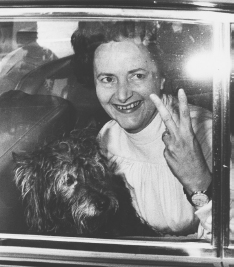
‘Madam Cyn’ (Cynthia Payne), the bawd of Streatham, leaving court in 1987.
While entrepreneurs such as Cynthia had fled, Soho continued to have a raffish reputation throughout the 1950s and 60s. There were the clip-joints, where unsuspecting tourists were lured into paying £300 a bottle for champagne which tasted suspiciously, in the words of the Kinks, ‘just like cherry cola’. There were the prostitutes themselves, the peep shows and the fifty-eight sex shops. There were the ‘private’ cinemas, which operated like clubs, allowing patrons to watch films which had not got past the British Board of Film Censors; and there were the strip clubs. While the Windmill was forced to renege on its claim that ‘we never closed’ by closing for good in 1964 and becoming the Compton Street Cinema, Raymond’s Revue Bar opened on 21 April 1958 with a garish sign proclaiming it to be the ‘World Centre of Erotic Entertainment’. Raymond’s first job in show business had been as a mind-reader on Clacton Pier, and this early exposure to male psychology must have provided some useful insights, as he became a millionaire by exploiting the public’s fascination with sex. The ‘King of Soho’s’ empire included pornography, property development and the magazines Razzle, Men Only and Mayfair.
The Revue Bar closed in 2004, a victim of the new permissiveness; soft-porn ‘lads’ mags’, the internet, cable television and DVDs rendered such venues superfluous; lap-dancing clubs offered more salacious entertainment; and Soho itself had been cleaned up by Westminster City Council on the orders of Dame Shirley Porter in the 1980s. Proprietors were forced to adopt discreet shop fronts and all blatant displays of nudity or sexual activity were banned. Just as New York’s raunchy Times Square was sanitized under Mayor Giuliani, London’s Soho lost its raffish quality beneath a tide of creeping gentrification, coffee shops and wine bars. Media types replaced alcoholic painters and dissolute journalists in the old pubs, and the milieu became just another part of the London heritage experience.
London’s prostitutes responded by starting to fight back. Supported by the English Collective of Prostitutes (a lobbying organization founded in 1975), one group of whores from Shepherd Market put up a spirited resistance to Westminster City Council’s clean-up campaign in May 2009. Shepherd Market is a small quarter of Mayfair between Curzon Street and Piccadilly. Mayfair has always been one of the smartest addresses in London, realm of the super-rich and, traditionally, of the prostitute. From the eighteenth century onwards, Shepherd Market had been associated with high-class prostitutes. For years, the working girls and the aristocrats lived side by side; in the mid-1970s, up to one hundred girls walked the streets of the district every night, waiting for their regulars. Commissionaires in the grand hotels of Park Lane would tell families of tourists not to go to Shepherd Market because of the gauntlet of girls they would have to run. On one occasion, a gang of girls set upon and beat up an American tourist. They were convinced she was a new prostitute trying to move in on their territory. In fact, the unfortunate woman was just a little provocatively dressed.

Focus Cinema, Brewer Street, W1, in 1976, before Westminster City Council imposed advertising restrictions on the sex trade.
As organized crime strengthened its grip on London, many of the Shepherd Market girls became targets for pimps and petty criminals. With corruption rife in the Metropolitan Police, particularly the vice squad, local residents felt helpless in the wake of a crime wave. ‘A girl was financing three people from the game as well as herself: her landlord, her ponce and the local police,’ remembers one local resident, when interviewed by the Independent.
Things became so bad that in 1978 we established the Save Shepherd Market Campaign and took a murder map along to the House of Commons. This showed the position of every murder, act of arson and defenestration of prostitutes that had taken place in the previous 12 months. It was a horrific document. Three days after that, I had my restaurant raided and turned over by the police. It was a public statement, not so much to me as to those who lined their pockets.15
Eventually, enforcement action from Westminster City Council and an anti-corruption drive by the Metropolitan Police resolved the issue. These days, you are more likely to walk past expensive bars and restaurants than brothels, and the shabby old pub the Maisonette has been replaced by a mosque serving the quarter’s wealthy Arab residents. However, not all the prostitutes have fled. In 2009, when police raided flats in Shepherd Market and reported the prostitutes to the council’s planning department, council officials wrote to them accusing them of ‘a change of use from residential accommodation’ – in other words, running a business from a private address, which constitutes a breach of planning law. According to Niki Adams of the English Collective of Prostitutes (ECP), ‘the women have been working here safely for more than a decade, which means they haven’t “changed use” of the properties. The women are a welcome part of the community here and should be allowed to run their businesses without hassle from the police or council.’16
Niki Adams’s statement represented a fight-back by prostitutes against the council. In February 2009, when the Metropolitan Police closed a brothel in Dean Street, Soho, the decision was overturned by the magistrates following lobbying from the ECP. This body also campaigned against the closure of the estimated sixty to a hundred flats used by prostitutes across the borough, supported by residents who maintained that the working girls were an integral feature of the diverse local community.
Back in Shepherd Market, the ECP’s argument was that evicting prostitutes from their flats would mean that they were forced to work the streets, where they faced increased danger. ‘Megan’, a London prostitute for twenty-five years, has worked out of a Shepherd Market flat for fifteen years and was reluctant to go anywhere else.
‘It’s a little village here and we couldn’t work in a better place,’ she told the London Informer newspaper. ‘Over the years we have had a great relationship with the police. Whenever they need help tracing a girl who has gone missing they come up and ask our help, because we are open and know everybody. The eight girls here in the flats have all been working for a long time. I don’t know why suddenly we have become the enemy. The community supports us and perhaps the council did not realise that when they started sending threatening letters out.’17
Megan appreciated that there were problems with the sex industry, and young girls being coerced into working as prostitutes, but pointed out that by being driven onto the street, she and her colleagues would be put at risk. ‘It’s a hard time for us, the recession is hitting our clients and the new laws are making them scared to come to us – even if they’ve been with us for years.’18
The new laws Megan referred to represented yet another attempt to clean up prostitution, but for the working girls they may prove as punitive as previous legislation. The Policing and Crime Bill, passing through Parliament at the time of writing, aims to curb sex trafficking and protect women from being coerced into the sex trade. However, according to opponents, it would potentially criminalize men paying for consensual sex with a prostitute and women who employed maids or other workers to help them, damaging their business and forcing them to take greater risks. While in theory the bill appears to defend prostitutes, in practice it may become oppressive. According to Megan: ‘If the police carry on raiding us, we will lose customers and then be forced onto the streets. We will then be in the same danger as the women the police say they want to protect. It doesn’t make sense. But we will stand firm and fight any attempts to close us down.’ And so they did. In May 2009, the working girls successfully overturned Westminster City Council’s attempts to oust them from their flats in Shepherd Market. Megan’s parting shot to her interviewer on the London Informer proved prophetic: ‘This is the oldest business in the world and we’re not going anywhere.’19 Indeed, it was business as usual, ‘the oldest business in the world’, in one of the oldest cities in the world.

A ‘West End Girl’ illustrates an investigation into the sex trade, 1966.