

THE CARAVEL
From across the pier, the Vera Cruz seems no bigger than a toy sailboat, her masts no more than two chopsticks poking the air; she looks like a little dinghy next to the hulking freighter chained up at the adjacent berth. Up close, the small craft is about the size of a Greyhound bus with masts and spars rendered of modest tree trunks crocheted together by a web of fasts and stays. She lies bound to an anonymous concrete jetty on the Lisbon waterfront, her black hull glum now that her sails have been furled. Yet even when her triangular sheets are raised and puffed out with the ocean breeze, there is still something awkward and even homely about this ancient sailing ship, this caravel. It seems all too incredible that sailors from such a little country, navigating unassuming vessels like the Vera Cruz, crisscrossed the Atlantic to scout the path for a sea route to the spice coast of Malabar, that these short and sinewy seamen were the leading edge in Europe’s conquest of the world.
When the Venetians, the Genoese, and even the independent Catalans went sailing to procure their aromatic cargo in the Middle East, they traveled over routes that had been amply documented for a couple of thousand years. The winds, the shoals, the rocky shores were the same as Odysseus had endured on his long trip home. But when the Portuguese pointed their prows south and east into the Atlantic gales, it was another matter altogether. Experts debated whether it could even be done. There was concern that great beasts would swallow ships whole; that sailors, as they entered the torrid zones to the south, would be incinerated; that the vessels, as they rounded the curve of the earth, would simply fall right off into oblivion. In fact, the real-life obstacles were probably worse. Yet in spite of all of this, thousands went willingly to die of scurvy and of thirst, to perish on alien rocks and on foreign spears. Historians have filled many exhaustively footnoted volumes with their explanations of why this chronically impoverished fleck of a nation achieved so many improbable feats. And their theories have great merit, I’m sure. Still, I figured if I wanted to make sense of it all, I would do better to ask a sailor.
To get to the Vera Cruz dock, I had to dodge the thick morning traffic that sputtered fitfully along Avenida Infante Dom Henrique (named, appropriately enough, after Prince Henry “the Navigator,” who is popularly credited with encouraging the voyages that eventually led the Portuguese past the Cape of Good Hope). Across the asphalt and past the chain-link fence, a dusty trailer serves as the command center of Aporvela, an organization that might be described as a sailing club for time travelers, navigating ships that haven’t seen salt water for five hundred years. Inside the cramped trailer, Hernâni Xavier greeted me in his office, hemmed in by high shelves crammed and spilling over with charts and books. He rose from his old office chair, looking more like the Portuguese Ford executive he used to be rather than the sailor he has become. “My original plan was to join the codfish fleet, but then I met my wife…,” he would later tell me, dismissing the memory of corporate servitude with a shrug. Even while he was with the automobile company, he began making antique ship models—first plastic, then wood, and finally this: he points out the window to the black hull. Hernâni is squat, burly, and dead serious, much like the caravel itself. He knows just about everything there is to know about the little ships and a great deal about naval history in general. “I have fourteen thousand books on history, sailing, and navigation,” he notes, pushing a wayward volume back into its place.
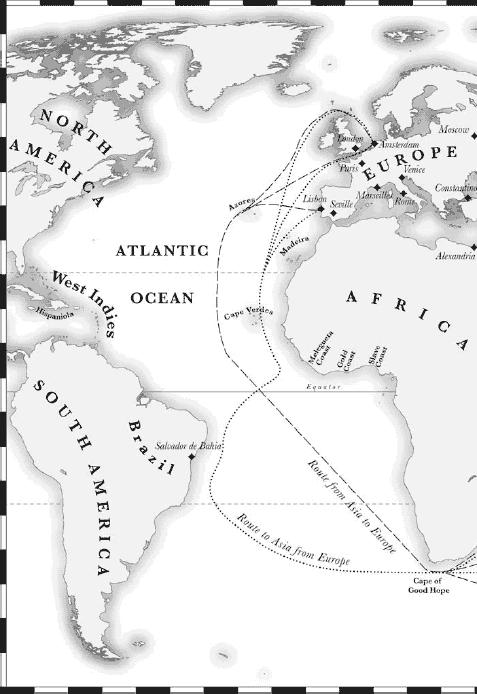
Hernâni’s stubborn humorlessness seems to break down only when he espies the vast horizons of my ignorance. To make it simpler, he draws me pictures to explain the difference between a round ship (the one with square sails) and a caravel (with triangular sails) and then draws a simple chart to explain how the caravels could practically sail into the wind, where the square-rigged ships had to tack back and forth a dozen or more times. This is how the caravels could skim south along the African coast all the way to the Cape of Good Hope. He pulls out his pencil again to draw a diagram to show why the much larger square-rigged pepper ships had to go all the way to Brazil in order to make the same journey.
“But you must see the caravel to understand.” He summons me to follow him across the ramshackle waterfront. “It was exactly to have a glimpse of how it worked, how it stood on the sea, how it was navigated—because none of this was known—that thirty years ago, we founded Aporvela to study this.” A curt motion indicates the tethered black hull. Up close, the vessel’s deck gleams with finely polished wood, but even standing on deck, you feel cramped. The original crews consisted of some dozen sailors, if for no other reason than that there wasn’t enough room to store food for more. Hernâni indicates the shallow hold. “The Vera Cruz draws only 330 centimeters [about 11 feet], so it could go up the African rivers.” But, because of space considerations, that same shallow hold meant that they could bring back only the most precious African cargo. In the fifteenth century, that meant gold, melegueta pepper, and slaves. “We didn’t capture the slaves,” Hernâni reassures me; “we traded for them with the natives”—a distinction I find even more technical than his explanation of fifteenth-century rigging.
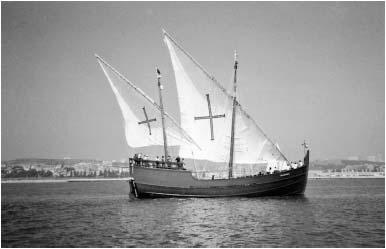
The Vera Cruz, Aporvela’s re-creation of a fifteenth-century caravel.
The very first caravel built by Aporvela, the Bartolomeu Dias, was financed by the Portuguese community in South Africa to commemorate Dias’s famous trip round the Cape of Good Hope. Naturally, the club’s volunteer sailors had to sail it there. “Up until then, there were only theories. Now we built one, we navigated it, so we know how the maneuver of the sail was.” Then two more ships were built. Hernâni’s attention to the practical details is reminiscent of the early Portuguese navigators, who got to where they were going by trusting the experience of their weathered companions, while other explorers (a certain Genoan comes to mind) trusted armchair geographers whose ideas of the world came from Ptolemy and Mandeville.
Aporvela’s weekend mariners have sailed their feisty vessels from the Baltic to Brazil, to South Africa, to the Azores. Hernâni Xavier allows himself a hint of a smile. “In all, we’ve sailed them over seventy thousand miles!”
You have to wonder how many of those first sailors risked life and limb just because they were similarly curious and obsessed. Perhaps more than historians would have us believe. Human beings often behave in ways that make more rational types question their reason. But even reasonable people must have been swayed by the wealth that was off-loaded on Lisbon’s docks—at first, in a precious trickle of African gold in the fourteen hundreds and then in a fabulous flood of Indian spice in the following century. So when you add up the curious, the bored, the impoverished, and the greedy, it’s no wonder that there were plenty of men willing to board the little caravels to gamble their lives on the treacherous seas.
Portugal, then as now, was a poor, small country situated at the western extremity of Europe. It takes up no more than 15 percent of the continent’s westernmost peninsula, but even that sliver has little to recommend it when it comes to making a living. The sharp cliffs that rise from narrow valleys make lovely backdrops in tourists’ snapshots, but try tilling the soil. Getting from place to place used to be a wretched affair. It is only quite recently that a decent highway system has connected up the country. For most of its history, any industry or commerce depended on the sea.
This was all too evident to the medieval Portuguese king João I as he surveyed his army of armed and hungry knights with nowhere to go and nothing to do. In the early Middle Ages, conquistadores from northern Portugal had gradually annexed the country from the Muslims in a move that mirrored the Christian expansion in next-door Castile. By 1385, the kingdom was secured from the greedy encroachments of the Castilians and consolidated under João I. But now that there were no more Moors to slaughter or Castilians to fight, what was a king to do? The sensible João, “having no one to conquer on land,” to quote the Portuguese national poet Luís Vaz de Camões, “attacked the waves of the ocean.”
Or to put it more prosaically, in 1415, he dispatched a fleet of his restless conquistadores just across the narrow Strait of Gibraltar for a looting spree at the wealthy Muslim port of Ceuta. It was just a logical extension of the Christian campaign in Europe. “The Portuguese kings were very keen on the idea of guerra justa, a ‘just war,’” is the way Hernâni explains it. Which is to say that Christian legal scholars could always rationalize fighting (and enslaving) Muslims. And if the infidels happened to occupy a town bursting with grain and gold, so much the better. Ceuta had become wealthy because it was the outlet for caravan routes that delivered sub-Saharan gold, melegueta pepper, and slaves to the Mediterranean coast. These were then sold to Arab, Genoan, and Catalan merchants, who exchanged them for grain but also for Asian spices brought in from the Levant. Though João’s greedy troops had been more or less aware of the loot behind Ceuta’s gates before their battering rams splintered them to pieces, they had had only a vague glimmer of where the riches came from. After some unsubtle interrogation of the residents, they now knew. It’s worth noting that among the desert-dusted knights who rode into Ceuta were the king’s own sons, including the young Henrique, the one later dubbed “the Navigator.” The prince, who was subsequently made governor of the colonized city, seemed especially keen on the details of the caravan route.
Hernâni tells me there were no caravels during that first African incursion, but they came into play very soon afterward. Their voyages down the African coast started shortly after the Ceuta conquest, no doubt stimulated by the riches the conquistadores had found, and some of these trips, at least, were under the auspices of Henrique. In many ways, these excursions were just an extension of what Portuguese mariners had been doing for uncounted generations. Lisbon merchantmen had long been sailing the rough Atlantic waters north to Flanders and the Baltic ports with cargoes of olive oil, salt, and oranges. To the south, Portuguese fishermen had traced the African shore for hundreds of miles. Hernâni scoffs when I remind him that the Venetians and Genoans, too, delivered spices to the northern ports. “They stayed by the shore,” he corrects me. “We sailed direct across the open sea.”
Yet despite the impression given by Aporvela’s historian-in-residence, the Portuguese did not discover everything. The Genoans, Catalans, and even the Castilians had sailed out into the broad Atlantic and certainly discovered at least the Canary Islands and Madeira. The very idea of going round Africa to reach the spiceries most likely originated with the Genoese, who were trying to pull one over on the Venetians. Still, however daring, those earlier trips never led to much of anything. It was only when the Portuguese rediscovered the uninhabited islands of Madeira and the Azores far out in the Atlantic that they came to be colonized and exploited on Lisbon’s behalf. Extensive sugar plantations were carved into ravines between Madeira’s craggy slopes in the early fourteen hundreds. A hundred years later, the Azores became essential for provisioning armadas sailing back and forth from the Americas. In the meantime, as the caravels were sent south past the desert shore and farther south to the jungle coast of Guinea (as most of sub-Saharan Africa was called), they discovered riches only hinted at by the caravans that crossed the dunes.
There is no question that the caravels’ main objective was the gold that flowed down West African rivers. But other “goods” were picked up along with the precious cargo, too—most notably, enslaved Africans, ivory, and the “pepper” collected in the backwoods. Melegueta pepper, also known as grains of paradise and Guinea pepper, had been imported into Europe for centuries, mostly via North African ports such as Ceuta. The French, in particular, had an especial fondness for les graines de paradis, as fourteenth-century cookbooks such as the Ménagier de Paris make abundantly clear, but the African spice was used in other parts of northern Europe, too, mostly to flavor beer and wine. According to medieval physicians, the spice was “hot and moist,” and perhaps because of this, it was much appreciated in colder climates. The little grains were, at least for a time, more expensive than Asian black pepper. In Ceuta, melegueta was even used as a local currency (much like peppercorns in Europe), and prices were quoted in gold and melegueta, much as we might say dollars and cents. When caravels replaced camels, the profits from the melegueta trade poured into the Portuguese treasury. The West African spice imports would generate a steady flow of cash well into the sixteenth century, even if the profits never approached the fabulous wealth of the later black pepper imports.*19 All the same, in Prince Henrique’s day, the Portuguese were still only dabbling in the spice trade.
Just when the idea of turning those profitable little trips down the African coast into a concerted effort to round the Cape of Good Hope occurred is unclear. Hernâni insists that it was the Navigator Prince who came up with the idea; still, even he will agree with most other historians that it was Henrique’s great-nephew, King João II, who really made reaching Asia by sea a national priority. It was under his watch and with his often-direct supervision that the scheme of circumnavigating the Muslim world for a direct path to India’s pepper coast was put into action.
With twenty-twenty hindsight, it’s easy to admire the audaciousness of João’s plan, the relentless drive down the coast, the investment of enormous treasure to secure a goal that was perhaps a generation in the future. A Venetian of the time would most likely have dismissed the idea as unaccountably reckless, but then no merchant of the great trading republic could have assembled enough investors for this kind of risky adventure—or, for that matter, sacrificed the lives of thousands of his employees to secure such an ephemeral prize. The Portuguese approached the spice trade much as they had the attack on Ceuta, flailing their battle lances and yelling out the war cry Santiago e a elles! (“Saint James and at them!”). They could justify every raiding party as an assault against the Moor, each trip up an African river as a scouting party for potential Christian allies. This kind of reasoning might not have cut it in the boardrooms on the Rialto, but at the royal palace in Lisbon, suffused with the ideology of chivalry and holy quests, who could argue with a king whose stated goal was to defeat the infidel and free Jerusalem? To further these ends, each caravel was charged with searching for Prester John, the fabulous Christian ruler who supposedly waited in the Muslims’ rear. Of course, it didn’t hurt the king’s cause that money was pouring in from gold, melegueta, and, increasingly, sugar. All the same, João II and his men needed the foolhardiness of conquistadores to stay the course, given all the hardships along the way.
Yet why India? Why pepper? João’s kingdom was already profiting handsomely from melegueta, so it could be argued that black pepper was just another lucrative item to add to the product line. For many years, historians asserted that the motivation for Portugal’s expansion could be explained by a rise in pepper prices at the end of the fifteenth century. But the numbers do not bear this out; prices actually slid. Moreover, it does not naturally follow that a small maritime nation at the westernmost edge of Europe would decide to expand its trading sphere from the middle Atlantic to India, a spot more than five thousand miles in the opposite direction (and that’s as the bird flies, not as the caravel sails).
There’s no doubt that the king needed more money for the treasury. The court soaked up mountains of African gold just to keep up appearances: to purchase Florentine woolens, Oriental silks, and Venetian spices. Whereas the royals’ relatives in Castile, Burgundy, and England could depend on the receipts from their vast estates and to some degree taxes, the monarchs in Lisbon grew increasingly dependent on their income from overseas to make ends meet. As it was, they were always living beyond their means, needing to borrow money from Italian bankers to pay the bills.
It’s worth remembering that Lisbon was directly on the Italian route between the Mediterranean and Flanders. Venetian ships, loaded with spices, would pull up to docks only a few hundred feet distant from João’s harbor palace to pick up supplies before continuing north. The king could literally open his window and sniff the precious cargo as the pepper galleys passed by. Hernâni Xavier points out that the Italians, however, had no use for the salt and olive oil that were Portugal’s stock-in-trade, so when the royal court needed pepper or cinnamon, it had to pay for the spices with precious African gold.
As in the rest of Europe, the Portuguese elite used to eat food seasoned with saffron, ginger, cloves, and pepper, and especially cinnamon. The earliest Portuguese cookbook that has come down to us apparently traveled with the household of the Infanta Maria, João II’s great-niece, when she married into an Italian family. The manuscript, O livro de cozinha, has a scattering of recipes that call for the usual medieval masala. To make a dish of lamprey eel, for example, you sauté it and then “add a very small amount of water and vinegar, and sprinkle on cloves, pepper, saffron, and a little ginger.” However, the Renaissance O livro de cozinha had many fewer of these well-spiced recipes than its Italian and French counterparts. Quite a number of the recipes use no spices at all, and others confine themselves to a finishing sprinkle of sugar and cinnamon. This last touch can probably be credited to the Moorish influence, as is hinted by a recipe for galinha mourisca (Moorish chicken).*20 The fact that the Portuguese had to pay hard cash for their beloved cinnamon may account for the relatively modest use of spices at the time; by the same token, it made the royal household aware firsthand how much money there was to be made in the spice business, a point that was brought home with every royal bite.
The thought must have occurred to João that if his merchants were already turning a neat profit from the melegueta (less expensive than pepper by now), how much more could be earned from wresting the pepper trade from those lagoon-dwelling, money-grubbing collaborators of the Moor. He must also have heard more than one whisper in his ear from the Genoese who had flocked to the Lisbon court. The Venetians’ archrivals had long been active across Iberia as bankers, merchants, and mariners. They had also once provided Atlantic Europe with a good portion of its spices, but as the fifteenth century wore on, the Rialto merchants gradually pushed most Genoans out of the spice business. What sweet revenge if Portugal would snatch the spice monopoly from their Adriatic foes! And the Genoans weren’t the only Italians to smell opportunities at the Lisbon court. The Florentines were there, too, ready to invest in the lucrative trade at the first opportunity. Yet I wonder if João’s men would have made the sacrifices for a more ordinary commodity, for the alum (used as a mordant in dyeing wool) that made the Genoese piles of money in those days or the barrels of herring that funded the early Dutch republic. Did not the stench of Eden so long associated with spices make them more worthy of the conquistadores’ quest?
The idea of circumnavigating Africa must have dawned slowly on the king as Portuguese caravels moved steadily down the Guinea coast, but at some point, the initial motive of the voyages—the search for gold and Prester John—was joined by a concerted strategy to reach the pepper coast of India. To further the plan, João sent spies across the Sahara to Alexandria and as far as Malabar to report what they found. But mostly, he sent the nimble little ships farther south to find their way under unrecognizable stars, past unknown coasts, in search of the southern passage to the Orient. Finally, in early January 1488, two caravels captained by Bartolomeu Dias rounded the cape that João would call the “Cape of Good Hope” for the promise it offered.
During these decades of exploration, Lisbon’s state-of-the-art shipyards refined and enlarged their vessels. A document from 1478 mentions a caravela de descobrir purpose-built for the voyages of discovery, while a tubbier version called caravela redondabecame popular for its larger hull capacity. (Columbus’s Niña and Pinta were both caravelas redondas.) Eventually, a much larger ship—the nau, or carrack—was designed. The nau had even more cargo space, thereby making the trip to India worthwhile.
The knowledge of those consummately skilled shipwrights hasn’t been entirely lost, or at least not yet. Aporvela was able to build modern-day caravels because there is one remaining shipyard that builds fishing boats much as they have been built for five hundred years. The sailors still sail them as they did in the heroic days of Prince Henrique and Bartolomeu Dias, Hernâni tells me as we clamber off the Vera Cruz and say our goodbyes.
A CITY RISES
In the Alfama, the district that rises across the road from Aporvela’s trailer office, the smell of grilling fish penetrates every alley and tilted square, especially at lunchtime, when restaurants set up impromptu grills on the sidewalks and the working-class residents jostle elbows at the small tables that spill out onto the streets. The neighborhood gives you a sense of the rather modest place medieval Lisbon must have been before the profits from the black Indian gold transformed the city: a Lisbon of fishwives more than of God-possessed explorers. Today’s local restaurants, however, give virtually no clue as to Lisbon’s history as the capital of a spice empire. The fish is exquisitely fresh, the portions are abundant, but as far as spice, it is almost entirely absent, even if there is something vaguely medieval in the buckets of salt the Portuguese use in their cooking. But maybe I shouldn’t be looking for remnants of a world-spanning empire in my lunch of fat and delicious sardines. I would do better to look about. The harvest of Lisbon’s pepper ships is all around me, in the pink, brown, and black faces of the men at the next table; in the intertwined light and dark fingers of the couple next to me; in the kinky hair and sea gray eyes. This is where you can see the Christian Portuguese conquerors, the Jews who had fled Isabella’s Spain, the North African Moors, and sub-Saharan slaves. Sailors and fishwives still rub shoulders here (and not only shoulders, I expect) as they did when they came back from Cochin and Malacca.
In the fifteen hundreds, Lisbon was one of Europe’s greatest cities, a magnet for shipwrights, bankers, and merchants as well as seamen and working girls. It was a metropolis of ornate churches and sumptuous palaces that towered above another city of crowded tenements. Yet, today, that vision of gilded cloisters, tile-covered mansions, and twisting streets of teetering pastel houses is no more in evidence than the Asian aromatics that once used to season Lisboetas’ fish. Unlike Venice, which continues to float like a mirage from the distant past, or even Amsterdam, where the solid mansions built on the profits of the spice trade still stand to remind you of the Dutch city’s glory, the Lisbon you see today was built in a later, shabbier time. The resplendent city built of pepper and gold was almost entirely destroyed by an earthquake on the feast of All Saints on November 1, 1755. Ironically, the neighborhood that survived the earthquake was one of the city’s poorest. It is only in the upper reaches of the Alfama—on the steep slopes of the hill where the Romans first built their fortress, where the Moors set their citadel, and where the Christian kings spawned their schemes—that there are still hints of the gilded city that was.
When you look up from the Vera Cruz, the medieval houses of the Alfama tumble down the hill without, somehow, managing to look picturesque. In the ancient neighborhood’s lower reaches, the buildings are as mangy and unkempt as the cats that lounge in deep pools of shadow. Climbing up the narrow lanes strung with celery green undershorts and custard yellow tank tops, it’s all too easy to imagine dodging the foul consequences of women yelling “Àgua, vai!” (Water, go!), as they used to before throwing the contents of their chamber pots out the window.*21 The crooked passageways of the lower Alfama have always belonged to the city’s working poor. Even in the heyday of the Portuguese spice trade, chances are that the grilled fish here never saw most of the Asian seasonings that provided jobs for the locals. Pepper might have been an exception. Hernâni Xavier makes the intriguing suggestion that Lisbon’s working classes were able to buy third-rate pepper (ruined on the return voyage) on the cheap, and so it is perfectly conceivable that it was more common then than it is now. What is certain, though, is that up the hill, the aroma of cooking fish would have mingled with cloves and cinnamon.
As you climb the ever-wider stairways toward the crowning citadel of the castle, you leave the leaning tenements behind. The alleys become tidier and larger. Concealed behind some of the old walls, there are clues of the wealth that poured in with the Carreira da Índia, the annual convoy that arrived packed with pepper, ginger, cinnamon, and cloves. Through the open door of the Church of Santiago, a single gilded altar that escaped the earthquake’s fury still glimmers like a faded beacon from that earlier Midas-touched era. A half-open gate offers a tempting glimpse of a palm-shaded courtyard, the ancient tiled walls a florid tangle of blue, white, and gold. Out in the street, the steps take you higher, past mansions and boutiques filled with antique ceramics.
At the top of the hill, the tallest of Lisbon’s seven-odd peaks, the citadel, the Castelo de São Jorge, towers over the skyline. The castle itself is fake, constructed in the 1940s by the fascist-leaning government of the time in a postcard-perfect, medieval style that Prince Valiant would be proud to call home. The current structure completely obscures a succession of older hilltop fortresses built by the Romans, the Muslims, and the conquering Portuguese. As you pause atop the crenellated towers with the other out-of-breath tourists, you can see why this would be the perfect place to build a fortress. Below, the river Tejo forms an estuary as it approaches the Atlantic Ocean, which makes it an almost ideal port. It is shaped like a bottle, the neck facing the Atlantic and the city occupying one of the shoulders. The Phoenicians called it “Ubis Ubbo” (Gentle Bay) when they settled here. Under the Romans, that turned into “Olisippo” or “Olissipum” (thus, Lisbon). They called the natives Lusitanians, a name later revived by the poets of the Renaissance.
The last invaders to take the hill were a force of northern Portuguese conquistadores in 1147, led by King Afonso Henriques and assisted by a Frankish band of Jerusalem-bound Crusaders (described by one Christian observer as “plunderers, drunkards and rapists…men not seasoned with the honey of piety”). Given its ideal location, Lisbon soon became the country’s main market, then, in 1260, its capital. From their hilltop aerie, the kings could overlook the sails multiplying on the wide green Tejo and peer down to see growing mountains of merchandise loaded and unloaded on the docks below.
Under the Christian monarchs, the city grew beyond the confines of the castle hill as ad hoc streets and squares spread across the surrounding peaks and valleys. Between 1400 and 1600, the city’s population more than doubled. Not that the rest of Portugal saw much benefit from the yellow and the black gold that was unloaded on Lisbon’s docks only to be immediately reloaded onto ships headed to London or Antwerp. Lisbon was increasingly the shining city on the hill surrounded by a country of shantytowns. But that only made it more of an attraction for the peasants and artisans who flocked here. Naturally, it wasn’t merely needy agricultural laborers and skilled craftsmen who were lured by the city’s wealth. Clerics, squires, and sycophants milled around the tiled courtyards by the castle walls to sniff out any opportunity of advancement. Fidalgos bowed and preened to train for any potentially lucrative appointments.*22 The path to fortune was different here than in Venice or any of the Italian merchant republics. Here, everything depended on royal favor. If you wanted to advance your career as a soldier, merchant, or priest, you needed the monarch’s blessing. For the king, it was an expensive proposition. By 1500, Manuel I was providing for some four thousand retainers at his court alone. It’s no wonder the Portuguese royals were always on the lookout for a new revenue stream.
As profits from African gold and Indian pepper increasingly flowed up the Tejo, it was more than symbolic when Manuel moved his residence down from the castelo to the riverbank Paço Real da Ribeira, right in the middle of the harbor. Just east of the palace, a broad beach swarmed with longshoremen off-loading foreign slaves, sugar, spices, and gold even while boats were packed with domestic oil, dried fish, and salt. A few hundred yards to the west were giant dry docks, where the groans of bending timbers and the pounding of hammers kept the monarch’s windows rattling from morning to dusk. The kings, who prided themselves on their crusading zeal, now lived much like shopkeepers who set up house above their store to keep an eye on the merchandise. King François I of France had a point when he dismissed his Portuguese counterpart as “le roi épicier” (in French, épicier means both grocer and spice seller). The jibe must have stung, though, and it explains, at least in part, the Lusitanian rulers’ chronic need to mix a judicious dose of evangelism into their commerce, to search for Christians as well as spices.
BEYOND GOOD HOPE
Looking down from the castelo, it would appear no more than a quick scramble to the Praça do Comércio, where the king’s harborside palace used to stand. In fact, it is a long, circuitous descent down winding alleys and precipitous stairs. These days, the vast, charmless square is mostly desolate except for the occasional camera-toting visitor and the itinerant street peddler hawking fake Armani sunglasses. Under the grocer king and his immediate successors, this used to be the royal residence’s busy front yard and was accordingly referred to as Terreiro do Paço (literally, “Palace Grounds”). Old illustrations show grand parades in honor of visiting potentates filling the field. Temporary grandstands were erected here to give a better view of heretics burned alive at the frequent and well-attended autos-da-fé. I’ve been told that visitors occasionally comment on the resemblance of the Praça do Comércio to the Piazza San Marco. It is true that both are more or less right on the water, both have monotonous three-story neoclassical façades defining three sides. There are no famous cafés here, though, and no pigeons. Nevertheless, it’s worth noting that Lisbon, just like Venice, turns her back to the mainland to greet the sea. And in much the way the doge’s palace stood guard over the Adriatic harbor, the king’s palace stood sentry at his realm’s front gate.
But the Portuguese monarch was a different sort of creature than the CEO of Venice Inc. It’s almost as if the local topography reflected the way decisions were made in each town. Like Lisbon’s tumbling vertical façade, here, all the power and the glory cascaded down from the king, while in Venice (and Amsterdam, too, for that matter), wealth and influence spread horizontally, much as the watery city spread across the lagoon. But that may just explain why the Portuguese pioneered the direct route to India. It’s hard to see how anyone but an absolute monarch could have mustered the resources necessary to get the job done.
At Lisbon’s Museu de Arte Antiga, there is a series of fifteenth-century panels that might as well be a family portrait. Here is Henrique, the Navigator Prince, doughy and wry. Nearby is his nephew King Afonso V in a fabulous tunic of purple and green velvet with his wife, Isabel, in a gorgeous scarlet dress. (It makes you wonder how many shiploads of melegueta paid for those fabulous outfits.) Their son, the future João II, is just behind his father—a pudgy preteen with tousled hair. His almond eyes show no hint of his later Machiavellian streak. Yet who knows how far the Lusitanians would have gone if it hadn’t been for this ruthless and determined young man? At the time, not everyone in Portugal thought the Atlantic explorations were a good idea. King Afonso, for one, was never much interested in the Indian project. João, though, had none too subtle ways of convincing his opposition. Once he assumed the throne in 1481, he beheaded his most prominent opponents. An uncooperative bishop perished in a cistern. João personally stabbed to death one of his detractors. Even before he sat in his father’s seat, he was, by all accounts, fixated with reaching India. The obsession was apparently born some years earlier when, as crown prince, he secured the African spice and gold monopoly from the king. Then, once he held the reins of power, João II pursued the search for a southern passage to India with all his resources. And finally, when Bartolomeu Dias rounded the Cape of Good Hope, the way to India’s perfumed riches was clear.
Among the many hangers-on at Paço da Ribeira during João II’s rule was a Genoese navigator named Christopher Columbus. He had married into a Portuguese family*23 and had his own ideas about reaching the Spice Islands. Contrary to what you may have been taught in elementary school, educated people did not think the world was flat in the Renaissance. There was, however, no consensus about just how big the globe was. According to one eminent Florentine geographer of the time, the earth was some ten thousand miles around the equator. (The actual distance is closer to twenty-five thousand.) Using this number, Columbus made the perfectly reasonable calculation that you could get to the Indies much faster by sailing west than by going south and east. There is some indication that João didn’t cotton much to the Italian adventurer on a personal level, but what eventually damned his proposal in Portuguese eyes was the preposterousness of the numbers. The frequent trips down the coast of Africa had given Portuguese navigators a pretty good sense of how big the earth was from pole to pole. If Columbus’s numbers were to be believed, the earth would have the improbable shape of an upended football. All the same, the king apparently took the idea seriously enough to have a commission look into it. They gave it a thumbs-down.
There may have been another reason why João was none too interested in going west. He may already have known what was there. Hernâni Xavier, for one, is convinced that two Portuguese maps show Brazil as early as the 1430s. But even if those maps are discounted, other circumstantial evidence all but proves that the Portuguese had at least some idea of the Americas before Columbus’s voyage. Portuguese sailors certainly spent the years between Dias’s discovery of the cape route and da Gama’s epochal voyage exploring the southern Atlantic, and given the currents and winds, it’s almost impossible that they didn’t at least sight South America. This is the likely reason why, in the 1494 treaty of Tordesillas, which divided up the world between Portugal and Spain, João fought tooth and nail to have the dividing line moved west. This just happened to place Brazil in the Portuguese sphere—six years before Brazil was officially discovered! But, at least for the moment, João knew that he did not have the resources to simultaneously explore a new world and pursue the pepper project in the East.
Spurned in Lisbon, Columbus went knocking on Isabella’s door in neighboring Castile, talked the queen into backing his plan, and the rest, as they say, is history. It all seems inevitable now, the partnership of Columbus and Isabella and the subsequent Spanish conquest of the New World, but at the time, it seemed an unlikely scenario. The Castilians had never been especially interested in the Atlantic, busy as they were with conquests back home. But once Dias had shown the feasibility of the cape route, the Spanish monarchs must have felt a certain urgency to act so that they wouldn’t lose out to their neighbors in any potential spice bonanza. This insecurity, this need to keep up with the Joãos, must have helped convince the queen next door to invest in the Genoan’s scheme. Columbus, in the meantime, was so convinced of his numbers that even after several trips to the West Indies, he would never admit that he had not found the fabled East. Not only did he insist on calling the indigenous peoples “Indians” and their islands the “Indies,” he came back with spices that he called pepper (pimienta), which were in fact capsicums and allspice. (The Spanish continue to call the latter pimienta dulce or pimienta de Jamaica.) Isabella was not impressed. When she found out that Vasco da Gama had returned from Calicut with the real thing, she sent for Columbus, who was on his third voyage to the Antilles at the time. Subsequently, the Genoan was brought home in chains and stripped of his titles and income. As far as the Castilian queen was concerned, his voyages were failures, the route to the Indies and their aromatic riches now in firm possession of the Portuguese. In Lisbon, Vasco da Gama would receive precisely the same titles (in imitation of the Castilian model) that Columbus had lost: those of admiral and viceroy of India.
Vasco da Gama set sail from the Lisbon suburb of Restelo on July 8, 1497, with a small flotilla of two naus, the São Gabriel and São Rafael, and a caravel, the Bérrio, dispatched by the king, according to an anonymous chronicler of the voyage, “to make discoveries and go in search of spices.” King João II was fated never to see those sails emblazoned with the Crusaders’ cross swell with the Atlantic wind. He had died two years earlier, at the age of forty. The day he had been planning for all his life was witnessed by his cousin and brother-in-law, Manuel I. Apparently, João didn’t think much of his wife’s brother (he made an aborted attempt to have his illegitimate son declared heir), which may explain, at least in part, why King Manuel worked so hard to outstrip his predecessor’s legacy. It must have rankled him that they dubbed him “the Fortunate” while João had been called “the Perfect Prince.”
We know quite a lot about Vasco da Gama’s fortunate royal patron, but the young explorer is a bit of a cipher. According to records, da Gama was only twenty-eight when he commanded that first mission to India. He was a middle son of middling aristocracy from the southern seaport town of Sines. While most definitely not a professional seaman, he seems to have had some experience serving in coastal missions under João’s administration. In later years, he had a reputation for being temperamental and capricious. However, on this first journey, the young captain-general comes across as so cautious as to verge on paranoia—at least when dealing with the locals in the Indian Ocean.
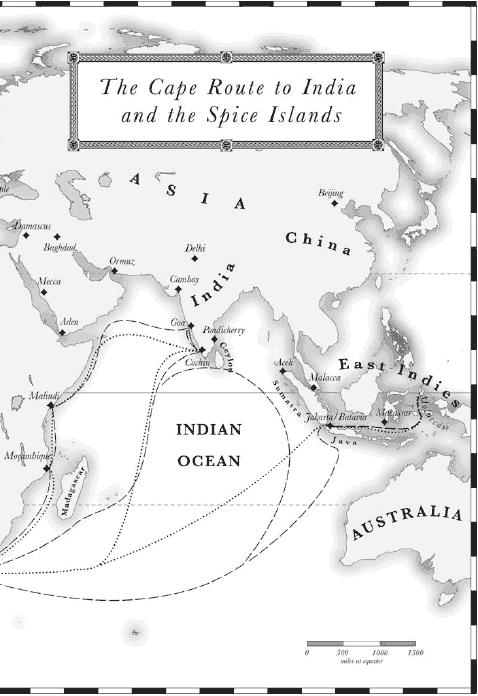
Da Gama’s ships carried provisions for three years, guns and gunners, interpreters, musicians and priests, and a few convicts (death-row inmates who had their sentences commuted to naval service) for some of the riskier tasks. The commander also carried a royal letter addressed to Prester John. Oddly, given its ostensible mission, the armada was surprisingly devoid of trade goods. The ships set course straight across the Atlantic, then back down to the Cape of Good Hope, and up to the city of Malindi, about halfway up Africa’s eastern coast in what is today’s Kenya.
By the time they reached Malindi on the eve of Easter 1498, more than nine months after setting sail, da Gama’s sailors had been suffering weeks of dehydration and dying of scurvy left and right. Several close calls with none-too-friendly natives along the East African coast had convinced them that no one could be trusted, so even in Malindi, where their reception was cordial, the Lusitanian adventurers kept a wary distance. Here, they took on fresh food and water, and equally important, they hired a Gujarati pilot to guide them across the Indian Ocean to Calicut. The pilot, though Muslim, supposedly even spoke some Italian! The rest of the trip was thankfully uneventful. The fleet reached Calicut in a mere twenty-six days on May 18, 1498, arriving just in time to be drenched by the southern Indian monsoon.
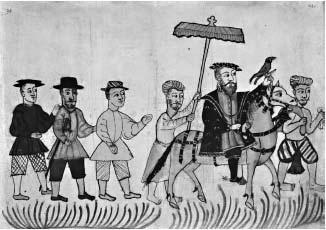
The Portuguese did not make a great impression on the locals when they arrived in India.
What came next was more farce than high drama. After his close shaves along the African coast, da Gama had no intention of putting himself at risk. That’s what the onboard convicts were for. So the first Portuguese conquistadores sent out to meet the legendary Indians were a couple of jailbirds. When they finally tracked down someone they could talk to, they also turned out to be foreigners—mainly, two Tunisians who just happened to speak Castilian and Genoese. Not surprisingly, the Arabs were none too pleased to see these all-too-familiar infidels. “May the Devil take you! What brought you here?” was their unsubtle greeting. To which the cons offered the oft-quoted reply “We come in search of Christians and of spices.” That first Calicut visit was not terribly successful on either account. Later visits would prove much more lucrative—at least, when it came to the spices.
The following weeks saw the Portuguese slogging back and forth through the rain-soaked streets between the harbor and the royal palace. During their first visit, they could barely move because of the thick crowds who had come to gawk at this novel species of foreigner. Early on, the local ruler, the zamorin, had been quite favorably inclined toward the newcomers. He even granted da Gama a long interview, in which the potentate punctuated his sentences by expelling great gobs of betel juice and saliva into a royal-sized golden spittoon. But subsequently, the zamorin thought better of it and had the Europeans detained. Then he changed his mind and released them, and then once more locked them up. Da Gama spent several intermittent weeks fuming under house arrest, at a loss to figure out what was going on. He had arrived with the firm belief that the zamorin was a Christian, and now he wasn’t going to let mere facts get in the way. The Portuguese were so convinced they had found their longed-for coreligionists that they took the Hindu temples for churches. These “churches,” according to the chronicler, were decorated with “saints” wearing crowns and “painted variously, with teeth protruding an inch from the mouth, and four or five arms.” Naturally, the only explanation for the zamorin’s behavior could be that it was caused by his malevolent courtiers, the perfidious Moors.
You need not be a religious bigot to understand why the Muslim traders ensconced in Calicut wanted to get rid of the Europeans. Still, the conquistadores didn’t make it any easier for themselves. While it’s hardly surprising that courses in comparative religion would not be part of an aspiring fidalgo’s curriculum, it also seems that neither were the ABCs of business etiquette. The zamorin’s commercial representatives reportedly burst into peals of laughter when they saw the presents the Europeans had brought for their master. “The poorest merchant from Mecca, or any other part of India, would give more,” they sniggered. (The Portuguese chronicle of the voyage itemizes twelve pieces of cotton cloth, four scarlet hoods, six hats, four strings of coral, six washbasins, a case of sugar, two casks of oil, and two of honey as the sum total of the gifts for a ruler who used gold even for his cuspidor.) The Hindu potentate was not amused.
In the end, though, the two sides reached a compromise, no doubt aided by the fact that the Portuguese grabbed a few hostages of their own. So for the last few weeks, da Gama could supervise the trading operation from the safety of his own cabin. His men took advantage of this time to rummage through their chests to find anything and everything that they could hock in the Calicut spice market. The sailors went so far as to literally sell the shirts off their backs in order to buy pepper and cloves. The sweaty linen tops were apparently worth a lot less money here than back home, but then spices were even cheaper. The captain-general got to hold on to his clothes, but he did part with his personal supply of silver cups and other tableware, which he traded in for a hefty cargo of spices and precious stones.
All in all, this first European expedition to Asia didn’t make much of an impression on the locals. Just to make sure the foreigners would be less confused in the future, the zamorin sent them off with a letter spelling out just what he wanted to see next time they arrived: “My country is rich in cinnamon, cloves, ginger, pepper and precious stones. That which I ask of you in exchange is gold, silver, corals and scarlet cloth.” Future visitors, including da Gama himself, got the message. In the interim, though, the Portuguese had to survive the return voyage home. Not many did.
When da Gama’s ships finally limped back to the quiet waters of the Tejo in the summer of 1499, they were down to 55 men of the original crew of perhaps 170. Just how much spice they brought home is impossible to say, since most of it was in the hands of the officers and crew. There must have been at least several thousand pounds’ worth of pepper, ginger, cinnamon, cloves, and nutmeg on board—enough, at any rate, that the king awarded da Gama a bonus of more than a ton of spices while the surviving sailors received a couple of hundred pounds each. Still, it’s unlikely the crown made a profit on this particular voyage. But at least King Manuel now had plenty of firsthand intelligence. He knew that a hundred-pound bag of pepper selling for sixteen ducats in Venice could be had for two in Calicut, and what was perhaps even more important to the heir of the Crusader kings, he also had eyewitnesses (however deluded) who swore that India was crawling with Christians.
The king embraced the returning mariners as heroes. They were paraded through the streets, and Vasco da Gama was the toast of the town. Manuel “the Fortunate” quickly dispatched the news to courts across Europe. In a jubilant letter sent a bare forty-eight hours after the India fleet’s return, the Portuguese ruler announced to Isabella and Ferdinand, the joint monarchs of Castile and Aragon, the Portuguese “discovery” of the (real) India, where his men had found great quantities of cloves, cinnamon, and other spices, to say nothing of “rubies and all kinds of precious stones.” (No wonder Isabella got so ticked off at Columbus just then.) He bragged that he would sweep the Indian Ocean clear of the infidel and, with the help of the Indian Christians, take over the spice trade. He even had the chutzpah to give himself a new title, “Lord of Guinea [that is, Africa] and of the conquest of the navigation and commerce of Ethiopia, Arabia, Persia and India.” That would stick it in the eye of anyone who thought he wasn’t good enough to succeed João II!
In the following ten years or so, Manuel actually came close to living up to the terms of his boastful title. As soon as da Gama came home, preparations were made for another expedition, this one much bigger, better armed, and most important, better supplied with the silver that Indians wanted in exchange for their black gold. This was the 1500 armada led by Pedro Álvares Cabral that just happened to discover Brazil during a brief stopover on the way to India. But Cabral was even less of a diplomat than da Gama. When he finally reached Calicut, he quickly got into an altercation with the local Muslim merchants. This escalated into an all-out bombardment of the zamorin’s capital. Needless to say, Calicut was not very receptive to trading with the Portuguese after that. However, the attack endeared Cabral to the zamorin’s enemies.
In Cochin, the Europeans were greeted with open arms and allowed to buy spices by the ton: mostly, the local pepper, but also cinnamon brought in from nearby Ceylon and cloves and nutmeg from the distant Spice Islands of Indonesia. This second trip showed even more promise than the first. After all, the fleet returned home with some half million pounds of spices aboard (presumably, mostly in the form of pepper), and it did discover Brazil. But at what cost? Manuel couldn’t have cared less about the beaches of Ipanema. His concern was those blessed Christians, and Cabral came back with the truth this time. Now the king knew that the longed-for fifth column in the Moor’s rear was an illusion. What’s more, Cabral had lost half the fleet along the way. Hundreds of men had died, and it wasn’t even clear that the crown made a profit on the trip. Manuel complained to the Venetian ambassador that he had lost eighty thousand ducats on the venture—though, admittedly, that figure should be taken with a grain of salt, given his audience. Still, to put this into context, that half million pounds of spices brought back by what remained of an original fleet of fifteen ships was roughly equivalent to the average load of a single Venetian galley returning from Alexandria at the time. Whatever the actual numbers, Manuel was not pleased and never gave Cabral another commission. There were apparently many at court who thought the whole project should be abandoned. But Manuel had staked too much on it to give up just yet.
The next two trips—in particular, another large expedition led by da Gama—proved so fabulously profitable that from now on, an annual fleet left Lisbon for India’s Malabar Coast. In many ways, the Portuguese modeled their approach on ideas developed by Venetians in their spice trade. There was the same thuggish behavior, the same brutal enforcement of the spice monopoly. Nevertheless, though the design may have been similar, Manuel and his men were drawing on a much larger canvas. The Portuguese set up fortified feitorias (trading posts) at strategic points from West Africa to the Moluccas. Unilaterally, Lisbon declared a monopoly in trading pepper throughout the whole Indian Ocean and proceeded to seize or sink any ship that wouldn’t cooperate. Along the way, the sea-hardened conquistadores seized Ormuz, the critical lump of rock that controlled the entrance to the Persian Gulf; captured Goa, about halfway up India’s western coast; and took Molucca (near present-day Singapore), which commanded the sea-lanes between the East Indies and points west.
With their paltry resources, at least six months’ and perhaps seventeen thousand miles’ journey from home, that the Portuguese more or less succeeded seems nothing short of miraculous. King Manuel’s men certainly thought so and credited their God. More objective observers might note that the Europeans also had other things going their way. When the Portuguese arrived in the Indian Ocean, most of the spice trade was in the hands of loosely organized merchants, mostly Muslim, North Indian Gujaratis. A good part of northern and central India was in the process of being overrun by the Moguls sweeping down from central Asia, while Egypt was succumbing to the Turkish Ottomans. Both of these ascendant powers were vastly more powerful than the underresourced kingdom on Europe’s western promontory. However, they were almost entirely land-based empires with no navies worthy of the name.*24 The masterful Lisbon shipwrights had no competition to speak of on the open seas, and Portuguese gunnery was state-of-the-art in its day. The Muslim merchants’ ships carried no heavy artillery. They were less maneuverable, and their all-wood construction made them crumple up like balsa wood when smashed by Portuguese cannonballs. In 1513, the adroit Portuguese admiral Albuquerque boasted to his king that “at the rumor of our coming, the native ships all vanished, and even the birds ceased to skim over the water.” In point of fact, plenty of smuggling went on, especially in the later years, more often than not with Portuguese collusion.
While Lisbon’s caravels, galleons, and naus rode unchallenged on the waves, on land it was another matter. Here, the Portuguese never established anything even vaguely resembling an empire along the lines of the Spanish land-based conquests in the Americas. In Asia, the Lusitanians wrested a few square miles here, a couple of acres there—little more than supply stops for their spice armadas.
All the same, the arrival of the naus didn’t just gum up the works of Muslim commerce in the Indian Ocean. It had serious repercussions for the Arabs’ main trading partners in the Mediterranean, the Venetians. At first, the traders on the Rialto were nonplussed, reassured by the fact that what was now referred to as the “Calicut voyage” had been a financial bust. The Cabral voyage seemed only to confirm their theory that it was just a matter of time before the Portuguese monarch would give up on the Indian money pit. Others were less sanguine. Girolamo Priuli, himself a spice trader of note, wrote in his diary only weeks after Cabral’s return, “I can clearly see the ruin of the city of Venice, because without the [spice] trade the city will lose its money, the source of Venice’s glory and reputation.”
Above and beyond the dispatches from Lisbon, the Venetians had more immediate, and probably more serious, concerns closer to home. While news of da Gama’s return to Lisbon trickled back to Italy, war had broken out between the Republic and the Ottoman Empire. This was a disaster for the spice trade, which depended on those very ports—Alexandria in Egypt, Aleppo in Syria—that were now (or would shortly be) under Istanbul’s rule.*25 Before the war, the Venetians’ annual spice convoy averaged some 1.5 million pounds of pepper (a little more than half the total spice cargo), but ten years after da Gama’s first trip, Venice’s combined spice imports were a bare third of what they had been before. The difference was now made up in Lisbon, which was bringing in something like five times as much spice as the city of Saint Mark. As a final humiliation, in 1515, Venice had to sail up the Tejo to buy spices for her customers. Things eventually got so bad that in 1527, the Venetian senate offered to buy the spice monopoly of the Portuguese crown, a proposal that was looked into with at least some seriousness at the Paço da Ribeira, though the two sides could never agree on the terms.
Venice’s Italian competitors were chortling with glee to see the mighty Queen of the Adriatic put in her place. A Florentine resident in Lisbon at the time smirked that the Venetians would be reduced back to catching fish for a living. The opinion among historians has gone back and forth over the years as to whether the Portuguese blockade of the Indian sea route or the war in the Middle East had the more severe impact on Venetian trade, but however you weigh the causes (everyone agrees that it was a mixture of both), the result was that the Republic of Saint Mark seemed to be all washed up in the spice trade. Or so it appeared to observers in the first couple of decades of the sixteenth century. Yet, by the 1530s, Istanbul, Alexandria, and the Levant reopened to the Europeans, and the Rialto traders were back in business. The Portuguese had never really been up to the job of controlling all the shipping in the Indian Ocean. They had not managed to plug up the Red Sea route. And while they had a more or less tight grip on the Malabar Coast, they had virtually no say in what went on in Java, Sumatra, or the Spice Islands. As a consequence, tons of pepper slid through their fingers (often as a result of well-greased palms) on their way to the eastern Mediterranean. By the end of the final years of the sixteenth century, almost as much pepper was sailing past the Lido as was unloaded on the Lisbon waterfront.
Still, the Portuguese king was making a tidy profit, at least for a time. The half dozen or so ships that arrived yearly on the Carreira da Índia (the flotilla from Cochin) unloaded millions of pounds of spice—somewhere on the order of 2 to 3 million pounds in the early years and at least twice that later on. More than 80 percent of this would have been pepper, with cinnamon, ginger, cloves, nutmeg, and mace making up the bulk of the rest.*26
Commentators often remark on the smallness of Portugal and the enormity of its achievements. But that’s just it: it’s only when you take that very smallness (and poverty) into account that you can begin to understand why the Portuguese were so willing to risk their shirts—it’s all they had. To the kings of France, with a population (and tax base) ten times that of Portugal, the profit rung up in the pepper trade would have amounted to only a small percentage of their takings. For the Mogul emperor ruling more than a hundred million Indians, it would have been chump change. However, for the impecunious country of Portugal, spices became even more valuable than African gold. King Manuel I was making twice as much money from the spice trade as from precious metals. When his daughter Isabella was betrothed to the Hapsburg emperor Charles V in 1521, her dowry was paid largely in sacks of pepper. In the case of Manuel’s son João III, fully one-half of his revenue came from re-exporting the African and Asian spices that his father’s men had fought so hard to purloin. For the Portuguese kings, it was worth mobilizing all the resources of their little kingdom to secure the shriveled black berries for which Europeans were willing to pay good money. As a result, pepper became the currency that paid for the Lusitanian empire. Yet it wasn’t just emperors who were paid off in pepper. Captains, officers, and even cabin boys received part of their wages in the form of spices.
THE CAIXA
Lisbon is full of sailors. Still, I had not expected that my official tour guide at the Museu de Marinha would greet me at the entry of the naval museum decked out in the glimmering white of a Portuguese navy uniform. Despite his outfit, it turns out that the navy does not pay Lieutenant Bruno Gonçalves Neves to serve upon the roiling seas but rather to dig through dusty archives. I soon realize that the young officer’s polite, military demeanor has done nothing to discipline his fascination with bizarre detail that is every historian’s stock-in-trade. As he leads me into the gallery devoted to “the age of discovery,” he makes sure to point out the location of the storerooms and kitchens on the elaborately detailed ships’ models—mostly, it seems, so that he can expound (with barely a flicker of amusement in his earnest brown eyes) on the rats and ship’s biscuit worms that must have made up a good share of common seamen’s protein ration after several months on board. Lieutenant Neves has made the Carreira da Índia his specialty, and he is more than happy to share its every grisly detail.
He steers me past the display cases full of Lilliputian naus and caravels to a large, ornate wooden crate, about the size of an old-fashioned telephone booth set on its side. It was these caixas de liberdade—these “liberty chests,” he notes breezily—that really kept the East India fleet afloat. “You see, the Portuguese kings could never afford to pay their sailors a decent wage,” he explains, “so instead of an adequate salary, they got to fill these boxes with spice.” He searches for the right word. “It was like a tip or a bonus.” Crown employees could transport what they wished in the caixas, free of duty or freight charges, a little like the duty-free allowance that overseas tourists have today. The chests were a regulation size, and seamen were awarded one or more caixas depending on their rank—a nice little bonus if they came back filled with pepper but a princely gratuity if they returned packed with cinnamon. The finely carved crate at the museum must have belonged to an officer and could hold close to a ton of pepper, worth some six hundred ducats on the Lisbon market, or more than twice that value if it held cinnamon.*27 A captain was entitled to almost ten tons of spice, while a common sailor could bring home about three hundred pounds, an amount worth several years’ wages if his caixa was filled with one of the more expensive spices. A big wooden box full of cloves at least begins to explain why someone would endure the hardships involved in the passage to India.
In the words of an Italian Jesuit who made the trip in 1574, the Carreira da Índia was “without doubt the greatest and most arduous [ journey] of any that are known in the world.” It was more difficult by several orders of magnitude than anything Italians engaged in the Mediterranean spice trade had to endure. An earlier Portuguese historian had boasted that the navigation of the ancients was as child’s play compared to what the Portuguese accomplished. As far as he was concerned, the legendary Argonauts were barely better than weekend sailors, traveling a mere three hundred to five hundred leagues, “dining in one port, supping in another, consuming many refreshments, and stopping frequently for water, with the result that their voyages were more of a pastime than toil.” Though the comparison is a little over-the-top, Lieutenant Neves assures me that you could hardly overstate the perils of the India route.*28
There are plenty of firsthand accounts of the miseries of the carreira, but ask a Portuguese navy historian to suggest a good source on the cape spice route, and he will inevitably point you to a book written by a Dutchman. The little Iberian kingdom never produced enough sailors to man every spritsail and ratline in its navy, and as a result, it had long been common for other nationals to join up—though, in this case, if the higher-ups had known the consequences, they would never have let this particular foreigner on board.
The book was written by Jan Huyghen van Linschoten, a Netherlander who had grown up in the little port town of Enkhuizen in the north of Holland. The sixteen-year-old Jan left home to seek his fortune in Seville, where his brothers had relocated earlier. He arrived in 1580, just in time to witness the Spanish annexation of Portugal. A couple of years later, with the help of one of the brothers, he managed to find a position in the entourage of the newly appointed archbishop of Goa and sailed for India. Then, after spending some nine years abroad, he returned home, where he wrote down his observations. The resulting exposé of the Estado da Índia turned out to be a bestseller, not only in Holland but in England and France, too. The book was full of information that Lisbon considered state secrets. Any Portuguese who wrote what Linschoten did would have been quickly relieved of his head. And with good reason. The Dutch later used Linschoten’s book as an instruction manual on how to beat the Portuguese at their own game.
There is more to the book, though, than just the dry data of the secretive spice trade. The twenty-eight-year-old Dutchman managed to combine a shopkeeper’s attention to detail with a social scientist’s curiosity, so that even while he gave his readers a comprehensive catalog of hardheaded business information, he also included an almost anthropological survey of foreign lands and cultures. And, for good measure, a dose of sex seasoned the mix. He explained the commodities needed to buy pepper (gold), the best places to buy spices (Cochin and Malacca), but then he also revealed, in intimate detail, the libidinous escapades of Goa’s mestiza women.*29
His description of his outward voyage to India is delightfully informative. Not only does he give the breakdown of the wages paid to just about every one of the five hundred men on board, he tells us what they got to eat and drink. (The translation dates from 1598.)
All the officers and other persons which sayle in the ship…have for their portion every day in victuals, each man a like, as well the greatest as the least, a pound and three quarters of Biskit, halfe a Can of Wine [probably the Portuguese canada, equaling 1.4 liters], a Can of water, an Arroba which is 32 pound of salt flesh the moneth, some dryed fish, onyons and garlicke are eaten in the beginning of the voyage, as being of small valew, other provisions, as Suger, Honny, Reasons, Prunes, Ryse, and such like, are kept for those which are sicke: yet they get but little thereof, for that the officers keepe it for themselves…as for the dressing [cooking] of their meate, wood, pots, and pans, every man must make his owne provision.
The ships of the Carreira da Índia were a far cry from the little caravels that had slipped in and out of African coves. They were vessels of five hundred, six hundred, even one thousand tons that were constructed like giant wooden warehouses with a modest-sized town perched on top. On the outgoing trip, they might hold anywhere between five hundred and a thousand people in a space about the size of a large American suburban house. The upper-class passengers, officers, and clergy could count on proportionately more room, leaving the rest packed even tighter. Yet on a ship swarming with six hundred people, no more than a quarter were likely to be involved in sailing the ship. The rest had a half year or more on their hands: months of boredom, seasickness, malnutrition, and stench (“stinking ayre, and filth,” as Linschoten puts it). There were usually lots of priests and friars aboard, on their way to save the unbelievers, and at least some of them tried to make sure the Devil did not find too much work for idle hands on the long voyage to India. The way Lieutenant Neves explains it, priests acted a little like the entertainment directors aboard cruise ships. They put on pageants and organized processions, to say nothing of keeping the passengers occupied attending frequent masses. Nevertheless, gambling seems to have filled much of the time between prayers—in spite of priests’ efforts to quench it. There were very few women on board—a dozen or less was typical—and given the Portuguese penchant for sequestering their wives and daughters, they must have been cooped up even more than normal. The sexual climate on board ship would have been much like what you’d find in a twenty-first-century American penitentiary. Cabin boys reportedly tied their trousers with a stout rope if they did not wish to wake up sodomized to the tropical dawn.
As weeks turned into months, conditions worsened. In the first few weeks, the food must have been plentiful and even rather elaborate for the upper classes. We have several accounts of food brought aboard by Jesuit priests. One clergyman brought with him some seventy-five liters of wine, a whole smoked pig, fifty (live) chickens, fifty sides of pork ribs, seventy pounds of beef, seventy hakes, a hundred dogfish (all presumably salted), sweets, dried fruits, olive oil, butter, and “one pound of each spice”—and this covers only part of the list. Cages filled with several hundred squawking birds and glum rabbits were tied down by the mainmast so they wouldn’t be blown away by the first gale. There were enormous stoves that were lit in the early morning by the ship’s boys and kept going the whole day as the boys, along with the personal servants and slaves of the gentry, prepared at least two meals daily. Naturally, mountains of wood had to be stocked aboard. They must have had quite the feasts in those first weeks, eating well-spiced fricassées and fish pies finished off with a sprinkle of cinnamon and sugar.
By the time the ship had crossed the Atlantic, any fresh meat and live chickens would have been gone. The water began to stink in the barrels. At this point, both nobles and crew turned to the preserved meats and fish they had brought aboard. The Portuguese had not yet discovered salt cod, their beloved bacalhau (which today is supposedly prepared in more than 365 ways), but hake was prepared much the same way: split open, heavily salted, and air-dried. Sardines were packed in barrels between layers of salt. Hernâni Xavier tells me he has tasted these sardinhas de barrica in the North. “Blaagh,” he says when asked to describe the taste. “It smells too much.” The preserved fish were soaked in seawater before cooking (to decrease the salt content!), though when pitching waves made it impossible to use the stoves, or once the firewood had run out, the fish were often eaten raw. Another preparation of the time that is still current uses pork instead of sardines to make conserva. This is a little like the goose confit of southwestern France. To make it, small pieces of pork are fried, then layered with lard or oil. Today’s recipe is more lightly spiced than those sixteenth-century Jesuit missionaries would have liked. Nevertheless, it uses plenty of black pepper, cloves, and chilies, especially if it is intended for long keeping. Today, conserva is typically eaten as a sandwich or occasionally grilled. Linschoten’s sailors would have had to use hard ship’s biscuit to make their sandwich—before it, too, began to spoil.
By the time the ships reached the Cape of Good Hope, the hardtack was likely to be crawling with worms, and the water in the barrels was fetid. On at least one vessel, some of the sailors apparently turned to eating the dogs and cats aboard so that they wouldn’t have to eat the infested ship’s biscuit. Crew members began to suffer from scurvy, the disease caused by vitamin C deficiency. At first, the affected sailors became lackluster and pale. Then their limbs would swell, and their gums began to bleed. Finally, bloody sores covered the body. High fever was followed by convulsions and then death. The cure was perfectly well known at the time, but the fresh fruit that would have nipped the illness in the bud didn’t last long enough in the tropical heat. The smell emanating from the ship, where five hundred unwashed men had been eating, sleeping, and relieving themselves of every bodily fluid (seasickness was all too common) in extremely close quarters for at least four months must have been astonishingly putrid as it sailed up the African east coast and into Moçambique harbor to restock. If lucky, a ship would lose no more than 10 percent of its human load on the outbound voyage. The remainder of the trip across the Indian Ocean was usually uneventful, discounting storms, shipwrecks, and the like.
The ships typically called first at Cochin, made their way up to the capital at Goa, and returned to load up with pepper at ports down the Malabar Coast, returning home about a year after they had left Lisbon.
Whereas, on the way to India, the ships were relatively empty, laden mostly with ballast and provisions for those on board, on the return trip, they were so overloaded that they were dangerous to sail. Two entire decks of each nau were specially constructed with compartments to hold pepper. Once they were sealed, their lids were caulked and each one carefully numbered under the watchful eye of the king’s officials. All the other cargo—including the sailors’ and officers’ caixas; the bundles of cinnamon imported from Ceylon; the bales of cloves, nutmeg, and mace from the East Indies; all the provisions necessary for the return trip; and even the odd rhino or elephant—were placed anywhere there was room.*30 The survivor of one wrecked nau in 1554 recalled that there had been “about seventy-two boxes and so many bales and boxes stacked that they equaled the height of the castles.” Others report that there was so much cargo, it might be hung on the outside of the hull, supported by ropes. No wonder there were so many wrecks on the return trip! Between the trip there and back, the losses amounted to some 25 percent.
If you think it completely irrational that an ordinary person would undergo such hardships and risk his life to fill that caixa with pepper, think back to the conditions in Lisbon’s slums. Here, the narrow lanes were open sewers, which, during the long, dry summer season, would remain unflushed for months. Dysentery was common, malaria endemic, accommodations not much more spacious than aboard ship, and the chances of social advancement almost nil. In the countryside, the peasants were starving. A single caixacould set you up for life (though given contemporary life spans, that didn’t necessarily amount to all that many years).
Like rich people everywhere, the upper classes succumbed less often to deadly diseases than the people in the Alfama, yet they, too, had their reasons for the risky passage to and from India. The junior sons of nobility—the knights, squires, and fidalgos with little or no inheritance—saw the same kind of opportunity as the impoverished laborers. They, too, could come back with a fortune that would enable them to dine off Ming china and sip spiced wine from flagons of Venetian glass.
The motivations weren’t always monetary, though, or at least, simple greed is only part of the explanation. If we can believe all the contemporary plays, poems, and songs that oozed with medieval chivalry, the spirit of the Crusades was still very much alive in the fifteen hundreds. “You, Portuguese, as few as you are valiant…Through martyrdom, in its manifold forms, you spread the message of eternal life…Heaven has made it your destiny to do many and mighty deeds for Christendom,” writes Camões in the middle years of the century, when, admittedly, the chivalric ideals were no longer what they used to be. Nonetheless, in the early fifteen hundreds, the greatest honors could still be earned only by swinging your sword on the battlefront, and in those days, the greatest field of glory was India (as it was loosely defined). When it came to the risks involved, it was a win-win situation. Like jihadists today, and like the Crusaders who had battered down Jerusalem’s gates, the early-sixteenth-century Portuguese conquistadores, I’m sure, genuinely believed that if they died in the pursuit of holy war (and the conquest of India was at first defined as such), they would garner all the rewards of heaven. And if they didn’t die, they’d return home filthy rich. This sincere belief in the spice trade as just one part of the great crusade against the infidel must at least in part explain the crazy risks the Portuguese were willing to take.
Of course, the many priests sent annually to India were putting their lives on the line with no promise (at least theoretically) of worldly reward. Even if they were not all saints, most must have departed from Lisbon believing they were on their way to do God’s work in saving the heathens and stamping out the heretics. Later in the century, a Jesuit missionary would write, “If there were not merchants who go to seek for earthly treasures in the East and West Indies, who would transport thither the preachers who take heavenly treasures? The preachers take the Gospel and the merchants take the preachers.”
THE MONASTERY
Tram number 15 begins its route to the suburb of Belém just a few steps from Terreiro de Paço, the old front yard of the Portuguese kings. It makes a sharp turn at the waterfront and heads due west—past the ferry terminal of Cais de Sodré, where commuters pack the vessels that ply the waters of the Tejo; then alongside the riverbank, past the clamorous docks of the Porto de Lisboa lined with engorged tankers and overgrown passenger liners; past schools of sailboats skipping across the green and gentle waves. Once you’ve reached Belém, the Mosteiro dos Jerónimos is unmistakable. The monastery stretches the length of three football fields. If you miss one tram stop, you can get off at the next one and still be in front of it.
It may be huge, but at least from the outside, the Real Mosteiro de Santa Maria de Belém (Royal Monastery of Saint Mary of Bethlehem), as it is officially known, is disappointingly plain. Yet step inside and you enter another world. The cloister is like a fantastical garden where all the inhabitants have been turned to stone. A population of gloomy saints and grinning griffins is held up by twisting trunks of a hundred different species of column. Flowered vines wind and weave up treelike pillars where fishes and dragons hide, and up above, birds cavort amid limestone foliage. Inside the church, the forest of columns soars up some seven stories to the graceful arching branches of the Gothic vaults. Architectural historians have named this hyperornate style the Manueline, after the reign of the fortunate king when this late-Gothic exuberance flourished. At first glance, it would appear that the rational ideas of the Renaissance had made no inroads here whatsoever, that this petrified Eden is as medieval as the Lusitanians’ quest against the infidel. And yet, if you look carefully, you will notice the vaults turn into ropes, and hidden among the wondrous menagerie are carvings of navigational instruments, the so-called armillary spheres made up of interlocking ribbons of steel that were the GPS devices of their day. Looking up, you can see the same tension between the ancient and the modern, between religion and science, between God and Mammon, that led the Portuguese kings to try to run a spice-importing business as a way to pay for gilded churches half the world away. The Mosteiro dos Jerónimos itself was built to pay off God for helping the kingdom attain the peppery riches of the Orient. Manuel pledged to build the monastery in gratitude for Vasco da Gama’s epic voyage with money made in the spice trade, dedicating all the profits accrued from a crown investment of twenty thousand cruzados in a private trading company to the building project.
On entering the church, you find the tomb of Vasco da Gama just on the right and the remains of Luís Vaz de Camões, Portugal’s great epic poet and da Gama’s self-declared publicist, on your left. Belém was traditionally the last landfall before the outbound trip to India, and one of the jobs of the Hieronymite monks sequestered here was to look after the spiritual needs of the sailors before their long and perilous voyage. Vasco da Gama and his men went to Mass here (it was a modest chapel then) before clambering aboard the São Gabriel and the São Rafael, their two ships named—not by happenstance—after archangels.
Academic historians of the last hundred years or so get all stiff and tweedy when you suggest that people will go to all ends for the sake of their religion. They’ll assure you that religion is just a cover for other, more “rational” motivations. They would prefer to explain the world in terms of economic self-interest, of class warfare, or of dynastic imperatives. But has not the early twenty-first century made it catastrophically clear how many people (and not just the desperate, either) are ready to leap over the brink in the name of their religion? The same was certainly true of “the age of discovery.” While greed should certainly be given her due, there is no reason to think that da Gama was not perfectly sincere when he said that he came in search of Christians and spices. Certainly, the grocer kings spent piles of money to promulgate Christianity around the world, often using cash they didn’t actually have. Portuguese viceroys in India regularly complained that money was being spent on gilding altars while their cannons rusted. Letters dispatched from the Paço da Ribeira overseas would typically begin with “Forasmuch as the first and principal obligation of the Kings of Portugal is to forward the work of conversion by all means in their power” or some such thick and pious phrase. And this idea was not limited to the kings. Portuguese of every class considered themselves as “the standard-bearers of the faith,” chosen above all Western nations to spread the Catholic creed.
The way Europeans saw it in those days, the obstacle that stood in the way of Christianity was Islam. As far as the spice trade was concerned, it was simply a bonus, a gratuity that could be collected by the conqueror of the infidel—much as it had been during the Crusades. It’s clear from the record that the Portuguese monarchs were on the lookout for Christians long before they got it in their heads to look for spices. And the Christian who was at the top of their list was, of course, Prester John. As everyone knew, he was the powerful ruler of a Christian kingdom somewhere in “India,” a place that was vaguely indicated as anywhere to the south and east of Europe in most medieval conceptions of the world. Popular books written by the likes of John Mandeville described the mythical monarch’s fabulous riches in tantalizing detail. In his land, precious stones were supposed to be so large “that men make of them vessels, as platters, dishes and cups.” And what was even more enticing to the Lusitanian kings, the legendary ruler could field an army of more than one hundred thousand—according to Mandeville, at least. To give the court of Lisbon some credit, Prester John’s kingdom wasn’t entirely wishful thinking, since in the high plateaus of Abyssinia (today’s Ethiopia), a Christian enclave had, in fact, withstood Muhammad’s armies—though the modest mountain kingdom could hardly live up to the English knight’s fantasy.
The Europeans had good reason to drool over a potential ally in the infidel’s rear. Things weren’t going so well for Christendom in the fifteenth century. Admittedly, Catholic Portugal and Spain had consolidated their possessions in the Iberian Peninsula and had even made some successful forays into North Africa. But elsewhere, the situation was grim. To the south and east, Christian armies were crumbling at the onslaught of an expansionist Turkish superpower. In the years before their 1571 defeat at Lepanto, the Ottomans seemed unstoppable, gobbling up the Orthodox Christian Balkans and ready to gulp down Catholic Vienna.
Because they had so successfully muscled into Muslim territory—admittedly, their opponents were the ninety-pound weaklings of North Africa’s beaches—the Castilian and Portuguese monarchs figured it was their responsibility to venture out farther and save Christendom. Accordingly, the search for Prester John became a strategic imperative and the circumnavigation of the Cape of Good Hope a military maneuver designed to get behind the enemy lines. Prince Henrique even went so far as to send out an open letter to the European rulers to join him in his pursuit of Prester John so that they might all band together in a great Christian army to march on Jerusalem. (They turned him down.) João II’s enthusiasm for the African project was also, in large part, motivated by the search. All those caravels were sent up the Senegal, the Niger, and the Congo rivers with the idea that they might connect with the Nile, which would take them to Prester John’s kingdom. When that idea came to naught, Bartolomeu Dias was dispached to find an alternate route. At the same time, another expedition was sent overland with the same goal. That there was money to be made along the way simply made the project more attractive.
Unlike the Venetians, who considered business an estimable occupation, the European nobility—and the court of Lisbon was no exception—shuddered at the idea of making money through trade. Da Gama’s knightly order of Santiago, for instance, specified that not only could Jews, Moors, and heathens not be admitted to the order but neither could money changers, merchants, their employees, or anyone who had at any time “exercised any art, craft or occupation unworthy of our knightly Order, and still less should any entrant ever have earned his living by the work of his hands.” There was an out, however. While, under normal circumstances, knights would lose their standing if they became mere merchants, the act of buying and selling was considered okay if it was in connection with war (or with the holding of land). In holy war, which could potentially weaken the infidel, trade and plunder were even a Christian duty. According to the same rationale, the king could build an empire based on trade as long as it was seen as an ongoing crusade. It was why King Afonso V named the coin minted from African gold the cruzado (“crusader”). Not everyone saw it this way. After all, when the king of France called Manuel “the grocer king,” it had been an obvious put-down.*31
The Renaissance popes—who were, at any rate, too busy poisoning their enemies, begetting children, and decorating chapels (at least, according to the Protestants)—were perfectly happy to let the Portuguese and Castilians take the fight to the enemy. To make the line of control crystal clear, the Spanish-born pope Alexander VI split the world between the two in a papal edict that began “Inter caetera.” This was later finessed in the famous 1494 treaty of Tordesillas, which gave Castile all of the New World with the exception of Brazil, while granting most of Asia to Portugal. Over the years, various agreements forged in Rome gave the respective Iberian kings the right to exercise almost complete religious control over any conquered lands. As a result, as long as the ships departing Belém were filled with priests, the king could retain a clean conscience about the holds that returned packed with pepper.
Opinions on the Lusitanian record when it comes to evangelization are sharply divided. (We’re talking about religion, after all.) Hernâni Xavier, for example, would point out that the missionaries sent by Lisbon were far less violent in imposing their religion in Asia than the Castilians were in the New World. In fact, official policy supposedly forbade forcible conversion, and the Portuguese methods did tend to be more subtle—if hardly less coercive—than was typical of the time. But perhaps more important, once Lisbon discovered that Eastern Christians were few and far between and Prester John had neither the means nor the desire to help conquer the infidel, the lure of India’s black gold shoved the proselytization effort to a sputtering back burner. The Christians just couldn’t keep up with the spices. A group of newly arrived clerics told the scandalized vicar of Malacca in 1514 “that the chief reason why they had come out to the East was to amass a fortune in cruzados; and one of them said that he would not be satisfied unless he had secured 5,000 cruzados and many pearls and rubies within the space of three years.” Even if they were not all this greedy, the quality of the average clergyman did not improve until the arrival of the Jesuits in 1542.
Unlike the Spanish in America, where slaughtering the heathen simply facilitated the looting of temples, the Portuguese in India couldn’t be so cavalier. (Lieutenant Neves, who, like every Portuguese, will find any opportunity to put down the Spanish, adds the telling detail that the looting Castilians referred to their cargo as “treasure,” while Lisbon-bound pepper was always referred to as “merchandise.”) Unlike their Iberian neighbors, the Portuguese needed the Hindu and Muslim spice merchants alive to deliver the goods. Consequently, non-Christians in most Portuguese possessions were allowed to practice their religion more or less unhindered during the first thirty years after da Gama’s arrival. This, however, was to change as the winds of the Counter-Reformation propelled the foot soldiers of a newly proactive Rome to the eastern empire.
The Catholic Church in Europe had taken several decades to react to its Protestant critics, but by the mid-sixteenth century, a sweeping retrenchment was in full swing. The so-called Council of Trent, which met on and off throughout the middle years of the century, set a take-no-prisoners policy toward anyone who wavered from the rule book. Partly as a result of this uncompromising approach, Europe would be embroiled in a century of religious wars. In India, the new emphasis on toeing the Vatican’s line led to a much more aggressive policy of intolerance. In Goa, the Hindu temples that had previously been allowed to stand were burned to the ground. New, highly discriminatory laws were put in place, making the practice of religion and livelihood onerous for any non-Christian. Orphans were forcibly taken from their relatives and raised as Catholics. On alternate Sundays, Catholic enforcers rounded up Hindu families and corralled them in nearby churches, where they were subjected to interminable sermons. Non-Christians, arrested for breaching the religious laws, often sought to evade punishment by asking to be baptized. But, lest they go back on their word, the Jesuits “invited” the quaking Hindus to lunch. For a Brahman, to eat a meal prepared by untouchables was tantamount to being excommunicated from his religion. The practice is recounted in a letter to the queen in 1552, in which a crown official describes the Jesuits’ forcibly shaving their Hindu victims and compelling them to eat beef. Not that the correspondent found the practice itself particularly reprehensible; his complaint was that so many of the locals had fled due to this overzealous behavior that no one was left to work the fields! Obviously, not every Jesuit considered force-feeding heathens part of his job description, and, at least among the lower castes, many Indians came willingly to Christianity. They, after all, had nothing to lose by abandoning Hinduism with its discriminatory rules. What’s more, no matter how involuntary were the original converts, by the second and third generation, their descendants invariably turned into devout Catholics.
In Portugal, many Jews had also converted under duress, and there, too, most became sincere practicing Christians. Nevertheless, enough tried to hold on to the vestiges of Judaism that the Inquisition wouldn’t let them be. Much like the Brahmans forced to eat their sacred cows, the so-called New Christians were compelled to eat pork sausages to prove the authenticity of their conversion.*32 Refusal to do so could land you in the clutches of the Holy Office. This would result, at best, in a life of disgrace and, at worst, in a fiery death at the stake.
Needless to say, food is used to constrain as well as to unify the members of many faiths. Most religions meddle in the day-to-day culinary habits of their adherents. The Christian rules could never compare to the thicket of Talmudic jurisprudence that grew up around the laws of kashruth, nor the tangled hierarchy of dietary strictures of the Hindu caste system. Even so, there were plenty of regulations that obedient Christians were supposed to observe. The most notable restriction was on the consumption of warm-blooded animals. Birds, mammals, and their by-products—eggs, milk, butter, and so on—were restricted for something like a third of the year by the time you added up Lent, Advent, every Friday, and a basketful of other ecclesiastical fast days. Fashions in canon law and the practical considerations of the Vatican meant that there were usually plenty of exemptions made for certain individuals (the infirm and soldiers come to mind) and even for whole regions of Christendom. After 1365, parts of northern Europe were exempted from the no-butter rule on meatless days. (It continued to be banned during Lent.) But even in Europe, caste also played some part. Many of the religious orders, for example, had to adhere to more restrictive rules than laypeople. Much like several Indian religions, Christianity put great stock in the mortification of the body, and fasting was seen as a particularly effective tool for spiritual enlightenment. Peasants, on the other hand, made do with a mostly Lenten diet year-round, whether they liked it or not.
All this might be worth no more than an esoteric footnote in a history of medieval Europe if it weren’t for the fact that these religious rules and restrictions had an enormous impact on national economies and international trade—to say nothing of what ended up on the dinner table.
The church’s diet rules, like the religion itself, were invented in the Mediterranean, with its gracious weather, olive groves, and abundant coastline. An Italian would hardly take it as hardship that she was forced to cook with olive oil and eat fish one day in three. In the north of Europe, however, it was another matter. Here, cooks had only animal fats to cook with, and fishermen were at the mercy of months of miserable weather when they could hardly go fishing at all (notably during the winter months of Advent and Lent). One result of the fasting rules had been to encourage fishing where it was possible and fish-farming where it was not. In part, the Dutch were aswim in capital to invest in the spice trade because they had made a fortune off the herring fishery. To preserve the perishable catch, tons of salt had to be shipped across seas and up rivers, subsequently followed by a return cargo of the preserved fish themselves. The Portuguese, despite their renown as fishermen, imported dried fish from northern Germany. Along with the salt, thousands of barrels of olive oil made the trip north as well, accompanied by smaller quantities of almonds (to make almond milk) to provide a substitute for lard, butter, and milk. Southerners didn’t necessarily export their best. The English expression “as brown as oil” is noted as early as the fifteenth century and gives an idea of the quality of much of the oil arriving in the North. To add insult to injury, the imported oil could be at least double and sometimes as much as ten times the cost of local butter (itself an expensive commodity). Portugal was especially well located to profit from this religiously required trade, since, by sea, it was the closest to the needy nations of the North. Long before Lisbon was outfitting naus for the East India route, her merchants were already making a tidy profit sending salt, olive oil, and almonds to London, Bruges, and Hamburg.
Spices came into this religious framework rather indirectly. Since most pepper, ginger, cinnamon, and their like were considered “hot” and “dry” according to medieval dietary beliefs, they were especially needed on all those fast days to temper or adjust the “moist” and “cold” humors attributed to fish. (A quick look at any medieval cookery manual makes it evident that fasting was in no way related to abstemiousness; some of the fish dishes are even more over-the-top than meat preparations.) In general, the church did not particularly approve of spiced food, especially when cinnamon and ginger were added purely for reasons of taste. As the early medieval saint Bernard points out, you could sin by “taking carnal pleasure in smelling spices or potions or flowers or herbs or foods or other things with a good scent, not out of praise to God, but for immoderate sensual pleasure.” In a late-fourteenth-century diatribe, “Of Antichrist and His Followers,” the proto-Protestant preacher John Wycliffe describes the minions of Beelzebub wolfing down foods “seasoned with hot spices and extra-hot with sauces and syrups.” When taken for “medical” purposes, however, the use of spices was more excusable. Moreover, theological antipathy to the Asian imports waxed and waned. In the early Middle Ages, cinnamon and other aromatics were actually brewed up into an anointing oil used in church sacraments, but by Wycliffe’s day, spices were more likely to show up on a bishop’s pot roast than on his altar. The early medieval emphasis on mortification of the body was losing much of its appeal in those later years. Certainly, most of the Renaissance popes had no issues with pursuits of the flesh—culinary or otherwise. But then this is what led to the Protestant reaction, after all. To Martin Luther and his fellow travelers, the Roman church was a cesspool of corruption and moral turpitude; Christianity could be purified only by returning to its simpler origins. The abolition of pleasure, whether in the form of exotically spiced dishes or public baths where the genders mixed, was placed high on the new puritan agenda. Unfortunately, the Catholic reaction to this was to become even more puritan than the puritans, with sex and cooking falling as sacrificial lambs to the Counter-Reformation. Not that the religious reformers managed to ban fun entirely. People still licked their chops with pleasure, but now they worried more about going to hell for it.
Even more indirectly, the popularity of spices fell victim to the religious conflicts that wracked Europe during the years of the Reformation and its Catholic response. The split in Christendom affected life far beyond the limits of Sunday morning. Borders were sealed to foreign ideas. In Portugal and Spain especially, Catholic censorship eviscerated the local presses. The censors did not target merely nonorthodox religious material, they went after anything even vaguely scientific, which included diet books. Not only did the doctrinal divide encourage the rise of national churches, it also promoted the use of the English, German, and French vernacular, from the pulpit and the poet’s pen as well as cookbook authors. What’s more, the rift also meant that Protestants and Catholics would now follow different rules when it came to dinner. Protestant northerners dumped the Catholic fasting regulations faster than you can recite a Hail Mary. And though it might be overreaching to claim that the butter eaters of boreal Europe rose up against popish Rome just because they were sick of overpriced, rancid olive oil and months of salted fish, getting rid of the diet rules certainly didn’t hurt the Protestant cause. Whereas once medieval Europe had adhered to a common Catholic religion, a common Latin language, and common well-spiced cuisine (at least, for the elite), the balkanization of the Christian world along national lines now meant that nations could no longer gather around the same table as easily as before. Even though it would take some years, the Europe-wide fashion for spices—as much as Latin—would be a casualty of Martin Luther’s squabble with the bishop of Rome.
The irony of Europe’s splitting asunder even while the Iberian voyages were bringing the world closer together was not lost on contemporary commentators. Camões excoriated his fellow Christians—the Germans, who, “devising a new pastor, a new creed…wage hideous wars” the Italians “enslaved by vice”—bent more on mutual destruction than on uniting to defeat the Turk. Accordingly, it was up to “this little house of Portugal” to carry the Catholic seed across the earth.
Many of the early sailors who prayed at the Mosteiro dos Jerónimos before setting off halfway across the world sincerely believed this, yet if you look around Asia, the impact of Portugal’s evangelization effort is thin on the ground. Today, in Goa and Malacca, great Catholic churches rot in the tropical sun. But other reminders of Lisbon’s conquistadores grow and flourish. The Portuguese seeds that took root in Asia and Africa had little to do with religion. One of the unremarked, yet most significant, corollaries of the spice trade is the transfer of foods from the Americas to the African and Asian continents. The pepper ships that passed from the New World to the Old brought cashews, cassava, chilies, tomatoes, corn, sweet potatoes, and other unknown foods along with the friars and the fidalgos.
GOLDEN GOA
When you step out of the main gate of Lisbon’s hilltop Castelo de São Jorge, you can’t help but notice a small restaurant on the square opposite. With its timbered ceilings and racks of dusty wine bottles, Arco do Castelo has that quaint, rustic look that is usually a sure sign of more caldo verde (potato kale soup) and bacalhau, those ubiquitous clichés of the Portuguese kitchen. Yet, surprisingly, a small sign above the door reads “Cozinha de Goa,” and a quick look at a menu listing shrimp curry and pork vindaloo tells you that the chef is a long way from home. I had been invited to the exotic bistro by Rui Lis, the childhood friend of a Portuguese naval archaeologist. He had commended Rui to me as a fascist, a raving lunatic, and a very good person. A sound judgment, it would seem. It turns out that Rui divides his time between defending local mob figures and working as a human rights lawyer. He often finds himself in Portugal’s former African colonies (the ones established in the wake of the pepper naus) taking unconscionable risks on behalf of political prisoners. Portuguese missionaries apparently still carry some weight in Africa. Totally deadpan, he tells me how he used to dress up as a priest in order to dodge Angolan guerrillas. I can see it, too. He looks the part of one of those rotund Jesuits sent to convert the heathen, though I somehow can’t see him force-feeding hamburgers to recalcitrant Hindus. Filet mignon, perhaps. In Lisbon, the renegade lawyer’s enthusiasm for tossing rhetorical Molotov cocktails is exceeded only by the relish he takes in eating well.
Rui had promised me spice in a city that, given its history, is oddly devoid of spicy food. His eyes sparkle as he gestures to the platter of Goan sarapatel that arrives on the table. He assures me that it is simply a variation on a dish much like you’ll find in his hometown in the southern Portuguese province of Alentejo before he dips naan lustily into the (mildly) spicy sauce and spears the meat with his fork. I haven’t the heart to tell him that Goans don’t eat Indian flatbreads like naan, they eat pãozinhos, fluffy Portuguese rolls, with their curry, and that an Indian would have no use for all the flatware that clutters the table; like medieval Europeans, Goans eat with their hands. Nevertheless, when it comes to the sarapatel, I concede Rui his point. Portugal does in fact have several variations on the dish. In the Alentejan version, pork or lamb, with their respective offal, go into a stew seasoned with a small quantity of garlic, bay leaf, paprika, peppercorns, cloves, cumin, and vinegar—a mixture that, apart from paprika, could come from the medieval O livro de cozinha. The Goan version, which uses more spice, may be closer still to the lost Portuguese original. Even today, the state of Goa, which was incorporated into India only in 1961, remains as a remnant of Portuguese-influenced culture hemmed in by the multihued tapestry of the subcontinent. In Goa, only the tourists are sparing with the spice.
Sitting in Arco do Castelo while Rui riffed on Maoist paramilitaries and Portuguese mobsters, and eating the all-too-delicately seasoned chicken stew called xacouti, I kept thinking back to my last meal in Goa earlier that same spring. There, a basket on the table was piled high with fluffy pãozinhos. I had insisted that the chef season the giant prawns with as much chili as if he were eating them himself—despite the waiter’s skeptical eyebrows. It was Fat Tuesday, and the tall windows of the grand dining room of the Hotel Mandovi shuddered with the techno-beat coming from one of the many parties that announced the end of Carnival in Panjim, Goa’s capital. Earlier in the day, a parade of writhing naked abdomens had flowed along the reviewing stands just outside, one of the happier residues of colonialism as far as I’m concerned. Inside, the cavernous room, frosted with ornate blue and gold plasterwork like an elaborate gâteau, was almost entirely empty. I could just barely make out the whisper of Portuguese conversation emanating from a prim elderly couple seated in a secluded corner. Before long, the smiling waiter arrived with my order. The prawns were violently spicy, and delicious.
Panjim is reminiscent of a provincial town on the Portuguese seaboard. The architecture is more Mediterranean than South Asian, with window grilles of curlicues, and shaded balconies behind ornate metal balustrades. Here, though, the houses are dyed in colors of Indian intensity: the deep pink of watermelon; the russet of hot cinnamon; and, hotter yet, mango yellow and papaya orange. Red-tiled roofs top these confections, often supplemented by rusting sheets of corrugated metal. The colony’s capital was moved here in 1760, when the viceroys finally gave up on the original disease-ridden location several miles up the Mandovi River.
There are excursion boats that will take you the five miles up the languorous river to the old capital, much as the local dhows once ferried cargo from the naus that had to anchor at the river’s mouth. There is something oddly evocative of Lisbon in the way Goa Velha, “Old Goa,” nestles among low-lying ocher hills on the bank of the broad river. When the Portuguese viceroy relocated his capital from the tropical jungles of Cochin to this semiarid site so reminiscent of southern Portugal, I wonder if they didn’t settle here, in part, because it reminded them of home.
Today, all that remains of the city that gave the state of Goa its name is a carefully manicured tourist destination, a scattering of churches circled by stray dogs, day-trippers, and the vendors who supply the visitors with the requisite liquid refreshments, simulated silver crucifixes, and miniature chess sets. I suppose I had expected to stumble upon the crumbling remains of a colonial empire rotting in the jungle, but instead, I found a carefully embalmed collection of brilliantly whitewashed buildings isolated by primly manicured lawns burned brown by the dry season’s sun. All the same, the churches are sensational. No wonder they called this place “the Rome of the East.” The Sé Cathedral is vastly bigger than Lisbon’s own, with a wildly gilded altar, outrageous chandeliers, and fantastically coffered chapels. The ceiling is denuded of its gold, but the red ocher sizing reminds you just how radiantly gaudy it must once have been. The altar of the Basílica do Bom Jesus remains an orgy of gilt with a giant relief of Saint Francis Loyola, like a giant gold egg, with arms upraised to another, smaller egglike orb that is supposed to represent the Divinity. The many other churches—São Caetano, São Francisco, São Augustin, Santa Mónica, Santo António, Santa Catarina, Nossa Senhora da Graça, Nossa Senhora do Rosário, and Nossa Senhora do Monte among them—are not as well preserved, with no more than a few gold flecks reminding you of the wealth that built the city the Portuguese called Goa Dourada, “Golden Goa.” How much African and then later American gold was diverted from buying pepper and cinnamon so that it could be beaten into acres of imperceptibly thin sheets to cover all these altars and ceilings and walls?
Back in Linschoten’s day, the city was much more than an ecclesiastical theme park. He describes a vibrant urban organism alive with the babble of barter and the chatter of a dozen nations: Persians, Arabs, Jews, Armenians, Gujaratis, Jains, Brahmans, and “all Indian nations and people.” Streets were lined with shops selling everything from silks, satins, and damask to “a thousand sorts of clothes and cottons.” You could buy “curious works of [porcelain] from China.” Jewelers from the northern Indian port of Cambay specialized in “all sorts of precious stones.” Gold-, silver-, and coppersmiths had a street unto themselves, as did the carpenters and the wholesale wheat and rice merchants. Others sold vegetables and spices. And just as in Indian markets today, all this was intermingled with dust and trash.
In 1534, the Portuguese made Goa the capital of the Estado da Índia, the network of forts and trading posts that extended from the city of Moçambique in Africa to the island of Amboina in eastern Indonesia. Yet “the Queen of the Orient” reigned over territories that could hardly be described as an empire, at least when you compare it to the vast territories the Dutch and English would later conquer in these self-same waters. Although their naus and caravels sailed unchallenged on the sea-lanes, the Lusitanian kings never held more than a few flecks of the Asian landmass—often just enough property to build a fort or a warehouse to protect the precious, peppery cargo.
Even on the sea, the Portuguese mostly just forced their way into routes that had been traveled for hundreds of years. Europeans had never been the world’s main customers for the pungent berries and seeds of southern Asia’s jungles. Persia, the Middle East, North India, and China were all vast, populous markets for spice. It has been estimated that Europeans took no more than a quarter of the spices produced. My bet is that it was even less.
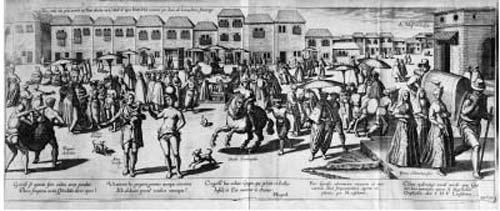
The decadent ways of Portuguese Goa are amply illustrated in this print from a Latin translation of Linschoten’s Itinerario.
When Vasco da Gama arrived on the scene, the intra-Asian spice trade was mostly in the hands of Muslim traders from the northern Indian state of Gujarat. A contemporary Florentine reporter estimated that fifteen hundred “Moorish” vessels arrived in Calicut during da Gama’s initial three-month sojourn. They brought their wares to China, too. At the end of the thirteenth century, Marco Polo had claimed that for every Italian spice galley in Alexandria, a hundred docked at the Chinese port of Zaiton (Quanzhou). And in the following centuries, Chinese demand for spices spiraled ever upward. According to one well-placed sixteenth-century source, China alone was importing three times as much pepper as the Europeans. Among the Ming elite, spices were as much a part of the privileged lifestyle as they were in Baghdad or Barcelona. North India itself was an enormous market for South Indian pepper and imported cloves and nutmeg as well. Here again, spicy food was associated with the court—in this case, the Muslim Moguls, who had grown up with sophisticated Persian cuisine. It’s worth remembering that spices were an exotic import here, too. Great caravans of mules and oxen had to transport the tropical spices across the high peaks of the Western Ghats to reach North India’s capitals; it is almost as far from Cochin to Delhi as from Alexandria to Venice.
Wherever the North Indian merchants loaded their junks and dhows with pepper and cloves, they left behind their religion as well. The diffusion of Islam throughout Southeast Asia can be directly credited to the spice route. (The story of the earlier spread of Hinduism is much the same.) As the Muslim merchants established trading posts, they eventually put down roots, erected mosques, and married local women. Moreover, what is remarkable about the spread of Islam is how peacefully it occurred here, especially in comparison to the violent methods employed by Muhammad’s immediate successors in the Middle East or, for that matter, when compared to the Portuguese conquistadores.
In spite of Manuel’s stated intention to wrest the Indian spice trade from these “Moors,” the king’s men never managed to achieve anything close to the wished-for monopoly. In the early years, they had some small successes in disrupting the old route when Admiral Albuquerque took Ormuz, the critical link between the Persian overland route and the subcontinent, but by the middle years of the century, realpolitik had made it necessary to placate the Persian shah in order to support the Portuguese against the Turks. As a consequence, Persian merchants, soon followed by Arabs and Venetians, were able to come to Ormuz to buy as much spice as they liked. And increasingly, the pepper wasn’t coming from Portuguese-controlled territories at all. Once they had gotten over the initial shock of the Europeans’ arrival, the Gujaratis had figured out how they could bypass the Estado’s strongholds in India and ship pepper directly from Sumatra to Egypt. Among the Lusitanians, the crusading spirit that had launched the early voyages seems to have faded, too. The seek-and-destroy impulse toward any Muslim that had characterized da Gama’s generation was eventually replaced by a grudging entente. By midcentury, trade within Asia itself had settled down to a pattern familiar before the Europeans’ arrival. The Portuguese contented themselves with playing the racketeer, skimming a small percentage of all the trade that passed within cannon-shot of their vessels. The fidalgos had learned that there was more money to be made selling spices to local merchants than filling up the king’s ships. As a result, long caravans loaded with aromatic cargo would trudge again across the dusty Arabian desert, and the warehouses of the Campo San Bartolomeo were filled once more with the sharp scent of Asian pepper.
Yet, while the Portuguese never achieved anything near a monopoly in pepper, it was a different story with cinnamon. In the sixteenth century, Cinnamomum verum (“true” cinnamon) was limited to Ceylon (Sri Lanka), and although it had been traded for at least a thousand years, only relatively small quantities ever left the island. What most of the world knew as cinnamon was actually a closely related spice called cassia (Cinnamomum cassia), which grows in numerous locales in southern Asia. Even today, most of the “cinnamon” sold in the United States is in fact cassia. True cinnamon is recognizable by its lighter color and softer bark. It has a more floral aroma hinting of incense and resin. Both spices are distinctly sweet, but cassia has a much more noticeable burn in its aftertaste. They are produced by stripping the second bark from either species’ tree shoots. As the bark dries, it forms the characteristic stick. The spice grown on Ceylon was long considered superior. Writing in Goa in 1563, the Portuguese botanist Garcia da Orta noted in his vastly informative Colóquios dos simples e drogas a cousas medicinais da Índia (Colloquies on the Simples and Drugs of India) that, “as a fruit is better in one country than in another, so the cinnamon of Ceylon is better than all others…. They do not send any other cinnamon than that of Ceylon to Portugal.” At the time, the aromatic bark was collected in the wild, while the Ceylonese monarch controlled its sale and distribution. The Portuguese, using their usual persuasive ways, convinced the king to grant them a monopoly, with the result that a ship was dispatched each year from Ceylon to meet up with the Carreira da Índia.
Lisbon had entered the spice trade at a time when Christendom’s tastes were in flux. In southern Europe, in particular, the medieval fashion for sharp flavors dominated by pepper and ginger with the sour tang of vinegar or verjuice seemed to be giving way to a decidedly sweeter flavor complex by the middle years of the fifteenth century. By the sixteenth century, ginger had also been planted in the Caribbean and had now become cheap and commonplace. Documents record that Jamaica alone exported more than two million pounds of ginger to Spain in 1547! Other spices, such as turmeric and cardamom, disappeared almost entirely from the European repertoire. Pepper at least seemed to retain its previous popularity, though mainly in the north of Europe. The new fashion was to pair sugar with the sweet spiciness of cinnamon, whether on the Piazza San Marco or the Terreiro do Paço. Da Orta has the following to say about his countrymen’s favorite spice: “One cannot eat any spice with pleasure except cinnamon. It is true that the Germans and Flemings eat pepper, and here our negresses eat cloves, but Spaniards [that is, Iberians] do not eat any of the spices except cinnamon.”
He certainly overstates his case; moreover, he may not have been the best-placed individual to comment on mainstream Portuguese foodways given the fact that he was a “New Christian,” one of the many nominally converted Jews who went abroad to escape the prying eyes of the Inquisition.*33 Nevertheless, he has a point. Infanta Maria’s Livro de cozinha repeatedly instructs the cook to finish dishes with a sprinkle of cinnamon. A contemporary Catalan cookbook says much the same. But even the Italian sources, including the widely disseminated cookbooks of Scappi and Messisbugo, make it clear that cinnamon was the “it” spice of the sixteenth century. Not that cinnamon wasn’t used earlier. The recipes of Martino/Platina, so popular in the latter part of the fifteenth century, use plenty of cinnamon, but they typically use it in concert with ginger and only occasionally sprinkle it on as a final garnish. It would be hard to prove that the increased availability of better-quality Ceylonese cinnamon brought about by the direct sea route between India and Lisbon had a direct impact on the tastes of the fashion capitals of southern Europe; however, it is a documented fact that the naus increasingly devoted more cargo space to cinnamon as the century progressed.
The taste for sugar increased in tandem with the fashion for cinnamon. Food historians who find medieval quantities of spice off-putting must be apoplectic when they read how much sugar was used in meat and fish dishes in the Renaissance. In a typical recipe from Cristoforo Messisbugo’s trendy sixteenth-century cookbook, a fish pie made with some three pounds of fish includes more than a cup of sugar as well as cinnamon and rose water. The slightly earlier Livro de cozinha may not give quantities, but more than half the “savory” dishes include sugar. And while the Portuguese certainly did not invent the European sweet tooth, their plantations—first in the Algarve, then in the Atlantic islands, and finally in Brazil—went a long way toward creating the very idea of dessert in European cuisine. Even today, the Portuguese love their sugary sweets sprinkled with cinnamon. Moreover, the use of cinnamon as a final garnish, even for savory items, has never entirely left the Portuguese repertoire. In Arte de cozinha, a cookbook written by the royal chef Domingos Rodrigues around 1680, cinnamon makes an appearance in dozens of meat, poultry, and vegetable dishes as well as the expected sweets, typically sprinkled on at the end. Fish seems to be the exception; there, pepper is more popular. Rodrigues’s book stayed in print until 1836, attesting to the recipes’ popularity. At the turn of the last century, cinnamon was still used commonly in stews. Even today, it can be found in rustic main-course dishes in the mountainous enclaves in the Algarve as well as in soups in the Azores. Admittedly, these days, cinnamon appears much more commonly in Portuguese confectionary than in savory dishes, yet a popular culinary website still recommends cinnamon sticks for flavoring “chicken, lamb and stuffed vegetables.”
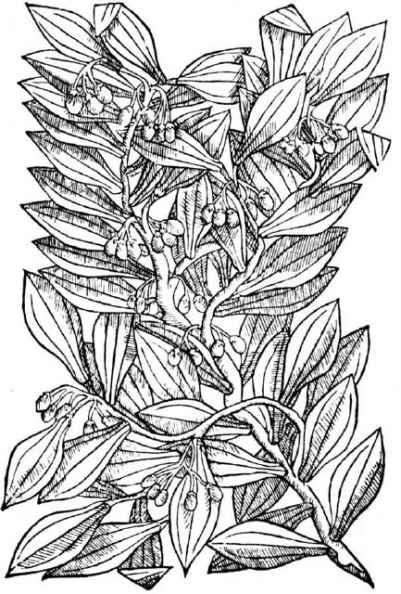
Portugal’s favorite spice, cinnamon, in a somewhat fanciful print from Garcia da Orta’s masterwork.
Though the opening of the sea route to India made spices more widely available (albeit by no means cheaper) in Europe, Portugal’s influence on the continent’s tastes north of the Pyrenees can be considered only marginal at best. Elsewhere, however, this little country’s impact on the way people eat was nothing short of transformational. Today, a brief walk through Panjim’s central market reveals piles of cashews still attached to the yellow, plum-sized fruit on which they grow, papayas the size of watermelons, fat winter squashes, hillocks of tomatoes, straw baskets bristling with pineapples, galvanized metal tubs of white and purple sweet potatoes, woven trays of lumpy passion fruit—all foods brought from the Americas by the Portuguese. The transfer of foods between the New and the Old Worlds has come to be known as “the Columbian exchange,” but at least in the Tropics, it would be more apt to describe it as “the Cabralian exchange,” for the man who put Brazil on the map. It was the Portuguese sailors in their pepper naus, not the Spanish conquistadores, who brought peanuts to Africa and cashews to India.
Nonetheless, when we think of Indian cuisine, we tend not to dwell on cashews and sweet potatoes. The first thought that comes to mind is the spicy burn of red pepper. The produce aisles of the Panjim market have plenty of chili peppers both large small, but it isn’t until you enter the ill-lit back section of the sprawling market, where row after row of vendors display their dry spices, that Cabral’s stopover in Brazil hits home. As you would expect in this nation of curry eaters, there are bright plastic basins full of every indigenous spice, from fat yellow fingers of turmeric and loose brown curls of cassia to fine crystals of asafetida and wrinkled peppercorns. Yet as you breathe in (and I would recommend doing this gingerly, for even the locals go about sneezing), you do not smell the spices that Europeans risked their lives for. What you smell, what scrapes through your nostrils and lungs, what makes your eyes well with tears, is the fierce burn of chili pepper. For while the other spices occupy modest washbasin-sized containers, the chilies fill enormous chest-high burlap bags, color foot-high pyramids of ruddy masala powders, and flavor jars of spicy relishes and pickles. It is certainly the most delicious irony of the spice trade that the Portuguese, who had come to India to bring home black pepper, would be the ones to introduce red pepper to most of the world. It is widely accepted that New World peppers—which are, of course, in no way related to Piper nigrum—were carried to Africa, India, and Southeast Asia in Portuguese ships. What is less clear is just how this happened and when, and even more obscure is how capsicums got to Portugal itself.
THE PEPPER MYSTERY
In Portugal, until recently, people bought their fish, their fruit, their spices, in much the same sort of sprawling market as you still find in Panjim. But today, the customers who make the trip down to Lisbon’s main waterfront market are getting older and fewer. Just as everywhere else in the developed world, almost everyone now shops in supermarkets. If you really want to know what people in Lisbon eat day in and day out, visit a Pingo Doce. The Portuguese are mad about their shopping malls, and it seems that nearly every one is anchored by a Pingo Doce, the country’s largest chain of supermarkets. Most of these markets are upscale, antiseptic, and entirely generic. There is Coca-Cola by the case; you can stop by the sushi bar or buy vacuum-packed tortellini. But since this is Portugal, there are also counters of exquisitely fresh sardines and overtly odiferous bacalhau. So what can Pingo Doce tell us about chilies in the national cuisine?
You’ll find plenty of sweet peppers in the produce section. In Portugal, these are called pimentão, and you’ll find them grilled, slow-roasted in olive oil, and ground up into a paste that is used as a marinade. The spice shelf features jars of equally sweet peppers dried and ground into a paprika-like spice referred to as pimentão doce. When the locals want a bit of heat, they reach for cellophane packages of little dried peppers called piripiri. But just to confuse things, the Pingo Doce sells fresh hot chilies under the name malagueta, the same name once given by the Portuguese to grains of paradise. Out of this comes a misconception I hear stated more than once that chilies actually went from Africa to Brazil instead of the other way around. Yet this very confusion is illuminating, for it hints that the route that chili peppers took from America to Portugal was far from direct.
When João II sent Bartolomeu Dias past the Cape of Good Hope in search of a quicker route to those Christians and spices, there was no doubt about what spice his sailors were after. It was black pepper, Piper nigrum, the fruit of that leafy vine that still clambers up trees in the emerald jungles of India’s Western Ghats. Columbus had much the same idea when he pointed his caravelas redondas west. Yet, in our time, the world’s most widely traded spice is not Piper nigrum but the dried fruits of the Capsicumgenus—what we call hot pepper, red pepper, chili, chilli, or chile, depending on just who is doing the cooking. And the world’s appetite for this incendiary seasoning is growing by leaps and bounds.*34
When we look back to 1492, the only cooks familiar with the spice were limited to the kitchens of the Western Hemisphere. Kashmiris had to make do with black pepper and ginger to give a little kick to their rogan josh, there wasn’t a Thai curry that could make you break a sweat, and Korean kimchi wouldn’t have been much hotter than sauerkraut. Yet fifty years later, chilies had circled the globe. How did this happen so fast? And just who brought the chilies from the “New World” to the Old, and why did they bother in the first place? Then there is the question of why they were so quickly adopted from Spain to Sichuan.
The broad outlines of the answers are reasonably uncontroversial. It is in the details that the story gets murky and promises to remain so until a cadre of fanatical graduate students scours all the unpublished sources and digs through Renaissance privies of five continents to find the undigested seeds that would provide more definitive answers. In the meantime, we have botanical clues, some scattered linguistic testimony, and the occasional eyewitness. Unfortunately, none of this adds up to more than circumstantial evidence.
Here’s what we know. In Mexico, chilies had been cultivated as far back as 5000 to 7000 B.C.E. By the time Columbus made landfall, an assortment of cultivated varieties grew across most of what is now Latin America. In addition, many varieties must have grown wild, since chilies are widely distributed by certain birds that happily munch the fruit of these little tropical bushes. (Birds are apparently not sensitive to capsaicin, the chemical responsible for chilies’ characteristic burn.) Chilies are notoriously promiscuous and will cross-pollinate with no more than the glancing touch of a passing insect’s thigh. This makes them particularly hard to classify. There are nevertheless some four or five domesticated species (with hundreds of cultivars) that botanists can reliably identify.
Columbus and his crew mention chili peppers several times during those early Castilian visits to the Caribbean. “The pepper which the local Indians used as a spice is more abundant and more valuable than either black or melegueta pepper,” he writes. Elsewhere, he notes that “there is…much aji, which is their pepper and is worth more than our pepper; no one eats without it because it is very healthy. Fifty caravels can be loaded each year with it on this Isla Espanola [the island of Hispaniola, today divided between Haiti and the Dominican Republic].” The misguided Genoan naturally called this newly encountered spice pimienta, after the Spanish word for black pepper, in much the same way as he called the islands he visited the Indies and the indigenous people, Indians. There’s been confusion ever since. In South America, the term ají (from the Arawak axi ) became a common name for the spice; in Mexico, chile (from the Nahuatl chilli ) was preferred; while in Spain, pimienta de India (“Indian pepper”) was gradually supplanted by the word pimentón. In most European languages, some variation on the word pepper is used.
Back in Castile, as we know, Isabella did not exactly leap off her throne in delight when she learned the details of Columbus’s discoveries. Others were more intrigued. Within months of the Niña’s return, the spice was planted in several monastery gardens, the botanical incubators of the time. By 1564, the visiting Flemish botanist Charles de L’Écluse reports seeing peppers growing all over Spain. He adds, “The fruit has various shapes and is used both fresh and dry as a condiment.” Five hundred years on, we can’t be sure whether these peppers were of the sweet or hot variety, but it’s a fair bet they were both. Later on in the text, he mentions coming across a hotter, yellowish variety at a Lisbon monastery. These were apparently so strong that they would burn the jaws for several days. Today in Spain, pungent and mild pimentón exists side by side, though the sweet type is much more common. We can infer from pimentón’s absence from Spanish cookbooks for the next couple of hundred years that it was a decidedly lower-class seasoning used by peasants to color as much as flavor their fare. Given the way ground red pepper is often used to tint food orange in today’s Spain and Portugal, it may have replaced domestic saffron in the culinary ecosystem rather than imported black pepper. In other parts of Europe, capsicums were slow to take off, though botanists across the continent noted the new plant with great curiosity.
One of the earliest descriptions and illustrations of the capsicum plant comes from an herbal written in 1542 by the German naturalist Leonhard Fuchs. Here (in the hand-tinted versions, at least), we have peppers in shades of red and green. There were also little champagne-cork-shaped chilies and long peppers like lizards’ tongues. You would presume that they made their way to Germany from the Caribbean by way of Spain. But just where Fuchs himself thought they came from is hard to decipher. The one he calls Piper hispanum, or Spanish pepper, is a nobrainer. But did he think the Indianischer pfeffer (Indian pepper) came from India, or was it just a translation of the current Spanish name? More intriguing is the Calechutischer pfeffer (Calicut pepper). Had capsicums already made the round-trip from the Americas to Malabar and back to Germany in the fifty years following Columbus’s inadvertent discoveries? It’s possible. Fuchs spent most of his career in German cities up the Rhine from Antwerp, the great spice entrepôt of its day. Literally tons of Portuguese black pepper were being shipped up the river in those days, so who is to say that a few capsicum seeds might not have made the trip, too?
But how did chilies arrive in India to begin with? In the West Indies, according to at least one Castilian conquistadore, Gonzalo Fernández de Oviedo y Valdes, European settlers were eating as many chilies as the natives by the 1520s at least. The hidalgo was particularly taken with the plant’s healthful qualities. Because of its heating properties, it is most suitable for the winter, even better with meat and fish than “good black pepper,” he writes. He also mentions in passing that the spice had been taken to Spain, Italy, and many other places, though, unfortunately, he doesn’t spell out any specific itinerary.
There are two likely scenarios that sent the spice around the world, the first premised on boredom and the second on curiosity. While wealthy officers and passengers of the Portuguese naus boarded with plenty of fine spices to flavor their oversalted food, common sailors had fewer options. It’s reasonable to think they picked up dried chilies as they stopped to provision the ship on the way to India so as to add a little zing to their dreadful diet. They then introduced the spice to new ports along the way. This dissemination could have occurred intentionally or perhaps inadvertently as the pepper seeds were deposited in dung heaps from Moçambique to Malacca. Another possibility is that members of the religious orders carried the seeds with them to gardens established in Portuguese forts along the spice route.
Where the sailors (or friars?) got the chilies to begin with is unclear. The Carreira da Índia made one, or sometimes two, stops on the way to the Cape of Good Hope: one in the Cape Verde Islands to pick up fresh water and provisions and occasionally another (though Lisbon discouraged this) in Brazil as the ships swung across the Atlantic to take advantage of the trade winds. Most likely, it was the semiarid Cape Verdes, ideally situated off the African coast, that were the first tropical beachhead for chilies’ march around the world. Whether the peppers came from the Caribbean or Brazil is impossible to say. José de Acosta, a sixteenth-century Jesuit priest who spent many years in New Spain, claims that in his day, chilies were called axi (a variant spelling of ají ) in India. Brazil was closer, though, and the so-called bird chilies grown early on in India and eastern Africa are closely related to their South American cousins. Both might have occurred—there was plenty of traffic between the African islands and the New World. As early as 1512, a letter from the Cape Verdes records “a large concourse of ships” arriving from Portugal, Brazil, as well as the nearby Guinea coast.
After the Atlantic islands, the next stop en route to India was the eastern African port of Moçambique, just down the coast from the Swahili-speaking cities in what are now Tanzania and Kenya. Across southeastern Africa, hot peppers would come to be known by their Swahili name pilipilior piri-piri. Goans, too, use the term periperi masala for a mixture made especially spicy with the addition of hot chili peppers, though just when the African term came into use here is unclear.
In the Indian subcontinent, the first mention of the chili appears in the work of the southern composer Purandaradasa around the middle of the sixteenth century. “I saw you green, then turning redder as you ripened,” he sang, “nice to look at and tasty in a dish, but too hot if an excess is used. Savior of the poor, enhancer of good food, even to think of [the deity] is difficult.” A roughly contemporary Sanskrit work also mentions chilies. Nevertheless, it is surprising that the otherwise highly perceptive Garcia da Orta did not mention them in his 1563 opus, despite the fact that he was living right there in Goa. Were chilies first introduced into the south before reaching Goa? (Recall that Fuchs calls it “Calicut pepper,” not Goan pepper.) Portuguese ships typically made landfall in the southern city of Cochin before going on to the viceroy’s capital. Would it not be logical that the residents of the pepper coast would pick up the habit of using chilies before Indians to the north?
I put the question to Thomas Thumpassery, as we had lunch at his pepper plantation in the southern Indian province of Kerala. Thomas’s mother had been sure to choose dishes that would not cauterize my delicate gringo palate. Accordingly, I was presented with a series of delicate vegetable dishes and mild meat preparations along with a sweet mango pickle that is usually served to children. The food was a delicious blend of smoke, coconut, and spice with a subtle interplay of chile, turmeric, cumin, ginger, and curry leaf. But where was the black pepper that grew just across the driveway? “We don’t eat it,” Thomas told me. One of the odd ironies of the black pepper trade is that the spice is hardly ever used in the local cooking. Just about the only exception, made mostly by Keralan Christians, is in so-called continental preparations, which are the local interpretations of European cooking. But very little is used in indigenous dishes. This is not true in other parts of India, where Keralan pepper is used much more commonly than in its place of origin. Even just across the Western Ghats, which separate Kerala from the state of Tamil Nadu, they use lots of black pepper. “I hate the taste,” quips Thomas, confirming the point.
He reminds me that in India, outside of its native Malabar, black pepper was also an exotic import, which—while perhaps not so dear as in Antwerp—was affordable only for the well-to-do. The only part of India where black pepper was used as a seasoning by the common people would have been right here where they could go into the woods to pick it for free.
Coincidentally, just about the time chilies arrived in India, around 1500, the worldwide demand for black pepper (in China and North India as well as Europe) was going through the roof.*35 For the first time, black pepper began to be cultivated rather than just foraged in the woods. It became a cash crop. Put yourself in the place of a Keralan peasant. Would you sell your pepper crop for hard currency or crush it into your curry? The cheaply grown chilies must have made landfall at just the perfect time to replace the locally grown but now especially marketable pepper. There are other indications that chili was a poor people’s spice—pimento dos pobres, as it was once known in Goa. Thomas explains that when it comes to ritual foods made by upper-caste Brahman monks in the south, only black pepper will do, even in preparations that commonly use red peppers. Yet despite these sorts of ritual exceptions, most of the population would have found it easy enough to incorporate chili into their cuisine. In Indian cooking, spices are used to correct or adjust other foods much as they were in the Europe of Vasco da Gama’s time. Accordingly, capsicums not only made food spicy-hot in a way reminiscent of black pepper, they fit the same pharmacological slot.
From Malabar, chilies must have followed the same routes traveled by black pepper for hundreds of years: up the coast to Goa and then to North India, across the Himalayas to the interior provinces of China. (The Sichuanese were especially enthusiastic converts to the new spice.) Going west, Indian chilies certainly made it as far as Persia and even possibly Turkey, though it is much more plausible that the Ottomans got their hot peppers from Spain.*36 It was also Portuguese (and Gujarati) traders who most likely brought chilies to Southeast Asia as well, though it is also perfectly possible that Spanish seamen sailing the Manila galleon route from Acapulco to the Philippines can be assigned the credit. But even in places where merchants and mariners were inadequate to the task, birds swooped in, scattering capsicum seed–filled droppings in even the most remote locations.
West Africa is a different matter altogether and adds yet another layer of haze to an already cloudy picture. In the years when Christopher Columbus was hanging around the Lisbon court, Portuguese caravels were shipping two kinds of “pepper” from what was known as the Guinea or Melegueta coast of Africa: grains of paradise, aka melegueta pepper (Aframomum melegueta), and also an African peppercorn (Piper clusii ) related to cubeb pepper. Few people would mistake the spice called pimenta malagueta in Portuguese for black pepper (Piper nigrum). The seeds are much smaller, smoother, and lighter in color. They largely resemble the cardamom seeds to which melegueta is related, though, once it is ground, the spice has its own floral, juniperlike aroma with, admittedly, a distinctly peppery bite. The second pepper, which the Portuguese came across as they were nosing up the Niger in 1485, was dubbed pimenta de rabo, “pepper with a tail,” because it looked like a peppercorn with a little stem attached. The Italian pilot aboard described it as especially pungent. “It is very similar to cubeb pepper in appearance, but in flavor an ounce of this [African pepper] has the effect of a half-pound of ordinary pepper.” These little berries, occasionally called Ashanti pepper today, actually are related to the Indian spice; they have a similar kind of pungency. However, their somewhat bitter flavor may explain why this so-called false pepper had a relatively short run in the European market.
The caravels weren’t just shipping pepper, of course. One of the main “commodities” transported from the Guinea coast to Madeira and southern Spain to work the sugar plantations was human beings. Then, after Columbus’s famous trip, the Portuguese quickly got into the business of supplying slaves to the new Spanish colonies, and by the 1530s, they could count on customers in Brazil as well. Once again, the records are inadequate, but chilies must have arrived on the West African coast by way of the Cape Verde Islands, since this was the most common stopover for the slavers going in both directions. By the late sixteenth century, some Europeans are referring to chilies as “Guinea peppers,” while Brazilians are calling their native chilies malaguetas or pimenta de rabo.Is it any wonder that historians as knowledgeable as Aporvela’s Hernâni Xavier are convinced that chilies were native to West Africa and were being imported into Portugal long before Columbus set sail?
My guess is that chilies got to Portugal proper relatively late through several distinct if circuitous routes and were incorporated into the cuisine in a series of waves. Walk into any Portuguese deli and you’re likely to bump into red-tinted chouriços, linguiças, morcelas, and salpicõeshanging from the ceiling and filling the display cases—all sausages tinted to a greater or lesser extent with pimentão. Cooks will add pimentão to foods cooked at home as well but with nowhere near the frequency found across the border in Spain. All the indicators suggest that these mild chilies reached Portugal by way of its next-door neighbor rather than directly from the New World and that here, too, they replaced expensive saffron as much as black pepper.
When a Lisboeta wants heat, she reaches for a malagueta or for piripiri. Both words are used rather loosely for any hot pepper, though the latter is usually dried. At some point, chilies called malaguetas must have been brought in from both Brazil and the Guinea coast, probably long after pimentões arrived from Spain. They’ve become widely popular only in the past few decades when the retornados, colonials (and natives) who fled Portugal’s newly independent former colonies in the 1970s, brought their African tastes back to the metropolis. The popularity of East African piripiri is of similarly recent vintage. Ask for piripiri in a restaurant (it is as common as ketchup in America) and you’ll get a little jar of ground hot pepper in olive oil. You can slather the condiment on whatever pleases you (though you might see a few eyebrows raised if you use it on some very traditional dishes). Even today, hot pepper has a working-class (and gender) association. I have found that piripiri is by no means ubiquitous in Portugal. Rui Lis, the nonconformist lawyer who has seen his fair share of heat in Africa, insists that’s because I’ve eaten at too many yuppie restaurants. When pressed, he admits that Portuguese women are also generally not fond of the condiment, but men, real men, need their piripiri.*37
Of course, most contemporary Lisboetas give as little thought to the origin of piripiri as they do to the globe-spanning empire the capital once ruled. No wonder: the hot pepper is much more pungent than some dimly remembered history lesson about a little country whose long-gone wealth was once coveted by grasping hands from Madrid to London to Amsterdam.
SHIPWRECKS AND CUSTARD TARTS
Across the railroad tracks and the highway that now separate the Mosteiro dos Jerónimos from the Tejo River stands Lisbon’s best-known monument, an ornate little tower that looks like nothing so much as a toy fortress put up so that children can play king of the castle in the radiant southern sun. Like the monastery, the Torre de Belém is constructed of shiny white limestone and decorated with graceful arches and proud shields bearing the Crusaders’ cross. The whole thing is girded with a faux stone rope tied in a sailor’s knot, as if the architect had decided to gift wrap his present to the king. Yet all this is disguise, an ornate blind with twelve-foot walls, a platform for the sixteen cannons pointed at anyone who would dare trespass into Lisbon’s estuary. From the tower’s highest platform, there’s an unlimited view of the entire river—all the way to where it opens up to greet the Atlantic near Cascais. Any enemy ship arriving from the ocean would have had to sail past these cannons, but perhaps even more important, the lace-covered gun battery reminded any would-be smuggler not to mess with the king. When the pepper-laden ships entered the estuary, they were met by customs officials who followed the ships all the way to Lisbon to make sure none of the crown’s spices were surreptitiously brought to shore.
The sea could be treacherous between here and the mouth of the bay. There, the unseen sandbanks shifted with every storm. Hundreds of ships wrecked within sight of Belém. We know a great deal about one in particular thanks to recent joint American-Portuguese archaeological excavations led by Filipe Castro and Francisco Alves.
On September 15, 1606, the lookouts of the Torre de Belém saw the tall masts of the Nossa Senhora dos Mártires careening in the blowing wind, tilting and then crashing to the water as the massive hull struck an underwater obstacle and shattered, spilling cannons, caixas, sailors, and close to a million pounds of black pepper into the boiling waters. The next morning, Lisboetas awoke to beaches tinted black from the midnight tide of peppercorns. Witnesses report a mad rush to collect the costly cargo washed ashore before the king’s officials could fish out the remainder. Even recently, when the marine archaeologists went looking for the remains of the great nau, they discovered them embedded in a layer of muck mixed in with peppercorns. Many of the artifacts were long gone, pilfered by amateur divers and swept away by four centuries’ storms, but in the midst of the peppercorns, the fragments of the hull contained a sampling of the riches of the east—silver pieces of eight, gold jewelry, and Chinese porcelain—as well as the more common pewter plates and earthenware pots that are the bread and butter of the archaeology trade. You can go and see some of the finds at the Museu de Marinha. There’s even a generous pile of peppercorns. Pepper does keep well, but not this well. Some of the team’s members actually tasted the four hundred–year–old peppercorns. Not surprisingly, any trace of taste was gone. All the same, Professor Castro confesses that he detected a dim aroma when he dove down into the deepest of the muddy layers. Mostly, though, the peppercorns were just a flimsy outer layer with nothing inside. They had to be dehydrated in alcohol, then dried with a hair dryer in small batches, and impregnated with glue so that they would not turn to dust in the exhibit.
The breakup of the Mártires was just one more incident to add to a rising tally of shipwrecks that were a symptom of an empire that was increasingly as flimsy and hollow as the Mártires’ peppercorns. You can blame the loss of Lisbon’s spice trade on a long inventory of reasons, but the empire built on a shoestring—and held together with the spit and sealing wax of distant forts and factories—was just too wobbly to sustain the incompetence within and the assault from without.
Much of what went wrong, all my sailor historians are quick to point out, can be blamed on the Spanish. In 1578, King Sebastião I of Portugal (one of the more unhinged of the royal line) got himself killed on yet another crusade against the Moors. The result was that two years later, the Portuguese crown fell into the lap of the workaholic and fanatically religious Hapsburg monarch of Spain, Philip II, thereafter also Filipe I of Portugal. “We refer to those sixty years of Spanish rule as our ‘Babylonian captivity,’” Lieutenant Neves informs me, lest I have any illusions about the love lost between Portugal and her pushy neighbor. Theoretically, the two kingdoms were supposed to stay separate under Philip, but it didn’t work out that way for long. The Spanish ruler just couldn’t keep his fingers off the profits from the spice trade, especially when he needed the money to pay for his religious wars. At the same time, the annual Carreira da Índia, which was already depending on too many slaves and convicts to man the sails, lost even more of its experienced sailors to the comfier and more profitable Spanish galleons that used to make the relatively quick passage to the Americas. When Philip sent his disastrous armada to punish England’s Protestant queen in 1588, a good part of his fleet was actually Portuguese. “Those were our ships he wrecked!” Hernâni Xavier spits out. But the Spanish kings had their eyes fixed elsewhere—which meant that Lisbon’s fleet withered and her empire shriveled from neglect.
Holland’s entry into the spice trade—or at least, its timing—can also be laid at Philip’s door. Portugal had had a long, cordial history with the Low Countries from the days when her kings married into Burgundian nobility and her merchants unloaded salt and oil on Bruges’s medieval piers. Throughout most of the sixteenth century, Portuguese pepper was distributed through Antwerp, and Dutch middlemen regularly came down to Lisbon to fill their holds with melegueta, black pepper, and cinnamon. The Portuguese kings had encouraged this trade, granting the Dutchmen a package of privileges analogous to the Venetians’ fondachi in Muslim lands. The crown even allowed the northerners to practice their heretical rites within their own compound. In 1580, though, Holland was in the midst of an armed rebellion against Spain (the Netherlands had fallen under Hapsburg rule some years earlier). Philip II reacted by closing all his ports to Dutch shipping and sending his shock troops north to bring the heretics to heel. It didn’t work out quite the way he planned. The conquistadores experienced one humiliating defeat after another, and Holland’s navy sailed right up to Gibraltar and sank a Spanish armada a stone’s throw from Andalusia’s shore. With no pepper available to them in Lisbon, the Hollanders decided to go to the Asian source, looting and sinking as many of the enemy’s ships as they could along the way. The poorly manned Portuguese ships were especially tender targets, particularly when compared to the heavily armed Spanish galleons that made up the silver fleet from New Spain.
Goa was always too well defended for the Dutch to take it by force, but Portugal’s other redoubts in the Estado da Índia were picked off one by one. The spice islands of Tidore and Amboina fell in 1605, Malacca in 1641, Ceylon in 1656. Even Cochin, where the carreira had so long filled its ships to bursting with pepper, succumbed to Dutch assault in 1663. When, after the sixty years of Spanish captivity, a Portuguese king once again occupied the Paço da Ribeira in 1540, he could count on a mere eleven ships worthy of the name: eight galleons of Portuguese construction—of which, one was not fit to sail—and three other ships that had been seized from the French and the Dutch. In contrast, according to one contemporary estimate, the Hollanders could muster more than fourteen thousand vessels for war! Increasingly, the pepper fleet left India later and later in the season to avoid the Dutch (and later English) marauders, with the result that they missed the dependable winds of the monsoon and wrecked on the way home. The number of wrecks rose so precipitously in the early seventeenth century that in some years, Portugal had no pepper to sell at all.
Nonetheless, the Dutch could hardly be held responsible for every shipwreck. The Lisbon-bound ships were always chronically overloaded because of the crews’ own allotments of merchandise, whether in the form of the official caixas or in contraband. Given their rotten salaries, it was the only way to make the perilous trip worthwhile. Incompetence at every level could also take a share of the blame. In Portugal, the job of captaining a ship was assigned as a royal favor to members of the high nobility. Knowing prow from stern was not one of the prerequisites. As a result, the actual practice of sailing the ships was handed over to the pilot. You can imagine what happened when captain and pilot disagreed. Beaches from Moçambique to Madeira saw their share of pepper tides. As if this weren’t bad enough, experienced pilots were in short supply. In a meeting held at the viceroy’s Goan palace in 1643, the local authorities realized that, back home, there wasn’t a single pilot qualified to navigate a ship to India, since all those with adequate experience (all ten!) were stuck in Goa due to a Dutch blockade.
Sailors who had some idea of what they were doing were hard to find, too. Between the death toll on the carreira itself and the seamen who never returned from the Indies, the kingdom had been hemorrhaging sailors for years. Lieutenant Neves supplies a telling statistic, noting that in many years, there were more deaths on the return trip to India than there were mariners in the entire Spanish armada that sailed to America. Neves, like every historian of the spice route, repeats the story recounted by the royal chronicler Castanheda of the 1505 departure of the pepper fleet from Belém. The sailors were so green that the captain of one caravel nailed a braid of garlic to one side of the ship and an onion braid to the other so that they could tell right from left. Then, when he wanted to turn the ship to starboard, he shouted “Garlic,” and to port, he yelled “Onion.” The confusion wasn’t limited to the sailors, though, for Castanheda mixed the two up as well. Just imagine the first storm they encountered! And the sailors didn’t get better as the century progressed.
The Portuguese enthusiasm for promoting the faith, the very same fanaticism that had once led to the voyages of discovery, was now dragging the empire down. Not only was the king’s purse being drained to gild the magnificent altars of Goa Dourada, the realm’s policy of gunboat evangelism wasn’t making it too many friends in the East. Meanwhile, back home, the jackboot tactics of the Inquisition were sending many of the “New Christians” packing to less hostile climes. The exodus of these formerly Jewish artisans, merchants, and professionals was a disaster for the Portuguese middle class, even as it did wonders for Amsterdam, Antwerp, and London, which took them in. What’s more, the Counter-Reformation had insidious effects on the culture that were not as public as the autos-da-fé, where pork abstainers were burned alive. Compare the era of King João II, who authorized two French booksellers to import tax-free as many books as they chose because he believed “it is good for the common weal to have many books circulating in our kingdom,” to the stultifying climate of a hundred years hence. By then, the dread of foreign heresies had imposed a totalitarian form of censorship on any books printed in or imported into the kingdom. Even masterworks by Portuguese authors such as da Orta were much more widely circulated abroad than at home.
In Asia, it used to be that the promotion of religion was every Lusitanian’s business. Lieutenant Neves describes the early Portuguese mariner as a kind of multipurpose tool that could function as a sailor, soldier, merchant, and Christian enforcer, depending on the time and place. However, even before the years of Spanish rule, the religious campaign was firmly in the hands of a cadre of professionals, the Jesuits, many of whom were not even Portuguese. The Lusitanians once firmly believed that the reason their little country had conquered the waves was that they were doing God’s will. Yet by the middle years of the sixteenth century, the crusading impulse had more or less evaporated in the rank and file who sailed out past the Torre de Belém, now wholly replaced by a quest to line their pockets.
Echoing the locals’ low expectations, Linschoten mentions that when each viceroy arrives in Goa for his three-year term, he spends the first year redecorating, the second amassing as much treasure as possible, and the third covering his footmarks. Much the same could be said for every other crown official. The Dutchman writes, “There is not one of them, that esteemeth the profit of the commonwealth, or the furtherance of the king’s service, but rather their own.” This had direct consequences on the spice trade across the Estado da Índia. You could make a lot more money buying and selling within Asia than sending pepper and cloves to the king’s agents, who were sending spices back home. Consequently, the trading system settled back to pretty much the same pattern that had existed before da Gama’s arrival. It’s been estimated that in 1515, the Portuguese were shipping some 30 percent of Malabar’s pepper production. At the end of the century, this had shrunk to some 3 or 4 percent. (Admittedly, total production had increased in the meantime.) Once more, Gujarati merchants brought pepper to ports on the Red Sea and the Persian Gulf. And yet again, Venice became the Mediterranean’s greatest spice emporium. The viceroys and the captains of forts across Asia were happy to cream off what they could from this trade and made sure that little was done to stem the flow that greased their palms. The result of this was that even before the Spanish takeover, and long before the arrival of the swift ships from Amsterdam, the Portuguese had been losing market share in Europe.
It’s a wonder that the whole Lusitanian empire did not collapse like a half-baked soufflé at the crash of the first Dutch cannon. But maybe that’s the wrong way to look at it. Rather than bemoaning the Estado da Índia’s demise, it might be better to marvel at how long this improbable realm actually prospered, especially given the fact that it was based on nothing much more than the profits loaded into the half dozen ships that arrived yearly in the carreira. Amazingly, this rather impromptu empire survived, even if in greatly diminished form, until the twentieth century. Goa finally submitted to Indian troops as late as 1961. In the meantime, Lisbon found other revenue streams to build her palaces and gild her churches. As the Dutch slowly strangled the Portuguese spice route in the East, the monarchs in Lisbon turned west to their long-neglected territories in Brazil for a source of income. Sugar, not pepper, would be the lure of this new El Dorado.*38
Whatever good and bad can be said of the consequences of da Gama’s and Columbus’s trips across the oceans in search of spices and paradise—and there is no shortage of either—they had the effect of undamming the flow of humanity and commerce across the earth. The silver that was mined in Mexico now influenced currency markets in China. An increase in the demand for pepper in Europe led to changes in production techniques in India. The labor requirements of Portuguese sugar plantations in Brazil had repercussions deep within Africa. People in Lisbon and Madrid made decisions that directly affected the lives of people halfway around the world. The Venetian ambassador to Manuel I had no illusions about the immensity of these transformations: “What is greatest and most memorable of all, you have brought together under your command peoples whom nature divides, and with your commerce you have joined two different worlds.” The wheels of globalization were sent spinning by the wake of the great nausthat took leave of the little white tower at Bélem.
Tell any Lisbon native that you are going to this historic suburb and her mouth will curl into a lip-smacking smile. Naturally, every visitor to Lisbon must make a pilgrimage to Belém’s national shrine. But don’t think for a moment that what she has in mind are the Mosteiro dos Jerónimos and the Torre de Belém. “They are nice, of course,” the Lisboeta sniffs regarding these architectural jewels, “but you really must go for the pastéis de Belém.” The citizens of Lisbon are impassioned about their sweets. A sweet muffinlike bolo is a typical breakfast; lunch might conclude with any one of a dozen variations of pudim (the term flan could hardly begin to describe the myriad variations in color and texture). Other desserts are so peculiarly Portuguese that the English language could not possibly do them justice. I am convinced that the city holds more pastry shops per capita than any other place on earth. A recent search of Lisbon’s Yellow Pages indeed turns up more than eight hundred pastelarias in the capital alone. (A similar search on much larger Paris yields only about 180!) Most Portuguese pastries use plenty of eggs, many are scented with cinnamon, and all of them are very sweet. All this comes together in what is the national dessert, the pastéis de nata, in Belém rechristened the pastéis de Belém. It is perhaps not entirely coincidental, then, that the high temple of this custard tart, the Casa dos Pastéis de Belém, should be located just between the president’s pink-tinted palace and the nation’s pantheon at the Jerónimos, where the country’s greatest kings, heroes, and poets lie interred. On weekend afternoons, the pastry shop’s bar is crowded four deep as visitors and locals alike wait for their turn to nibble the still-warm confection downed with a creamy espresso.
Today’s Portuguese don’t spend much time thinking about their history. In this, they are much like people everywhere. Hernâni Xavier would like to blame the gays and communists who he claims run the Ministry of Education, but even he admits that the sixteenth century is of little concern to his countrymen. Heroism is not in fashion in the European Union, and most of the citizens of what used to be called Christendom would prefer not to be reminded of the jihadist fervor that launched “the age of discovery.” To most of his countrymen, Camões is just the name of a street, a square, an institute. When, in school, they read the great poet’s epic account of their ancestors (“risking all / In frail timbers on treacherous seas, / by routes never charted, and only emboldened by opposing wind; / having explored so much of the earth / from the equator to the midnight sun [they were] drawn / to touch the very portals of the dawn”), it is no more than literature. You can hardly expect the descendants of those Lusitanians to make the connection between Camões’s ancient, stubborn seamen sailing round an unknown world and the cinnamon on their pastéis de Belém, to remember the complaint of another Portuguese poet who lamented, “At the scent of this cinnamon, the kingdom loses its people.”
And yet, the stories those little custard tarts could tell. You could distill Portugal’s past into a single bite. The delicate flaky pastry that shatters on the tongue is a souvenir of the Moors who brought the technique of making phyllolike pastry to Iberia. The generous sprinkle of cinnamon is like so much aromatic dust, all that’s left of the long-lost Asian empire. Then there’s the sugar brought by the Portuguese to America, a memento of the continent found by accident on the way to the spiceries, a reminder of the sweet cane that sent helpless Africans to suffer and die across the sea and dispatched shiploads of the white crystals to pastry shops from Lisbon to Vienna. All this history bound up with creamy, cinnamon-scented custard.
