
It is necessary to address a few questions of method.
First, a note on geography. This book concentrates exclusively and unashamedly on the Renaissance in “Italy,” and I am conscious that this geographical focus may be subject to some reasonable question. There was, after all, no Italy before 1871, and though humanists such as Petrarch did have a certain concept of what “Italy” meant, the notion was fairly amorphous. On the one hand, boundaries of any kind—least of all the hard-and-fast borders beloved of modern political debate—simply did not exist, and that which contemporaries might have thought Italian in some vague way quickly shaded off into other species of identity, particularly in places like Naples, Trent, and Genoa. On the other hand, even within those territories that might be defined as certainly “Italian,” the existence of dialects (there was, after all, no such thing as the Italian language yet), independent statelets, and strong local loyalties makes any geographical generalizations somewhat dangerous. This is particularly true when it comes to the great North/South divide, a division that is so intense it continues to dominate Italian political debate today but is no less troublesome when applied even to the states of early Renaissance Tuscany, for example. Yet despite these reservations, it is possible to talk of “Italy” in relation to the Renaissance with some degree of useful meaning. As scholars have readily acknowledged, the cultural developments that occurred in the Italian peninsula (broadly conceived) between ca. 1300 and ca. 1550 do indeed seem to have certain common features that stand apart from the culture of the rest of Europe and that justify talk of “Italy” in this context. I cannot help but suspect that Renaissance humanists of Petrarch’s stripe might have approved, if not on scholarly grounds, then at least for emotive reasons.
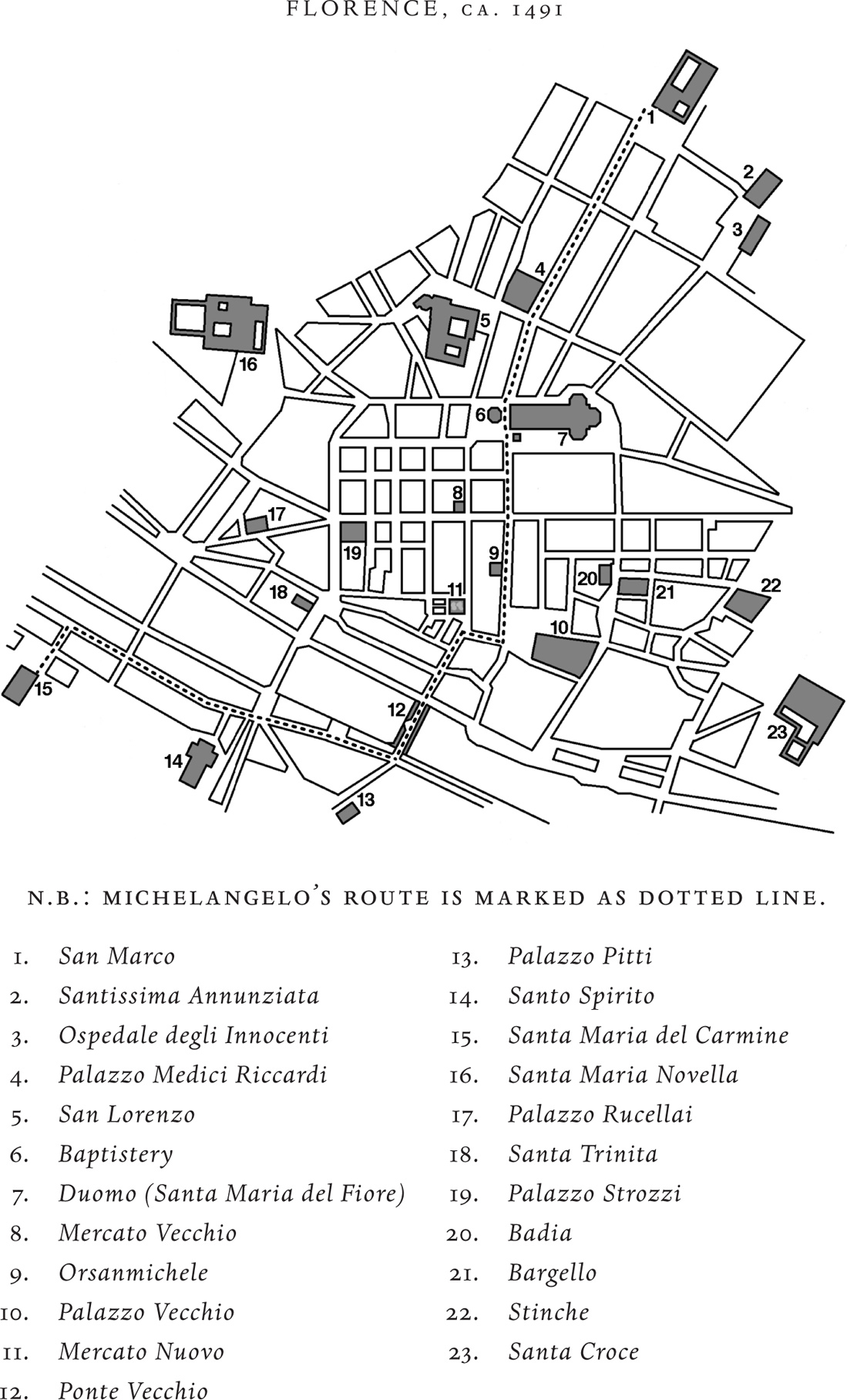
Having set out my “Italian” stall, I must point out that this book focuses most heavily on two or three major cities—that is, Florence, Rome, and (to a lesser extent) Urbino. This is not to say that other centers do not get a look in. Venice, Milan, Bergamo, Genoa, Naples, Ferrara, Mantua, and a whole host of other cities all appear in the narrative where appropriate, and it would certainly not be accurate to pretend that the Renaissance did not touch every single town and city in Italy to one extent or another. But the focus on Florence, Rome, and Urbino—with a particular accent on Florence—is, I think, justified on two main grounds. First, Florence constitutes the historical and spiritual “home” of the Renaissance as a whole. Both contemporaries and modern historians have generally agreed that it was in Florence that the “Renaissance”—however we might wish to define it—began and grew to maturity. In their different ways, and to very different degrees, Rome and Urbino constituted major focal points for artistic and literary endeavor, albeit at a later stage. Second, any narrative has to have some measure of order, and a completely comprehensive study that showed no more favor to one city than another would be both inaccurate and unwieldy.
Second, a note on chronology. Anyone with even a passing knowledge of the subject of this book will be aware of how enormously difficult it is to put dates on the Renaissance. Given how very troublesome it has proved to define what the Renaissance actuallywas, it is perhaps unsurprising that historians have agonized not only over where the termini of the period lie but also over whether it is useful to think of it in terms of a “period” (in the true sense) at all. The chronological bounds I have chosen to use for this book—that is, the years between ca. 1300 and ca. 1550—are not intended to be either authoritative or definitive, but instead reflect the general sense of scholarly consensus and are meant simply to give a measure of structure to what is already a complex enough series of phenomena. I will not deny that such vagueness is rather ugly, but since it is something that all Renaissance historians have to deal with at some stage, I can’t help but feel it is just one more example of why the “ugly” Renaissance is with us all in one way or another.