
VII
Trouble had come immediately after the road bond issue passed, as soon as Tom Pendergast discovered that Harry meant to keep his promise to the voters and refuse favoritism on contracts.
“The Boss wanted me to give a lot of crooked contractors the inside and I couldn’t,” he wrote. Pendergast became furious when Harry held his ground. The code of honor that meant so much to Harry, said T.J., was worth nothing in the real world. He dismissed the road plan as needless fuss that would serve only to give the engineers big reputations. Bids need merely be doctored so that the right people got the contracts, Pendergast told him. Harry held firm, arguing that his way was the best for the public and for the party, and it seems Pendergast realized for the first time the sort of man his brother Michael had brought into the organization. Possibly T.J. had been testing Harry. In any event, his anger appeared to pass. A meeting was called at his office, a confrontation that may have been arranged in part for T.J.’s own amusement, and one that Harry would enjoy recounting in later years.
The office at 1908 Main was so small, all of 12 by 14 feet, that it seemed overcrowded when T.J. sat there alone. Two windows with Venetian blinds overlooked the street. Furnishings were sparse—a rolltop desk against the wall, a few chairs and spittoons, a faded green rug, and over the desk, in a frame, the original drawing of an old cartoon from the Star showing an expansive Alderman Jim with a box of First Ward votes in his grip. The spittoons were an accommodation for guests, since T.J. smoked cigarettes only, using an elegant cigarette holder. Customarily he also kept his hat on while at his desk and sat well forward in his wooden swivel chair, as though about to leave on other business, a technique, he found, that helped keep conversations short. Stationed just outside the office was his massive, veteran secretary, or gatekeeper, Elijah Matheus, a former riverboat captain called “Cap,” who was as large as T.J. himself.
Five were present for the meeting—Pendergast, Harry, and three road contractors who were old friends of the organization and all extremely upset over Harry’s attitude, according to Harry’s later account, which is the only one available. One man, Mike Ross, was not only head of Ross Construction, in which T.J. had part interest, but ward boss in Little Italy, which made him extremely important. Privately Harry considered Ross “a plain thief.”
“These boys tell me that you won’t give them contracts,” Pendergast began.
“They can get them if they are low bidders,” Harry answered, “but they won’t get paid for them unless they come up to specifications.”
“Didn’t I tell you boys,” said Pendergast. “He’s the contrariest cuss in Missouri.”
When the meeting ended and the three contractors left, Pendergast told Harry to go ahead and run things as he thought best, adding only that of course he, Pendergast, always had the two other judges to call on if he needed to vote Harry down.
From that point forward apparently Pendergast was as good as his word, never asking Harry to do anything dishonest. “And that’s the God’s truth. I did my job the way I thought it should be done,” Harry said in an interview years afterward. “And he never interfered….”
They were not close—there was never to be the kind of relationship Harry had with Mike—but they grew to respect one another. Pendergast recognized Harry’s integrity as an asset. Harry, in the Pickwick Hotel memoir, written close to events, portrayed the Big Boss as a man of parts whose code, though very different from his own, he could not help but admire. Pendergast was no hypocrite, no “trimmer,” however rough and sordid his background. “He, in times past, owned a bawdy house, a saloon and gambling establishment, was raised in that environment, but he’s all man.” He wondered, Harry wrote, who was worth more in the sight of the Lord, Tom Pendergast or the “sniveling church members who weep on Sunday, play with whores on Monday, drink on Tuesday, sell out to the Boss on Wednesday, repent about Friday and start over on Sunday?”
He felt he understood Tom Pendergast. At least he knew where he stood with him. It was Vrooman and Barr, the other two on the court, who dismayed and infuriated him. Any man who was dissolute with women, Truman believed, was not a man to be trusted entirely. He had discovered that Vrooman and Barr both “loved the ladies” and kept “telephone girls” on the payroll. (“I’ll say this for the Big Boss,” he wrote as an aside, “he has no feminine connections.”) Vrooman, the western judge, though a “good fellow,” seemed determined to make any profit possible from county transactions. Barr, the eastern judge and Harry’s own choice for the job, was a total disappointment, and, to Harry, beyond understanding:
Since childhood at my mother’s knee, I have believed in honor, ethics and right living as its own reward. I find a very small minority who agree with me on that premise. For instance, I picked a West Pointer, son of an honorable father, a man who should have had Washington, Lee, Jackson, Gustavus Adolphus for his ideals, to associate with me in carrying out a program and I got—a dud, a weakling, no ideals, no nothing. He’d use his office for his own enrichment, he’s not true to his wife (and a man not honorable in his marital relations is not usually honorable in any other). He’d sell me or anyone else he’s associated with out for his own gain….
Worse than Barr’s immorality, more troubling than anything for Harry, was a situation, only vaguely described in his account, in which he had found it necessary to do wrong himself in order to prevent a greater wrong. Barr, it appears, had been in on the theft of some $10,000, and Harry, who found out, felt he must let Barr get away with it to protect his bond issue and to keep Barr from stealing even more.
This sweet associate of mine, my friend, who was supposed to back me, had already made a deal with a former crooked contractor, a friend of the Boss’s…I had to compromise in order to get the voted road system carried out…I had to let a former saloonkeeper and murderer, a friend of the Boss’s, steal about $10,000 from the general revenues of the county to satisfy my ideal associate and keep the crooks from getting a million or more out of the bond issue. Was I right or did I compound a felony? I don’t know…. Anyway I’ve got the $6,500,000 worth of roads on the ground and at a figure that makes the crooks tear their hair. The hospital is up at less cost than any similar institution in spite of my drunken brother-in-law [Fred Wallace], whom I’d had to employ on the job to keep peace in the family. I’ve had to run the hospital job myself and pay him for it…. Am I an administrator or not? Or am I just a crook to compromise in order to get the job done? You judge it, I can’t.
This and more came pouring out of him in the hotel room. He went on for pages. He described how Vrooman and Barr would shoot crap while court was in session, crouching down behind the judge’s bench as Harry tried to transact business. (He had actually found it easier to get things accomplished if they were so occupied.) He had always thought most men had a sense of honor. Now he wasn’t at all sure. Pendergast, as if lecturing a slow student, had told him that very few men stayed honest if given opportunity to cheat and get away with it. What chance was there for a clean honest government, he wondered, when a bunch of vultures sat on the sidelines? “If we only had Tom to deal with, the public might have a chance, but Tom can’t operate without Joe [Shannon] and Cass [Welch]. Cass is a thug and a crook of the worst water, he should have been in the pen twenty years ago. Joe hasn’t got an honest appointee on the payroll….”
The more Harry wrote, the angrier he grew:
I wonder if I did the right thing to put a lot of no account sons of bitches on the payroll and pay other sons of bitches more money for supplies than they were worth in order to satisfy the political powers and save $3,500,000. I believe I did do right. Anyway I’m not a partner of any of them and I’ll go out poorer in every way than I came into office.
He reckoned he could already have pocketed $1.5 million, had he chosen, which, as future disclosures would make plain, was altogether realistic. As it was, “I haven’t $150.” He wondered if he might be better off if he quit and ran a filling station.
“All this,” he added, “gives me headaches….”
To little Sue Ogden, the big house where her playmate Margaret Truman lived was a magnificent sanctuary secure from the troubles of Depression times. Margaret’s Grandmother Wallace was an elegant lady who wore her old-fashioned clothes with style. Margaret had a beautiful new bicycle. Margaret had a new swing set. Whenever Margaret’s father came home from a trip, he brought her a present. “She had everything she wanted,” Sue remembered. Judge Truman always looked dressed up and there was a black servant, Vietta Garr, who did the cooking and waited on the table.
Independence was hard hit by the Depression. In 1931, three banks closed within three weeks. Hundreds of families were suffering. According to the records, in the fiscal year 1931–32 more than 900 families in town, some 2,800 people, were receiving relief—food and clothing—from a half-dozen organizations, including the Community Welfare League, the Red Cross, the Kiwanis Club, and the Salvation Army. The Salvation Army had set up a soup kitchen on the Square. The Welfare League had taken over the old county jail as a distribution center and the lines there grew steadily longer. In 1932–33, families “comprising 4,347 individuals” received help, more than half again the number of the year before. Sue Ogden’s father, a machinist, had trouble finding work of any kind and kept leaving town to look elsewhere. She would remember being hungry during the times her father took the family away with him to other towns. Margaret, she knew, was never hungry. To Sue and her family, Margaret Truman was a child of wealth and privilege.
Margaret would remember that because of the Depression her allowance had been cut from 50 cents a week to 25 cents. “And this was a disaster!”
Sue Ogden and her older sister Betty lived next door, across a narrow alley on the south side. Mrs. Truman encouraged Margaret to play with the two Ogden girls, who were tomboys, as Mrs. Truman had been once, and because they lived so close by. They were playmates “without risk,” as Sue remembered, and since the kidnapping scare, the Trumans were “terribly fearful” about Margaret. “We kind of had to teach her how to play.”
Judge Truman seemed always relaxed and friendly, “just a father.” He “wasn’t upset to be caught in his pajamas. He was just very calm about having us around the house. We played on his rowing machine in the bathroom and he didn’t mind.”
The two Ogdens were in and out of the house as if it were their own, or playing out back on the driveway, where Mrs. Truman or Vietta Garr could keep watch. The house was a “wonderful place” to play. A basement called “the dungeon” was big enough to ride Margaret’s bicycle in. A “fine attic” was filled with old-fashioned clothes for dressing up. It was a household that seemed to run smoothly year after year, with never a sign of friction. “If there was ever any bad feeling, even an undercurrent of bad feeling, they certainly hid it well,” Sue recalled. Vietta Garr, who had first come to work in 1927, said later, “I never heard a squabble the entire time I was with them. I have never seen Mr. Truman angry….” Her father had been groomsman for Grandfather Gates. “The whole family had good dispositions and were easy to work for,” she remembered. “They liked things nice, and that is the way I liked them, so we got along fine.”
For Bess, life was ordered, private, sociable within bounds. She belonged to a bridge club and served as secretary of the Needlework Guild, a group of women who collected clothing for the needy—such activities as appeared among the society items dutifully reported by young Sue Gentry in the Independence Examiner. And for Bess that was quite enough. Her family was her life. She had no wish for more, no desire whatever for public attention or acclaim.
Margaret would remember her own life being nearly perfect. “I was an only child and I had lots of aunts and uncles with no children. And everything went to Margaret. It was lovely.” The only disciplinarian in the household was her mother, whose eyes could turn steely and who on occasion spanked her, as her father never did. Her mother, Margaret recalled, was far more likely than her father to be hard on people who deserved it. “I could twist him around my little finger.”
At dinner, Grandmother Wallace sat at the head of the table, Father at the other end. Margaret sat with her mother on one side, with Uncle Fred opposite. Dinner was served at 6:30. There was a white linen tablecloth, linen napkins, and good silver. Father did the carving, and “beautifully,” according to Vietta Garr. The atmosphere was calm and proper, always. Grandmother Wallace did her hair a little differently for dinner and put on a fresh dress. “My manners were expected to be perfect,” Margaret remembered. If her father and uncle discussed politics, her mother occasionally joined in, but never her grandmother, who did not care for politicians, or politics. “Her presence was very much felt. Even though she didn’t talk a great deal.”
The food, ordered each morning by Madge Wallace by telephone, was straightforward and ample—baked Virginia ham, standing rib roast, warm bread and old-fashioned biscuits, baked sweet potatoes, fresh vegetables in season, cakes, pies, peach cobbler. Harry particularly liked corn bread and Missouri sorghum. His favorite dessert was angel food cake, according to Vietta Garr, who, in all, would spend thirty-six years with the Truman family. “Yes, I spoiled him,” she would say, “but he was always such a nice man.”
On Sundays, Harry, Bess, and Margaret would drive to Grandview for a big, midday fried chicken dinner at the farm, where, as Margaret remembered, the atmosphere was “entirely different.” It was not just that her father looked forward to these visits, but her mother as well. “She liked Mamma Truman immensely.” Mamma was “full of spice,” with opinions on nearly everything, including politics. The difference between this spry little “country grandmother” and the one in Independence was extreme. With Mamma Truman one felt in touch with pioneer times, with a native vigor and mettle that seemed ageless. Mamma still went rabbit hunting with Margaret’s boy cousins, Vivian’s sons. Once when she offered food to a tramp at the back porch and the tramp complained the coffee wasn’t hot enough, she took the cup, went inside, and promptly returned with a shotgun. He could be on his way, she said, or she would warm more than his coffee for him.
It pleased Margaret to see the enjoyment her father took in Mamma’s company. “Now Harry, you be good,” she would say as they were leaving. But Mamma could also observe that “Being too good is apt to be uninteresting,” a line they all loved.
With the Ogden sisters and a half-dozen other neighborhood girls, Margaret put on plays in the backyard at 219 North Delaware. For one called The Capture of the Clever One, with Margaret in the title role, the Examiner sent a photographer to make a portrait of the cast. Performances were after dark. A Ping-Pong table tipped on its side served as a backdrop, lights were strung, kitchen chairs set out for the audience. Harry attended dutifully. “I want her to do everything and have everything and still learn that most people have to work to live, and I don’t want her to be a high hat,” he had written to Bess.
He was habitually dutiful and responsible about all kinds of family matters, the sort of father who checked to see that the tires had good tread and 35 pounds of pressure, who had the oil changed every 1,000 miles without fail. “The car was washed every few days,” Margaret would remember. “And the upholstery was vacuumed and cleaned and people did not throw gum wrappers around—they were put in the ashtray—and he did not like people to smoke because he had never smoked and because the smoke would get into the upholstery…. He was very particular about his cars.” And about himself—his suits, ties, his shoes. He never went out the door without his hat, as few gentlemen of the day ever would, and his hat was always worn straight on his head. “Straight, absolutely straight,” she remembered.
He was interested in the weather, like most farmers. “He read all the weather maps in the papers and he always had a barometer where he could see it.”
He was a string saver. He could get two weeks’ use out of a straight razor by stropping the blade on the palm of his hand before each shave. Interestingly, for all his years on the farm, for all he knew about tools and odd jobs, he did no repairs around the house, never cut the lawn or put up screens. Undoubtedly, his mother-in-law had some say in this. Such work was for the yard man.
“It never seemed like the Truman house,” Sue Ogden remembered. “It was so clearly Mrs. Wallace’s house. And she was clearly in charge of everything about it.”
Another of Margaret’s childhood friends, Mary Shaw, would remember hearing her parents say, “How does Harry put up with that?”
“It was very hard on my father,” Margaret would concede long afterward, while showing a visitor through the house. “You know, my father was a very quiet, nontemperamental man at home. He got along. I mean, he made it his business to get along…because he loved my mother and this was where she wanted to live.”
Up early every morning, well before dawn, and always before anyone else, he had the house to himself, to read the papers, including the comic strips which he loved, and especially Andy Gump. (Told that as county judge he could have any license plate number he wished, he had picked Number 369, because it was Andy Gump’s number, a point he delighted in explaining to anyone who asked.)
In the evenings he would turn to his books and become wholly immersed. “You could talk to him if he were reading and you wouldn’t get an answer.” Indeed, Margaret could not recall her father sitting down quietly at home without a book in his hand.
He became a great joiner. In addition to the Masons, the American Legion, the Veterans of Foreign Wars, he belonged to the Elks, the Eagles, the International Acquaintance League. Monday nights he went uptown to the Square to play poker in a back room over the Farmer & Merchants Bank. It was a regular game among the same old friends, several of them Army pals like Edgar Hinde and Roger Sermon, a grocer who had become the town’s mayor. They named themselves the Independence Harmonicon Society, or Harpie Club, because one of their number had once distinguished himself playing the harmonica, or French harp, extremely poorly but with exuberance in a contest at the local movie house. The game had a 10-cent limit. A little beer or bourbon was consumed, Prohibition notwithstanding, and the conversation usually turned to politics. Such was the social life of Judge Harry Truman in the early 1930s, the worst of the Depression, years when Adolf Hitler was rising to power and Japan invaded Manchuria.
As much as he enjoyed going out to the farm to see his mother and sister, he had no desire ever again to live in the country. He loved the town. “He liked his walk up to the courthouse square,” said Margaret. “He liked people…he genuinely liked people and he liked to talk to them….”
In many ways it was still the town he had grown up in. Farmers crowded the Square on Saturday nights, but the rest of the week, nights were quiet, broken only by the sound of passing trains and the striking of the courthouse clock. Margaret Phelps and Tillie Brown still taught history and English at the high school. The town directory listed most of the old names of the original settlers—Boggs, Dailey, Adair, McClelland, Chiles, Hickman, Holmes, Ford, Davenport, McPherson, Mann, Peacock, Shank, not to say Truman, Wallace, and Noland. Harry knew nearly all the family histories—it was good politics to know, of course, but he also loved the town.
His devotion to Bess appears to have been total, no less than ever. On his travels, at summer Army camp, he wrote to her nearly every day. How had he ever gotten along without her before they were married was a mystery he pondered in a letter from Fort Riley, Kansas, the summer of 1930. “Just think of all those wasted years….”
“Have you practiced your music?” he wrote to Margaret from. Camp Ripley, Minnesota, another summer. He had splurged and for Christmas bought her a baby grand piano, a Steinway, a surprise she did not appreciate. She had dreamed of an electric train. “I’m hoping you can play all those exercises without hesitation. If you can I’ll teach you to read bass notes when I get back.”
As early as 1931 there was talk of Harry Truman for governor, a prospect that delighted him. “You may yet be the first lady of Missouri,” he told Bess. Whatever inner turmoil he suffered, however many mornings of dark despair he knew, the truth was he loved politics. He was as proud of the roads he had built and of the new Kansas City Courthouse as of anything he had ever accomplished, or hoped to. Work was progressing on the new Independence Courthouse, his courthouse, as he saw it, and everyone approved. “From the time of the establishment of Jackson County until now,” wrote Colonel Southern in the Examiner, “men with the same indomitable courage of the county’s namesake, Andrew Jackson, have dwelt in this ‘garden spot of Missouri’—with eyes always fixed on the future greatness of this great domain and with the thought uppermost to build, build, build a county that the rest of the state would be proud of.”
But the greater satisfaction for Harry was in what he had been able to do for ordinary people, without fanfare or much to show for it in the record books—things he could only have done as a politician. Years afterward, over lunch in New York with the journalist Eric Sevareid, he would describe how as a county judge in Missouri he had discovered that through a loophole in the law, hundreds of old men and women were being committed to mental institutions by relatives who could not, or would not, cope with their care or financial support, and how by investigating the situation he had restored these people to their rights and freedom. This, he said, had given him more satisfaction than anything.
“He loved politics,” remembered Ted Marks, “and he strived for something and never let loose until he got there. I think no matter what job he held he put all he had into it. He enjoyed it and did the best he knew how….”
He had not found his real work until late in life, not until he was nearly forty. But then, observed Ethel Noland, hadn’t he been a late bloomer all along? “He didn’t marry until he was thirty-five…. He didn’t do anything early.” Politics came naturally. “There,” she said, “he struck his gait.”
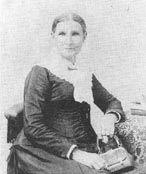

Harriet Louisa Gregg Young and Solomon Young.
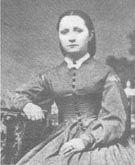
Mary Jane Holmes Truman and Anderson Shipp Truman.

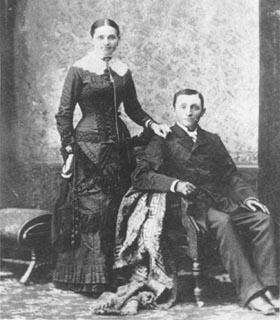
Martha Ellen Young Truman and John Anderson Truman at the time of their marriage, December 1881.

Harry S. Truman at about age ten.

In a graduation portrait of the Class of 1901, seventeen-year-old Harry Truman stands fourth from the left at the back. Bess Wallace is on the far right, second row, and Charlie Ross sits on the far left in the front row. The Latin inscription over the door says: “Youth the Hope of the World.”

The center of Independence, Jackson Square, at the turn of the century. The courthouse is on the right.

Truman at about the time he was employed as a clerk at the National Bank of Commerce, Kansas City. “His appearance is good and his habits and character are of the best,” wrote a supervisor.
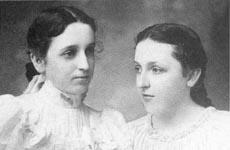
Cousins Nellie and Ethel Noland, to whom he was the adored “Horatio.”

The junior partner of J. A. Truman & Son, Farmers, stands with his mother and grandmother Young by the front porch of the house at Grandview.
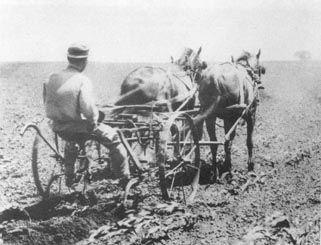
The work day began with his father’s call from the foot of the stairs at 5:30 A.M. Here, Truman rides the cultivator across a field of young corn.

Truman at the wheel of the second-hand, right-hand drive, 1911 Stafford touring car that transformed his life. With him are Bess Wallace (in front), sister Mary Jane Truman, and cousin Nellie Noland.

A summer outing on the Little Blue River with Harry at the oars, Bess with the fishing pole. “Harry was always fun,” remembered Ethel Noland.

The portrait of Bess that Harry carried to war in 1918. “Dear Harry,” she wrote on the back, “May this photograph bring you safely home again from France.”

His AEF identity card shows a newly commissioned Captain Harry S. Truman with no glasses and a regulation haircut.
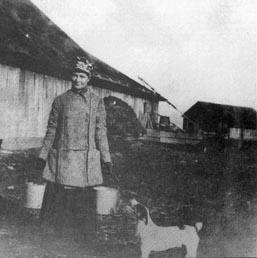
With Harry “over there,” Mary Jane was left to run the farm. “It was quite a blow to my mother and sister,” he later conceded.

Truman (third from right) poses with some of his fellow artillery officers “somewhere in France.”

Wounded soldiers from the Argonne are tended beneath an undamaged painting of the Ascension in a ruined church in Neuilly, September 1918.
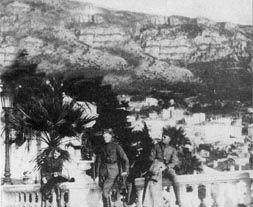
The war over, Captain Truman (on the right) relaxes in the sunshine at Monte Carlo.

Harry and Bess Truman pose for their wedding portrait with bridesmaids Louise Wells (left) and Helen Wallace, Bess’s brother Frank (center rear), who gave her away, and best man Ted Marks, who made the groom’s suit on special order. The day, Saturday, June 28, 1919, was extremely hot and humid—standard for summer in Missouri.

The Gates-Wallace house, 219 North Delaware Street, Independence, as it looked at the time the Trumans moved in “temporarily” with Bess’s mother, following their honeymoon.


Truman & Jacobson, “the shirt store,” as Truman called it, opened for business on 12th Street, Kansas City, in November 1919. Above, on the left, haberdasher Harry S. Truman strikes a characteristic pose at the sales counter.

Thomas J. Pendergast, the “Big Boss” of Kansas City, beams for photographers at his daughter’s wedding.
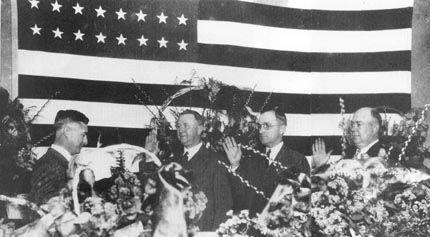
All but lost in floral tributes, Truman is sworn in for a second term as Presiding Judge of the Jackson County Court, January 1931.

Michael Pendergast, whom Truman “loved as I did my own daddy.”

James Pendergast, Michael’s son and Truman’s devoted friend.
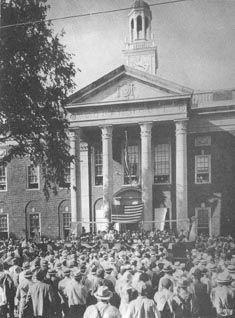
Judge Truman speaks at the dedication of the new Independence Courthouse on September 17, 1933, one of the proudest days of his life.
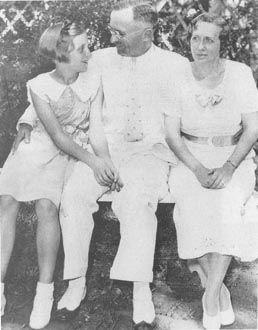
Ten-year-old Margaret with her parents, the summer of Truman’s first campaign for the Senate, 1934.
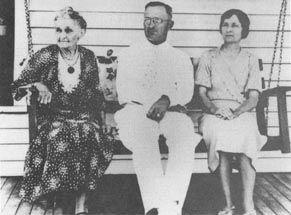
Throughout the campaign Truman stressed his farm background. At right, for a publicity photograph, he sits on the porch swing at Grandview with the two other most important women in his life, his mother and sister Mary Jane.

Crisscrossing the state, the candidate spoke at one county seat after another, his platform usually the courthouse steps. Town loafers and boys on summer vacation often represented a good part of his “crowd.” He was not a captivating or impressive speaker, but people also had no difficulty understanding what he meant and seemed to feel better for having listened to him. The punishing heat and time on the road bothered him not at all.

At first “under a cloud” in the Senate because of his Pendergast connection, Truman nonetheless kept a portrait of “T.J.” prominently displayed in his office.

A rare photograph of Truman and Tom Pendergast together was taken at the 1936 Democratic National Convention in Philadelphia. With them are Kansas City attorney James Aylward (center), FDR’s political adviser, James A. Farley (the tall figure at rear), and David E. Fitzgerald, Sr., Democratic National Committeeman from Connecticut (right foreground).

John L. Lewis, head of the United Mine Workers (seated near left), makes a dramatic appearance before the Truman Committee, as Chairman Truman (far right) listens impassively.
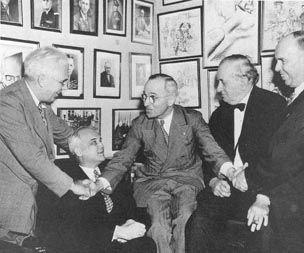
Truman, who loved the Senate “club,” became one of its most popular members. Here, in his office, he is surrounded by fellow Truman Committee members (from left to right) Homer Ferguson, Harold H. Burton, Tom Connally, and Owen Brewster.

In the midst of the 1944 Democratic National Convention at Chicago, Truman signals his feeling about the drive to make him FDR’s running mate.

Bess and Margaret at the moment Truman is named the nominee for Vice President. Margaret would be remembered cheering as if at a football game. Bess, however, rarely smiled for photographers.

Truman and Roosevelt smile for photographers at lunch in the Rose Garden at the White House, August 18, 1944. Shocked by the President’s appearance, Truman later told an aide, “His hands were shaking…physically he’s just going to pieces.” This was one of the few occasions when Truman and Roosevelt were seen together.