
II
“Harry Truman was one of the liveliest, most vital Senators in my time,” wrote a veteran Senate employee, the liaison for the press, Richard Riedel, who had first come to work as a Senate page at the age of ten in 1918. Riedel had observed them all, from the days of Henry Cabot Lodge, Sr., and doubted that any had ever enjoyed public life as much as Truman, or took it so in stride. “An easygoing joviality emanated from him…[he had] an interest in everything and everyone….” But often at the hearings of his committee, Truman seemed to present a different face to the world. “When he got down to business, the twinkle in his eyes would be replaced by a look of concentration. At such times, at close range the thick lenses of his glasses gave his eyes a fearsome, eerie stare so stern that it gave the weird illusion that one was confronting an entirely different person.” At such times, said Riedel, he was grateful Senator Truman was his friend.
In the frenzied, confusing weeks after Pearl Harbor, the Under Secretary of War, Robert Patterson, had urged the President to do away with the committee, saying it would “impair our activity if we have to take time out to supply the Truman Committee all the information it desires.” But Roosevelt had no such wish, and as the work of the committee continued, the energy and effectiveness of its chairman drew increasing attention. The first annual report was presented to the Senate on January 15, 1942. In time would come 50 additional reports, as a consequence of extensive, careful research, and more than 400 hearings at which 1,798 witnesses appeared. Amazingly, all reports of the committee were to be unanimous. Asked how this could happen, Republican Owen Brewster said it was not hard to get men to agree when the facts were known.
Early 1942 was a dark time. Singapore fell to the Japanese, then Bataan, with the surrender of General Wainwright and some 75,000 American and Filipino troops, the largest surrender of an American fighting force since Appomattox. Leningrad was still under siege, after more than six months, and along the eastern seaboard of the United States, off shores long thought safe from Europe’s wars, German U-boats were sinking oil tankers almost at will—and “so close,” wrote Eric Sevareid, “that a chorus girl in a Miami penthouse could see men die in flaming oil.” Washington made ready for air raids. Bess Truman had blackout curtains on order for the Connecticut Avenue apartment. The senator took his World War I helmet to the office and at night would lie awake tossing and turning, “fighting the war.” In April, driving through North Carolina on committee business, he tried to think only of spring returning, “the return of Ceres from Pluto’s palace.” The dogwood and apple orchards were in bloom along the winding road, and at the hotel at Chapel Hill all was quiet and restful. Still he couldn’t sleep, fretting over the course of the war.
In a speech on the Senate floor that summer of 1942, he called for a second front in Europe to relieve the Russians—as a matter of clear military necessity. In a speech at home in Jackson County he said the war was only a tragic continuation of “the one we fought in 1917 and 1918.” The victors in that war, he argued, “had the opportunity to compel a peace that would protect us from war for many generations. But they missed the opportunity.” A “spirit of isolationism” had brought the worse calamity of the present conflict. It must never happen again.
Disclosures produced by his committee were shocking. Curtiss-Wright was discovered manufacturing faulty airplane engines for delivery to combat forces. One inspector for Curtiss-Wright, a man with two nephews in the Army Air Corps, broke down and wept as he told a committee investigator what was going on. “If I were the executive in charge of a plant of that sort, I would know what was going on,” Truman told an Air Corps officer who testified, “and I think it is plain negligence, and maybe worse than that…that they didn’t know. They should have known.” The officer agreed. “No doubt about it,” said Truman. The Air Corps had denied that there were problems. Curtiss-Wright launched an advertising campaign stressing the company’s contribution to winning the war. But the faulty engines were a reality, and as Truman surmised, more than negligence was involved. As an aftermath of the committee’s investigation one Air Corps general involved was sent to prison.
Questioning the cause of troubles with the B-26 bomber built by the Glenn Martin Company, the committee was informed by Martin himself that the wings were not wide enough. Truman asked why the wings weren’t fixed. Martin said plans were too far along and that besides he already had the contract. Truman said that if that was how Martin felt, then the committee would see the contract was ended. Martin said he would correct the size of the wings.
They saw a lot of the seamy side of the war effort, Truman once remarked, speaking for the committee. Yet for Truman the disclosures appeared to confirm many of his worst suspicions about big business in America. He was truly a Jeffersonian in spirit; William Jennings Bryan remained a political hero. The things Truman had said in the Senate in earlier years about the evils of big banks, big insurance companies, big corporations had been said in earnest. He had never really known any industrialists or heads of giant corporations, most of whom were Republicans. He had never counted such people among his personal or political friends.
Nor, at this stage, does he appear ever to have accepted the view that a certain amount of corporate stupidity and corruption was inevitable in an undertaking so massive and involving so many interests as the war effort. In fact, the American industrial powerhouse, America’s phenomenal productivity was what would turn the tide against Germany and Japan. It would prove the decisive factor in the war, and Truman was to give too little credit to the vast majority of patriotic business people and industrialists who were making this happen. At times, in what he wrote and said, he made it seem as though the committee and its investigators were the only ones doing their duty. He didn’t believe that, of course. Also, from what he and his investigators were finding, it is easy to understand why he might have felt as he did.
A classic case and one of the most memorable days of testimony concerned the United States Steel Corporation and its subsidiary, Carnegie-Illinois Steel. At issue was the quality of steel plate being produced for ships.
As frequently happened, the committee’s first hint of trouble came in letters from employees who felt it their patriotic duty to report what was going on. At first little was done. The volume of similar complaints and warnings from around the country had become too great to handle. Much of it was obviously crank mail and to follow every lead would have been impossible. But when a newly launched ship, a tanker called Schenectady built by Henry J. Kaiser, broke in two at Portland, Oregon, in January 1943, the question of steel plate became one of vital importance.
At the Irvin Works, the Carnegie-Illinois rolling mill at West Mifflin, Pennsylvania, investigators for the Truman Committee found that at least 5 percent of the plant’s production, or about 3,000 tons of steel per month, failed to meet Navy specifications, yet was being labeled and delivered as up to standard. The results of quality tests—chemical analysis conducted in the mill to determine the quantity of carbon and other elements in the steel—were simply altered (as were other tests for tensile strength) “to conform to what the customer expected to receive,” in the words of the chief specifications examiner, a man named Murray Stewart. If the chemical analysis of a “heat” of steel wasn’t known, he said, then they would just make one up for the record book.
Stewart was among the first to appear on the day of the hearing, March 23, 1943, and he provided some of the most damaging of all testimony, as well as a touch of unintended humor, when Hugh Fulton encouraged him to explain how exactly the system worked:
FULTON: In other words…you would make up a chemical analysis which you thought would fit what the steel should have been.
STEWART: That is right.
FULTON: And how would you deal with that in that particular record book?
STEWART: In order to keep our records so that we would know when it was an incorrect heat number, we would enter it in this book in pencil.
FULTON: How were the other entries made?
STEWART: They were made in ink.
FULTON: And did you, in addition to making them in pencil, put any prefix letter in front of them?
STEWART: It was a common practice to put an “F.”
FULTON: What did “F” mean?
STEWART: Fake.
FULTON: You told our investigator originally that it meant phone.
STEWART: That is right.
FULTON: But now under oath you desire to state it meant fake?
STEWART: That is correct. The investigator was a stranger to me and I was sort of pressed for something to say at the moment.
An assistant metallurgist, David B. Ireland, Jr., testified—apparently hoping to put operations at the Irvin mill in a better light—that he learned how to fake the tests at the Edgar Thomson Works, another giant Carnegie-Illinois mill near Pittsburgh. Indeed, he had become so proficient, said Ireland, that he could readily fool a Navy inspector, whenever one was on hand. To date only one tester had been caught cheating by a Navy inspector, Ireland continued, but there was an explanation for that: “He cheated more than he was supposed to cheat.”
Was the man fired, asked Senator Homer Ferguson. No, said Ireland, he was demoted. Was he demoted because he went too far, Chairman Truman asked a higher-ranking employee, chief metallurgist W. F. McGarrity.
“Yes, sir,” said McGarrity.
“Going a little too far, he was demoted,” repeated Truman. “He wasn’t fired, he was just demoted.”
“And through satisfactory work elsewhere he was brought back to a better paying job,” added McGarrity.
Three investigators from the committee had gone to the Irvin Works earlier in March, or roughly two months after the Schenectady incident. They had called first at the Carnegie-Illinois headquarters in Pittsburgh, where they were told by the president of the corporation, J. Lester Perry, that they could speak to no employee unless a company attorney were present. Nor would they be permitted inside the mill until he, Perry, put through a call to Senator Truman to see what this was all about, a move that infuriated Senator Truman and made him immediately suspicious that Perry was trying to hide something. When the investigators arrived at Irwin about noon they were kept waiting for half an hour, then invited to lunch at the company cafeteria. They did not want lunch, they said, they wanted to see the record book from the mill at once. But they were kept waiting another hour, and when the book was at last made available at two in the afternoon, they learned it had been taken apart the night before and distributed among several people who were “doing work” for the company attorney. Two hours had been required to put it back together again. How much had been removed or altered they had no way of knowing, wrote one of the investigators in his report to Chairman Truman.
“I don’t think that was exactly strong cooperation, Mr. Perry,” Truman said when Perry took his place at the witness table, after Stewart, Ireland, and McGarrity had all completed their testimony. “And I was also rather surprised…that you didn’t take immediate action to clean the plant and find why this procedure was followed. I want you to explain to the committee fully why that was.”
“Senator Truman, it is not my intention to explain this and to be controversial,” Perry answered smoothly.
“You can be as controversial as you like,” said Truman. “It is your privilege.”
He had never had any desire except to cooperate, Perry insisted. Perhaps he had not appreciated the full importance of the investigators’ visit, perhaps he should have done more. He had demonstrated goodwill, he thought. As he recalled, it was only late in the day when the seriousness of the situation became clear to him. “That afternoon, late, it appeared definitely that they wanted to make an investigation,” he said.
“We don’t send investigators to plants just for fun,” Truman snapped.
“I understand that now,” replied Perry.
Truman pressed him again on what action had been taken to straighten things out in the mill. Had anybody been fired? What corrections had been made? Trying first to evade the questions, Perry admitted that as yet nothing had been done. He needed time to get all the facts, “the fullest implications.” Truman found that unacceptable. If he had been president of the company, he said, he would have gotten to the bottom of the situation at once. “You had all this information as soon as our investigators had it.”
It was Perry’s position, as expressed in a prepared statement and in the course of testimony, that while management deplored such devious practices as had been disclosed by the committee’s investigators—practices that higher management had no part in—even the substandard plates supplied by the mill were “entirely suitable for their intended use.” If the Navy was not getting what it ordered exactly, what it was getting was good enough for the purpose. “The only explanation which can be given for the failure to carry out prescribed testing procedures is that a few individuals…grew lax under the pressure of heavy production….” He found the word “cheat” as used in other testimony unacceptable. He preferred “misrepresentation.”
Most important, concerning the Schenectady, he said that failure of steel plate in the ship had not been the cause of its breakup and even if that were the problem, the plate at the point where the break began was not a product of the Irvin Works.
Of the senators present, it was Ferguson and Brewster, the two Republicans, who bore down hardest on Perry, while Fulton or Truman would move in with a question or comment from time to time. Ferguson picked up quickly on the question of where the Schenectady plate had been made. It was not made at Irvin, Perry affirmed again. Then where, asked Ferguson. Homestead, admitted Perry.
“Didn’t you hear the witness testify here that he was taught how to cheat down at the Homestead Works?” Ferguson asked.
“Senator, this word ‘cheat’…”
“Have you a better one?”
Senator Brewster then read aloud from the report of an investigation conducted by the Bureau of Ships, stating quite plainly that “a very poor quality of steel” had been “most directly responsible” for the failure of the Schenectady. The plate was “of definitely inferior quality,” Brewster read on. It was so brittle it was more like cast iron than steel.
Had Perry read the report? He had read parts of it, he replied. Brewster, his anger becoming more apparent, wondered how Perry might feel if he had a son going overseas in a ship made of such steel.
Perry answered, “Why, Senator, I don’t for a moment condone poor steel, defective steel in ships or anywhere else that has to do with the war effort. Don’t worry about how I feel about the sons going over there.”
Truman interposed to explain that Senator Brewster had a son overseas in the war.
“If a customer asks you for a strength of 60,000 pounds, the breaking point on a test,” Ferguson said, “and you give him a product of 57,000 pounds, but you represent to him in figures that you have tested it and it did test 60,000 pounds, is that a misrepresentation of a material fact?”
PERRY: Yes, sir.
FERGUSON: You understand that was done up to five percent of the material furnished?
PERRY: That is the evidence here this morning.
FERGUSON: Do you say that that was not selling a product to the United States Government under false representations?
PERRY: If that was done, to that extent it would be.
FERGUSON: You heard the testimony. Is there any doubt in your mind that it was done?
PERRY: There is a doubt in my mind as to whether it was done in regard to material that was furnished to Government specification and testing where the Government made the inspection or supervised the inspection.
FERGUSON: Do you mean to say—do I understand you now to say that you don’t believe the testimony of your own men here under oath?
PERRY: Did they actually testify to that point that where inspection was made by the Navy…?
FULTON: And also to the Navy where they said it was possible to cheat with the Navy inspector standing right there.
PERRY: I have stated that where that was done it was a misrepresentation.
FERGUSON: Do I understand that you still insist that no inferior material was sold to the Government?
PERRY: I still insist that it was not inferior for the end use to which it was put….
FERGUSON: In other words, you are the man who is stating what you think the Government should buy, is that right?
PERRY: No, sir.
FERGUSON: Then, why don’t you live up to the Government specifications?
PERRY: We should.
FERGUSON: Why didn’t you?
PERRY: We will.
TRUMAN: I’ll say you will….
The hearing lasted five hours. When the company’s attorney, testifying after Perry, talked of his need to master the technicalities of the steel business before “justifying this situation,” Truman broke in to ask what knowledge of technicalities had to do with removing cheaters from jobs of critical responsibility. “I don’t know anything about the steel business,” Truman said, “and don’t expect to know about it, but I can tell you when the books have been tampered with and when there is a bunch of crookedness going on. That is plain enough for me to see.”
But the question of who ultimately had been responsible for what went on—of how high up the blame should go—was never really answered. No one above the chief metallurgist, McGarrity, would admit to any knowledge of rigging tests or falsifying records. Nor did the hearing disclose a substantial motive for passing off the inferior steel. Those in the mill involved in the deception had nothing to gain by their actions and everything to lose if found out. The one plausible explanation offered was that it was all in an effort to set an impressive production record.
In any event management promised to set everything straight, and in the final hour the president of U.S. Steel, Benjamin F. Fairless, promised Truman that whoever was responsible would “walk the plank.”
“You realize, Mr. Fairless,” said Senator Brewster, “how incredible it seems that subordinates in the company would risk their entire future without hope of reward of any character. That, of course, is what impresses the committee and makes it so amazing.”
Senator Ferguson was curious whether Mr. Fairless thought, from what he had heard during the day, that the operation of Carnegie-Illinois Steel was an example of good management. “I certainly do not,” said Fairless. “I consider it was very, very poor management.”
At the close of the hearing, asked by a reporter for his personal comment on what had been divulged during the day, Truman said he did not think that could be printed.
On the issue of the dollar-a-year men on the War Production Board, Truman stood fast, stressing with great feeling the essential injustice of the system, but giving in at last, much against his better judgment, because the production czar he had helped create, Donald Nelson, argued otherwise. Nelson wanted no change in the system, insisting it was the way to get maximum results from industry. He had to have people who understood how industry worked, he told the committee. Asked why such men should be allowed to retain their corporate ties and benefits, he said people with big salaries had big expenses—mortgages, insurance, and the like—and could not make the change to government pay without suffering hardship.
“I don’t think there should be any special class,” Truman responded. Only that morning he had received a letter from a man who had been earning $25,000 a year, a reserve officer who had been called up for duty. “He is going to get $140 a month, and he can’t draw his $25,000 while he is gone,” Truman said. “He is satisfied to do that because he wants to win the war, just as you do and just as I do, by every means possible, no matter what it costs him, because if he doesn’t win it his $25,000 a year won’t be worth a cent. I am laboring, and have been, under the delusion, maybe, that if the government had the power to take these young men away from their jobs and their outlook on life for the purpose of this emergency, the dollar-a-year men could face the same situation and face it adequately, and would be glad to do it.”
He was not opposed to the dollar-a-year men because they were businessmen—he wanted more businessmen in government, especially in the war effort—but he knew how “human” it was for a steel executive on loan to the war administration to hesitate in ordering any action that might injure the standing of his company or industry once the war was over. He had learned that certain high-ranking dollar-a-year men had initially delayed the construction of new furnaces when they were needed because of concern over what increased ingot capacity might do to their postwar profits.
But reluctantly he backed off, saying that if Nelson felt the system was what it took to win the war, then the committee should not stand in the way. In a letter to Nelson a few days later, he was more specific. The committee did not like having procurement matters entrusted to those who were such obvious hostages to fortune, he wrote.
However, the committee believes that the best interests of the procurement program require that it be administered by a single head who will be able to do things in his way and who will be judged by his accomplishments as a whole…. The committee will, therefore, support you even on matters in which it disagrees with you….
By pushing harder on the issue, he felt, the committee could run the risk of overreaching its power, to the point of dictating policy, like the intrusive Civil War committee.
In backing Nelson he was also standing by a fundamental conviction that control of the war effort must be kept in civilian hands. In just the first six months of 1942 military contracts added to the economy totaled $400 billion. He saw ambitious generals and admirals on all sides gaining influence over industry and agriculture and he worried what this could mean for the future. In the fall of 1942, on a broadcast for “The March of Time,” he called the issue of civilian control the foremost of the day and warned it could shape the whole political and economic structure of the country after the war. “The function of generals and admirals is to fight battles,” he said, “and to tell us what they need to fight battles with.”
General Brehon Somervell, wearing three stars now, was again called before the committee to explain an incredible project, called Canol, after “Canadian oil.” The scheme was to build a four-inch oil pipeline across 1,200 miles from Canada to Alaska, and it had been launched “on the nod” from Somervell, secretly, with little thought to the realities of terrain, climate, available materials, available manpower, or the views of oil experts, the Corps of Engineers, and the War Production Board. An item was added to the War Department budget of $25 million with no description except that it was for the construction of military facilities in Canada and Alaska.
The shroud of secrecy had been primarily to avoid interference from other civilian sides of government, and in particular the notoriously irascible Harold Ickes, Secretary of the Interior and head of the Petroleum Administration. Employees of the contractor, Stephen Bechtel, began calling Canol “the greatest project since the Panama Canal.” But then Ickes found out about it and went before the Truman Committee to say the whole project “grew entirely out of a one-page memorandum from General Somervell, who was anxious to conserve paper….” Ickes called the pipeline useless and the committee came to much the same conclusion, having heard more from Somervell’s chief adviser for the project, James H. Graham, a dollar-a-year man who, Ickes said, was “worth every penny of it.” Graham, the committee found, had no idea how long the pipeline was to be. He had made no estimate of the cost, nor did he believe anybody else had. “I don’t regard cost in time of war,” he told the committee more than once.
“The committee damns it up and down while the War Department is as usual scrambling desperately to save face instead of having the guts to admit a mistake frankly and go on from there,” wrote a new observer on the scene, a young reporter for the United Press named Allen Drury, on the day of Somervell’s appearance. “All the desperate assertions of an embarrassed incompetence have been hurried forth to justify the thing, but the committee is unimpressed.”
Somervell had paraded into the hearings flanked by four brigadier generals and several majors. At one point, as Drury happily recorded in his journal, Somervell asked for some water, handing his glass to a brigadier who handed it to a major who, finding no one of lesser rank available, filled the glass himself and returned it to the brigadier who returned it to the general.
The committee hammered away at Somervell for four and a half hours, with Hugh Fulton and Senator Harley Kilgore doing most of the questioning. The chairman listened quietly. But in winding up the day Truman read Somervell a letter he had received from the Navy Department—a letter, he explained, written in answer to his own question whether the Navy had ever been asked for its opinion on Canol, or requested to participate. According to the letter, a search of Navy files had turned up no communication indicating such an inquiry. No officers or officials of the Navy Department had ever been questioned orally about Canol.
Somervell said he never implied that he had asked the Navy. “It is not a Navy situation. Not any more than a bakery we might build….”
Truman suggested that very possibly it could have to do with the Navy, since ships burn a good deal of oil.
“Yes, sir,” replied Somervell, who now said the Chief of Naval Operations and others had “expressed themselves in favor of the project.”
“The Secretary of the Navy, however, has the other opinion,” said Truman. “The committee will stand adjourned.”

Worn down at day’s end, he would complain to Bess that the pressures on him had begun to tell again. She knew of his headaches and exhaustion and worried he might push himself to the point of collapse. Witnesses at the hearings got on his nerves far more than he let on, he told her. He talked of just going away somewhere and reading Shakespeare and Plutarch “over and over and over.”
Yet nothing about his public manner revealed any of this. He was brisk and cheerful as always. He radiated good health and youthful energy. In contrast to so many among the congressional brotherhood, the gray, double-chinned, food-stained veterans of Capitol Hill, he appeared abnormally fit and his good clothes, his one indulgence, were spotless. Though not a fancy dresser—he remained too much the midwesterner for that—he looked always, as Margaret said, as if he had just stepped from a bandbox. His suits were perfectly cleaned and pressed, his shirts immaculate. (He had had a time his first few years in Washington finding a dry cleaner who could do his clothes to his satisfaction.) He had dozens of suits—some old favorites custom-made by Ted Marks, others from Eddie Jacobson’s new store in Kansas City or from Garfinckel’s in Washington, mostly double-breasted, grays and blues, and cut to accentuate how trim he was. (He could still get into his old Army uniform, he liked to tell people.) Lately, too, he had begun wearing bow ties—a departure viewed by his wife and daughter with considerable disfavor—and there was always a fresh, perfectly folded handkerchief in the breast pocket showing five points, always the World War I service pin in his lapel. He looked crisp. He moved with a bounce, even in the heat of summer, his two-tone summer shoes clicking down the marble halls more rapidly than any. Richard Riedel, the young press liaison who prided himself in being able to get about the Capitol in double-quick time, remembered Truman’s good-natured approval of the pace he set. “One day in a typical kidding mood he [Truman] started in behind me and walked lock-step through the Lobby to the amusement of all who saw him.”
His vitality seemed greater than ever, in keeping with his new confidence. He had “arrived” in the Senate, as everybody knew, and it agreed with him. He was having a splendid time being Senator Harry Truman of the Truman Committee.
Yet he acquired no airs, for all this. He was as unpresuming, as accessible as always, despite the extraordinary new power he had and the urgent, wartime atmosphere of Washington. Self-importance was on display in the city in many quarters to a greater degree than ever in memory, but Truman seemed somehow unaffected. A reporter for the St. Louis Globe-Democrat described later how he had been sent by his editor to see the senator, who was reportedly back in town briefly after one of his committee forays and staying at the Jefferson Hotel on 16th Street:
I went up to the front desk and asked the room clerk for the number of Senator Truman’s room. He gave it to me. I went to a house phone and called the Senator’s room. The phone was answered not by a security guard, not by an aide, not even by a secretary. It was answered by Harry Truman. I identified myself, and he said sure, come on up. I knocked on his door, and the door was opened by Senator Truman. He was alone, in his shirt sleeves, with a book held closed on a finger. He put the book aside, offered me a chair, poured us each a bourbon highball, and sat back with a friendly smile. We talked, without interruption, for almost an hour. What we talked about, what I later wrote, I have no real recollection of. All I remember is that the book he was reading was Volume III of Douglas Southall Freeman’s biography of Robert E. Lee. That the bourbon we drank was Old Crow. That he was completely relaxed and responsive. And that there was no one else around.
Nearly everything being said about him in the papers was complimentary, and the committee and its work now had the respect of the administration. “I am more surprised every day at the respect with which the special committee is regarded by people in high places,” he wrote to Bess, very pleased. “If I can just keep from making any real errors, we are on the way to really help win the war and to make the job more efficient and quicker. That means fewer of our young men killed and a chance for a more honorable settlement. So you must pray for me to go the right way.”
In the Senate, where he was always well liked, he had achieved a new stature, even among liberals who, until now, had regarded him as pleasant enough and conscientious, but bland. “The man from Missouri,” remembered Claude Pepper, “had dared to say ‘show me’ to the powerful military-industrial complex and he had caught many people in the act.”
He was notable too for so much that he was not. He was not florid or promiscuous. He made no pretense at being superior in any regard. He did not seem to need the limelight, flattery, or a following. He did not want to be the President.
To his pleasure, he was recognized now in restaurants and hotel lobbies, as he had never been before except in Missouri, and not always there. “Now you’ve got to help me more than ever so I won’t be a damn fool or stuffed shirt,” he told Bess.
Margaret, now in her late teens, had begun singing lessons and was doing splendidly, he thought. She was talking already of a singing career. Neither he nor Bess was a singer. Margaret never heard him even try to sing, which seemed odd for someone with such love for music. But he did nothing to discourage her, said only that she must first finish college.
He called her “Margie” or “Miss Skinny.” Alert and energetic, with a sunny disposition, she was one of the great satisfactions of his life.
They so clearly enjoyed one another’s company that it gave pleasure to others. “One time, one Christmas,” remembered a niece of Ethel Noland’s, who lived in the Noland house on North Delaware, “Margaret was with him and they came across for a little visit Christmas morning. And I don’t think I ever laughed any harder…. They just gave it back and forth…. They were as fun as can be. Repartee! He was so crazy about Margaret, just enjoyed being with her and talking with her and we sat there just entranced….”
With friends in Washington he could talk about her by the hour, as she knew.
You have a good mind, a beautiful physique and a possible successful future outlook—but that now is up to you [he wrote when she turned eighteen]. You are the mistress of your future. All your mother and dad can do is to look on, advise when asked and hope and wish you a happy one. There’ll be troubles and sorrow a plenty but there’ll also be happy days and hard work.
From a financial standpoint your father has not been a shining success but he has tried to leave you something that (as Mr. Shakespeare says) cannot be stolen—an honorable reputation and a good name. You must continue that heritage and see that it is not spoiled. You’re all we have and we both count on you.
Later, to Bess he would write, “Tell my baby she has a most beautiful voice-to keep it natural without any gimcracks, pronounce her words clearly and in English so they can be understood—and she’ll be a great singer.” She too must never become a damn fool or a stuffed shirt.
They remained an extremely close-knit family, their social schedule modest, their way of life private and quiet. At home in the small, simply furnished apartment on Connecticut, Truman’s corner of the living room included a chintz-covered armchair, a reading lamp, his phonograph, and his record collection. In a small, free-standing bookcase within arm’s reach was a leatherbound set of Plutarch’s Lives, a two-volume Andrew Jackson by Marquis James, all four volumes of Freeman’s Lee, the Bible, Stories of the Great Operas, a biography of John Nance Garner, and Don Quixote.
Bess, now in her fifties, looked plumper and more matronly by the year, and was enjoying Washington as she never had. The stepped-up pace of wartime agreed with her. He had put her on the office payroll, a not uncommon practice, but one he had criticized others for, most notably Tuck Milligan during his first Senate race. Her salary was $2,400. Truman worried about damaging publicity if ever this were known, but the extra income made a difference. How much real work she did would remain a matter of opinion among the staff, none of whom were as well paid. At one point he advised her privately to “only just drop in and do some signing” of letters. “It helps all concerned.” She was working also at the USO one day a week, and reportedly “reveled” in the excitement he was causing on the Hill.
In a letter from Independence during a visit in June of 1942, she told him how much better he was sounding on the radio. A speech explaining the rubber shortage had been broadcast nationwide. She thought it his best yet, and Ethel Noland agreed. His consonants had all been pronounced just right, Ethel said.
The day before their twenty-third wedding anniversary, he sent Bess twenty-three roses, then telephoned her that night and wrote a letter the next morning:
Washington, D.C.
June 28, 1942
Dear Bess:
Well this is the day. Lots of water has gone over the dam. There’ve been some terrible days and many more nice ones. When my store went flooey and cost my friends and Frank [Wallace] money, when Margie came, don’t think I ever spent such a day, although the pains were yours. And to name one more, when we thought Stark had won and when I lost actually for eastern judge. But the wins have far outweighed ’em. June 28, 1919, was the happiest day of my life, for I had looked forward to it for a lifetime nearly or so it seemed. When a man gets the right kind of wife, his career is made—and I got just that.
The greatest thing we have is a real young lady who hasn’t an equal anywhere. That’s all the excuse we need for living and not much else matters.
It was grand to say hello last night. I was so tired I could hardly sit up. Went to bed right away after playing Margie’s song record and the Minuet (in G) and Chopin waltzes. It’s pretty lonesome around here without you….
Kiss Margie, lots and lots of love and happy returns,
Harry
In November 1942, after the American landing in North Africa, he was praised in the St. Louis Post-Dispatch in a way that would have been inconceivable a few years before. Harry Truman, wrote Marquis Childs, had become “one of the most useful and at the same time one of the most forthright and fearless of the ninety-six” in the Senate. In a book published that same fall, a brilliant portrait of Washington going to war called I Write from Washington, Childs also contrasted the appalling revelations of the Truman Committee to the kind of false picture presented by the Office of Facts and Figures, a new propaganda agency.
Truman and his committee were now known nationwide, observed the Washington Star. So great was their reputation, said BusinessWeek, that “often a threat to ‘take everything to the Truman Committee’ is sufficient to force a cure of abuses.” The whole country was greatly indebted to Senator Truman and his colleagues, wrote The Nation.
Arthur Krock of The New York Times so admired the senator’s “objectivity at the total expense of partisanship” in his running of the committee that he invited a select few of his fellow journalists to lunch with Senator Truman at the renowned Metropolitan Club and wrote later of the “excellent impression” he made.
By 1943 the committee had produced twenty-one reports covering a wide range of subjects—gasoline rationing, lumber, farm machinery, the loss of American shipping to U-boats. The week of March 8, 1943, “Investigator Truman” was on the cover of Time. In many ways, said Time,the Truman Committee was among the outstanding successes of the entire war effort. It was the “watchdog, spotlight, conscience and spark plug to the economic war-behind-the-lines,” and a heartening sign that even in wartime a democracy could keep an eye on itself. Hardly less remarkable, said the magazine, was the transformation of Harry Truman, from Pendergast errand boy to able, energetic committee chairman just when he was needed:
For a Congressional committee to be considered the first line of defense—especially in a nation which does not tend to admire its representatives, in Congress assembled—is encouraging to believers in democracy. So is the sudden emergence of Harry Truman, whose presence in the Senate is a queer accident of democracy….
Truman himself, wrote Time, was “scrupulously honest…. His only vices are small-stakes poker, an occasional drink of bourbon.” (“WHAT DO THEY MEAN AN OCCASIONAL DRINK OF BOURBON?” Lewis Schwellenbach cabled from Spokane.)
In a poll of Washington correspondents conducted by Look magazine, Senator Truman would be named one of the ten men in Washington whose services had been the most important to the war effort. Further, he was the only one on the list from either branch of Congress.
On April 14, 1943, putting aside his committee work, Truman flew to Chicago to champion a cause that had little to do with the war effort and that seemed a bit surprising for a midwestern senator, a Baptist, a Mason, and proud member of the American Legion to involve himself with. He spoke at a huge rally called to urge help for the doomed Jews of Europe. Chicago Stadium was packed, the crowd estimated at twenty-five thousand. The chairman was a prominent Roman Catholic, Federal Judge William J. Campbell. The keynote speaker was Rabbi Stephen Wise of New York, head of the American Jewish Congress.
The war in which he and his comrades fought twenty-three years earlier, said Senator Truman in his speech, had been waged “not only that nations might be free but also that the people who make up those nations might be free.” Now that freedom had been trampled to dust under the “iron heel of the barbarian.” The Jews of Europe, through the edict of “a mad Hitler,” were being “herded like animals” into concentration camps. It was time something was done about it.
In private, Truman was a man who still, out of old habits of the mouth, could use a word like “kike,” or, in a letter to his wife, dismiss Miami as nothing but “hotels, filling stations, Hebrews, and cabins.” But he spoke now from the heart, and with passing reference to Roosevelt’s “Four Freedoms,” made an implied criticism of the President for doing too little to help the Jews. Truman was not among those who refused to believe the Germans capable of such atrocities as were being reported from Europe.
Merely talking about the Four Freedoms is not enough. This is the time for action. No one can any longer doubt the horrible intentions of the Nazi beasts. We know that they plan the systematic slaughter throughout all of Europe, not only of the Jews but of vast numbers of other innocent peoples.
Now was the time for fighting, he continued, but no less important was planning for the day when the war would end. “Today—not tomorrow—we must do all that is humanly possible to provide a haven and a place of safety for all those who can be grasped from the hands of the Nazi butchers.” Free lands must be opened to them, he said.
Their present oppressors must know that they will be held directly accountable for their bloody deeds. To do all this, we must draw deeply on our traditions of aid to the oppressed, and on our great national generosity. This is not a Jewish problem, it is an American problem—and we must and we will face it squarely and honorably.
It was a remarkable speech, one of the strongest he ever made. How very important it was that he felt as he did, neither he nor any of his audience could possibly yet know.
With other senators on the committee—Hatch, Ball, Harold Burton—Truman was giving more and more thought to problems of the postwar world. And though he played no direct part in the drafting of a Senate resolution for the establishment of a postwar international organization, a United Nations—a resolution sponsored by Senators Ball, Burton, Hatch, and Lister Hill, and hence known as B2H2—Truman was the acknowledged guiding spirit. The United States could, “not possibly avoid the assumption of world leadership after this war,” he was quoted in The New York Times. And with Republican Congressman Walter Judd of Minnesota, who had also fought in World War I, Truman set out on a Midwest speaking tour in the summer of 1943 to spread the internationalist word under the sponsorship of the United Nations Association. He kept hammering at the same themes over and over across Iowa, Nebraska, Kansas, and Missouri. “History has bestowed on us a solemn responsibility…. We failed before to give a genuine peace—we dare not fail this time…. We must not repeat the blunders of the past.”
Not all the Truman Committee’s efforts were successful. The Canol Project went on and wound up costing $134 million, all money that need never have been spent, and more serious even than the financial waste was the misuse of vitally needed manpower and materials. (At one point 4,000 troops and 12,000 civilians were involved.) Corporations and government agencies found to be bungling things or committing outright fraud, like Carnegie-Illinois Steel, were frequently let off the hook to keep production rolling. “We want aluminum, not excuses,” Truman said after the committee’s tangle with Alcoa.
Yet overall the committee’s performance was outstanding. It would be called the most successful congressional investigative effort in American history. Later estimates were that the Truman Committee saved the country as much as $15 billion. This was almost certainly an exaggeration—no exact figure is possible—but the sum was enormous and unprecedented, and whatever the amount, it was only part of the service rendered. The most important “power” of the committee was its deterrent effect. Fear of investigation or public exposure by the committee was enough in itself to cause countless people in industry, government, and the military to do their jobs right, thereby, in the long run, saving thousands of lives.
It was not just that the production of defective airplane engines or low-grade steel had been exposed; the committee also made positive contributions to the production of improved military equipment. The most notable—and one that saved many lives—was the famous, hinge-prowed Higgins landing craft used for amphibious assault, which was built and ordered by the Navy’s Bureau of Ships only after heavy prodding from the committee. With the new Higgins craft troops could be landed on a variety of shallow beaches, rather than just established harbors. It increased mobility for the offense, made obsolete much of the old coastal defenses. Yet until the committee looked at the subject with a fresh eye, Navy bureaucrats had been trying to force the adoption of a plainly inferior design.
The committee was also a continuing source of information about the war effort for the whole country. In its report on the loss to U-boats, for example, the committee said 12 million tons of American shipping were destroyed in 1942, an alarming figure. This was 1 million tons more than all the nation’s shipyards were then producing. The Navy immediately denied the validity of the report. But when Secretary of the Navy Knox appeared before the committee in executive session, he admitted the committee was telling the truth.
Unquestionably, the relentless “watchdog” role, the attention to detail during the hearings, the quality as well as the quantity of the reports issued, all greatly increased public confidence in how the war was being run. Further, anyone called before the committee could count on a fair hearing. The chairman would have it no other way.
From what he had observed of Chairman Truman during the day of General Somervell’s testimony, Allen Drury of United Press recorded: “He seems to be a generally good man, probably deserving of his reputation.” But after watching several more sessions, including one in which Truman went out of his way to keep some of the other senators from browbeating a witness, Drury could hardly say enough for the head of the committee:
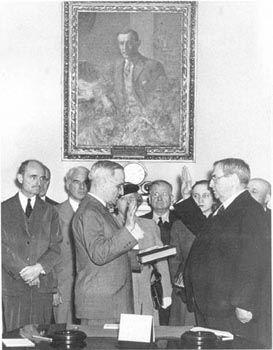
April 12, 1945: Harry S. Truman takes the oath of office from Chief Justice Harlan F. Stone in the Cabinet Room at the White House.
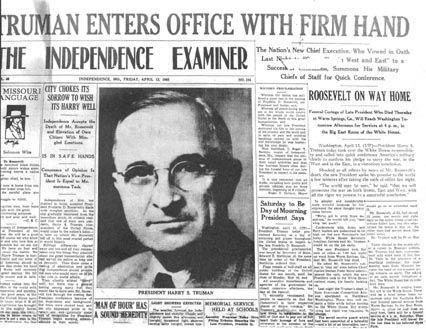
Expressions of grief, as well as confidence in Harry Truman, fill the front page of the Independence Examiner.

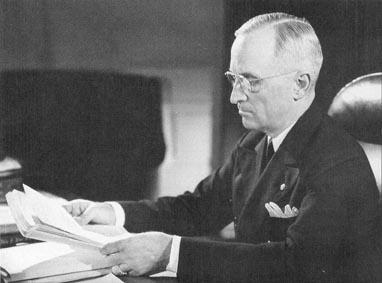
James F. Byrnes (left) and Henry A. Wallace, ardent candidates for the vice-presidential nomination only the summer before, wait with Truman for Roosevelt’s funeral train at Washington’s Union Station. Below: The new President of the United States at his desk.
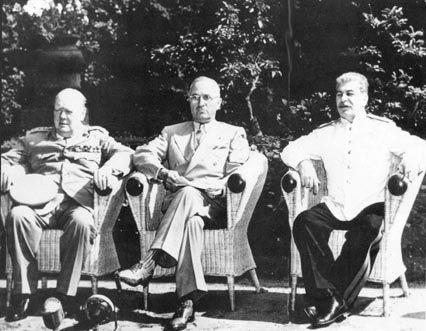
July 1945: Prime Minister Winston Churchill, President Truman, and Generalissimo Joseph Stalin, “The Big Three,” meet at Potsdam, Germany.
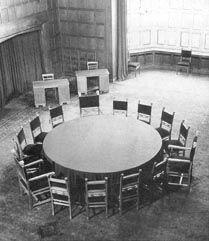
Conference table, Cecilienhof Palace.

Truman in Berlin with Generals Eisenhower and Patton. Eisenhower was high on the new President’s list of favorite generals; not so Patton.

Above: Truman’s headquarters during the Potsdam Conference was No. 2 Kaiserstrasse, the “nightmare” house where the decision on the atomic bomb was made. Below: Truman’s desk in the second-floor study.


Above: Truman’s order, handwritten in pencil to Secretary of War Stimson, to use the atomic bomb on Japan. Below: At his desk in the Oval Office, 7:00 P.M., August 14, 1945, Truman announces the surrender of Japan.


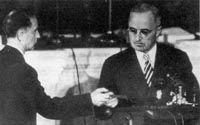
May 25, 1946: As he calls on Congress for the power to draft striking rail workers into the Army and thus break a nationwide shutdown, Truman is handed a note saying the strike has ended. Left: He and the First Lady had hosted a reception for wounded veterans the day before, just as worries over the rail strike were at their worst. The postwar burdens of his office bore heavily on Truman (opposite). But he had discovered a retreat away from Washington, the naval base at Key West, Florida, and aide Clark Clifford (shown below with Truman at Key West) had emerged as a bright new star on the White House staff.


Two who helped turn the tide in 1947: Left: Republican Senator Arthur H. Vandenberg shaking hands on March 12, as Truman is about to ask Congress for aid to Greece and Turkey—the speech that introduced the Truman Doctrine; and (opposite) Secretary of State George C. Marshall, the “great one,” as Truman called him, who in a commencement speech at Harvard on June 5 proposed what came to be known as the Marshall Plan.

Eddie Jacobson, a behind-the-scenes key figure in the decision to recognize Israel, talks with his old friend and former business partner.
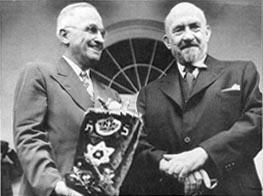
Chaim Weitzmann, the new president of Israel, presents Truman with the Torah scrolls during a first official call at the White House.

Opposite: In the first address ever made by a President to the NAACP, Truman speaks from the steps of the Lincoln Memorial to a crowd of ten thousand, June 29, 1947.

America’s best-known walker steps out in a 35th Division Reunion parade in Kansas City.

Past 2:00 A.M., July 15, 1948, his hands chopping the air, Truman tells cheering convention delegates at Philadelphia, “Senator Barkley and I will win this election…arid don’t you forget that!” His odyssey began in September. Below: From the rear platform of the Ferdinand Magellan at Richmond, Indiana, Truman makes one of hundreds of “whistle-stop” speeches.

After Stalin clamped a blockade on Berlin on June 24 (the day Dewey was nominated), Truman launched the Berlin Airlift. Tensions over Berlin continued for months.

Republican candidate Thomas E. Dewey and his wife. According to the press, only a miracle or a series of unimaginable Republican blunders could save Truman from defeat.


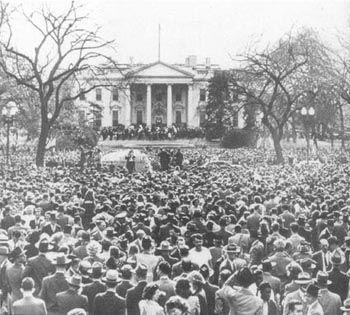
In one of the most memorable photographs in the history of American politics, the “sure loser” holds aloft a premature Chicago Tribune headline. Heading east after the election, Truman’s train had stopped at St. Louis where he was handed a copy of the paper. Below: Part of the throng that welcomed Truman back to Washington. Some 750,000 people filled the streets in the largest outpouring for a President that the capital had ever seen.
There are a number of times, when it is quite easy to find oneself thanking whatever powers there be that the country has Harry Truman in the Senate. He is an excellent man, a fine Senator and sound American. The debt the public owes him is great indeed. And Boss Pendergast put him in. Politics is funny business….